
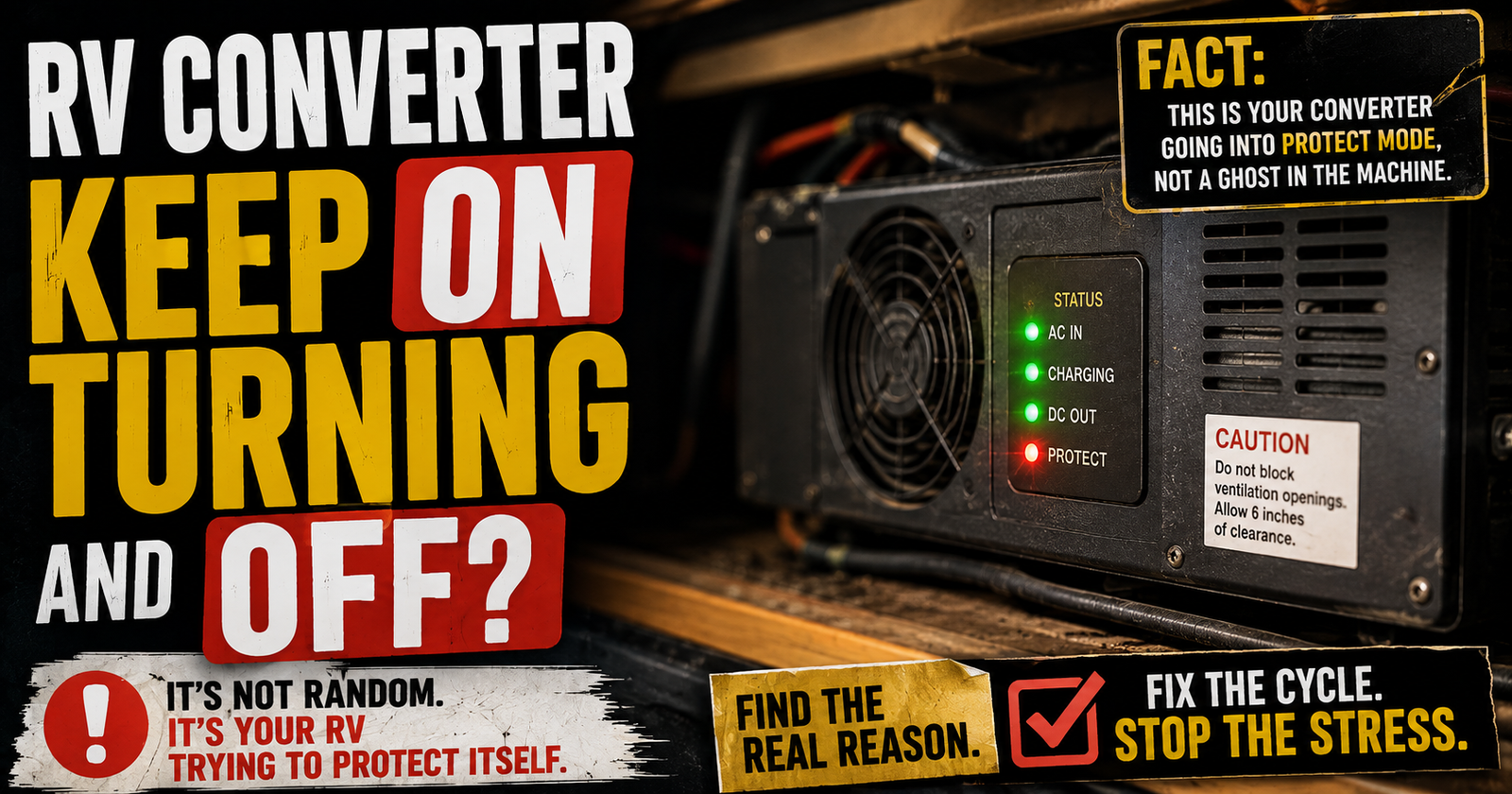
Your RV converter shouldn’t feel like it’s playing a game of on-again, off-again every few minutes. If your 12-volt lights keep changing brightness, the converter fan starts and stops strangely, battery charging disappears and comes back, or the converter seems to shut down until it cools off, something is giving you a clue.
The tricky part is that the converter itself isn’t always bad.
I’ve seen enough RV electrical problems to know that replacing the box making the symptom isn’t always the answer. A converter can shut itself down because it’s protecting itself from another problem.
Overheating can do it. Too much 12-volt demand can do it. A short can do it. Bad incoming AC power can do it. Generator voltage can do it. Even a problem with the battery can make converter behavior look completely different than normal.
So before buying a new converter, I’d figure out exactly what makes yours turn off and, even more importantly, what makes it come back on.
That second part can tell us a lot.
Is It Normal for an RV Converter to Turn On and Off?
It depends on what you mean by turning on and off.
A modern converter/charger doesn’t necessarily sit at one charging voltage and one level of output forever. It can change charging modes as battery conditions change.
The cooling fan can also cycle on and off normally.
For example, Progressive Dynamics says the intelligent cooling fans on its PD9100 and PD9200 converters operate only as much as needed based on temperature.
So if you’re hearing the fan start and stop, that doesn’t necessarily mean the converter itself is shutting down.
That’s the first distinction I’d make.
Make Sure It’s Actually the Converter Shutting Off
This is important.
What exactly disappears when you think the converter turns off?
Does the fan stop?
Do the 12-volt lights go out?
Does charging voltage drop?
Does the battery stop charging?
Does converter output fall to zero?
Does an AC breaker trip?
A fan cycling normally is completely different from the converter losing DC output.
Don’t diagnose the converter based only on what you hear.
Get the multimeter involved.

Watch the Battery Voltage When the Problem Happens
This is one of the easiest ways to understand what’s actually changing.
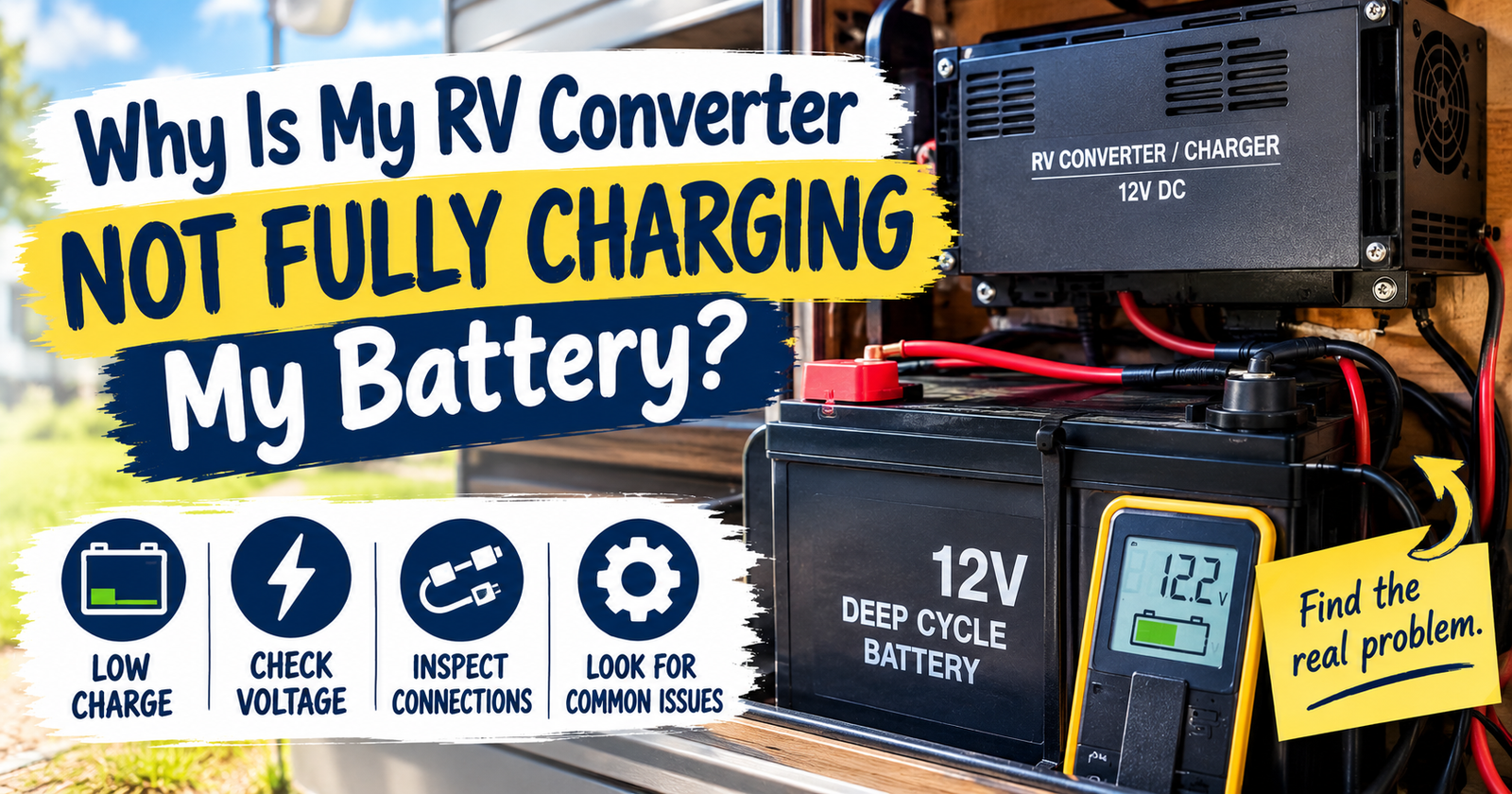
Check battery voltage while the RV is connected to shore power and the converter appears to be working.
Then watch what happens when you think the converter shuts off.
If charging voltage disappears and battery voltage begins settling toward the battery’s resting voltage, that’s useful information.
Your battery may now be carrying the RV’s 12-volt loads because the converter stopped supplying them.

If you need help interpreting those numbers, we’ve already broken down what RV battery voltage readings actually mean.
Don’t rely on the little battery indicator panel alone.
Overheating Is One of the First Things I’d Check
This is especially true if the converter follows a pattern like this:
It works normally.
It gets hotter.
Output disappears.
It sits for a while.
It cools down.
Then it starts working again.
That’s a pretty interesting pattern.
Some converters include automatic thermal protection specifically to prevent heat damage. Progressive Dynamics lists overheating as a cause of converter shutdown in its troubleshooting documentation and tells owners to check airflow and allow the converter to cool.
So if cooling seems to magically “fix” your converter every time, I’d pay close attention to temperature.
Feel for a Pattern, Not Just Heat
Converters normally generate heat.
That’s why I wouldn’t touch one once and say:
“Yep. It’s hot. Found the problem.”
Instead, watch the sequence.
Does the converter shut down only after it’s been operating for 20 or 30 minutes?
Does it stay on much longer when the camper is cool?
Does the problem happen more often on hot afternoons?
Does it happen while charging a deeply discharged battery?
Does opening up an appropriate storage area improve airflow and make the converter operate longer?
Those patterns can point us toward a thermal problem.
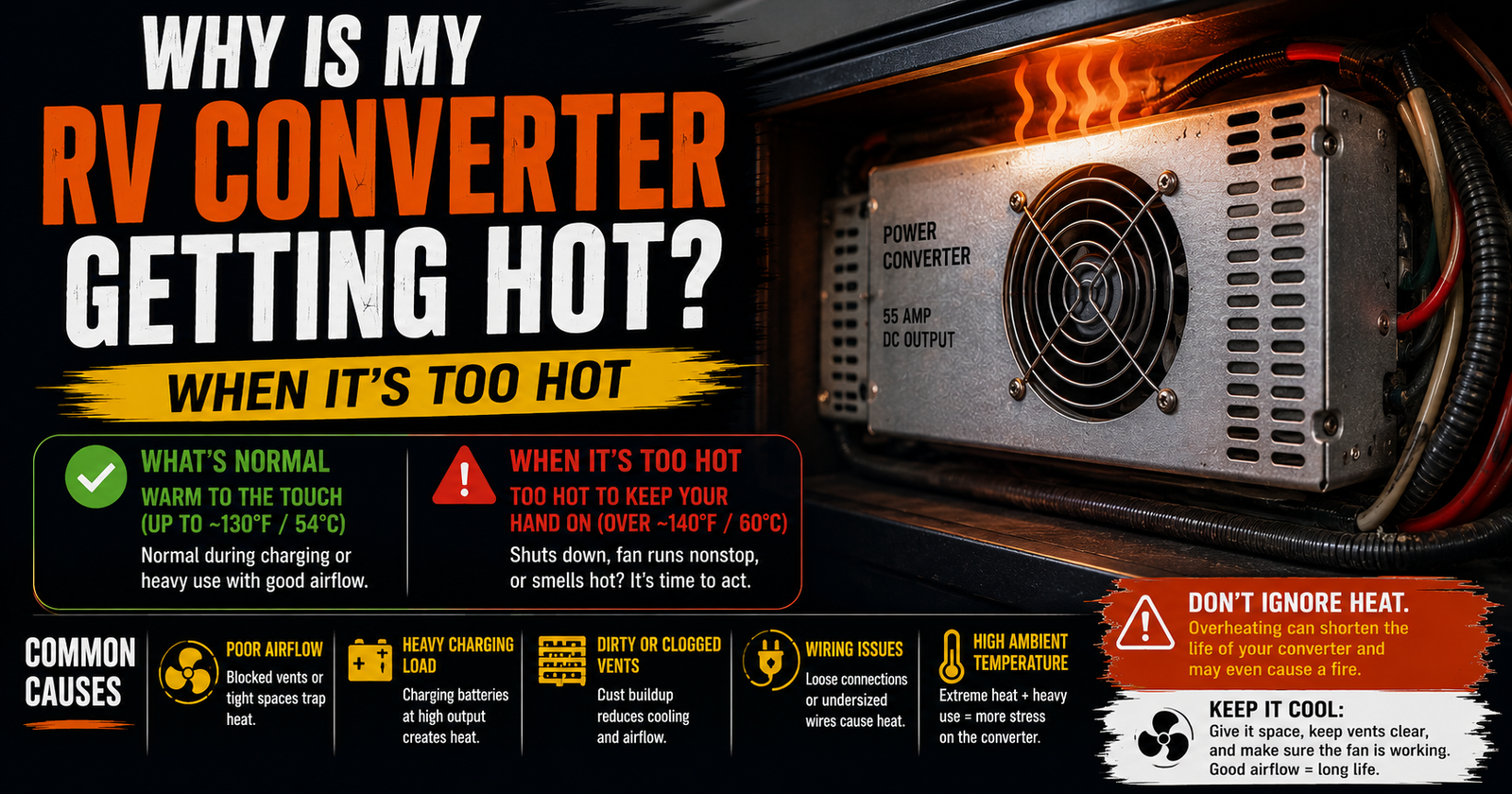
We’ve already gone much deeper into when an RV converter getting hot becomes a problem.
Check the Converter’s Airflow
This is one of those wonderfully simple RV checks that costs nothing.
Find the converter.
Look around it.
Has somebody packed the compartment full?
Blankets?
Towels?
Camping chairs?
Extension cords?
Tools?
Pet supplies?
Paper products?
Converters need to get rid of the heat they produce.
For example, Progressive Dynamics calls for at least five inches of clearance or otherwise sufficient ventilation around its PD9100 and PD9200 converters to maintain adequate airflow. Your converter may have different requirements, so check its manual.
If the converter is buried under camping gear, fix that before blaming the electronics.
Dust and Pet Hair Can Restrict Cooling Too
You don’t necessarily need something physically sitting against the converter to create an airflow problem.
Dust accumulates.
Pet hair accumulates.
Lint gets pulled toward fans.
Cooling openings get dirty.
Over several years, a converter compartment can look completely different from the day the camper left the factory.
Inspect the cooling area with the appropriate power sources safely disconnected.
Don’t start spraying liquids into electrical equipment or blindly shoving tools through the vents.
The goal is simply to restore the airflow the converter was designed to have.
Check What the Cooling Fan Is Doing
Now the fan matters.
If the converter gets extremely hot and shuts down, but its cooling fan never operates, that’s a big clue.
Maybe the fan itself has failed.
Maybe something is blocking it.
Maybe its control circuitry isn’t functioning correctly.
Maybe the converter has another internal problem.
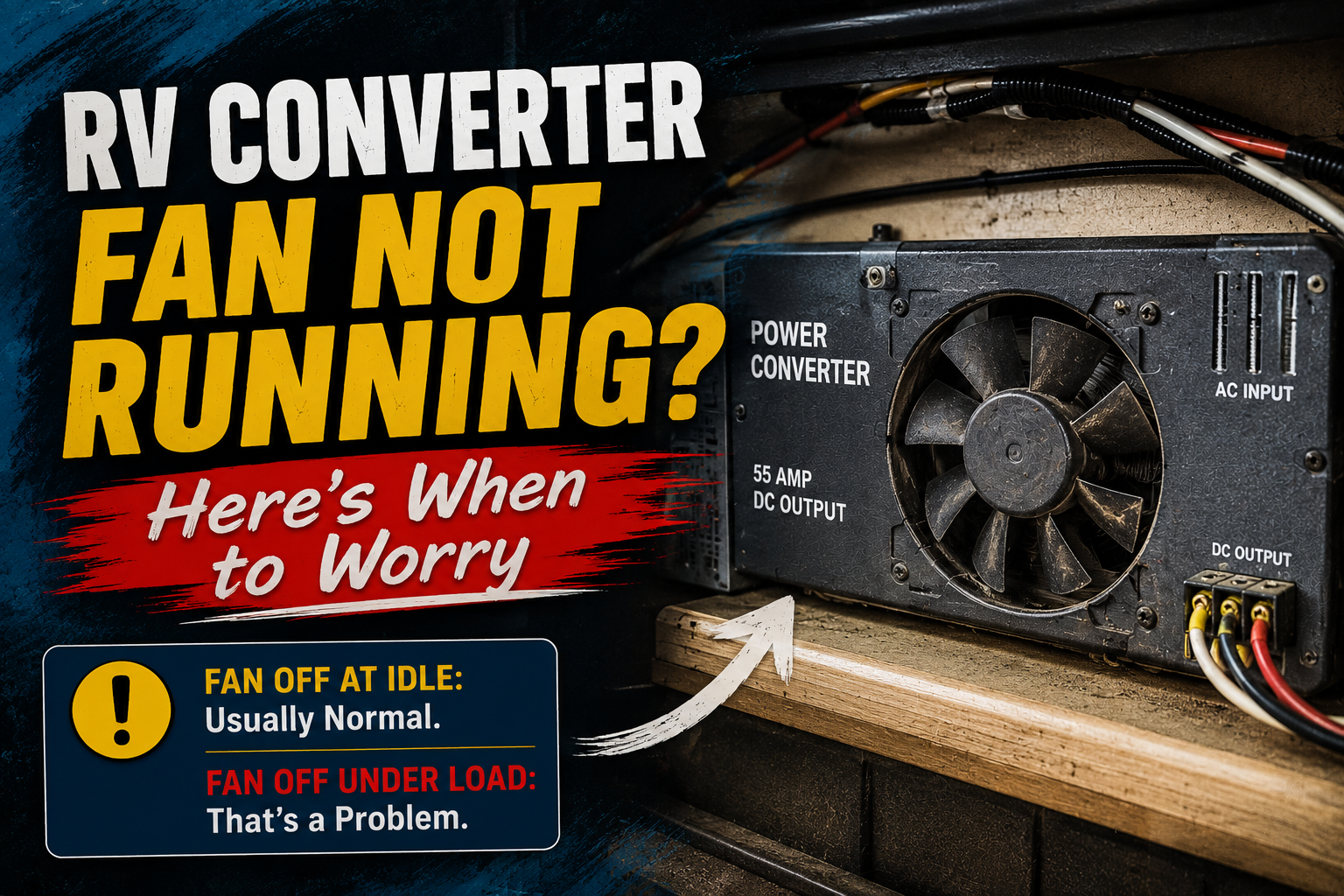
We’ve already built a full troubleshooting guide for an RV converter fan that isn’t running.
The key is not assuming a stationary fan is automatically bad. Many converter fans are temperature controlled and don’t run continuously.
But hot converter + shutdown + dead fan gets my attention.
What If the Fan Runs Constantly Before the Converter Shuts Down?
That tells us something too.
The cooling system may already be doing everything it can.
If the fan runs hard for an extended period and then the converter still shuts down, I’d start looking for the reason it’s generating so much heat.
Heavy battery charging?
Excessive 12-volt demand?
Bad ventilation?
High compartment temperature?
Battery problem?
Internal converter trouble?
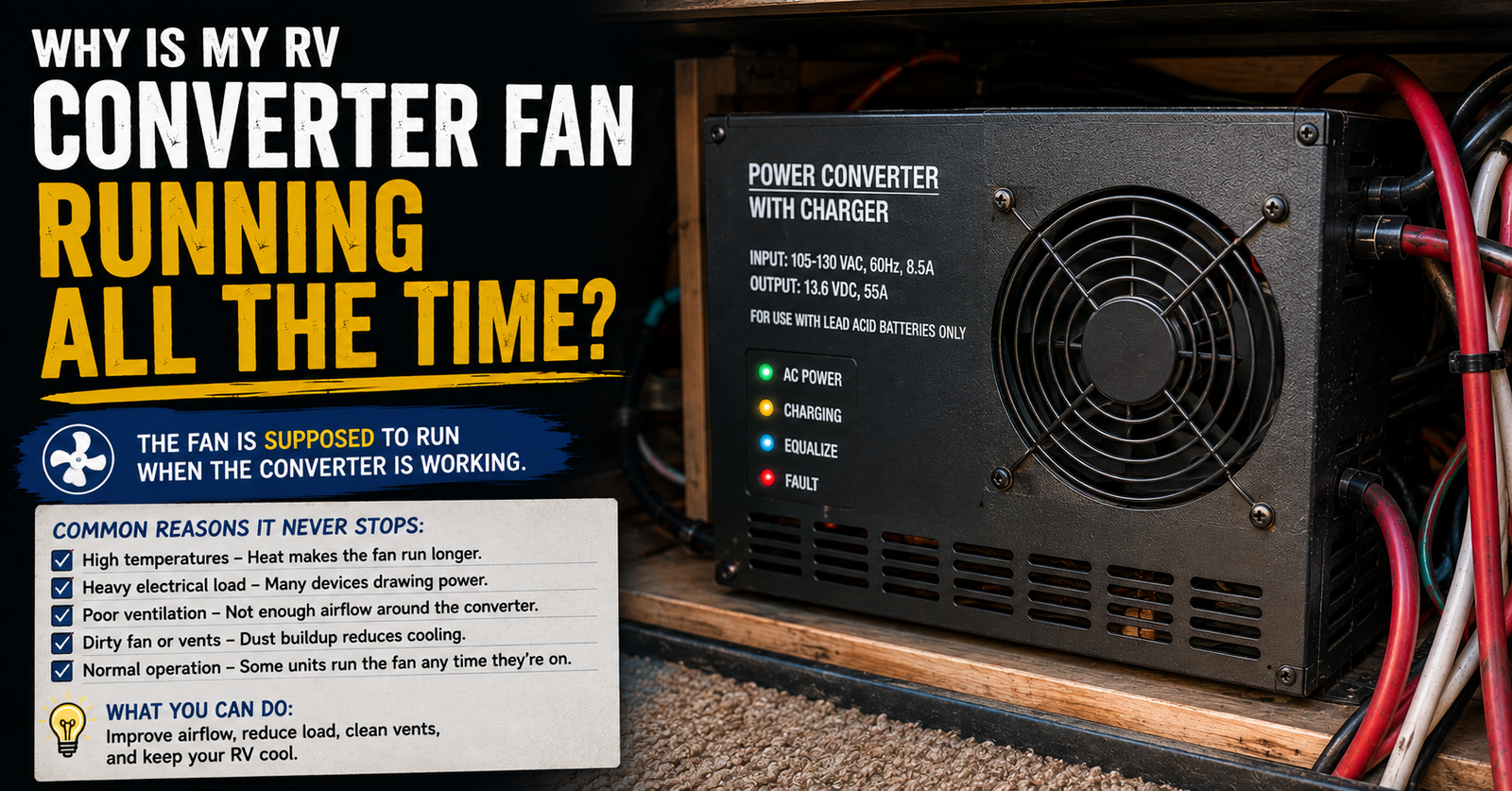
Our companion guide explains why an RV converter fan may run all the time.
The fan may not be the problem. It may be warning you about the problem.
Too Much 12-Volt Demand Can Cause Trouble
Converters have limits.
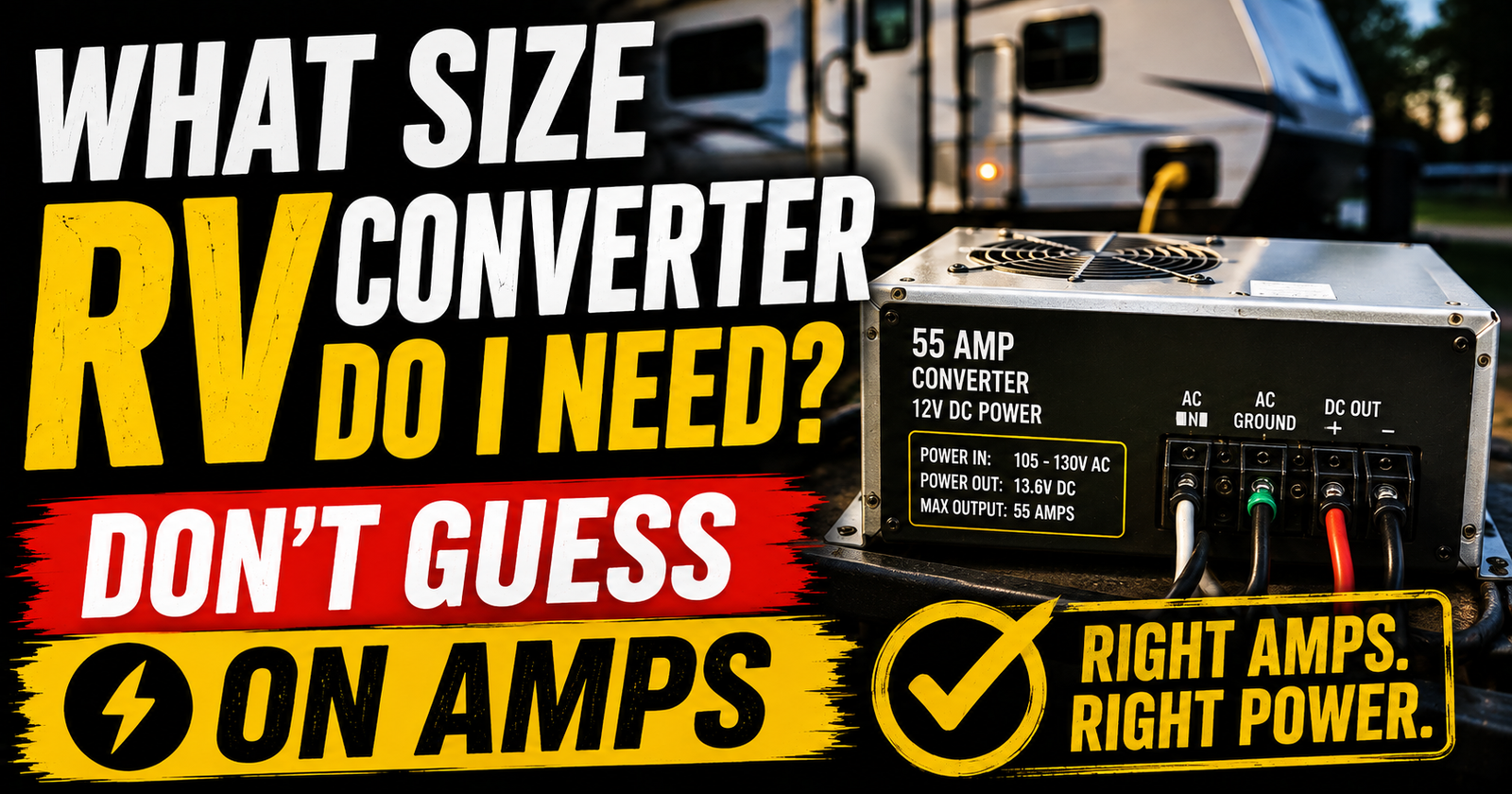
A 45-amp converter isn’t an unlimited source of 12-volt power just because the camper is plugged into shore power.
Every converter has a rated maximum output.
Progressive Dynamics says its PD9100 and PD9200 converters incorporate current limiting and can shut down if demand exceeds the converter’s designed output. When the excessive demand is removed, the converter can resume normal operation.
That’s almost exactly the symptom we’re troubleshooting.
Converter works.
Demand gets too high.
Converter shuts down.
Demand decreases.
Converter comes back.
Think About What’s Running When It Shuts Off
This can uncover the problem surprisingly quickly.
Does the converter cycle only when the furnace is running?
When several lights are on?
When the water pump starts?
When you’re charging devices?
When a particular 12-volt appliance operates?
When you’ve just plugged in with a nearly dead battery?
Don’t just ask when the converter turns off.
Ask:
What happened immediately before it turned off?
That’s often more useful.
Try Reducing Normal 12-Volt Loads
You don’t need to tear anything apart for this test.
Turn off unnecessary DC equipment.
Then see whether converter behavior changes.
If the converter suddenly stays running normally with several 12-volt loads removed, you’ve learned something valuable.
That doesn’t automatically mean the converter is too small.
There may be an abnormal load somewhere.
But we’ve established that demand affects the symptom.
That’s progress.
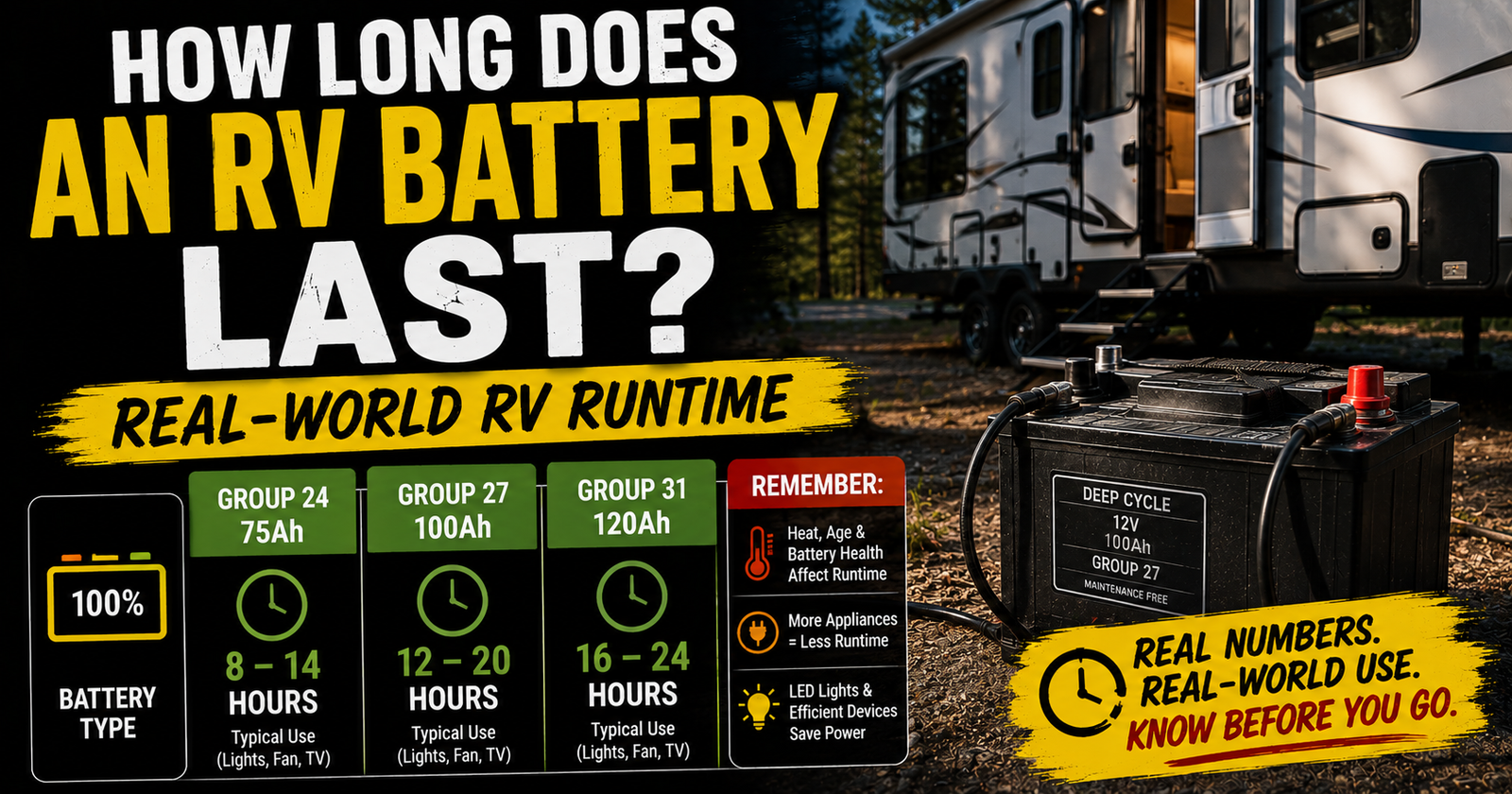
A Deeply Discharged Battery Can Add a Big Load
This is easy to overlook because you can’t “see” battery charging the way you can see ten lights turned on.
Suppose you’ve been boondocking.
Your house battery is significantly discharged.
Then you connect shore power.
The converter now needs to power whatever 12-volt equipment you’re using and recharge the battery.
That can be a substantial workload.
Progressive Dynamics notes that recharge time and converter demand are affected by battery size, converter output rating, battery state of discharge, and the number of 12-volt loads operating during charging.
If the converter only cycles when recovering a deeply discharged battery, that’s useful information.
What If It Stops Cycling After the Battery Charges?
That points us toward load or heat.
As the battery charges, the converter’s workload can change.
If the converter runs hot and cycles early in the charging process but settles down later, I’d investigate:
Battery condition.
Converter sizing.
Ventilation.
Cooling.
Actual charging current.
12-volt loads running at the same time.
Don’t immediately assume the converter is defective.
It may be struggling with the conditions it’s operating under.
A Bad Battery Can Cause Strange Converter Behavior
The battery itself needs to stay on our suspect list.
Progressive Dynamics specifically lists bad battery cells among possible causes of low converter output in its troubleshooting information.
A damaged battery may not charge normally.
A poor battery connection can also interfere with the charging system.
So inspect the battery side too.
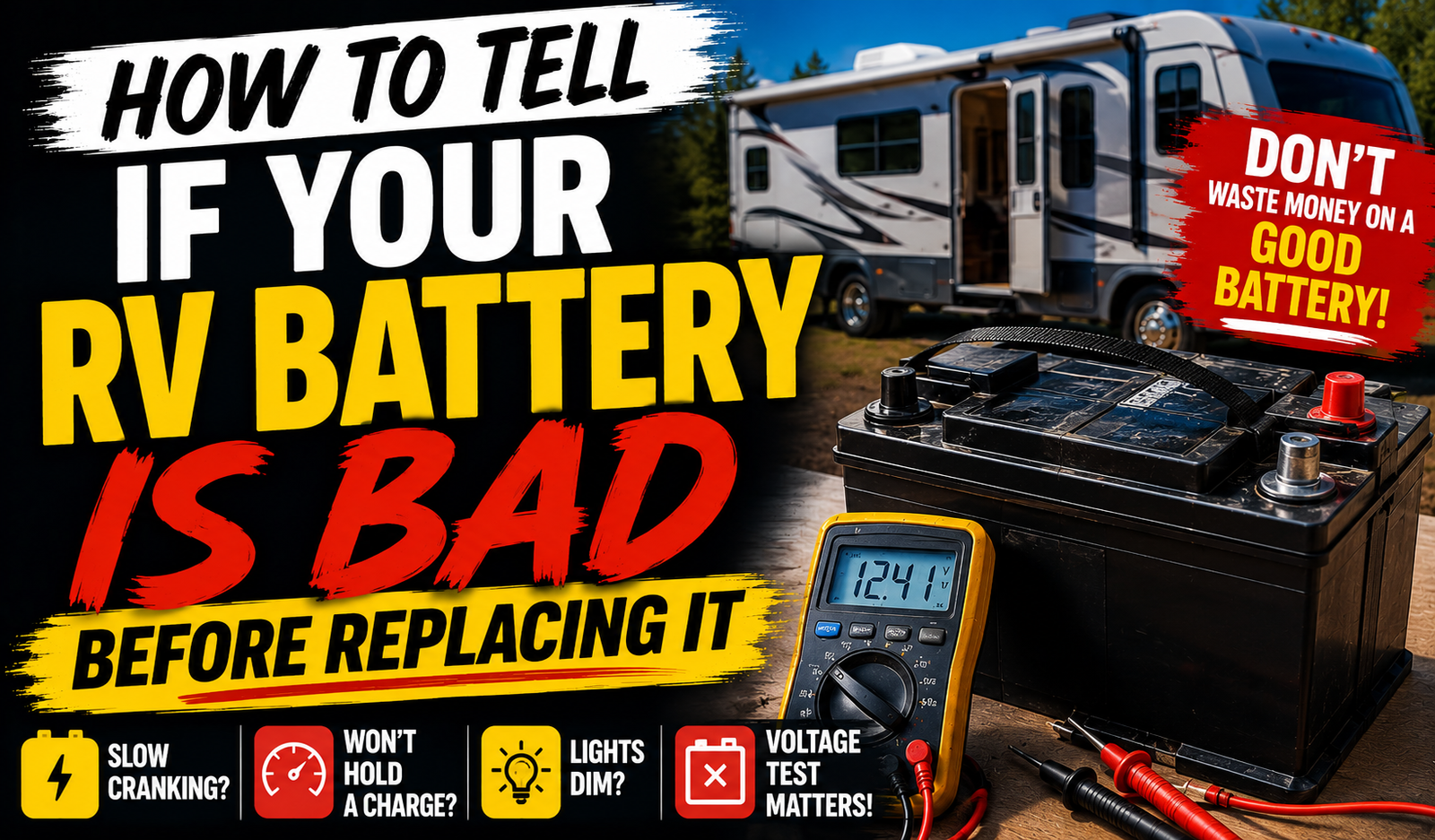
If the battery has been questionable lately, use our guide showing how to tell if an RV battery is bad before replacing it.
Sometimes the converter is reacting to the battery rather than failing on its own.
Check the Battery Connections
Loose or corroded battery connections can create all kinds of confusing symptoms.
Inspect the accessible connections with the electrical system properly isolated.
Look for:
Loose terminals.
Corrosion.
Damaged cables.
Overheated connections.
Poor grounds.
Broken conductors.
Aftermarket wiring that doesn’t look right.
A connection doesn’t have to be completely disconnected to create trouble.
Intermittent electrical problems are often more frustrating than complete failures because everything may work perfectly until vibration, heat, or current changes.
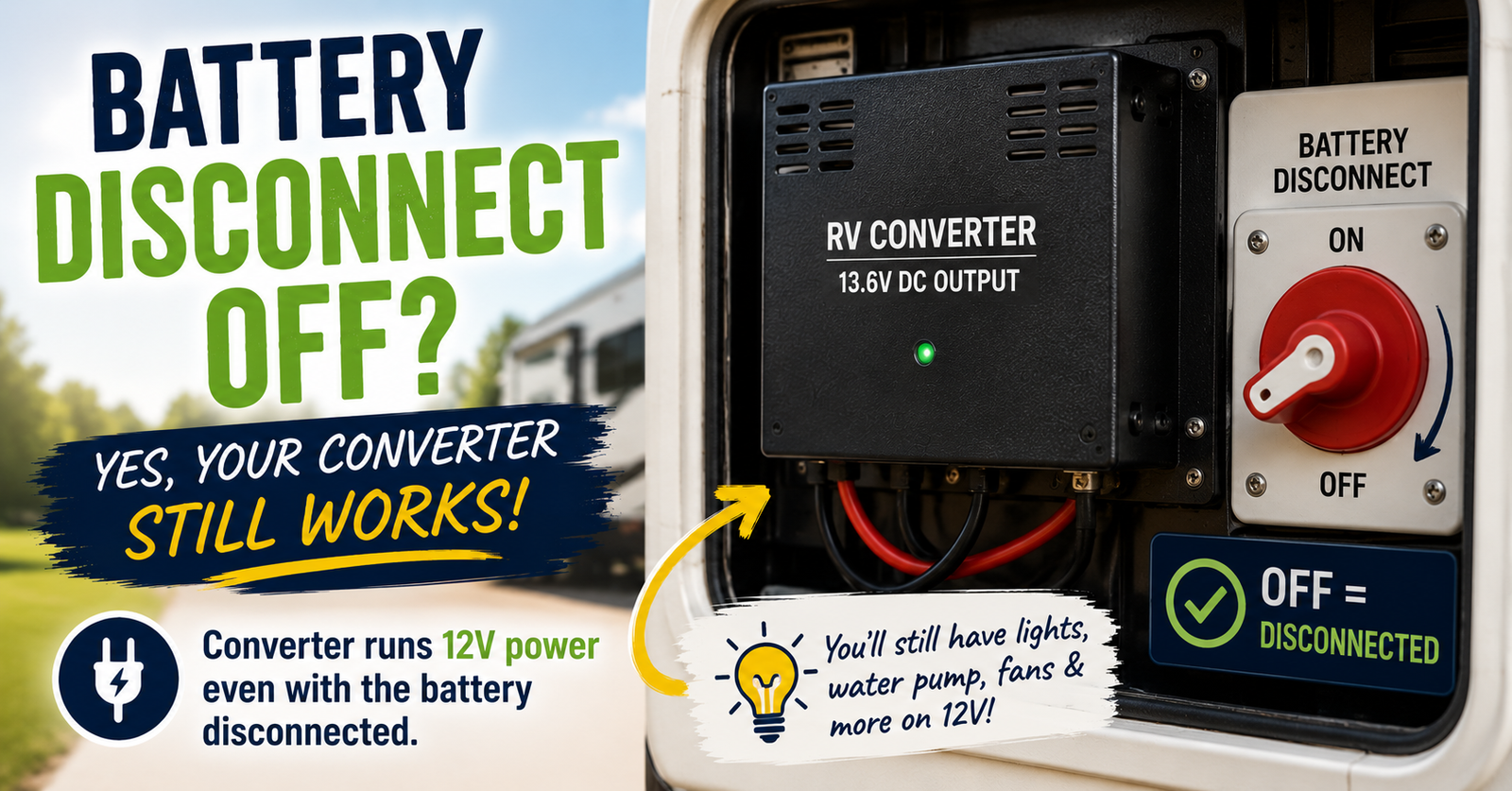
What If the Converter Keeps Cycling With the Battery Disconnected?
Don’t use this as a casual test unless your converter manufacturer’s diagnostic procedure calls for it.
Different RV systems are wired differently, and disconnecting batteries while equipment is operating isn’t something I’d recommend just to experiment.
But if a proper manufacturer troubleshooting procedure isolates the converter from the battery and the converter still repeatedly loses output under controlled conditions, that helps narrow the problem away from the battery itself.
Follow the diagnostic procedure for your exact converter model.
Find the Converter Model Number
This becomes especially important with a cycling problem because different converters have different protection features.
Find the manufacturer.
Find the model.
Then get the actual troubleshooting information for that converter.
Progressive Dynamics itself tells owners to identify the model number before selecting the correct troubleshooting guide.
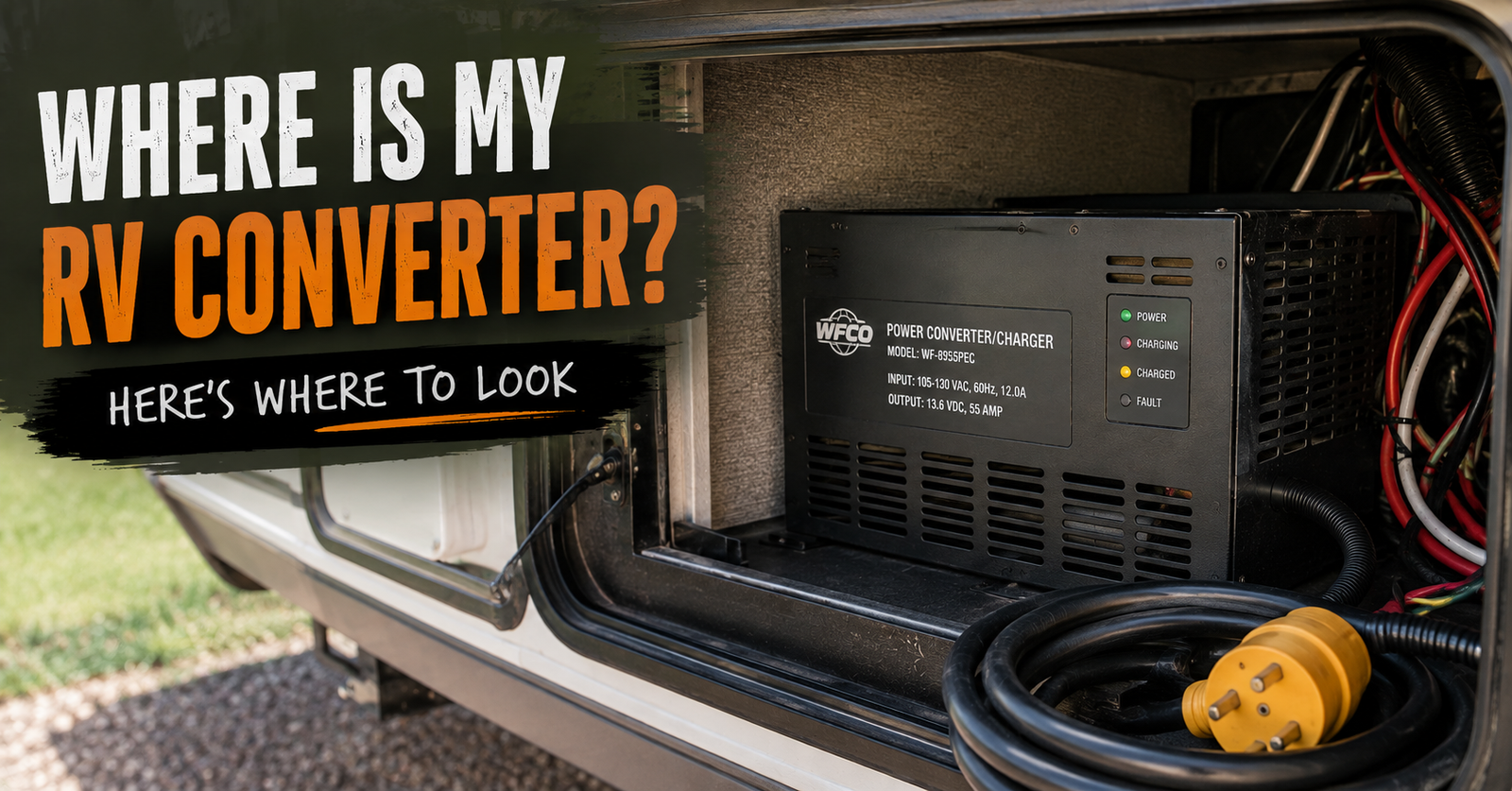
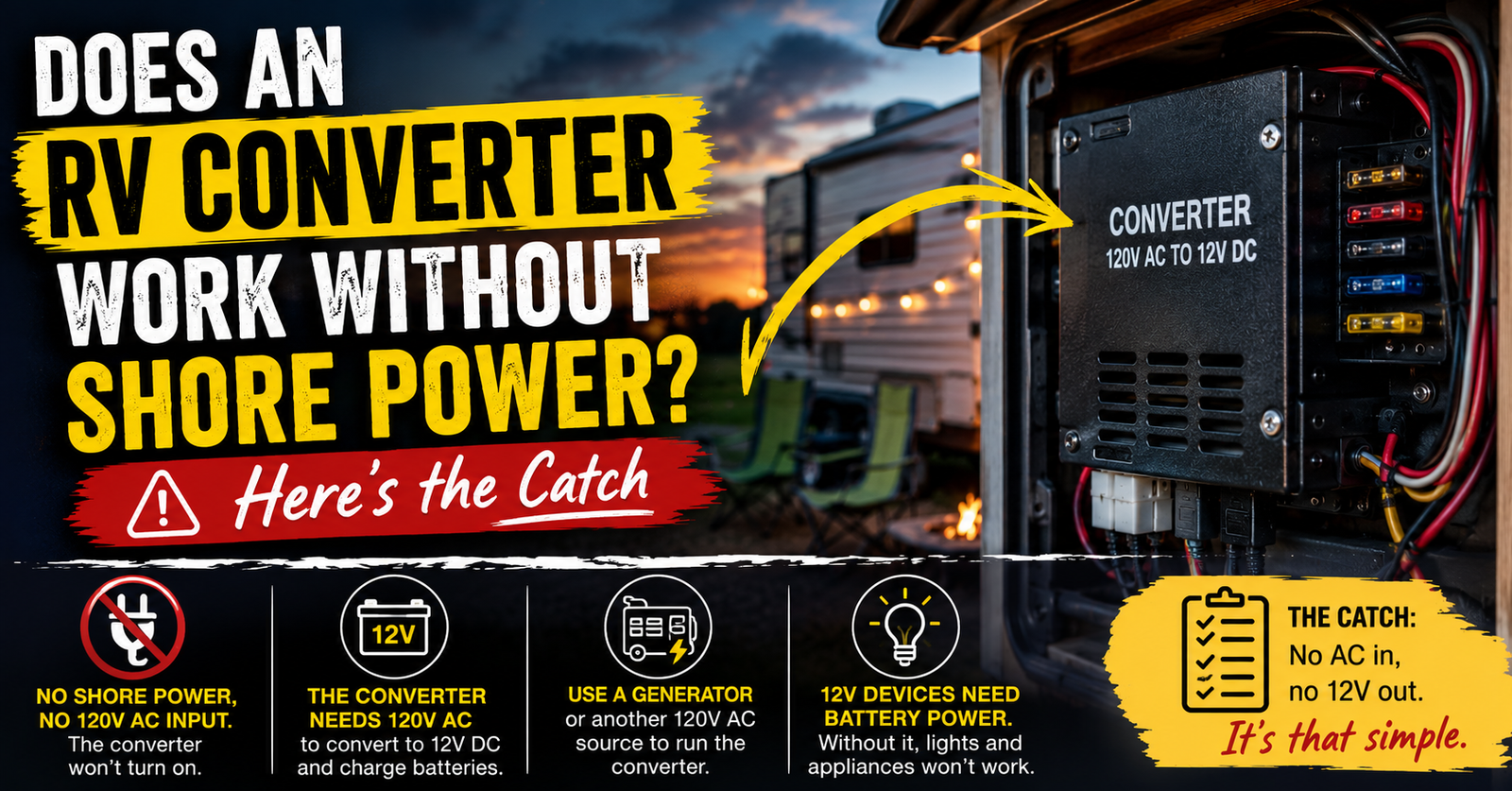
If you’re not even sure where the converter is hiding, we’ve already covered where to find an RV converter.
Don’t troubleshoot an unidentified box based on specifications from a completely different converter.
A Short Circuit Can Make Some Converters Shut Down and Reset
This is another big possibility.
Some modern converters have electronic short-circuit protection.
Progressive Dynamics says its PD9100 and PD9200 converters can shut down rapidly during a short or current-overload condition and automatically reset once the condition is removed.
Think about what that could look like from inside the camper.
Something causes the fault.
Converter shuts down.
Fault disappears or protection resets.
Converter comes back.
Fault occurs again.
Now you’ve got the converter seemingly turning itself on and off.
Look for a Particular Circuit That Triggers It
This is where troubleshooting becomes detective work.
Does the converter stay on until you operate the water pump?
Until the furnace starts?
Until a particular light is switched on?
Until you plug something into a certain 12-volt outlet?
If one DC circuit consistently triggers the problem, that’s a much better clue than simply saying the converter is bad.
The fault may be downstream of the converter.
Don’t Keep Replacing Fuses Without Finding the Cause
If blown fuses are part of your symptoms, stop treating the fuse as the problem.
A fuse is protection.
If the correct fuse keeps opening, something is causing it.

We’ve already built a dedicated guide explaining why an RV converter keeps blowing fuses.
Never solve repeated fuse failure by installing a larger fuse than the equipment or circuit specifies.
That’s removing protection, not repairing the fault.
Incoming Shore Power Can Make the Converter Cycle
Now we need to look upstream.
Your converter can’t operate correctly if its AC supply keeps disappearing or falls outside what the converter is designed to accept.
And this is one area where model-specific specifications really matter.
Current Progressive Dynamics PD9300 documentation specifies an input operating range of 105 to 130 volts AC. The troubleshooting guide says the converter will shut down if input voltage falls outside that range.
Your converter may have different limits.
Check its specifications.
But the larger lesson is important:
Sometimes the converter is turning off because the power feeding it isn’t right.
Check Whether the Problem Happens at Every Campsite
This is such an easy clue to overlook.
Converter works perfectly at home.
Works perfectly at Campground A.
Cycles constantly at Campground B.
Then works perfectly again when you leave.
I’m checking campground power before ordering a converter.
The same applies if the symptom changes dramatically depending on which electrical source you’re using.
Patterns save parts.
Low Voltage Isn’t the Only Problem
Excessive voltage can cause protective shutdown too.
Current Progressive Dynamics troubleshooting information says its PD9300 converter shuts down if input voltage exceeds 132 volts.
Again, don’t apply that exact threshold to every converter ever built.
Use the specifications for yours.
But if your converter repeatedly shuts down because incoming AC is outside its allowable range, replacing the converter isn’t fixing the source of the problem.
What If It Only Turns On and Off While Using the Generator?
This is one of my favorite diagnostic clues because it separates the power sources.
If the converter behaves perfectly on shore power but cycles when you’re running the generator, investigate the generator side.
Progressive Dynamics specifically addresses this in its troubleshooting documentation. It notes that some generators can produce voltage spikes that cause converter over-voltage protection to shut the unit down. Current PD9300 guidance also tells owners to verify AC voltage and make sure the generator is running smoothly when converter output is intermittent on generator power.
That’s pretty compelling evidence not to blame the converter first.
Listen to the Generator
Is it surging?
Hunting up and down?
Changing speed?
Struggling under load?
Does converter cycling line up with changes in generator sound?
If so, that’s worth investigating.
Measure generator output using appropriate equipment and procedures, or have it checked.
The converter may simply be protecting itself from unstable incoming power.
What If the Converter Clicks Every Time It Cycles?
The sound itself depends on converter design.
But repeated clicking accompanied by actual changes in DC output is much more useful than clicking by itself.
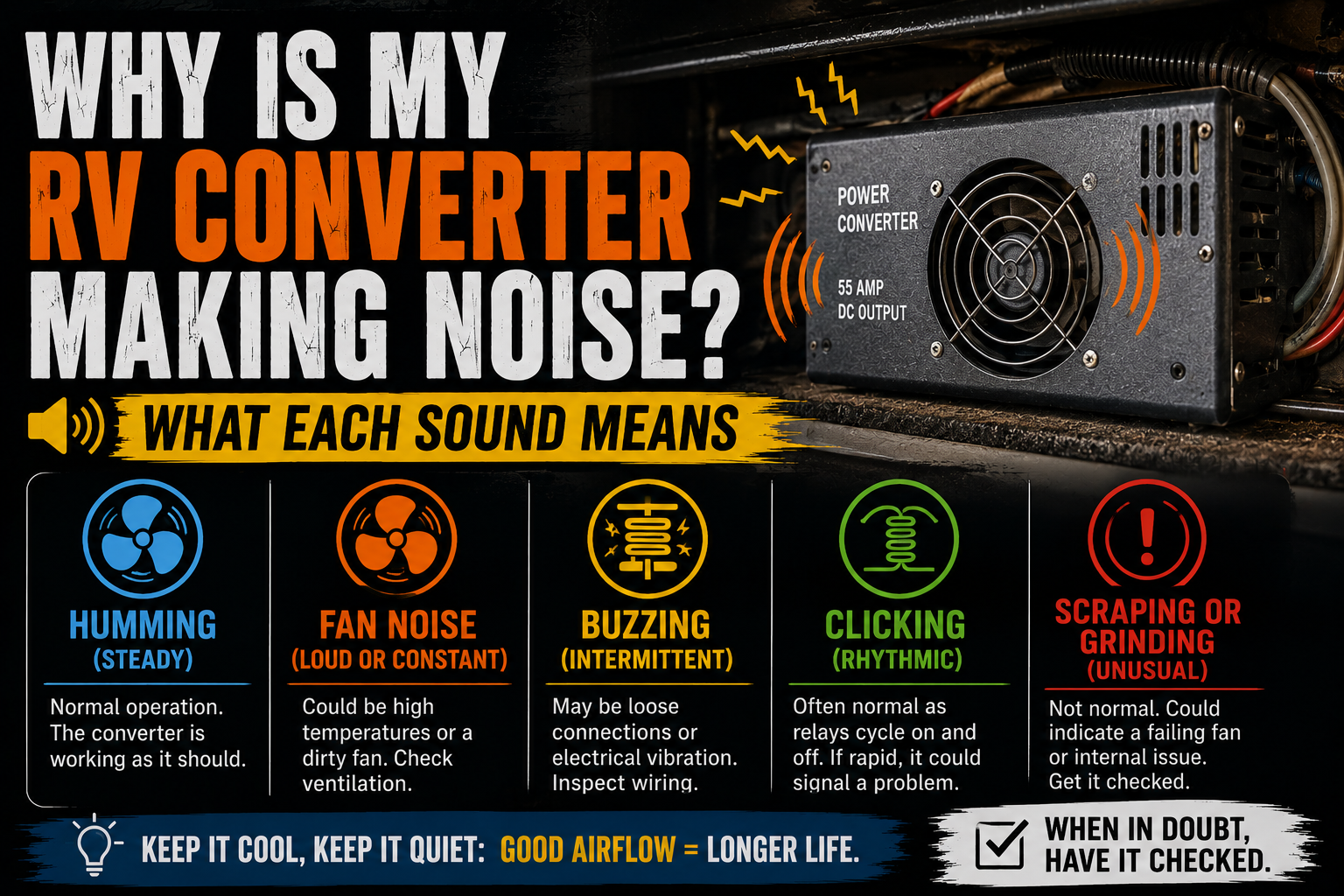
We’ve already built a guide explaining what different RV converter noises can mean.
If you’re hearing:
Click.
Lights change.
Click.
Lights change back.
Click.
Charging disappears.
That’s worth investigating as an electrical cycling problem rather than simply a noisy converter.
What If It Smells Hot or Burnt While Cycling?
Stop normal operation and investigate.
That’s no longer just an intermittent inconvenience.
We’ve got repeated electrical shutdown plus evidence of excessive heat or electrical damage.
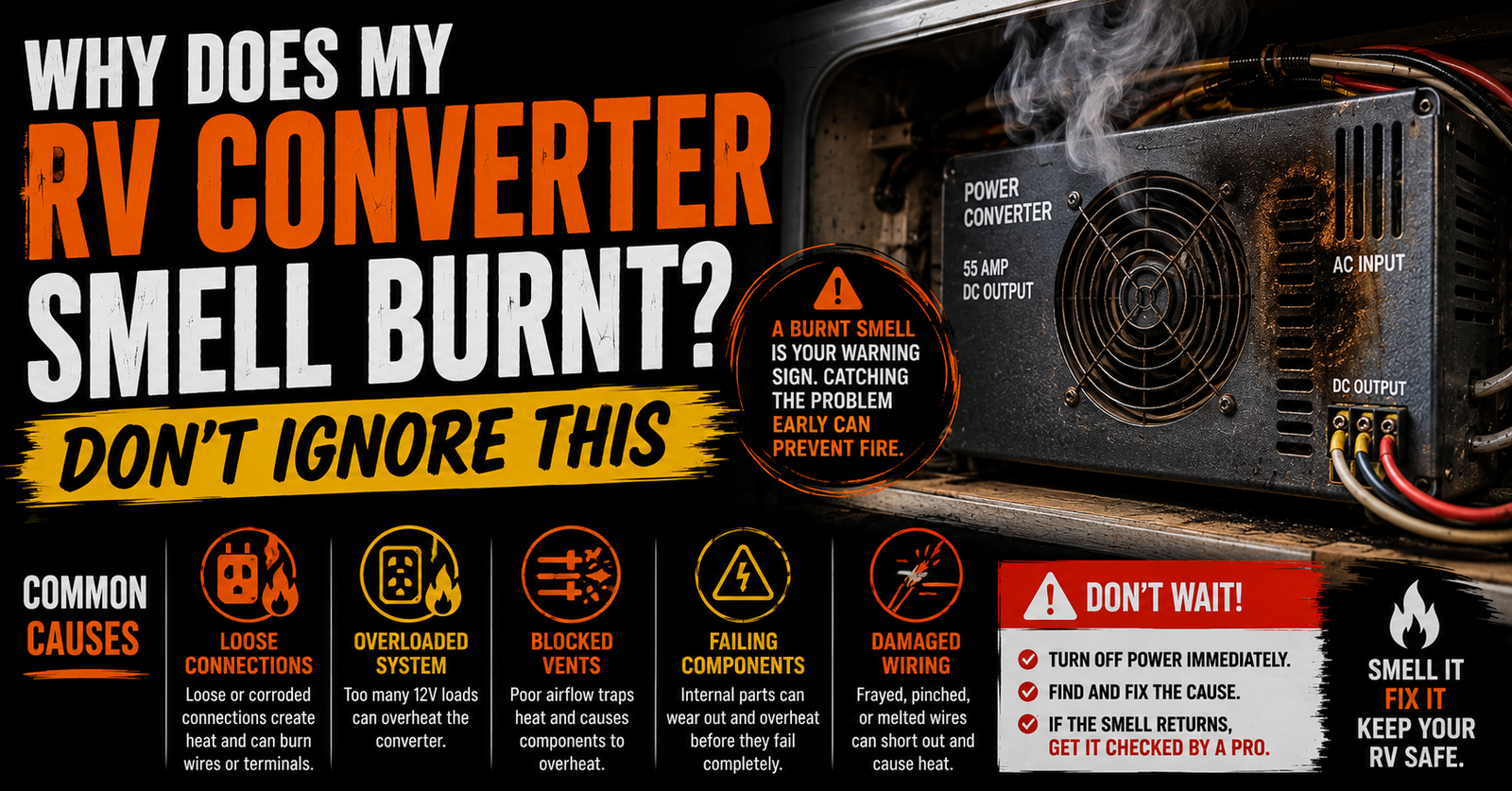
If you’re getting a hot-plastic, burning-wire, or overheated-electronics smell, our guide to what to do when an RV converter smells burnt explains why I wouldn’t keep powering it up just to see whether it eventually fails.
A burnt smell is a warning, not a troubleshooting feature.
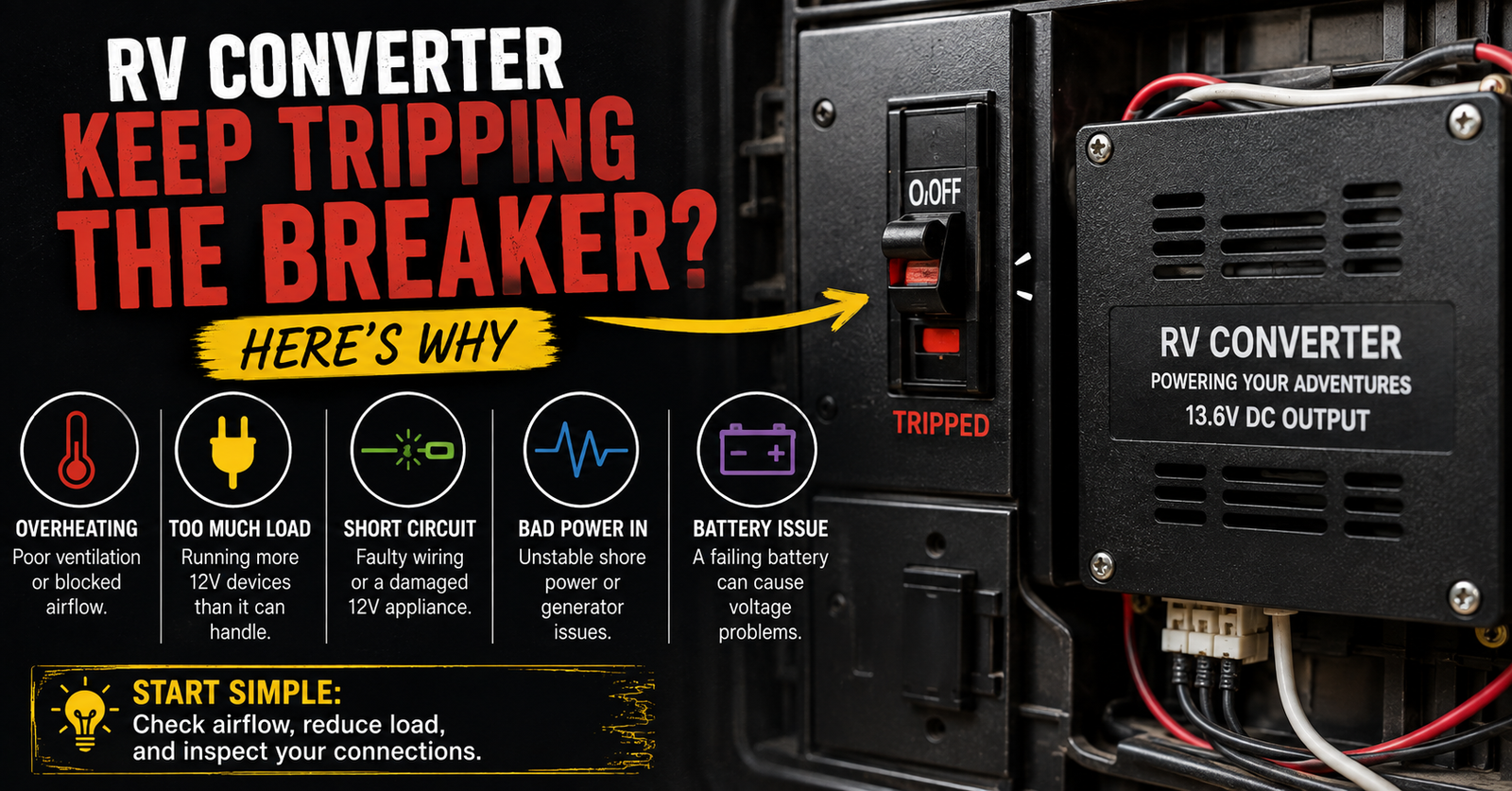
Check the AC Breaker Supplying the Converter
Another possibility is that the converter isn’t electronically shutting itself down at all.
Maybe it’s losing AC power.
Check whether the converter’s breaker is actually tripping.
If it is, that’s a different troubleshooting path.
For the PD9100 and PD9200 series, Progressive Dynamics says that if the converter’s supplying AC breaker is tripped, reset it. If it immediately trips again, their troubleshooting procedure identifies the converter as bad and calls for replacement.
That’s specific manufacturer guidance for those converters, not a universal rule for every RV.
Identify your equipment first.
Don’t Keep Resetting a Breaker That Immediately Trips
This is another place where people can make an electrical problem worse.
Breaker trips.
Reset.
Trips.
Reset.
Trips.
At some point the electrical system is making its opinion pretty clear.
Find the fault.
A breaker is a safety device.
It’s not an annoying switch that needs convincing.
Could the Converter Be Turning Off Because It’s Bad?
Absolutely.
We’ve spent most of this article looking for other explanations because I don’t like replacing expensive RV parts based on guesses.
But converters do fail.
Internal electronic components can deteriorate.
Thermal protection can begin behaving abnormally.
The converter may develop unstable output.
It may operate when cold and fail after heating up.
At some point, the evidence starts pointing back toward the converter itself.
Test Converter Output Directly
This is where we stop guessing.
Progressive Dynamics’ standard troubleshooting procedure for its PD9100 and PD9200 converters includes isolating the converter according to its instructions and measuring DC output directly. For standard versions, it specifies approximately 13.6 volts DC, plus or minus 0.3 volts, during that particular no-load test.
Your converter may specify a different test or voltage.
Follow its manual.
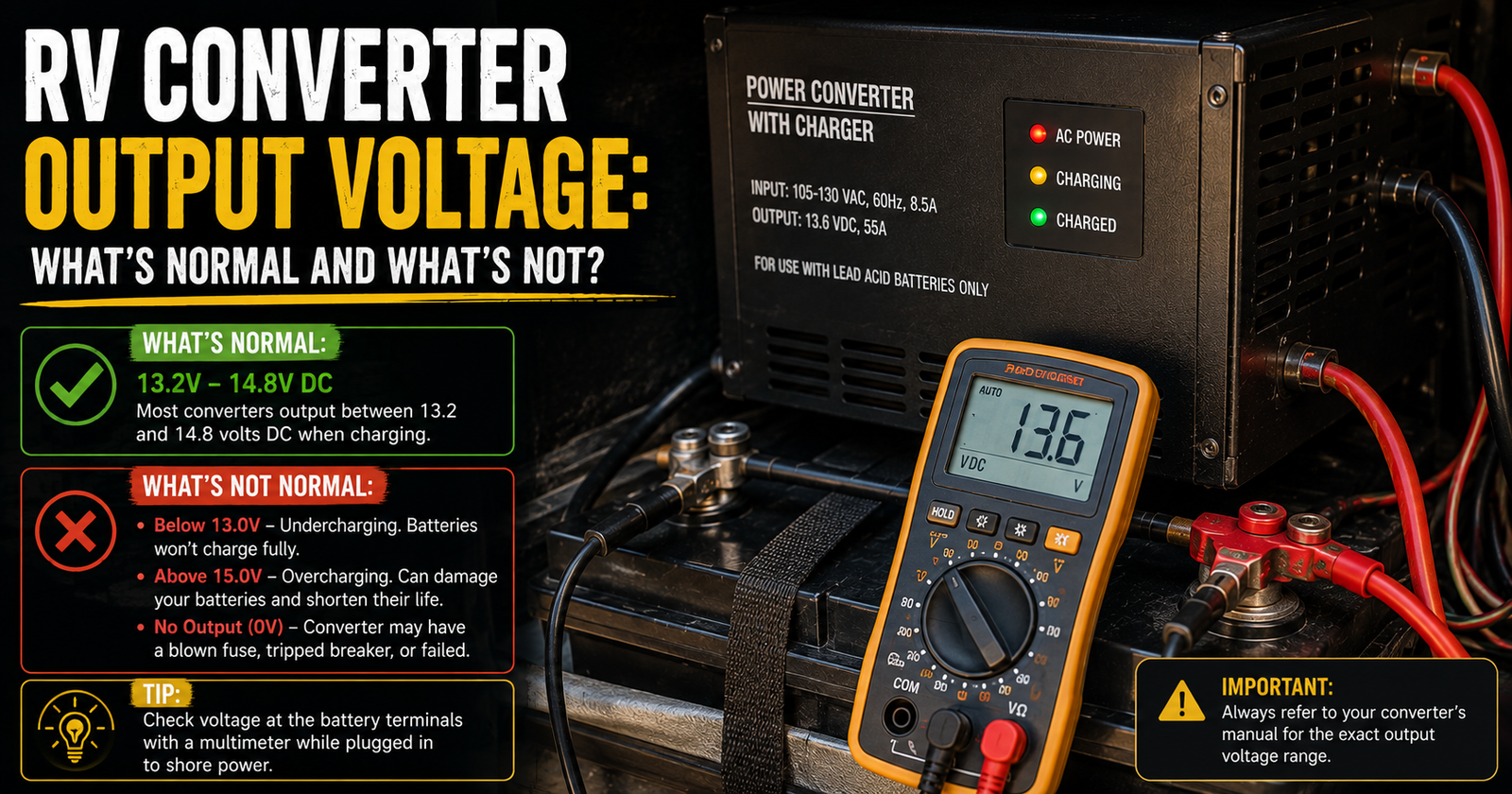
We’ve already built a much deeper guide to RV converter output voltage and what the readings mean.
Measure instead of guessing.
Catch the Converter While It’s Failing
This is especially important with an intermittent problem.
A converter that tests perfectly after sitting cold for an hour doesn’t tell us what happened 20 minutes earlier when the lights went out.
If it can be done safely according to the manufacturer’s procedure, compare readings:
When the converter is working.
When the problem starts.
After it shuts down.
After it recovers.
You’re trying to catch the electrical change as it happens.
That’s far more useful than testing it only when everything is behaving normally.
Write Down the Pattern
This sounds overly simple, but intermittent problems can make you question what you actually saw.
Write down:
Time converter started.
Battery voltage.
Shore-power voltage if safely monitored.
What 12-volt equipment was running.
Whether the fan was operating.
How hot the converter felt.
When output disappeared.
How long it stayed off.
What happened immediately before it came back.
After two or three cycles, you may see an obvious pattern.
Don’t Forget the Difference Between Converter and Inverter
If you’re new to RV electrical systems, make sure you’re troubleshooting the correct component.
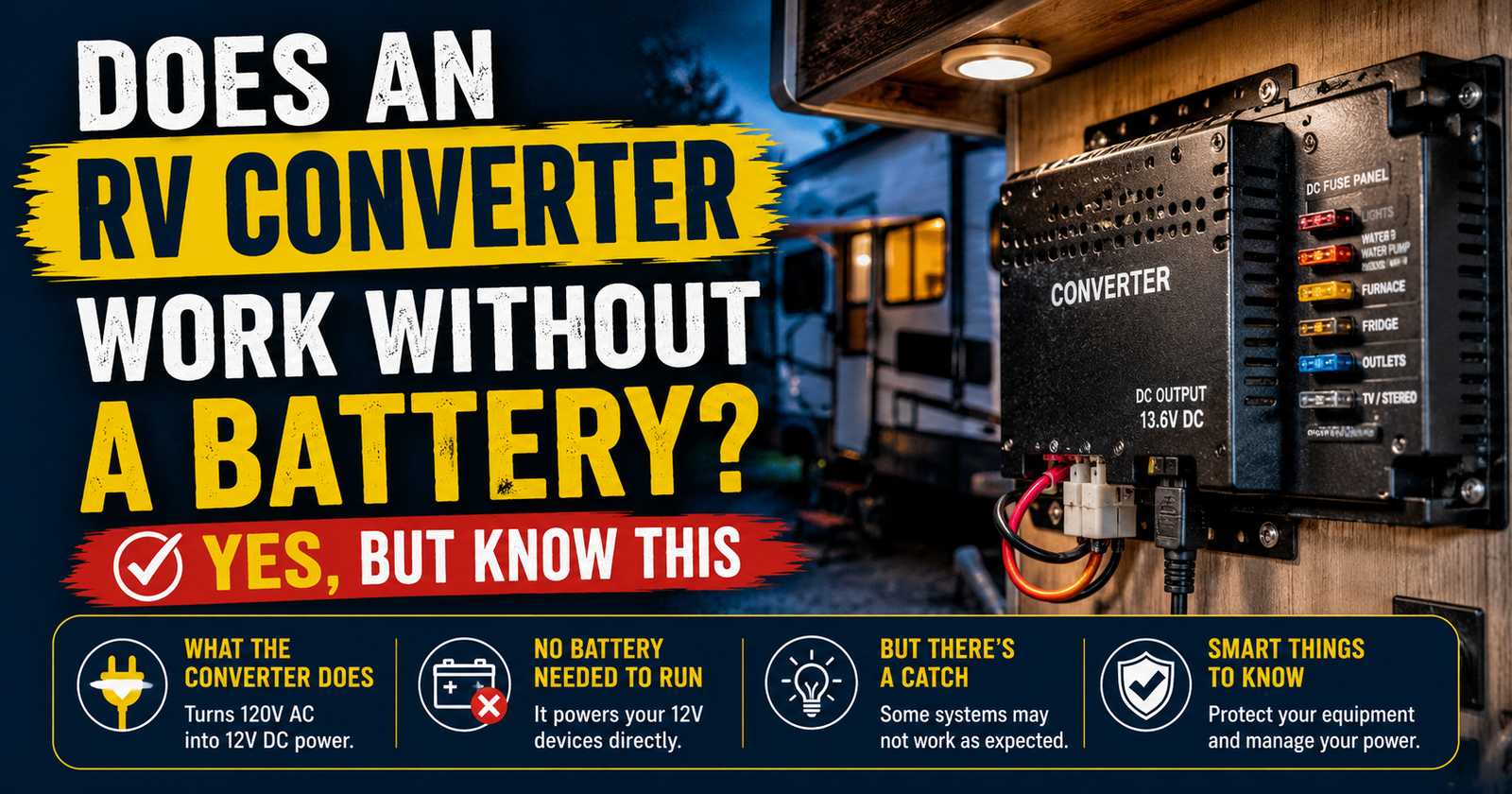
The converter generally takes AC power and produces DC power while supporting battery charging.
An inverter does essentially the opposite, taking DC battery power and creating AC power.
Some RVs have inverter/chargers that combine functions, which can make terminology even more confusing.
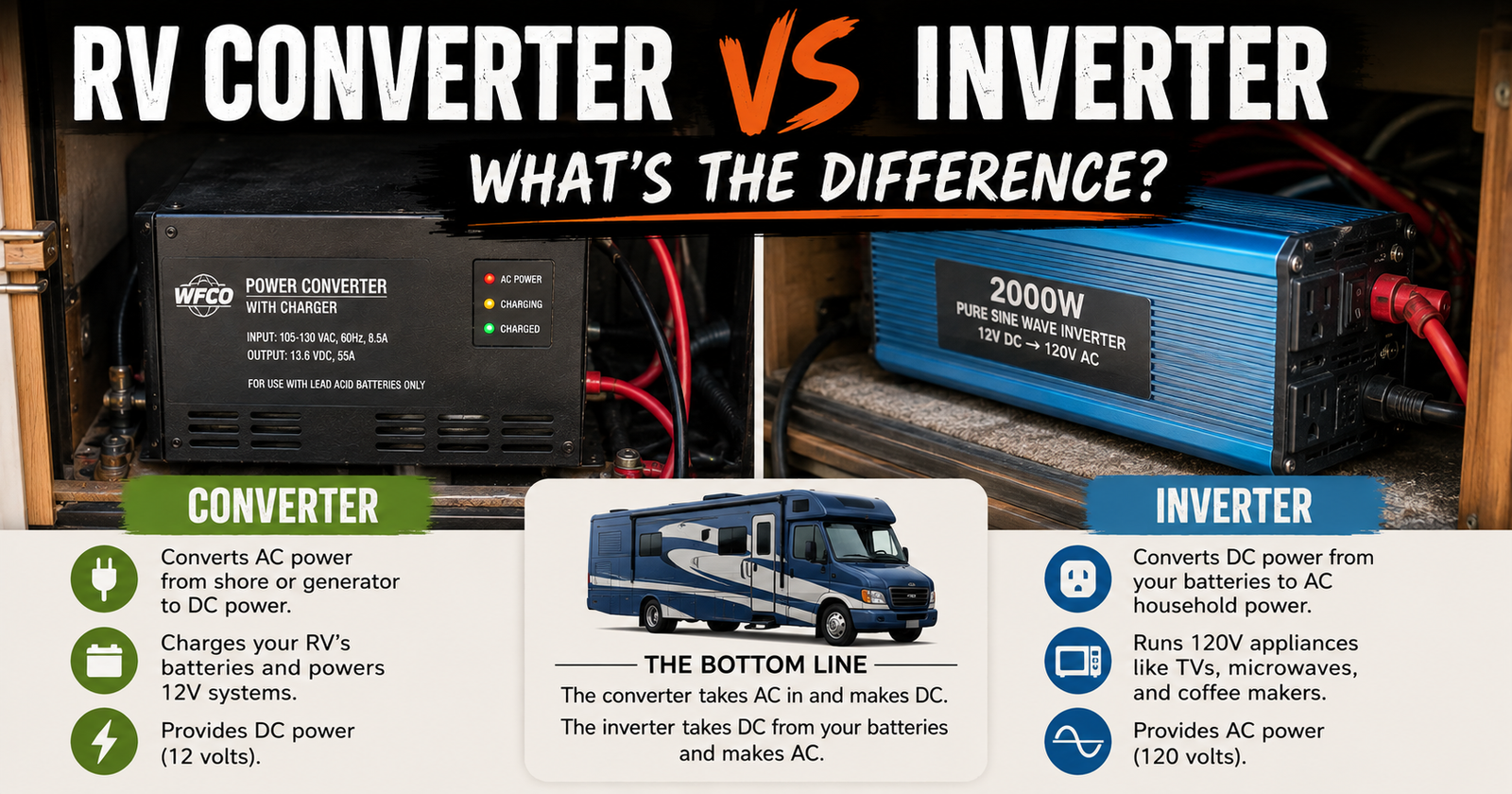
We’ve already explained the difference between an RV converter and inverter if you’re not sure which piece of equipment is actually cycling.
What If My Lights Keep Dimming and Brightening?
That can be a useful symptom, but don’t diagnose the converter from light brightness alone.
Changes in DC voltage can change the behavior of certain 12-volt lights.
If converter output disappears, the battery may suddenly become the DC power source.
When converter output returns, system voltage may rise again.
That can look like:
Bright.
Dim.
Bright.
Dim.
Put the meter on the system and see whether those brightness changes correspond with actual voltage changes.
What If My Battery Keeps Dying Too?
Now we’re connecting two symptoms.
Converter cycling.
Battery going dead.
If the converter spends significant time shut down, the battery may be supplying the camper’s DC loads during those periods.
Eventually, the battery loses charge.
That can make it seem like the battery itself is the original problem.
Our guide to why an RV battery can die even while you’re plugged in covers that relationship in much more detail.
The battery may simply be covering for a converter that keeps disappearing.
What If the Battery Says Full but the Converter Still Acts Strange?
Don’t trust the RV monitor panel blindly.
A battery can show decent voltage and still have poor usable capacity.
We’ve already covered the frustrating situation where an RV battery says full but dies surprisingly fast.
If the battery is questionable, test it properly.
You don’t want a failing battery sending you down the wrong converter troubleshooting path.
Could a Loose Connection Make It Turn On and Off?
Yes, intermittent connections deserve attention.
Heat and vibration can change how a marginal connection behaves.
The camper moves.
Equipment heats up.
Equipment cools down.
A loose connection can make contact one moment and lose it the next.
With all appropriate power sources disconnected, inspect accessible wiring for obvious problems.
Loose connections.
Heat discoloration.
Melted insulation.
Corrosion.
Damaged cables.
Poor previous repairs.
If you find signs of overheating, take them seriously.
RVs Have More Than One Power Source
This is worth repeating whenever we talk about electrical troubleshooting.
Unplugging the shore cord doesn’t necessarily mean the camper is electrically dead.
There may still be:
House-battery power.
Solar input.
An inverter.
Generator connections.
Other auxiliary equipment.
And the converter itself deals with 120-volt AC input.
Progressive Dynamics warns that converter troubleshooting can expose a person to dangerous voltage and says electrical troubleshooting should only be performed by someone who understands those risks.
If testing requires working around exposed energized AC equipment and you’re not qualified to do that, bring in an RV technician or electrician.
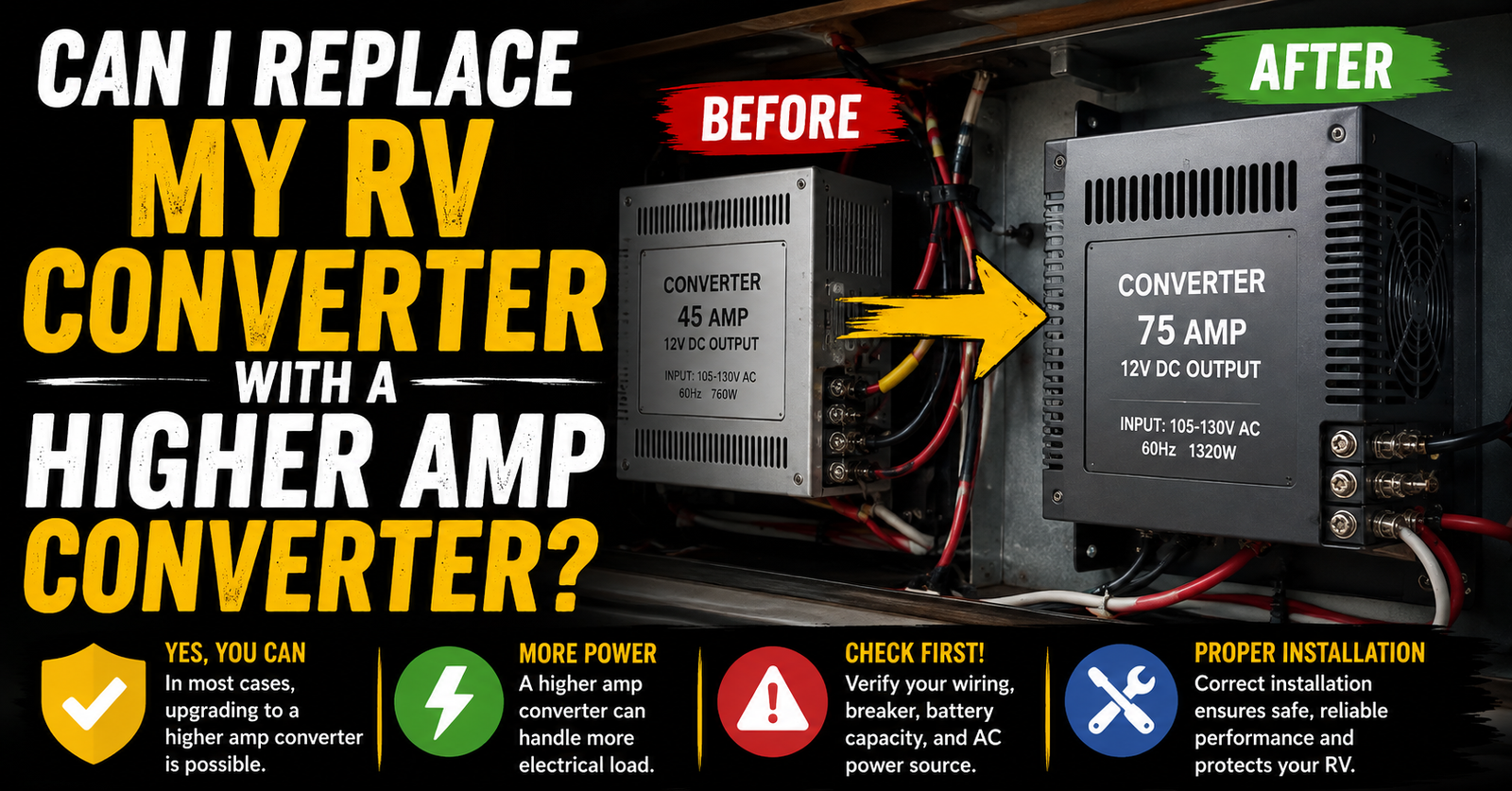
Don’t Replace the Converter Until the Evidence Points There
This entire troubleshooting process can be boiled down to one question:
Why did the converter stop?
If it stopped because it overheated, find out why it overheated.
If it stopped because DC demand exceeded its capacity, find the excessive load.
If it stopped because of a short, find the fault.
If it stopped because shore power is outside its acceptable range, fix the incoming-power problem.
If it only stops on generator power, investigate the generator.
If the battery is causing charging trouble, deal with the battery.
But if the converter has correct AC input, reasonable DC demand, proper ventilation, a healthy battery, good connections, no external short, and it still repeatedly loses output, then the converter itself starts looking awfully suspicious.
That’s when I’d move into our complete guide for telling whether an RV converter is actually bad.
The Timing of the Shutdown Is Probably Your Best Clue
Don’t just stare at the converter waiting for it to fail again.
Look for the trigger.
Shuts down after getting hot? Start with cooling.
Shuts down when several 12-volt loads are running? Start with demand.
Shuts down when one particular circuit operates? Look for a circuit fault.
Works on shore power but cycles on the generator? Investigate generator output.
Cycles only while heavily charging the battery? Look at charging load, battery health, heat, and converter capacity.
Has good input power and still randomly loses output under light load? The converter itself moves higher on the list.
That’s how I’d attack this problem in a real camper.
Don’t start by asking what part you should replace.
Figure out what changes immediately before the converter turns off.
Once you find that pattern, an annoying on-again, off-again converter usually becomes a whole lot less mysterious.
Written by Evan Mercer
Evan Mercer writes about RV electrical systems, converter troubleshooting, batteries, and practical camper repairs for CamperAnswers.com. His work focuses on helping camper owners follow the symptoms, understand what their electrical system is actually doing, and replace parts only when the testing points there.