
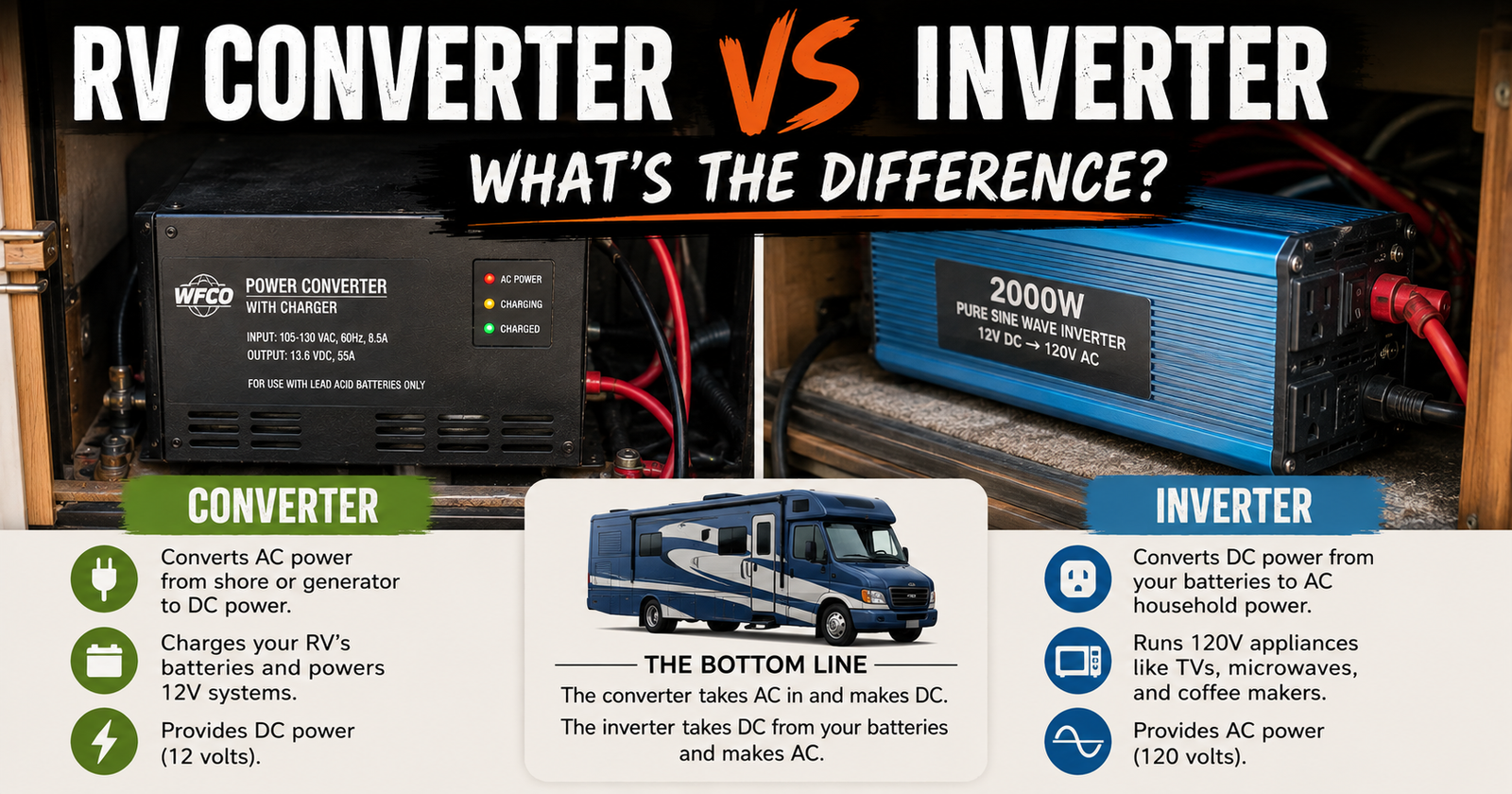
RV electrical terminology has a special way of making something fairly simple sound harder than it needs to be. Converter. Inverter. Inverter/charger. Shore power. 12-volt DC. 120-volt AC.
When I first explain converters and inverters to someone, I usually skip all the technical language and start with this:
A converter helps turn incoming AC power into DC power. An inverter takes DC battery power and turns it into AC power.
They’re basically working in opposite directions.
That’s the simple answer, but understanding what that actually means inside your camper can save you a lot of confusion. It can also keep you from troubleshooting the wrong piece of equipment when your battery won’t charge, your outlets quit working, or something only works while you’re plugged into shore power.
RV Converter vs Inverter at a Glance
Think about the direction electricity needs to travel.
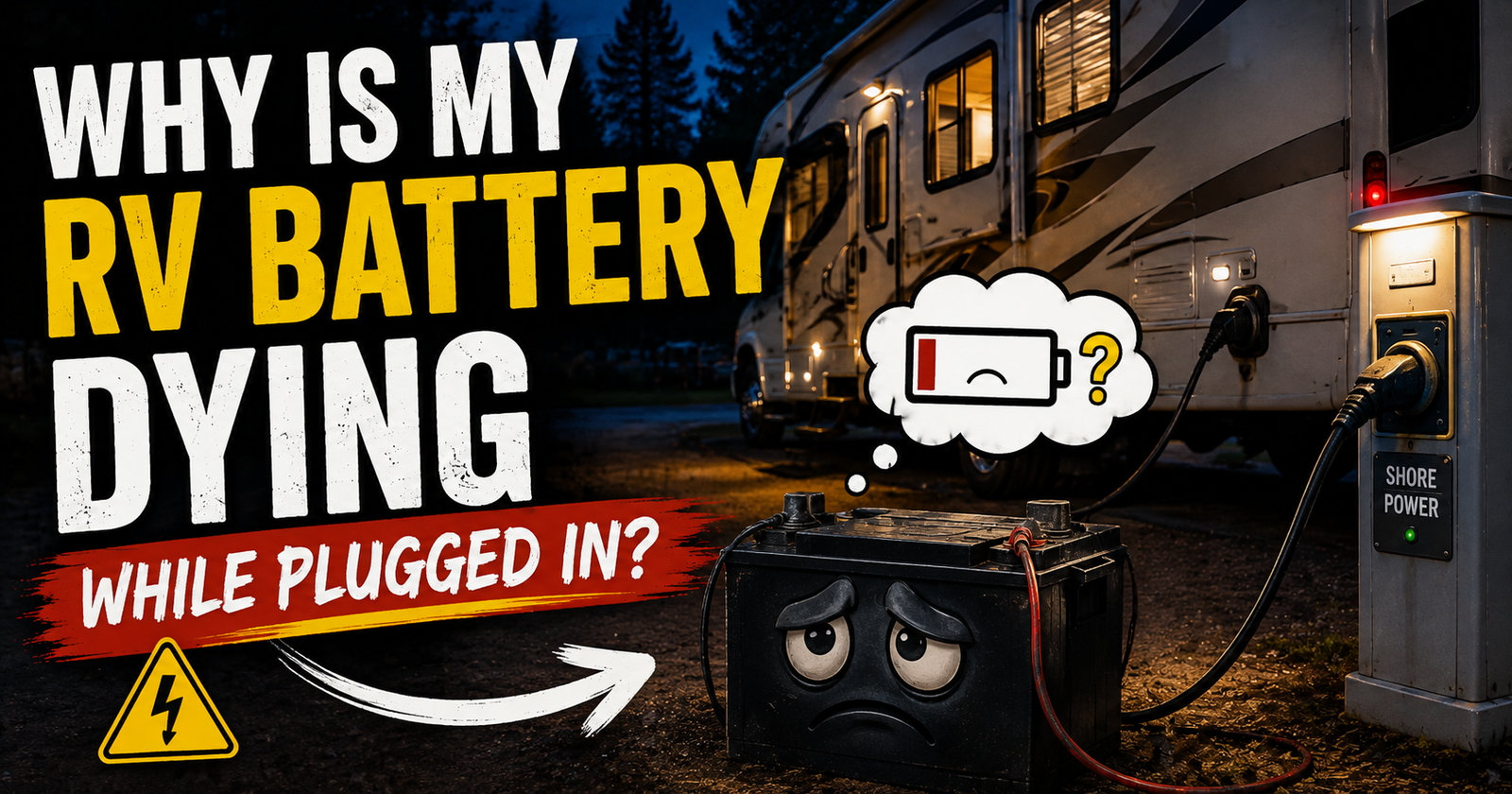
When you’re plugged into a campground pedestal, you have 120-volt AC power available. Your RV still has a 12-volt DC electrical system that needs power, and your house battery needs charging. That distinction becomes especially useful when diagnosing an RV battery that dies even while plugged in.
That’s where the converter/charger comes in.
When you’re camping without shore power, your house battery provides DC electricity. If you want to operate certain 120-volt AC equipment from those batteries, you need to turn DC into AC.
That’s where the inverter comes in.
Progressive Dynamics describes an RV converter/charger as supplying 12-volt power to lights and appliances while recharging the battery whenever 120-volt AC power is available.
So the easiest way I remember it is:
Converter: AC → DC
Inverter: DC → AC
Now let’s put that into normal RV life.
What Does an RV Converter Do?
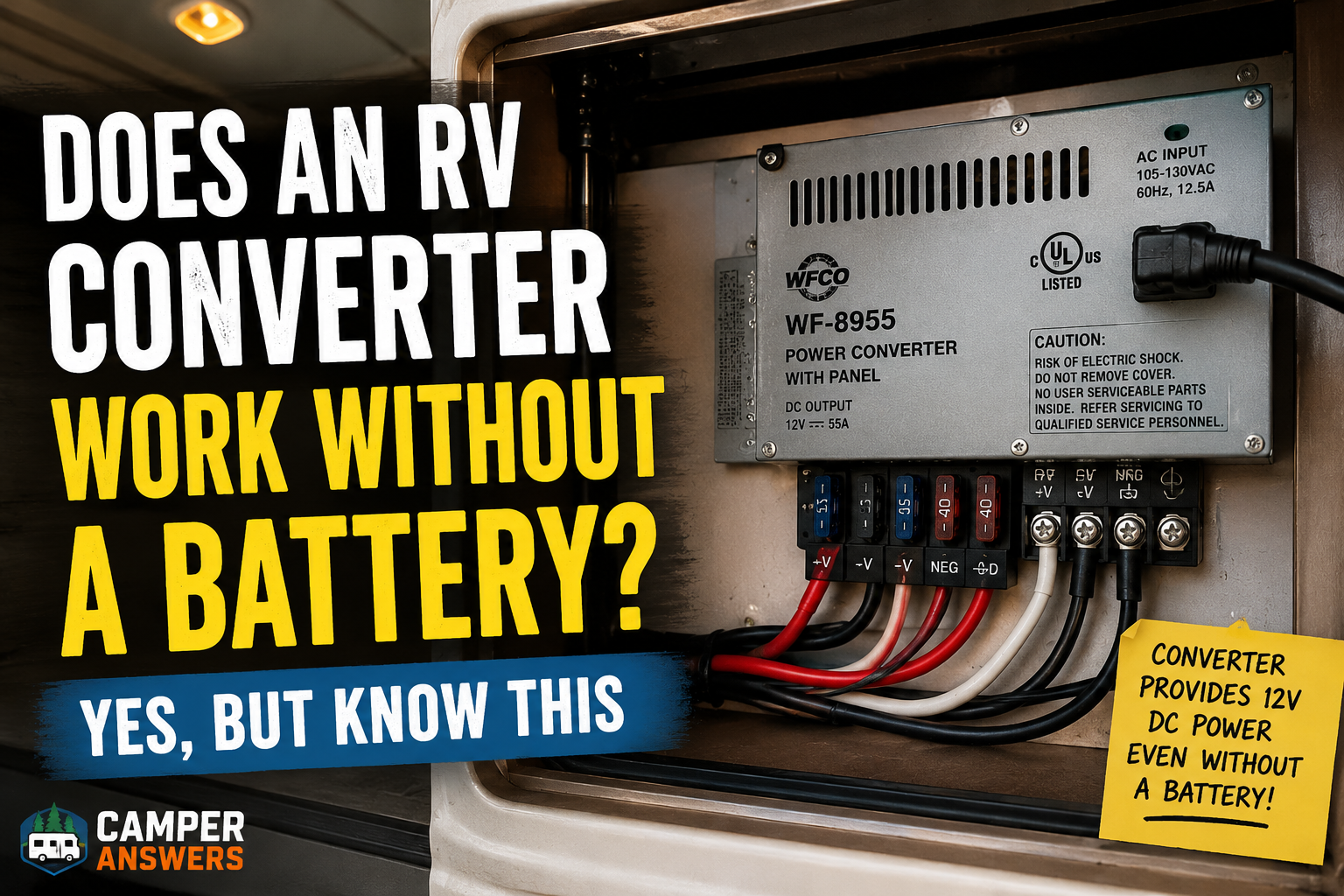
Your RV converter is primarily associated with the 12-volt side of the camper when AC power is available.
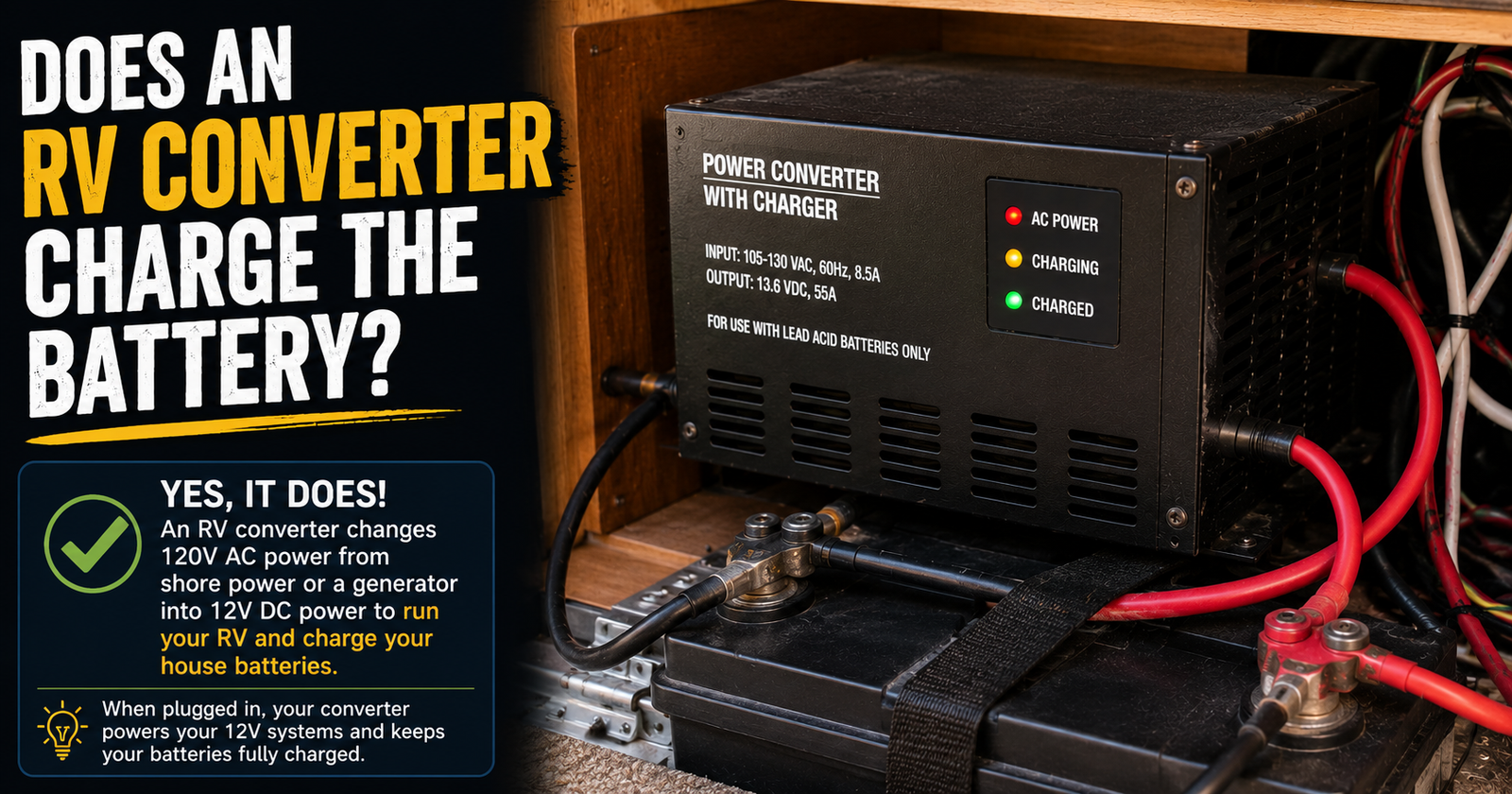
Plug your camper into shore power and the converter/charger uses that incoming AC electricity to provide DC power and charge the house battery. The step-by-step explanation of how shore power charges the battery clarifies what happens between the campground pedestal and the battery.
Your RV’s 12-volt system can include things such as interior lights, the water pump, vent fans, furnace controls and blower, appliance control boards, and other equipment depending on the camper.
The converter helps keep that side of the RV alive while you’re plugged in.
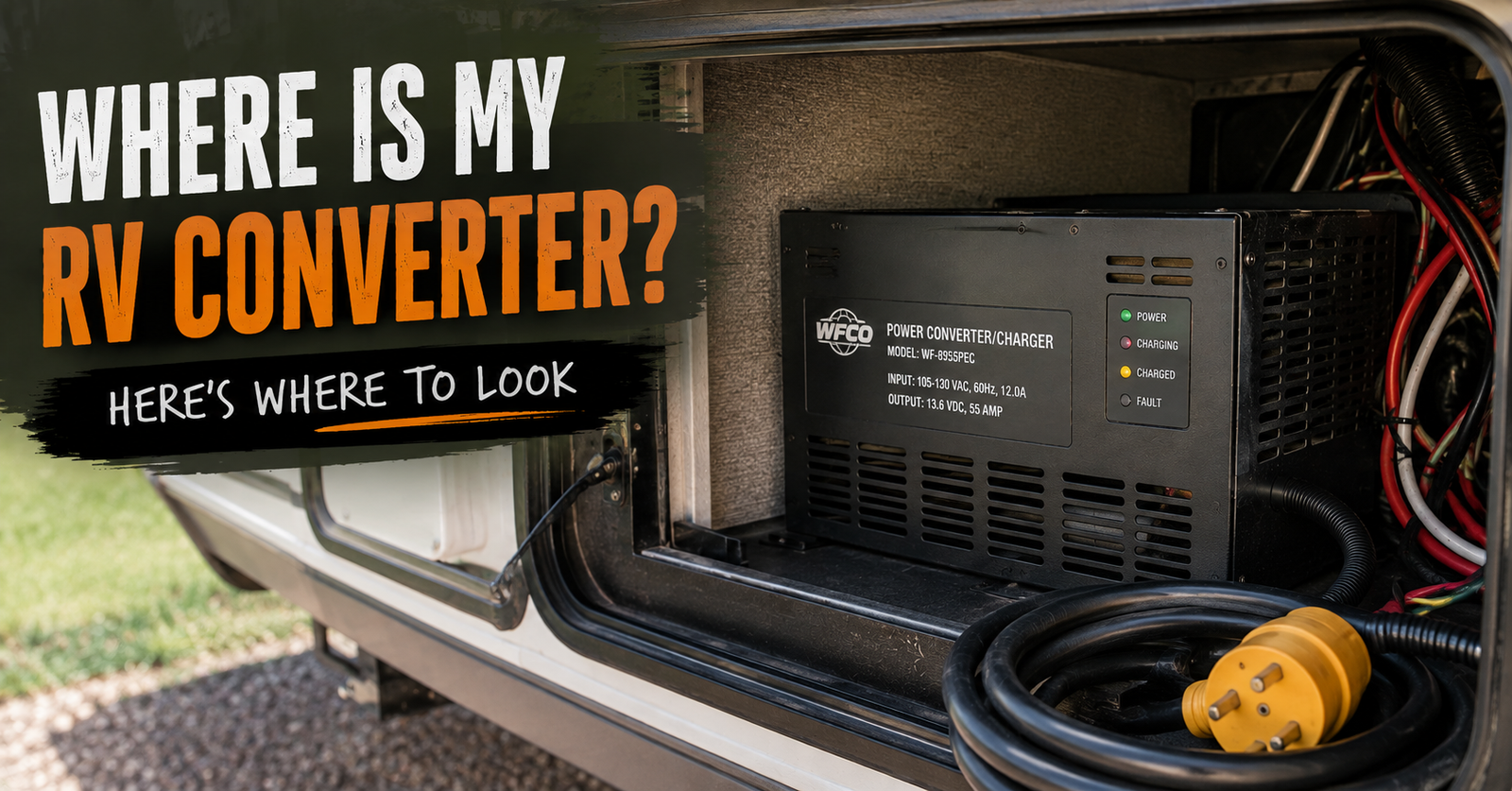
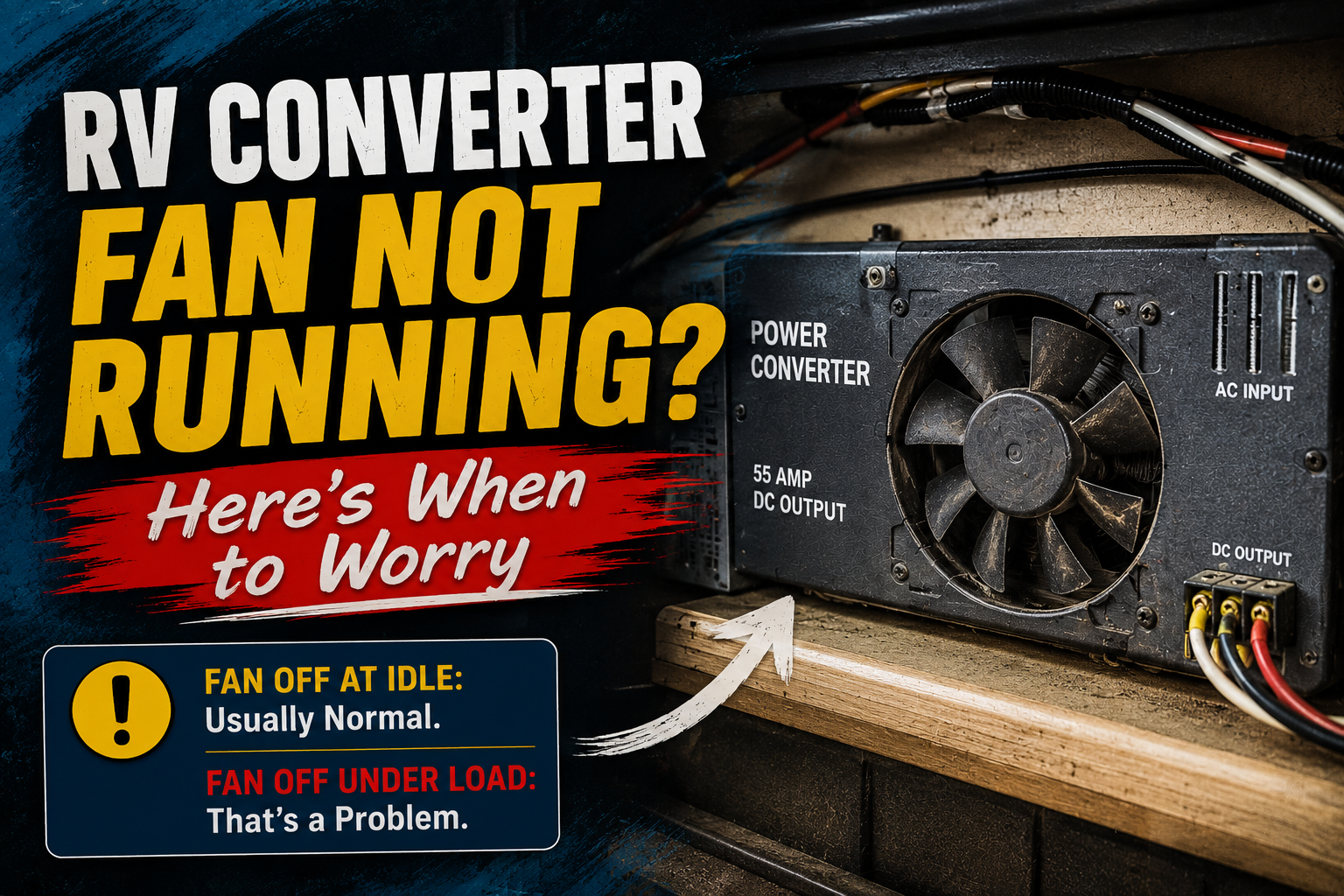
If you’re wondering where the thing actually is, I’ve already covered the most common places RV manufacturers hide the converter.
Sometimes it’s part of the main power center. Sometimes it’s a separate converter located elsewhere.
What Does an RV Inverter Do?
An inverter starts on the other side.
It takes DC electricity stored in your house batteries and changes it into AC electricity that can power compatible 120-volt equipment.
That’s extremely useful when you’re camping without shore power.
Want to run an AC television from your battery bank?
An inverter can make that possible.
Want certain wall outlets available while boondocking?
They may be supplied by an inverter.
Want to power larger AC appliances from a big lithium battery bank?
Now the inverter becomes a major part of the electrical system.
Victron describes inverter operation similarly, with the inverter supplying AC power from the batteries when an external AC source isn’t available.
Here’s a Simple Real-World Example
Imagine you’re at a campground.
You plug the shore-power cord into the pedestal.
Now 120-volt AC electricity enters the RV.
Your converter can use that electricity to supply the 12-volt DC system and charge the battery.
That’s AC going toward DC.
Tomorrow you leave the campground and spend the night somewhere without hookups.
No shore power.
Your battery contains DC electricity.
You turn on your inverter so you can operate an AC device from battery power.
That’s DC going toward AC.
Once you picture electricity moving in those two directions, the names become much easier to keep straight.

Does Every RV Have a Converter?
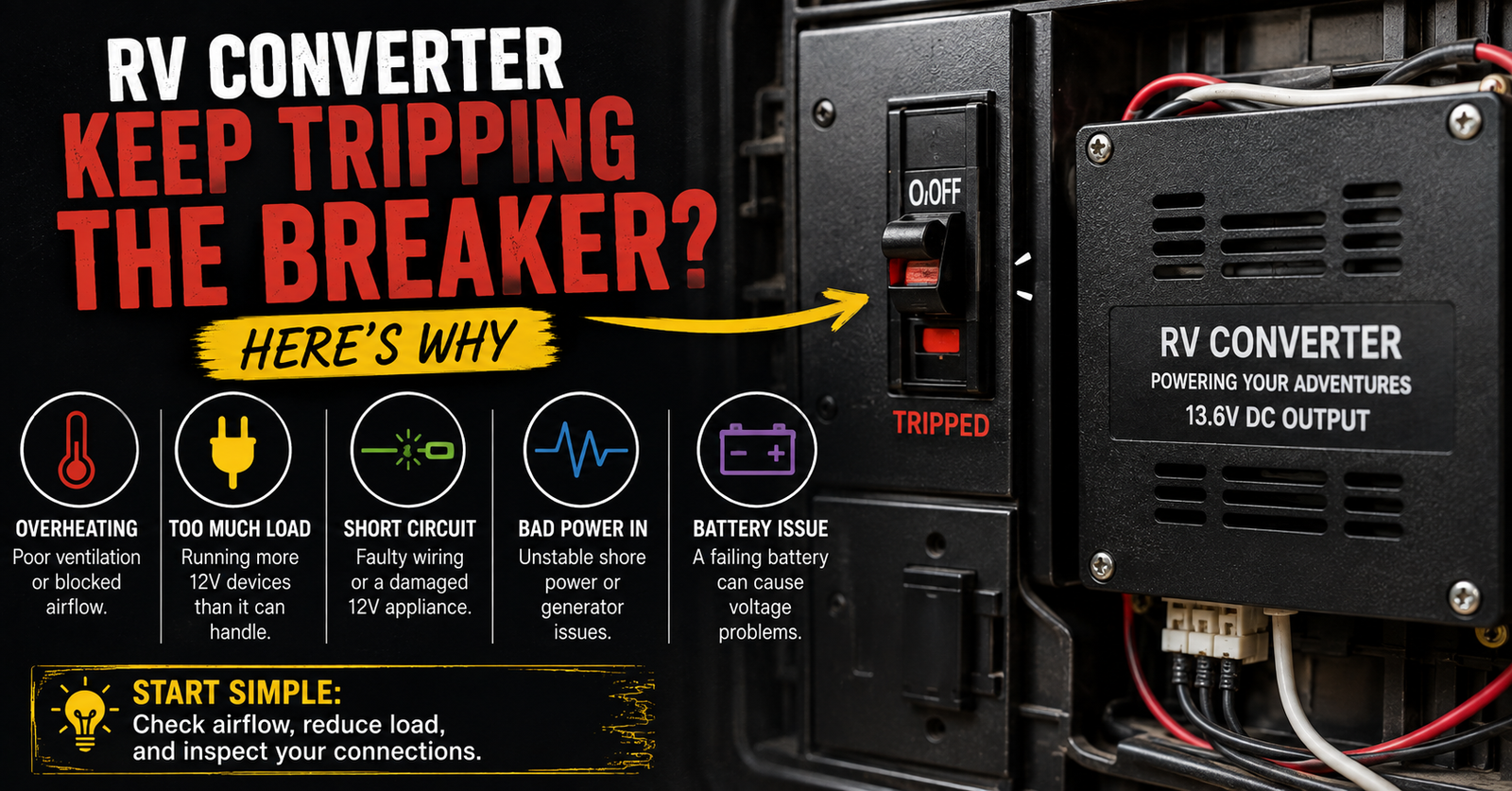
Most conventional RV electrical systems need some method of supplying the 12-volt system and charging the house batteries from shore power.
That function may be performed by a traditional converter/charger.
But don’t assume every modern camper has a separate box labeled “converter.”
Some systems use an inverter/charger, which combines functions.
That’s particularly common as RV electrical systems become more sophisticated.
So if you’ve searched your camper from one end to the other and can’t find the standalone converter somebody on YouTube says you definitely have, find out what equipment your RV actually uses.
Does Every RV Have an Inverter?
No.
And this surprises some new RV owners.
Having a battery does not automatically mean your RV can operate its regular 120-volt outlets from that battery.
The battery supplies DC power.
Those household-style outlets use AC power.
Something has to convert between the two.
Without an inverter or another AC source such as shore power or a generator, your normal AC outlets may have no power even though the 12-volt side of the camper works perfectly.
That’s normal.
Why Do My Lights Work but the Outlets Don’t?
This is one of the easiest ways to see the two electrical systems in action.
You’re camping without hookups.
Interior lights work.
Water pump works.
Furnace works.
But you plug your phone charger into a regular wall outlet and get nothing.
You might think the camper has an electrical problem.
Maybe it doesn’t.
Those lights and other equipment may be operating from the 12-volt battery system.
The wall outlet needs 120-volt AC electricity.
If the RV doesn’t have an inverter supplying that outlet, there’s no reason for it to work from the battery alone.
An Inverter Doesn’t Create Free Electricity
This sounds obvious when I say it, but inverter discussions sometimes make it seem like you’re getting extra power.
You’re not.
The inverter takes energy stored in the battery and converts it into a form AC equipment can use.
And that conversion isn’t perfectly efficient.
Every watt you use has to come from somewhere.
Run a big AC appliance through an inverter and your battery bank has to supply the energy.
That’s why large inverter systems and large battery banks often go together.
A Converter Doesn’t Create Free Electricity Either
Same rule.
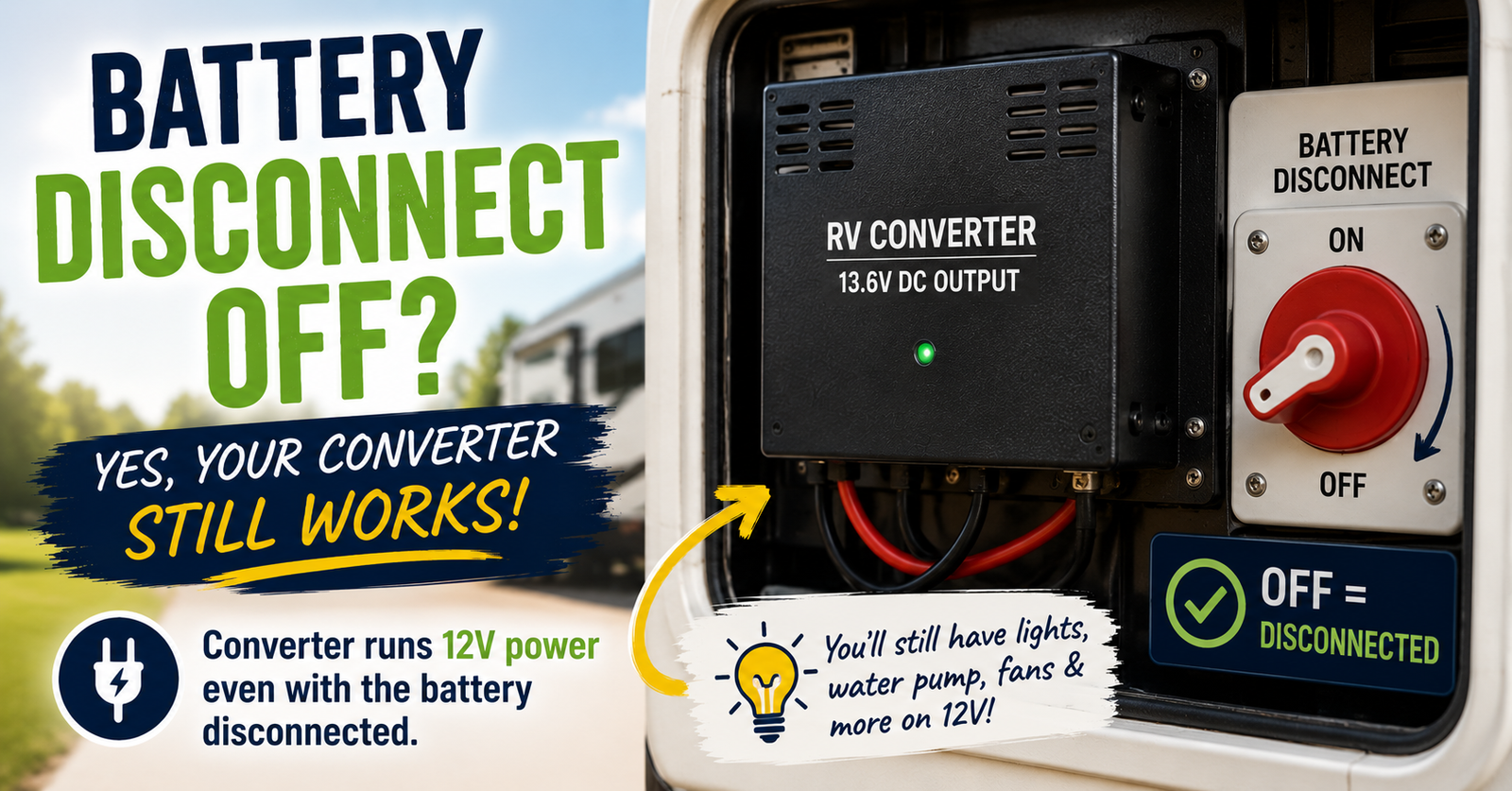
The converter needs an AC source.
That might come from campground shore power.
It might come from a generator.
But the converter can’t charge the battery from nothing.
If your camper isn’t connected to an AC source, a traditional converter isn’t magically recharging the battery.
That’s where other charging sources such as solar or alternator-based charging come into the picture.
Can an RV Have Both a Converter and an Inverter?
Absolutely.
You can have a converter/charger handling shore-power charging and a separate inverter supplying AC power from the battery.
This is common enough, especially when an inverter was added later.
For example, somebody may buy a travel trailer with a factory converter and later install an inverter for boondocking.
Now both boxes exist.
They just have different jobs.
What Is an Inverter/Charger?
This is where the names start getting mashed together.
An inverter/charger combines the ability to produce AC power from the batteries with the ability to charge those batteries when an external AC source becomes available.
Some also incorporate automatic transfer functions.
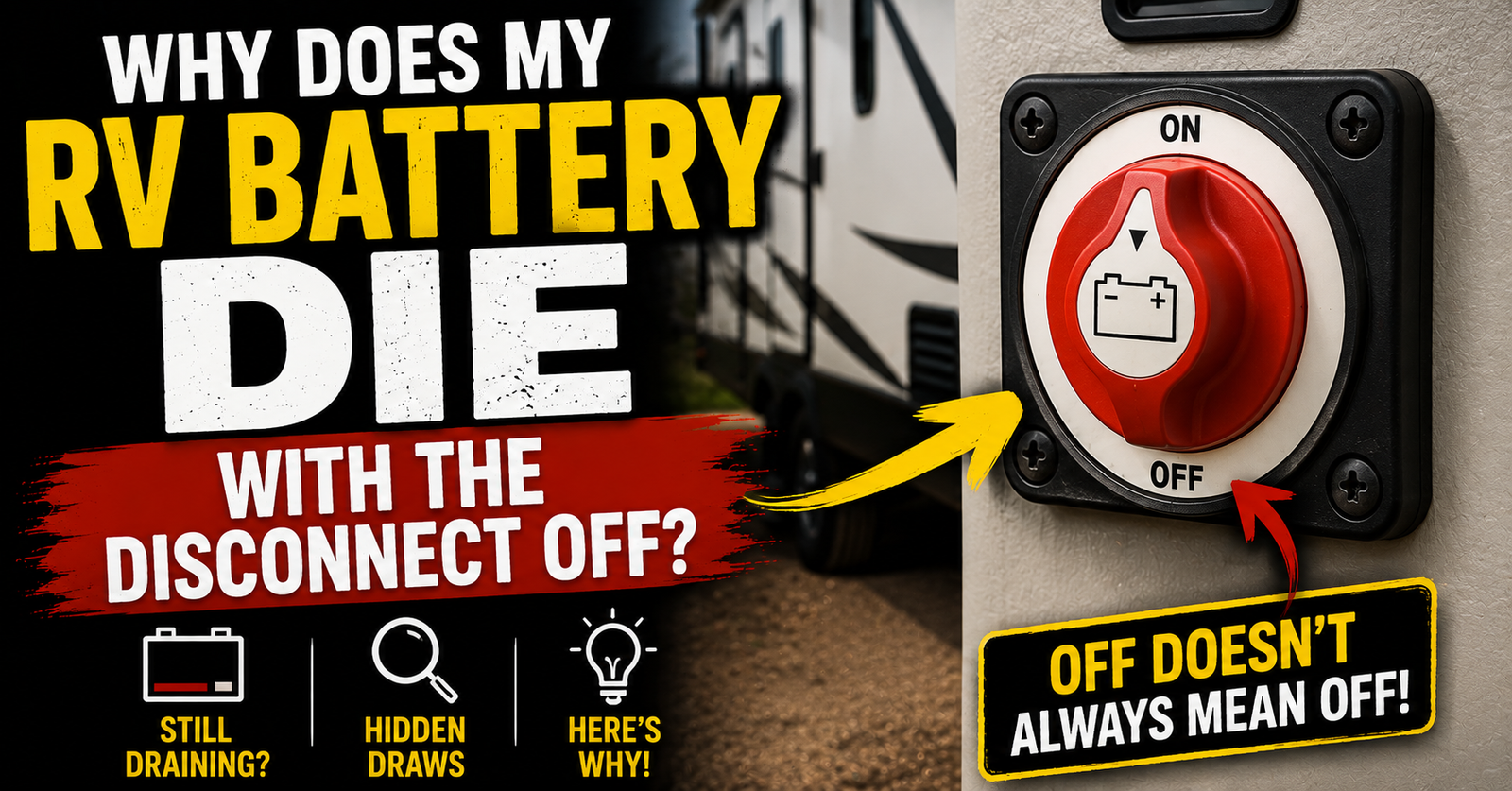
Victron’s inverter/chargers, for example, can use external AC power to run loads while charging the battery, then switch to inverter operation when that external source disappears. That separate inverter behavior is one reason to check inverter battery connections before assuming the main disconnect has isolated the entire coach.
Instead of having separate pieces of equipment doing those jobs, one unit handles both.
Does an Inverter/Charger Replace the Converter?
It can, depending on how the electrical system is designed.
This is important when people upgrade older RV electrical systems.
If a properly designed inverter/charger is taking responsibility for battery charging from shore power, you generally don’t want an old converter blindly operating in parallel unless the system was specifically designed and configured for that arrangement.
This isn’t something I’d rewire based on a generic internet diagram.
Electrical design, battery chemistry, charger settings, circuit protection, cable sizing, and the particular equipment all matter.
Which One Charges the RV Battery?
In a traditional setup, that’s the converter/charger.
This is one of the easiest troubleshooting distinctions to remember.
Battery won’t charge while you’re plugged into shore power?
I’m interested in the converter/charger and the charging path.
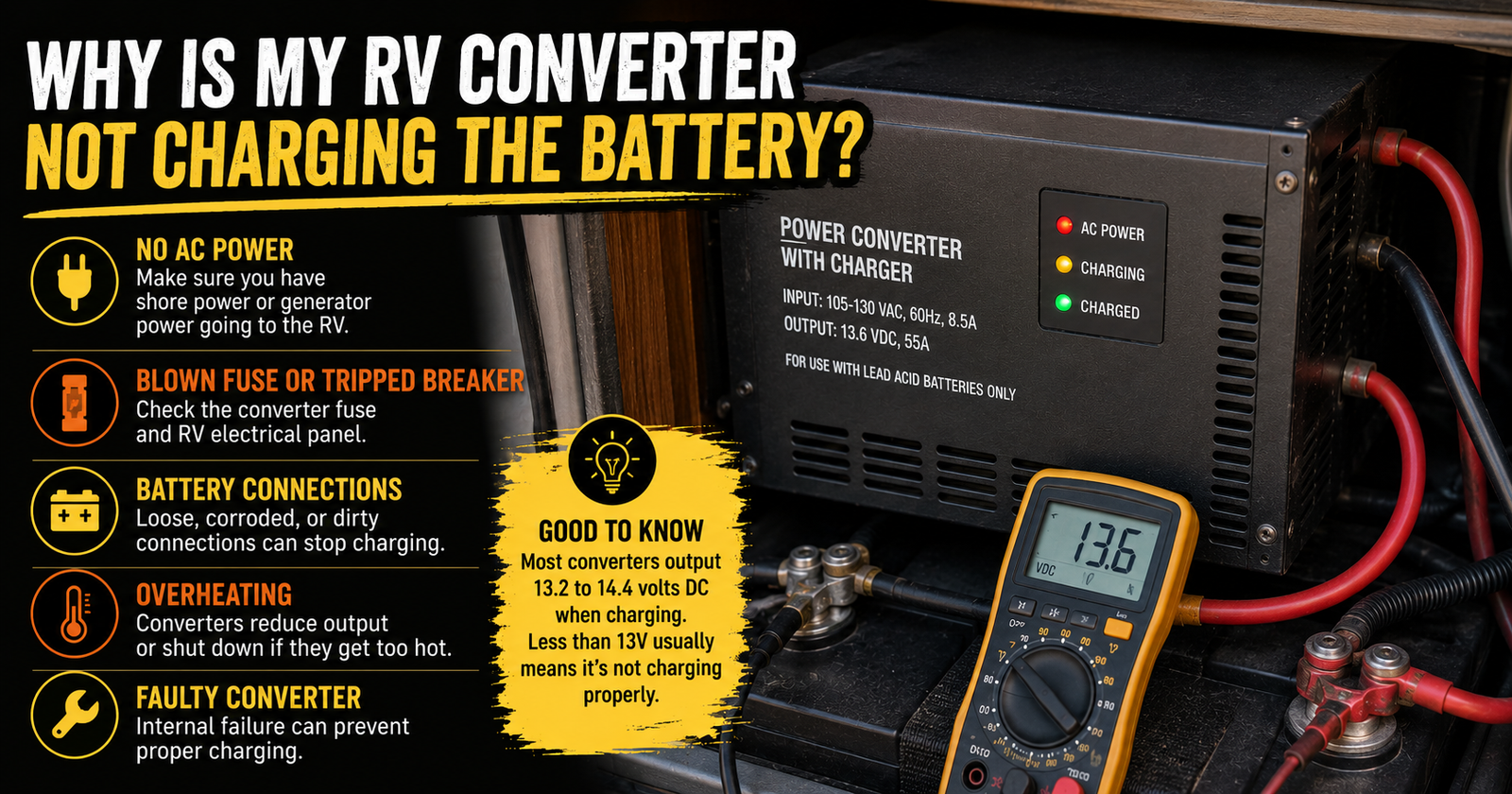
We’ve already built a complete guide for an RV converter that isn’t charging the battery.
An ordinary standalone inverter isn’t what I’d blame for failing to charge the battery because charging isn’t its job.
An inverter/charger, however, is different because charging functionality is built into it.
Which One Powers My Outlets From the Battery?
That’s the inverter.
Assuming, of course, your particular outlets are connected to its AC output.
This last part matters.
Having an inverter doesn’t necessarily mean every outlet in the camper is inverter-powered.
Some installations supply only selected circuits.
Larger inverter systems may power much more of the RV.
So if one outlet works from the inverter and another doesn’t, don’t automatically assume something broke.
Find out how your system is wired.
Which One Works When I’m Plugged Into Shore Power?

The converter/charger normally becomes useful when AC power is available because it can supply the DC system and recharge the battery. That charging activity can also make a battery monitor show a reassuring reading before you know how much energy the battery can actually deliver; voltage reading taken while the converter is actively charging explains the distinction.
An inverter may not need to actively invert battery power when shore power is available.
With an inverter/charger, things get more interesting.
A unit such as Victron’s MultiPlus can pass external AC power through to loads while simultaneously charging the batteries. If the external AC disappears, it can switch to inverter operation.
That’s why modern integrated electrical systems can feel nearly seamless from inside the camper.
Which One Works When I’m Boondocking?
Your converter doesn’t have much to convert if there isn’t an AC source feeding it.
Your inverter, on the other hand, can use battery power to operate AC equipment.
That’s why inverter size and battery-bank capacity become so important for boondocking.
A 2,000 or 3,000-watt inverter sounds awesome.
And it is.
Until you realize that using 2,000 watts for any meaningful length of time requires a serious amount of energy from the battery bank.
The inverter determines what you can power.
The battery bank helps determine how long you can power it.
Does the Generator Use the Converter?
Often, yes.
An RV generator produces AC electricity.
That AC power can supply the RV, and the converter/charger can then use it to recharge the battery just as it does when an appropriate shore-power source is available.
So here’s something people sometimes miss:
If the converter isn’t charging properly, running the generator longer may not solve the battery problem.
The generator can be producing perfectly good AC power while the charging equipment downstream has a problem.
What About Solar?
Solar adds another piece to the puzzle.
Solar panels produce DC electricity, and a solar charge controller manages that energy for battery charging.
So solar doesn’t need the traditional AC-to-DC converter to charge the battery.
That’s one reason a camper can have several completely separate charging sources:
Shore power → converter/charger → battery
Generator → converter/charger → battery
Solar panels → solar charge controller → battery
Vehicle alternator → appropriate charging path → battery
Once you understand the paths, RV electrical troubleshooting becomes much less mysterious.
Can the Converter and Solar Charge at the Same Time?
Depending on the equipment and how the system is designed, multiple charging sources can be present.
That’s why testing can get confusing.
You plug into shore power and measure charging voltage at the battery.
You assume the converter is working.
But the camper is also sitting in bright sunlight with solar charging active.
What did you actually prove?
Only that something is charging.
When I’m diagnosing one charging source, I account for the others.
Why Does the Inverter Drain My Battery So Fast?
Because making AC power can require a lot of battery energy.
The actual drain depends heavily on the AC load.
A small television is one thing.
A microwave is another.
An air conditioner is an entirely different conversation.
There’s also some inverter self-consumption and conversion loss.
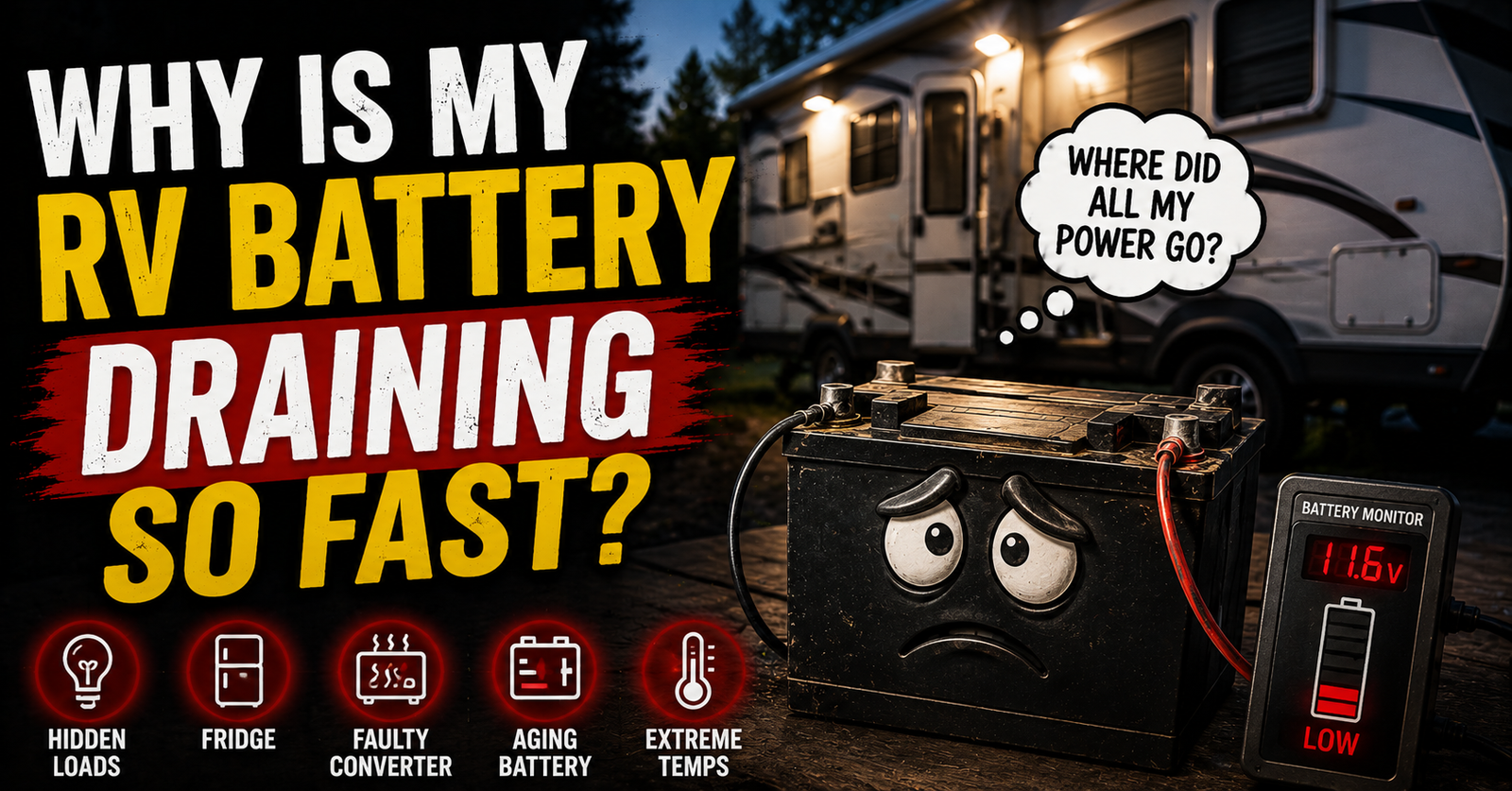
So if you turn on a large inverter and start using household appliances, don’t be surprised when battery runtime looks dramatically different from running a few 12-volt lights. For a broader way to identify what is consuming that power, see battery power disappearing quickly.
Can an Inverter Drain the Battery With Nothing Plugged In?
Yes, an inverter can consume some power simply by being on, although the amount varies substantially by equipment and operating mode.
Some have low-power search or standby modes.
Others consume more at idle.
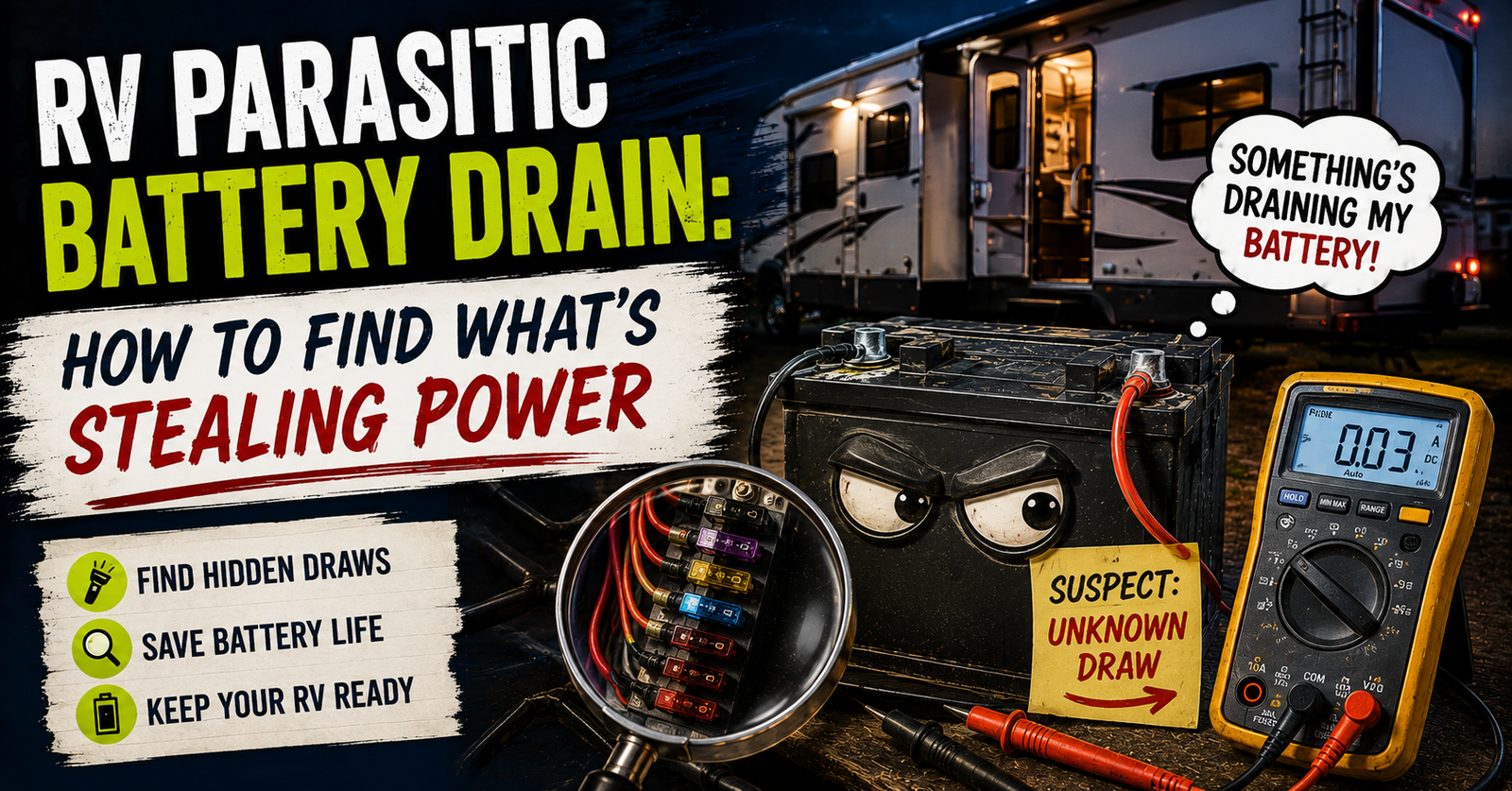
This is something we’re going to give its own article because it’s a great example of an RV battery drain that can be completely invisible. That invisible consumption is explained in a hidden parasitic battery drain, including how to separate normal standby loads from a real problem.
Nothing appears to be running.
But the inverter itself is still awake.
Can a Bad Converter Drain My Battery?
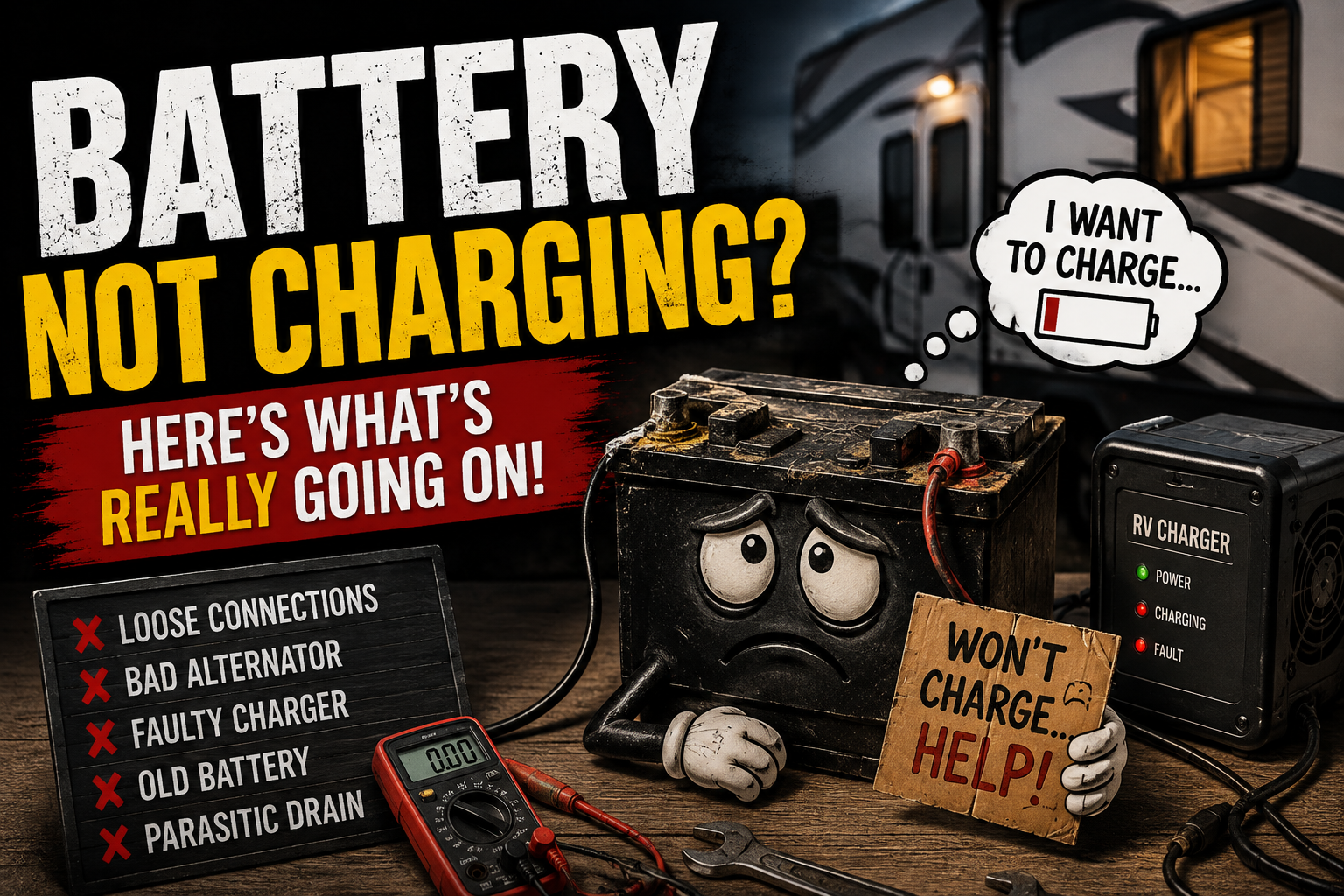
A converter problem can certainly contribute to a battery repeatedly ending up discharged if it fails to recharge the battery properly.
But I like being careful with the wording.
If the battery goes dead while you’re camping unplugged, don’t automatically say:
“The converter drained it.”
The converter may simply have failed to charge it beforehand.
Those are different failures.

If your battery keeps ending up dead, our broader guide to why RV batteries repeatedly go dead is a better starting point because it considers both charging and consumption.
Can a Bad Inverter Drain My Battery?
An inverter can absolutely be responsible for substantial battery consumption, especially if it remains on or is powering a load you didn’t realize was active.
Whether the inverter itself is faulty is another question.
First determine:
Is it actually powering something?
What is its idle consumption?
Is it entering standby correctly?
How much current is leaving the battery?
Don’t label normal inverter consumption a failure just because you didn’t expect it.
Measure first.
Converter Problems and Inverter Problems Look Different
This is a useful troubleshooting shortcut.
If the main complaint is:
“My battery isn’t charging when I’m plugged in.”
I’m thinking about the charging side, especially the converter/charger.
If the complaint is:
“My AC outlets won’t work from the battery.”
I’m thinking about the inverter side, assuming those outlets are supposed to be inverter-powered.
If the complaint is:
“My battery goes dead incredibly fast when I use the microwave.”
I’m looking at inverter load, battery capacity, and battery condition.
Different symptom.
Different direction of power flow.
How Do I Know If My RV Converter Is Bad?
Don’t diagnose it because the lights flickered once.
Check it.
Verify AC input.
Check appropriate breakers and fuses.
Measure DC output according to the converter manufacturer’s procedure.
Then determine whether that output is reaching the battery.
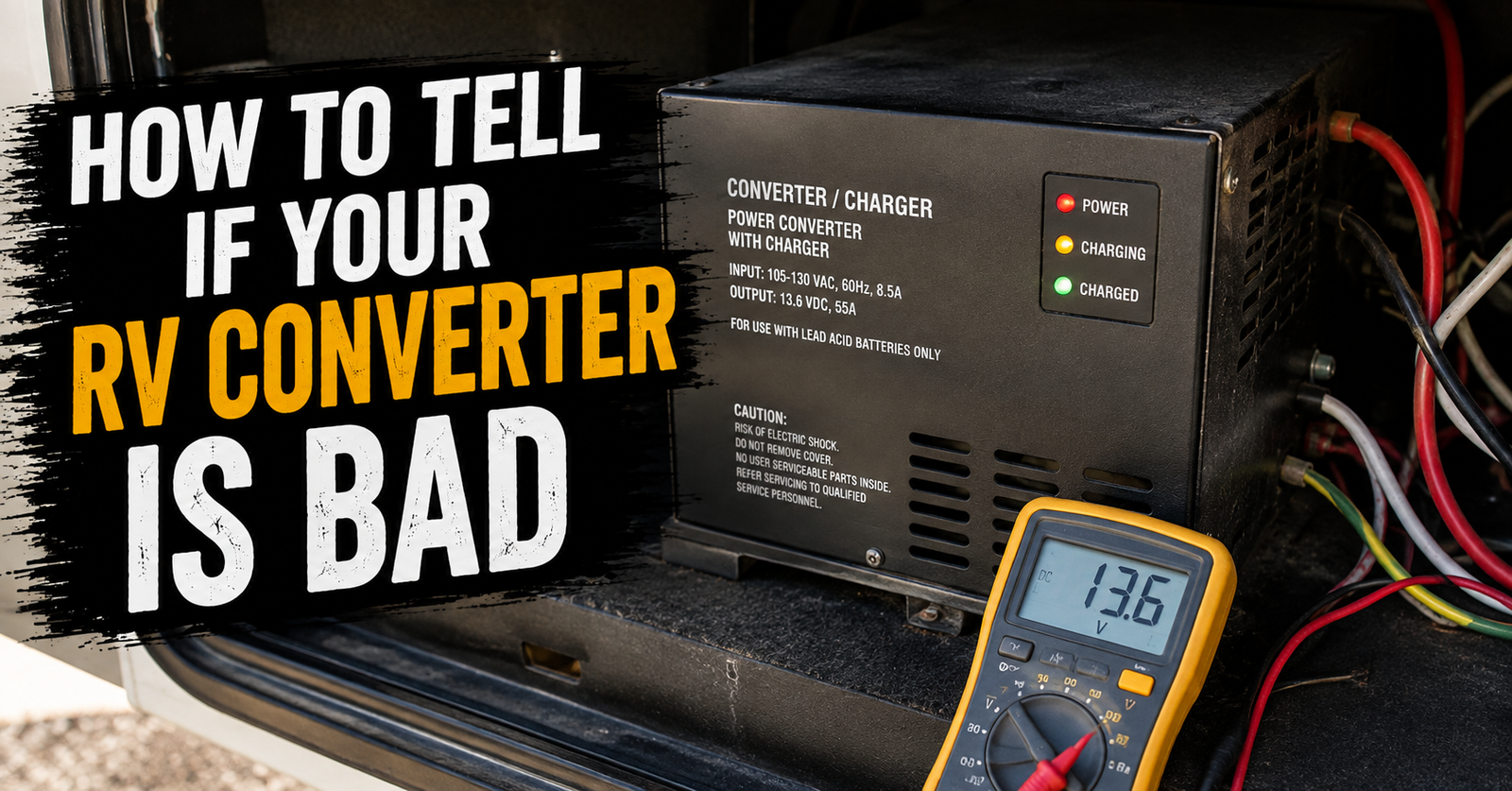
We’ve already gone through the entire process for telling whether your RV converter is actually bad.
That’s where I’d go before ordering a replacement.
How Do I Know If My RV Has an Inverter?
Look at your RV documentation first.
Then look for equipment labels.
An inverter is commonly connected to the battery bank with relatively heavy DC cables because substantial AC output can require high DC current.
Larger units may be installed in storage or electrical compartments.
But don’t identify one based purely on the size of the cables.
Read the model number.
You might be looking at an inverter/charger instead.
Try the Outlets Without Shore Power
This isn’t a definitive identification method, but it gives you a clue.
Disconnect shore power appropriately.
Make sure the generator is off.
If certain AC outlets still operate, something is producing AC electricity.
If you know the RV has an inverter, that’s probably what you’re seeing.
If none of the AC outlets work but the 12-volt lights and water pump still operate, the camper may not have an inverter supplying those circuits.
Again, that’s not necessarily a malfunction.
Can I Add an Inverter to an RV?
Yes, but I don’t treat it like plugging in another appliance.
Inverter installation involves battery-bank capacity, cable sizing, overcurrent protection, grounding, AC distribution, transfer switching, inverter size, expected loads, and physical installation.
High-power inverters can pull enormous DC current.
This is one place where short, properly sized battery cables and proper circuit protection become extremely important.
Adding a 3,000-watt inverter to a camper isn’t just adding a 3,000-watt box.
You’re modifying the electrical system.
Can I Upgrade My RV Converter?
Absolutely, and converter upgrades are common when owners change battery types or want improved charging performance.
Lithium conversions are a major example.
Victron’s current RV lithium guidance recommends evaluating the existing AC shore-power charging system, alternator charging system, and solar charging system when changing battery chemistry because the whole charging setup needs to work with the new battery bank.
So don’t think of a lithium conversion as merely pulling one battery out and dropping another one in.
Converter vs Inverter vs Battery
Here’s another way I explain the three.
The battery stores electricity.
The converter helps put electricity into that battery from an AC source while supplying DC power.
The inverter lets you use stored battery electricity for AC equipment.
Storage.
AC to DC.
DC to AC.
Once those three roles click, a huge chunk of RV electrical terminology suddenly makes sense.
Why Knowing the Difference Actually Matters
This isn’t just trivia.
Suppose your battery isn’t charging.
If you start troubleshooting a standalone inverter, you’re looking in the wrong direction.
Suppose your outlets don’t work while boondocking.
Replacing the converter isn’t going to magically give those outlets AC power from the battery.
Suppose your battery drains extremely quickly whenever you turn on an AC appliance.
Now understanding the inverter matters a lot.
Knowing which box does what lets you follow the electricity instead of guessing.
The Easiest Way to Remember It
When I get mixed up with RV electrical terminology, I think about where the electricity starts and where I need it to go.
You’re plugged into shore power and need DC power or battery charging?
Think converter.
You’re running from batteries and need household-style AC electricity?
Think inverter.
You have one box doing both jobs?
You’ve probably got an inverter/charger.
That’s really all the terminology is trying to describe.
And once you understand that, troubleshooting an RV electrical problem gets a whole lot easier because instead of staring at a collection of mysterious electrical boxes, you can start asking the question that actually matters:
Which direction is the electricity supposed to be moving right now?
Written by Evan Mercer
Evan Mercer writes about RV electrical systems, battery charging, converters, inverters and practical camper troubleshooting for CamperAnswers.com. His work focuses on explaining what each part of an RV actually does so owners can understand their campers without needing an electrical engineering degree.