
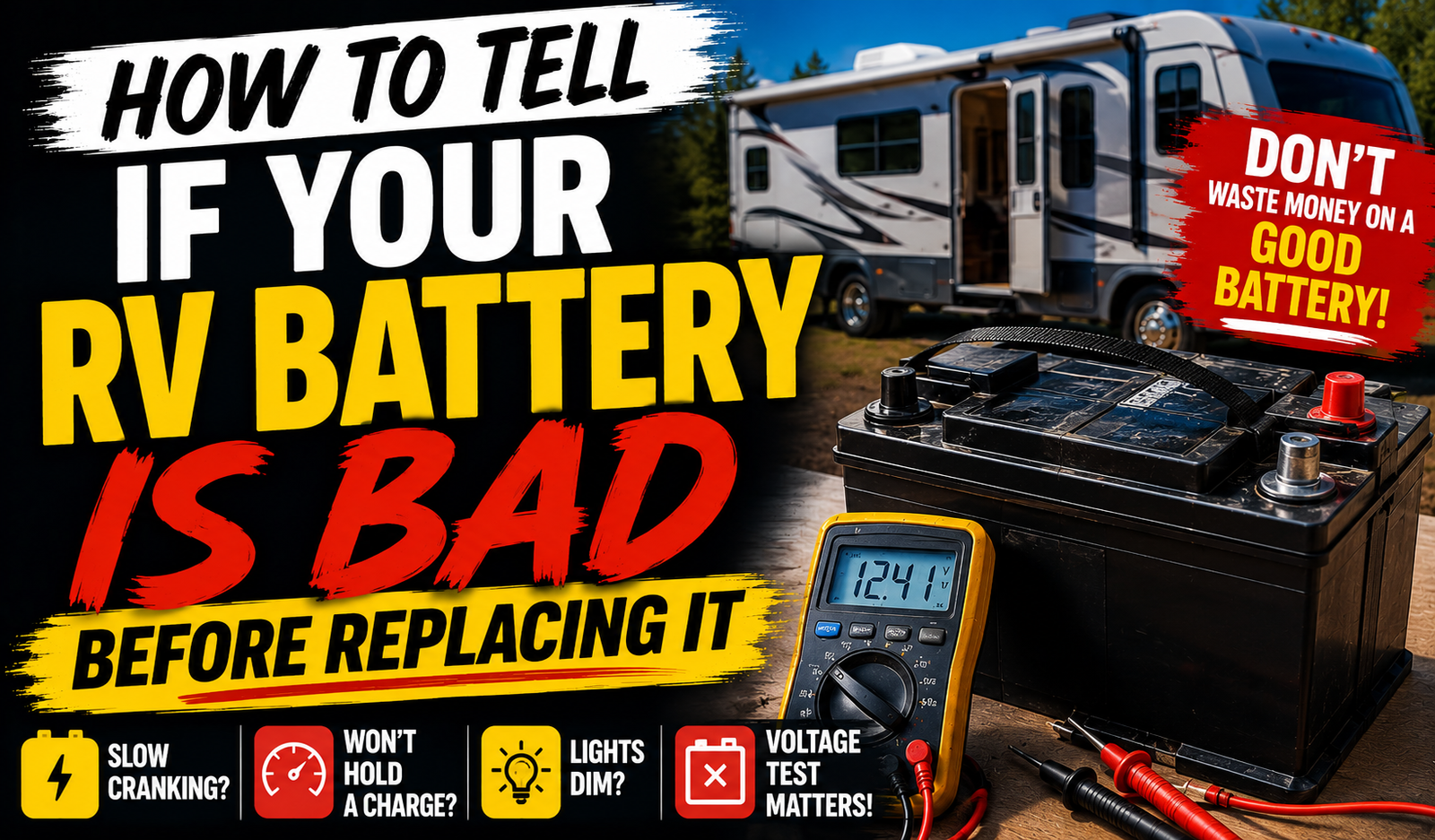
I’ve seen enough weird RV battery problems that I don’t replace a battery just because it went dead once. Honestly, I don’t even replace one just because it went dead twice.
A dead battery and a bad battery are two very different things.
Your camper can drain a perfectly good battery. A converter can fail to charge it. A loose cable can make the entire 12-volt system act like the battery is dying. An inverter can chew through stored power. A disconnect can be in the wrong position. Even the little battery indicator inside the camper can convince you a battery is full when it really isn’t. Before replacing the battery, compare these possibilities with RV battery draining unexpectedly.
Then there are times when the battery really is worn out.
The trick is figuring out which problem you actually have before spending money.
If I suspect an RV battery is bad, I want to answer three basic questions: Can I fully charge it? Can it hold that charge when isolated? Can it deliver useful power when I put a load on it?
Those three questions can tell you an awful lot.
What Are the Signs of a Bad RV Battery?
The symptoms I pay the most attention to are pretty simple.
A battery may charge unusually quickly and then discharge unusually quickly.
It may show reasonable voltage with almost nothing running but drop badly as soon as a load is applied.
It may lose charge rapidly even after you’ve verified that it’s isolated from the RV.
Your camper may work normally on shore power but struggle almost immediately after you unplug.
Runtime may have become dramatically shorter even though your camping habits haven’t changed.
Or the battery may simply refuse to reach or maintain the expected voltage for its chemistry and charging conditions.
None of those symptoms individually prove the battery is bad.
Together, though, they start building a case.
First Make Sure the Battery Isn’t Simply Discharged
This sounds painfully obvious, but it’s where I start.
A discharged battery is not automatically a defective battery.
If somebody tells me:
“My RV battery only reads 12.0 volts. Is it bad?”
My answer isn’t yes.
My next question is why it’s at 12.0 volts.
For a traditional 12-volt lead-acid battery at rest, 12.0 volts is a low state of charge, but the reading alone doesn’t explain why it got there.
Maybe the battery hasn’t been properly charged.
Maybe something drained it overnight.
Maybe the camper sat in storage with electrical loads connected.
Maybe the battery has reduced capacity.
Or yes, maybe the battery is failing.
We need more information.
Charge It Before You Judge It
I want to start battery testing with a properly charged battery whenever possible.
Otherwise, you’re testing the condition of a discharged battery and trying to use that result to determine its overall health.
Those aren’t the same thing.
Use charging equipment appropriate for your battery chemistry and follow the battery manufacturer’s charging instructions.
Don’t assume that leaving the RV plugged in for an hour means the battery is full.
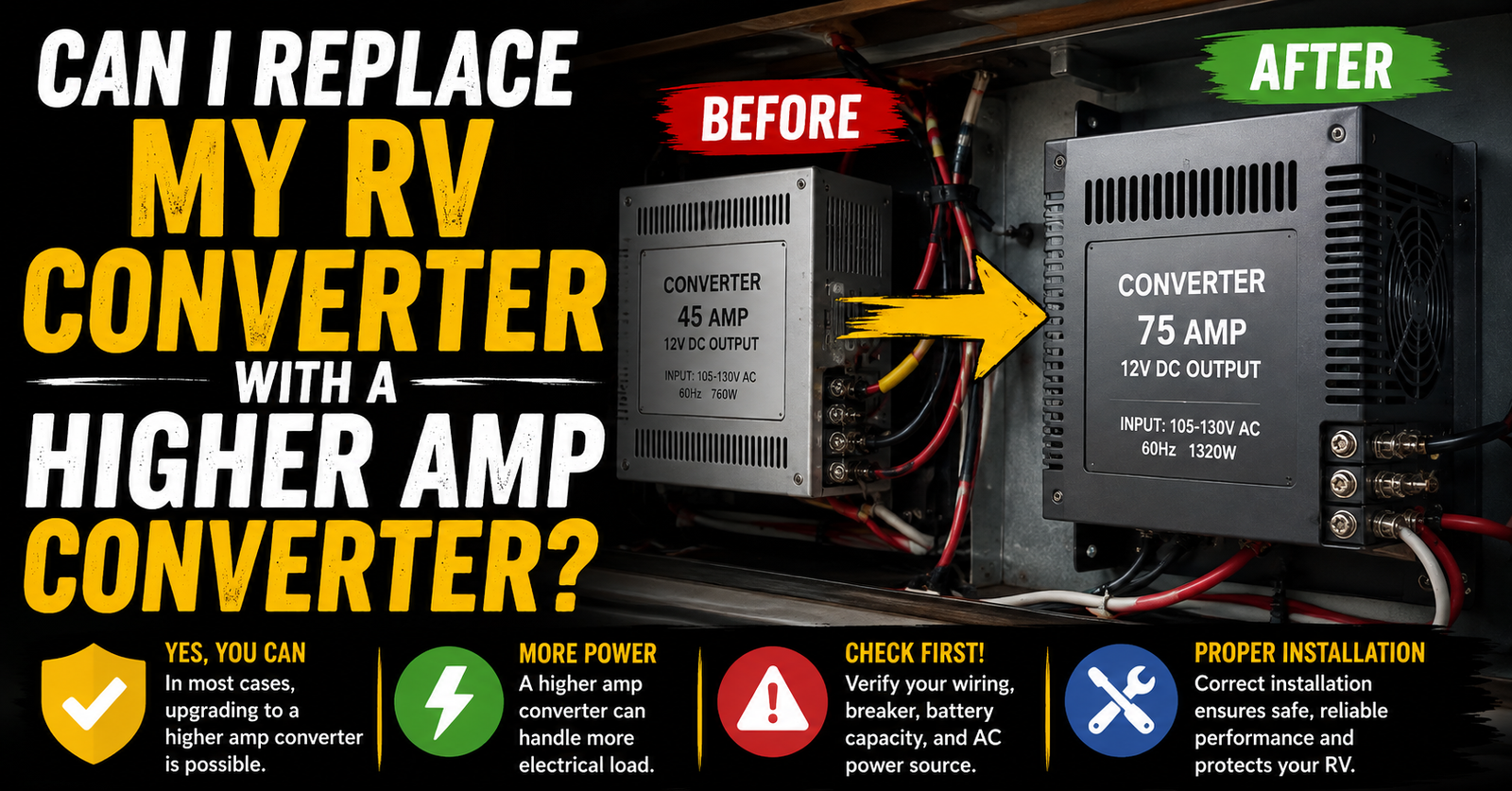
A depleted battery bank can take substantial time to recharge, and the amount of time depends on battery capacity, charger output, battery chemistry, RV loads and how deeply the battery was discharged. If charging time is prompting an upgrade, first consider whether you can safely install a higher-amp RV converter alongside the battery’s chemistry, wiring, and capacity.
Make Sure the RV Is Actually Charging It
This is where people accidentally replace perfectly usable batteries.
They plug the camper into shore power.
Everything inside works.
Therefore, they assume the battery is charging.
Not necessarily.
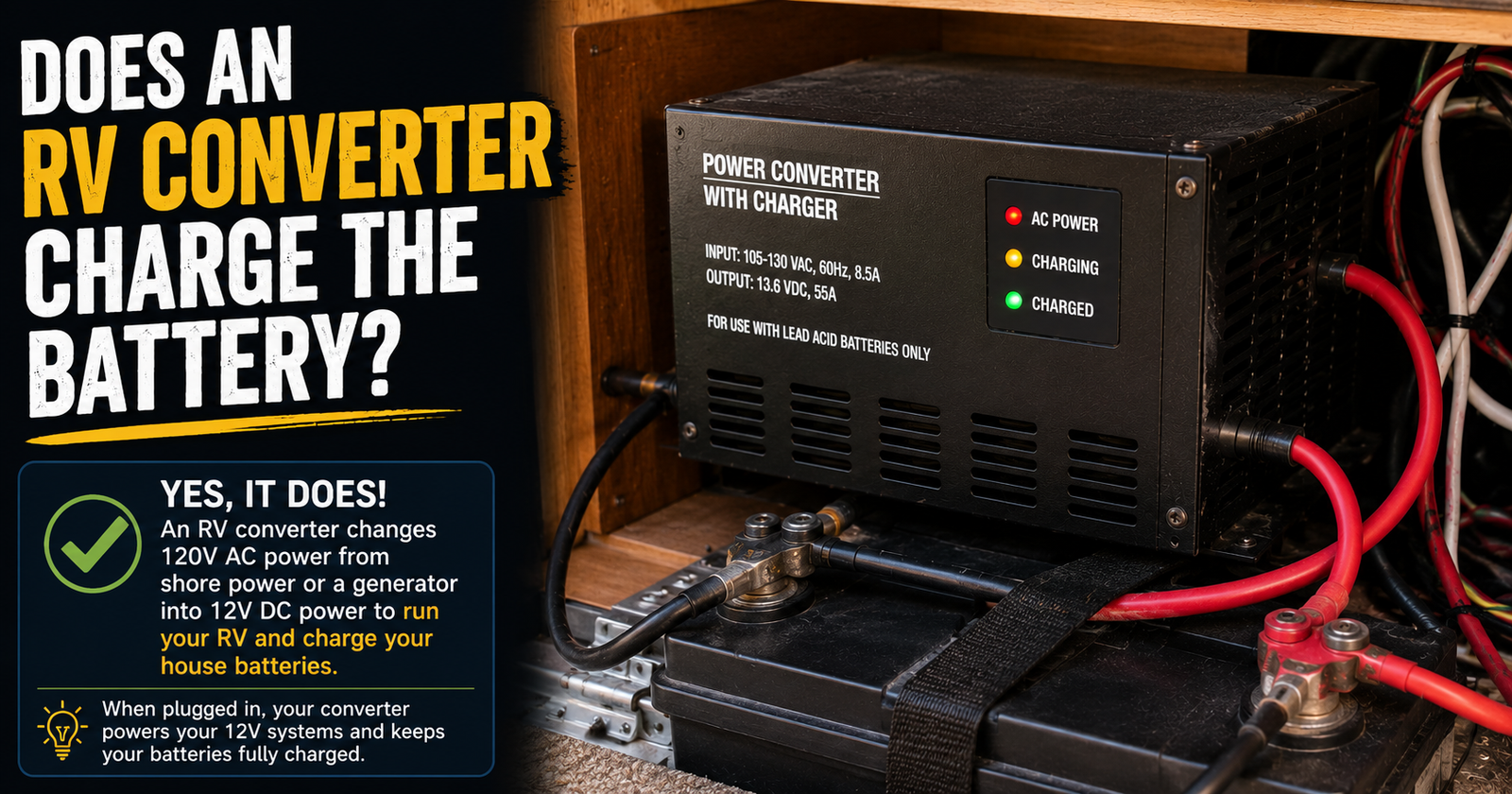
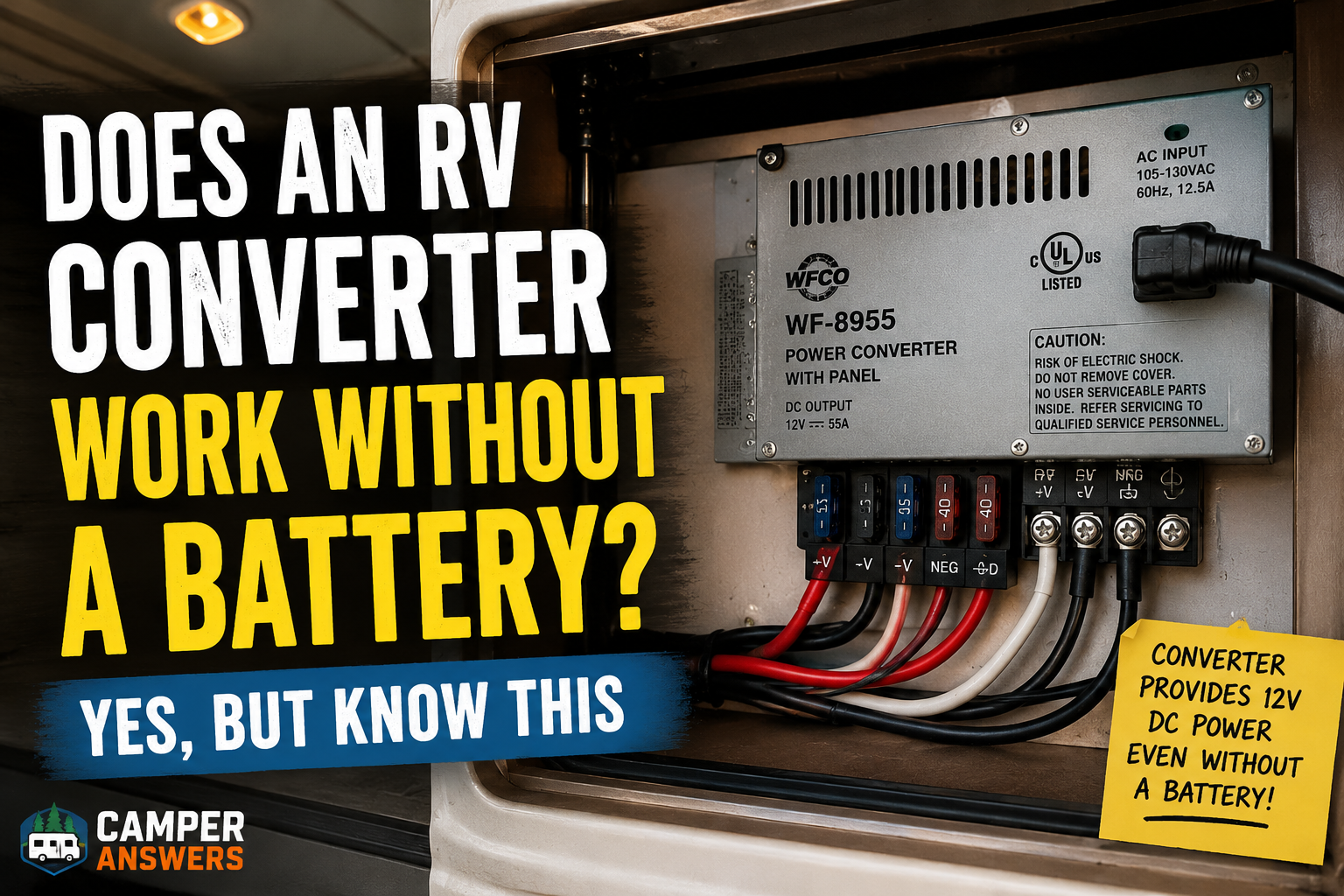
The converter can be powering 12-volt equipment while a problem elsewhere prevents the battery from receiving the charge it should. This distinction makes more sense after reviewing why the converter may power loads.
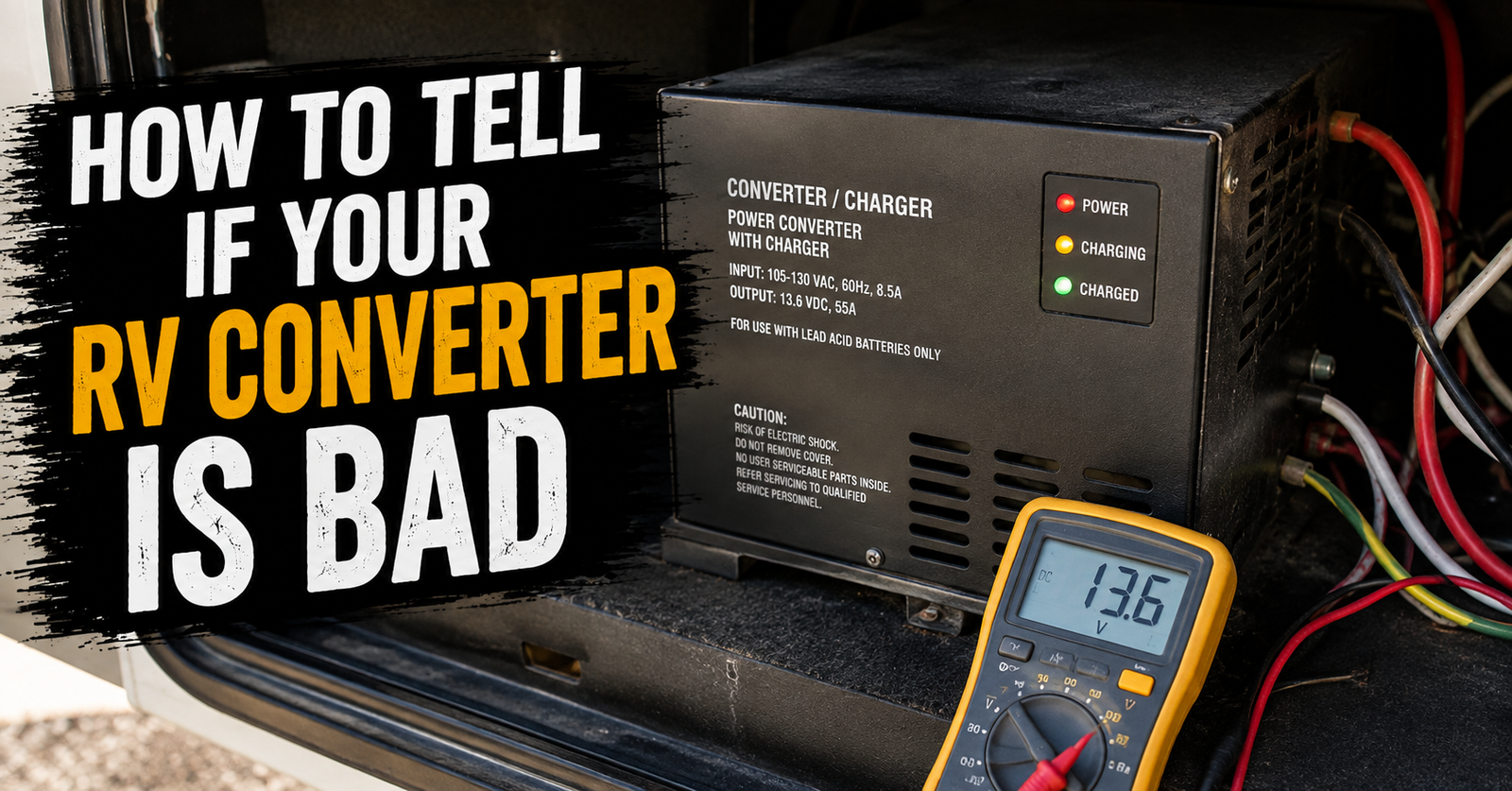
Progressive Dynamics’ troubleshooting procedure for applicable converters separates these two issues. It instructs owners to test converter output first and, if converter output is correct but the battery isn’t charging, check the fuse or breaker in the battery’s positive lead. Before condemning the battery, test the RV converter can help confirm whether the charging source is actually doing its job.
That’s exactly why I don’t condemn the battery until I’ve verified the charging system.
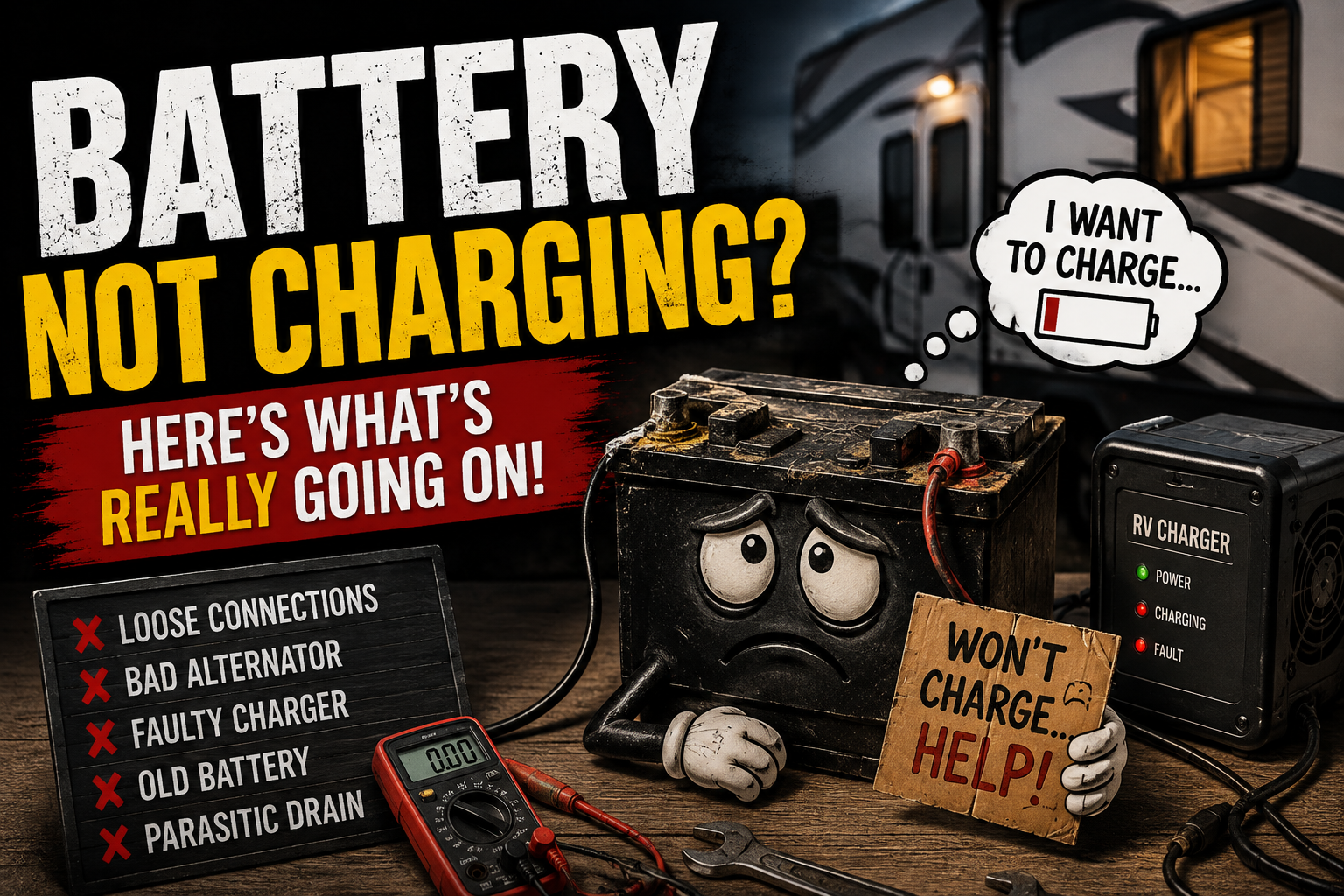
If you haven’t done that yet, start with our guide to an RV battery that won’t charge.
Check the Battery Voltage at the Battery
When I’m troubleshooting, I want an actual voltage measurement directly at the battery terminals.
The little GOOD, FAIR, LOW indicator inside the camper isn’t enough for me.
I want numbers.
And I want to know what was happening when I got those numbers.
Was the battery resting?
Was shore power connected?
Was solar charging?
Was the engine running?
Was the furnace blower operating?
Voltage without context can send you in the wrong direction.

We’ve already broken down what RV battery voltage readings actually mean, and that’s worth understanding before deciding that one meter reading proves your battery is toast.
Don’t Test Resting Voltage While the Charger Is Fooling You
If the converter is charging the battery, you may see voltage well above normal resting battery voltage.
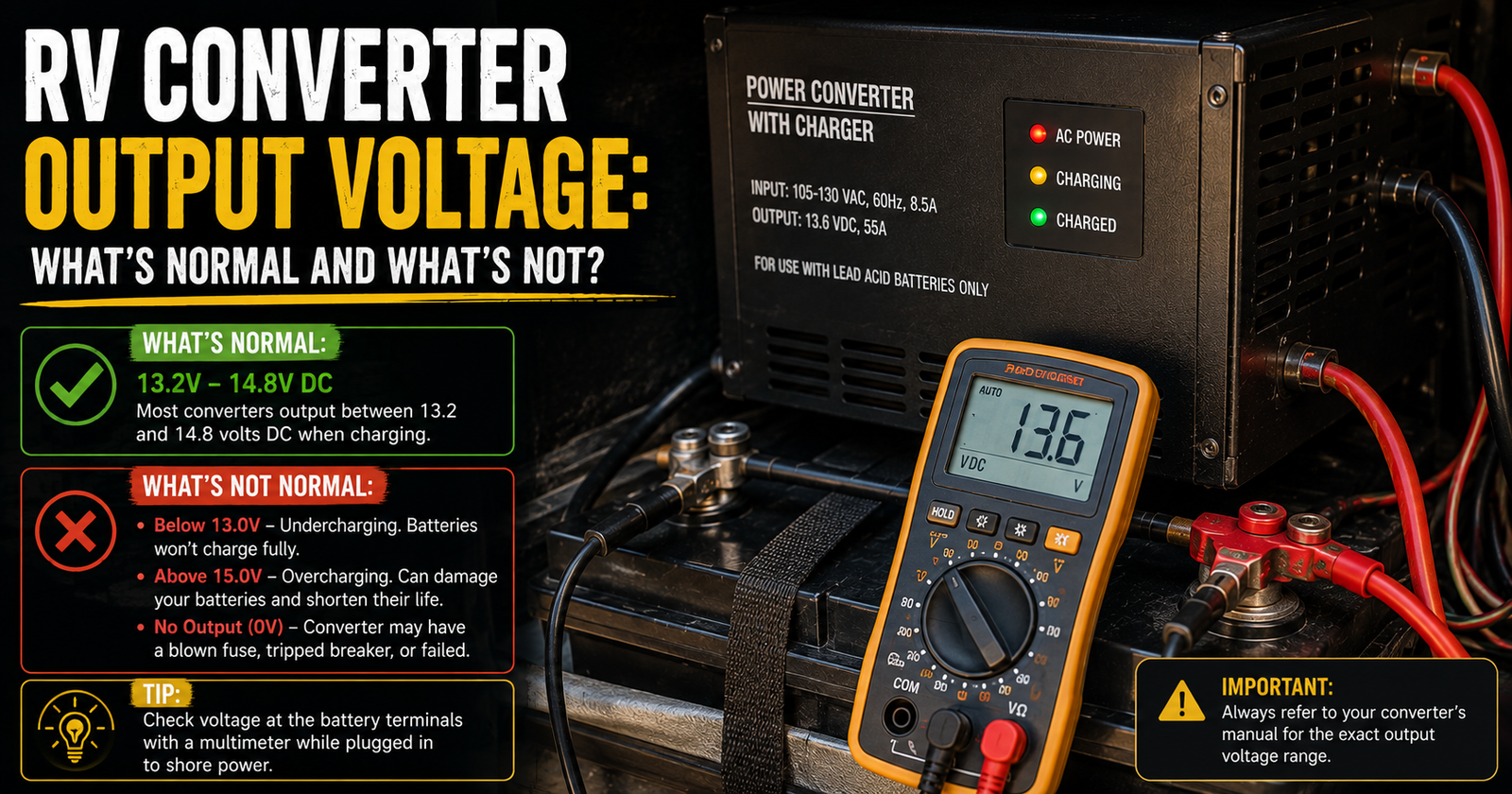
For example, Progressive Dynamics specifies about 13.6 volts for the converter output test on certain standard PD9100 and PD9200 units, with a different specified voltage for applicable lithium models. The model-specific reading makes the RV converter output voltage guide useful before judging the battery or converter.
That’s useful for checking the converter.
It isn’t the same thing as checking the battery’s resting voltage.
Disconnecting the charging source and evaluating the battery under the appropriate conditions for its chemistry gives you different information.
Know which test you’re performing.
A Battery Can Have Good Voltage and Still Be Bad
This is probably the most important thing in this article.
Suppose the battery shows a voltage that looks pretty good.
Does that mean it still has good capacity?
No.
Voltage is one clue.
Capacity is another.
A deteriorated battery can reach an encouraging voltage after charging and still have very little usable energy available.
That’s how you end up with a battery that looks fine on the meter and disappoints you the minute you actually start camping.
Watch What Happens When You Put a Load on It
This is where a weak battery often gives itself away.
At rest, there’s not much being asked of it.
Now turn on a reasonable 12-volt load.
Watch the battery voltage.
A voltage change under load is normal.
What gets my attention is a dramatic collapse under a load that a properly charged, healthy battery should reasonably support.
If the battery seems fine until the furnace blower starts, water pump runs, or another meaningful load is applied, don’t ignore that pattern.
The battery may have lost capacity or have excessive internal resistance.
But there’s something else we need to check before blaming it.

Bad Battery Connections Can Produce Similar Symptoms
This is why troubleshooting RV electrical systems can be annoying.
A loose or corroded battery connection can make a healthy battery act weak.
Under a tiny load, the problem may barely show itself.
Increase current and the voltage drop across that poor connection becomes much more noticeable.
Now lights dim.
Equipment shuts down.
The inverter complains.
You measure low voltage somewhere in the camper.
And naturally you blame the battery.
Inspect the connections first.
Look at the Battery Terminals
I want them clean, secure and in good physical condition.
Look for corrosion.
Loose connections.
Damaged cable ends.
Frayed conductors.
Signs of overheating.
Poorly crimped terminals.
A cable that can move when it shouldn’t.
Also look for multiple accessory wires that may have been added over the years.
Those can matter later when we’re figuring out whether something is draining the battery.
Don’t Forget the Negative Cable
The positive side gets all the attention.
The negative side can ruin your day too.
A poor battery-negative or ground connection can cause voltage drop and strange electrical behavior.
If the battery itself measures properly but equipment isn’t seeing the voltage it should under load, I start looking at the complete circuit.
Electricity needs a path out and a path back.
A shiny positive terminal doesn’t make up for a terrible negative connection.
Now Ask Whether the Battery Can Hold a Charge
This is one of my favorite ways to separate an RV problem from a battery problem.
Properly charge the battery.
Then isolate it from RV loads in a safe and appropriate way for your particular setup.
The exact procedure depends on the RV and battery system, so don’t start removing wires blindly.
Once you know the battery is actually isolated, see whether it retains its charge normally.
If it does, but goes dead when connected to the camper, that makes me much more suspicious of the RV.
If it loses charge unusually quickly even while truly isolated, the battery itself moves much higher on my suspect list.
The Battery Disconnect May Not Fully Isolate It
This deserves a warning because we’ve already seen how misleading it can be.
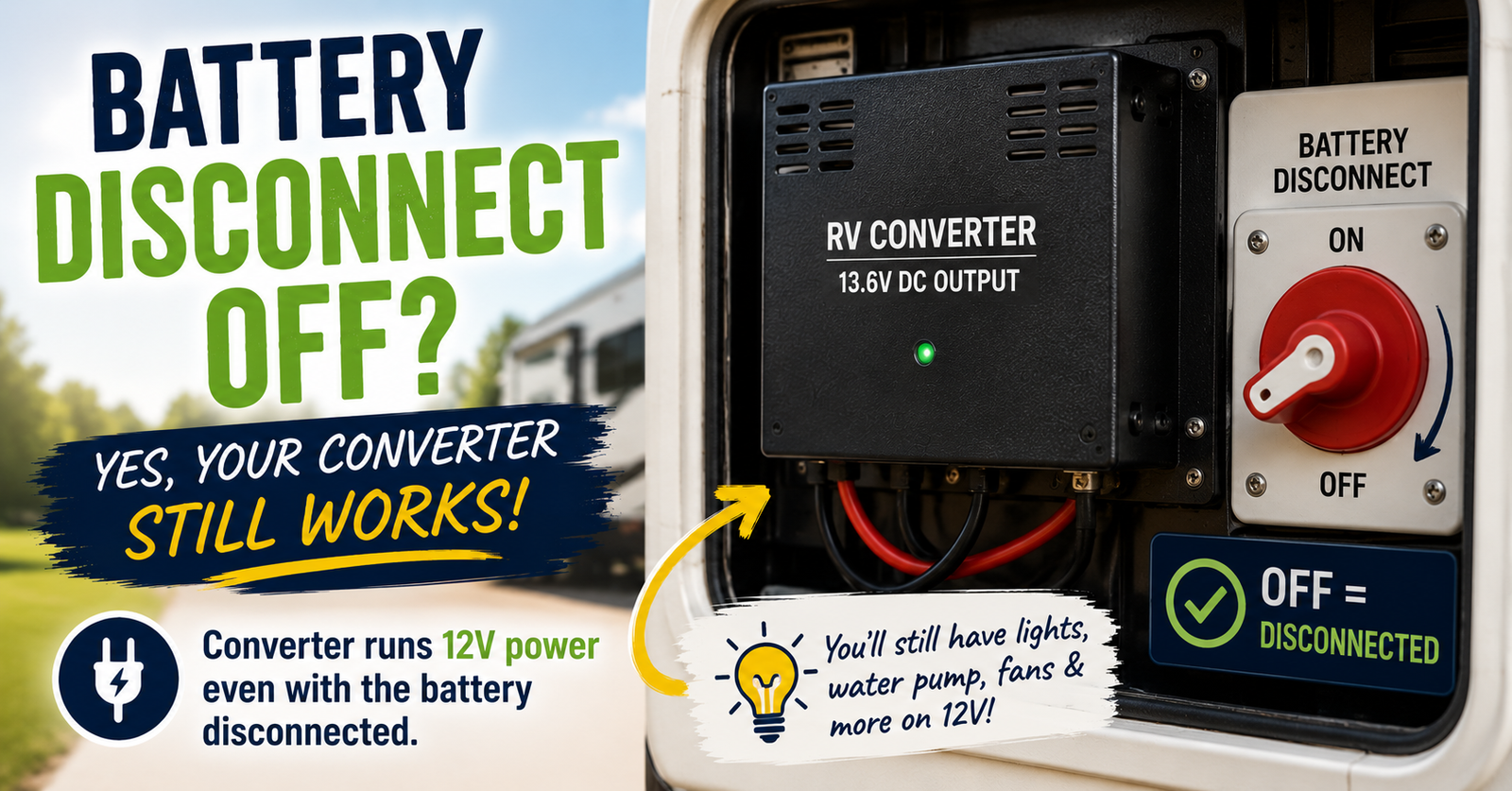
Turning the factory battery disconnect to OFF doesn’t necessarily prove the battery has no electrical loads connected to it.
Some RV equipment may be wired ahead of the main disconnect.
An inverter may have its own battery connection.
Aftermarket accessories may connect directly to the battery.
Solar equipment may have a separate arrangement.
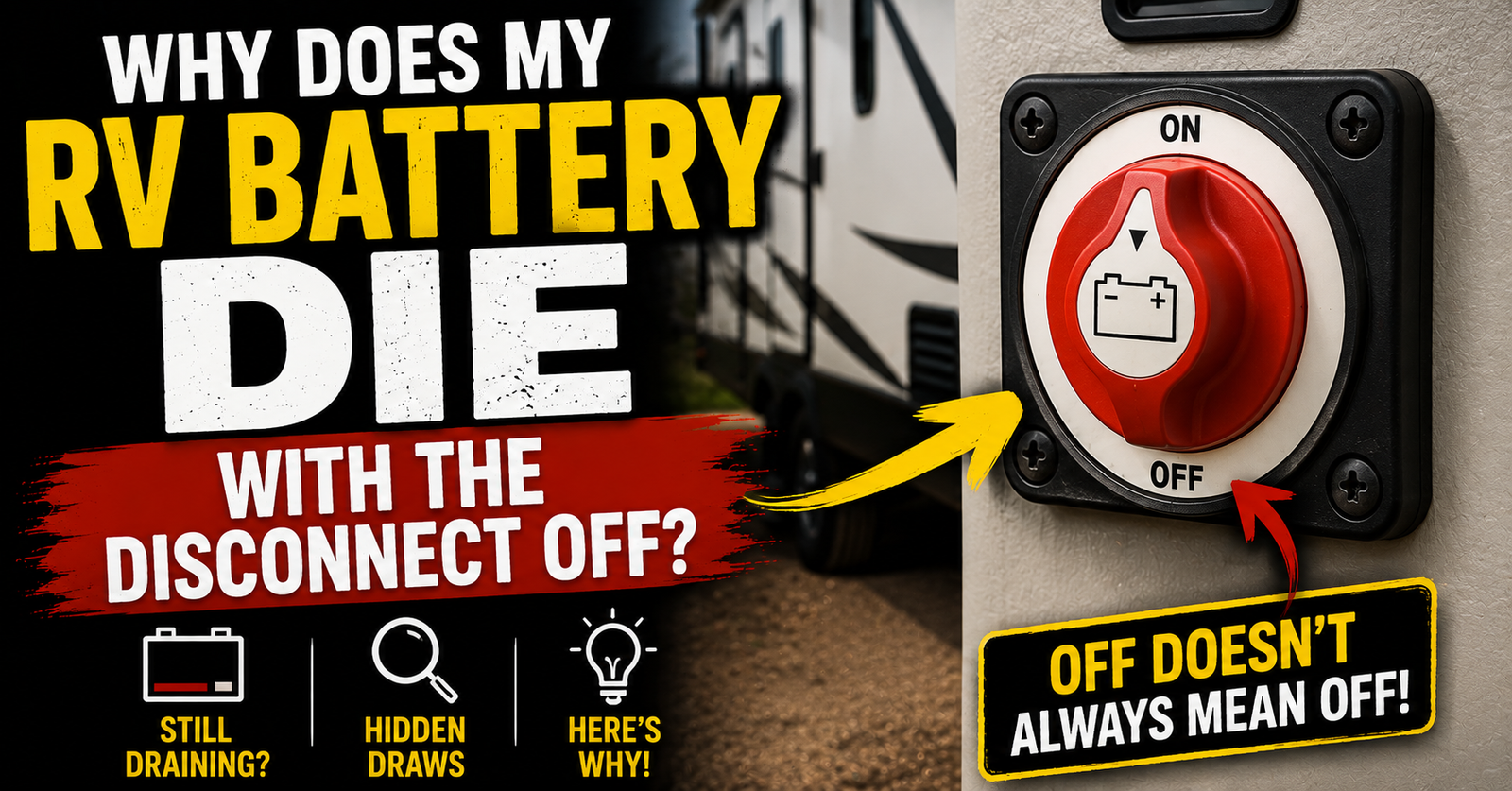
That’s why we wrote a separate guide explaining why an RV battery can die with the disconnect off.
If you’re trying to determine whether the battery can hold a charge while isolated, make sure it really is isolated.
A Parasitic Draw Can Make a Good Battery Look Terrible
This is one of the easiest ways to misdiagnose a battery.
Charge it.
Install it.
Wait a couple of days.
Dead again.
“Bad battery.”
Maybe not.
A small electrical load running 24 hours a day can remove a surprising amount of energy.
An inverter left on, aftermarket electronics, control modules, safety equipment, stereo memory and other loads can all contribute depending on the RV.
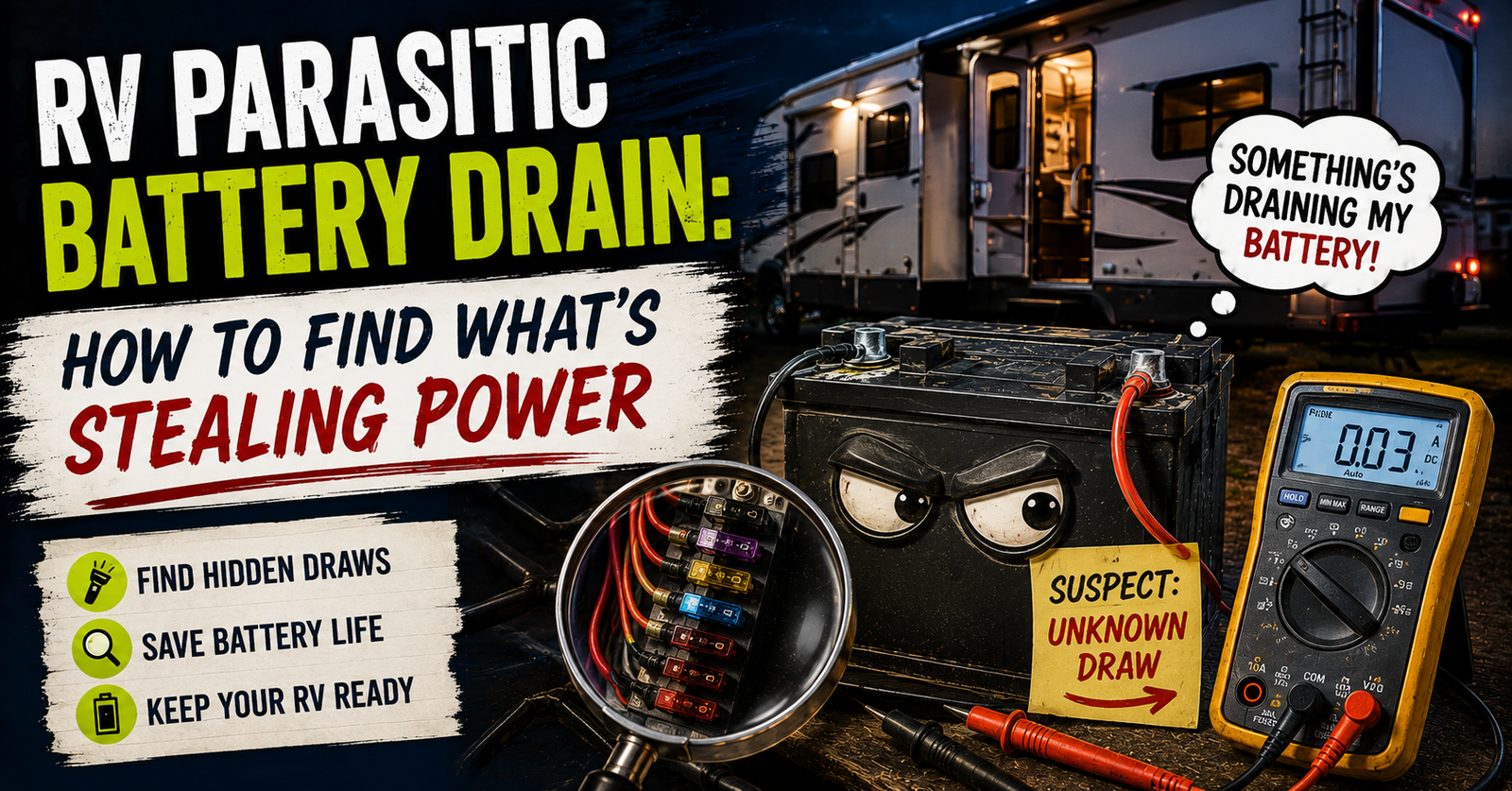
If the battery behaves normally while isolated but repeatedly dies in the camper, start looking for a hidden parasitic battery drain.
Replacing the battery won’t fix something that’s quietly draining it.
This Is Why Brand-New Batteries Sometimes “Go Bad”
I’ve heard some version of this plenty of times:
“I just bought this battery three months ago and it’s already dead.”
That doesn’t necessarily mean the new battery was defective.
Maybe the charging system isn’t charging it.
Maybe it’s repeatedly being deeply discharged.
Maybe something is draining it during storage.
Maybe the battery disconnect doesn’t isolate the loads the owner thought it did.
Maybe a poor connection prevents proper charging.
A new battery can be damaged by the same unresolved problem that killed the old one.
That’s why I want to find the cause before installing battery number three.
How Fast Should a Good RV Battery Lose Charge Sitting Disconnected?
There isn’t one universal answer because battery chemistry, temperature, condition and storage recommendations differ.
All batteries can experience some amount of self-discharge.
But if a properly charged battery that’s genuinely isolated loses a huge portion of its usable charge surprisingly quickly, I wouldn’t ignore it.
At that point, proper battery testing becomes worthwhile.
We’re no longer trying to explain an RV electrical load.
We’re asking whether the battery itself can store energy.
A Battery That Charges Fast and Dies Fast Is Suspicious
This pattern gets my attention immediately.
The battery seems dead.
You connect the charger.
Before long, it looks full.
Great.
Then you start using it and the battery is dead again almost immediately.
That’s not what I want to see from a battery with healthy usable capacity.
One possible explanation is that the battery has lost substantial capacity.
There simply isn’t much useful storage left to refill.
It appears to charge quickly.
Then it empties quickly.

Our guide to an RV battery that says full but dies fast goes deeper into why that happens.
Your Battery Gauge Can Be Wrong Too
Don’t forget the messenger.
Sometimes the battery isn’t lying.
The monitor is.
A basic voltage-based RV panel gives you only limited information about battery state of charge.
Even a much better shunt-based battery monitor depends on proper installation and configuration.
Victron explains that its SmartShunt calculates state of charge by continuously measuring current entering and leaving the battery and tracking the resulting amp-hours over time.
That’s far more useful than a few little indicator lights.
But it still has to know what battery it’s monitoring.
A Shunt Monitor Needs the Correct Battery Capacity
Suppose you have a 100Ah battery bank but the monitor thinks it’s 200Ah.
Its calculated state of charge isn’t going to behave the way you expect.
Victron specifically instructs users to configure the battery monitor with the actual battery capacity and notes that lithium installations require additional setting changes compared with the default lead-acid configuration.
So if the monitor says the battery has plenty left while the electrical system says otherwise, don’t automatically condemn the battery.
Verify the monitor.
Battery Monitors Need to Synchronize Too
A shunt doesn’t magically know state of charge merely because you bolted it into the system.
The monitor uses measured current over time and needs a reliable reference for when the battery has actually reached full charge.
Victron describes automatic synchronization using charged voltage, tail current and a charged-detection period. Once those conditions are met, the monitor can synchronize state of charge to 100 percent.
If those settings are wrong or the battery never actually reaches the synchronization conditions, the displayed percentage can drift away from reality.
Again, don’t replace a battery because a screen is confusing you.
How Long the Battery Lasts Is One of Your Best Clues
Runtime gives me real-world information.
If a battery used to comfortably get you through two nights and now struggles through one, despite similar weather and electrical use, something changed.
Maybe your consumption increased.
Maybe charging decreased.
Maybe the battery lost capacity.
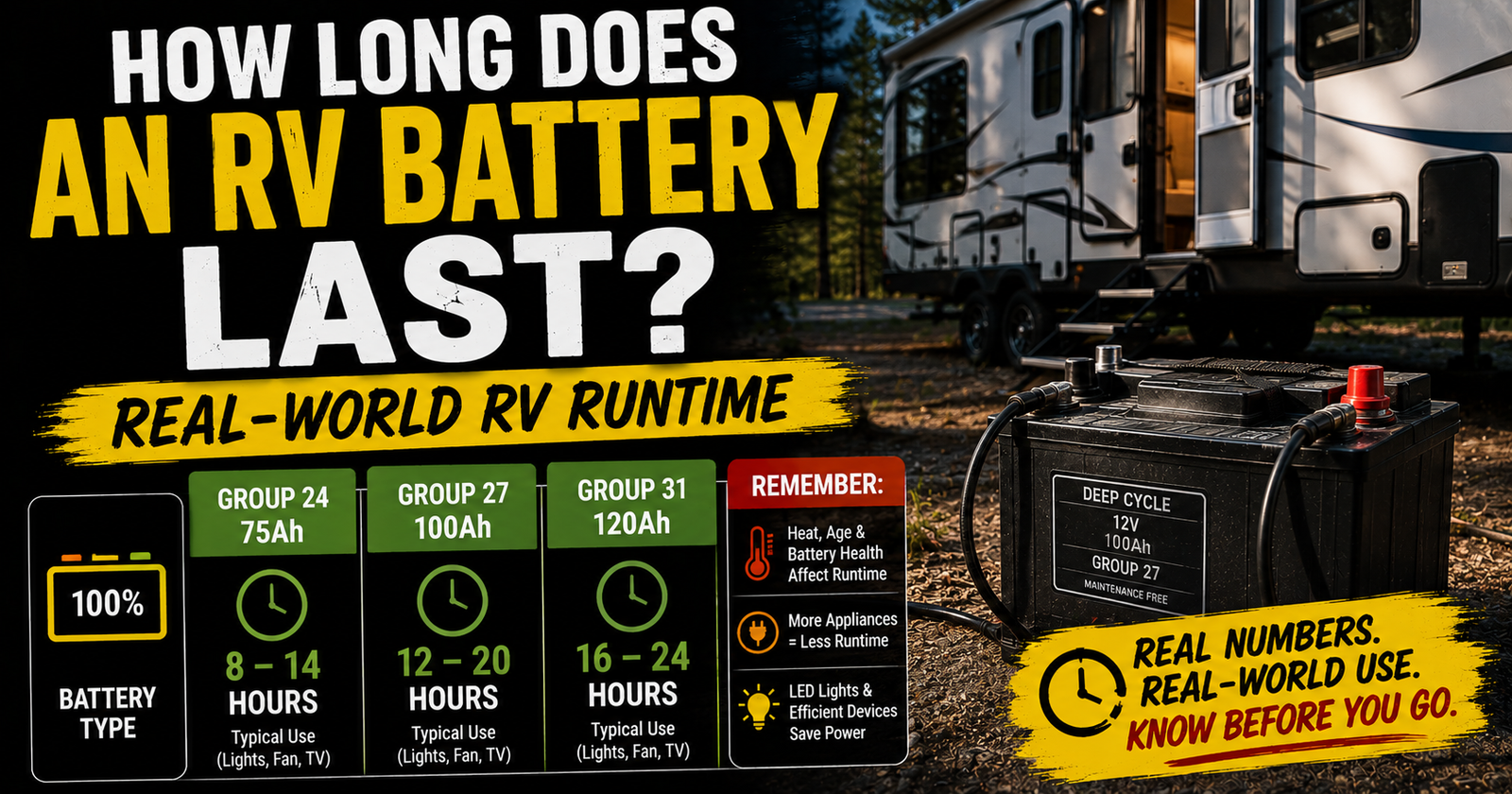
That’s why knowing how long an RV battery should actually last is so useful.
Once you understand your normal energy use, an abnormal change becomes much easier to recognize.
Compare Runtime Under Similar Conditions
Don’t compare a summer camping trip with a freezing January night.
The furnace alone can completely change your energy use.
Don’t compare a weekend when the inverter stayed off with a weekend when you powered AC equipment.
Don’t compare full sun with three cloudy days if solar is part of your charging system.
Good troubleshooting means controlling as many variables as possible.
If your electrical use is genuinely similar but runtime has collapsed, the battery deserves more scrutiny.
Lead-Acid Batteries Can Lose Capacity With Age and Use
A lead-acid battery doesn’t have to suddenly fail like a light bulb.
Capacity can gradually decline.
You may barely notice at first.
Then one camping season you realize you’re charging much more often than you used to.
Age alone doesn’t prove the battery is bad, but age combined with poor runtime, repeated deep discharge, difficulty holding charge, and poor load-test performance paints a much clearer picture.
Battery history matters.
Repeated Deep Discharges Can Be Hard on Lead-Acid Batteries
This is why I don’t ignore an RV battery that keeps dying.
Even if the original problem is elsewhere in the camper, repeated deep discharge can eventually leave you with a battery problem too.
You might start with:
Problem 1: Something keeps draining the battery.
After enough time, you can end up with:
Problem 1: Something keeps draining the battery.
Problem 2: The battery now has reduced capacity.
Fixing the drain doesn’t automatically restore lost battery performance.
Sometimes both problems need attention.
Flooded Lead-Acid Batteries Give You Another Thing to Check
If you have a serviceable flooded lead-acid battery, electrolyte level matters.
Follow the battery manufacturer’s maintenance instructions.
Low electrolyte can damage the battery.
Flooded batteries also allow testing methods that aren’t applicable to sealed AGM or lithium batteries, including checking individual cell specific gravity with the appropriate equipment and procedure.
That’s one reason I always identify battery chemistry before giving testing advice.
The right test for one battery can be completely inappropriate for another.
A Hydrometer Can Reveal a Weak Cell in a Flooded Battery
For serviceable flooded lead-acid batteries, a hydrometer can provide useful information about individual cells.
What I’m interested in isn’t just one overall number.
I’m looking for consistency between cells after the battery has been properly charged and tested according to the manufacturer’s procedure.
One cell behaving substantially differently from the others can point toward an internal battery problem.
But don’t open or attempt this kind of testing on a sealed battery.
Use the testing procedure intended for your exact battery design.
AGM Batteries Need a Different Approach
An AGM battery is sealed.
You’re not popping caps off and checking electrolyte with a hydrometer.
Voltage testing, charging behavior, load testing and capacity testing become more important.
Again, follow the manufacturer’s testing specifications.
Don’t take a flooded-battery tutorial and apply every step to an AGM battery just because both are lead-acid.
Battery chemistry may be related.
Construction and maintenance are different.
Lithium Batteries Are Different Again
Lithium iron phosphate batteries have changed RV electrical systems in a lot of good ways, but they also require different troubleshooting expectations.
Voltage behavior differs from lead-acid.
Charging requirements differ.
Usable capacity differs.
And lithium batteries commonly incorporate a battery management system, or BMS.
That BMS can disconnect the battery under certain protective conditions.
If that happens, an owner can easily conclude:
“My lithium battery suddenly died.”
Maybe.
Or maybe the BMS protected it.
A Lithium BMS Shutdown Doesn’t Automatically Mean the Battery Is Bad
The BMS may protect against conditions such as excessively low or high voltage, excessive current, or temperature limits depending on the battery design.
If the battery suddenly shuts down, check the manufacturer’s diagnostic information.
Some batteries provide Bluetooth or app-based BMS information that can make this much easier.
A protection event and a failed battery aren’t the same diagnosis.
Figure out why the BMS acted before replacing the battery.
Cold Weather Can Make Lithium Troubleshooting Interesting
Lithium iron phosphate batteries have specific temperature limits, particularly around charging, that vary by battery design.
Some batteries include low-temperature charging protection.
Some include internal heaters.
Others rely on the charging system or owner to prevent charging outside permitted conditions.
If your lithium battery suddenly behaves differently in freezing weather, temperature belongs on the suspect list.
Check the actual battery specifications.
Don’t use generic internet rules for an expensive battery bank.
A Swollen or Damaged Battery Is Different
Electrical testing isn’t the first priority if the battery is visibly damaged.
If you see significant swelling, cracking, leaking, melting, severe corrosion, evidence of overheating, or other physical damage, stop treating this like an ordinary capacity test.
Follow the battery manufacturer’s safety guidance and have the battery handled appropriately.
Don’t continue charging or experimenting with a visibly compromised battery just to see what the multimeter does.
Smelling Something Strange Around the Battery Deserves Attention
A strong unusual odor around a lead-acid battery, especially during charging, is not something I’d ignore.
Neither is excessive heat.
Charging batteries can involve hazardous conditions, and lead-acid batteries can produce explosive gases.
Ventilation, proper charging equipment and safe battery handling matter.
If a battery is overheating, visibly damaged or behaving abnormally during charging, stop and address the safety issue rather than continuing a DIY test.
Battery Testing Isn’t Worth Getting Hurt
RV batteries can deliver enormous current during a short circuit.
A wrench across the wrong terminals can become a serious problem very quickly.
Remove metal jewelry.
Use insulated tools where appropriate.
Protect your eyes.
Follow battery manufacturer procedures.
Be mindful of polarity.
And if you’re uncomfortable around batteries or energized electrical equipment, have an RV technician or battery professional perform the test.
Knowing how the diagnosis works is still valuable even if you don’t personally perform every step.
What Does a Load Test Tell Me?
A load test asks the battery to prove it can actually supply current.
That’s valuable because resting voltage can look fine even when usable battery performance is poor.
The correct load-test procedure depends on battery type, size and manufacturer specifications.
I don’t recommend randomly attaching a huge load and deciding whether the battery “looks okay.”
Use appropriate test equipment and the procedure intended for the battery.
Many auto-parts or battery shops can perform battery testing too, although make sure the test method is appropriate for the type of deep-cycle battery you’re bringing them.
Starting Batteries and Deep-Cycle Batteries Aren’t Identical
This matters when interpreting test results.
A starting battery is designed to provide very high current for a short period.
A deep-cycle RV battery is designed around repeated energy delivery over longer periods.
Some RV batteries are dual-purpose designs.
Lithium house batteries are different again.
So I don’t want a test result interpreted only through the lens of “Will this battery crank a car?”
We’re trying to determine whether the battery is healthy for its intended RV application.
Capacity Testing Is the Test I Really Care About
If runtime is the complaint, capacity testing gets right to the heart of the issue.
How much energy can the battery actually deliver under specified test conditions before reaching the manufacturer’s discharge endpoint?
That tells you far more about usable capacity than simply seeing 12.6 volts after charging.
A battery can pass the “looks like a battery on a multimeter” test and still have disappointing capacity.
That’s why I keep separating voltage from capacity.
A Shunt Can Help You See Capacity Loss in Real Life
A properly configured battery monitor can be incredibly useful here.
Victron explains that a shunt-based monitor measures current flowing into and out of the battery and integrates that current over time to track consumed amp-hours.
That gives you a much better picture of what happened.
Suppose the battery appears fully charged.
You consume only a modest number of amp-hours.
Voltage collapses much sooner than expected.
That’s useful evidence.
Now the battery’s actual condition becomes much more suspicious.
But Make Sure Every Load Passes Through the Shunt
This is a huge installation detail.
If some loads bypass the shunt, the battery monitor doesn’t know they’re there.
Now the monitor may say you’ve used 20Ah while the battery has actually supplied much more.
Victron’s troubleshooting guidance notes that incorrect readings and missing current are commonly associated with wiring issues.
So before accusing the battery of violating the monitor’s numbers, make sure the monitor sees the whole system.
If the Battery Goes Dead Only While Plugged In
That’s a very different clue.

A battery that dies despite the camper being connected to shore power makes me investigate the charging system and electrical loads before declaring the battery bad. A clearer picture of RV power sources and energy use can help separate a battery problem from a charging-system or load problem.
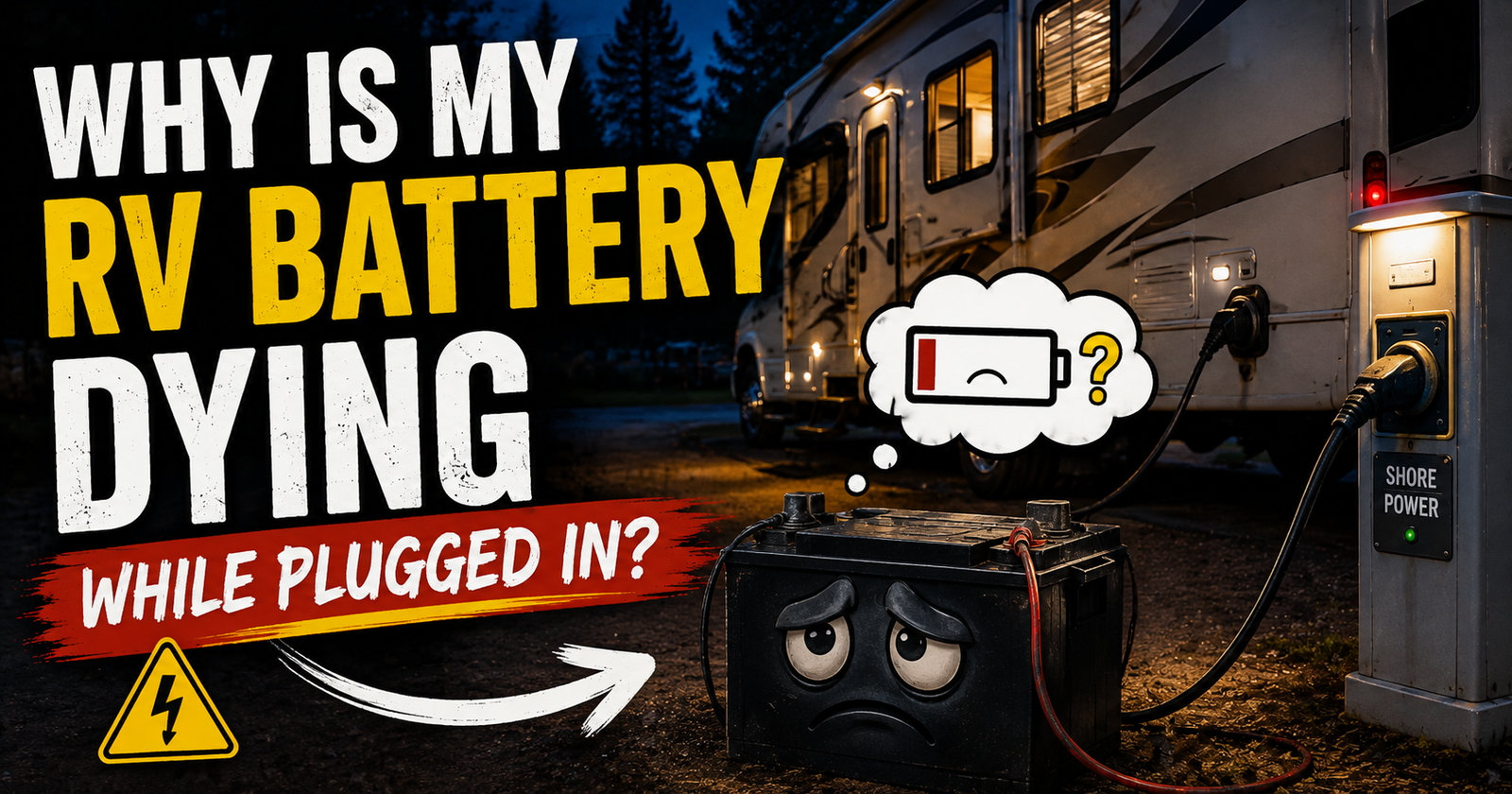
We’ve already covered why an RV battery can die while plugged in because the symptom seems impossible until you understand how the converter, battery and 12-volt loads interact.
A weak battery may still be part of that problem.
But don’t assume it’s the only part.
If the Battery Goes Dead Only Overnight
Again, follow the pattern.
The furnace may be cycling heavily.
Solar production disappears overnight.
An inverter may remain on.
Other loads continue operating for hours.
Maybe the battery simply doesn’t have enough usable capacity for your nighttime demand.
If the battery consistently survives the day but dies overnight in the RV, investigate what changes after dark.
The clock can be a diagnostic tool.
If the Battery Dies in Storage
Storage problems send me toward a different set of questions.
Was the battery fully charged before storage?
Was the disconnect actually isolating the expected loads?
Is an inverter still connected?
Are aftermarket accessories wired directly to the battery?
Is solar maintaining the battery?
How long was it stored?
Does the battery hold charge when genuinely isolated?
Don’t replace a battery because it died after three months of sitting connected to unknown loads.
Find out what happened during those three months.
If It Keeps Going Dead Again and Again
At some point, stop recharging it and hoping.
Repeated failure is a pattern.
Our broader guide to why an RV battery keeps going dead is designed for exactly that situation.
The important thing is determining whether you’re repeatedly dealing with the same discharge problem or whether the repeated discharges have now damaged the battery enough that you have two problems.
That’s why I test both the RV and the battery.
Here’s the Order I’d Check Everything
I don’t start by shopping for batteries.
I identify the battery chemistry and capacity.
I inspect the battery and connections.
I verify that the battery can actually receive a proper charge.
I measure voltage under known conditions.
I make sure unexpected RV loads aren’t draining it.
I see whether it can hold charge when properly isolated.
I watch its behavior under load.
And if the evidence points toward reduced battery performance, I have its capacity or condition properly tested.
That order keeps me from using a new battery as a diagnostic tool.
When I Would Replace the Battery
I feel much better replacing an RV battery when the charging system is known to work, the connections are good, excessive loads have been ruled out, and testing shows the battery can no longer store or deliver useful capacity as it should.
Physical damage can obviously change that decision immediately.
But for an ordinary “my battery keeps dying” complaint, I want evidence.
A replacement battery should be the solution.
It shouldn’t be another experiment.
When I Would NOT Replace the Battery Yet
I wouldn’t replace it merely because it went dead after storage.
I wouldn’t replace it because the interior monitor says LOW.
I wouldn’t replace it because it reads low immediately after running a bunch of equipment.
I wouldn’t replace it because the RV’s lights don’t work until I’ve checked connections and the electrical system.
And I definitely wouldn’t replace it repeatedly when every new battery develops the exact same problem.
At that point, the camper is practically begging you to look somewhere else.
The Best Test Is Whether the Battery Can Do Its Job
That’s ultimately what I care about.
Can the battery accept the proper charge?
Can it retain that energy?
Can it deliver the amount of usable energy it reasonably should?
If yes, stop blaming the battery and investigate the RV.
If no, and you’ve ruled out charging, wiring, monitoring and load problems, then you’ve got a much stronger reason to replace it.
That’s a far better way to diagnose an RV battery than waiting until the lights go dim and declaring the battery dead.
A battery is expensive enough that I want it convicted with evidence before I sentence it to the recycling pile.
Written by Evan Mercer
Evan Mercer writes about RV electrical systems, battery troubleshooting, maintenance and everyday camper ownership for CamperAnswers.com. His work focuses on helping RV owners understand what their campers are actually doing so they can troubleshoot problems logically instead of replacing expensive parts until something works.