
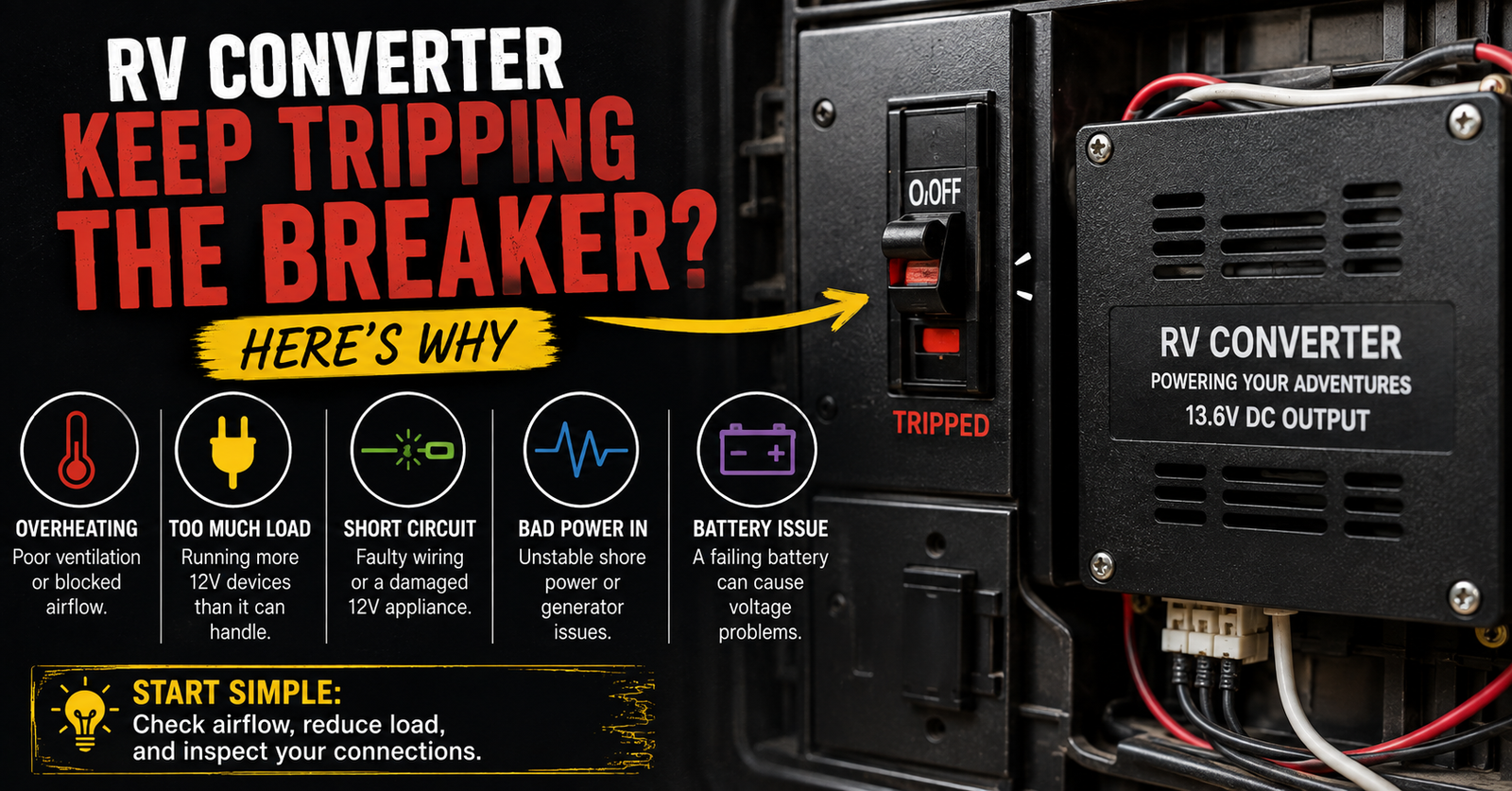
You reset the breaker for your RV converter, everything comes back to life, and a few seconds later you hear that familiar little click. The breaker trips again. Reset it one more time and the exact same thing happens. A general circuit breaker troubleshooting guide can help distinguish an overload from a short circuit: general circuit breaker troubleshooting
At that point, I stop resetting it.
An RV converter that keeps tripping its breaker can have an internal failure, but the converter isn’t the only possibility. The problem can also be in the AC circuit feeding it, a loose or damaged connection, excessive electrical demand, or another fault that needs to be isolated before you start buying parts. Repeated breaker trips are among the converter replacement warning signs worth evaluating before replacement.
There is also a huge difference between a breaker that trips immediately every single time and one that trips after the converter has been operating for 10, 20, or 30 minutes.
That timing is one of the first clues I’d pay attention to.
Progressive Dynamics actually makes this distinction pretty simple for certain PD9100 and PD9200 converters. Its troubleshooting procedure says that if the 120-volt breaker supplying the converter trips immediately again after being reset, the converter is bad and should be replaced.
That’s pretty convincing evidence for those specific converters.
But before we condemn yours, let’s figure out exactly what’s happening.
First Make Sure You’re Looking at the Converter Breaker
An RV power center can have quite a few breakers.
You may have breakers for:
Air conditioner.
Microwave.
Water heater.
General receptacles.
Converter.
Main RV service.
Depending on the RV, the converter may have its own dedicated branch breaker or share an arrangement that isn’t immediately obvious from looking at the panel.
I want to identify exactly which breaker is tripping before troubleshooting anything else.
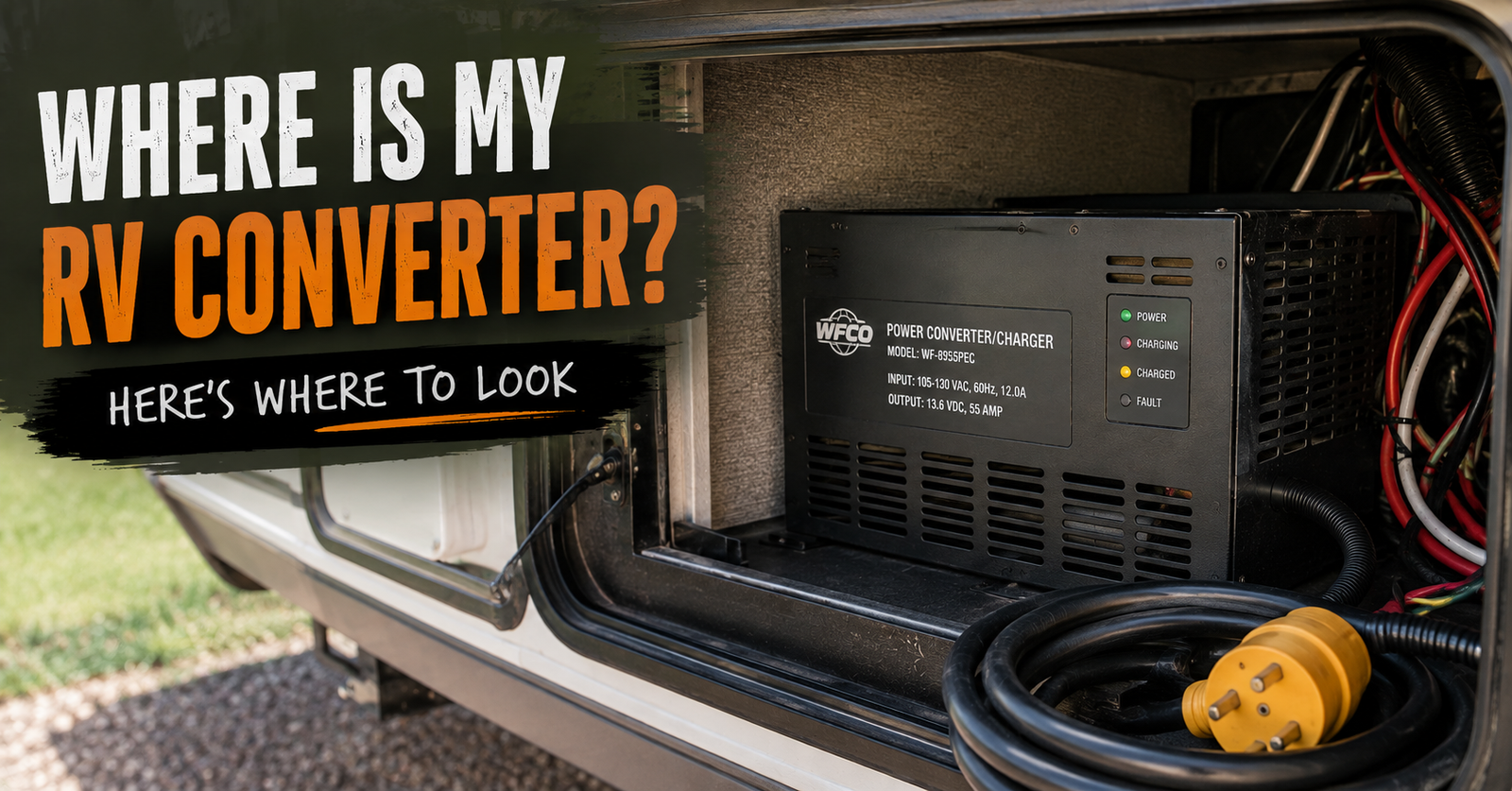
If you’re still trying to understand where the converter is or how it fits into the power center, our guide to finding your RV converter will help you get oriented.
Don’t assume the breaker that’s tripping belongs to the converter just because your battery stops charging afterward.
What Does the Converter Breaker Actually Protect?
Your converter needs AC electricity to operate.
When you’re connected to shore power, approximately 120-volt AC electricity reaches the converter through the RV’s AC distribution system.
The converter then turns that AC electricity into the lower-voltage DC electricity used by the camper’s 12-volt system and battery charger.
The breaker is on the AC input side of that equation.
So when that breaker trips, we’re not dealing with the same thing as a blown DC fuse.
That’s an important distinction.
A Tripped Breaker and a Blown Converter Fuse Are Different Problems

We’ve already covered why an RV converter can keep blowing fuses, but a breaker problem sends me down a different troubleshooting path.
The converter’s reverse-polarity fuses, for example, protect against a battery being connected backward.
Progressive Dynamics specifically says that reversed battery leads, even briefly, can blow the reverse-battery-protection fuses on applicable converters.
The AC breaker has another job.
It protects the AC circuit supplying the converter.
So before doing anything else, establish which protective device is actually opening.
Pay Attention to When the Breaker Trips
This can tell us a lot.
Does it trip the instant you reset it?
Does it stay on for five seconds?
Five minutes?
Half an hour?
Does it only trip when the battery is badly discharged?
Does it happen when several other things in the RV are running?
Does it happen only on shore power at one campground?
Does it happen from generator power too?
Does it trip after the converter gets extremely hot?
These details help narrow down the problem.
“Converter breaker keeps tripping” is a symptom.
We still need the cause.

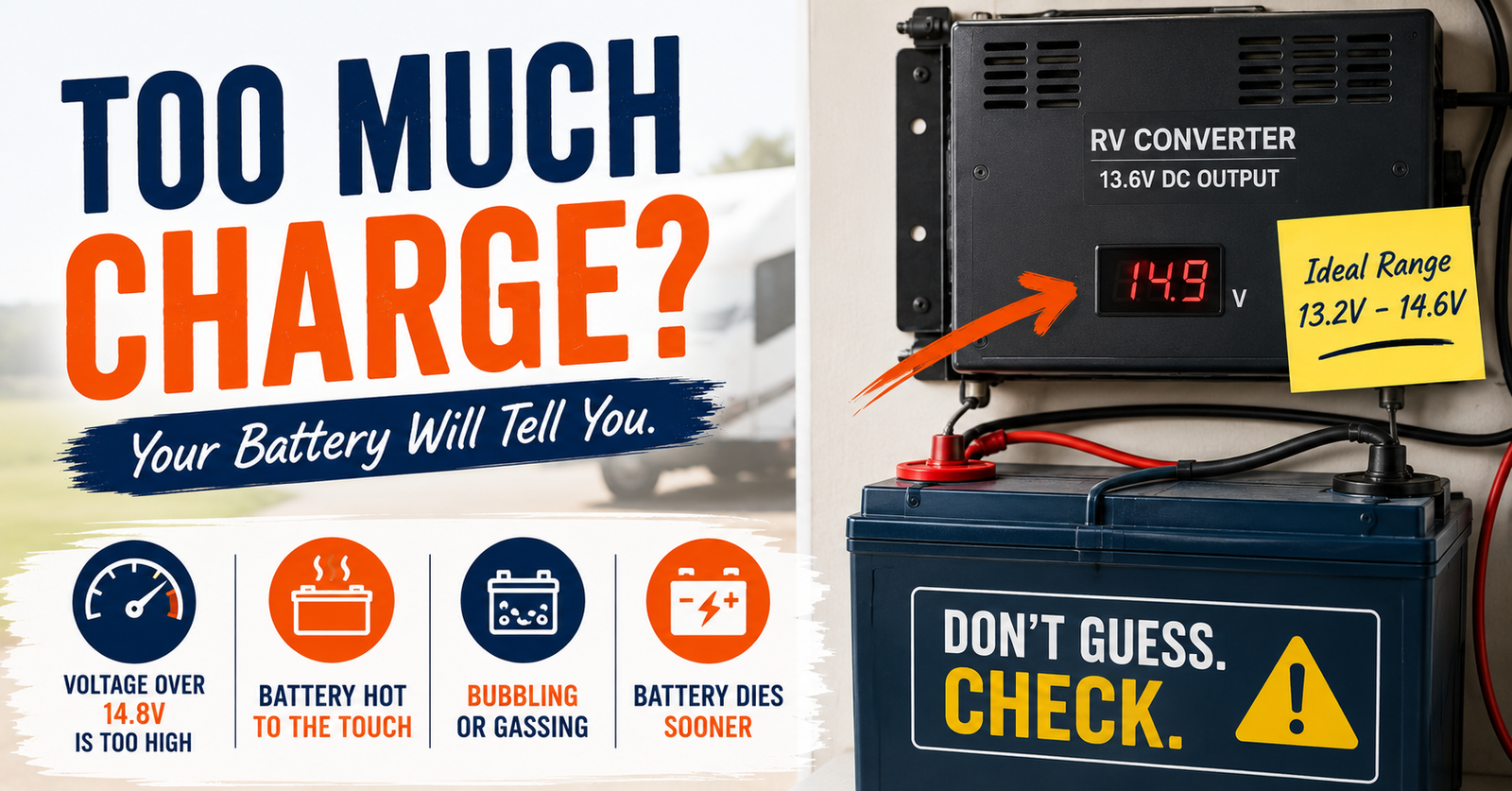
If It Trips Immediately, Stop Resetting It
This is the situation I take most seriously.
You reset the converter breaker.
Click.
It immediately trips.
Reset it.
Click.
Trips again.
Don’t keep doing that.
A breaker that repeatedly trips immediately is telling you there is a fault that hasn’t disappeared just because you moved the handle back to ON.
For applicable PD9100 and PD9200 converters, Progressive Dynamics says that if the converter’s AC supply breaker trips immediately after resetting, the converter is bad and must be replaced.
If that’s the manufacturer troubleshooting procedure for your exact converter, I’d follow it.
But Don’t Apply One Manufacturer’s Test to Every Converter Ever Made
This is important.
Progressive Dynamics can tell us exactly how its converter should behave.
That doesn’t automatically make the same diagnostic procedure correct for every WFCO, Parallax, IOTA, PowerMax, or older converter ever installed in a camper.
Find your model number.
Then find the manufacturer’s troubleshooting procedure.
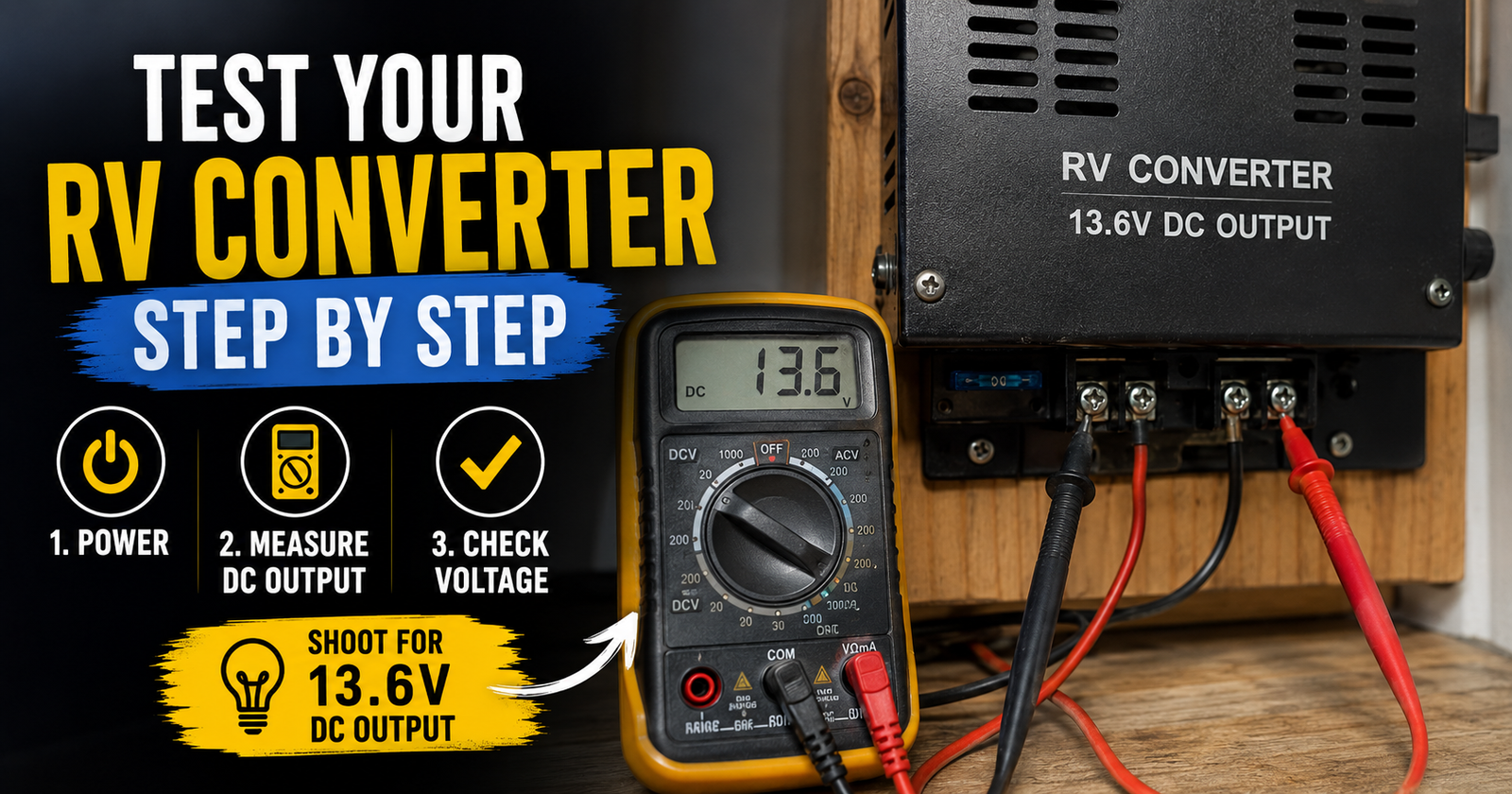
That’s the same approach we used in our step-by-step RV converter multimeter test.
The model number matters.
Why Would a Bad Converter Trip Its Breaker?
Because the converter contains electrical components connected to the AC supply.
An internal failure can create an electrical fault that causes excessive current to flow.
The breaker sees that abnormal condition and opens the circuit.
In that situation, the breaker isn’t the problem.
It’s doing its job.
That’s why I don’t like the idea of repeatedly resetting a breaker until it finally stays on.
You aren’t fixing anything.
You’re repeatedly energizing a circuit that’s trying to tell you something is wrong.
What If the Breaker Trips After a Few Minutes?
Now the diagnosis becomes less obvious.
If the breaker stays on for a while before tripping, I start thinking about things that change as the converter operates.
Temperature.
Electrical load.
Battery charging demand.
Loose connections heating up.
Converter cooling.
Intermittent internal failure.
AC supply conditions.
That’s a different pattern from a breaker that snaps off immediately.
The timing matters.
A Very Low Battery Can Make the Converter Work Hard
Suppose you’ve been camping without hookups.
Your house battery is heavily discharged.
You plug the camper into shore power.
Now the converter suddenly has two jobs.
It needs to supply the RV’s active 12-volt loads.
And it needs to recharge that depleted battery.
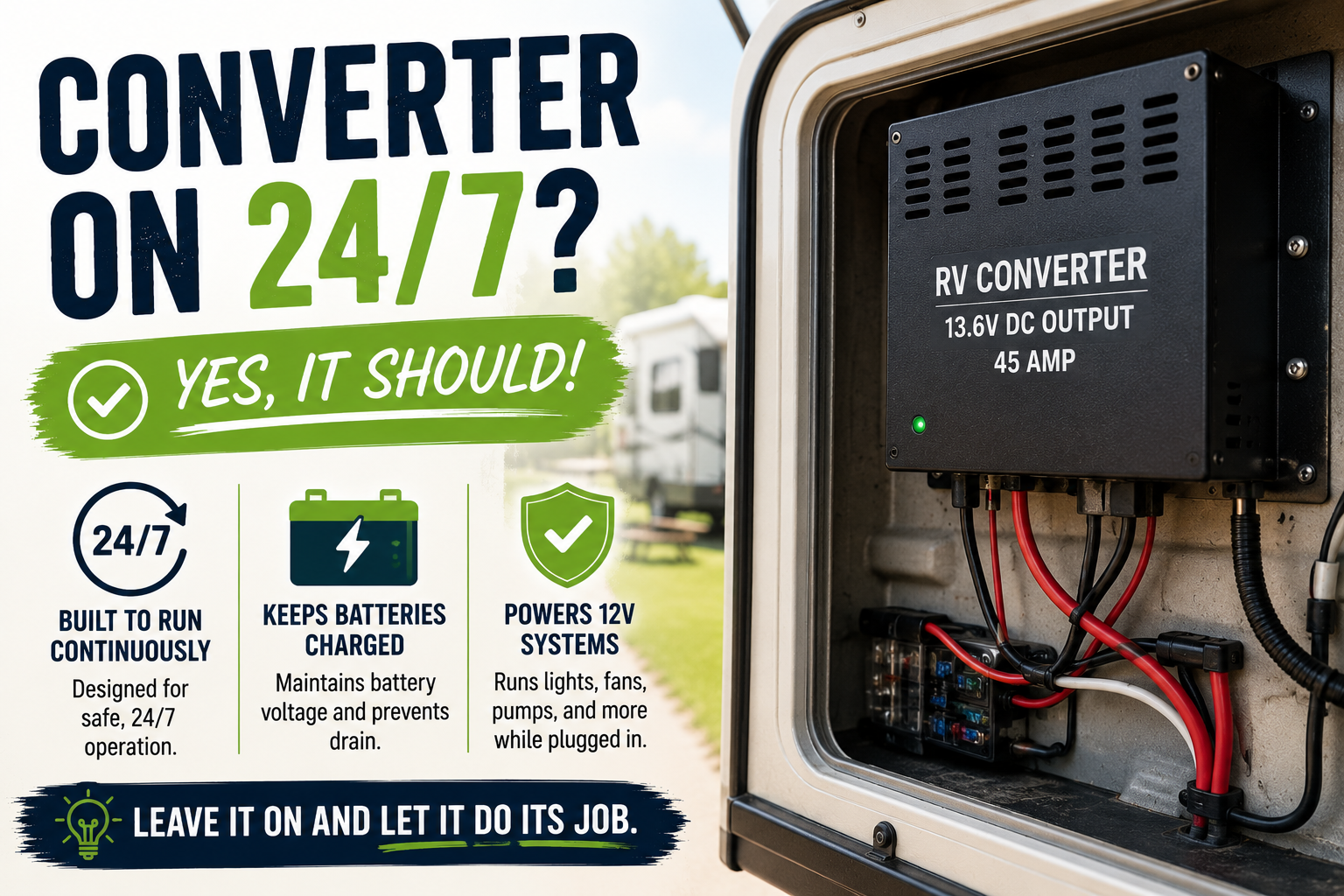
WFCO explains that converter amperage goes to the RV’s DC loads first, with the remaining capacity available for battery charging. It also notes that a battery can draw substantial current from the converter while charging.
That means a badly depleted battery can make the converter work much harder than a fully charged one.
But a properly functioning system should still operate within its designed limits.
A Heavy DC Load Does Not Automatically Mean the AC Breaker Should Trip
This distinction matters.
Converters are designed to supply DC loads up to their rated capacity.
Progressive Dynamics says applicable 9100 and 9200 converters have current limiting that protects the converter if RV DC demand exceeds its designed output. The converter can shut down until some 12-volt loads are removed.
WFCO likewise explains that converter output behavior changes as DC load approaches the converter’s maximum operating current.
So I wouldn’t shrug off a repeatedly tripping AC breaker as:
“The battery is low, so that’s normal.”
Repeated breaker trips are not something I’d consider normal converter operation.
Turn Off Unnecessary 12-Volt Loads and Observe What Changes
If the breaker doesn’t trip instantly and you’re trying to understand the pattern, reducing DC demand can give you a clue.
Turn off unnecessary:
Lights.
Vent fans.
Water pump.
Furnace if it isn’t needed.
Other 12-volt equipment.
Then observe whether the converter operates differently.
WFCO specifically recommends reducing RV DC loads when diagnosing overloaded converter behavior such as dimming or flickering lights.
If the breaker suddenly stays on with the DC load reduced, that’s useful information.
It still doesn’t tell us exactly what failed, but we’ve learned that load affects the symptom.
What If the Breaker Trips Only When the Battery Is Connected?
That’s another valuable clue.
Imagine this:
Converter breaker stays on with the battery isolated according to the manufacturer’s testing procedure.
Reconnect the battery.
Breaker eventually trips.
Now I’d want to investigate the battery and charging circuit.
Is the battery severely discharged?
Is it damaged?
Is there a shorted cell?
Is the battery connected correctly?
Is there a wiring fault?
Is the converter being forced into an abnormal condition?
WFCO specifically includes battery condition among the things owners should inspect when troubleshooting converter and charging problems.
Don’t automatically replace the breaker.
A Bad Battery Can Make Converter Problems Look Strange
A battery with an internal problem can behave very differently from a healthy discharged battery.
It may accept charging abnormally.
It may never reach normal charge.
It may become hot.
It may cause the converter to work continuously.
It may make you think the converter is the only thing wrong.
If the converter breaker problem seems strongly connected to the battery, I’d test the battery too.
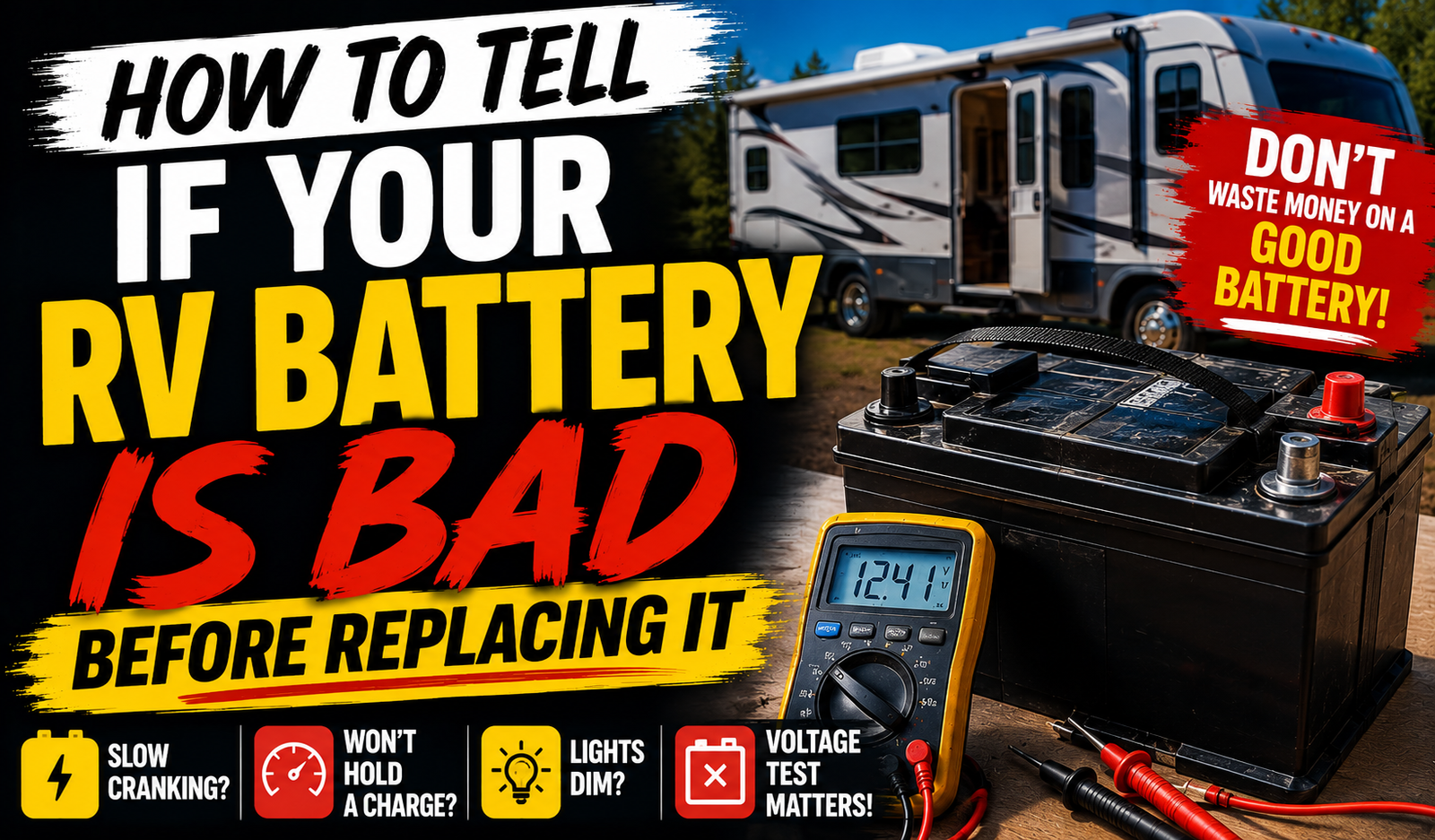
We already have a complete guide to telling whether your RV battery is actually bad.
Don’t let one failed component hide another.
What If It Trips With the Battery Disconnected?
That pushes me harder toward the converter or its AC supply circuit.
Again, only disconnect the battery according to the procedure for your equipment.
But if the converter has no battery charging load, normal RV loads are removed, and its AC breaker still repeatedly trips, we’ve eliminated quite a few variables.
Now I want to know:
Is the converter internally shorted?
Is the AC wiring damaged?
Is there a loose connection?
Is the breaker itself defective?
Is another load actually sharing that breaker?
That’s where proper isolation becomes useful.
Check Whether Something Else Is on the Same Breaker
Don’t assume the breaker feeds only the converter.
RV manufacturers sometimes make interesting use of limited breaker space.
WFCO notes that some converter wiring includes a pigtail intended to provide another circuit without sacrificing the converter’s breaker space.
That means understanding the actual wiring matters.
If another load is connected to the same branch circuit, that other load may contribute to the problem.
Identify what’s actually on the circuit before deciding the converter is drawing everything.
The Breaker Itself Can Be the Problem
Breakers don’t last forever.
A breaker can become weak or develop problems.
Loose connections at a breaker can also create heat.
So yes, the converter may be perfectly fine while the breaker or its connection has a problem.
But this isn’t where I’d start swapping breakers randomly.
A breaker is a safety device.
If it’s tripping because the circuit really has a fault, installing another breaker doesn’t fix the fault.
And never install a higher-amperage breaker simply to stop the old one from tripping.
Never Put a Bigger Breaker in Because the Converter Keeps Tripping It
This deserves its own heading because it is such a bad shortcut.
Suppose the converter is on a 15-amp breaker.
It keeps tripping.
Someone thinks:
“I’ll put a 20-amp breaker in there.”
No.
The breaker rating is part of the circuit design and must be appropriate for the wiring and connected equipment.
Increasing breaker size can allow wiring or equipment to carry more current than it was designed to handle.
If the correct breaker trips, find out why.
Don’t defeat the protection.
Look for Signs of Heat Around the Breaker
With all power sources safely disconnected according to the RV and equipment manufacturers’ procedures, physical inspection can sometimes reveal obvious trouble.
Look for:
Discoloration.
Melted plastic.
Burned insulation.
Darkened terminals.
Loose connections.
Damaged wire.
Burning odor.
A breaker that looks heat damaged.
If you find any of that, I wouldn’t keep experimenting.
Something has been getting hot enough to cause visible damage.
That deserves proper repair.
Loose AC Connections Can Create Heat
Electrical connections need to be secure.
A poor connection adds resistance.
Resistance generates heat.
Heat can damage the connection further.
That’s one reason loose electrical connections can become progressively worse rather than simply failing all at once.
WFCO specifically recommends checking AC wiring for problems when diagnosing loss of AC power and says loose wire connections should only be checked with AC power and batteries disconnected.
If you’re not comfortable inspecting AC distribution equipment, this is technician territory.
Don’t Work Inside a Live Power Center Unless You’re Qualified
This is where I draw a firm line.
Checking whether a breaker handle is tripped is one thing.
Opening a power center and probing live 120-volt conductors is something else.
Progressive Dynamics warns that troubleshooting some of its integrated power centers involves exposure to live 120 VAC and should only be attempted by a qualified technician.
You can diagnose a lot without sticking meter probes into an energized breaker panel.
If you’re not experienced with AC electrical work, let an RV technician or qualified electrician handle that portion.
What If the Converter Gets Very Hot Before the Breaker Trips?
That’s important.
A converter naturally produces heat while operating.
That doesn’t mean it should become excessively hot, smell burned, repeatedly shut down, or cause other electrical protection to operate.
Poor ventilation can make converter heat problems worse.
Progressive Dynamics recommends sufficient airflow around applicable converter models and specifies at least five inches of clearance or enough ventilation for proper airflow in the converter compartment.
If your breaker trip is preceded by a converter getting unusually hot, I’d inspect the cooling situation too.
Check Whether the Converter Fan Is Working
Many modern converters use cooling fans.
Depending on the design, the fan may respond to temperature or load rather than running constantly.
A failed fan or blocked airflow can contribute to overheating.
WFCO’s technician training specifically identifies overheating as a possible reason a converter repeatedly shuts down and notes that the cooling fan responds to converter heat.
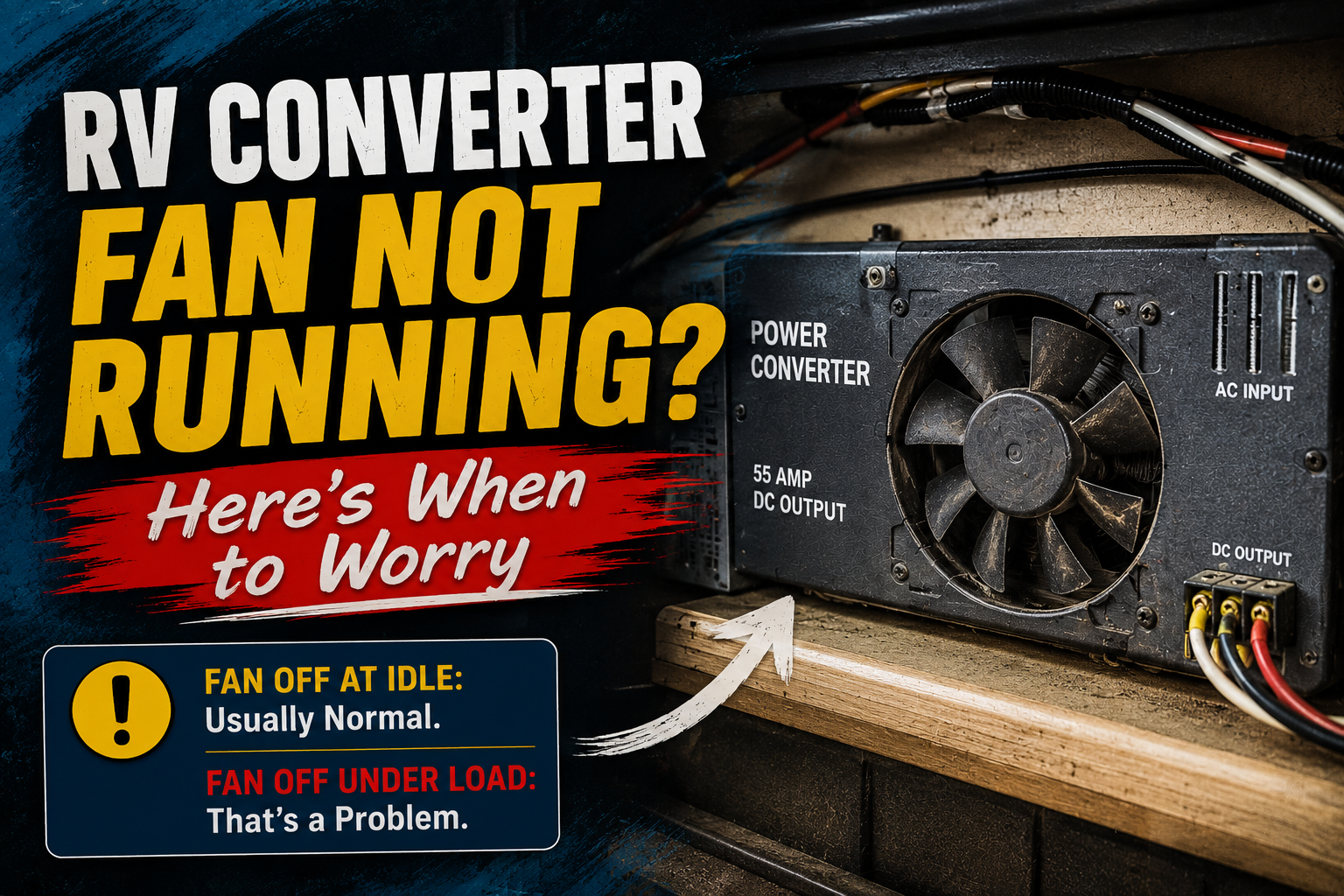
We’ve already covered what it means when an RV converter fan isn’t running.
If the converter gets extremely hot and the fan never runs, that deserves attention.
But Thermal Shutdown and Breaker Tripping Aren’t Exactly the Same Thing
This is another important distinction.
A converter may have internal thermal protection that shuts the converter itself down when it overheats.
That’s different from the 120-volt circuit breaker physically tripping.
If the breaker handle is actually moving to its tripped position, troubleshoot the AC circuit and converter input side accordingly.
Don’t call every converter shutdown a breaker trip.
Watch what’s actually happening.
What If the Converter Smells Burned?
Turn it off.
A burning electrical smell changes the urgency of the situation.
If you smell burning insulation or electronics, see smoke, or find melted components, disconnect the appropriate power sources safely and don’t keep resetting the breaker to “see what happens.”
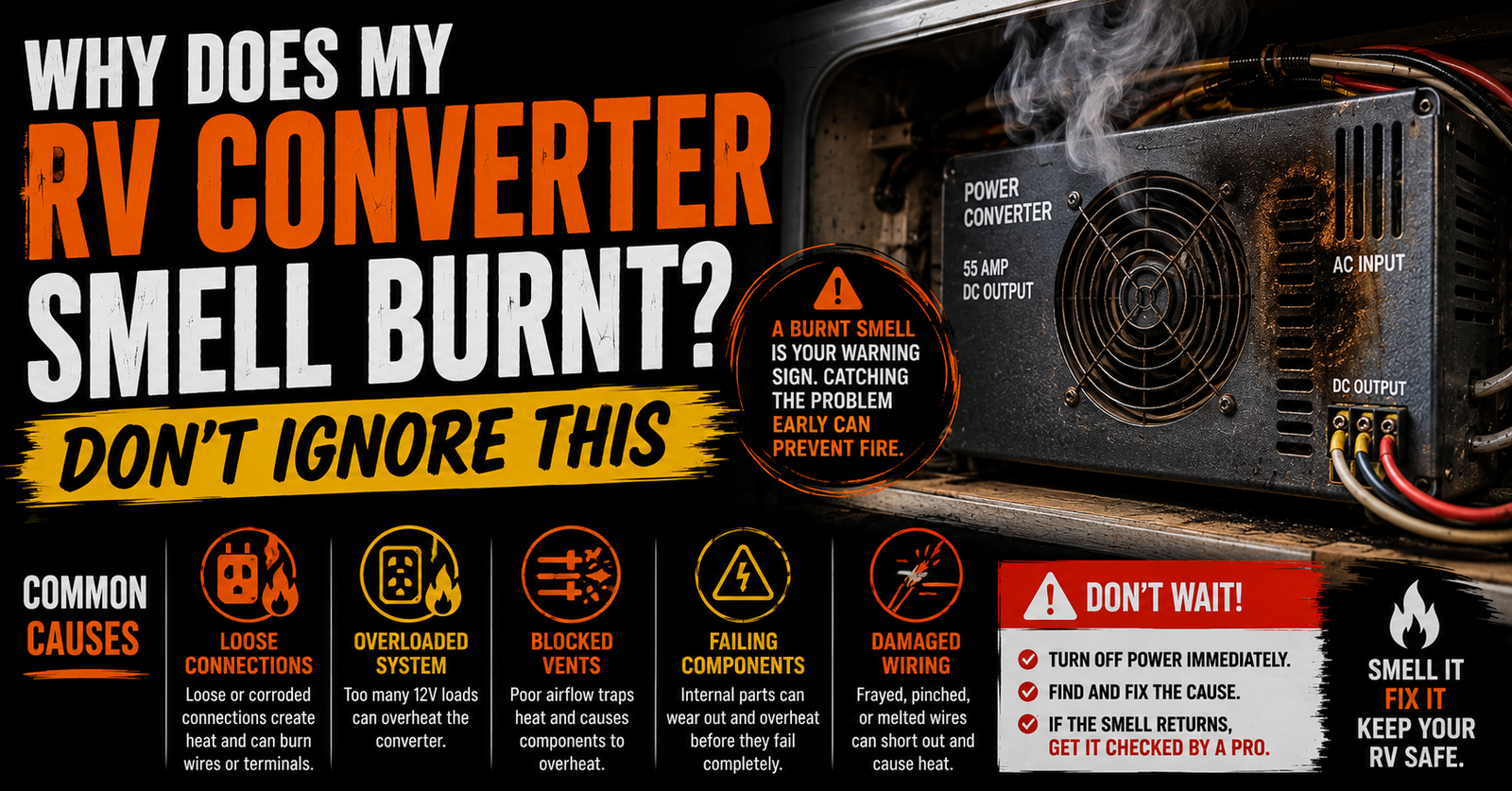
We have a separate guide covering why an RV converter can smell burnt.
At that point, I’m much more interested in preventing additional damage than squeezing one more diagnostic cycle out of the converter.
Does Shore Power Quality Matter?
It can.
Your converter depends on AC input.
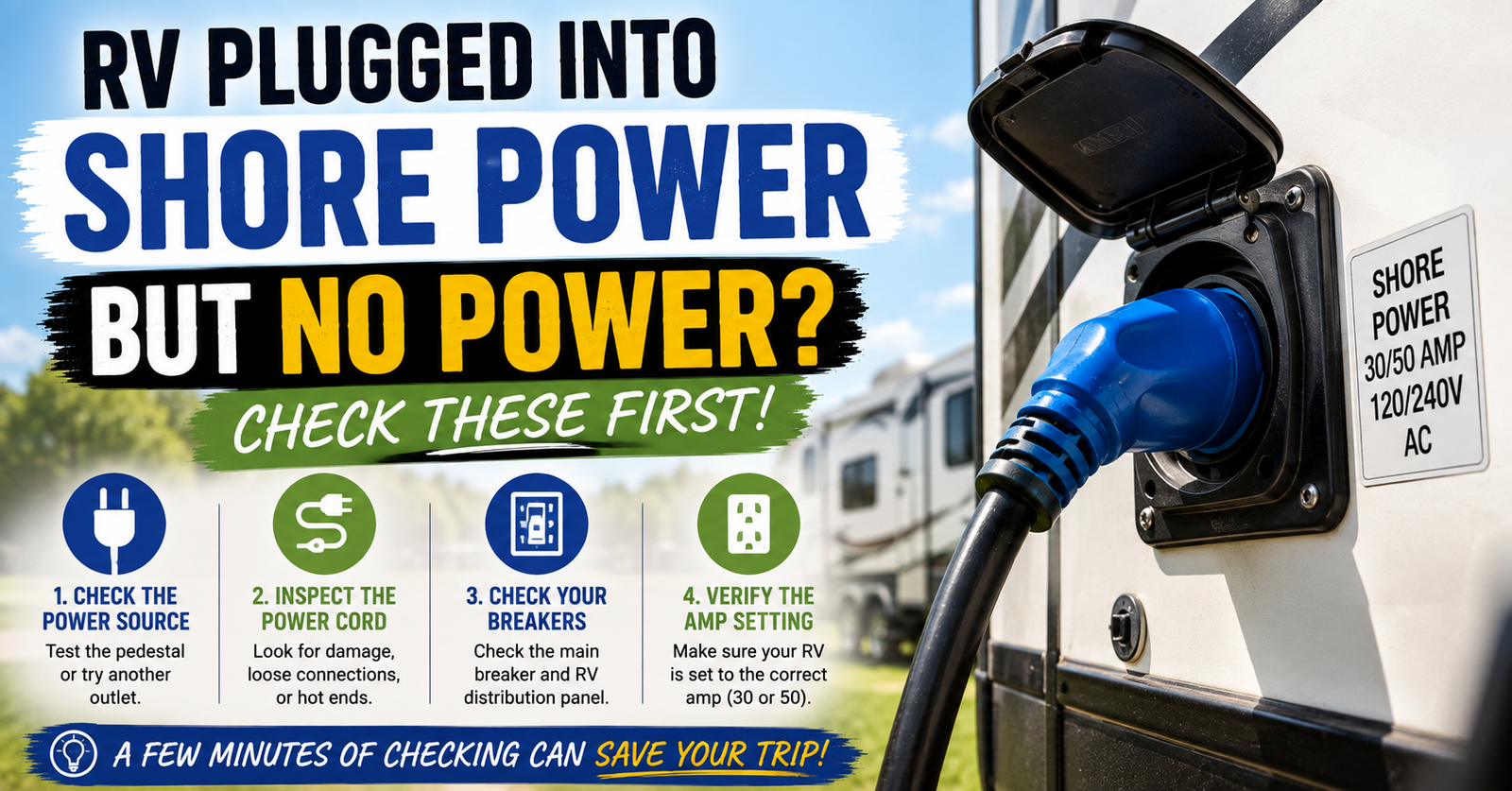
WFCO tells owners troubleshooting converter problems to verify that they’re actually connected to shore power and check breakers at both the pedestal and power center. That same outside-in approach is laid out in checking RV shore power first, including what to check when the camper appears connected but remains without power.
If the problem occurs at only one campground pedestal but disappears on another known-good electrical source, that’s useful information.
It doesn’t automatically prove the campground pedestal is bad.
But it tells me the AC source deserves investigation.
Test on a Known-Good AC Source When Appropriate
Suppose your converter breaker has never tripped at home.
You arrive at one campground.
Now it trips repeatedly.
Move to another properly functioning pedestal and everything works normally.
That’s a pretty significant clue.
Conversely, if the converter’s breaker trips immediately regardless of whether you’re on known-good shore power or an appropriate generator supply, the converter or its internal RV circuit becomes more suspicious.
The idea is to change one variable at a time.
What About Generator Power?
A properly connected generator can provide the AC input the converter needs.
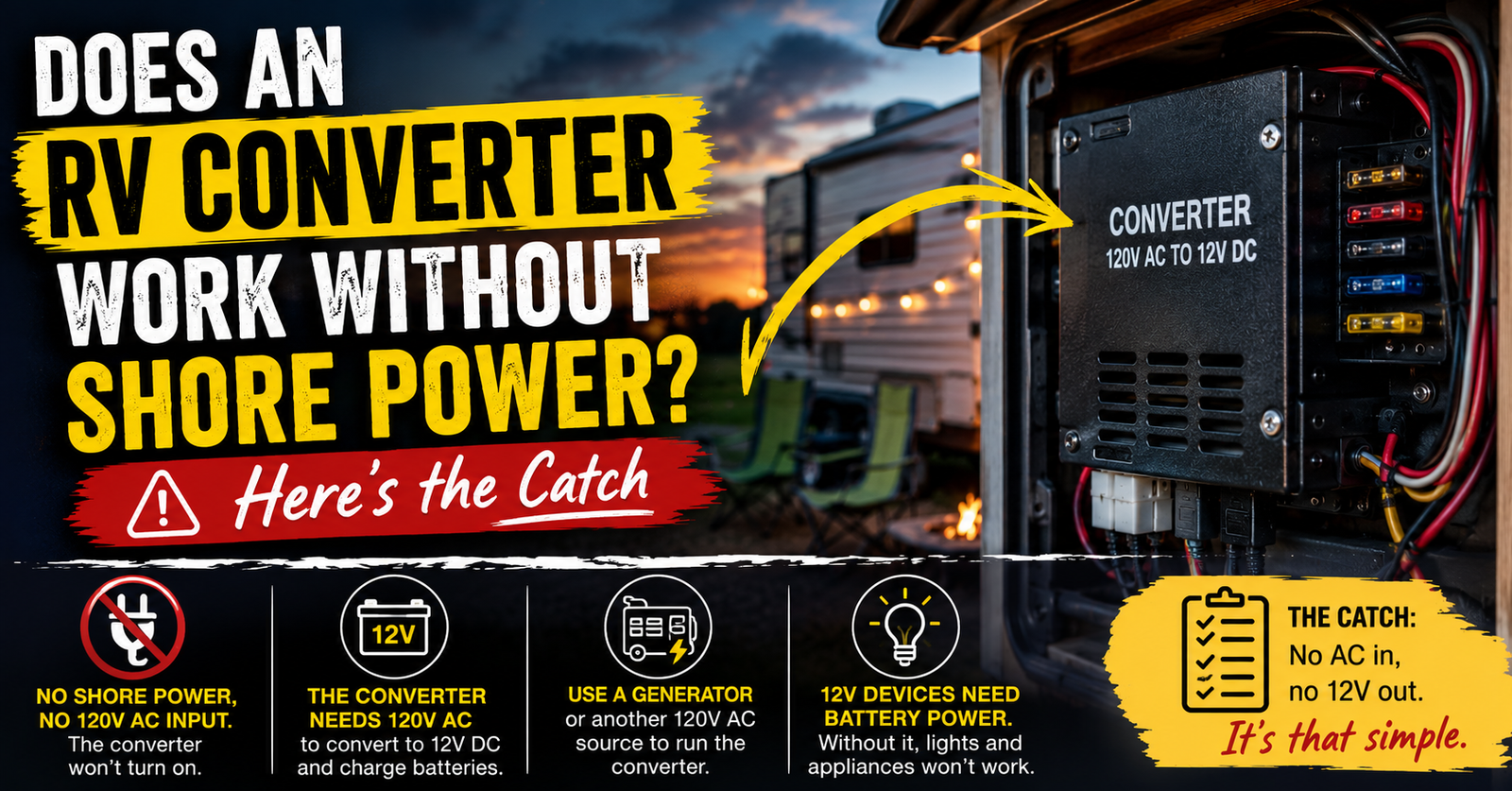
That’s why a converter can operate without campground shore power, something we covered in whether an RV converter works without shore power.
Generator operation can also give us another troubleshooting clue.
Converter works perfectly on generator.
Trips breaker only on one shore-power source.
Interesting.
Converter trips its breaker from both generator and known-good shore power.
Also interesting, but for a very different reason.
Can a Converter Be Overloaded?
Yes, but let’s be precise about what that means.
A converter has a rated DC output capacity.
If the RV’s 12-volt loads plus battery charging demand become substantial, the converter can approach that capacity.
WFCO explains that as total converter amperage reaches its maximum operating level, additional DC load can cause output voltage to decrease.
Progressive Dynamics says applicable converters use current limiting to protect themselves when DC demand exceeds their rated output.
So converter overload can absolutely cause weird DC behavior.
But a properly sized and functioning converter should have protections designed around its rated operation.
A repeatedly tripping AC breaker still deserves diagnosis.
Could the Converter Be Too Big for the Circuit?
This becomes especially interesting if somebody recently replaced or upgraded the converter.
Maybe the RV originally had a smaller converter.
A previous owner installed a higher-output model.
But did they verify that the AC circuit, DC wiring, and rest of the system were appropriate?
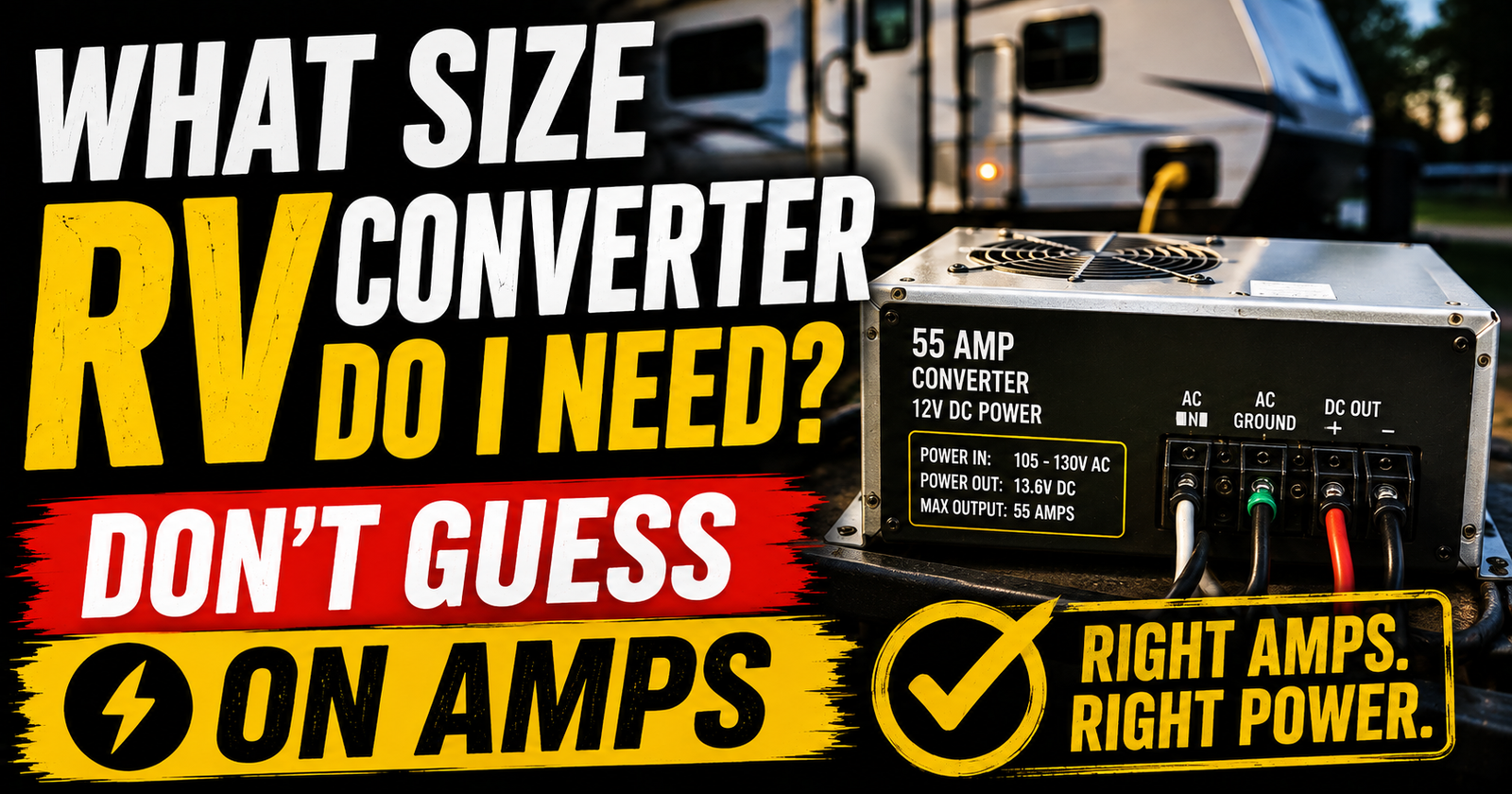
Progressive Dynamics specifically warns against replacing an existing converter with a higher-amperage model without verifying that the RV wiring can safely handle the additional current. That warning is part of the larger question of matching converter output to RV wiring: matching converter output to RV wiring.
If breaker trouble started immediately after a converter upgrade, I would absolutely review the installation.
This Is Why I Don’t Automatically Recommend Higher-Amperage Converters
More charging power sounds great.
Faster battery charging.
More DC capacity.
What’s not to like?
The problem is that the rest of the system has to support it.
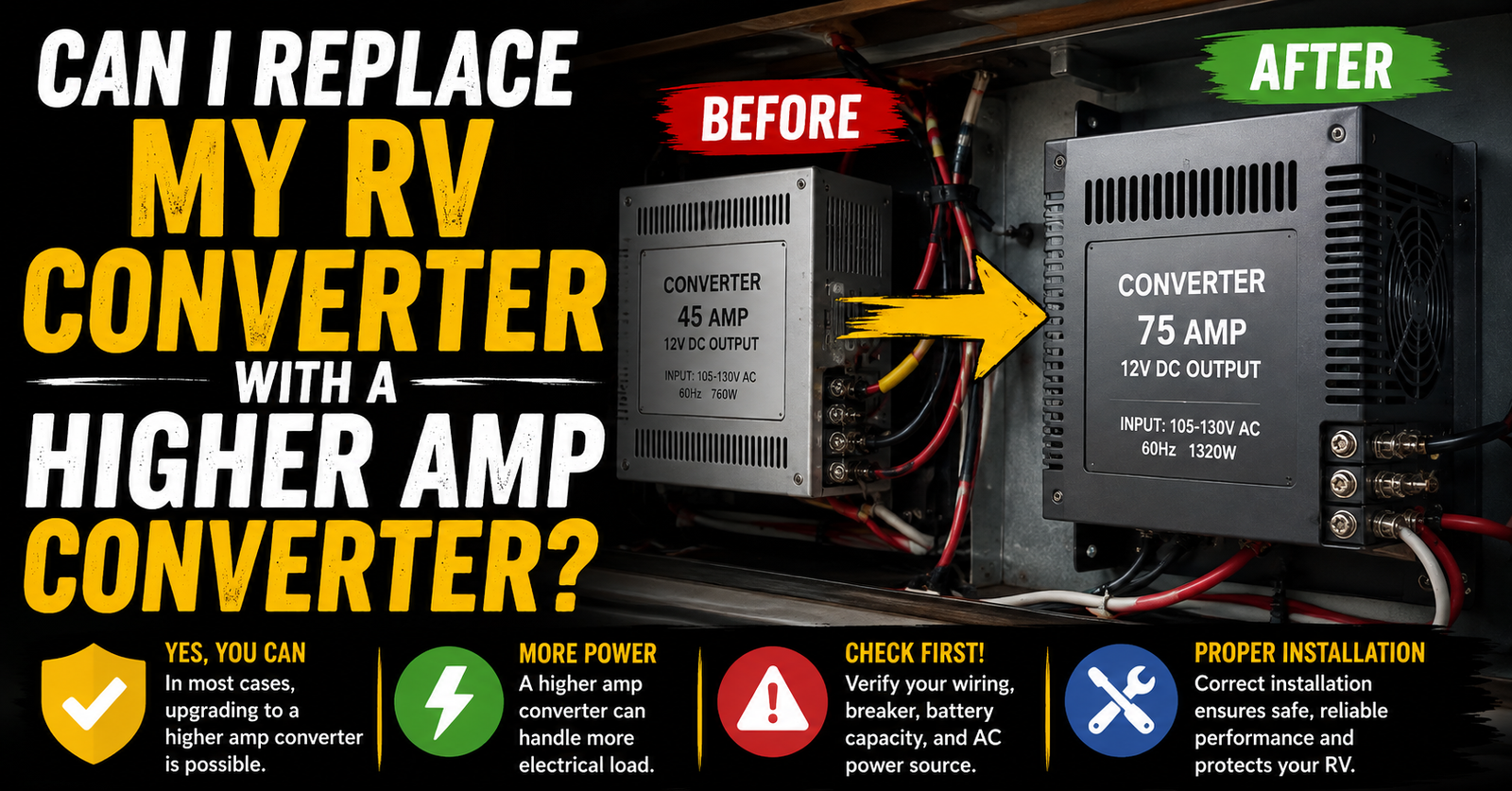
That’s why our article about replacing an RV converter with a higher-amp converter treats it as an electrical-system decision rather than a simple parts swap.
If the converter breaker started tripping after someone “upgraded” the converter, don’t ignore that history.
Did the Problem Start Right After Converter Replacement?
That’s one of the first questions I’d ask.
If the old converter never tripped the breaker and the new one does, something changed.
Possibilities include:
Wrong replacement converter.
Incorrect installation.
Loose AC connection.
Different input requirements.
Wiring mistake.
Damaged breaker.
Another circuit disturbed during installation.
Converter defect.
That’s a much different situation from a 15-year-old converter that suddenly started tripping its original breaker.
Check the Converter Model and Input Specifications
The label isn’t just there for decoration.
It tells you what the converter was designed to receive and produce.
Find the model number.
Look up the manufacturer’s specifications.
Confirm that the converter is appropriate for the installation.
If the equipment doesn’t match what should be there, I’d solve that before chasing tiny electrical mysteries.
What If the Breaker Trips Only After Several Hours?
That makes me think more about heat.
Maybe the converter itself heats up.
Maybe a loose breaker connection heats up.
Maybe the breaker is weak and nuisance-tripping as temperature rises.
Maybe a high charging load persists for a long period.
Maybe airflow around the converter is poor.
Timing is evidence.
A failure after two hours tells a different story than an instantaneous trip.
Feelings Aren’t Measurements, but Heat Still Gives You Clues
I’m careful about saying things like:
“If it feels hot, it’s bad.”
Converters can run warm.
Some can run quite warm under load.
But if you’re seeing repeated breaker trips combined with unusual heat, burning smell, fan problems, discoloration, or shutdowns, the pattern becomes more meaningful.
Don’t diagnose from temperature alone.
Use it as one piece of the puzzle.
Could Dust and Blocked Airflow Cause Trouble?
They certainly don’t help.
Converters need airflow.
If cooling vents are packed with dust or the converter is buried behind camping gear, heat has a harder time escaping.
Progressive Dynamics specifically calls for adequate ventilation around its applicable converter models.
I would clean accessible ventilation areas with the system safely de-energized and make sure storage isn’t blocking the converter.
But if the AC breaker is tripping immediately, I wouldn’t expect cleaning a dusty vent to magically fix an internal electrical fault.
Again, timing matters.
What If the Breaker Feels Hot?
I take that seriously.
A breaker can warm under load, but unusual heat, discoloration, odor, or signs of damage deserve inspection by someone qualified to work inside the AC panel.
The issue may be the breaker.
It may be the connection.
It may be excessive current.
It may be another problem.
Don’t replace the breaker with a larger one.
Don’t keep resetting it.
Find out why it’s getting hot.
Can I Test the Converter With a Multimeter?
Yes, and that’s one of the best ways to avoid guessing.
But the exact procedure depends on the converter.
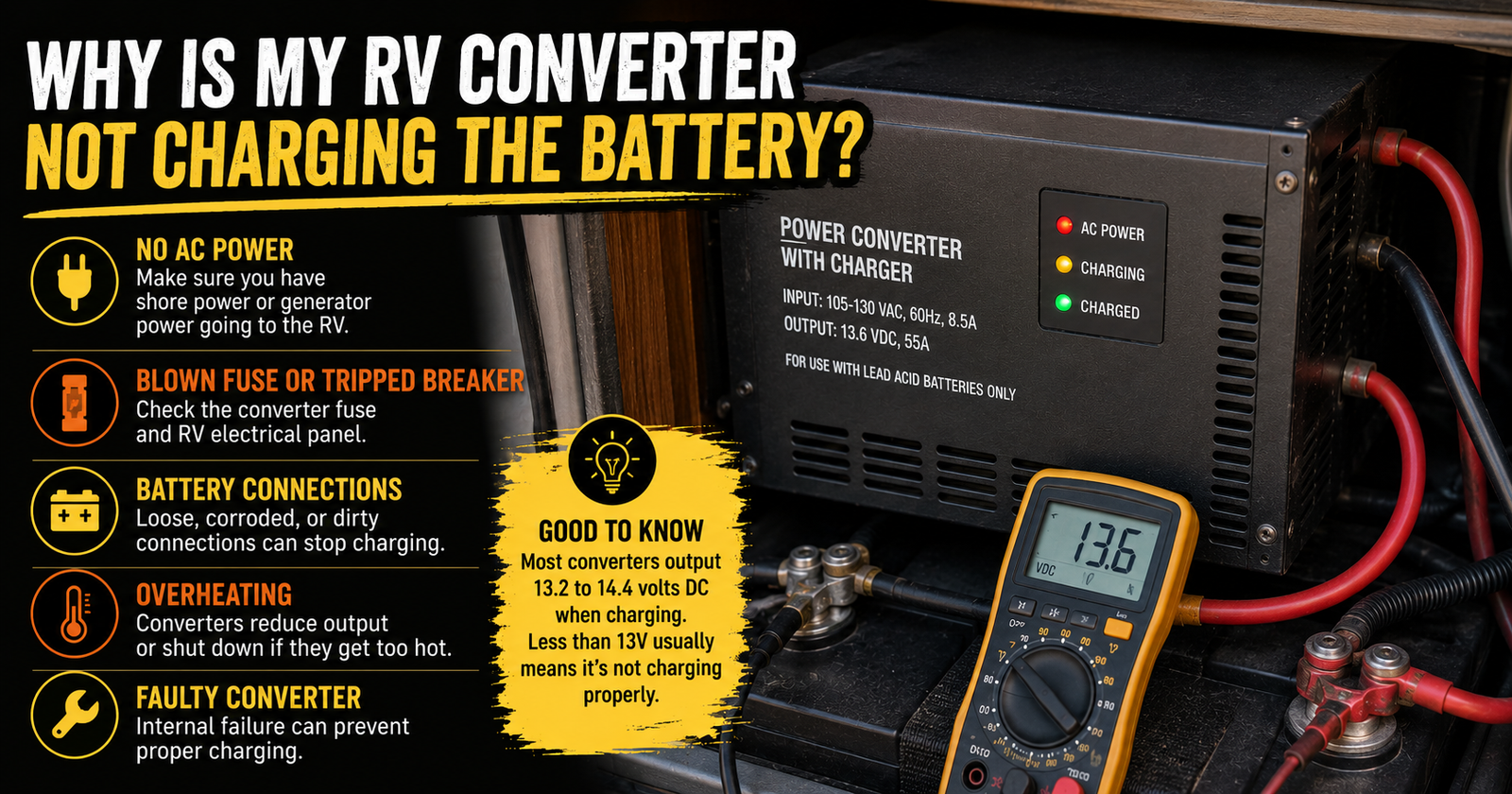
For applicable Progressive Dynamics PD9100 and PD9200 models, the manufacturer has you test converter DC output first, then check the AC supply if output is zero. If the converter has proper AC input but still produces zero DC output after the protection fuses have been checked, Progressive Dynamics says the converter is bad. For a broader way to isolate a converter that converter isn't working correctly, compare the AC input, DC output, fuses, and battery-side wiring.
Our multimeter converter-testing guide walks through how to approach those tests without treating every converter as identical.
But How Do I Test It If the Breaker Won’t Stay On?
That’s exactly why an immediate trip is such a strong clue.
If the breaker supplying certain Progressive Dynamics converters trips immediately after reset, the manufacturer’s troubleshooting procedure already considers that a failed converter.
For another brand or model, check its troubleshooting instructions or contact the manufacturer.
You don’t need to defeat the breaker to force the converter to stay energized long enough for testing.
Never bypass a breaker for diagnosis.
Don’t Hold the Breaker On
Don’t tape it.
Don’t wedge it.
Don’t bypass it.
Don’t install a bigger breaker.
Don’t wire around it.
The breaker is opening the circuit because it sees a condition it was designed to interrupt.
Your job is to find that condition.
Not defeat the device that’s protecting the circuit.
What If the Main RV Breaker Trips Instead?
That’s a different troubleshooting problem.
If the converter branch breaker stays on but the RV’s main breaker trips, the converter may simply be one of several AC loads contributing to the total.
Now you have to consider the entire RV’s AC demand.
Air conditioner.
Electric water heater.
Microwave.
Converter.
Space heater.
Coffee maker.
Hair dryer.
Other appliances.
A 30-amp RV can only use so much AC power at once.
That’s not necessarily a converter failure.
Converter Breaker Versus Campground Pedestal Breaker
Same idea.
If the breaker at the campground pedestal trips while your converter branch breaker remains on, don’t automatically blame the converter.
The pedestal breaker sees the RV’s overall AC load.
The converter is only one part of that load.
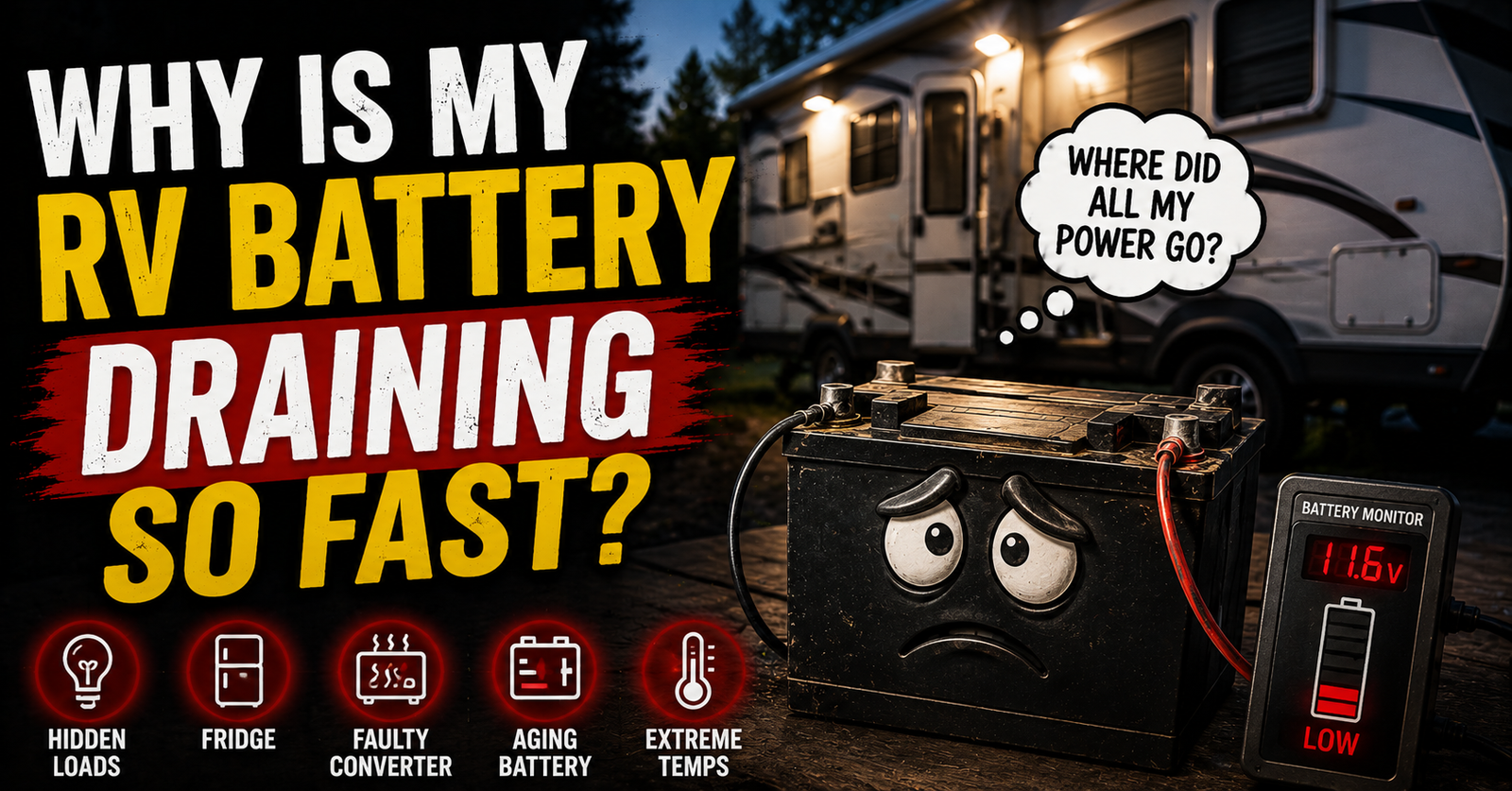
This becomes especially noticeable when the battery is deeply discharged and the converter is charging hard while you’re also running large AC appliances. That combination of a depleted battery and active loads is one situation covered in why an RV battery drains so fast.
That’s why identifying which breaker actually tripped is so important.
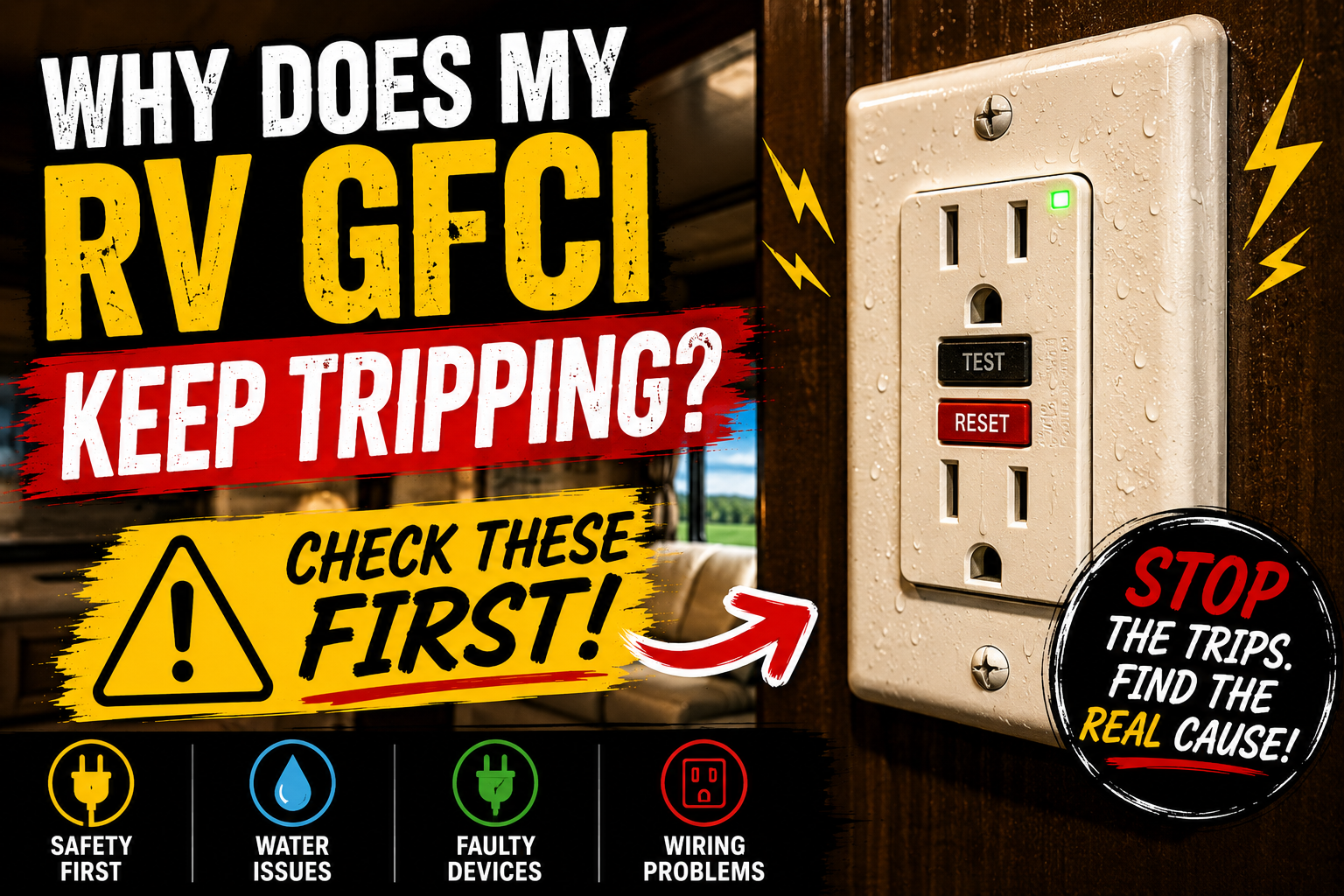
What If the Converter Trips a GFCI?
That’s another distinct clue.
A GFCI trips based on current imbalance rather than simply protecting against ordinary circuit overload.
WFCO’s technician training specifically treats a WFCO converter tripping a GFCI receptacle as an indication of a bad converter.
Again, that’s manufacturer-specific information, but it’s worth knowing.
If your converter suddenly causes a properly functioning GFCI to trip, don’t assume you just need a “stronger outlet.”
Find the cause.
Could Water or Moisture Cause the Problem?
Water and electrical equipment are never a combination I ignore.
If there has been a roof leak, plumbing leak, flood, condensation problem, or water intrusion near the converter or power center, I’d consider that important history.
Don’t energize visibly wet or water-damaged electrical equipment just to see whether the breaker stays on.
Dry doesn’t automatically mean safe either if corrosion or electrical damage has already occurred.
Water exposure is a good reason to have the system properly inspected.
What If I Hear Buzzing Before the Breaker Trips?
Pay attention to where it’s coming from.
Converter?
Breaker?
Power center?
Transfer switch?
Another electrical component?
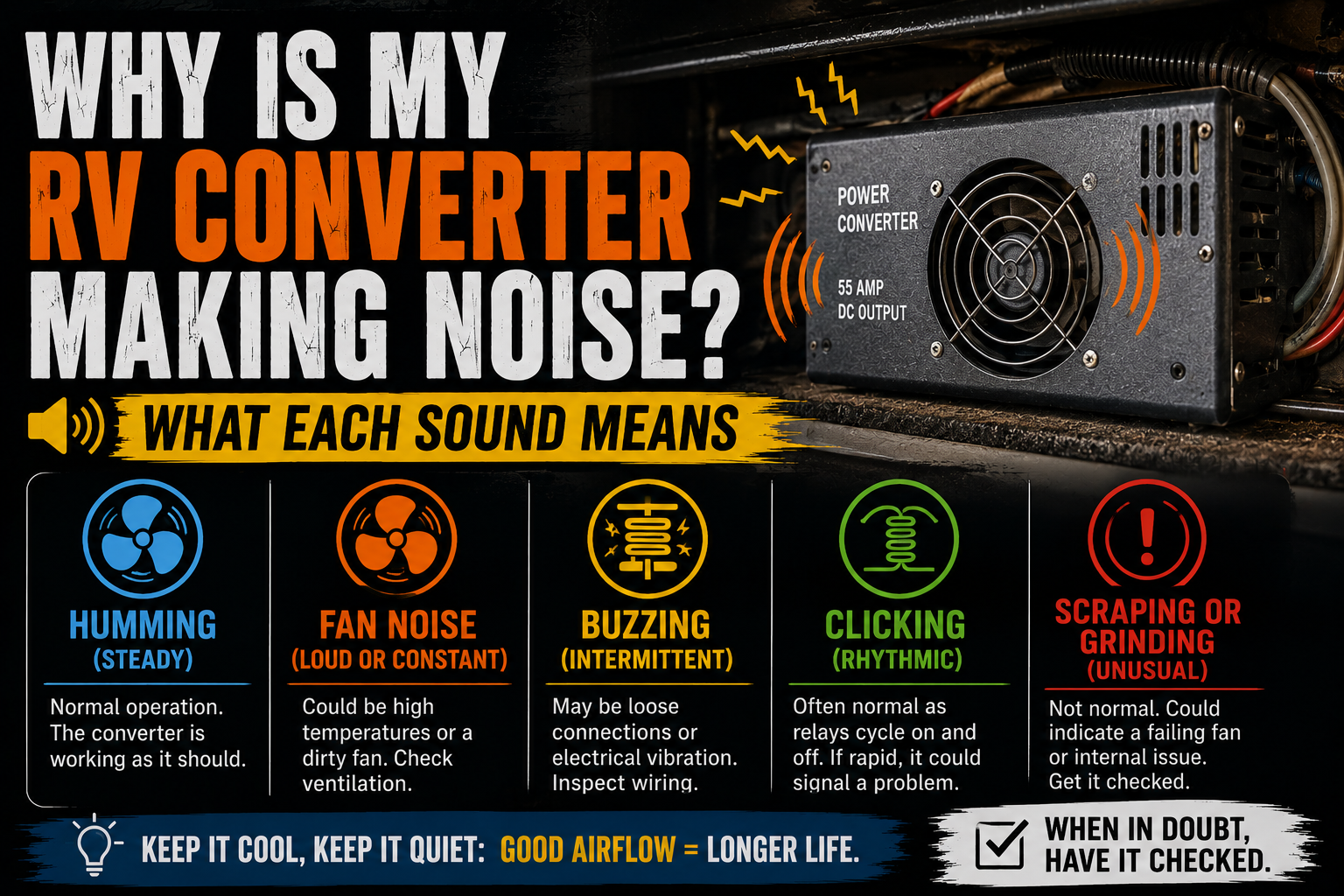
We’ve already covered what different RV converter noises can mean.
A little converter fan noise is one thing.
Loud electrical buzzing, arcing sounds, burning odor, and breaker trips together are something else.
Turn the system off and investigate.
What If the Converter Works After It Cools Down?
That points me toward a temperature-related issue.
Maybe the converter is overheating internally.
Maybe its cooling fan isn’t operating properly.
Maybe airflow is restricted.
Maybe a heat-sensitive internal fault develops as the converter warms.
Maybe the breaker or connection itself is heating.
WFCO identifies overheating as a reason a converter can repeatedly shut down.
If cooling temporarily “fixes” the problem, don’t mistake that for an actual repair.
Something is still causing excessive heat or temperature-sensitive failure.
Could a Loose Battery Connection Trip the AC Breaker?
Not necessarily in a simple direct way, but bad DC connections can make the converter and charging system behave strangely.
The converter’s output side deserves inspection whenever charging behavior is abnormal.
WFCO specifically tells owners troubleshooting no DC output to inspect DC wiring for loose connections and points out that missing ground connections and improperly terminated positive wires are common problems.
I wouldn’t ignore the DC side just because the visible symptom is on the AC side.
But an immediate AC breaker trip still makes me particularly interested in the converter and AC supply circuit.
What If the Battery Was Connected Backward?
Check the converter’s reverse-polarity fuses.
Progressive Dynamics says reverse battery protection fuses on applicable converters will blow if the battery leads are connected backward, even briefly.
WFCO also instructs owners to check reverse-polarity fuses when there is no DC output.
That’s normally a DC protection issue rather than the classic reason for an AC breaker repeatedly tripping.
But if the breaker problem began immediately after battery work, I absolutely want to know what happened.
Don’t Ignore Recent Electrical Work
This is one of the best troubleshooting questions in almost any electrical problem.
What changed right before this started?
New battery?
Lithium conversion?
New converter?
Solar installation?
Inverter installation?
Battery cables replaced?
Power center worked on?
Generator repair?
New appliance?
If the breaker started tripping the same day somebody changed the electrical system, that’s probably not a coincidence.
Start there.
Lithium Conversions Deserve a Closer Look
Switching to LiFePO4 can change charging behavior.
That doesn’t mean lithium batteries inherently cause converter breakers to trip.
But if you changed batteries, changed converter settings, installed a new converter, increased converter capacity, or modified wiring at the same time, you’ve changed several variables.
Our guide to using an older RV converter with a lithium battery explains why converter and battery compatibility need to be considered together.
If breaker trouble started after the lithium conversion, review the whole upgrade.
Don’t Assume a New Converter Can’t Be Bad
New parts fail.
It’s frustrating, but it happens.
If you just installed a converter and its properly sized branch breaker trips immediately, don’t assume the converter is innocent simply because it came out of a new box.
Check installation first.
Check wiring.
Check the correct model.
Check for pinched wires.
Then follow the manufacturer’s troubleshooting procedure.
A defective new converter is possible.
What If I Just Replaced the Converter Myself?
Go back through the installation.
And I mean carefully.
Did you install the correct model?
Are the AC conductors terminated correctly?
Are connections tight to the manufacturer’s specifications?
Did any insulation get trapped under a terminal?
Are wires pinched?
Is the converter grounded correctly?
Is the breaker correct?
Did you alter the converter amperage?
Our guide to replacing an RV converter without buying the wrong one covers exactly why I like documenting and testing the installation before closing everything up.
Should I Replace the Breaker First?
Not unless testing indicates the breaker is the problem.
I understand why people want to.
Breakers are relatively inexpensive.
Converter is expensive.
So replacing the breaker feels like an easy experiment.
But if the breaker is tripping because the converter has an internal short, the new breaker is going to see the same fault.
Diagnose.
Don’t parts-cannon the RV electrical system.
Should I Replace the Converter First?
Same answer.
Not until the evidence points there.
The exception is when the manufacturer’s own troubleshooting procedure tells you that the exact behavior you’re seeing indicates converter failure.
Progressive Dynamics gives us a good example. For its applicable PD9100 and PD9200 models, an AC breaker that immediately retrips after reset is specifically identified as a bad converter condition.
That’s not guessing.
That’s following the equipment manufacturer’s diagnostic procedure.
When I’d Be Comfortable Saying the Converter Is Probably Bad
I’d feel pretty confident when several clues line up.
The correct converter branch breaker trips immediately.
The circuit and installation have been verified.
There’s no unrelated load sharing the problem.
The manufacturer’s troubleshooting procedure identifies that behavior as converter failure.
Or the converter has proper AC input but cannot produce proper DC output after its protection devices are verified.
Maybe it also has other symptoms such as burning smell, abnormal heat, or internal damage.
At that point, replacement becomes much more reasonable.
When I’d Suspect the RV Wiring Instead
Suppose you disconnect or isolate the converter according to proper service procedures and the circuit breaker still trips.
That’s a huge clue.
The converter isn’t even participating anymore.
Now I’d be looking harder at:
Branch-circuit wiring.
Breaker.
Connections.
Another load on the circuit.
Power-center damage.
That’s why isolation testing is so valuable.
It separates components instead of blaming whichever box is easiest to see.
When I’d Suspect the Breaker
If the converter tests correctly, current draw is appropriate, wiring and connections are good, and the breaker trips under conditions where it shouldn’t, then the breaker itself deserves evaluation.
Breakers can fail.
But I’d want someone qualified to confirm that before replacing one.
The breaker is protecting an AC circuit.
You want to be absolutely sure the problem isn’t downstream before deciding the protection device is simply “too sensitive.”
When I’d Stop Troubleshooting Myself
I’d stop if I found:
Melted wiring.
Burned breaker terminals.
Smoke.
Arcing.
Persistent burning odor.
Water damage.
An immediately tripping breaker with no manufacturer-safe DIY isolation procedure.
Unidentified electrical modifications.
Or any situation requiring live testing inside an AC distribution panel that I’m not qualified to perform.
Progressive Dynamics specifically advises that electrical troubleshooting and replacement should be done only by someone who understands the risks, and recommends an RV technician or electrician when appropriate.
There’s nothing wrong with diagnosing as far as you safely can and handing the rest off.
My Troubleshooting Order for a Converter Breaker That Keeps Tripping
I start by identifying exactly which breaker is tripping.
Then I identify the converter model.
I pay attention to whether the trip is immediate or delayed.
I think about what changed recently.
I inspect for obvious heat, burning, moisture, or damaged wiring with all applicable power safely disconnected.
I reduce unnecessary DC loads if the converter can operate long enough for that comparison.
I consider battery condition.
I check whether another load shares the converter circuit.
Then I follow the converter manufacturer’s specific troubleshooting procedure.
If that requires live AC testing inside the panel and I’m not qualified to do it, that’s where the RV technician takes over.
That’s a much better path than resetting the breaker twenty times and hoping it gets tired of tripping.
If the Breaker Trips Immediately Every Time, Listen to It
A breaker that trips once can be an event.
A breaker that trips repeatedly is a problem.
A converter breaker that immediately trips every single time you reset it is an especially strong warning.
For applicable Progressive Dynamics converters, the manufacturer flat-out says an immediate retrip indicates the converter is bad and needs replacement.
For other converters, use the manufacturer’s diagnostic procedure rather than assuming the same test applies.
If the breaker takes time to trip, pay attention to load, heat, ventilation, battery condition, wiring, and the breaker itself.
But whatever you do, don’t solve a repeatedly tripping breaker by installing a bigger one or bypassing it.
The breaker isn’t being annoying.
It’s giving you information.
Figure out what it’s trying to tell you before you energize that circuit again.
Written by Evan Mercer
Evan Mercer writes about RV converters, batteries, shore power, 12-volt systems, and practical electrical troubleshooting for CamperAnswers.com. He focuses on helping camper owners narrow electrical problems down logically before replacing parts that may have been working perfectly all along.