
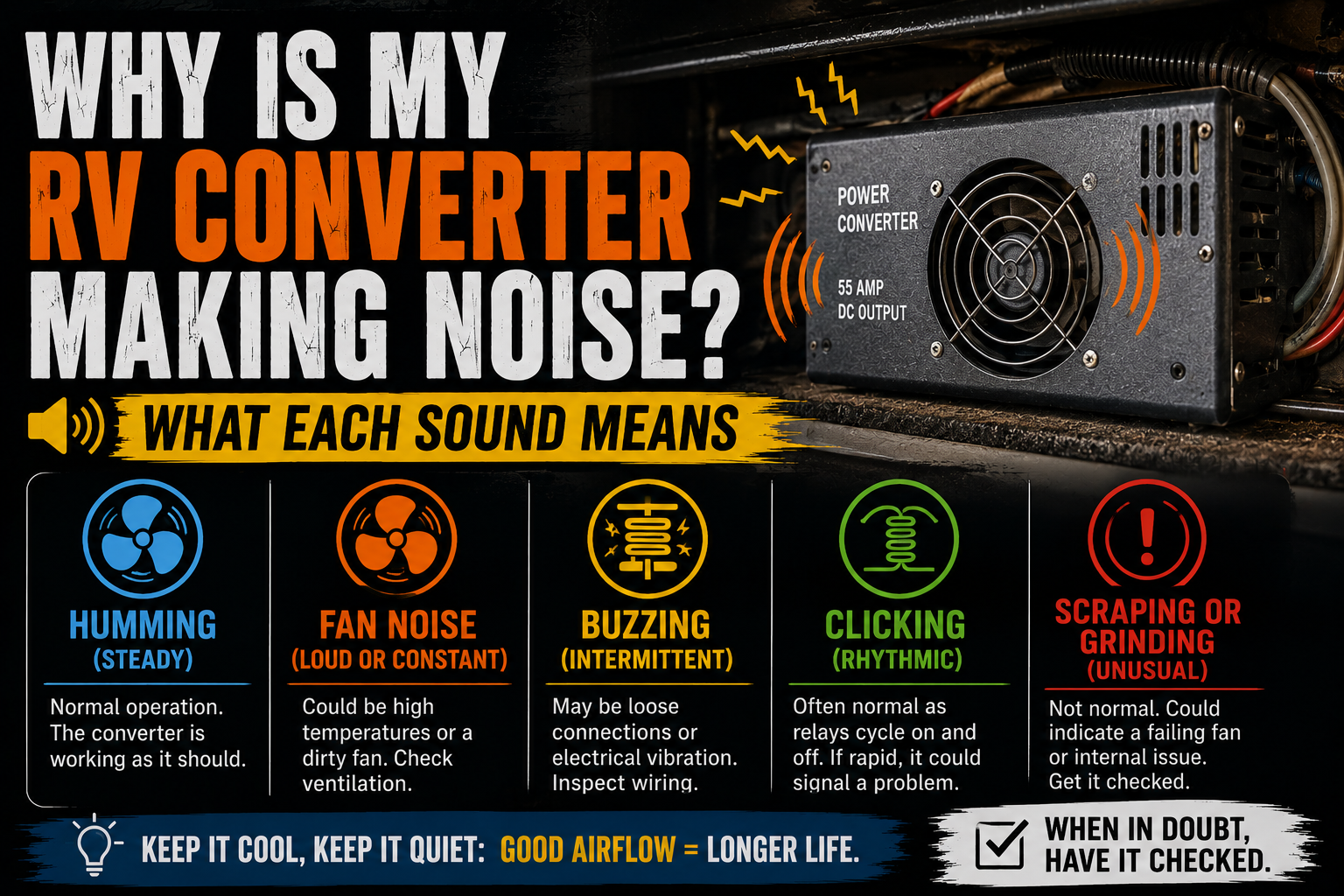
An RV converter doesn’t have to be completely silent to be healthy. That’s important to get out of the way right from the start.
You might hear its cooling fan kick on when the battery is charging hard. An older converter may have a noticeable electrical hum. Some older designs even contain relays you can physically hear click when shore power is applied. A fan that stays on beyond the initial charging period may need the closer troubleshooting described in converter fan running during charging.
But there’s another side to this.
If you’ve camped in the same RV for three years and suddenly the converter starts making a loud buzz, nasty rattle, high-pitched whine, repeated clicking, or grinding noise you’ve never heard before, I’m not going to tell you to ignore it.
Campers are pretty good at giving us little warnings before something quits.
The trick is figuring out whether you’re hearing normal converter operation or a sound that shouldn’t be there.
Is It Normal for an RV Converter to Make Noise?
Some noise can absolutely be normal.
How much depends heavily on the converter.
Modern converter/chargers contain electronic components and often use cooling fans. Older converter designs can be considerably different internally and may include transformers and electromechanical relays.
That’s why I’m hesitant whenever someone asks:
“Should my RV converter make noise?”
There’s no single sound that applies to every converter ever installed in a camper.
I want to know what kind of noise you’re hearing and whether it’s new.
Those two details tell me much more.
The Most Important Question Is Whether the Sound Changed
This is one of the simplest RV troubleshooting tricks I know.
Learn what normal sounds like in your camper.
Maybe your converter has always produced a faint hum when you’re plugged in.
That’s useful.
Maybe its cooling fan has always become fairly noticeable after you’ve been boondocking and reconnect to shore power.
Also useful.
But suppose that quiet hum suddenly becomes a loud electrical buzz.
That’s a change.
Or the smooth fan noise suddenly becomes a rattle.
That’s a change too.
A new sound doesn’t automatically mean the converter is dying, but it gives me a reason to investigate.


Why Is My RV Converter Buzzing?
A buzz is probably one of the most common descriptions people use for converter noise.
Unfortunately, “buzzing” can describe several completely different sounds.
A faint electrical buzz may simply be characteristic of the equipment.
A louder mechanical buzz could come from vibration.
A loose panel or mounting point can amplify a small vibration until the whole cabinet seems to be buzzing.
And a new, unusually loud electrical buzz can potentially indicate a problem that deserves closer inspection.
So before doing anything else, try to locate exactly where the noise originates.
Make Sure the Converter Is Actually Making the Buzz
Sound travels amazingly well through an RV.
You may swear the converter is buzzing when the actual noise is coming from something beside it.
The AC breaker panel.
A transfer switch.
An inverter.
A fan.
An appliance control.
A relay.
Another electrical component mounted against the same wall.
Put your ear near the area without opening energized equipment and see whether you can narrow down the source.
Don’t start replacing a converter until you’re sure that’s actually what’s making the noise.


Could an Older RV Converter Normally Hum?
Yes.
Older converter designs can contain a traditional transformer, which can produce an audible hum.
Progressive Dynamics’ documentation for some of its older converter designs describes a transformer that steps shore-power voltage down before the rectifier converts it to DC.
Transformers can produce some audible vibration during normal operation.
So if you’ve got a decades-old converter that’s hummed for as long as anyone can remember, I wouldn’t diagnose failure from that fact alone.
But if the hum suddenly becomes dramatically louder, that’s different.
Why Does My RV Converter Hum Louder Than It Used To?
Now I’d start looking at what changed.
Is the battery deeply discharged?
Are you running more 12-volt equipment than usual?
Did the sound start after replacing the battery?
Did somebody work on the converter?
Is the converter hotter than usual?
Has a mounting screw or panel loosened?
Does the noise disappear when the converter’s electrical load decreases?
Those clues help separate electrical load from a physical vibration or internal problem.
Battery Charging Can Change Converter Behavior
Remember what the converter is actually doing.
When you’re plugged into shore power, the converter supplies DC power and, in a typical converter/charger installation, charges the house battery.
A heavily discharged battery can make the converter work considerably harder than a fully charged battery.
So if you notice more converter activity immediately after plugging in with a low battery, don’t automatically assume the noise means failure.
Check what the charging system is doing.
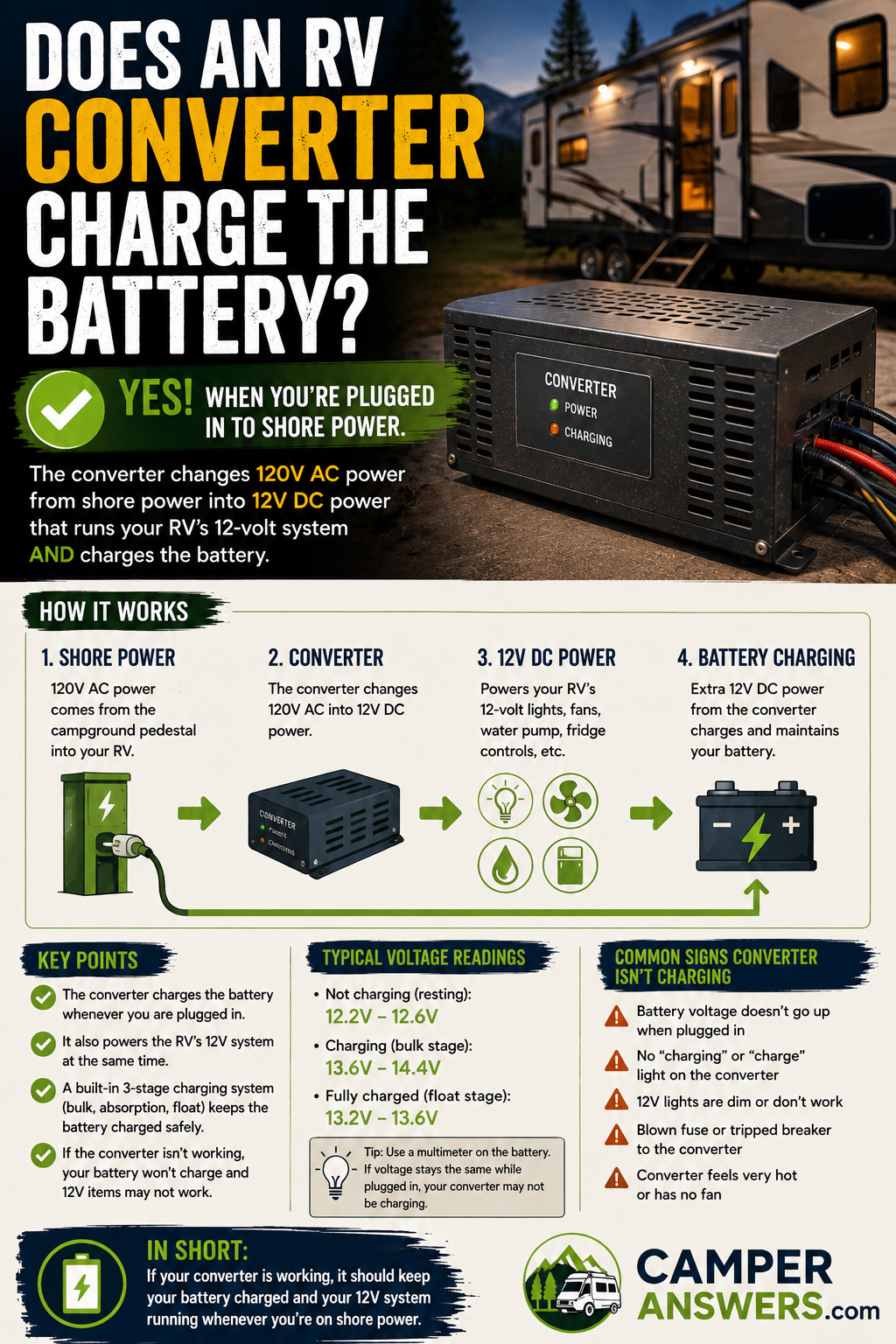
Our guide explaining how an RV converter charges the battery will help if you’re still getting familiar with that side of the electrical system.
Listen for the Cooling Fan
This is where people sometimes mistake completely normal fan operation for converter trouble.
Modern converters can use automatic cooling fans that run when necessary.
For example, Progressive Dynamics says the fans in its PD9100 and PD9200 converters use electronic temperature sensing and typically operate more during high-current conditions.
A smooth rush of moving air is very different from an electrical buzz.
Listen closely.
Is the noise actually the fan?
What Does a Normal Converter Fan Sound Like?
Usually I’m expecting something fairly smooth.
Air moving.
A steady fan motor.
Maybe the fan speeds up or slows down as conditions change, depending on the converter.
Some converter models use variable-speed cooling fans. Progressive Dynamics, for example, specifies automatic variable-speed cooling on its PD4600 replacement converters.
So a changing fan sound doesn’t necessarily mean something is wrong.
The converter may simply be changing its cooling effort.
What Does a Bad Converter Fan Sound Like?
This is different.
Grinding.
Scraping.
Rattling.
Squealing.
A fan that sounds like it’s struggling to start.
A repeated start-stop-start sound accompanied by mechanical noise.
That’s when I’d inspect the fan and ventilation area.
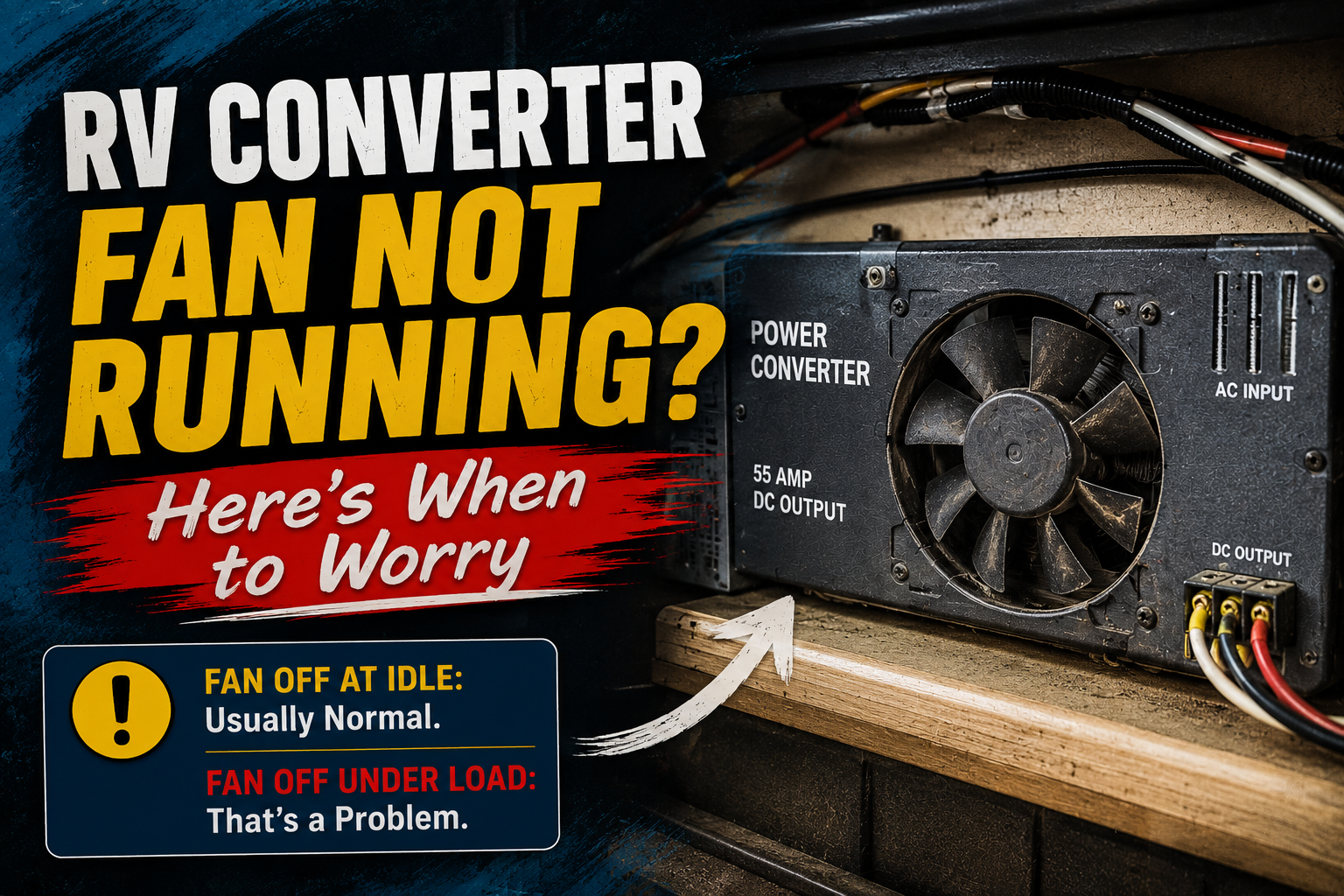
We’ve already built a complete guide for an RV converter fan that isn’t running, because a failed cooling fan can eventually become much more important than the annoying sound it makes.
Why Is My RV Converter Rattling?
A rattle makes me think mechanical before electrical.
The fan is one possibility.
Something could be touching the fan blades.
A bearing could be wearing out.
Debris may have found its way into the cooling area.
But don’t forget the converter mounting itself.
An electrical component that produces a small amount of normal vibration can make an enormous racket if that vibration transfers into a loose panel, cabinet, cover, or mounting surface.
That’s why I like physically inspecting the installation with the power safely disconnected.
Check Whether Something Is Loose
With all appropriate power sources safely disconnected, look at how the converter is mounted.
Is it secure?
Is a cover loose?
Is a nearby panel vibrating?
Is something sitting against the converter?
Has camping gear shifted against the enclosure?
Sometimes you can turn an apparently serious electrical buzz into silence by finding a piece of trim that’s vibrating against the cabinet.
Don’t open or modify the converter unnecessarily.
Start with the obvious external stuff.
Why Does My Converter Click?
Clicking depends enormously on converter design.
Older converters can contain relays that physically operate when shore power is connected.
Some old Progressive Dynamics documentation actually instructs owners to listen for a click from the converter as part of troubleshooting the relay operation.
So a single click during a power transition on certain older equipment isn’t automatically a problem.
Repeated clicking is another story.
Why Does My Converter Keep Clicking Over and Over?
Now I want to know what’s happening electrically at the same time.
Do the lights flicker?
Does converter output disappear?
Does battery voltage jump around?
Does the clicking happen only on generator power?
Does it happen when shore power is weak?
Does the converter repeatedly turn on and off?
Repeated clicking plus unstable electrical behavior gives us more to investigate than a single normal relay operation.
Don’t diagnose from the sound alone.
Measure what the electrical system is doing while the symptom occurs.
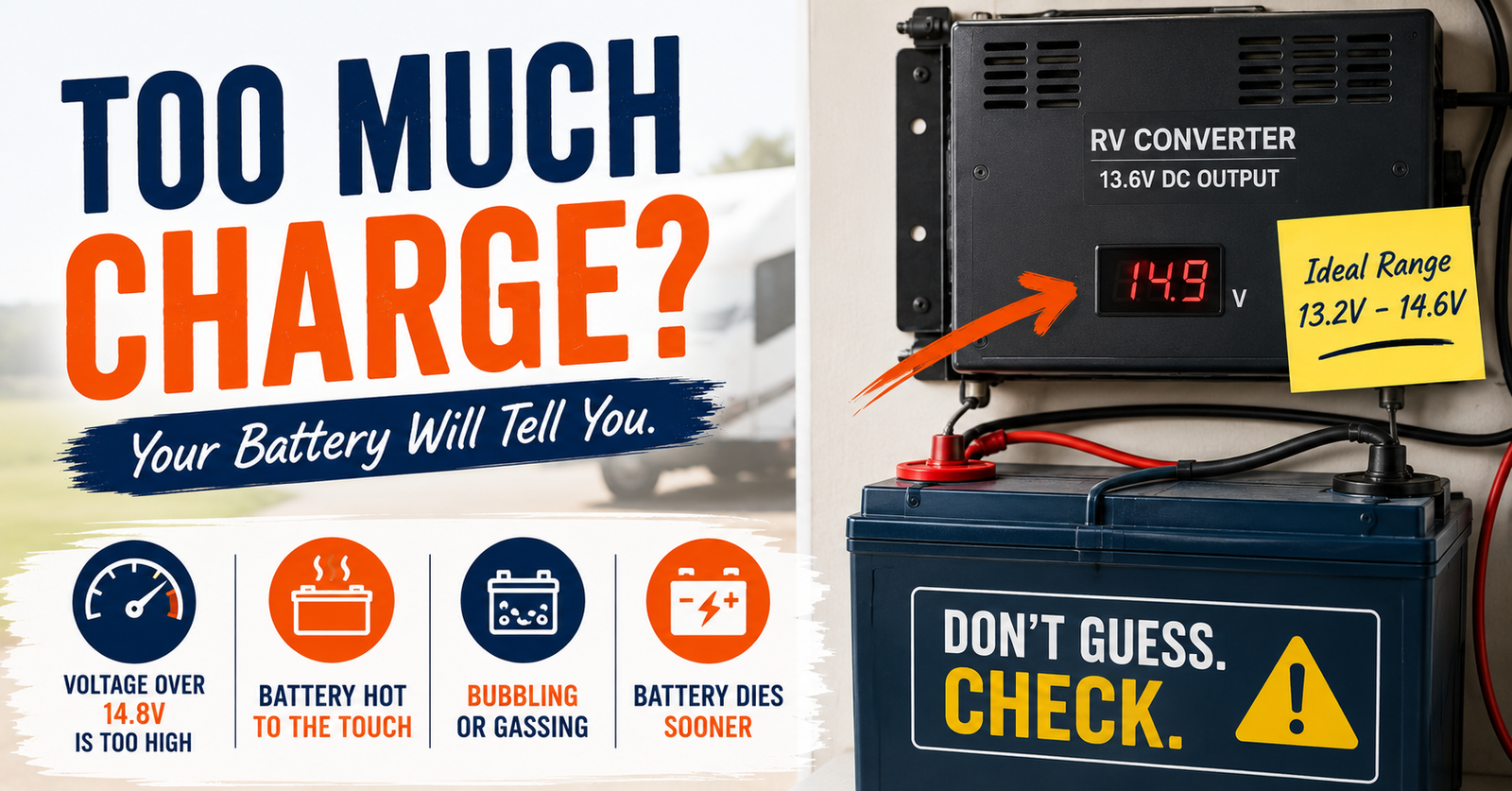
Check Your Converter Output Voltage
This is where the multimeter becomes much more useful than your ears.
If the converter is making a strange noise, see whether it’s still producing the voltage it should.
Different converters and charging modes can produce different voltages.
For example, Progressive Dynamics specifies approximately 13.6 volts, plus or minus 0.3 volts, for a particular no-load output test on many standard PD9100 and PD9200 converters.
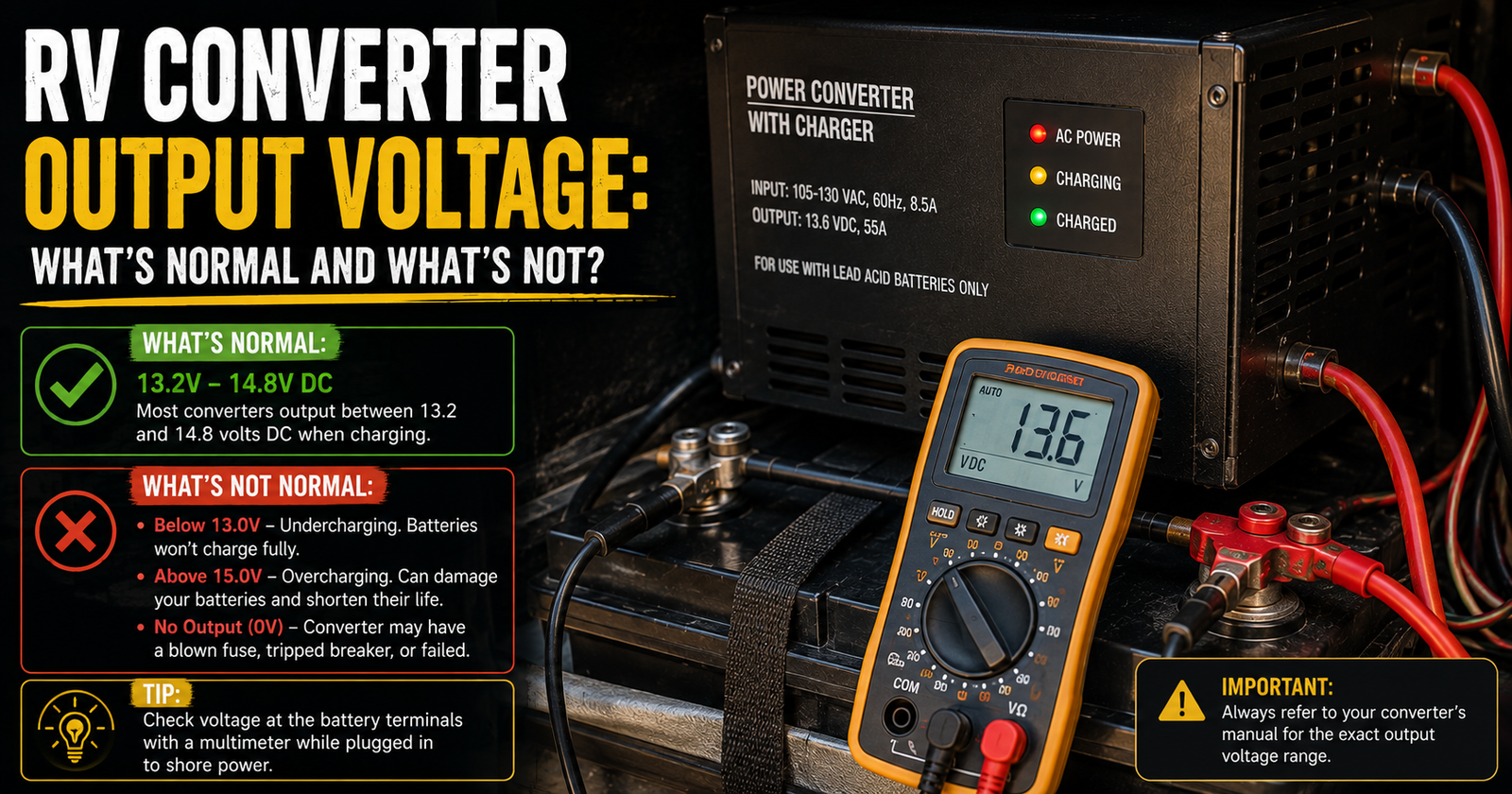
We’ve already gone much deeper into what RV converter output voltage should be.
Sound plus voltage tells me far more than sound alone.
Normal Voltage but Strange Noise?
That’s actually useful information.
Suppose the converter is producing exactly what the manufacturer specifies.
The battery is charging.
The 12-volt system works.
But you’ve got a rattle.
Now I’m more interested in cooling fans, vibration, mounting, covers, and mechanical noise than a complete electronic failure.
It doesn’t prove the converter is perfect.
But it helps us narrow the problem.
Strange Noise and Bad Output Voltage?
Now I’m more concerned.
Suppose the converter suddenly starts buzzing loudly and output voltage is no longer within its expected range.
That’s not something I’d brush off as “they all hum.”
We’ve now got two symptoms:
Abnormal sound
and
abnormal electrical output.
That’s when the converter itself moves much higher on my suspect list.
What If the Converter Is Buzzing but Has No Output?
Follow the no-output problem first.
The buzz is useful, but the electrical failure matters more.
Check the converter according to its manufacturer’s troubleshooting procedure.
On certain Progressive Dynamics models, that means checking reverse-battery protection fuses, verifying AC input power, and measuring converter DC output.
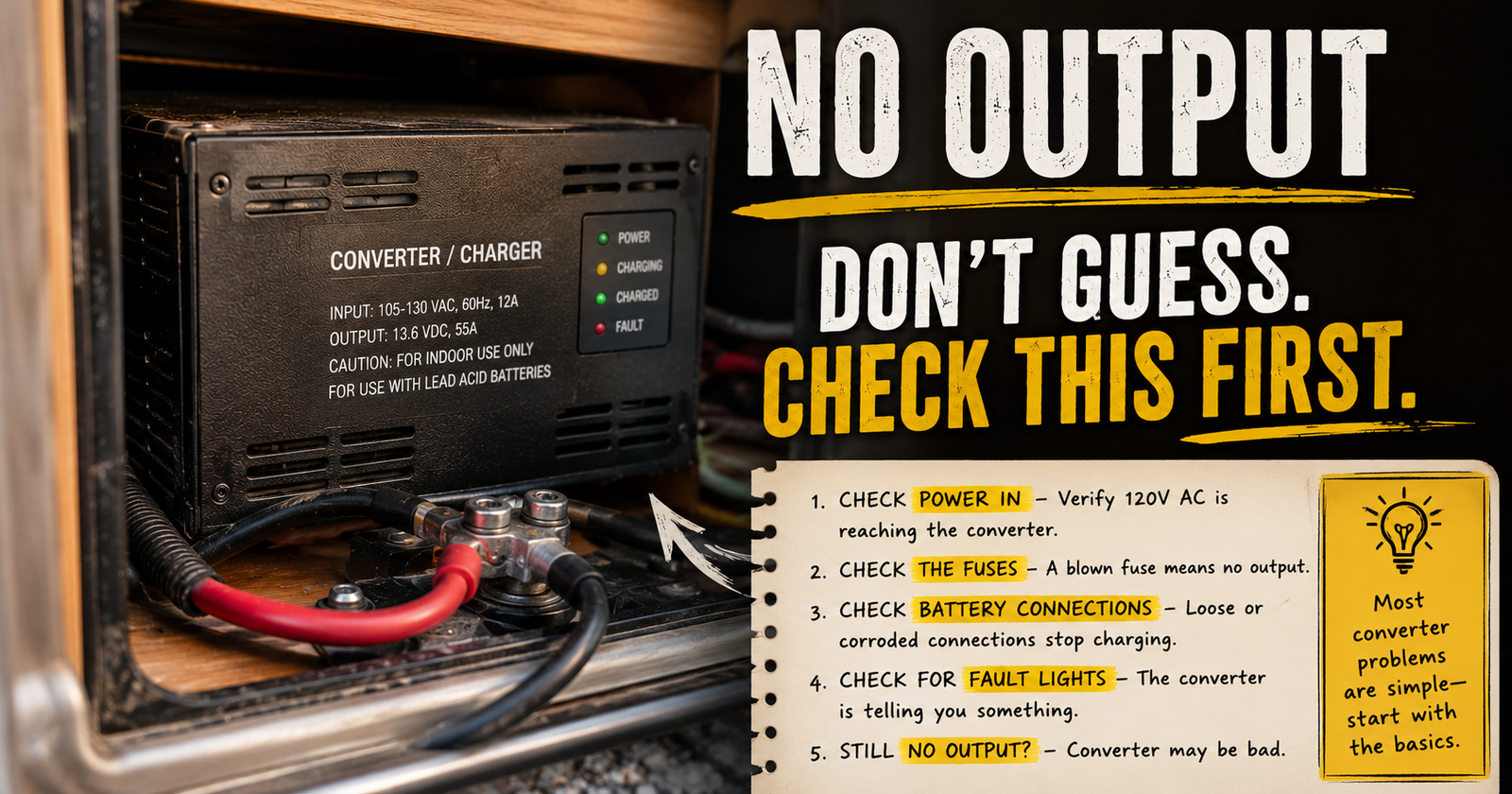
We’ve already built that whole troubleshooting path in our guide for an RV converter that has no output.
Don’t let an interesting sound distract you from a measurable failure.
Can a Bad Battery Make the Converter Noisy?
Potentially, although I’d describe this carefully.
A deeply discharged or problematic battery can make the converter work harder because it’s trying to supply charging current.
More converter load can mean more heat.
More heat can mean more fan activity.
So sometimes what sounds like a “converter noise problem” is actually the converter responding to what the battery is asking from it.
That makes battery condition worth checking.
Watch What Happens as the Battery Charges
This is a really useful observation.
Suppose you plug into shore power with a heavily discharged battery.
The converter is noisy.
Fan running.
Lots happening.
Several hours later the battery has recovered substantially.
Does the converter become quieter?
If yes, the noise may have been directly related to the heavy charging workload.
If it stays unusually loud even when the battery is charged and DC demand is minimal, I’m more interested in the converter itself.
A Battery That Never Finishes Charging Deserves Attention
If the converter constantly seems to be working hard, don’t forget to investigate the battery.
A damaged battery may not behave normally during charging.
Before blaming the converter for working overtime, make sure the battery can actually hold a charge.
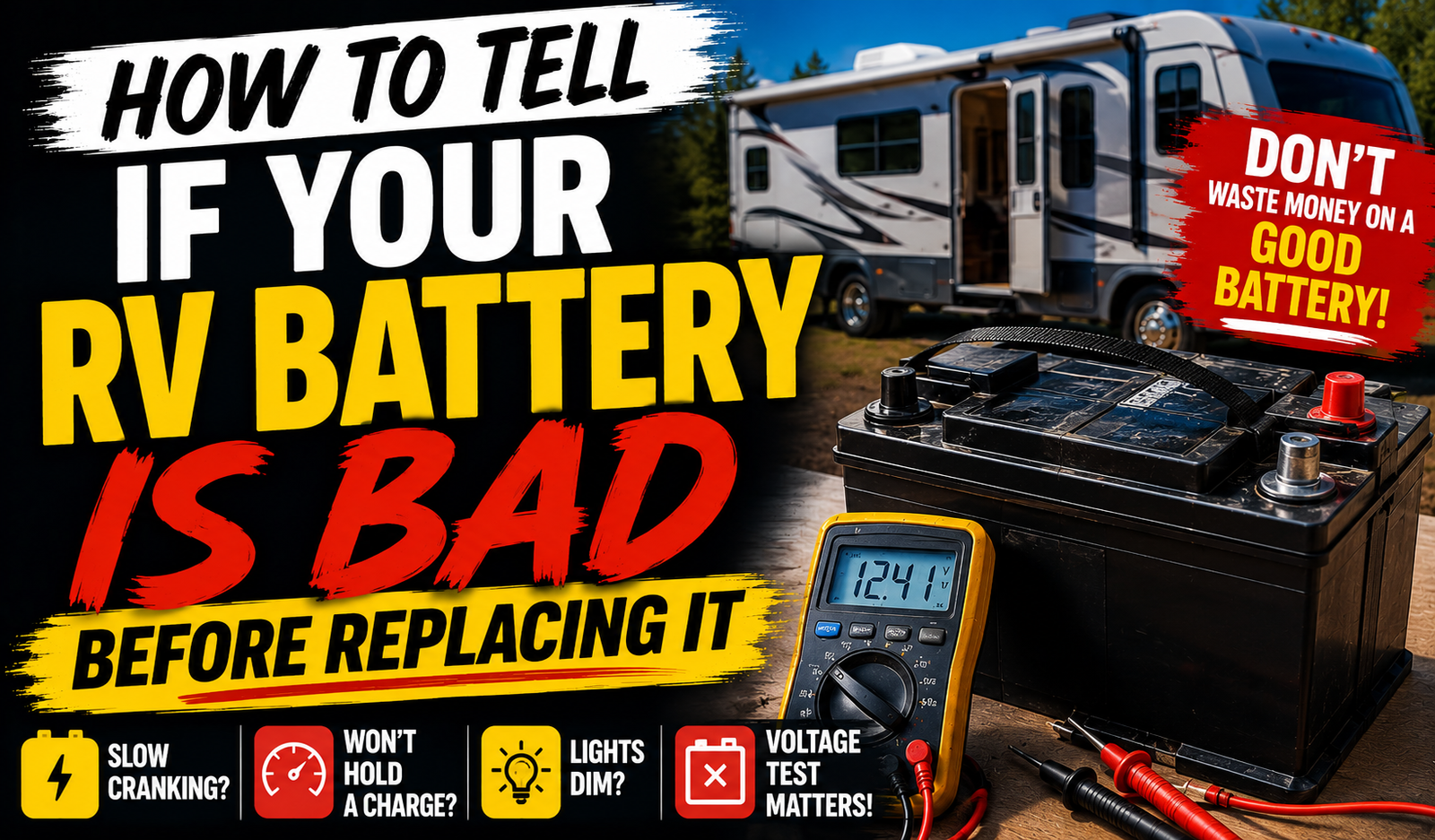
Our guide to telling whether an RV battery is bad before replacing it is where I’d go next if the battery is questionable.
What If the Noise Only Happens When Several Lights Are On?
That’s a fantastic clue.
Converter workload increases as DC demand increases.
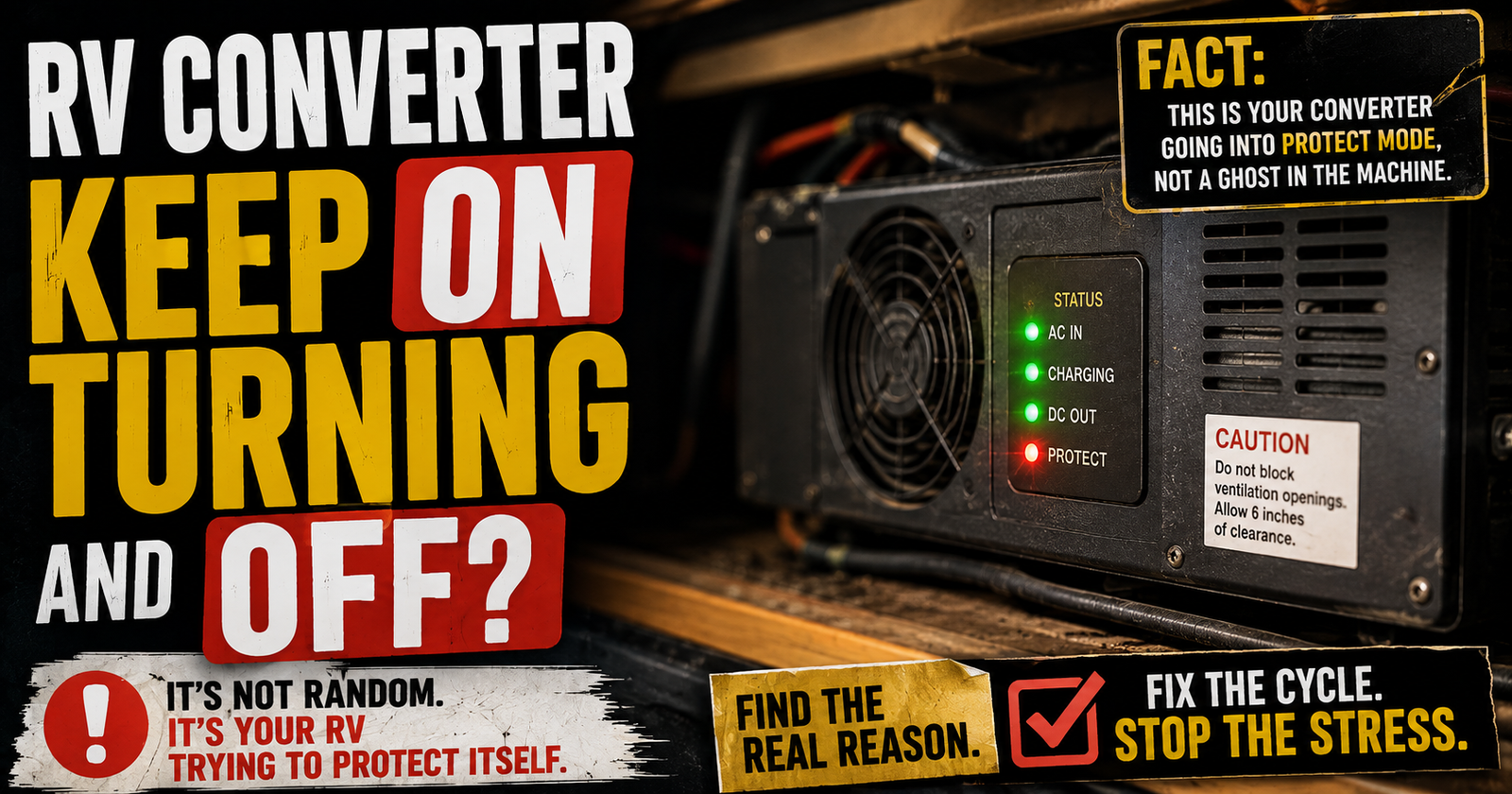
If fan speed or overall converter noise changes predictably as you add normal 12-volt loads, the noise may simply be associated with increased converter output and cooling. If the sound is accompanied by disappearing lights or charging, the guide to converter fan cycling explains how to distinguish normal cooling changes from lost output.
Turn unnecessary loads back off.
Does the noise settle down?
That’s useful information.
What If It Buzzes With Almost Nothing Turned On?
Now I’d be more curious.
Battery charged.
Few 12-volt loads.
Cool compartment.
Plenty of airflow.
Converter still suddenly buzzing much louder than it used to.
That’s when I’d investigate further.
Check output.
Check battery charging behavior.
Check for physical vibration.
Check the model’s documentation.
And pay attention to temperature.
Heat Changes the Situation
A noisy converter that’s cool and operating normally is one thing.
A noisy converter that’s extremely hot is another.
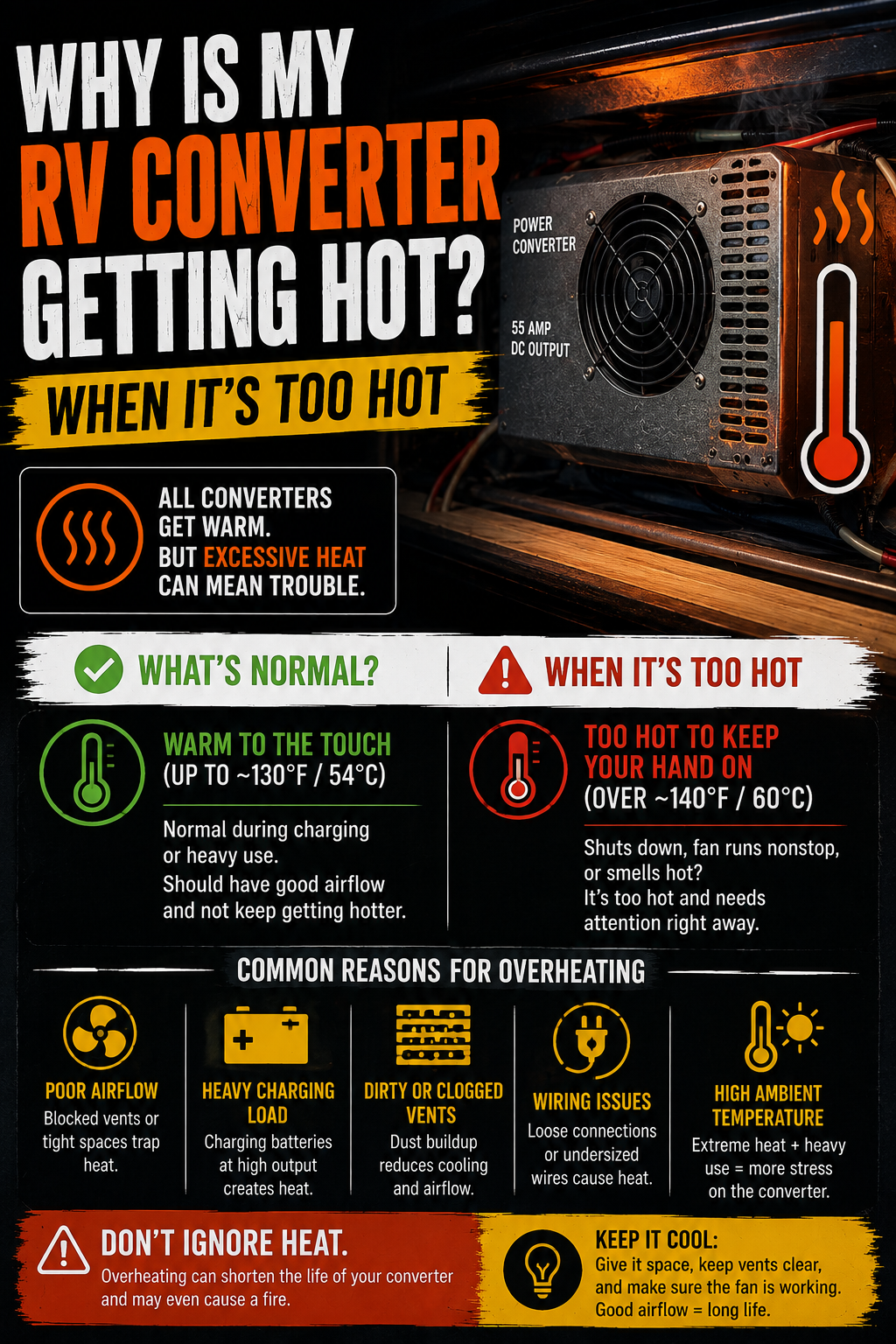
Converters need adequate ventilation. Progressive Dynamics specifies at least five inches of clearance or otherwise sufficient ventilation around its PD9100 and PD9200 installations to allow proper airflow. Poor airflow is one of the practical causes discussed in RV converter ventilation and overheating, especially when a converter runs warmer than usual.
If the converter is buried under camping gear or installed in a compartment with blocked ventilation, fix that problem.
Don’t make the cooling system fight for air.
What If It’s Buzzing and Smells Burnt?
Stop using it until the cause is identified.
That’s no longer just an annoying converter.
A burnt electrical smell, melting insulation, discoloration, smoke, or obvious overheating deserves immediate attention.
Safely disconnect appropriate power sources and have the system inspected.
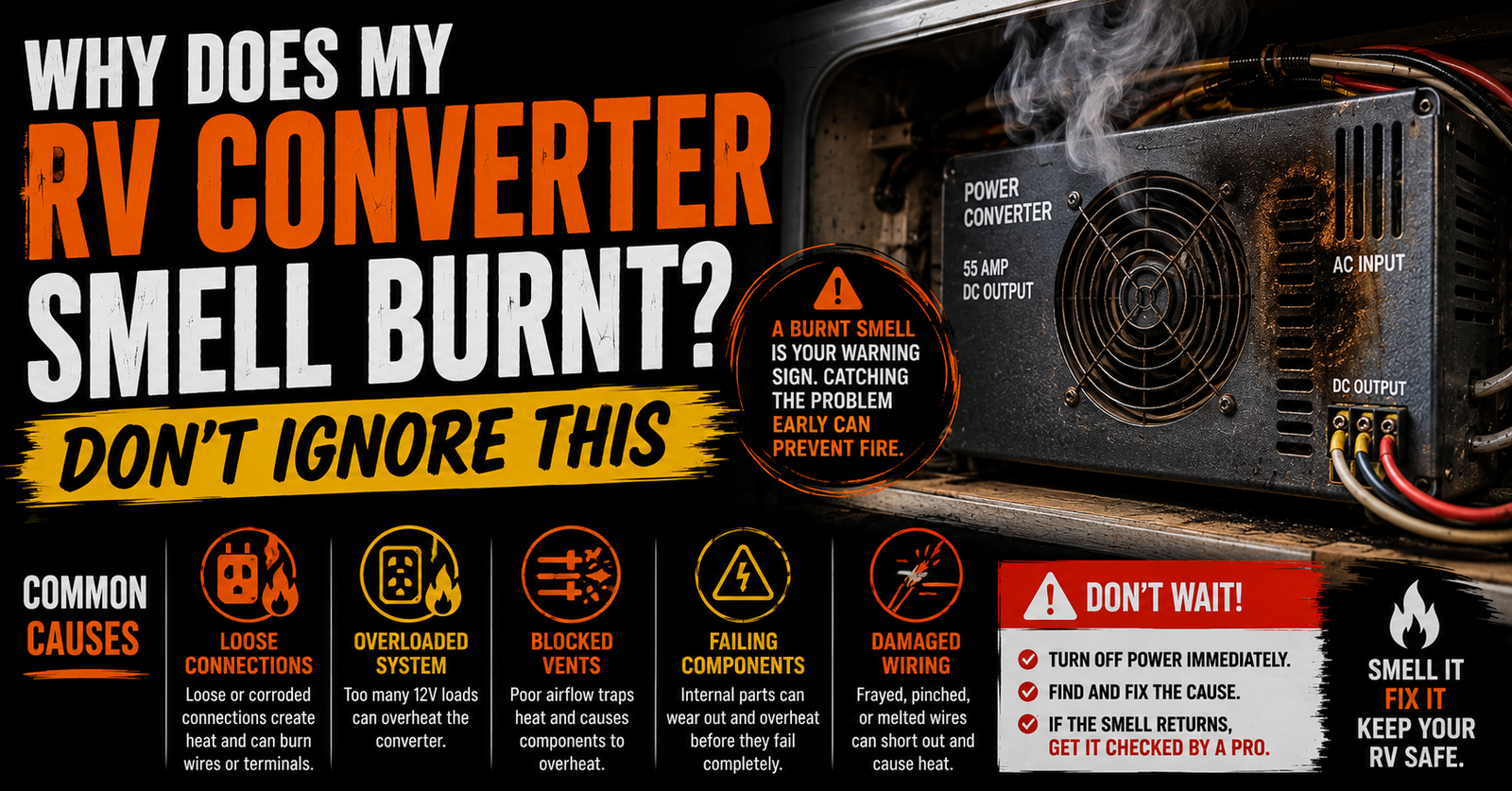
We’re going to make RV converter smells burnt its own article because I want that page to clearly separate ordinary converter warmth from symptoms where I’d stop using the equipment.
What If I Hear a High-Pitched Whine?
Electronic power supplies can sometimes produce higher-frequency sounds under certain operating conditions.
The significance depends on the converter, load, and whether the sound has always been present.
A faint whine that’s characteristic of a particular converter is different from a loud new whine accompanied by unstable output, excessive heat, or charging problems.
Again, don’t diagnose the converter from the pitch.
Look at everything happening with it.
Could Shore Power Cause Converter Noise?
Incoming AC power can absolutely affect how electrical equipment behaves.
Progressive Dynamics lists an input voltage tolerance of 105 to 130 volts AC for its PD4600 converter replacements, for example.
Your converter may have different specifications.
If the strange behavior happens only at one campground, that interests me.
If it happens everywhere, that’s different.
Patterns matter.
What If It Only Makes Noise on Generator Power?
That’s another great clue.
If the converter is quiet and completely normal on shore power but behaves strangely whenever you switch to a generator, investigate the power source too.
Check the generator output according to its specifications.
Check connections.
Check the converter’s allowable input range.
Don’t condemn the converter until you understand why changing AC sources changes its behavior.
Can Loose Electrical Connections Cause Noise?
Loose electrical connections can create heat, voltage problems, intermittent operation, and potentially arcing, so they deserve serious attention.
But don’t go tightening live electrical terminals because you heard a buzz.
Progressive Dynamics specifically warns that electrical troubleshooting can involve dangerous voltage and should only be performed by someone who understands the risks.
If the investigation reaches exposed 120-volt wiring and you’re not qualified to work on it, that’s where I’d bring in an RV technician or electrician.
Don’t Forget All the RV’s Power Sources
Unplugging the shore cord doesn’t necessarily make an RV electrically dead.
You may still have:
House batteries.
Solar.
Generator connections.
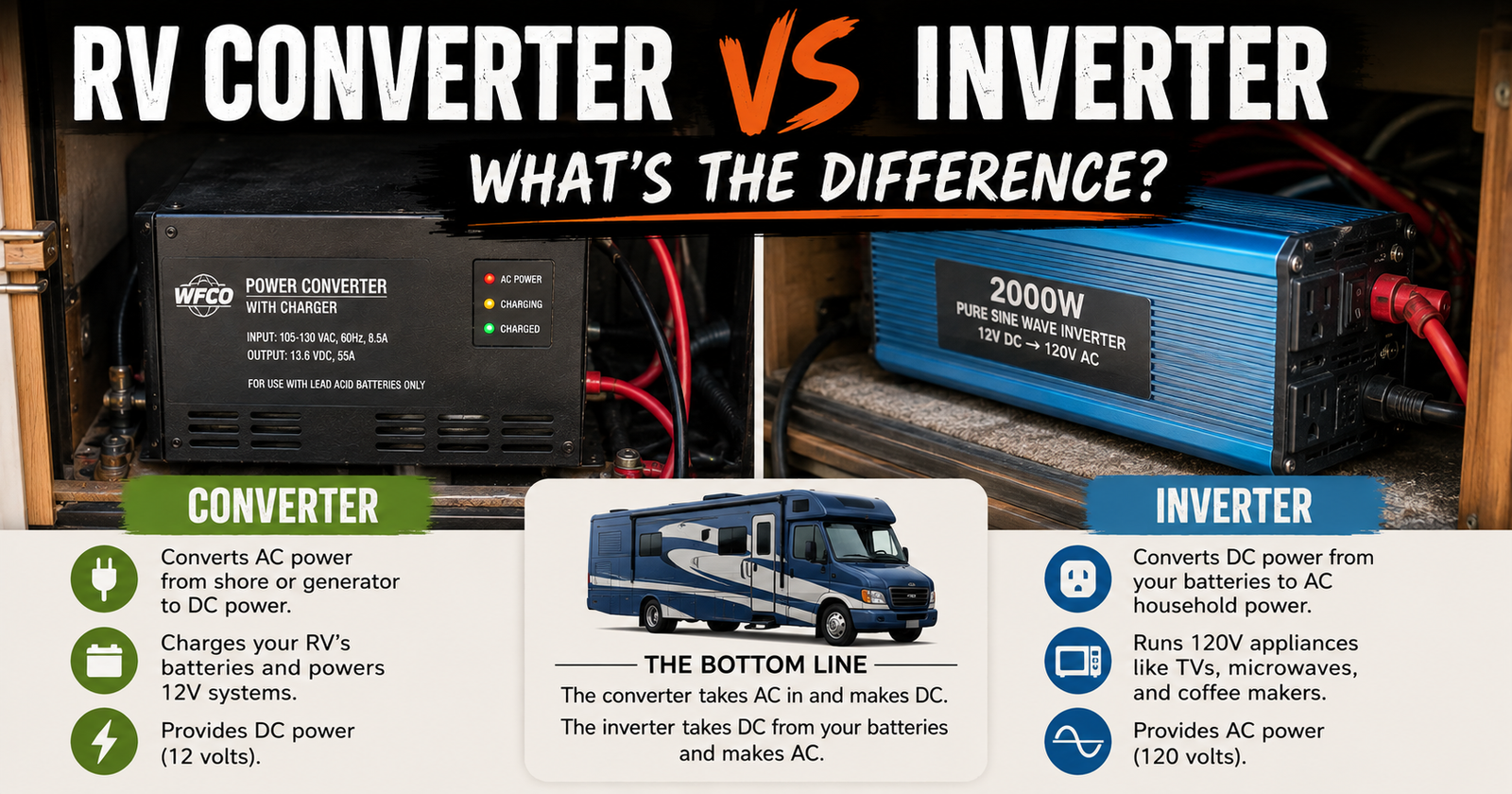
An inverter.
Other DC sources.
Progressive Dynamics replacement-converter instructions specifically call for disconnecting relevant AC and DC power sources before converter work.
Know what’s feeding the system before putting your hands into it.
Should I Replace a Noisy RV Converter?
Not just because it’s noisy.
I’d first determine:
Is the sound normal for this converter?
Is it the cooling fan?
Is something vibrating?
Is the converter output correct?
Is the battery charging properly?
Is the converter overheating?
Did the noise suddenly change?
Are there other electrical symptoms?
If everything tests correctly and the sound is simply characteristic of the converter, replacement may accomplish nothing except making your wallet lighter.
When Would I Suspect the Converter Is Failing?
The noise becomes much more concerning when it shows up alongside other symptoms.
Abnormal output voltage.
No output.
Repeated breaker trips.
Overheating.
Burnt smell.
Battery not charging.
Converter repeatedly shutting down.
Visible electrical damage.
A dramatic new sound.
That’s when I’d move into actual converter diagnosis.
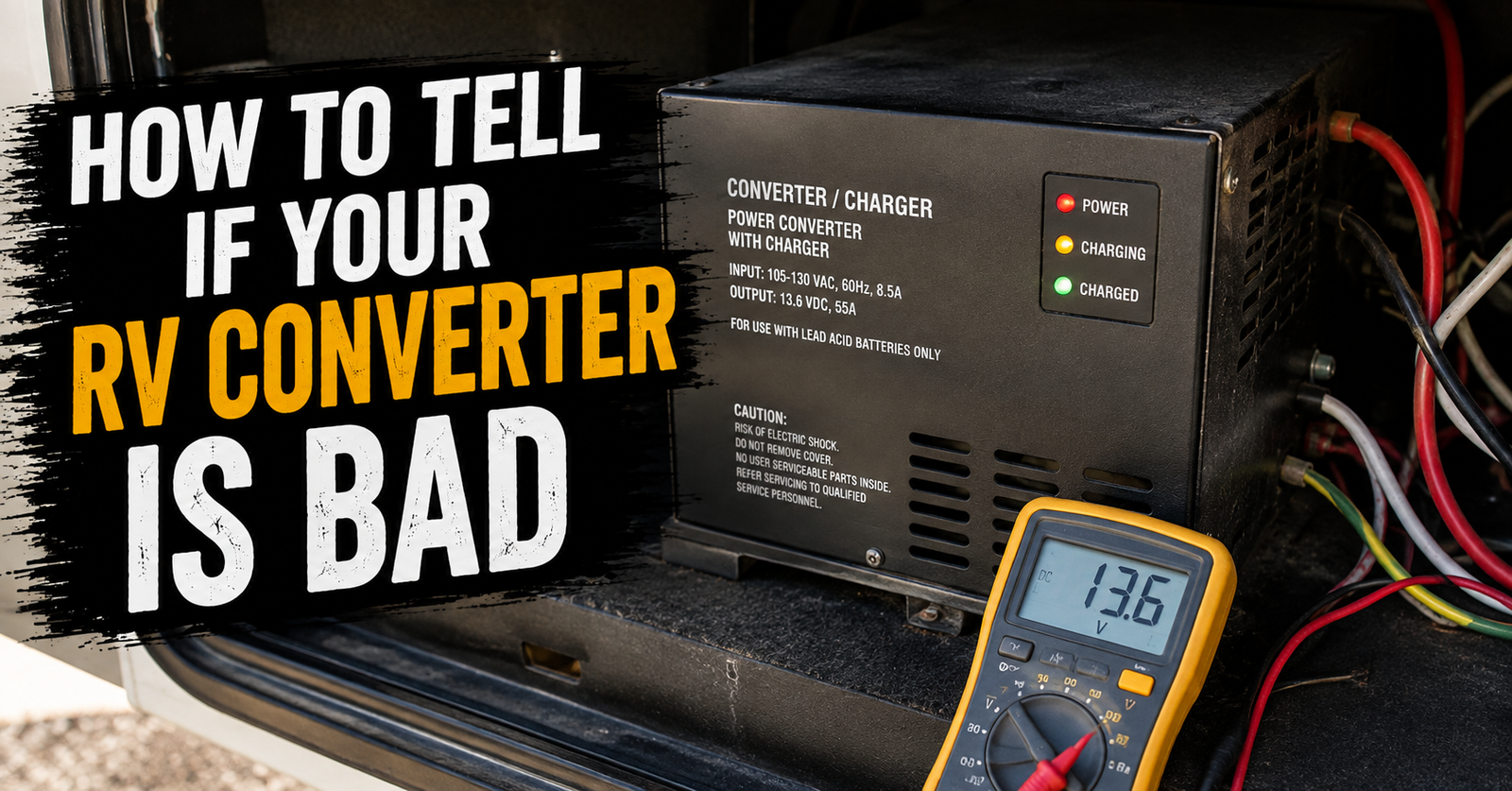
Our broader guide showing how to tell if an RV converter is bad is designed specifically for that decision.
Don’t Replace Parts Based on Sound Alone
That’s really the theme here.
Listen to your camper.
Absolutely.
A new buzz, hum, click, grind, or rattle can be an excellent early clue.
But then test what the converter is doing.
Check the battery.
Check output voltage.
Look at DC demand.
Pay attention to heat.
Inspect ventilation.
Figure out whether the noise changes with electrical load.
The sound tells you where to start looking.
The measurements tell you whether something is actually wrong.
And if your converter has always made a faint hum, its output is perfect, the battery charges properly, it stays at a reasonable temperature, and nothing else has changed, you may not have a problem at all.
But if that quiet little hum suddenly sounds like an angry electric toothbrush hiding under your dinette, I’d probably get the multimeter out.
Written by Evan Mercer
Evan Mercer writes about RV electrical systems, converters, battery charging and hands-on camper troubleshooting for CamperAnswers.com. His work focuses on helping RV owners understand which camper symptoms are normal and which ones are actually worth chasing down.