
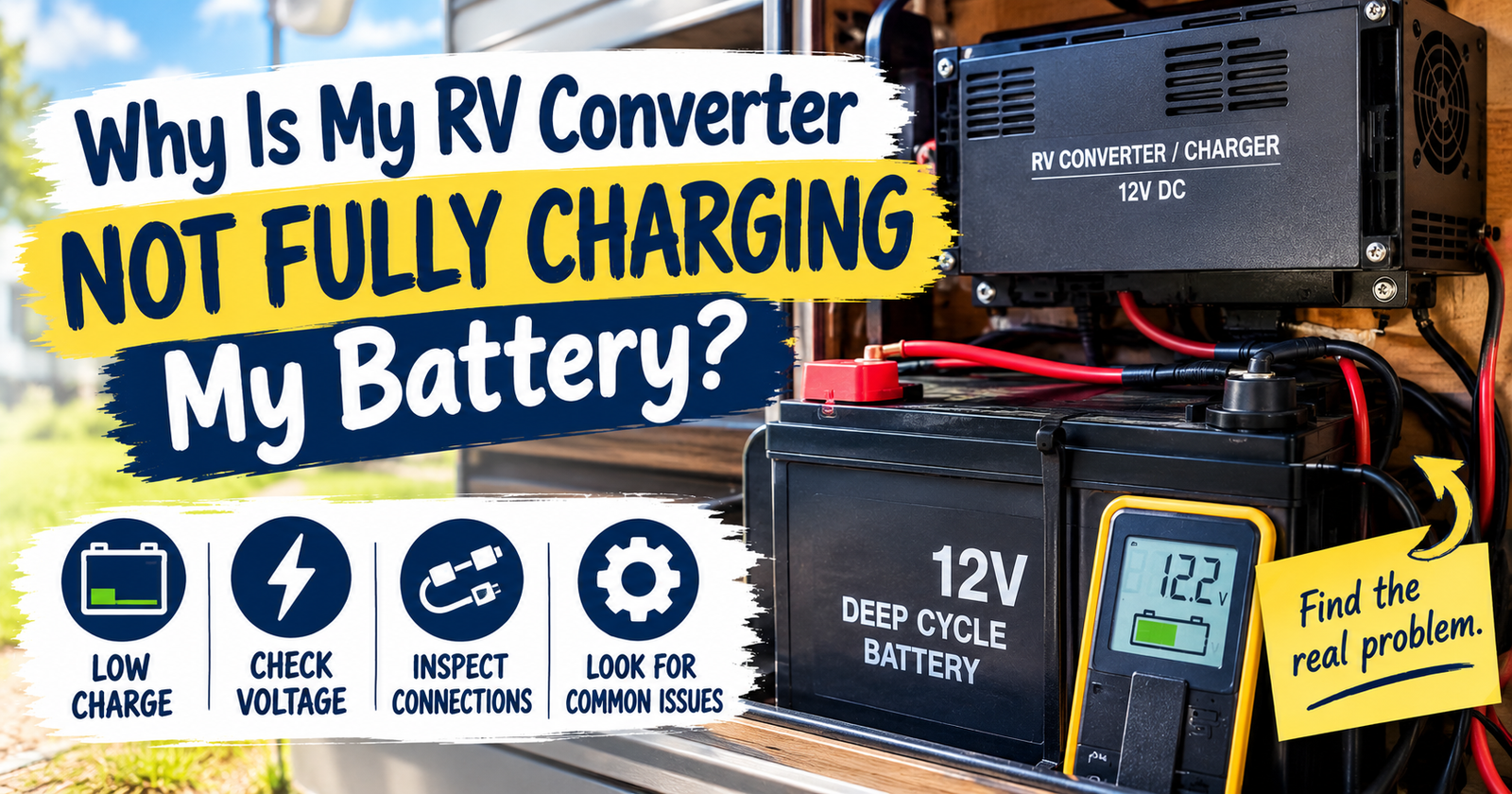
Your RV battery isn’t completely dead. The converter isn’t completely dead either. In fact, everything can look like it’s working normally when you plug into shore power. Before diagnosing the charging problem, review the difference between an RV converter and inverter so the shore-power and battery roles are clear.
That’s what makes this problem so aggravating.
You leave the camper plugged in all night expecting a full battery the next morning. You check it and find the battery still isn’t charged. Maybe it gained some charge, but nowhere near what you’d expect after sitting on shore power for hours.
If your RV converter charges the battery but never seems to get it fully charged, don’t immediately replace the converter. A weak battery, heavy 12-volt loads, voltage drop in the charging circuit, a bad connection, the wrong charging profile, or normal converter charging behavior can all make a perfectly good converter look weak. Before blaming the converter, use the RV battery health testing guide to separate a failing battery from a charging-system problem.
And there’s another possibility people often miss.
Your battery may actually be much closer to fully charged than the number you’re using to judge it suggests.
Before we condemn anything, let’s figure out what the converter and battery are actually doing.
First Make Sure the Converter Is Actually Charging
There’s an important difference between:
My converter isn’t charging the battery at all.
and:
My converter charges the battery, but it never seems to finish.
Those are two different problems.
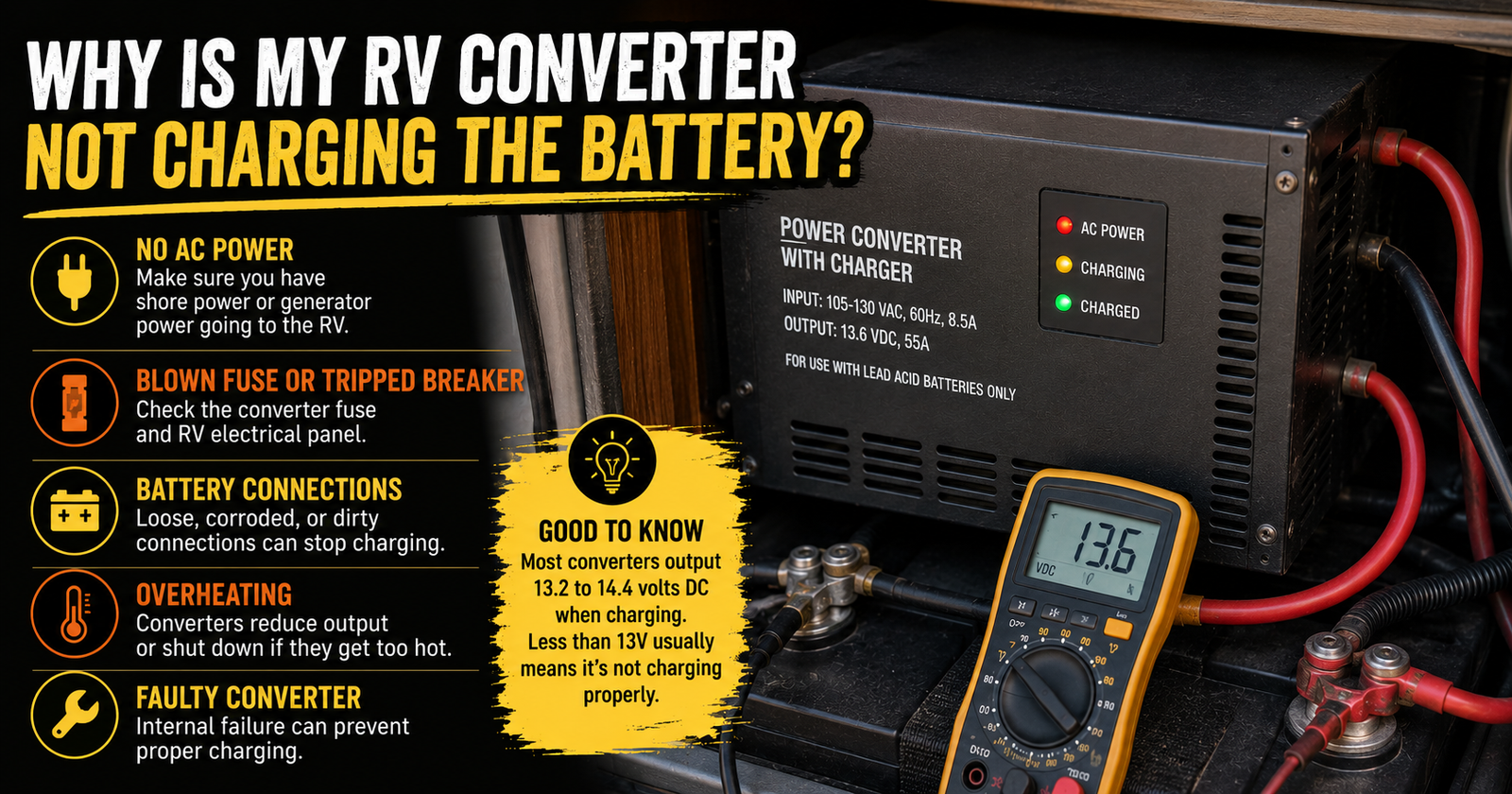
If battery voltage doesn’t rise at all when you connect the camper to shore power, I’d start with our guide to an RV converter that isn’t charging the battery.
For this problem, I’m assuming we’ve already established that charging is occurring.
Maybe the battery is sitting around 12.2 volts before plugging in and its voltage climbs once shore power is connected.
That’s useful.
We’ve proven that something is getting through.
Now we need to figure out why the charging process seems weak or incomplete.
What Voltage Should I See While My RV Battery Is Charging?
This depends on your converter and battery.
That’s going to become a recurring theme here because there is no single magic voltage that every RV converter should produce at every moment.
WFCO says applicable converters normally operate around 13.6 volts in absorption mode and can use approximately 14.4 volts during bulk charging of a substantially discharged lead-acid battery. The voltage can later drop to around 13.2 volts during float operation.
Other converter/chargers use their own charging strategies.
Progressive Dynamics, for example, specifies about 13.6 volts, plus or minus 0.3 volts, during the direct output test for applicable PD9100 and PD9200 standard converters. Its lithium versions have different specifications.
So don’t diagnose your converter from one generic number you found online.
Identify the converter first.

13.6 Volts Does Not Mean Your Battery Isn’t Charging
This is a really common misunderstanding.
People hear about 14.4-volt bulk charging and start thinking:
“Mine only shows 13.6. My converter isn’t charging.”
Not necessarily.
WFCO specifically says lead-acid batteries will continue charging around 13.6 volts during absorption mode, although charging can be slower.
That’s a big distinction.
Your converter doesn’t have to sit at its highest charging voltage every second that you’re plugged in.
It may be charging perfectly normally at a lower voltage.
Why Doesn’t My Converter Ever Reach 14.4 Volts?
This one gets even more interesting.
Your converter may actually be trying to enter a higher charging stage without you ever seeing 14.4 volts on your meter.
WFCO explains that its converters are current limited. When the converter is supplying a substantial amount of current, voltage can remain down in the high 12-volt range even when the converter is targeting its higher bulk-mode voltage. As current demand decreases, the measured voltage can climb.
That means:
“I never see 14.4 volts”
doesn’t automatically mean:
“My converter can’t produce 14.4 volts.”
Load matters.

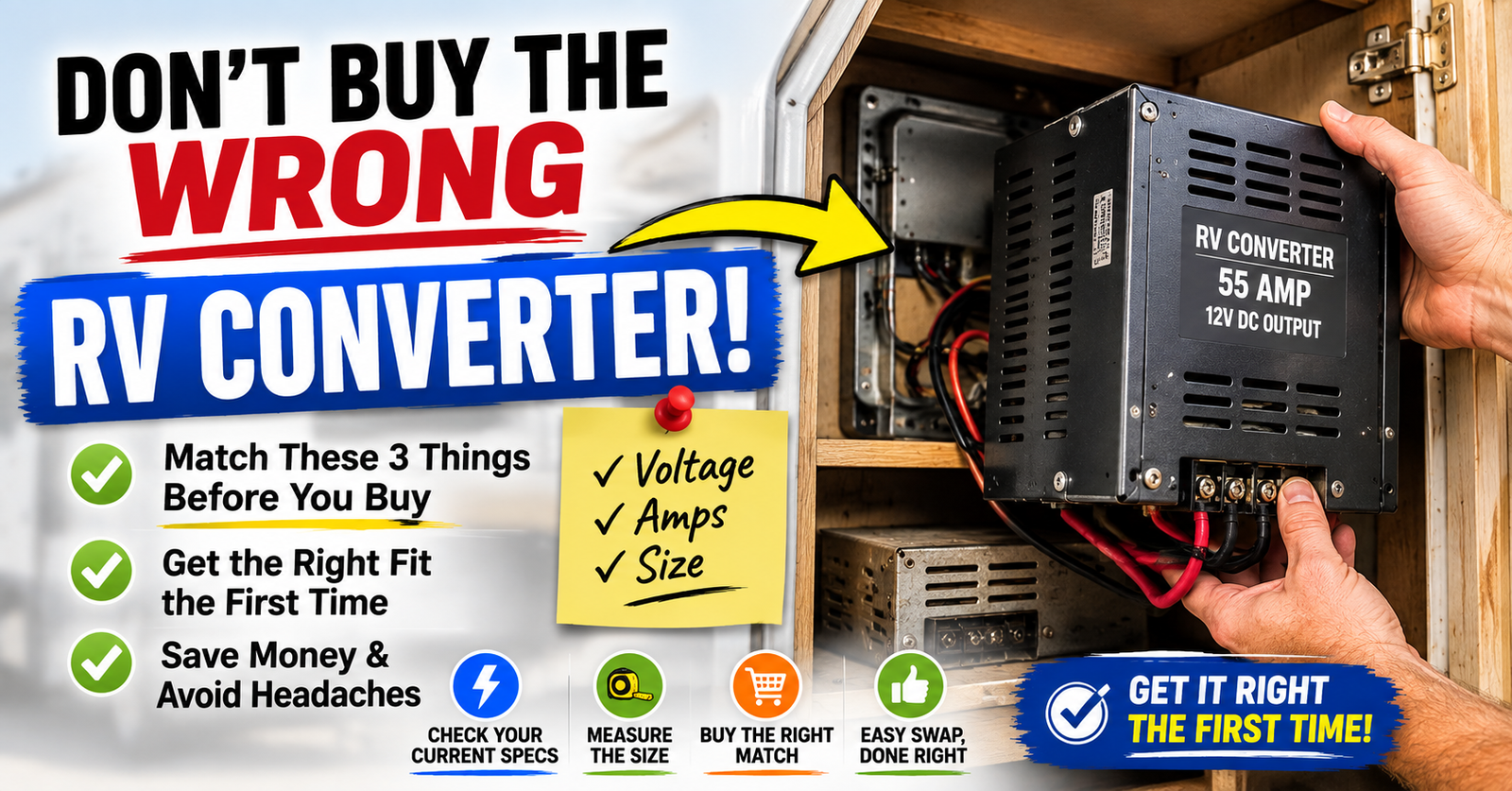
Your RV Is Competing With the Battery for Converter Power
This is one of the biggest things RV owners overlook.
The converter isn’t necessarily sitting there with its entire output dedicated to charging the battery.
It’s also running the camper.
Lights.
Vent fans.
Water pump.
Furnace blower.
Control boards.
12-volt refrigerator loads depending on the setup.
USB chargers.
Other DC equipment.
WFCO explains that converter amperage is supplied to the RV’s active loads first, with the remaining capacity available for battery charging.
So if you’re using a bunch of 12-volt equipment while trying to recharge the battery, you’re competing with yourself.
Try Turning Off Your 12-Volt Loads
This is one of the easiest tests you can make.
Turn off as many unnecessary 12-volt loads as practical.
Lights.
Fans.
Water pump.
Other DC equipment you don’t need.
Then give the converter time to charge.
WFCO specifically recommends reducing RV loads when a battery is taking a long time to charge because doing so makes more converter amperage available to the battery.
If charging performance suddenly improves considerably, you’ve learned something important.
The converter may not have been weak at all.
It may simply have been busy.
This Can Be Especially Noticeable With a Smaller Converter
Imagine a converter capable of supplying 35 amps.
Now imagine your RV’s active 12-volt equipment is consuming a significant chunk of that output.
Whatever remains is available for charging.
Compare that with a situation where almost every DC load is turned off.
Much more converter capacity can now go toward the battery.
That’s why converter amperage matters.
But don’t take that as permission to automatically install the biggest converter you can find.
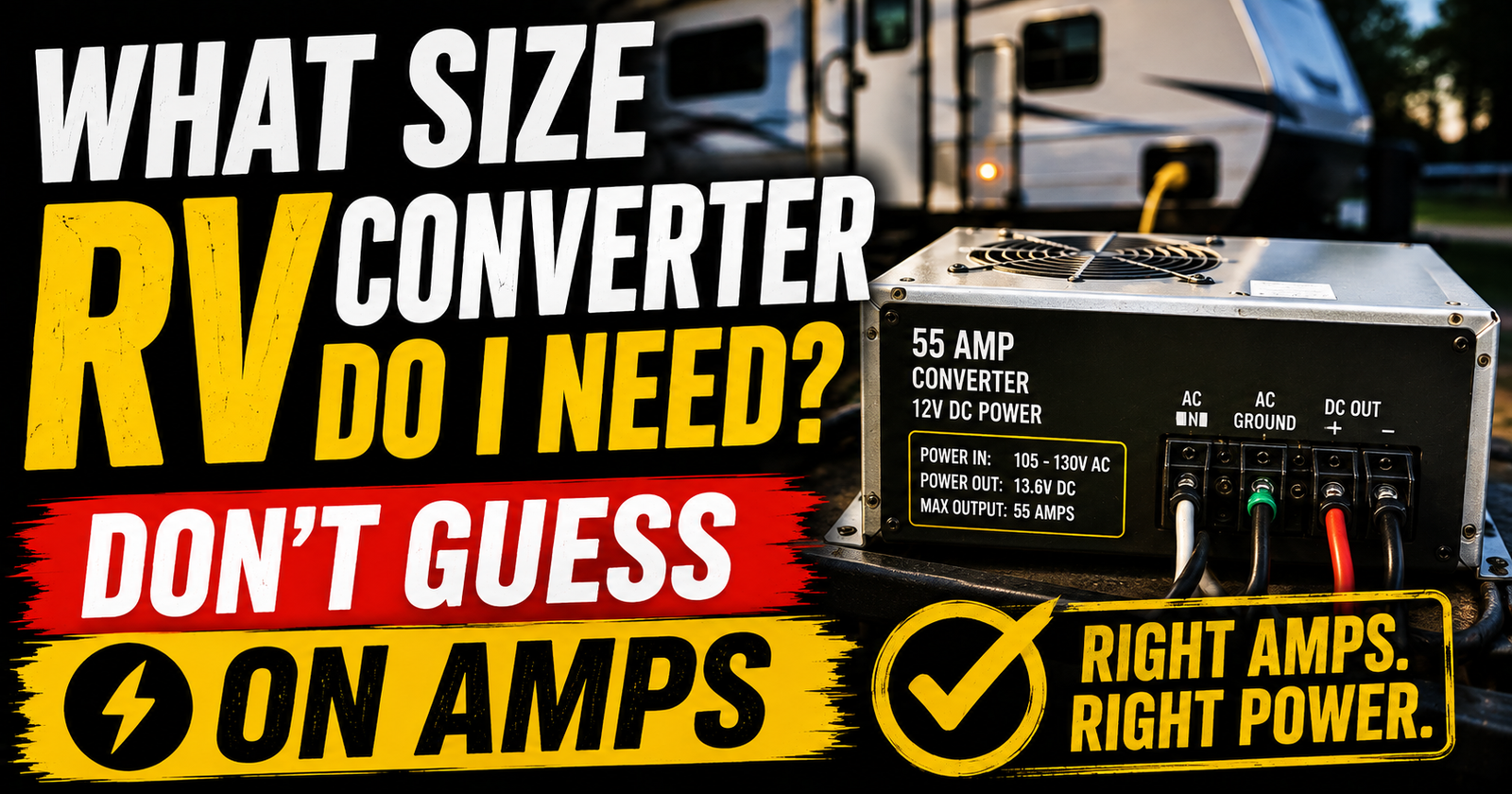
We’ve already covered how to determine what size RV converter you actually need.
The converter still needs to match the RV’s electrical system.
A Bigger Battery Bank Can Take Longer to Charge
This sounds obvious once you think about it, but it catches people all the time.
You upgrade from one house battery to a much larger battery bank.
Now you have far more usable capacity.
Great.
But after using a large portion of that capacity, you’ve also got considerably more energy to put back.
The converter hasn’t necessarily gotten any bigger just because the battery bank did.
A converter that felt perfectly adequate charging one modest battery may feel painfully slow charging a large depleted bank.
That doesn’t mean it failed.
It may simply be doing the same job for a much larger battery bank.

Adding Batteries Doesn’t Give You Free Energy
Suppose you double the size of your battery bank.
You may roughly double the amount of stored energy available, depending on the batteries and configuration.
But your converter doesn’t magically double its charging output.
WFCO notes that adding batteries can provide longer DC runtime when you’re away from shore power, while also potentially reducing charging efficiency or increasing charging time depending on the system.
This is why battery-bank upgrades and charging-system upgrades sometimes need to be considered together.
A Nearly Dead Battery Can Pull a Lot of Converter Current
A deeply discharged battery can create substantial charging demand.
WFCO notes that an RV battery can pull 30 amps or more from a converter under some conditions.
That doesn’t mean every battery will draw exactly 30 amps.
It illustrates how significant the charging load can become.
Now combine that with lights, furnace, fans, and other DC equipment.
Your converter can be working pretty hard.
Measure Voltage Directly at the Battery
This is where I grab the multimeter.
Don’t rely only on the RV’s little battery-level indicator.
Measure directly at the battery terminals.
I want to know what happens before and after shore power is connected.
For example, imagine you measure:
12.2 volts before shore power
Then:
13.5 volts after connecting shore power
Something is clearly happening.
Charging voltage is reaching the battery.
That’s very different from measuring 12.2 volts before shore power and essentially the same thing afterward.
Then Measure at the Converter
Now we can compare both ends of the charging circuit.
Suppose you have:
13.6 volts at the converter
but only:
12.8 volts at the battery
while substantial charging current is flowing.
That’s a clue.
We’ve got voltage disappearing somewhere between the converter and battery.
Wire and connections have resistance.
A little voltage drop is unavoidable.
A large drop is something I want to investigate.
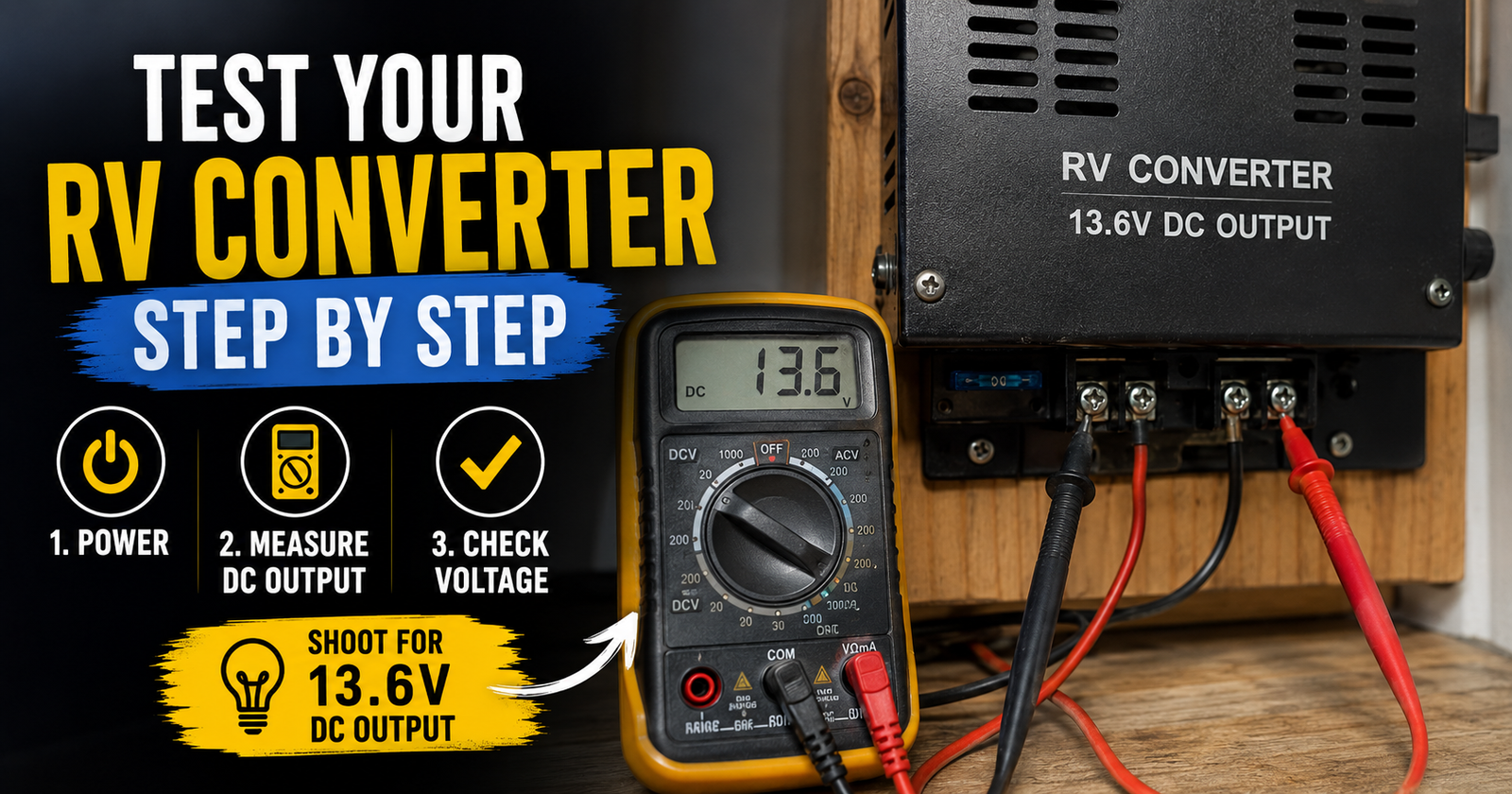
Our RV converter multimeter testing walkthrough goes deeper into checking converter output without guessing.
Voltage Drop Can Make a Good Converter Look Weak
Think about the charging path between the converter and battery.
There may be:
Battery cable.
Fuse.
Fuse holder.
Auto-reset circuit breaker.
Battery disconnect.
Distribution panel.
Connections.
Ground cable.
Frame ground.
More connections.
Every one of those is another place where resistance can develop.
Corrosion, loose terminals, undersized wire, damaged conductors, and poor grounds can all interfere with charging.
The converter may be producing exactly what it’s supposed to produce.
The battery just isn’t receiving all of it.
Check the Positive Charging Cable
Start with the obvious stuff.
With the system safely de-energized as appropriate for the work you’re doing, inspect the battery positive circuit.
Look for corrosion.
Loose terminals.
Damaged insulation.
Overheated connections.
Questionable repairs.
Poor crimps.
Discolored fuse holders.
Anything that doesn’t look right.
WFCO specifically recommends checking DC wiring for loose connections when troubleshooting converter output problems.
Don’t underestimate a bad connection.
Check the Ground Side Too
Everyone loves chasing the positive wire.
Then the ground gets ignored.
The circuit needs both.
A bad battery negative connection or poor chassis ground can interfere with charging just as effectively as a problem on the positive side.
WFCO actually identifies a missing ground connection as one of the common DC wiring problems encountered during converter troubleshooting.
Inspect both sides of the circuit.
Electricity doesn’t care which wire you forgot to check.
Don’t Forget the Battery Disconnect
This little switch causes an amazing amount of confusion.
Depending on how the camper is wired, the battery disconnect can interrupt the charging path between the converter and battery.
You can have perfectly good converter output while the battery remains isolated.
WFCO specifically includes an open battery disconnect switch as one possible reason proper converter voltage isn’t reaching the battery.
If the converter tests good but the battery isn’t charging properly, find out exactly what that disconnect controls.
Check for an Inline Fuse or Circuit Breaker Near the Battery
This is another easy one to miss.
Many RVs have protection in the positive battery circuit somewhere between the battery and converter.
WFCO notes that inline protection devices are commonly located near the battery on the positive side and should be checked when the battery isn’t charging correctly.
If that connection is open, damaged, or badly corroded, the converter can be perfectly healthy while the battery receives little or nothing.
Trace the charging path instead of staring at the converter.
A Bad Connection May Work Just Enough to Fool You
Electrical faults aren’t always completely open.
That’s what makes some of these problems irritating.
A corroded connection may pass some current.
A loose terminal may work intermittently.
A damaged fuse holder may show voltage on a meter while performing badly under significant load.
That’s why I like comparing voltage at different points while the system is actually doing work.
A circuit can look fine with almost no current flowing and fall apart when charging current increases.
Wire Size Matters More Than People Think
Long wire runs need appropriate conductor size.
The farther the converter is from the battery, the more important that becomes.
WFCO specifically notes that battery-to-converter wire size depends on both charging output and distance.
This becomes particularly important when somebody upgrades the converter.
Maybe the original converter was 35 amps.
Someone installs a much larger converter.
But the original battery wiring remains untouched.
Now the charging source has changed while the rest of the circuit hasn’t.
That’s not automatically a good upgrade.
Don’t Fix Slow Charging by Blindly Installing a Bigger Converter
I know it’s tempting.
Battery charges slowly.
Therefore:
Bigger converter = faster charging.
Maybe.
But the wiring and electrical system have to support it.
Progressive Dynamics specifically warns against replacing an existing converter with a higher-output model without verifying that the RV wiring can safely handle the additional current.
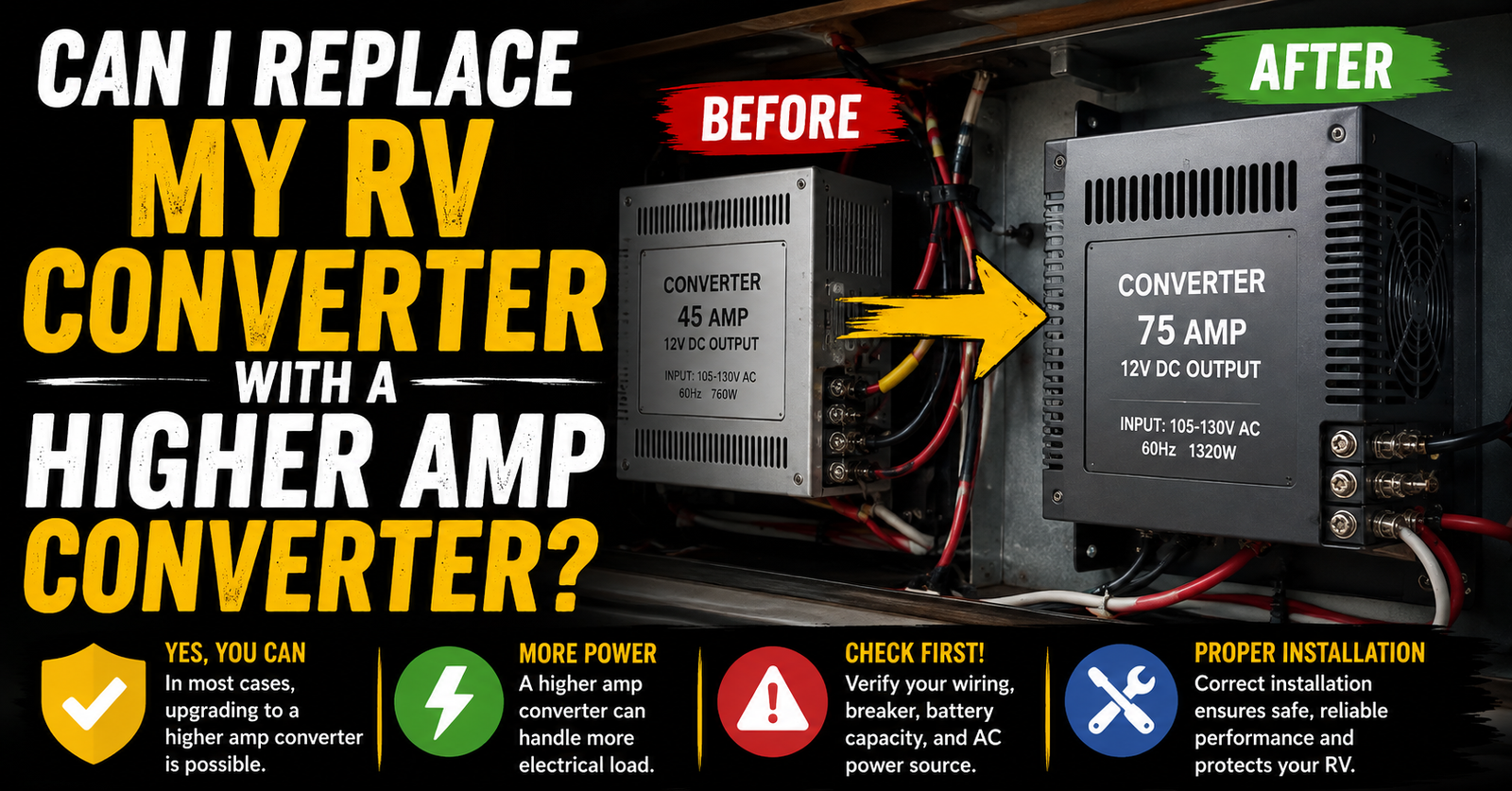
We’ve covered this in detail in our guide to replacing an RV converter with a higher-amp model.
Don’t create one electrical problem while trying to solve another.
Now Let’s Talk About the Battery Itself
Sometimes the converter gets blamed because the battery never reaches full charge.
But the converter can’t restore capacity that the battery no longer has.
Lead-acid batteries age.
They sulfate.
They lose capacity.
Cells can fail.
A battery can reach a charging voltage that looks reasonable yet have very little usable capacity once the charging source is removed.
That can make you think:
“The converter never fully charged it.”
When the real problem is:
“The battery can’t hold much anymore.”
A Battery Can Say Full and Still Be Bad
This is one of the stranger RV battery problems.
You charge it.
Voltage looks good.
Maybe your monitor even says it’s full.
Then you unplug from shore power and the battery falls flat surprisingly quickly.
That’s not automatically an undercharging converter.

We’ve already covered exactly why an RV battery can say full and still die quickly.
Voltage and usable capacity aren’t the same thing.
Let the Battery Rest Before Judging Its State of Charge
If you’re trying to estimate lead-acid battery state of charge from resting voltage, don’t measure it immediately after charging and expect a perfect answer.
Charging can leave a temporary surface charge.
Likewise, a battery under load can show lower voltage than it will after resting.
That’s why context matters whenever you’re interpreting battery voltage.

Our guide to what RV battery voltage readings actually mean goes much deeper into this.
One random voltage reading rarely tells the whole story.
A Battery That Never Reaches Full May Simply Be Worn Out
Suppose the converter is producing the correct voltage.
The charging path checks out.
Connections are good.
Loads are reasonable.
But the battery still behaves badly.
Now test the battery.
For flooded lead-acid batteries, inspect electrolyte according to the battery manufacturer’s instructions.
Check age.
Look for physical damage.
Test capacity or have the battery properly load-tested where appropriate.
WFCO specifically recommends considering battery age, water level, and possible shorted cells when troubleshooting charging problems.
The converter cannot repair a failed battery.
A Shorted Cell Changes Everything
A nominal 12-volt lead-acid battery is made from multiple cells.
If one cell fails, the battery voltage and charging behavior can become abnormal.
Now the converter may keep trying to charge something that isn’t capable of reaching the expected condition.
The converter gets blamed because it “never finishes.”
But it’s waiting for a battery condition that may never arrive.
This is another reason I test the battery before replacing expensive charging equipment.
Check the Water Level in Flooded Batteries
If you have a serviceable flooded lead-acid battery, don’t skip this.
Low electrolyte can hurt battery performance and eventually damage the battery.
WFCO specifically includes battery water level in its charging troubleshooting checklist.
Follow the battery manufacturer’s instructions for inspection and adding distilled water.
And if you discover the battery is constantly losing water while connected to shore power, that’s a different clue.
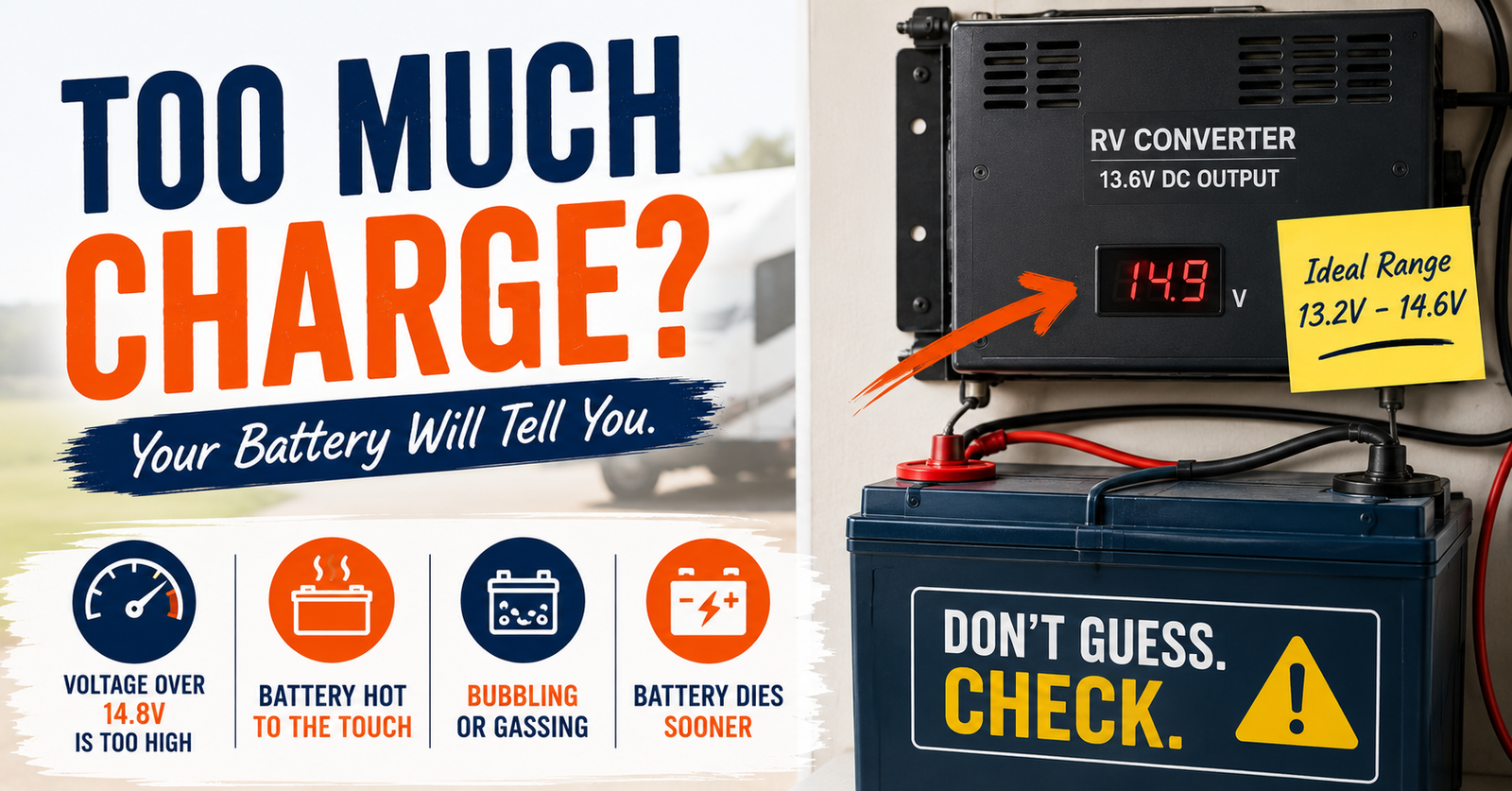
We just covered how to tell whether your RV converter is overcharging the battery.
Slow charging and excessive charging are opposite problems, but sometimes battery symptoms are what lead you to either one.
Temperature Can Affect Battery Performance
Cold batteries don’t behave exactly like warm batteries.
WFCO specifically notes that low temperature can have a major effect on battery performance.
If you’re troubleshooting in cold weather, keep that in mind.
Don’t compare how quickly the battery charges during a freezing January camping trip with how it behaved in July and assume the converter suddenly lost half its strength.
Battery chemistry is temperature-sensitive.
What About Lithium Batteries?
Now we need to change our expectations.
LiFePO4 charging isn’t the same as flooded lead-acid charging.
The appropriate charging profile depends on the battery and converter.
Some modern converters have lithium-specific modes.
Others automatically detect battery chemistry.
Some older converters were designed around lead-acid batteries.
That’s why the first two things I want to know are:
What converter do you have?
What battery do you have?
Without those answers, we’re troubleshooting half a system.
An Older Converter May Charge Lithium Without Fully Charging It
This is a particularly important situation.
An older lead-acid converter may provide enough voltage to put substantial energy into a LiFePO4 battery but may not follow the charging profile intended for that battery.
The result can be confusing.
The battery charges.
The camper works.
Nothing appears obviously broken.
Yet you may not be getting the charging performance you expected from the lithium upgrade.
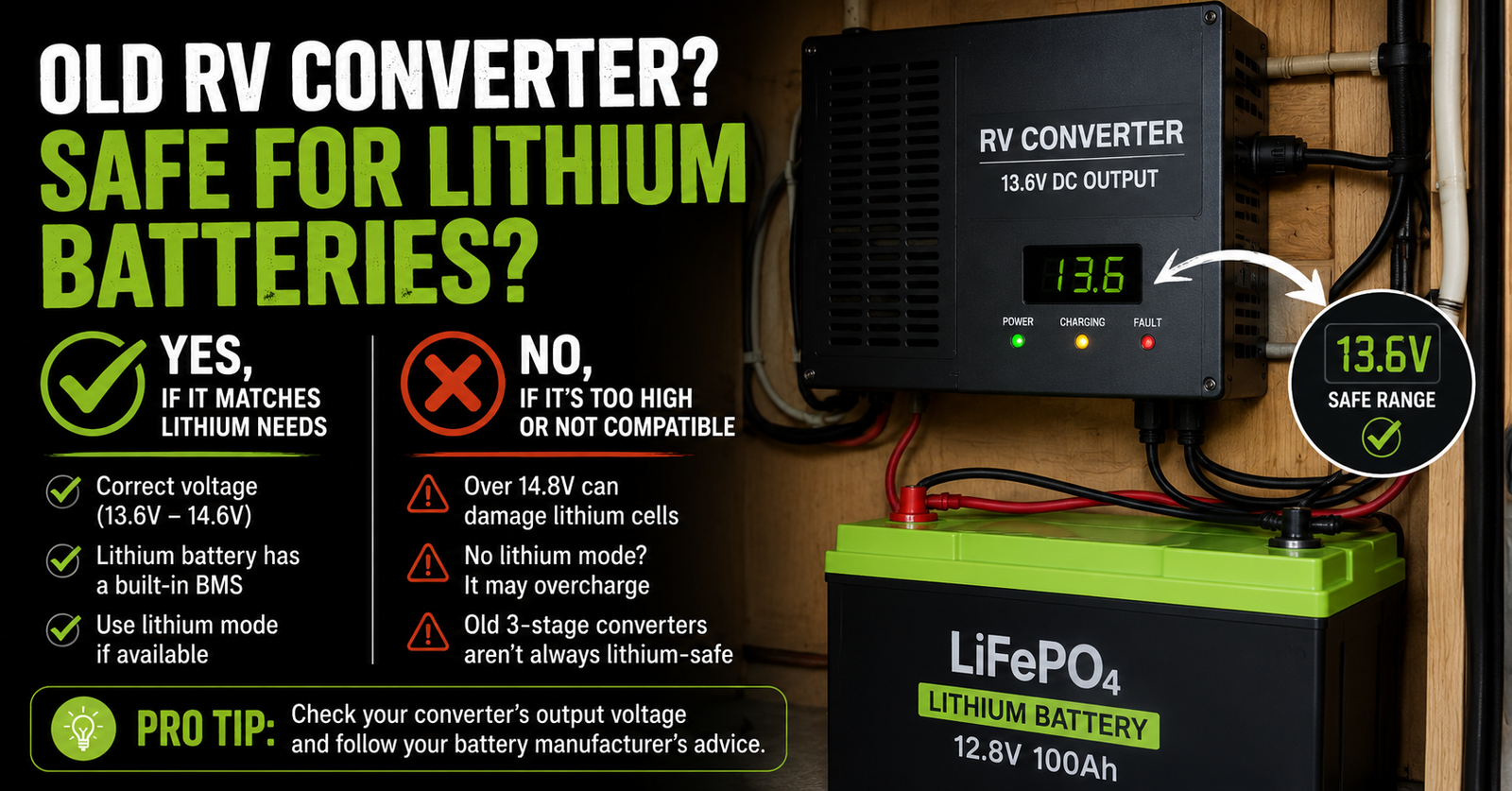
That’s why we built a separate guide explaining whether an old RV converter can be used with a lithium battery.
“Charges the battery” and “charges it optimally” aren’t always the same thing.
Don’t Judge Lithium State of Charge From Voltage Alone
LiFePO4 batteries maintain relatively flat voltage through much of their usable capacity.
That makes voltage less intuitive as a fuel gauge than many people expect.
If you have a quality battery monitor that actually tracks current in and out of the battery, use it.
If your lithium battery has Bluetooth monitoring, that information can also be useful.
You may discover the converter is putting energy into the battery perfectly well even though the voltage isn’t changing dramatically.
What If My Converter Is Stuck at 13.6 Volts?
First question:
Is that actually wrong for your converter?
For applicable WFCO lead-acid converters, approximately 13.6 volts is normal absorption-mode operation. The battery can continue charging at that voltage, although charging may be slower than during bulk mode.
So don’t replace a converter simply because it spends a lot of time around 13.6 volts.
Find out what its charging logic is supposed to do.
What If It Never Goes Into Bulk Mode?
Now we’re getting more specific.
If the converter is designed to enter a higher-voltage charging stage under certain conditions and it never does, I’d first make sure those conditions are actually being met.
WFCO explains that its microprocessor monitors system voltage and current conditions to determine when bulk charging is appropriate. Heavy loads can also keep the measured voltage lower even when the converter is targeting a higher output.
So “I never saw 14.4 on my meter” isn’t enough evidence.
You need to understand the converter’s operating logic.
Could the Converter Be Too Small for My Battery Bank?
Possibly.
A converter can be electrically capable of charging the battery while still being slower than you’d like.
This is especially noticeable with large battery banks.
If you’re plugged into shore power for days at a time, charging speed may not matter much.
If you’re running a generator specifically to recharge a large battery bank while boondocking, charging speed becomes much more important.
That’s where converter sizing becomes a practical issue rather than just a specification on a label.
Generator Campers Notice Slow Charging Much Faster
When you’re plugged into campground shore power overnight, who cares if the battery takes several hours?
You’re sleeping.
The converter can work.
But if you’re boondocking and running a generator specifically to recharge the battery, every extra hour means fuel, noise, and generator runtime.
That’s when an inadequate charging setup becomes really obvious.
You want to put meaningful energy back into the battery while the generator is running.
A charging system that technically works but charges painfully slowly may not fit the way you camp.
Does Shore Power Amperage Affect Converter Charging?
Usually not in the simple way people assume.
Being connected to a 50-amp RV pedestal doesn’t mean your battery suddenly charges twice as fast as it would on a 30-amp pedestal.
The converter has its own AC input requirements and DC output limits.
As long as it’s receiving proper AC power and the RV isn’t exceeding the available service, the converter determines how much DC charging capacity is available.
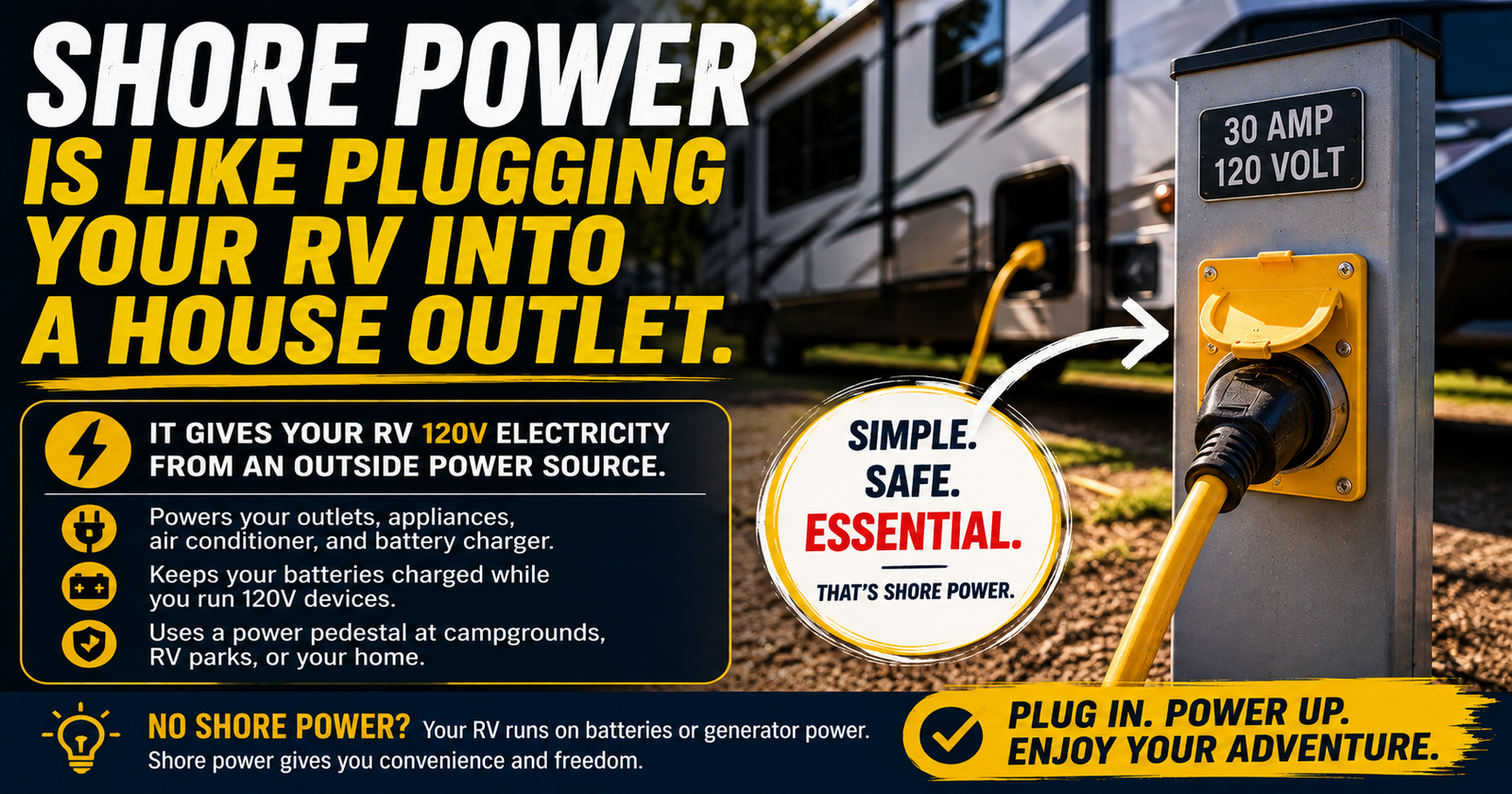
If the whole shore-power side still feels confusing, read our simple explanation of what shore power means in an RV.
Once AC and DC are separated in your head, converter troubleshooting gets much easier.
Can Low Shore-Power Voltage Affect Charging?
The converter needs proper AC input to operate as designed.
If the incoming AC supply is outside the equipment’s acceptable operating range, converter performance may be affected or protective behavior may occur depending on the model.
That’s why I don’t troubleshoot only the battery side.
If converter behavior seems abnormal, verify that the RV actually has proper AC power.
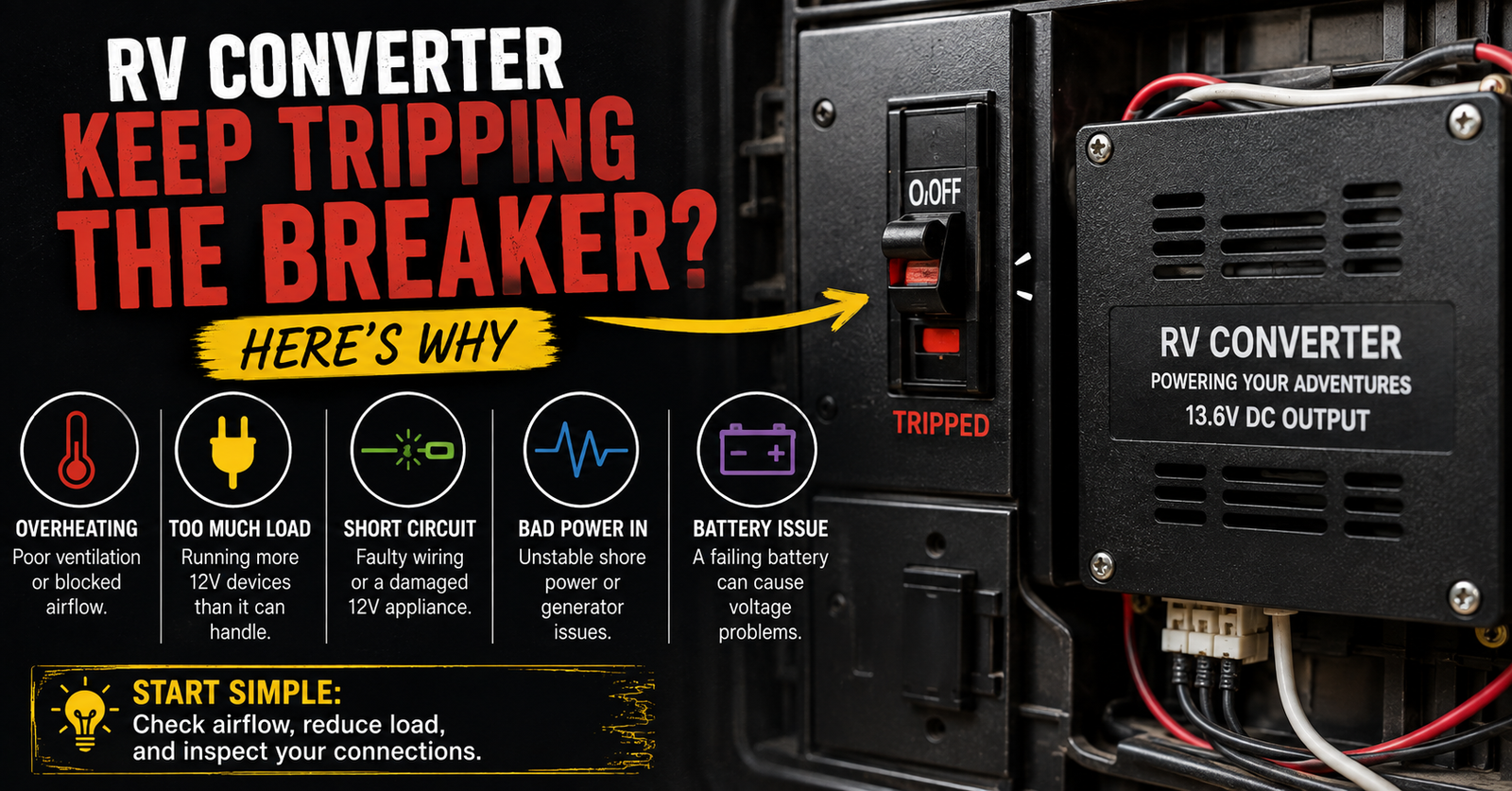
WFCO’s troubleshooting procedure specifically begins by confirming shore-power connection and checking breakers at the pedestal and power center. If one of those breakers trips again after reset, converter breaker diagnosis offers a more focused way to interpret the timing.
Start upstream when necessary.
What If the Battery Charges Better on the Generator?
That’s interesting.
If the same converter is being powered in both situations, the converter itself hasn’t changed.
The AC source has.
That gives me a reason to investigate the shore-power supply, transfer equipment, connections, and incoming voltage.
Likewise, if charging is equally poor on both known-good shore power and generator power, I start looking farther downstream.
Troubleshooting becomes much easier when you change one variable at a time.
What If It Charges Fine With an External Battery Charger?
That’s another useful clue.
Suppose your battery accepts a full charge from a proper external charger.
It holds that charge.
Capacity seems good.
But the RV converter struggles to accomplish the same thing.
Now the battery looks less suspicious.
I’d move my attention toward:
Converter output.
Charging profile.
Converter capacity.
Charging wiring.
Voltage drop.
Battery disconnect.
Fuses and circuit protection.
That’s how we narrow the system down without throwing parts at it.
What If My RV Battery Is Dying While Plugged In?
That’s more severe than slow charging.
If the battery is actually losing charge while connected to shore power, either the converter isn’t supplying enough power, the charging path is interrupted, the converter isn’t operating, or the DC loads are exceeding what the system is providing.
We already have a complete troubleshooting guide for an RV battery that keeps dying while plugged in.
Don’t confuse that with a battery that simply takes longer than expected to reach full charge.
What If My Lights Are Dim Too?
Now I’m especially interested in converter output and DC system voltage.
WFCO says dimming lights can indicate that the converter is overloaded or that the RV is operating from battery power rather than normal converter output. Its troubleshooting guidance recommends reducing DC loads and checking converter voltage.
If the battery charges slowly and the 12-volt lights are unusually dim while connected to shore power, that’s more evidence that something isn’t right on the DC side.
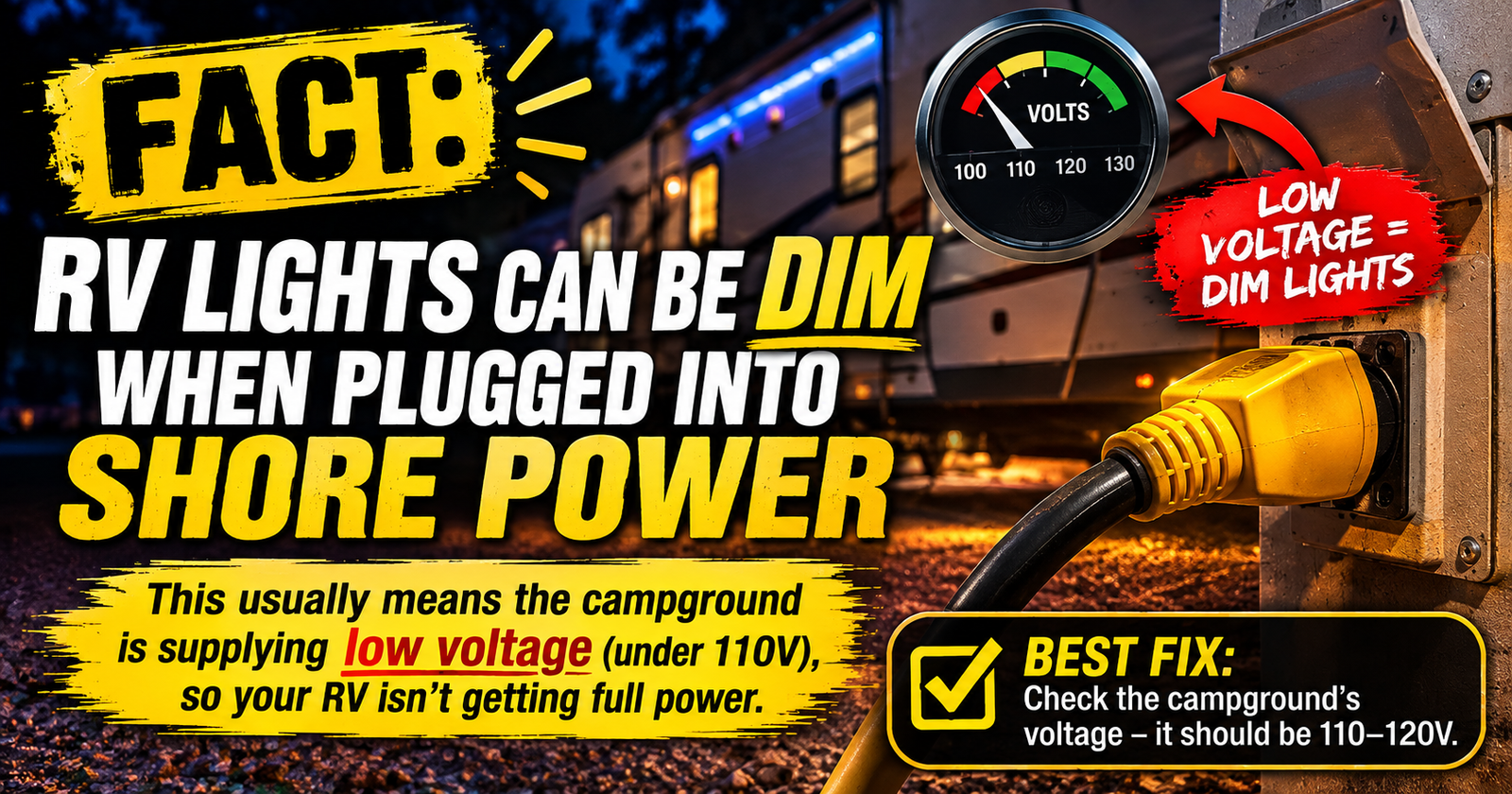
We’ve covered dim RV lights on shore power separately because that symptom can tell us quite a bit.
What If My Lights Flicker?
Same general area, slightly different symptom.
WFCO says flickering can occur when the converter is overloaded and recommends reducing 12-volt loads, checking battery condition, and checking converter output.
If slow battery charging comes with flickering lights, converter loading moves higher on my list.
Turn unnecessary DC equipment off.
See what changes.
The system is giving you clues.
Converter Heat Can Tell You Something Too
Converters produce heat.
That’s normal.
But if the converter is constantly working near its maximum output because you’re trying to recharge a large battery bank while running heavy DC loads, the converter may run warmer and its fan may operate frequently.
Progressive Dynamics notes that applicable converters use current limiting to protect themselves when DC demand exceeds their designed capacity.
If the converter is excessively hot, repeatedly shutting down, or acting abnormally, that’s a separate problem worth investigating.
Make Sure the Converter Can Breathe
Don’t bury it behind camping gear.
Converters need airflow.
Progressive Dynamics recommends at least five inches of clearance or otherwise sufficient ventilation around applicable 9100 and 9200 converters to allow adequate airflow.
If your converter is shoved into a packed storage compartment with blocked vents, fix that.
Overheating isn’t going to improve charging performance.
What If the Converter Fan Runs Constantly While Charging?
That may simply mean the converter is working hard.
A heavily discharged battery can represent a substantial load.
Add the RV’s active 12-volt equipment and the converter may have plenty to do.
We’ve already covered why an RV converter fan can run all the time.
Don’t diagnose slow charging from fan noise alone.
Measure what the system is actually producing.
Here’s a Simple Test That Tells Me a Lot
I’d start with a partially discharged battery that is otherwise known to be healthy.
Measure battery voltage.
Connect the RV to proper shore power.
Measure again.
Then turn off unnecessary 12-volt loads.
Give the converter time to operate.
Watch battery voltage.
Measure converter output if appropriate.
Compare the two.
If reducing DC loads noticeably improves charging, converter capacity was being shared with the camper.
If converter voltage is correct but battery voltage is significantly lower, investigate the charging circuit.
If converter output itself is outside the manufacturer’s specification, investigate the converter.
If everything electrical checks out but the battery still won’t perform, test the battery.
That one process can eliminate a lot of guessing.
Don’t Forget That Charging Takes Time
This seems almost too obvious to mention.
But a deeply discharged battery doesn’t instantly become full just because the converter is producing the correct voltage.
Energy has to go back into the battery.
The larger the battery bank and deeper the discharge, the more energy needs to be replaced.
Charging current also generally changes as the battery approaches full charge depending on the battery chemistry and charging system.
So don’t judge converter performance from ten minutes of charging.
Your Battery Monitor Can Lie If It Isn’t Set Up Correctly
This is especially relevant with aftermarket monitors.
A shunt-based battery monitor needs correct battery-capacity settings and proper synchronization to provide useful state-of-charge information.
If you doubled your battery bank but never changed the monitor settings, that little percentage number may not mean what you think it means.
Before accusing the converter of stopping at 82 percent, make sure 82 percent is real.
Measure.
Verify.
Don’t blindly trust one display.
The RV’s Factory Battery Gauge Isn’t Very Precise Either
Those little:
Empty.
One-third.
Two-thirds.
Full.
indicators are useful for a quick glance.
They’re not precision battery analyzers.
Battery voltage changes while charging and under load.
That can make simple voltage-based displays misleading.
If you’re seriously troubleshooting a charging problem, use a decent multimeter and appropriate battery-testing equipment.
Don’t replace a converter because one LED didn’t light.
Could Parasitic Loads Make It Look Like the Battery Never Charges?
Absolutely.
Imagine the converter is putting energy into the battery.
Meanwhile, hidden DC loads are constantly taking some of that energy back out.
Propane detector.
Stereo memory.
Control boards.
Aftermarket electronics.
Other always-on equipment.
Normally these loads aren’t enough to defeat a healthy converter while connected to shore power, but they matter when diagnosing battery behavior, especially once shore power is removed.
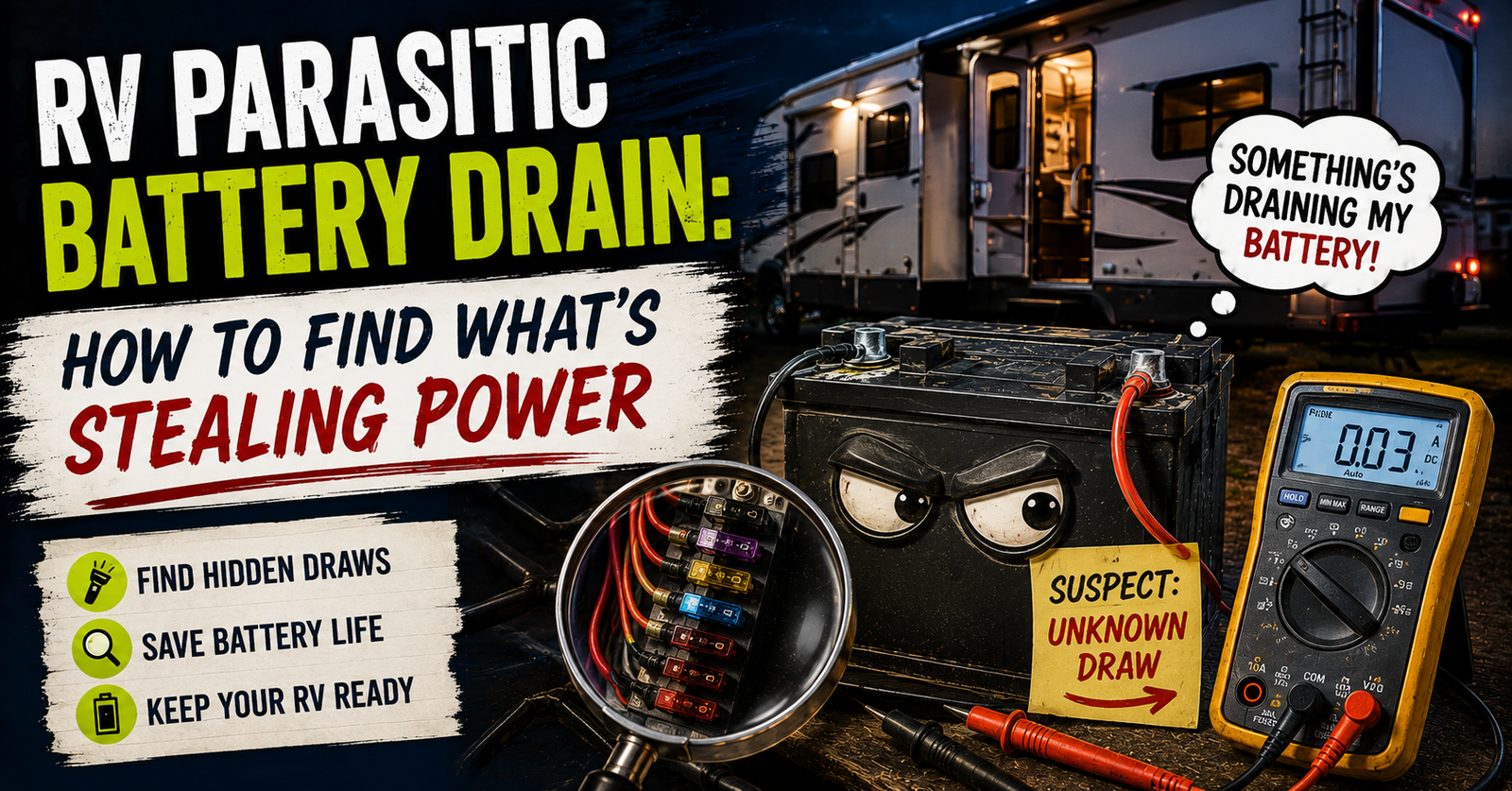
Our guide to finding RV parasitic battery drain can help if the battery seems charged when plugged in but loses that charge unusually quickly afterward.
Don’t Confuse Slow Charging With Fast Discharging
These two problems feel similar.
You unplug.
Battery doesn’t last.
Therefore:
“Converter never fully charged it.”
Maybe.
Or the converter charged it perfectly and something drained it afterward.
That’s why I like to separate charging from runtime.
First prove the battery reaches an appropriate state of charge.
Then disconnect shore power and observe what happens.
If the battery immediately collapses under modest load, that’s not necessarily a converter problem.
This Is Why the Converter and Battery Have to Be Diagnosed Together
They depend on each other.
The converter determines the charging environment.
The battery determines how much current it accepts and how it responds.
The wiring determines how effectively power moves between them.
The RV’s DC loads determine how much converter capacity remains available for charging.
You can’t understand the problem by staring at only one component.
That’s why converter troubleshooting sometimes feels more complicated than it should.
You’re troubleshooting a system, not a box.
When I Would Start Suspecting the Converter
I’d move the converter higher on the list if:
Its measured output doesn’t meet the manufacturer’s specifications.
It has proper AC input but inadequate DC output.
Its charging behavior doesn’t match the manufacturer’s operating description.
The battery and charging circuit test good.
Voltage is low directly at the converter, not merely at the battery.
Other 12-volt symptoms appear while connected to shore power.
Maybe the converter is also overheating, cycling, making unusual noises, or otherwise behaving abnormally.
At that point, the evidence starts stacking up.
When I Would Suspect the Wiring Instead
Converter voltage looks good.
Battery voltage doesn’t.
That immediately makes the path between them interesting.
Check:
Positive charging cable.
Negative cable.
Ground.
Battery disconnect.
Inline fuse.
Auto-reset breaker.
Distribution connections.
Terminals.
Corrosion.
Wire size.
Voltage drop.
If the converter is making good DC power, don’t throw it away because the battery isn’t receiving that power.
Find where it’s being lost.
When I Would Suspect the Battery
Converter output is correct.
Battery-terminal charging voltage is appropriate.
Wiring is good.
Charging time is reasonable.
Yet the battery still doesn’t seem to reach or hold a useful charge.
Now I want the battery tested.
Especially if it’s old.
Or has been repeatedly deeply discharged.
Or sat discharged for a long period.
Or has low electrolyte.
Or drops voltage rapidly under load.
At that point, replacing the converter probably isn’t going to fix anything.
When I Would Consider a Converter Upgrade
There’s a difference between a failed converter and a converter that simply doesn’t suit how you use the RV anymore.
Maybe you installed a much larger battery bank.
Maybe you converted to lithium.
Maybe you boondock frequently and want to minimize generator runtime.
Maybe your older converter uses a charging strategy you no longer want.
In those cases, upgrading can make sense even if the old converter technically still works.
But that’s an upgrade decision.
Not a diagnosis.
Don’t Buy a New Converter Until You’ve Done This
Before spending money, I want five answers.
What converter do I have?
What battery do I have?
What voltage is the converter producing?
What voltage is actually reaching the battery?
Is the battery itself healthy?
Those five answers will solve an amazing number of RV charging mysteries.
If you reach the point where testing actually proves the converter is failing, our guide to replacing an RV converter without buying the wrong one walks through what to check before ordering the replacement.
That’s when I’d spend money.
Not before.
A Converter That Charges Slowly May Be Working Perfectly
That’s probably the most important point here.
Slow doesn’t automatically mean broken.
A converter may charge slowly because the RV is using much of its available output.
The battery bank may be large.
The battery may be cold.
The converter may be operating in a normal lower-voltage charging stage.
There may be voltage drop between the converter and battery.
The battery itself may be damaged.
Or you may simply be expecting a charging speed the converter was never designed to provide.
WFCO specifically confirms that batteries continue charging around 13.6 volts in absorption mode and that reducing RV loads makes more converter amperage available for battery charging.
That’s why I don’t judge a converter by how long the battery icon takes to say FULL.
I grab a meter.
I check the converter.
I check the battery.
I check the wiring between them.
And once I know which part of the system isn’t doing its job, then I decide what actually needs fixing.
Written by Evan Mercer
Evan Mercer writes about RV converters, batteries, shore power, charging systems, and practical camper troubleshooting for CamperAnswers.com. He focuses on helping RV owners understand what the electrical system is actually doing before they start replacing parts.