

I still think one of the most misleading things about an RV battery is the big 12V printed right on the side of it. You’d think that would make this simple. Check the battery, see 12 volts, and everything must be fine.
Except a 12-volt RV battery reading exactly 12.0 volts may be telling you something very different.
And if you check that same battery while your camper is plugged into shore power, you might see well over 13 volts and wonder if something is wrong in the opposite direction.
Neither number makes much sense until you know what the battery and charging system are doing at the moment you measure them.
That’s why I don’t diagnose an RV battery from voltage alone. I use voltage as a clue, then put that number into context.
What Voltage Should a 12-Volt RV Battery Read?
For a traditional 12-volt lead-acid RV battery, a fully charged battery at rest is generally around 12.6 volts. Some AGM batteries may rest somewhat higher depending on the specific battery.
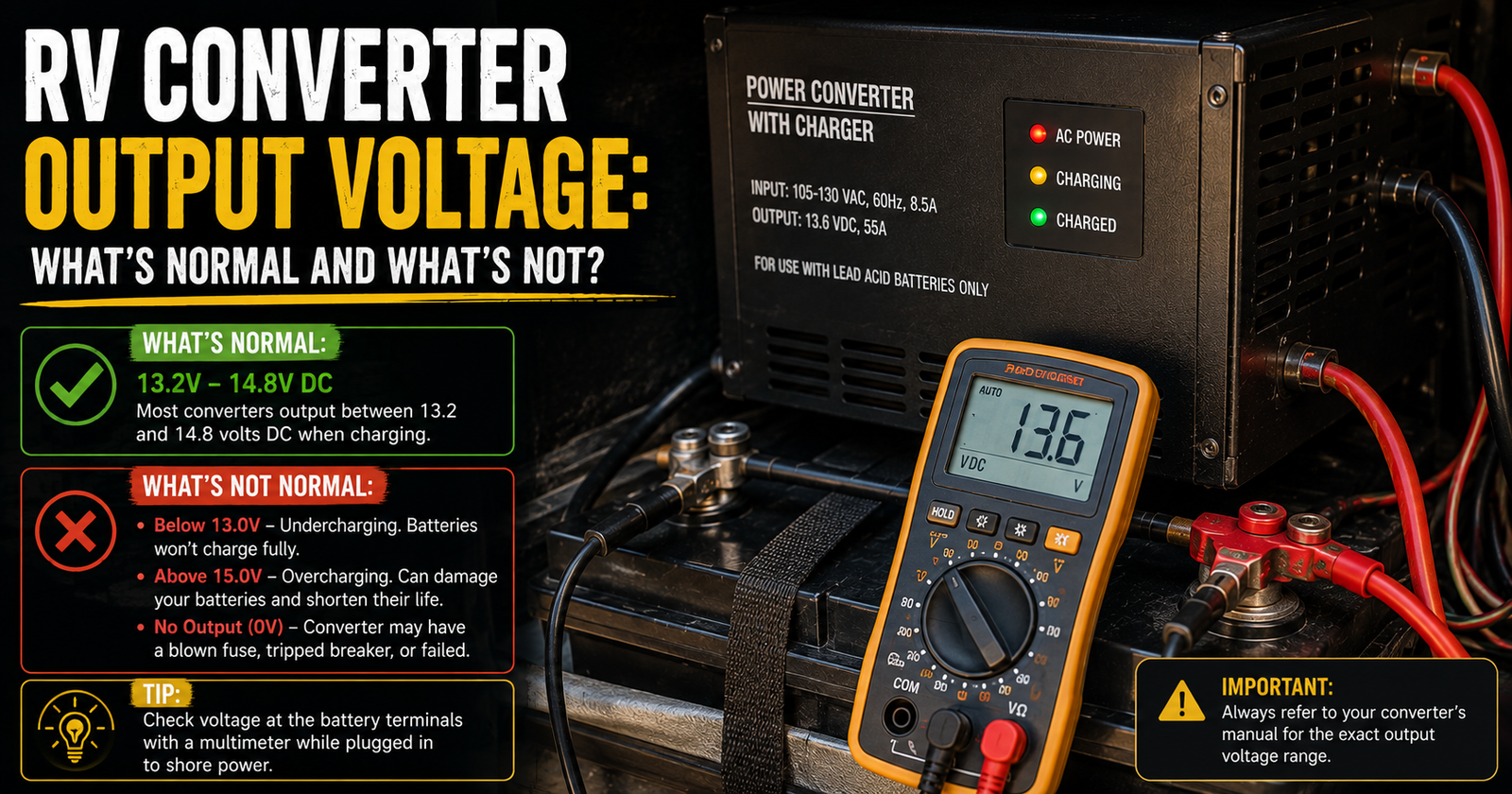
Once charging begins, seeing voltage in the 13-volt or 14-volt range can be completely normal because you’re no longer measuring only the battery’s resting voltage. You’re seeing the charging system at work.
That’s the first distinction I want every camper owner to understand:
Resting voltage and charging voltage are not the same thing.
A number that would look strange with the camper unplugged may be perfectly normal while the converter is charging.
Is 12 Volts Good for an RV Battery?
If we’re talking about a traditional lead-acid battery that’s been allowed to rest without a charger influencing the reading, 12.0 volts is not what I’d consider a fully charged battery.
That’s where the “12-volt battery” label causes so much confusion.
The battery belongs to a nominal 12-volt electrical system. That doesn’t mean 12.00 volts represents full charge.
Winnebago, for example, describes roughly 12.85 volts as full for an example AGM battery and about 12.05 volts as approximately 50 percent state of charge. The company also cautions that voltage is most useful when the battery is at rest because charging and heavy loads can temporarily push the reading up or down.
So if I see 12.0 volts on a resting lead-acid house battery, I’m not celebrating.
I’m figuring out why it’s that low.


A Fully Charged Lead-Acid Battery Is Usually Above 12 Volts
Progressive Dynamics explains the chemistry behind this pretty clearly. A typical 12-volt RV lead-acid battery contains six cells, with each producing about 2.1 volts, giving approximately 12.6 volts when fully charged.
That little fact makes the rest of this article easier to understand.
“12-volt battery” describes the system.
It doesn’t tell you the exact voltage you’ll see at every state of charge.
Don’t Use One Universal Voltage Chart for Every RV Battery
Before I start interpreting voltage, I want to know what’s actually installed.
Flooded lead-acid?
AGM?
Lithium iron phosphate?
Those batteries do not have identical voltage characteristics.
That’s especially important now because more campers are being converted to lithium.
A chart intended for flooded lead-acid batteries can give you the wrong impression about a lithium battery.
If you don’t know your battery chemistry, look at the label before doing anything else.



Here’s a Practical Lead-Acid Voltage Reference
For a conventional 12-volt lead-acid battery at rest, I generally think of the readings something like this:Resting VoltageGeneral Battery ConditionAround 12.6 to 12.8VFully or nearly fully chargedAround 12.4VPartially dischargedAround 12.2VSignificantly dischargedAround 12.0VLowBelow 12.0VHeavily discharged
I intentionally don’t put an exact state-of-charge percentage beside every tenth of a volt.
Why?
Because battery chemistry, temperature, battery condition and how the measurement was taken all matter.
I’d rather give you a useful troubleshooting range than pretend 12.37 volts universally means one exact percentage in every camper.
Why Does My RV Battery Read 13.6 Volts?
This is one of the most common readings that makes new RV owners nervous.
You bought a 12-volt battery.
Now your meter says 13.6.
Is the battery being overcharged?
Not necessarily.
If the camper is connected to shore power and the converter/charger is operating, voltage above the battery’s normal resting voltage is expected.
For example, Progressive Dynamics lists 13.6 volts as the normal charging mode for several of its lead-acid converter/charger systems.
That’s charging voltage.
If you unplug shore power and allow the battery to rest, you shouldn’t expect it to remain at that same charging voltage.
Why Does My RV Battery Read 14.4 Volts?
Again, context.
Some multi-stage RV chargers intentionally raise charging voltage during a bulk or boost stage.
Progressive Dynamics uses 14.4 volts in the boost mode of some of its lead-acid charging systems to rapidly bring a depleted battery up toward a high state of charge before reducing charging voltage.
So seeing 14.4 volts while charging doesn’t automatically mean the converter has lost its mind.
It may be doing exactly what it was designed to do.
What matters is your specific charger, battery chemistry and operating mode.
Why Does My Battery Drop to 12.6 Volts After I Unplug?
Because the charger stopped holding the electrical system at charging voltage.
That’s often normal.
Imagine your converter is maintaining 13.6 volts while you’re connected to shore power.
You unplug.
The converter stops supplying that voltage.
Now the battery is carrying the system.
Naturally, the number falls toward battery voltage.
That doesn’t mean you lost a huge chunk of battery capacity in five seconds.
It means the charging source disappeared.

This is one reason people sometimes think their RV battery says full and then dies surprisingly fast. They’re comparing charging voltage with battery voltage as though they’re the same measurement.
They aren’t.


Surface Charge Can Fool Your Multimeter
Here’s another reason I don’t immediately trust a reading taken right after charging.
Lead-acid batteries can retain an elevated surface charge for a while after the charging source is removed.
That can make the battery look slightly better than its true resting condition.
Winnebago has even instructed owners in some manuals to unplug shoreline power, shut down other charging sources, and turn on an interior light briefly to help remove surface charge before checking the coach battery condition meter.
That’s a useful reminder that when you measure matters almost as much as what you measure.
Resting Voltage Is More Useful for State of Charge
If I’m trying to estimate the state of charge of a lead-acid battery from voltage, I want a resting measurement.
That means I don’t want the converter actively charging it.
I don’t want solar pushing voltage upward.
I don’t want the alternator charging it.
And I don’t want a giant inverter load dragging voltage downward.
I want to see what the battery itself is doing.
That’s when voltage becomes much more useful.
Solar Can Make Your Battery Voltage Look Great
Solar is another source of confusion.
It’s a sunny afternoon.
Panels are producing.
The solar charge controller is sending energy toward the battery.
You check the voltage.
Looks fantastic.
Then the sun goes down and the reading falls.
Nothing necessarily broke.
You were looking at a battery while a charging source was active.
If you want to evaluate the battery itself, you need to account for the solar charger just like you would the converter.
Your Tow Vehicle Can Affect the Reading Too

Depending on your RV and charging setup, the tow vehicle or motorhome alternator may contribute charging current to the house battery. For the bigger picture, see how an RV's charging systems connect before diagnosing which source is charging the house battery.
That means a battery voltage measurement while the engine is running may tell you more about the charging system than the battery’s resting state of charge.
Again, context.
I keep repeating that word because it’s the difference between useful battery troubleshooting and chasing random numbers.
Generator Charging Changes the Reading Too
If your generator is powering the RV’s converter or inverter/charger, the same principle applies.
The battery may be receiving charge.
Voltage rises.
Turn the generator off and the number changes.
That doesn’t automatically represent an instantaneous loss of stored energy.
It represents a change in operating condition.
When somebody tells me, “My battery was at 14 volts and suddenly dropped to 12.6,” my first question is whether a charger just shut off.
What Should My RV Battery Read While Plugged Into Shore Power?
There isn’t one number that applies to every converter, battery chemistry and charging stage.
That’s important.
For some common lead-acid Progressive Dynamics converter/chargers, for example, the charging stages can include approximately 14.4 volts in boost mode, 13.6 volts in normal mode and 13.2 volts in storage mode.
Other equipment may use different charging profiles.
Lithium-specific equipment can use different voltages again.
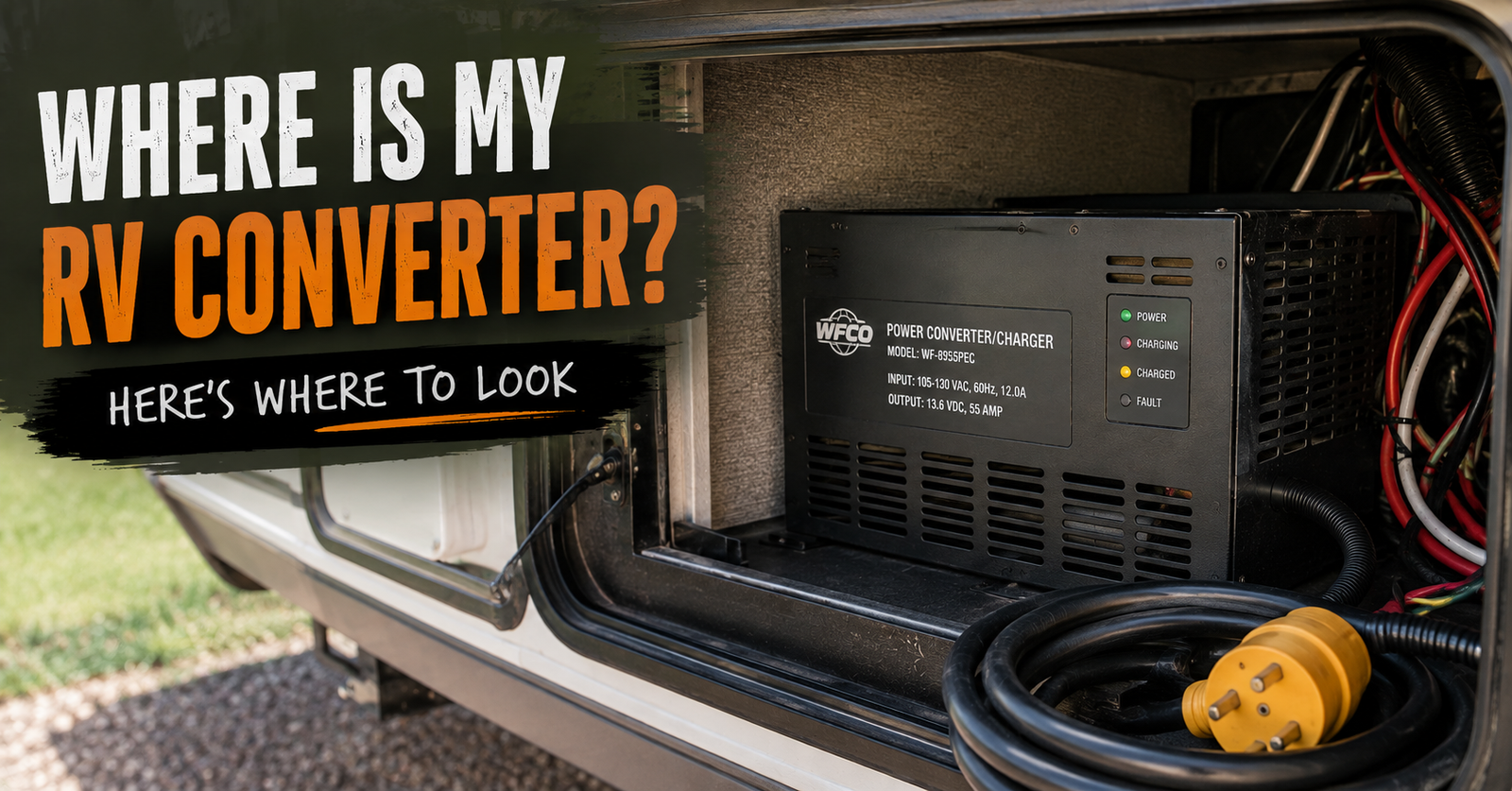
So rather than memorizing “my RV should always be at 13.6,” find out what converter or inverter/charger you actually have. Before identifying the correct specifications, use find your RV converter to locate the installed equipment and its model information.
Then compare its measured behavior with the manufacturer’s specifications.
What If the Battery Stays at 12.2 Volts While Plugged In?
Now I’m interested.
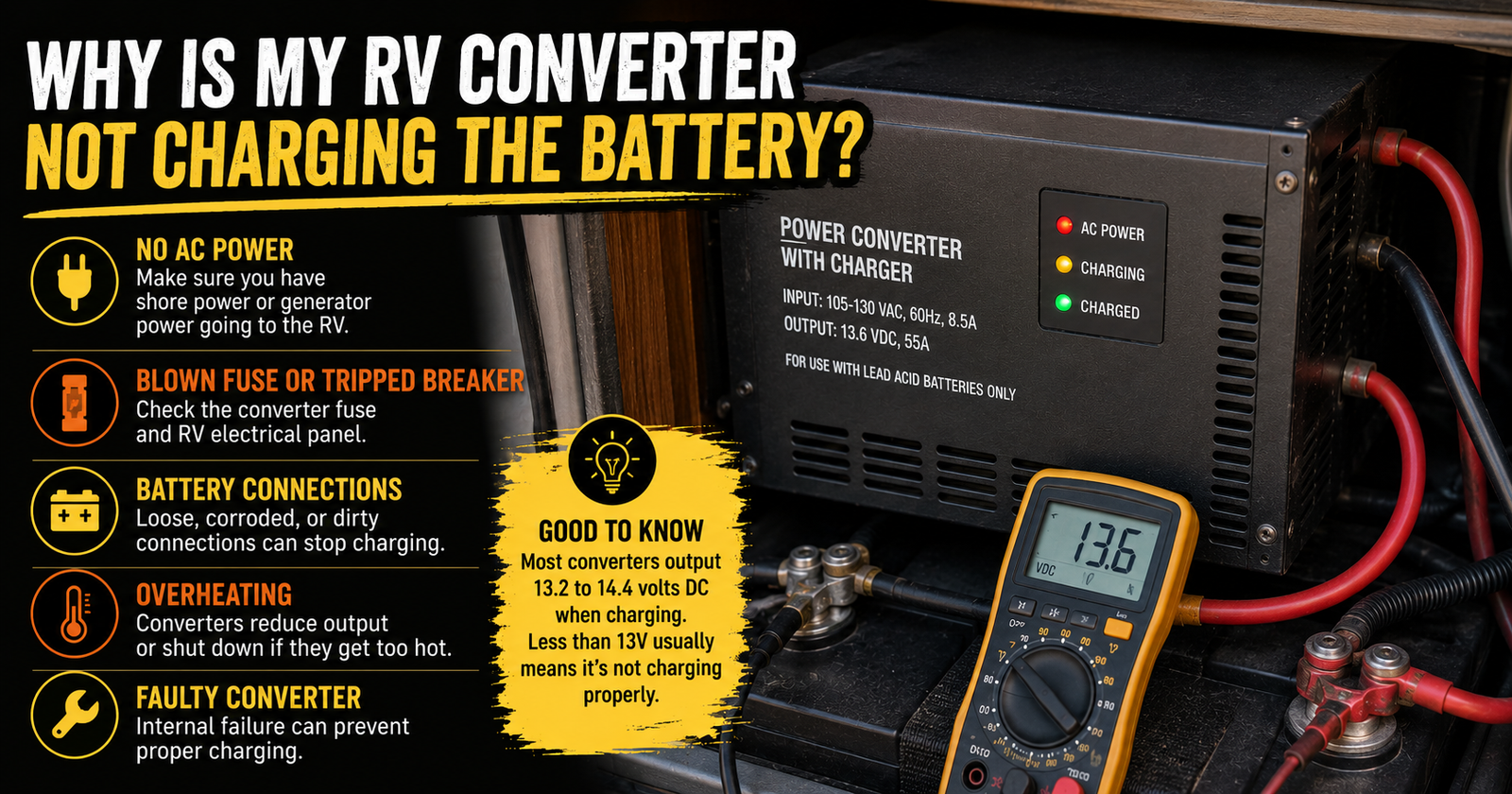
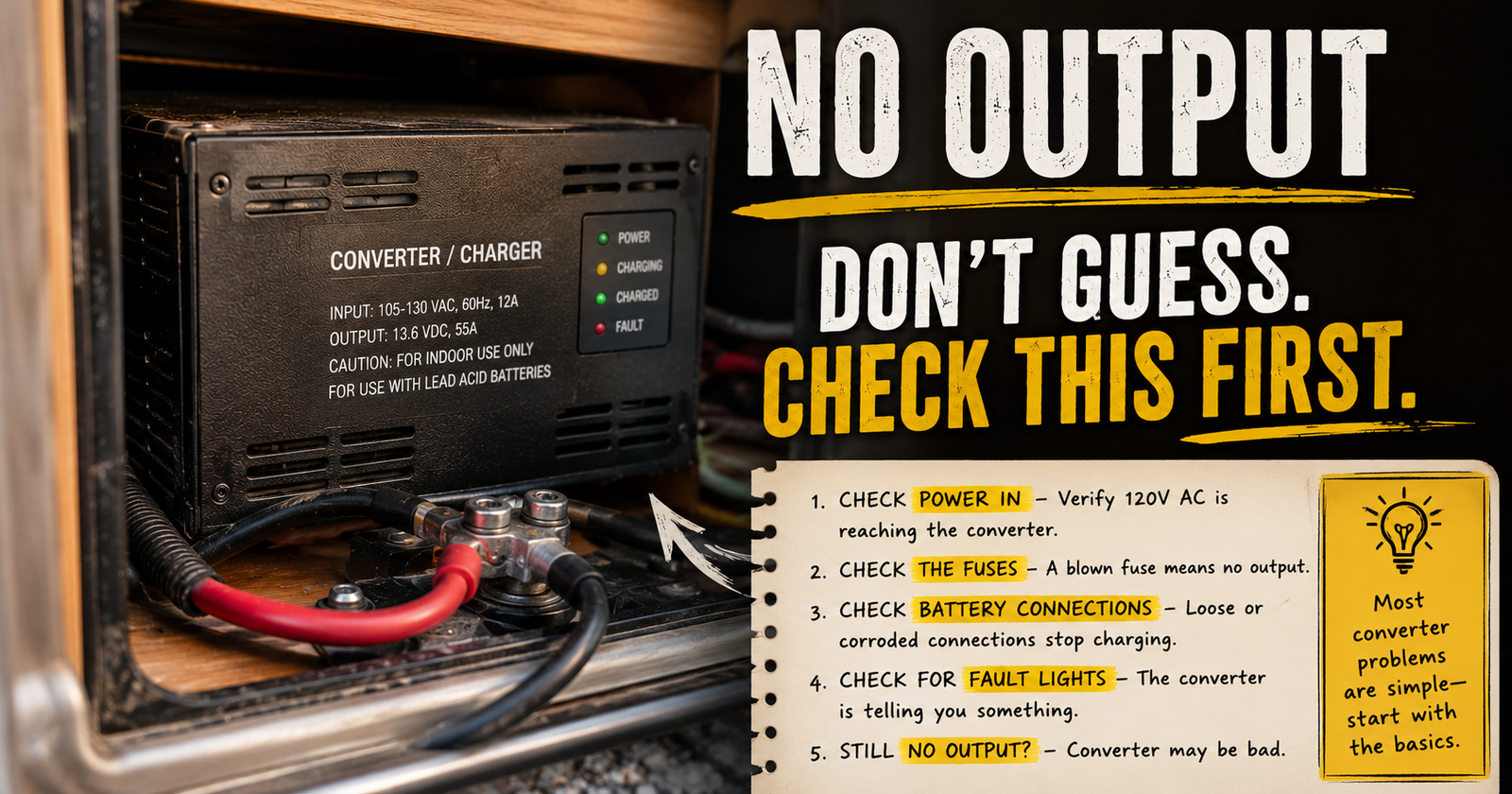
If a depleted battery remains around its low resting voltage even though shore power is connected and the battery should be charging, I want to verify whether charging voltage is actually reaching it.
Don’t immediately replace the battery.
Follow the charging path.
Does the converter have 120-volt AC power?
Is the converter producing DC charging voltage?
Is there a blown fuse or open breaker?
Is the battery disconnect affecting the charging path?
Are the battery connections good?
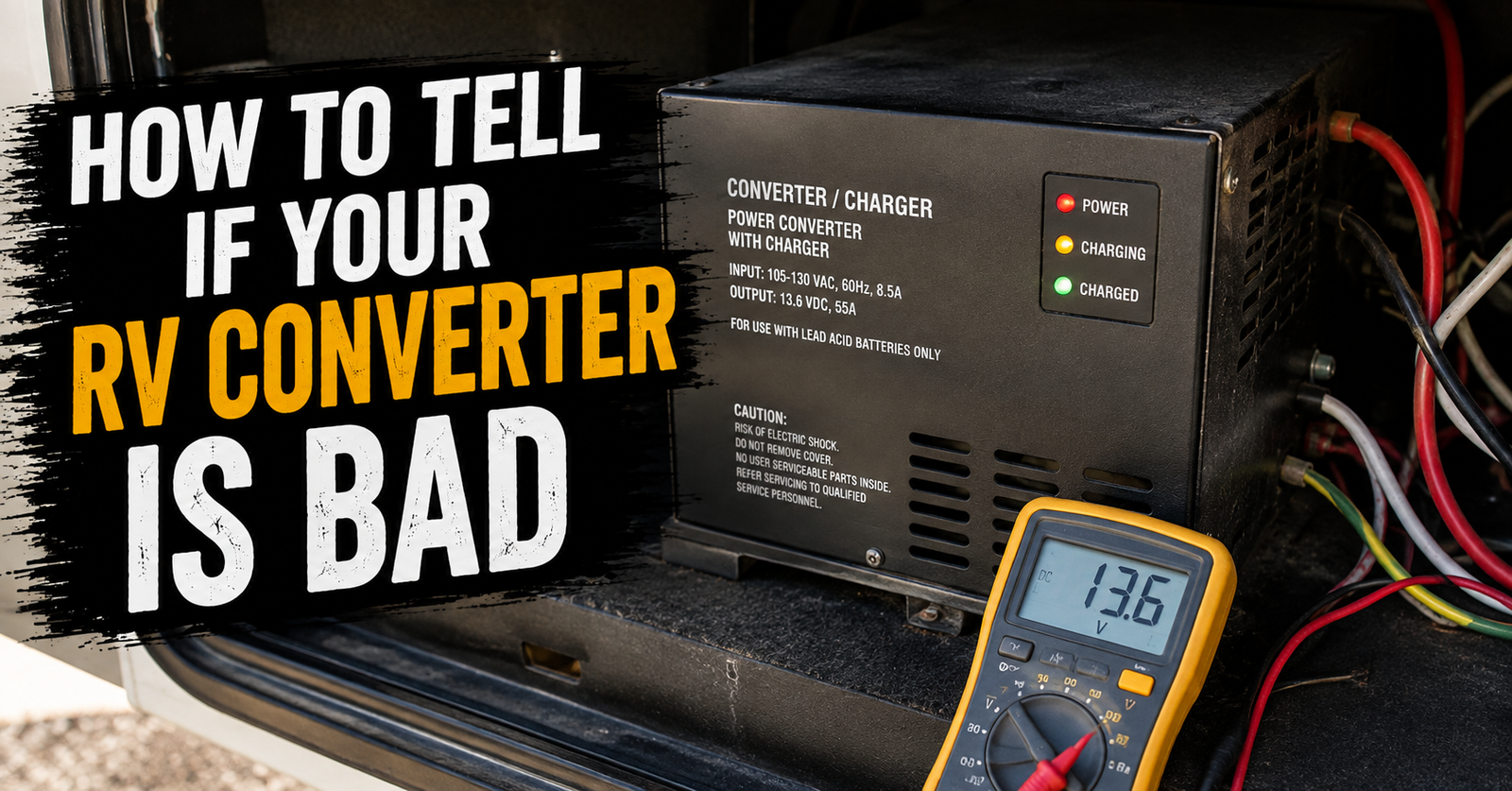
Progressive Dynamics’ troubleshooting procedure for its PD9100 and PD9200 converters says converter output should be around 13.6 volts for those standard models during the specified test. If converter output is correct but the battery still isn’t charging, it specifically directs owners to check the fuse or breaker in the battery’s positive lead. For a broader diagnostic sequence, determining whether an RV converter is actually bad shows how to interpret converter output alongside the battery and its protection devices.
That is why voltage testing can be so useful.
It helps us find where the expected voltage disappears.
A Multimeter Can Tell You More Than the RV’s Little Battery Lights
I like simple tools.
A basic digital multimeter can answer a lot of questions around an RV battery.
The factory monitor might say:
GOOD.
FAIR.
LOW.
Or show four little bars.
A meter gives me an actual number.
12.6.
12.2.
13.6.
14.4.
Those numbers give us something we can compare before and after charging, at the battery terminals, and under different operating conditions.
Just remember that a precise number isn’t automatically a precise diagnosis.
You still have to know why that voltage is there.
Measure Directly at the Battery When Troubleshooting
If I’m seriously diagnosing a charging problem, I like checking voltage directly at the battery terminals.
That gives me a baseline.
Then I can compare that reading with measurements elsewhere in the system when appropriate.
Suppose the converter is producing the correct charging voltage but I’m not seeing it at the battery.
That’s valuable information.
Now I start looking between those two points.
Protection devices.
Disconnects.
Connections.
Wiring.
The battery didn’t magically block the number from traveling across the camper. Something in the electrical path deserves investigation.
Voltage Drop Can Reveal Bad Connections
This becomes particularly useful when current is flowing.
A loose, corroded or otherwise poor connection can create resistance and voltage drop.
You may measure one voltage at the battery and something noticeably different at the equipment under load.
That’s when I start inspecting cable connections rather than immediately replacing the battery.
Progressive Dynamics troubleshooting information for older converter systems specifically calls out loose or dirty battery terminals and the negative frame connection when 12-volt equipment works from the converter but not properly from the battery.
Never forget the negative side of the circuit.
Why Does Voltage Drop When I Turn Something On?
Because the battery is now under load.
Some voltage drop under load is normal.
Turn on lights.
Start the water pump.
Run the furnace blower.
Power an inverter.
Current begins flowing and the voltage you measure may decrease.
The amount of drop becomes useful information.
If a healthy, charged battery falls dramatically under a modest load, I start investigating battery condition and connections.
If the load is enormous, the drop may be telling me something about the size of the load and the battery system supporting it.
A Weak Battery Can Look Good Until You Use It
This is one of the biggest limitations of voltage testing.
A worn battery may show a reasonably encouraging voltage with almost no load.
Then you ask it to actually power something.
Voltage collapses.
That’s why I never tell somebody a battery is healthy solely because it measured 12.6 volts once.
The battery needs to store useful energy and deliver current.
A resting-voltage measurement can’t prove its full usable capacity.
Voltage Does Not Equal Capacity
This deserves its own section because it’s probably the single biggest battery misconception I run into.
Voltage is not the same thing as amp-hour capacity.
You can have a battery with an apparently decent resting voltage that has lost a large amount of usable capacity.
That battery may look “full” and still run your camper for a fraction of the time it once did.
This is why the last article in our battery cluster focused specifically on a battery that appears charged but goes dead quickly.
If runtime is terrible despite apparently reasonable voltage, you need to look beyond voltage.
Battery Age Changes How I Interpret the Symptoms
If the battery is six months old and suddenly behaving strangely, I’m interested in charging, connections, loads and installation.
If it’s an older lead-acid battery that’s been run dead repeatedly and left discharged for long periods, capacity loss becomes much more believable.
Progressive Dynamics notes that lead-acid batteries left discharged can develop hardened lead-sulfate crystals that reduce battery capacity, which is why prompt recharging matters.
Battery history matters.
Two batteries showing the same voltage today may have very different amounts of useful life left.
What Voltage Is Too Low for an RV Battery?
I don’t like giving one universal shutdown number because battery chemistry and equipment requirements differ.

But for a conventional 12-volt lead-acid battery, readings down around 12.0 volts at rest indicate a substantially discharged battery, not a healthy full one. Because a low resting voltage does not identify the root cause by itself, test whether the battery is actually bad before concluding that replacement is necessary.
And if you’re repeatedly driving a lead-acid battery very deeply discharged, you’re not doing its longevity any favors.
Use the specifications for your battery and the equipment connected to it rather than waiting for the camper to go completely dark every time.
Don’t Wait Until the Lights Get Dim
Dim lights are a terrible battery monitor.
By the time obvious electrical symptoms appear, you’ve already learned far less than you could have from monitoring the system earlier.
I’d rather know the battery is getting low before the furnace starts struggling or the electronics begin shutting down.
This matters even more when you’re camping without hookups.
Battery monitoring isn’t just about protecting the battery.
It’s about not waking up cold at 3 a.m.
Why Does My RV Battery Read 11 Volts?
For a typical 12-volt lead-acid battery, an at-rest reading in the 11-volt range tells me the battery is deeply discharged or there’s another serious issue affecting the measurement.
I wouldn’t treat that as “a little low.”
I’d stop and determine why it happened.
Was the battery never charged?
Did something drain it?
Is it damaged?
Is a large load currently pulling voltage down?
Is the meter reading being taken at a poor connection instead of directly at the battery?
The exact diagnosis still requires context, but 11-something volts isn’t a reading I’d shrug off.
If the Voltage Keeps Falling While the Camper Is Parked
Now we may be dealing with ongoing consumption.
Turn everything off.
Wait.
Voltage continues trending downward.
That doesn’t prove a parasitic draw by itself, but it gives us a reason to investigate.

We’ve already built a full walkthrough for finding hidden electrical loads that steal RV battery power.

This is where a shunt-based battery monitor becomes much more useful than voltage alone because you can actually see current leaving the battery. Tracking that current makes it easier to compare real consumption with an expected current leaving the battery.
Voltage Can’t Tell You Where the Electricity Went
That’s another limitation.
Suppose your battery drops from a healthy state of charge to nearly dead overnight.
Voltage confirms the result.
It doesn’t tell you the cause.
Was it the furnace?
Inverter?
Tank heaters?
Parasitic draw?
Weak battery?
Incomplete charging?
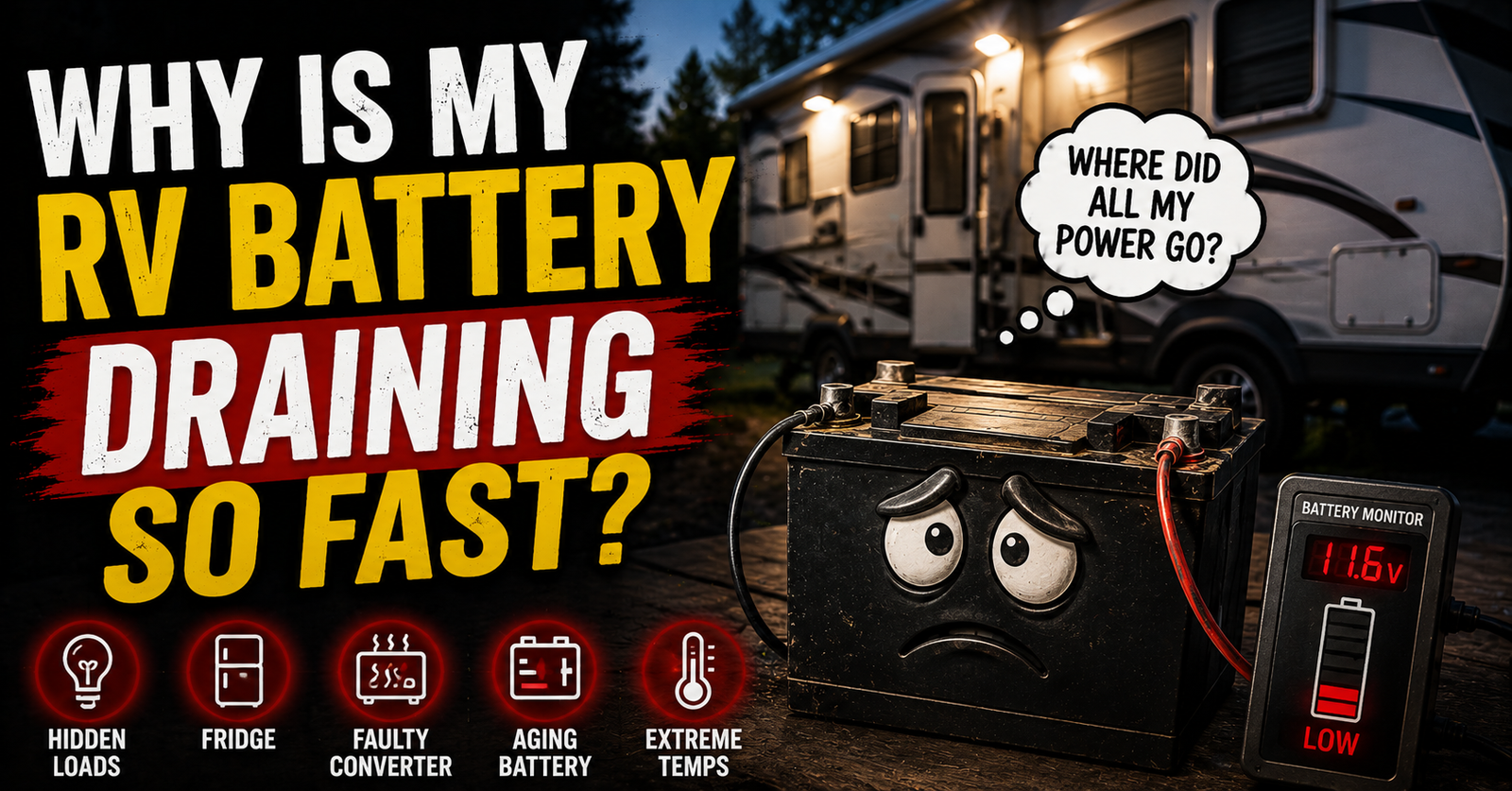
That’s why our RV battery draining fast troubleshooting guide focuses more on consumption and charging than on one voltage number.
Voltage tells you where you are.
It doesn’t always tell you how you got there.
A Shunt Monitor Gives You the Missing Piece
A properly installed shunt-based battery monitor measures current flowing into and out of the battery.
That’s incredibly valuable.
Instead of only seeing voltage fall, you can see electricity leaving.
Turn on the furnace.
Watch the current change.
Turn on the inverter.
Watch it change again.
Solar starts producing.
Now you can see charging.
Once you have voltage, current and energy use together, your battery system becomes much easier to understand.
But Even a Battery Monitor Needs to Be Set Up Correctly
A fancy screen doesn’t automatically mean accurate information.
The monitor needs the correct battery capacity and settings.
The shunt needs to be installed correctly.
Loads and charging sources need to be arranged so the monitor can actually measure the battery current they’re supposed to measure.
And state-of-charge calculations may need proper synchronization according to the manufacturer’s instructions.
If your monitor says 100 percent while everything else suggests a nearly dead battery, verify the monitor before rewriting the laws of electricity.
Lithium Battery Voltage Is Different
This is where I really want people to stop using generic charts.
Lithium iron phosphate batteries have a different voltage curve from lead-acid batteries.
Winnebago gives an example lithium resting-voltage range of about 13.5 volts at full, around 13.0 volts near 50 percent, and around 12.8 volts near 20 percent, while emphasizing that the exact voltage chart for the specific battery should be used.
Notice how tightly grouped those numbers are compared with lead-acid.
That’s why judging lithium state of charge by voltage alone can be frustrating.
Lithium Can Look Fine for a Long Time
A lithium battery can maintain relatively stable voltage through a large part of its usable charge.
That’s great for equipment.
It’s less great if you’re trying to use voltage as a fuel gauge.
The reading may not decline in the familiar way you’re used to seeing with lead-acid.
Then, near the lower end, things can change much more quickly.
If you’ve switched from lead-acid to lithium, change the way you think about monitoring too.
Your Converter Needs to Match the Battery Setup
Changing battery chemistry isn’t just a matter of finding a battery that physically fits.
Charging equipment matters.
Progressive Dynamics specifically tells RV owners considering lithium conversion to identify the existing converter/charger type and DC output rating before upgrading, and cautions against installing a higher-output replacement than the existing RV wiring is designed to handle.
That’s another reason charging voltage needs context.
Ask:
What battery is installed?
What charger is installed?
What charging profile is it supposed to use?
Then evaluate the numbers.
What Voltage Should I See When the Converter Is Working?
This depends on the converter.
Don’t let somebody at a campground tell you every functioning converter must produce exactly the same number.
For Progressive Dynamics’ PD9100 and PD9200 troubleshooting procedure, for example, standard converter output is specified at approximately 13.6 volts, while applicable lithium models use a higher specified test voltage.
Other manufacturers and models can differ.
Find the model number.
Find the manufacturer’s specification.
Measure it.
That’s much better than comparing your converter with somebody else’s fifth wheel.
What If I See Battery Voltage at the Battery but Higher Voltage at the Converter?
That’s a clue I really like.
Suppose the converter output tests correctly.
But the battery terminals aren’t seeing that charging voltage.
Now I know the converter can produce power.
The problem is somewhere between converter output and battery.
That’s when I inspect the battery-side fuse or breaker, disconnect arrangement, wiring and connections.
We’ve narrowed the problem considerably without buying anything.
This is exactly why I like using voltage diagnostically instead of simply asking whether the number is “good.”
What If the Converter and Battery Read the Same Low Voltage?
If the battery is depleted, shore power is connected, and both converter output and battery remain at an unexpectedly low voltage, I’d investigate whether the converter is actually operating.
Progressive Dynamics recommends checking the AC breaker feeding the converter and verifying that 120-volt AC power is available to it when converter DC output is absent.
This is where RV electrical troubleshooting begins crossing into potentially dangerous 120-volt AC work.
If you’re not qualified or comfortable working around energized AC equipment, stop and get an RV technician involved.
Knowing what to test doesn’t mean you personally need to perform every test.
Reverse-Polarity Fuses Can Matter After Battery Work
Here’s a very specific clue.
Did your charging problem begin immediately after the battery was replaced, disconnected or reinstalled?
Progressive Dynamics notes that reverse-battery protection fuses on applicable converters can blow if battery leads are connected in reverse, even briefly.
So if charging voltage suddenly disappeared right after battery work, don’t ignore the timing.
Problems love leaving clues.
The thing that changed immediately before the failure belongs high on my list.
Don’t Ignore Corroded Battery Terminals
Battery voltage measured directly on the posts may look fine while a poor terminal connection prevents that voltage from reaching the RV properly.
That’s why I distinguish between measuring the battery itself and measuring the system.
Clean, tight connections matter.
Look for corrosion.
Loose hardware.
Damaged cable ends.
Heat discoloration.
Frayed conductors.
Anything that doesn’t look right deserves attention.
A brand-new battery can’t overcome a terrible connection.
Check the Negative Side Too
I know I’ve said this elsewhere in our battery guides, but it keeps earning a repeat.
People naturally chase the positive wire.
Don’t forget negative.
A poor return connection can create voltage drop and strange electrical behavior just like trouble on the positive side.
If battery voltage looks good but the camper behaves like the battery is dead, inspect the complete circuit.
Electricity needs the trip out and the trip back.
Why Does My RV Battery Voltage Drop Overnight?
Now we’re getting into one of the most useful symptom patterns.
If voltage looks healthy at bedtime and is substantially lower in the morning, something happened during those hours.
The furnace may have run repeatedly.
An inverter may have stayed on.
Other 12-volt equipment continued operating.
The battery may have started less charged than you thought.
Or the battery may have poor usable capacity.

We’ve already gone deep into why an RV battery can die overnight, because overnight battery trouble deserves its own diagnosis.
The voltage drop is the evidence.
Your job is figuring out what consumed the energy.
Why Does My RV Battery Voltage Drop While Plugged In?
That gets my attention for a different reason.
If shore power is available and the charging system should be supporting the battery, yet battery voltage continues falling, I want to know whether the charger is actually operating and whether the RV loads exceed the available charging current.
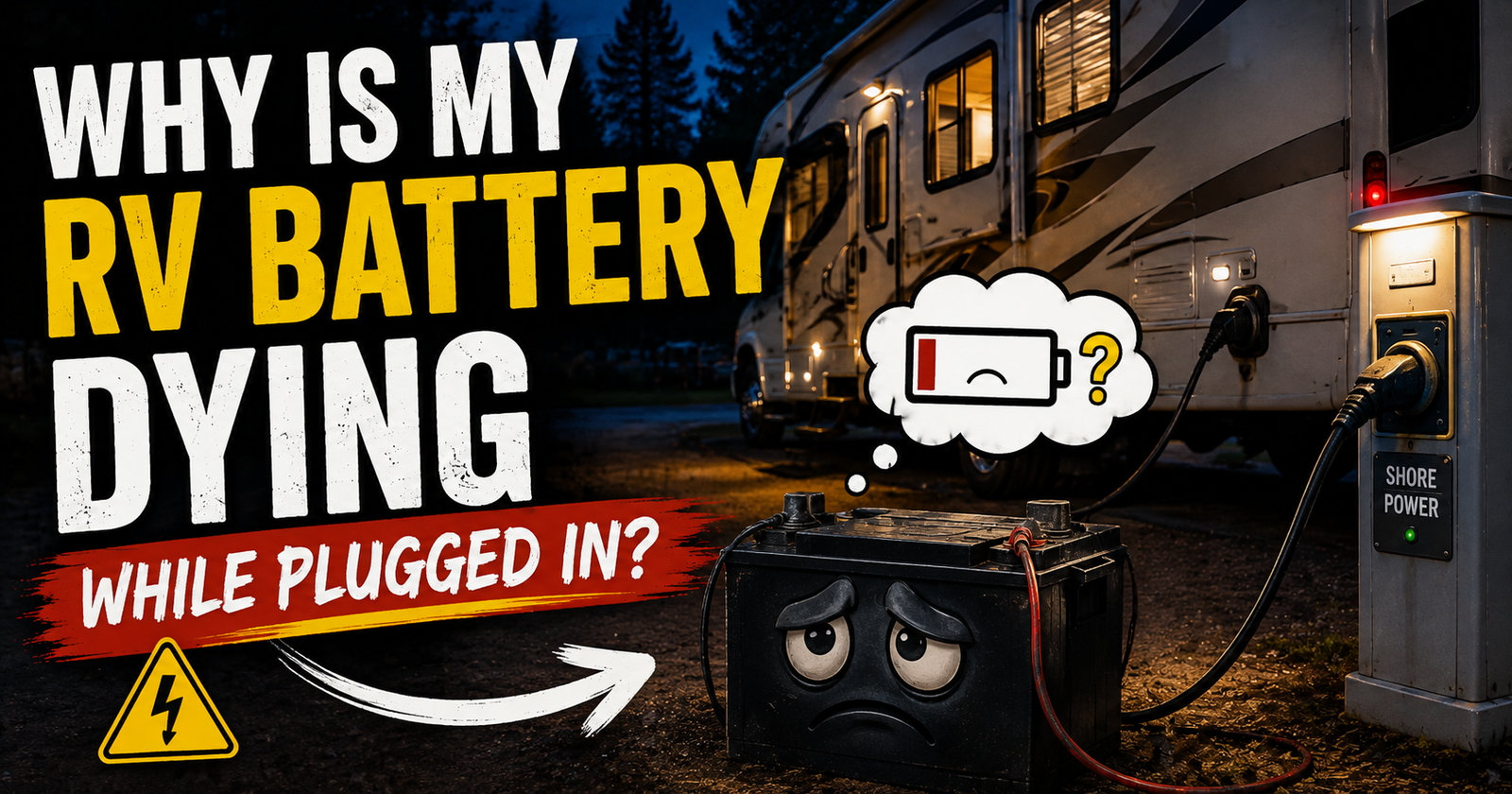
Our guide to an RV battery dying while still plugged in walks through that situation separately.
Don’t lump every falling-voltage problem together.
When it happens is one of your best clues.
Should I Replace My Battery Based on Voltage Alone?
I wouldn’t.
Voltage can tell you a battery is discharged.
It can show whether charging voltage appears to be present.
It can reveal voltage sag under load.
It can help uncover wiring problems.
But a single voltage measurement doesn’t tell you the battery’s entire condition or usable capacity.
If I suspect the battery itself, I want proper testing.
For flooded lead-acid batteries, that may include additional testing appropriate to the battery design.
For other chemistries, follow the battery manufacturer’s recommended diagnostic procedure.
Don’t spend $200, $500 or $1,000 on batteries because one number scared you.
My Simple RV Battery Voltage Routine
If I’m checking a camper battery and want useful information rather than random numbers, I do it in stages.
First, I identify the battery chemistry.
Then I measure while I know what’s happening.
What does it read while charging?
What does it read after charging influence is removed?
What does it read after an appropriate resting period?
What happens under a reasonable load?
Does the voltage recover when the load is removed?
What happens when shore power is connected again?
Those readings together tell a story.
One reading rarely does.
Write Your Readings Down
This sounds almost too simple to mention, but it helps tremendously.
Don’t rely on memory.
Write down:
Battery voltage before charging.
Voltage while plugged in.
Voltage after unplugging.
Voltage after resting.
Voltage under load.
Voltage the next morning.
If you’re troubleshooting a battery that keeps going dead repeatedly, those numbers can expose a pattern that you’d never notice from random checks.
Patterns solve electrical problems.
Your Battery Voltage Is a Clue, Not a Verdict
That’s the way I want you to think about this from now on.
12.6 volts?
Useful clue.
13.6 volts?
Useful clue.
14.4 volts?
Useful clue.
11.8 volts?
Definitely a useful clue.
But none of those numbers should be interpreted without asking what the RV was doing when you measured it.
Was the battery resting?
Charging?
Under load?
Connected to solar?
Connected to shore power?
Was the engine running?
What battery chemistry are we talking about?
Once you answer those questions, RV battery voltage stops looking like a bunch of random numbers and starts becoming one of the easiest ways to see what your electrical system is actually doing.
Written by Evan Mercer
Evan Mercer writes about RV systems, camper troubleshooting, maintenance and everyday ownership questions for CamperAnswers.com. His work focuses on turning technical RV information into straightforward, practical guidance that helps camper owners understand what their systems are doing before they start replacing parts.