
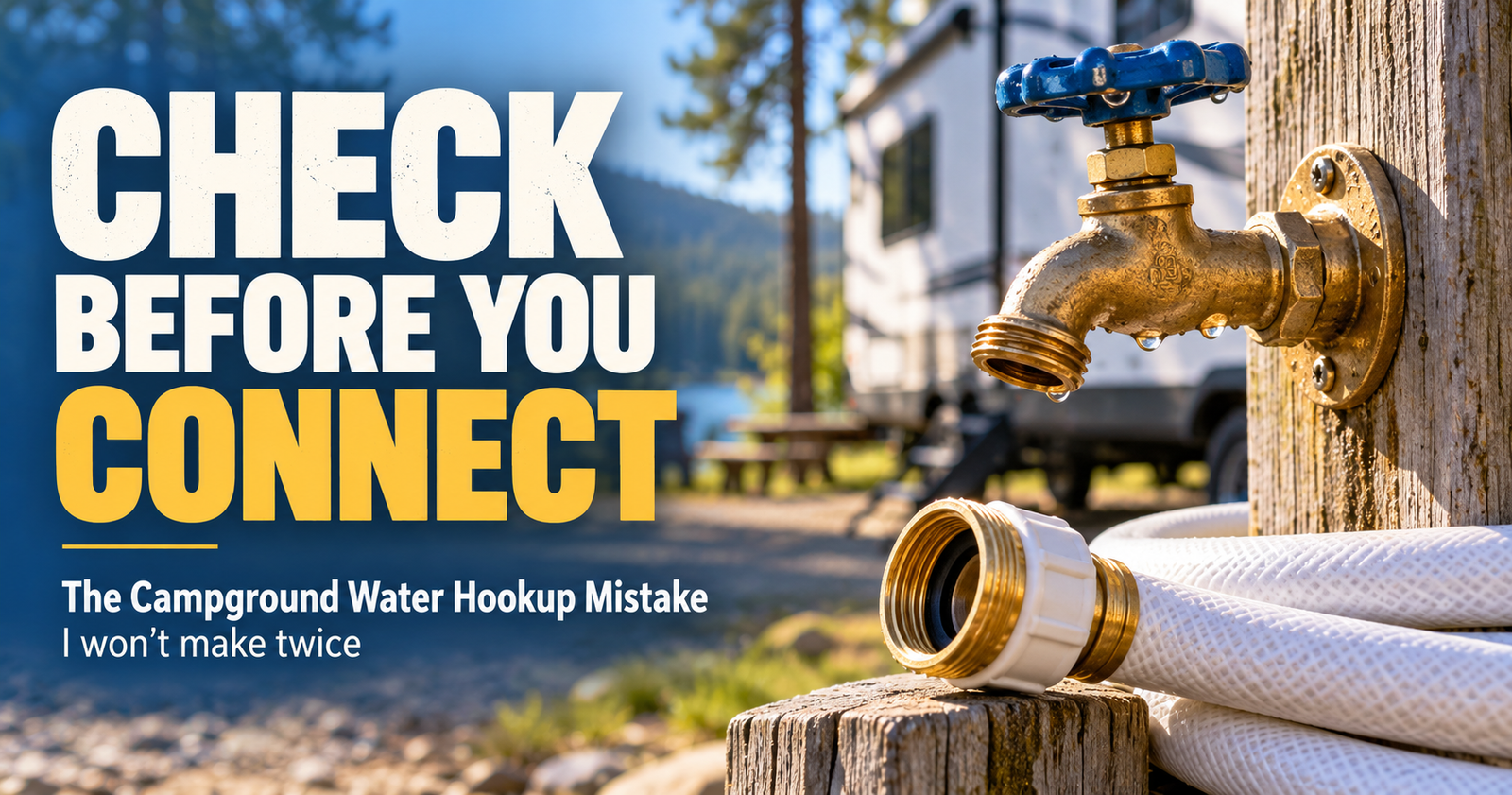
I used to think the water hookup was the easy part of setting up a camper.
Back in, level up, deal with the electrical cord, get everything situated, and then screw a hose onto the campground spigot.
How complicated could water possibly be?
The mistake was assuming that because the hose fit, whatever came out of that spigot was automatically fine for the camper.
It isn’t.
Campground water pressure can vary a lot from one place to another, and I don’t want unknown pressure going straight into RV plumbing anymore.
That’s why a water-pressure regulator is now one of those little pieces of camping equipment I’d rather forget almost anything else than leave at home.
Nothing Looked Wrong With the Spigot
That’s what makes this easy to overlook.
There wasn’t some giant warning sign hanging from it.
It looked like every other campground water connection.
Attach hose.
Turn handle.
Water comes out.
But the camper doesn’t know whether that incoming water is arriving at 45 PSI or considerably higher pressure.
It just gets whatever the campground sends it.
Current RV guidance recommends regulating campground water because supply pressure can vary significantly, with roughly 40 to 55 PSI commonly used as a practical range, although the RV manufacturer’s limit is what I’d ultimately follow.
I Don’t Want to Find High Pressure by Finding a Leak
That’s really the whole reason I care.
Too much pressure can stress fittings, hoses, valves and plumbing connections.
And an RV is about the worst place I can imagine discovering a water leak.
There’s plumbing behind cabinets.
Under sinks.
Inside walls and compartments.
Places I can’t easily see.
I’d much rather spend a minute controlling the incoming pressure than discover a wet floor later and start asking where the water came from.
The Regulator Goes at the Spigot
This was another little thing I had to learn.
I want the regulator before the hose, right at the campground water source.
That way I’m reducing pressure before it travels through the hose, filter and into the camper.
The basic setup becomes:
Campground spigot → pressure regulator → drinking-water hose/filter setup → RV city-water inlet.
That placement also helps protect more than just the plumbing hidden inside the RV.
I Like Being Able to See the Pressure
A simple fixed regulator can do the basic job.
But I understand the appeal of an adjustable regulator with a gauge.
I don’t have to wonder what pressure I’m dealing with.
I can actually see it.
And if the shower suddenly seems weak, that gauge gives me another clue instead of making me immediately blame the camper.
Maybe campground pressure itself is low.
A regulator can reduce excessive pressure. It can’t create pressure the campground isn’t supplying.

This Also Changed How I Think About Weird Water Problems
Water going somewhere unexpected gets my attention now.
If we’re connected to city water and the fresh tank starts getting fuller, that’s not something I’d shrug off.
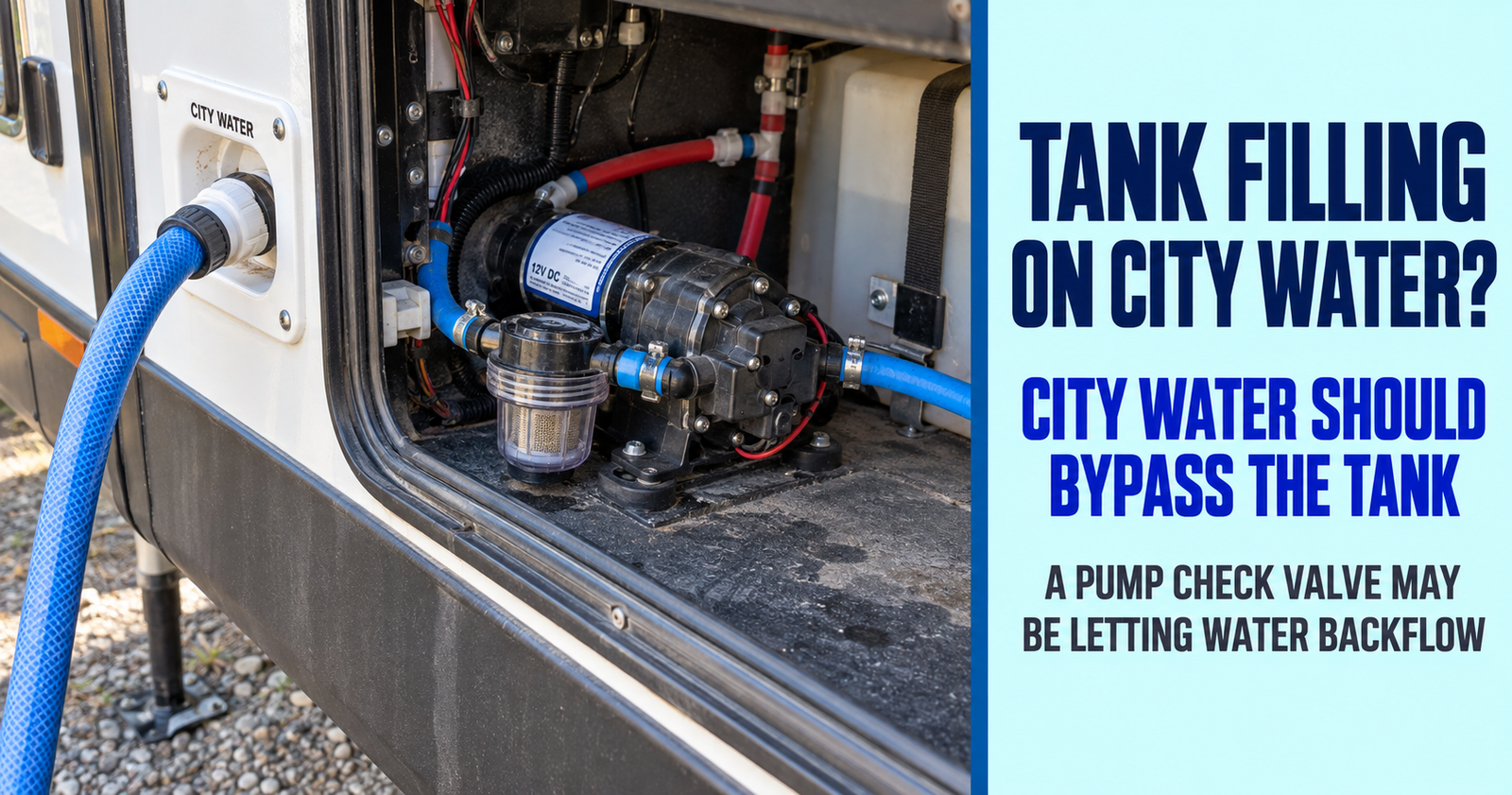
We already ran into that strange problem in our guide explaining why an RV fresh water tank can fill up while connected to city water.
That’s usually more about unwanted backflow or a valve problem than simply excessive campground pressure.
But both situations taught me the same basic lesson:
Don’t assume water is behaving correctly just because it’s coming out of the faucet.
I Also Don’t Crank the Spigot Open and Walk Away
Now I like to bring water into the system a little more deliberately.
Regulator connected.
Hose connected.
City-water inlet connected.
Then I turn the water on and actually stay around for a minute.
I go inside.
Check under the sinks.
Listen.
Look around the toilet.
Make sure nothing is dripping.
Make sure the plumbing sounds normal.
Especially at the beginning of a trip, I’d rather catch a problem while I’m standing there than after we’ve left the campsite for three hours.
A Strong Shower Isn’t Proof Everything Is Great
This is another thing I would’ve gotten backwards.
Really strong water pressure can feel fantastic.
That doesn’t mean I want unlimited pressure feeding the camper.
The goal isn’t:
Give me as much pressure as this campground can possibly produce.
The goal is enough pressure for normal use while staying within what the RV plumbing is designed to handle.
More isn’t automatically better.
And Weak Water Doesn’t Automatically Mean I Need More Pressure
If the shower is terrible, I wouldn’t immediately start adjusting things upward.
There could be a restriction somewhere.
Water filter.
Inlet screen.
Hose.
Faucet aerator.
Showerhead.
Campground supply itself.
A regulator can also affect flow depending on its design.
So I’d troubleshoot weak water before assuming the answer is simply increasing pressure.
That’s exactly the kind of problem we’ll get deeper into as we build out CamperAnswers’ water-system section.
I’d Shut the Water Off When Leaving for a Long Time
This is another habit I’ve come around to.
If we’re leaving the campground for most of the day, I don’t particularly need the RV sitting there connected to unlimited campground water.
If something inside develops a leak while I’m gone, the city-water connection can keep supplying it.
A fresh tank contains a limited amount of water.
A campground spigot doesn’t care how wet the camper is getting.
Turning the water off takes seconds.
That little bit of inconvenience is worth it to me.
It’s the Same Reason I Do the Walk-Around Before Leaving Camp
A lot of RV ownership comes down to tiny habits that seem unnecessary right up until the day they save you.

That’s why I now do a five-minute walk-around before pulling away from a campsite.
Water regulator.
Electrical protection.
Final walk-around.
Checking the battery before camping without hookups.
None of these things are exciting.
They’re just little habits that prevent the expensive stories.
Water Became One More Thing I Stopped Taking for Granted
That’s probably the biggest lesson.
At home, I turn on a faucet and almost never think about what’s happening behind the wall.
Camping makes you pay attention.
You bring the water with you or connect to somebody else’s supply.
A pump creates pressure from the fresh tank.
Campground pressure replaces the pump when you’re on city water.
Valves decide where water goes.
A regulator keeps incoming pressure under control.
Once I understood that, hooking up the water stopped being:
Screw hose on. Turn spigot. Done.
Now I spend another minute doing it properly.
Because I’d much rather spend that minute outside at the campground spigot than spend the afternoon inside trying to figure out why there’s water underneath a cabinet.
Written by Caleb Warren
Caleb Warren writes about real-world RV ownership, campground hookups, water systems, campsite routines, and the little mistakes that teach the biggest lessons for CamperAnswers.com. He focuses on practical habits that make camper ownership easier without turning every trip into a maintenance project.