
Seeing your RV battery go dead while the camper is plugged into shore power feels like something that shouldn’t even be possible. You’re connected to electricity, the cord is in the pedestal, and maybe some things inside the camper are working perfectly. So why in the world is the battery still losing power?
In most RVs, plugging into shore power should allow the converter or inverter/charger to support the 12-volt system and recharge the house battery. If the battery keeps dying anyway, either charging power isn’t reaching it, the charging equipment isn’t doing its job, the battery can’t hold the charge, or the RV is consuming 12-volt power faster than the available charging system can replace it. That distinction is also central to diagnosing an RV battery losing power quickly when the cause is not immediately obvious.
The important thing is not to automatically replace the battery.
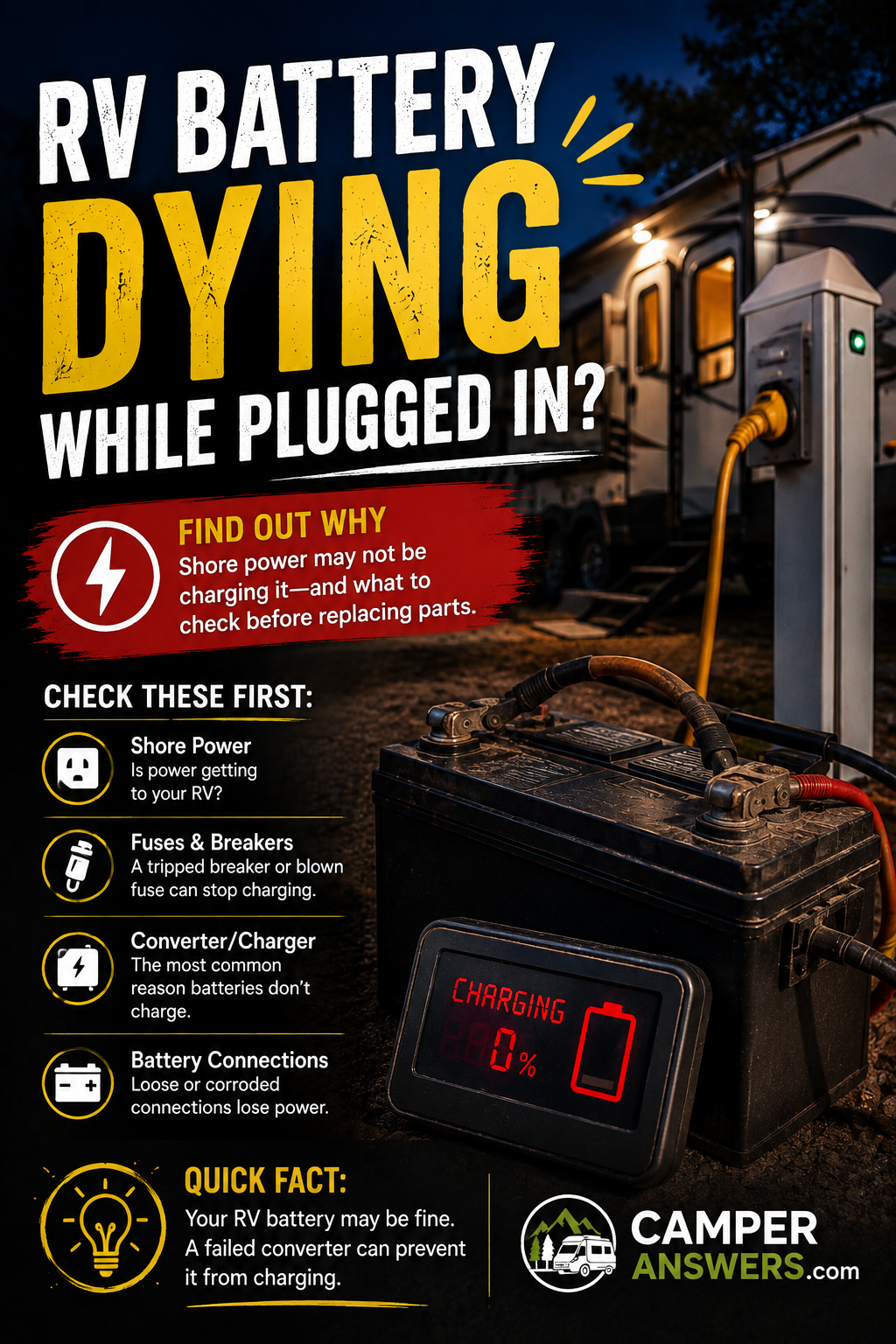
A dead battery is the symptom. We need to figure out why being plugged in isn’t preventing it.
Yes, Your RV Battery Should Normally Charge While Plugged In
This is the first thing worth clearing up because RV electrical systems can be confusing.
Plugging a typical RV into shore power doesn’t simply make the wall outlets work.
The 120-volt AC supply can also feed a converter/charger or inverter/charger. That equipment provides DC power and normally allows the house battery to recharge.
That’s how the two sides of the electrical system work together.
Your RV may be plugged into 120-volt electricity while lights, control boards, the water pump and other equipment continue operating on the 12-volt side.
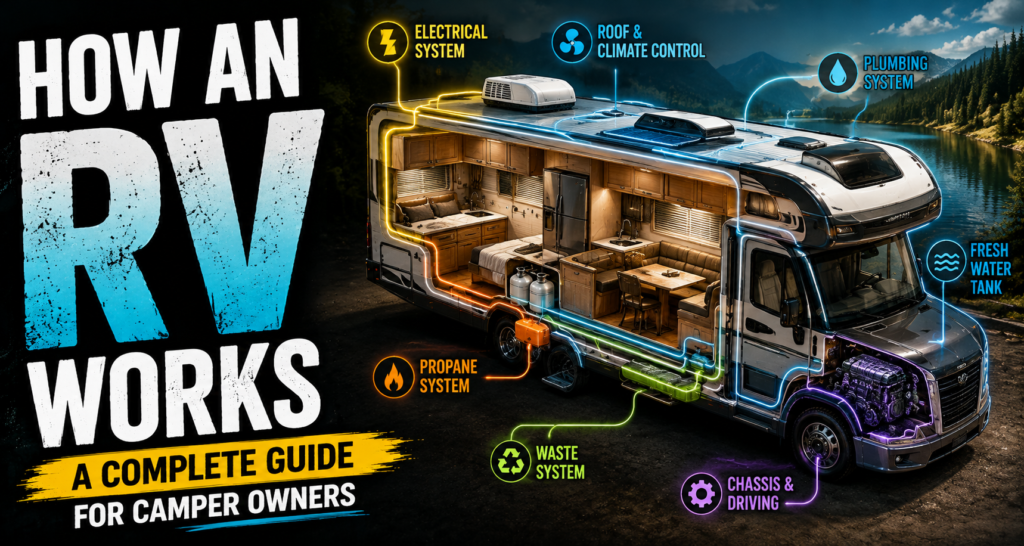
If you’re still getting familiar with that relationship, our guide explaining how the different systems in an RV actually work lays out the electrical system along with the rest of the camper.
For this problem, though, there’s one important takeaway:
Being plugged in and actually charging the battery are two different things.
The Converter Is One of the First Things I’d Think About
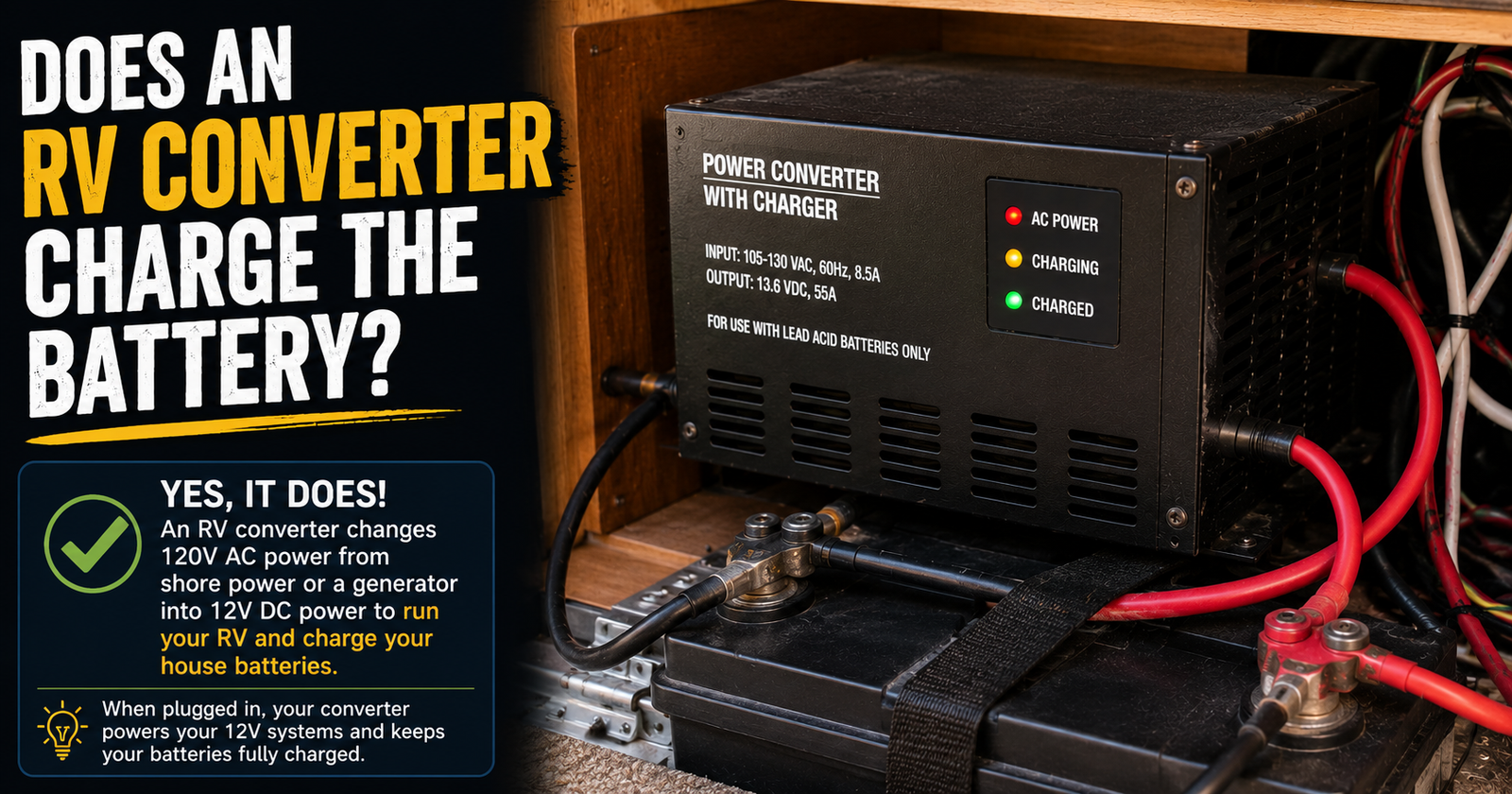
In many RVs, the converter/charger is responsible for taking incoming AC power and providing the DC power needed by the 12-volt system while also charging the house battery. That dual function is explained in more detail in the converter's battery-charging role.
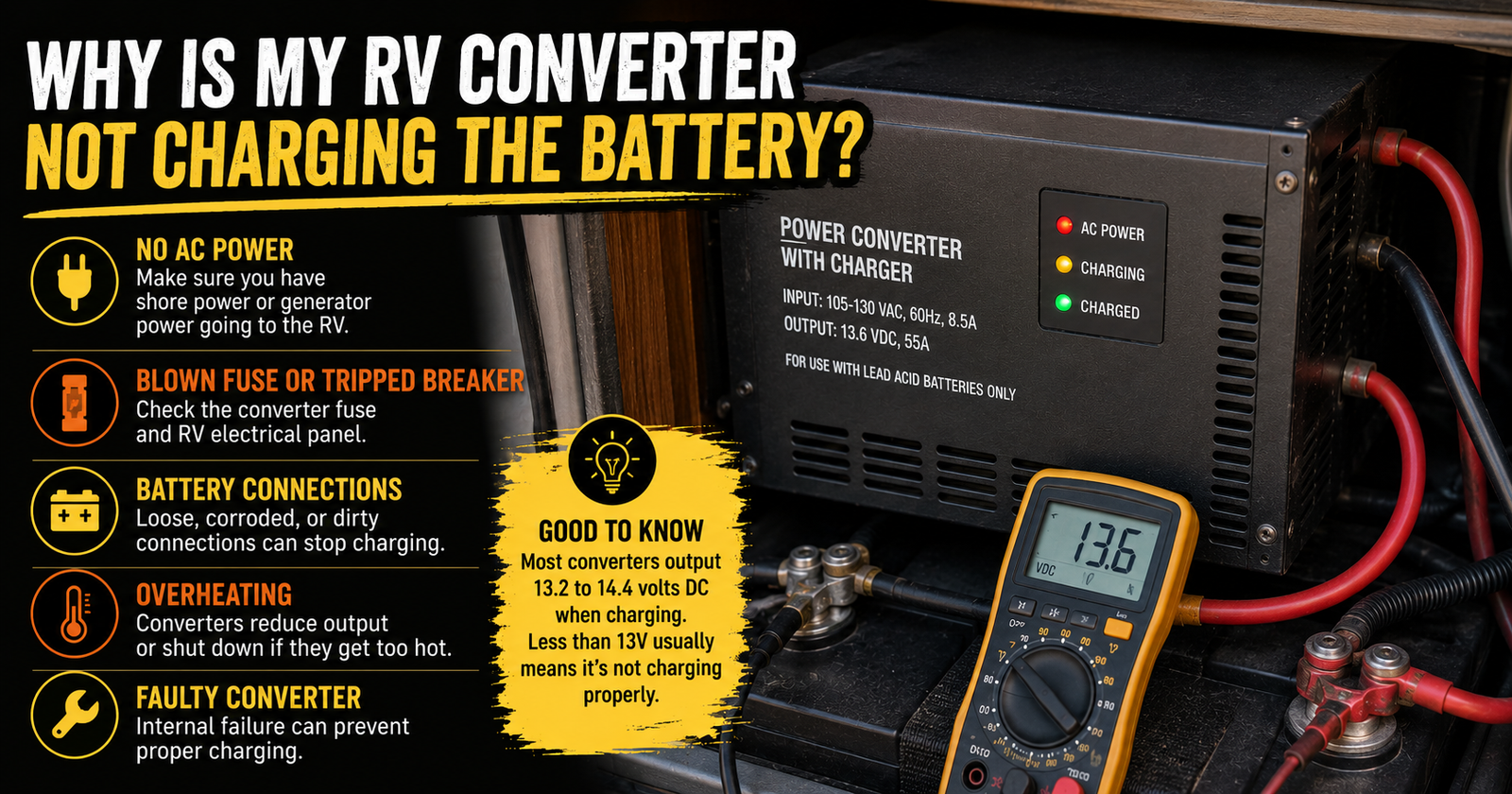
If the converter isn’t working correctly, your battery may continue carrying 12-volt loads even though the camper is connected to shore power.
Eventually the battery loses enough energy that the symptoms become obvious.
The lights may dim.
The furnace may stop operating properly.
Control boards can begin acting strangely.
The water pump may sound different.
Eventually 12-volt equipment may stop working altogether.
That can make the entire camper appear to have developed multiple problems when one charging failure is behind all of them.

But Don’t Replace the Converter Yet
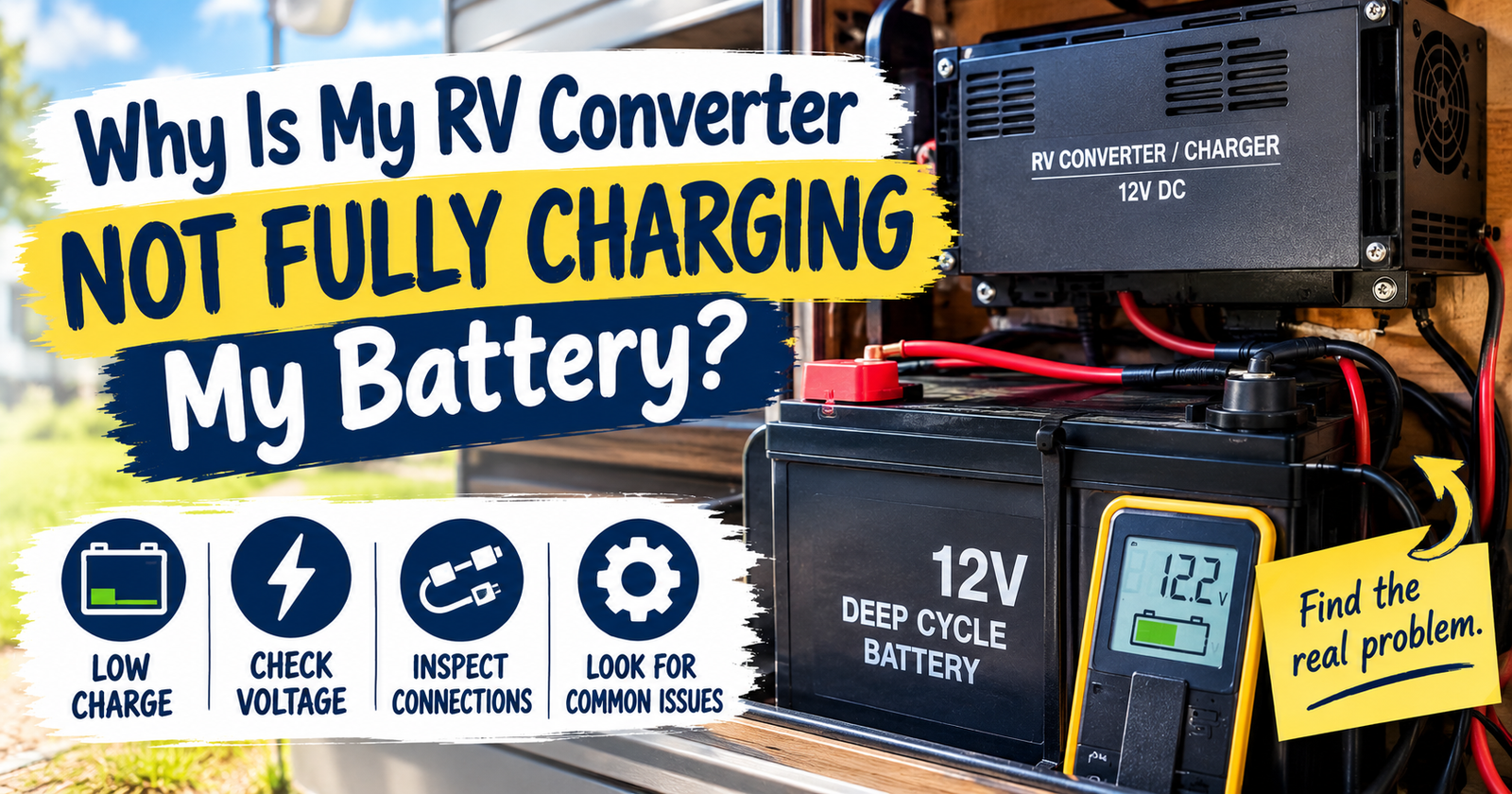
A converter that isn’t charging the battery isn’t automatically a failed converter.
The converter needs AC power before it can do anything.
There can also be protection devices and wiring between the converter and battery.
Progressive Dynamics, for example, directs owners troubleshooting certain converters to first verify converter output and then check the fuse or breaker in the battery’s positive lead when the converter itself produces the correct output but the batteries aren’t charging.
That’s an important diagnostic lesson regardless of converter brand.
You need to find where the charging path stops.
Make Sure the RV Actually Has Shore Power
The shore-power cord being plugged in doesn’t prove electricity is reaching the RV.
Start with the source.
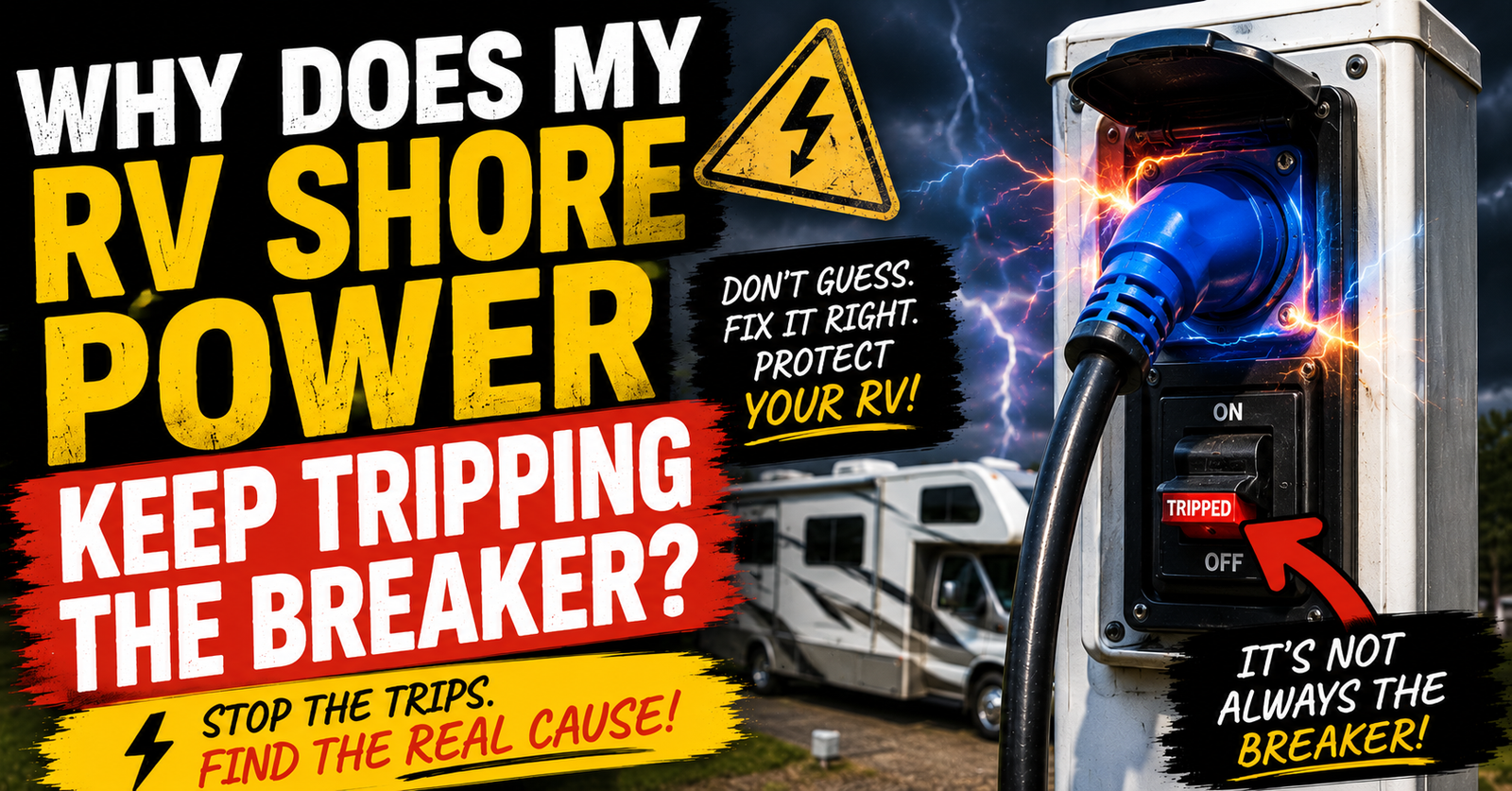
If you’re at a campground, check whether the pedestal breaker is on.
If you use an electrical management system or surge protector, check its display or indicators according to its instructions.
Look for evidence that the RV’s 120-volt AC system is actually operating.
But don’t use your ceiling lights as the test.
Most RV interior lights are 12-volt equipment. They can continue operating from the house battery even if shore power has completely disappeared.
A working light can actually fool you into thinking the camper still has shore power while the battery quietly discharges.

Check Whether the 120-Volt Side of the RV Works
Look at equipment you know operates from 120-volt AC power in your specific camper.
Are the appropriate wall outlets working?
Does the microwave have power?
Does other known AC equipment operate?
If the entire AC side is dead, your battery problem may really begin with a shore-power problem.
The converter can’t charge the battery from AC power that never reaches it.
That means the diagnostic path may include the campground pedestal, shore-power cord, connectors, electrical management equipment, main breaker or other parts of the incoming AC system.
A Tripped Converter Breaker Can Leave the Battery Draining
Your RV can have AC power while the converter doesn’t.
That’s an especially useful clue.
The converter may be supplied through its own breaker or circuit depending on the RV’s electrical design.
If that circuit loses power, other 120-volt equipment can continue working normally while the converter stops supporting the 12-volt system.
The house battery then begins supplying those DC loads.
From your perspective, the camper is “plugged in.”
From the battery’s perspective, it may be boondocking.
Check the applicable breakers according to your RV and converter documentation.
If a breaker trips repeatedly, don’t keep resetting it. Repeated tripping indicates a problem that needs to be diagnosed.
A Blown Fuse Can Separate the Battery From a Working Converter
This is one of the more interesting possibilities because it can produce misleading symptoms.
The converter itself may be producing DC power.
The RV’s 12-volt equipment may even operate while you’re connected to shore power.
But if the charging connection between the converter and battery is interrupted by a blown fuse, tripped DC breaker, damaged connection or wiring problem, the battery may not receive the charge it needs.
Then you unplug from shore power and discover the battery is dead.
It seems like the converter failed to charge it, but the converter itself may have been fine.
The problem was between the converter and battery.
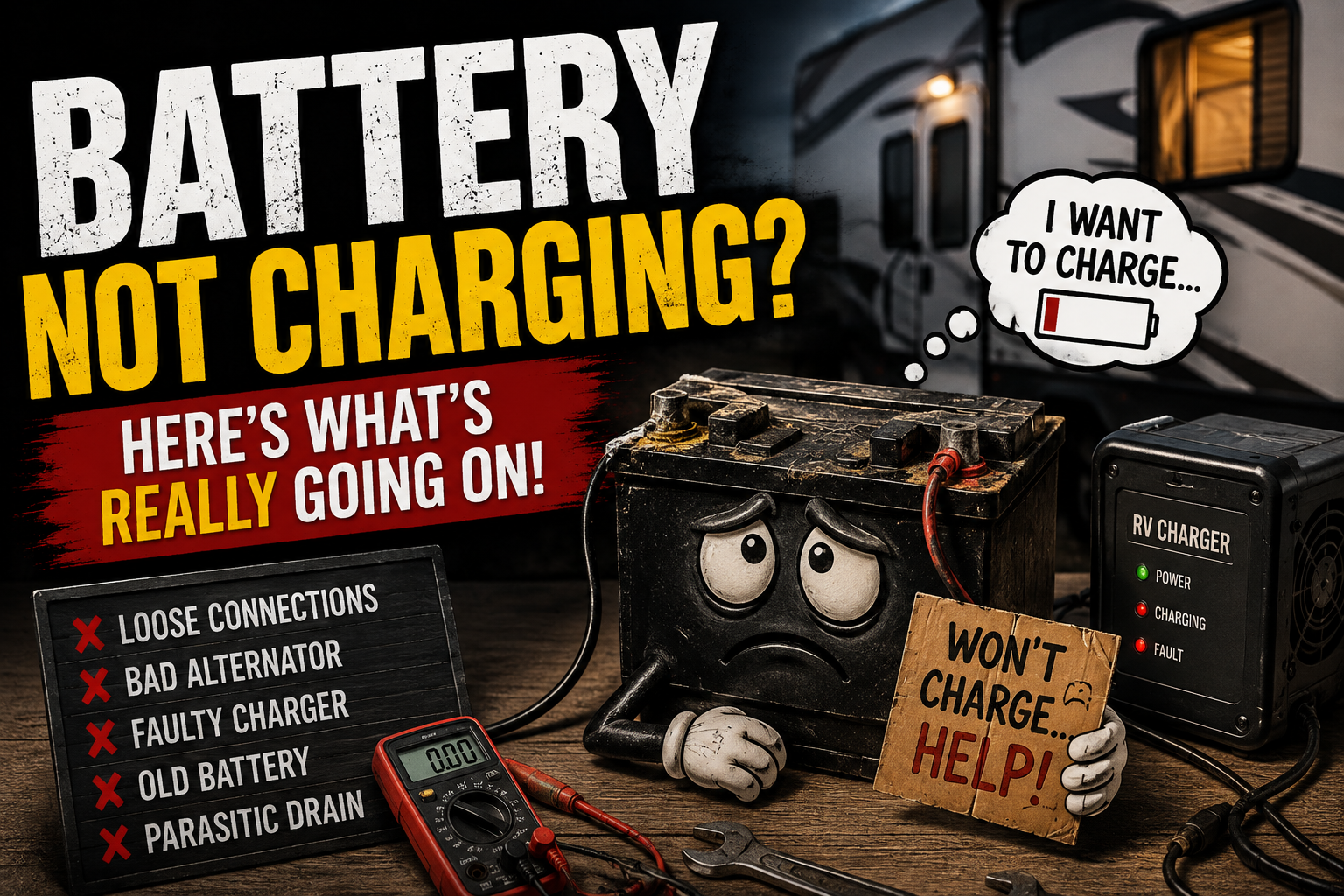
If your battery simply refuses to gain charge from any source, our more general guide to why an RV battery won’t chargewalks through the entire charging path in more detail.
Check for a Fuse or Breaker Near the Battery
Some campers have an inline fuse or DC circuit breaker in the positive battery circuit.
These protection devices can be surprisingly easy to overlook.
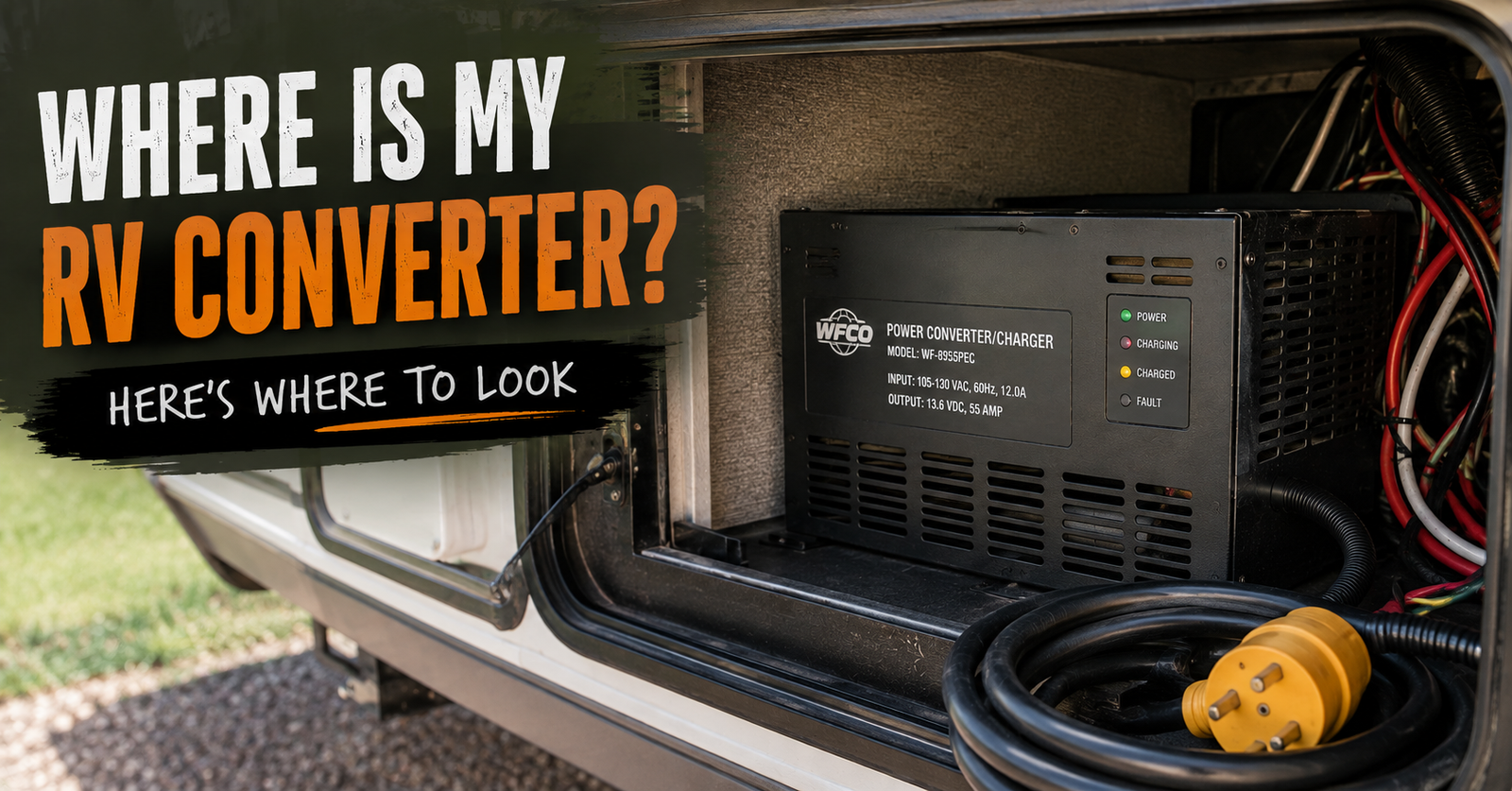
A DC breaker near the battery may look nothing like the familiar row of breakers in the RV’s AC electrical panel. Knowing where the converter sits relative to that equipment can make the charging system easier to trace; RV's AC electrical panel.
Its exact location and design vary by RV.
If the converter has proper output but that output isn’t making it to the battery, this portion of the circuit deserves attention.
Never permanently bypass a fuse or circuit breaker just to make the battery charge.
The device is protecting the wiring from potentially dangerous current.


Reverse-Polarity Fuses Can Stop the Charging Process
This moves much higher on my list if the problem appeared immediately after someone disconnected or replaced the battery.
Many converter systems have protection against reversed battery polarity.
Progressive Dynamics specifically notes that the reverse-battery protection fuses on certain converters can blow if battery leads are connected backward, even briefly.
You could correct the battery cables afterward and still be left wondering why the battery won’t charge.
If the charging problem began immediately after battery work, check the converter manufacturer’s instructions for reverse-polarity protection.
And if the fuse blows again, don’t install a larger fuse.
Find out why it’s blowing.
Your Battery Disconnect Could Be Involved
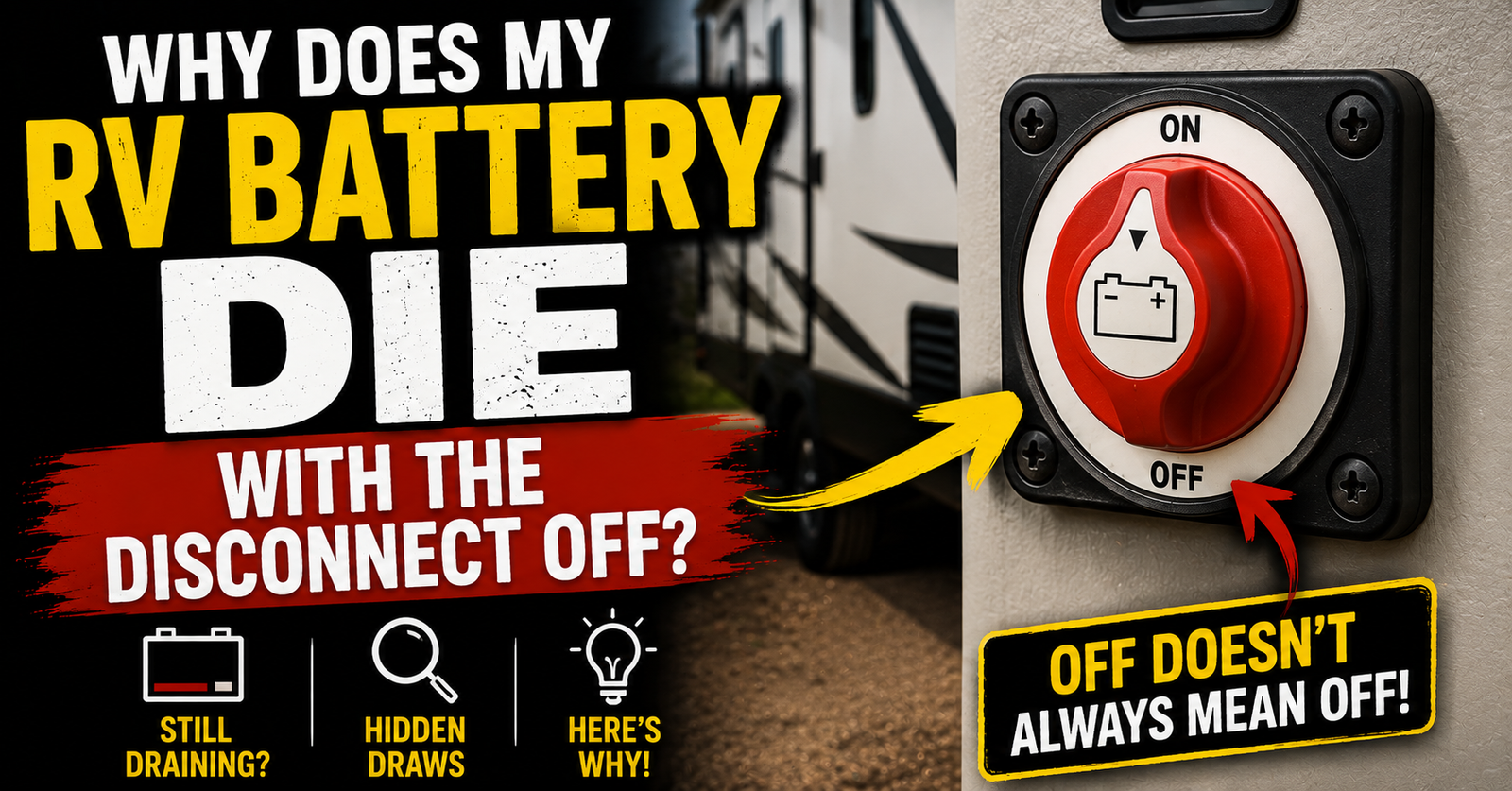
The battery disconnect seems simple until you realize RV manufacturers don’t all wire them exactly the same way. For an example of how those wiring differences can leave a battery connected, see RV battery disconnect wiring.
Depending on the camper, disconnect position can affect the battery’s relationship with the charging system.
This is particularly worth checking if the RV recently came out of storage.
Maybe someone turned the disconnect off months ago.
You plug the camper in and assume the battery is charging because the lights work.
Meanwhile, shore power and the converter are supporting the RV’s 12-volt loads without actually restoring the battery as expected.
Check the disconnect position and your RV’s documentation rather than assuming how the switch is wired.
The Battery Connections May Be Loose or Corroded
Charging current has to physically reach the battery.
Loose terminals, corrosion, damaged cables and poor connections can interfere with that path.
Inspect the battery connections carefully.
Look at both sides of the circuit.
The positive connection gets most of the attention, but a bad negative connection can cause trouble too.
If the problem began after battery replacement or other work around the battery compartment, I’d inspect the connections particularly closely.
Something may simply not have been tightened or reconnected correctly.
Don’t Forget the Ground Connection
The negative side needs a solid electrical path too.
A poor ground can create charging problems and other confusing 12-volt symptoms.
If the positive side looks perfect and measurements still don’t make sense, don’t assume the negative side is fine just because the cable is physically attached.
Corrosion, loose hardware or a compromised connection can increase resistance and interfere with proper operation.
Your Converter Could Actually Be Bad
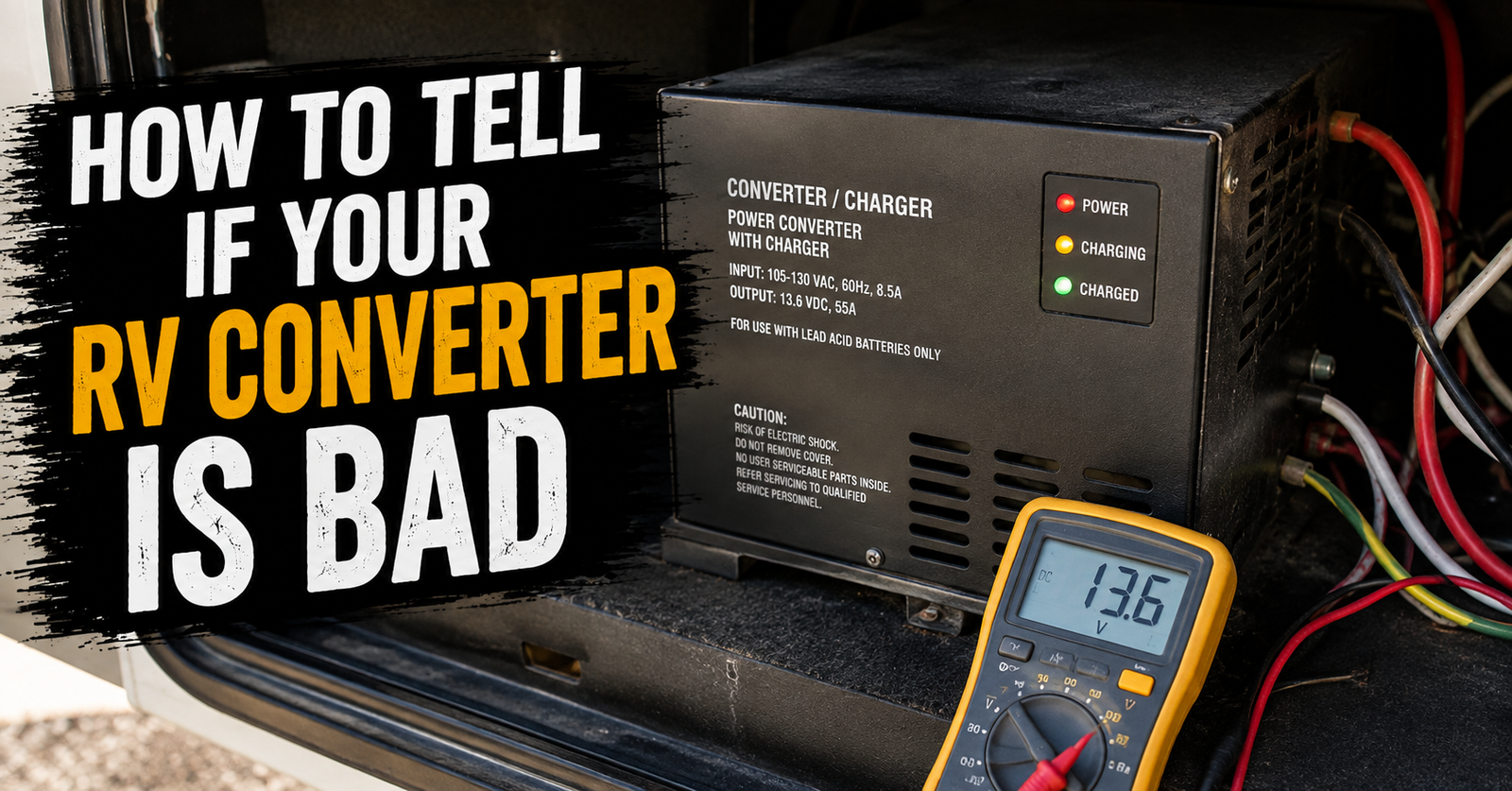
Once you’ve confirmed appropriate AC power reaches the converter and the obvious protection devices and connections aren’t the problem, the converter itself becomes more suspicious. At that point, converter is failing becomes the next component to test before replacing anything.
This is where testing is much better than guessing.
The converter manufacturer should provide specifications and troubleshooting procedures for the particular model.

For example, Progressive Dynamics specifies approximately 13.6 volts DC, with a tolerance, when testing the output of certain standard converter models, while some lithium-specific models use a different output value. Because those values vary by battery type and test conditions, RV battery voltage by chemistry is useful before comparing a measured number with a general charging range.
That’s exactly why I wouldn’t tell every RV owner that one universal voltage proves every converter is good or bad.
Find the model.
Use the manufacturer’s specifications.
Then test the actual equipment you own.
Your RV May Have an Inverter/Charger Instead
Not every camper uses a standalone converter.
Some RVs, particularly larger or more sophisticated setups, use an inverter/charger.
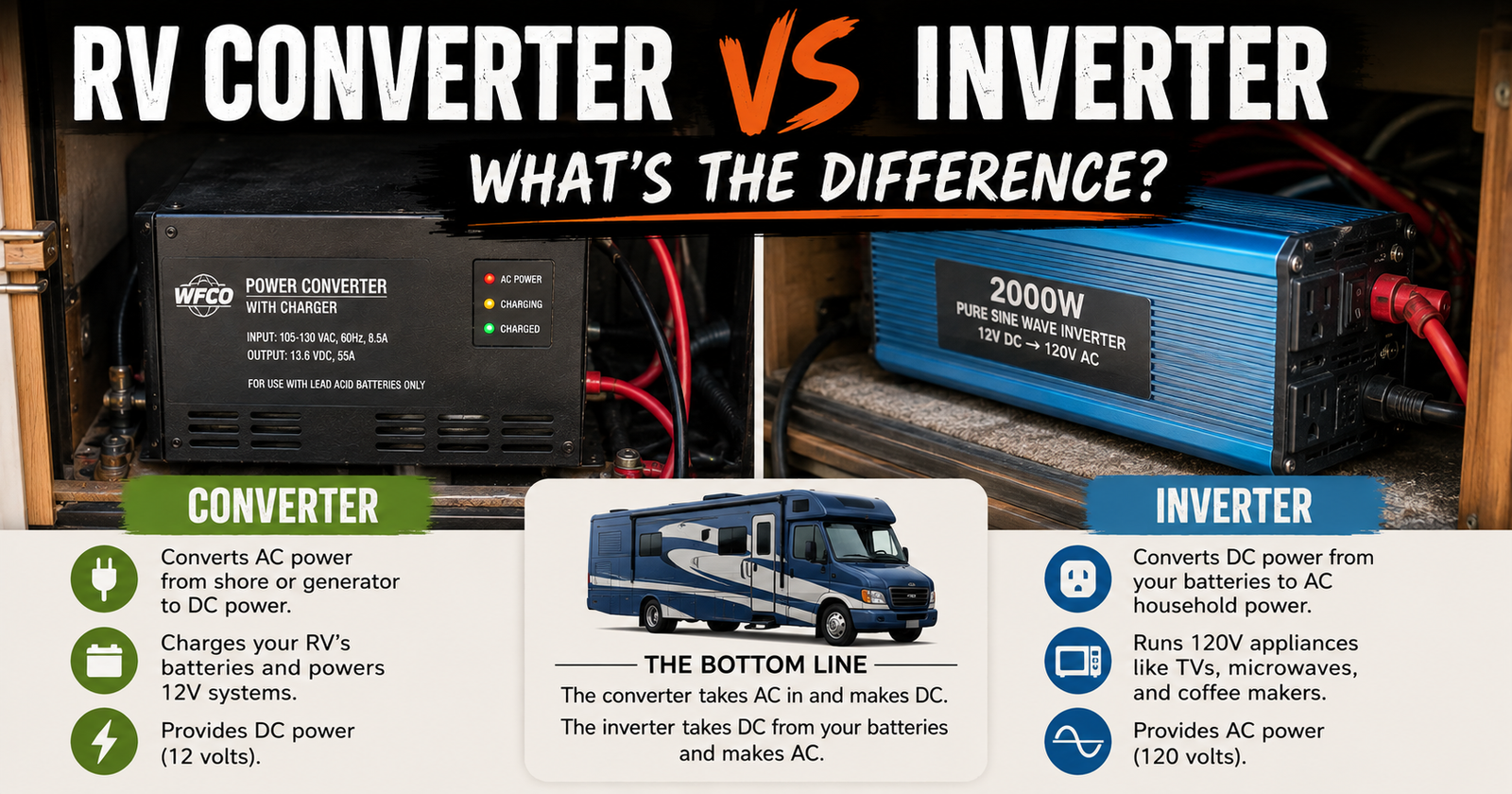
An inverter/charger combines the ability to create AC power from battery energy with the ability to charge the battery when an appropriate external AC source is available. Knowing which part handles charging and which part supplies AC power can make this why an RV battery can die while plugged in easier to diagnose.
These systems can introduce additional settings and operating modes.
Battery chemistry settings, charge-current limits and other configuration choices can affect charging behavior depending on the equipment.
If you have an inverter/charger, use its manual and model-specific troubleshooting information instead of blindly following instructions written for a conventional converter.
The Charger May Be Working but the Battery Is Bad
Here’s the other side of the equation.
Sometimes the camper is doing exactly what it’s supposed to do.
The battery simply can’t store the energy anymore.
A battery can lose usable capacity as it ages or after a difficult service life.
Repeated deep discharge can be hard on some battery types.
A damaged battery can also behave abnormally.
You may see charging voltage at the battery and assume everything is fixed, only to have the battery lose power quickly when charging stops.
That shifts suspicion away from the converter and toward the battery itself.
Don’t Judge Battery Health From One Voltage Reading
Battery voltage is useful, but context matters.
Is the battery actively charging?
Has it recently been disconnected from a charger?
Is a substantial load operating?
What battery chemistry are you dealing with?

A voltage reading taken while the converter is actively charging doesn’t necessarily tell you how much usable capacity the battery will retain once that charging source disappears.
Proper battery testing needs to account for the battery type and operating conditions.
Battery Chemistry Changes the Charging Rules
An RV may use flooded lead-acid, AGM or lithium batteries.
The charging requirements aren’t necessarily identical.
This becomes particularly important when a camper has been upgraded from one battery chemistry to another.
Maybe the original RV came with lead-acid batteries.
Someone later installed lithium batteries.
Now the question isn’t simply whether the converter runs.
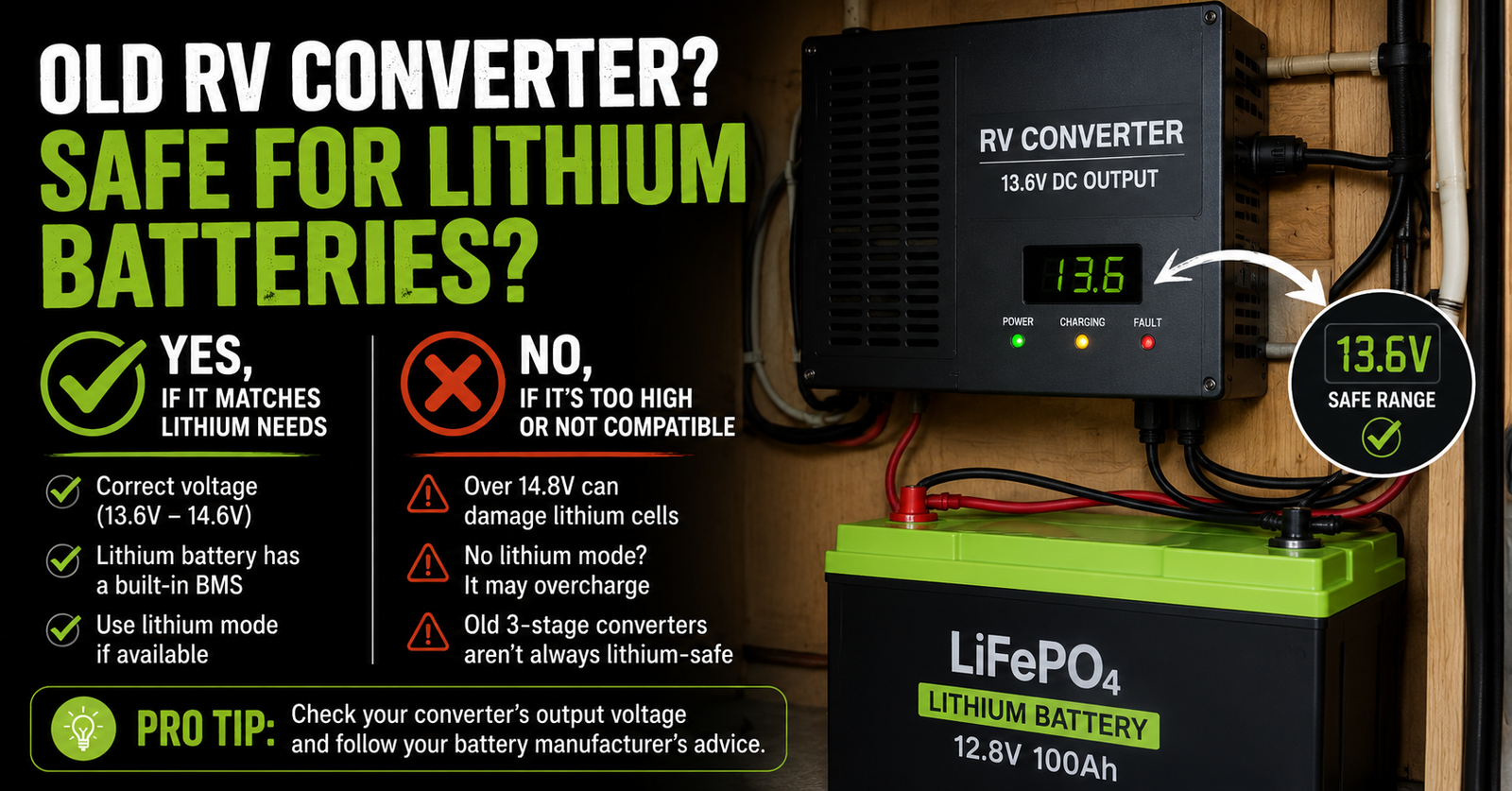
It’s whether the charging equipment is appropriate and configured for the battery that is actually installed.
Some chargers have selectable battery profiles.
Some equipment is designed specifically for particular chemistries.
Don’t assume compatibility.
Lithium Batteries Can Protect Themselves From Charging
Lithium batteries commonly include a battery management system.
Depending on the battery, the BMS may limit or stop charging under certain conditions.
Low temperature is a particularly important example because many lithium chemistries require protection against charging when the cells are too cold.
Some batteries include internal heating.
Others don’t.
If a lithium battery suddenly refuses to charge during freezing weather but the charging system otherwise appears normal, check the battery manufacturer’s temperature specifications and BMS behavior.
Don’t diagnose it using lead-acid rules.
Your RV Could Be Using More 12-Volt Power Than the Charger Can Supply
This isn’t the most common explanation in an ordinary setup, but it’s possible.
A converter has a maximum output.
The RV’s operating 12-volt equipment consumes some of that output, while the remaining available current can contribute to battery charging.
Under unusually heavy DC demand, a charging system can have less capacity available for replenishing the battery.
Progressive Dynamics notes in its converter documentation that excessive connected DC load can affect converter output on certain units.
If your battery problem happens only when several high-demand 12-volt systems are operating, load becomes worth considering.
The Furnace Can Make a Charging Problem Much More Obvious
Cold weather has a way of exposing weak RV battery systems.
The furnace uses propane for heat, but its blower and controls depend on 12-volt electricity.
If the converter isn’t properly supporting the DC system, a furnace cycling throughout a cold night can drain the house battery surprisingly quickly.
This can create a very specific pattern.
During the day, everything seems mostly normal.
Overnight, the furnace runs repeatedly.
By morning, the battery is nearly dead even though the shore-power cord never moved.
If that sounds familiar, the furnace may not be the actual problem. It may simply be the load that finally exposes a charging failure.
Dim Lights While Plugged In Are a Useful Clue
If 12-volt lights become noticeably dim while the RV is connected to shore power, pay attention.
A properly operating charging system should normally be supporting the DC side while external power is available.
Dimming lights combined with falling battery voltage can suggest that the battery is carrying loads without receiving adequate charging support.
Don’t use light brightness as your only diagnostic test, but treat it as another piece of evidence.
The Water Pump Can Give You Another Clue
The water pump is another noticeable 12-volt load.
If it suddenly sounds slower or weaker while you’re supposedly connected to shore power, battery voltage may be falling.
The same can happen with vent fans and other DC equipment.
Several unrelated 12-volt devices acting weak at the same time usually makes me think about their shared power supply before assuming they all failed independently.
Your 120-Volt Outlets Can Work While the Battery Dies
This is probably one of the most confusing versions of the problem.
You plug into shore power.
The microwave works.
The outlets work.
The air conditioner works.
Yet the battery continues going dead.
That’s absolutely possible because the AC distribution system and battery charging system aren’t the same circuit.

Incoming shore power can successfully supply the RV’s AC panel while something prevents the converter or inverter/charger from properly charging the battery. That distinction is one part of diagnosing why an battery isn't being properly recharged over time.
So don’t let working outlets talk you out of investigating the charger.
They prove AC power exists somewhere in the RV.
They don’t prove charging current reaches the battery.
Your Lights Can Work Too
It gets even stranger.
Depending on the exact failure and RV design, your 12-volt lights may continue operating while connected to shore power even though the battery isn’t charging correctly.
The converter can potentially support DC branch circuits while a problem in the battery connection prevents proper charging.
That’s why “everything works when I’m plugged in” is actually a valuable symptom.
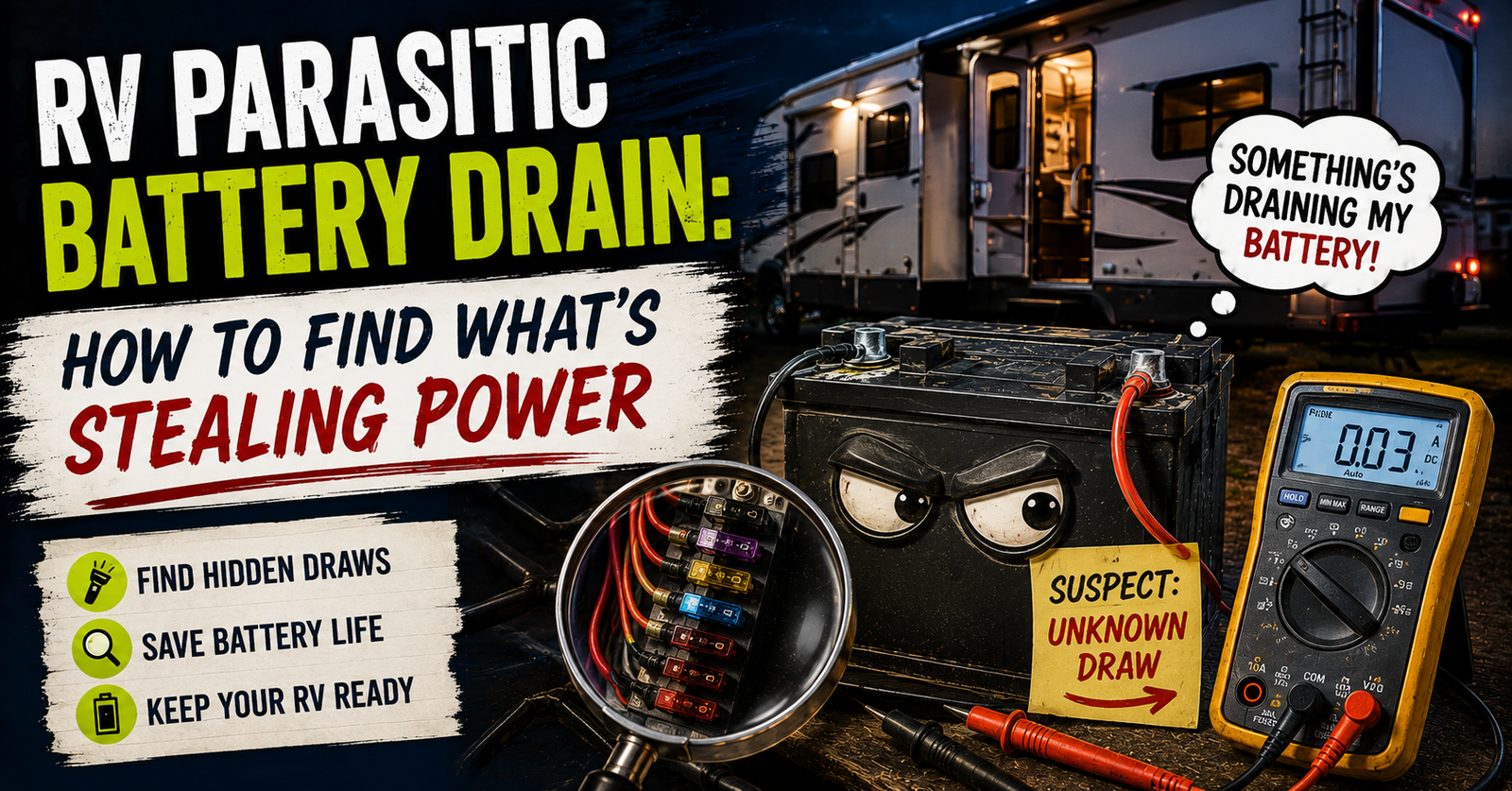
If everything works on shore power but the battery is dead the moment you unplug, investigate whether the battery is connected, healthy and receiving charging current. If charging checks out, finding hidden electrical loads that steal RV battery power can help explain why the battery still loses energy while the camper appears inactive.
What Happens When You Unplug Is Extremely Useful
Try to think about the exact transition from plugged in to unplugged.
If the RV’s 12-volt equipment works normally on shore power and immediately dies when you disconnect the shore cord, the battery isn’t providing usable power.
That could mean:
The battery is discharged.
The battery is disconnected.
A fuse or breaker in the battery circuit is open.
A cable connection is bad.
The battery itself has failed.
That symptom gives you much more information than simply saying, “My battery won’t charge.”
If the Battery Charges From Solar but Not Shore Power
This is a fantastic diagnostic clue.
If a properly functioning solar system can charge the battery, you’ve demonstrated that the battery can accept at least some charging energy through another path.
Now the shore-power charging side becomes much more suspicious.
I’d concentrate on the converter or inverter/charger, its AC input, configuration, protection devices and its connection to the battery.
There’s little reason to dismantle a functioning solar charging system just because another charging source isn’t working.
If Shore Power Charges It but Solar Doesn’t
Now we’ve flipped the diagnosis.
The battery has demonstrated that it can charge from shore power.
The converter is probably doing something useful.
The solar system becomes the branch that needs investigation.
This is why testing different charging sources is so powerful.
RV batteries can potentially receive energy from shore power, generators, solar and vehicle charging systems.
Finding out which sources work can narrow the failure dramatically.
If the Battery Dies Only at Certain Campgrounds
Don’t ignore that pattern.
If your charging system works normally at home and at most campgrounds but repeatedly acts strange at one location, look harder at the incoming power source.
An electrical management system may reject campground power because it detects a problem.
Voltage conditions can also affect equipment.
Progressive Dynamics documentation for certain converters, for example, specifies acceptable AC input ranges and notes that the converter can shut down outside those conditions.
Don’t assume every campground pedestal supplies perfect electricity simply because you were able to insert the plug.
If the Battery Dies While Plugged Into Your House
Home connections introduce another set of possibilities.
Many owners connect an RV to a household receptacle using an appropriate adapter.
The amount of available power can be significantly lower than at a dedicated RV pedestal.
That doesn’t automatically prevent the converter from charging the battery, but the overall circuit has less capacity for large RV loads.
Be especially careful about extension cords, adapters and connections.
Improperly sized cords and poor connections can overheat.
If you’re unsure whether the home circuit and equipment are appropriate for your RV, have the setup evaluated rather than improvising.
If the Battery Keeps Dying After You Replace It
This is where I’d stop buying batteries.
If the old battery died while plugged in and the new battery does exactly the same thing, there’s a strong reason to investigate the rest of the charging system.
The battery may have been the victim of the problem rather than the cause.
A chronic undercharging condition can also be hard on some battery types over time.
Replacing batteries without correcting the charging problem can simply start the cycle again.
If the Converter Keeps Blowing Fuses
Don’t solve repeated fuse failure by installing a larger fuse.
A fuse is a protection device.
If the correct fuse repeatedly opens, something is causing it.
Reverse polarity is particularly relevant with converter reverse-protection fuses, while other circuit fuses can open for other reasons depending on their purpose.
Use the equipment manufacturer’s troubleshooting procedure to determine what that particular fuse protects.
Repeatedly sacrificing fuses isn’t a repair.
Check What Happened Right Before the Problem Started
The timing of an electrical failure can tell you a lot.
Did the battery stop charging immediately after:
Replacing the battery?
Cleaning the terminals?
Taking the RV out of storage?
Installing lithium batteries?
Adding an inverter?
Installing solar?
Doing electrical work?
Connecting at a new campground?
Experiencing a power problem?
Changing the battery-disconnect position?
If something changed immediately before the failure, investigate that change before assuming an unrelated component coincidentally failed at the same time.
Here’s the Order I’d Personally Check Things
I wouldn’t start by pulling the converter out.
First, I’d verify that appropriate shore power actually reaches the RV.
Then I’d confirm the AC side is operating.
I’d check the relevant breaker supplying the charging equipment.
I’d verify the battery disconnect is in the correct operating position.
I’d inspect the battery terminals and accessible wiring.
I’d identify the converter or inverter/charger model.
I’d check the appropriate fuses and DC protection devices according to the manufacturer’s documentation.
Then I’d determine whether the charger is actually producing the output that manufacturer specifies and whether that charging voltage reaches the battery.
That sequence moves from simple observations toward actual electrical diagnosis instead of starting with the most expensive component.
A Multimeter Can Tell You a Lot, but Use It Correctly
Electrical measurements can quickly reveal whether voltage changes at the battery when shore power is connected.
Model-specific converter testing can also determine whether charging equipment is producing appropriate output.
But a multimeter isn’t automatically safe simply because you own one.
Converter troubleshooting can involve both 12-volt DC and 120-volt AC electricity.
Battery systems can produce extremely high current during a short circuit.
Progressive Dynamics itself warns that troubleshooting electrical equipment can expose people to dangerous electricity and recommends qualified technicians when appropriate.
If you’re uncomfortable identifying circuits, configuring a meter or working around energized equipment, don’t learn by trial and error inside an RV electrical panel.
When I’d Suspect the Converter or Inverter/Charger
The charger moves high on my list when appropriate AC input is confirmed, configuration is correct, the battery circuit is intact and the unit isn’t producing the output specified by its manufacturer.
I’d also become suspicious if the problem is isolated specifically to charging from shore power while other charging sources work normally.
That’s very different from condemning the converter because the battery happens to be dead.
Diagnosis should lead you to the component, not the other way around.
When I’d Suspect the Battery Instead
The battery moves higher on my list when proper charging voltage reaches it but it won’t accept or retain useful energy, it loses charge unusually quickly after the charger is removed, it fails appropriate battery testing or it shows physical signs of deterioration. Those signs warrant a closer diagnosis, and you can determine whether the battery is failing before purchasing another one.
Age and history matter too.
A battery that has spent long periods deeply discharged may not perform like one that has been properly maintained.
Still, test before assuming.
When I’d Suspect the Wiring or Protection Devices
I’d look particularly hard at the charging circuit when the converter produces proper output but that output isn’t reaching the battery.
That’s where connections, fuses, breakers, disconnects and wiring become central to the diagnosis.
This situation can produce some of the strangest symptoms because the converter and battery can each appear normal when tested independently.
The problem is the path between them.
Don’t Ignore a Battery That’s Hot, Swollen or Smells Strange
A battery showing obvious physical warning signs isn’t something I’d continue charging while casually experimenting.
Unusual heat, swelling, leaking or concerning odors deserve immediate attention.
Avoid ignition sources and sparks around batteries and follow the battery manufacturer’s safety instructions.
If you aren’t sure what you’re dealing with, stop using the system and get qualified help.
Being Plugged In Is a Clue, Not Proof That Charging Is Happening
That’s really the key to this entire problem.
Your shore-power cord can be connected while the pedestal isn’t supplying usable power.
The RV can have AC power while the converter circuit doesn’t.
The converter can operate while a fuse or breaker prevents charging current from reaching the battery.
Charging voltage can reach the battery while the battery itself can no longer store useful energy.
And the entire charging system can be functioning while unusually heavy DC loads consume more energy than you expected.
Don’t replace parts based solely on the fact that the battery is dead.
Follow the electricity.
Figure out what charging source should be operating, confirm that it reaches the charger, confirm the charger produces the correct output for that specific equipment, and then determine whether that output actually reaches a battery capable of accepting it.
Once you find where that chain breaks, an RV battery dying while plugged in stops being nearly as mysterious.
Written by Evan Mercer
Evan Mercer writes about RV systems, camper troubleshooting, maintenance and everyday ownership questions for CamperAnswers.com. His work focuses on turning technical information and manufacturer guidance into practical answers ordinary RV owners can actually use.