
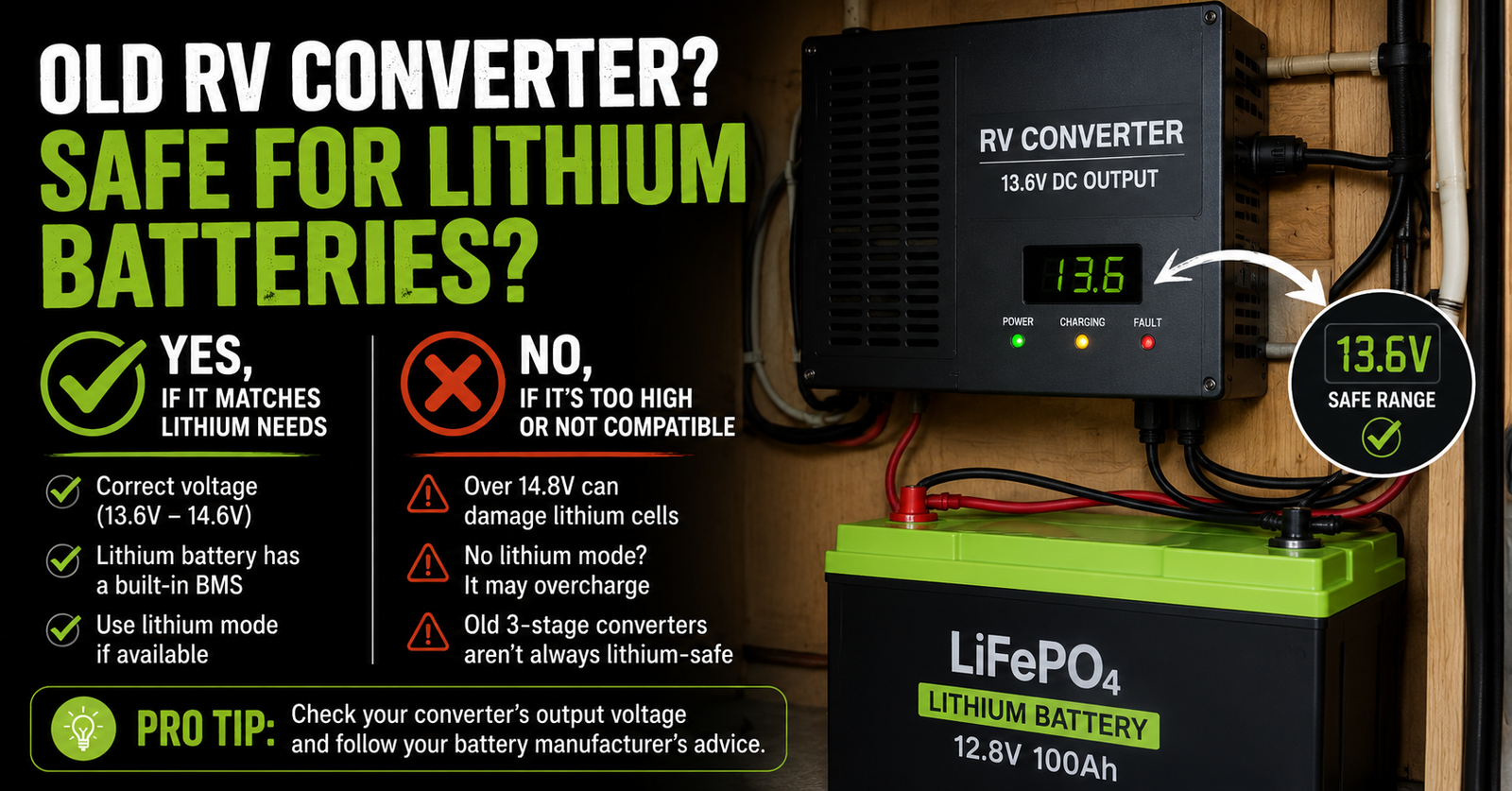
Switching an RV from lead-acid batteries to lithium sounds simple until you get to the converter. You pull out the old battery, drop in a new LiFePO4 battery, and then realize the converter in your camper may have been designed years before lithium batteries became common in RVs.
So do you really have to replace it?
Not always. An older RV converter may put some charge into a lithium battery, but whether you should keep using it depends on the converter’s charging voltage and profile, the lithium battery manufacturer’s requirements, and how completely and quickly you expect the battery to charge. If replacement is necessary, match the converter to the battery shows how battery chemistry fits into selecting the new converter.
That’s an important distinction.
“Will it charge?” and “Is it the right charger?” are not the same question.
Some newer converters specifically support flooded lead-acid, AGM, and LiFePO4 batteries. Others automatically detect the battery chemistry. Older converters may have been designed entirely around lead-acid batteries. Current Progressive Dynamics equipment, for example, offers selectable charging profiles specifically for flooded lead-acid, AGM, and LiFePO4 batteries, while WFCO offers models that automatically select an appropriate lead-acid or lithium charging profile.
If you’re standing in your camper wondering whether that old converter has to come out, here’s how I’d figure it out before spending a dime.
First, Make Sure We’re Talking About LiFePO4
When RV owners say they’re “switching to lithium,” they’re usually talking about lithium iron phosphate, commonly written as LiFePO4 or LFP.
That’s the chemistry this article is about.
Don’t assume charging information for one type of lithium battery automatically applies to every lithium chemistry.
And don’t assume every LiFePO4 battery has identical charging specifications either.
The battery manufacturer gets the final say about the charging voltage, recommended charging current, temperature limitations, and other requirements for the particular battery you’re installing.
Why Does the Converter Care What Battery I Have?
Because your RV converter is also normally your battery charger when you’re connected to an AC power source.
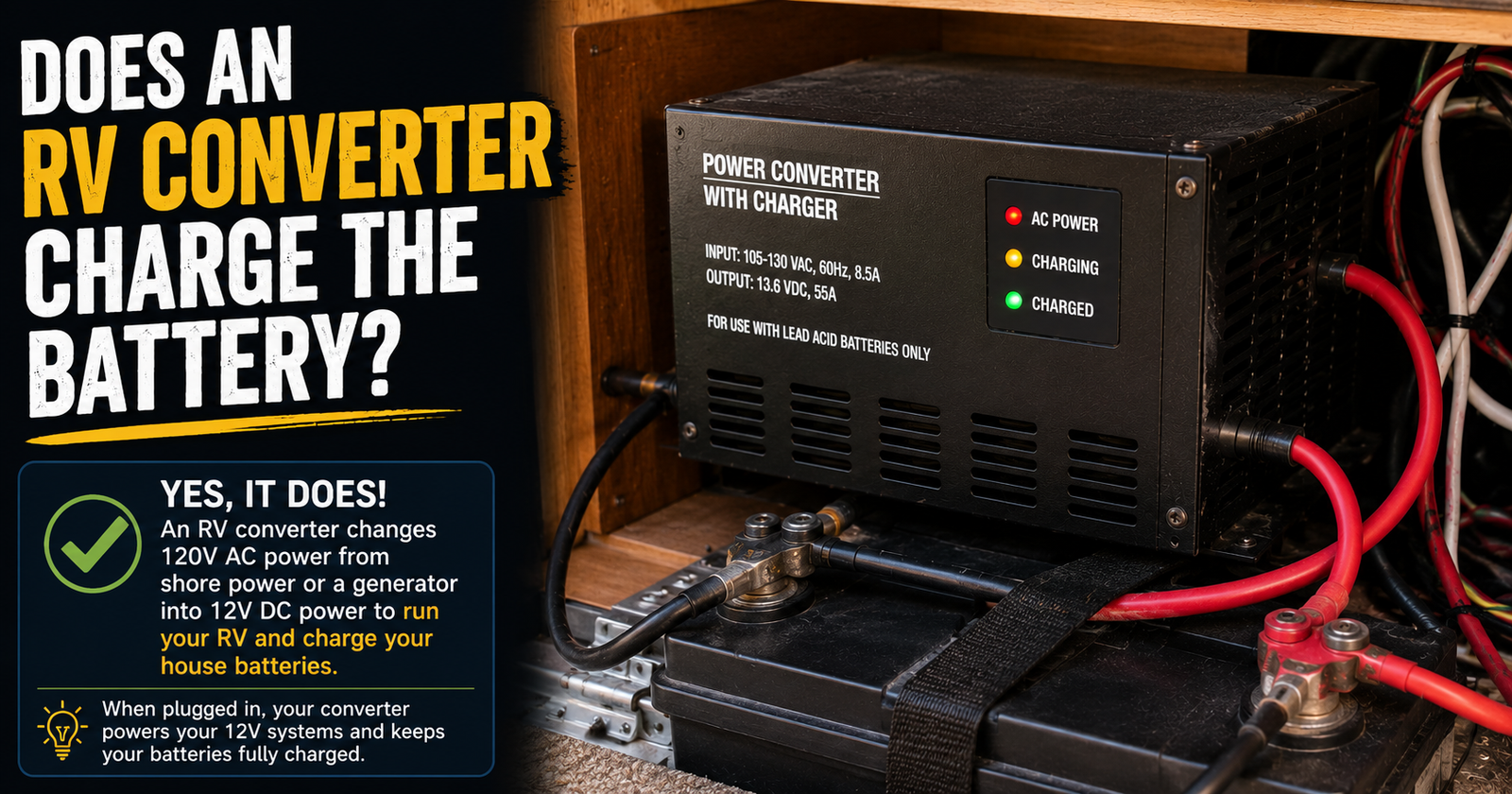
If you’re new to this whole electrical setup, our guide explaining how an RV converter charges the battery will make the rest of this article much easier to follow.
The converter isn’t simply supplying “some electricity” to the battery.
A modern converter/charger changes its output as part of a charging strategy.
Lead-acid batteries have one set of charging characteristics.
LiFePO4 batteries have different characteristics.
That’s why manufacturers now build converters with dedicated battery profiles.
Progressive Dynamics’ current PD9300 series, for example, lets the owner select separate flooded lead-acid, AGM, and LiFePO4 charging profiles.
If battery chemistry didn’t matter, manufacturers wouldn’t need those separate settings.


Will an Old Lead-Acid RV Converter Charge a Lithium Battery?
It may.
That’s why this subject gets confusing.
An old converter doesn’t necessarily see a lithium battery and refuse to do anything.
If its output voltage is higher than the battery voltage, current may flow into the battery.
So you could install lithium, plug the camper into shore power, measure the battery later, and discover that it gained charge.
That does not automatically mean your old converter is an ideal lithium charger.
The bigger question is whether its charging behavior matches what the battery manufacturer wants.
Why People Say an Old Converter “Won’t Fully Charge Lithium”
This statement gets thrown around a lot, and it’s too broad without knowing the equipment.
Different older converters use different charging voltages and strategies.
Different lithium batteries also have different charging specifications.
Progressive Dynamics notes that LiFePO4 charging requirements are not completely standardized among battery manufacturers. Its lithium charging information says that while 14.6 volts is commonly associated with LiFePO4 charging, some manufacturers specify charging voltages below 14.6 volts. Progressive Dynamics says its testing has shown batteries can reach a full charge using its 14.4-volt lithium profile.
That’s why I don’t like universal claims such as:
“Lithium absolutely needs 14.6 volts.”
or:
“Any old converter will charge lithium perfectly.”
Neither is a good rule for every battery and converter combination.
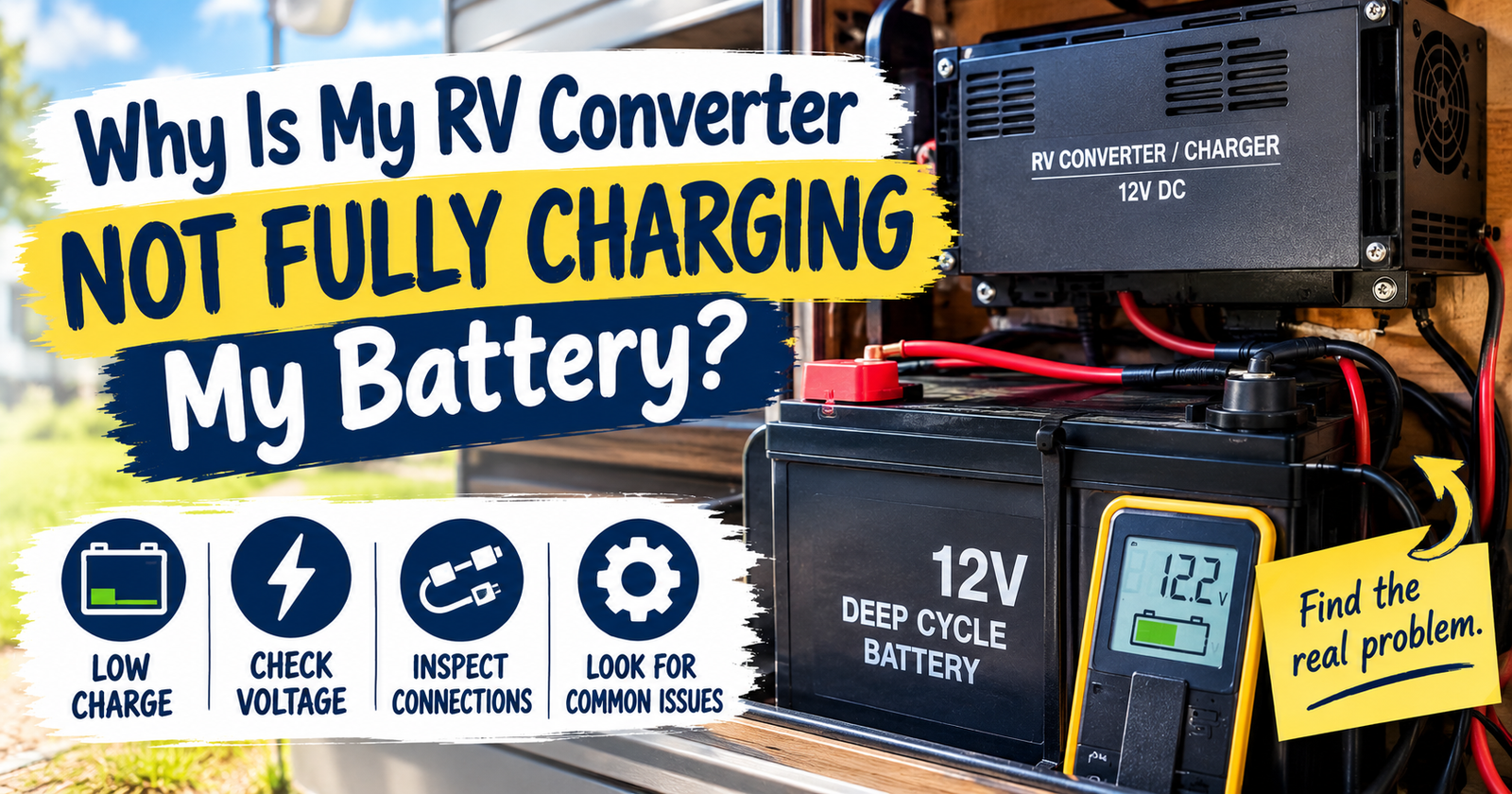
What Happens With a Converter That Only Reaches 13.6 Volts?
This is one of the situations you’ll run into with older RV charging equipment.
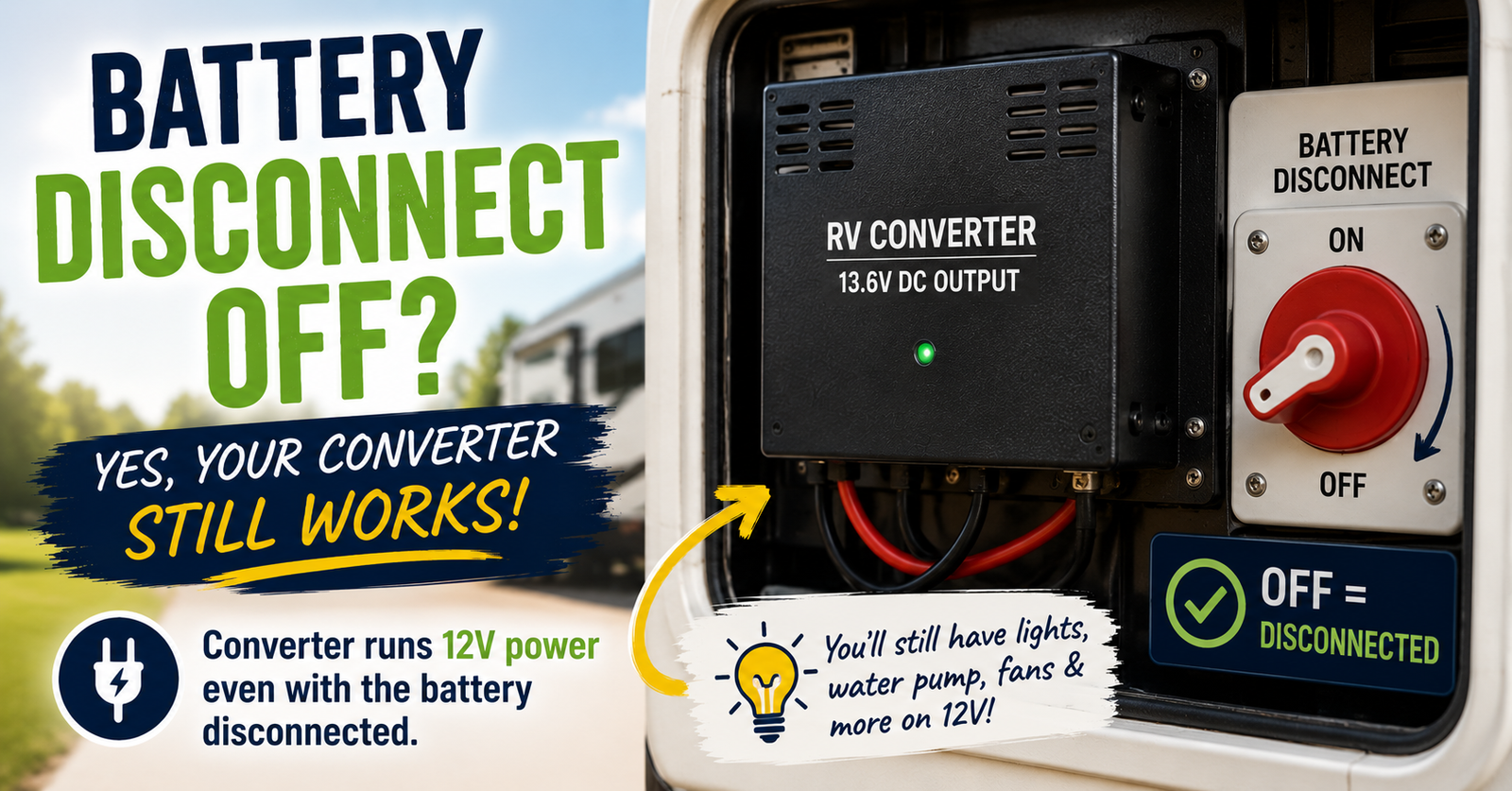
A converter sitting around 13.6 volts may still put energy into a LiFePO4 battery.
But that doesn’t automatically mean you’re getting the charging performance the battery and a modern lithium-capable charger can provide.
WFCO’s current documentation actually illustrates the difference nicely. Its lithium-capable models use different charging behavior depending on battery chemistry, and WFCO identifies 13.6 volts as a normal lithium “power mode” voltage on applicable equipment.
The point isn’t that 13.6 volts is somehow dangerous to lithium.
The point is that charging strategy matters.
Your old converter may simply not have been designed to optimize charging for the battery you’ve installed.
Your Lithium Battery May Still Get Mostly Charged
This is where the real-world answer is more nuanced than “replace it immediately.”
Suppose you have an older converter.
You switch to LiFePO4.
The converter supplies a voltage that allows the battery to accept charge.
You spend most of your time connected to shore power.
You don’t care whether charging takes somewhat longer.
Your battery manufacturer says the charging voltage being supplied is acceptable.
In that situation, you might decide the existing converter works well enough for your needs.
That’s very different from saying it’s the ideal setup.
When an Old Converter Becomes Annoying
Now imagine you boondock regularly.
You run the battery down overnight.
The next morning, you start a generator specifically to recharge it.
This is where charging speed suddenly matters a lot.
If the old converter doesn’t use a charging profile that allows the lithium battery to take advantage of its charging capabilities, you could end up running the generator much longer than necessary.
Now upgrading the converter has a practical payoff.
You’re not replacing it because somebody online said “old converter bad.”
You’re replacing it because the old charging system isn’t doing what you need it to do.
Lithium Batteries Can Accept Charge Differently From Lead-Acid
One reason lithium is attractive in RVs is the way LiFePO4 batteries can accept charging current.
But the battery still has limits.
Every battery has specifications.
A 100Ah LiFePO4 battery might have one recommended charging current while another battery of the same advertised capacity has different requirements.
That’s why I’d look at the battery manual before choosing the converter.
I want to know:
Recommended charging voltage.
Recommended charging current.
Maximum charging current.
Low-temperature charging limitations.
Battery-management-system limits.
Then I compare those requirements with what the converter can actually provide.
Don’t Start With “What Converter Should I Buy?”
Start with:
“What does my battery require?”
That’s the better question.
Once you know that, you can determine whether the existing converter meets those requirements.
If it does, great.
If it doesn’t, now you have an actual reason to change it.
That’s much better than throwing a perfectly functional converter in the trash just because the word “lithium” isn’t printed on the front.
Find Out Which Converter You Actually Have
Before doing anything else, find the converter.
Don’t guess based on the year of the camper.
Don’t assume the original converter is still installed.
Previous owners replace things.
Dealers upgrade things.
Campers get modified.
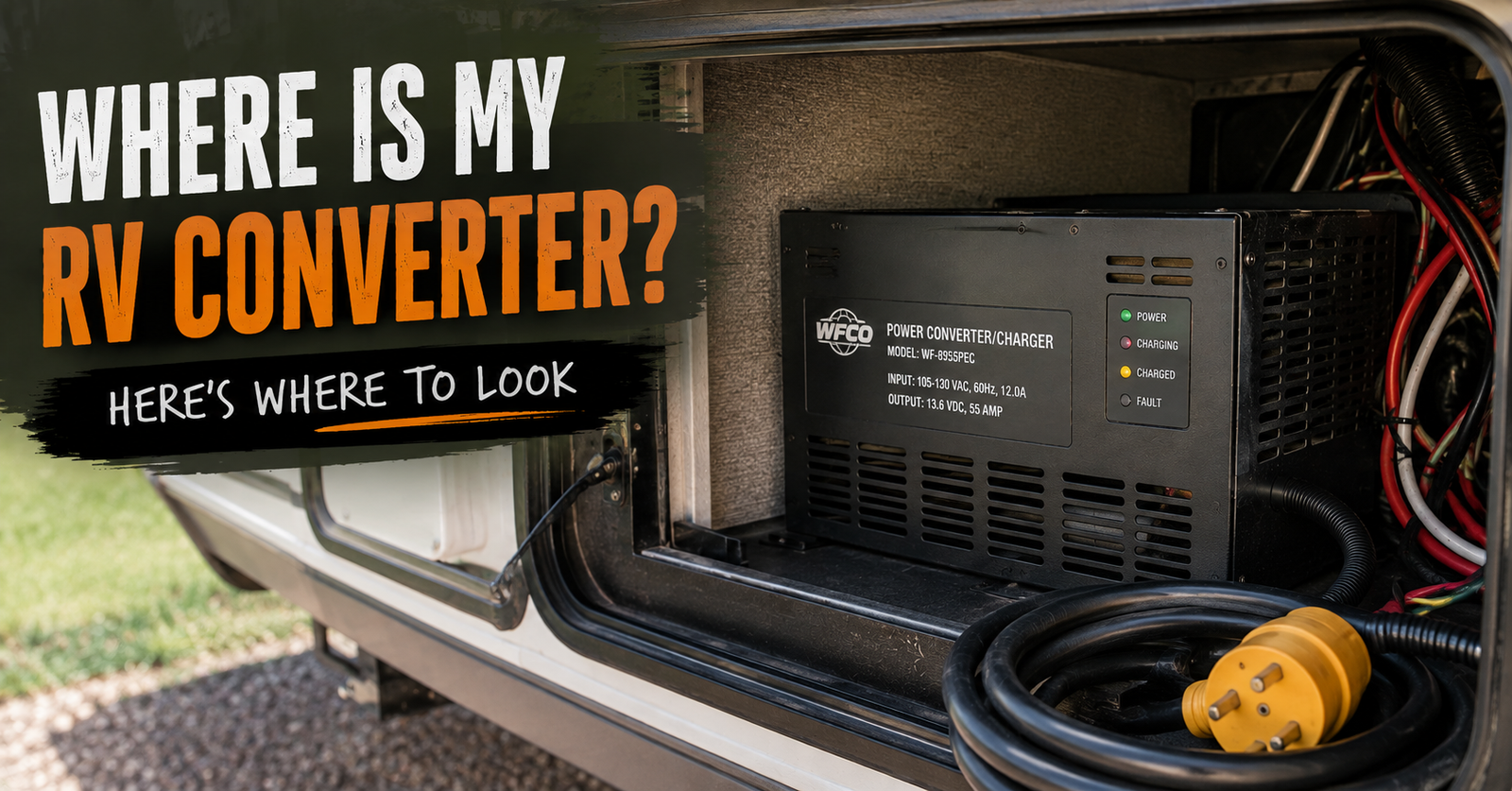
If you haven’t found yours yet, here’s how I go about locating the converter in an RV.
Once you find it, get the model number.
Take a clear picture of the label.
Write down the output amperage.
Then look up the manufacturer’s documentation for that exact model.
Your “Old” Converter Might Already Support Lithium
This happens more often as campers get newer.
You may discover a switch labeled something like:
LA / LI
Lead acid.
Lithium.
WFCO has produced converter/chargers with a switch that lets the owner choose between lead-acid and lithium charging modes. Its WF-8500LiS documentation specifically describes separate charging modes selected at the converter.
If yours already has that capability, you may not need to replace anything.
You may simply need to configure it correctly according to the converter and battery manufacturer’s instructions.
Some Newer Converters Automatically Detect Lithium
Technology has moved even further.
WFCO’s Auto-Detect converters are designed to recognize lead-acid or LiFePO4 batteries and select the appropriate charging profile automatically.
So don’t assume:
Old camper = old converter
or:
Lithium battery = converter replacement
Identify the equipment first.
You may already own what you need.
Some Converters Have Selectable Profiles
Progressive Dynamics takes another approach with some current equipment.
Its PD9300 series lets you choose among flooded lead-acid, AGM, LiFePO4, and a fixed 13.6-volt output. The selected profile is stored so the converter uses the appropriate charging behavior when powered again.
That flexibility is useful if you’re intentionally modernizing the RV’s electrical system.
It also shows why simply comparing converter amperage doesn’t tell the whole story.
A 55-amp lead-acid converter and a 55-amp lithium-capable converter may have the same maximum current rating while behaving differently as battery chargers.
Converter Amps and Charging Profile Are Different Things
This is important.
Suppose your old converter is rated at 55 amps.
You install a lithium battery.
You find a new 55-amp lithium-capable converter.
You might wonder:
“They’re both 55 amps. What’s the difference?”
The charging profile.
The amp rating tells you how much DC output the converter is capable of supplying.
It doesn’t tell you the charging voltages, charging stages, or battery chemistry the unit was designed around.
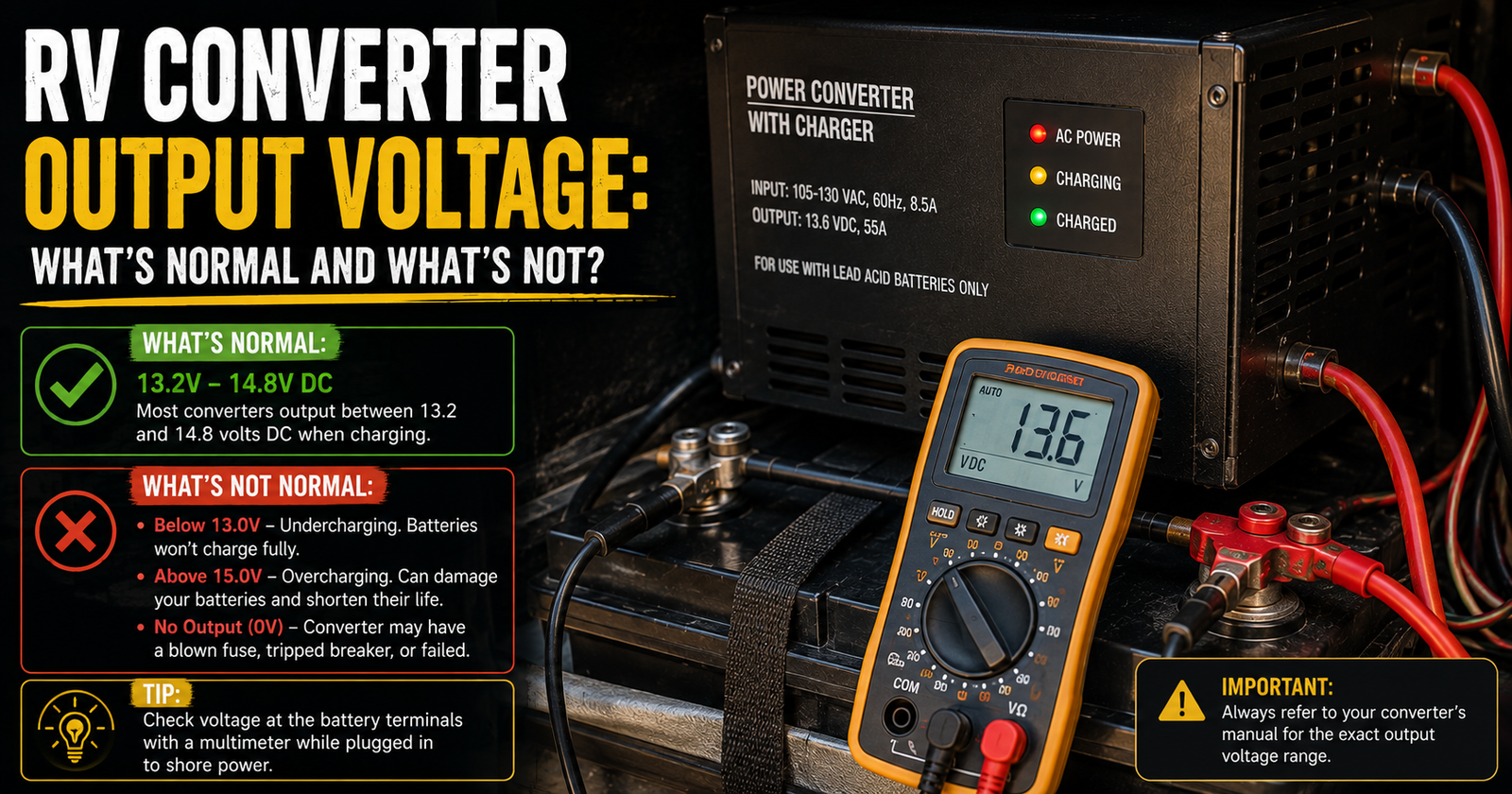
That’s why we treat RV converter output voltage separately from converter amperage.
Both matter.
Do I Need a Bigger Converter for Lithium?
No, not automatically.
Switching from lead-acid to lithium does not mean you should immediately increase converter amperage.
In fact, Progressive Dynamics specifically warns owners upgrading to one of its lithium converter replacements not to install a higher-output unit than the existing converter unless the RV wiring can safely handle the additional current.
That’s a really important warning.
If your RV originally had a 45-amp converter, don’t automatically buy a 60-amp lithium converter because “lithium can charge faster.”
Your wiring was part of the original electrical design.
Match the Existing Amp Rating Unless You’re Intentionally Upgrading the System
For a straightforward converter replacement, staying with the appropriate existing output rating is the safer starting point.
Progressive Dynamics specifically recommends matching its lithium replacement converter to the DC output amperage of the existing converter.
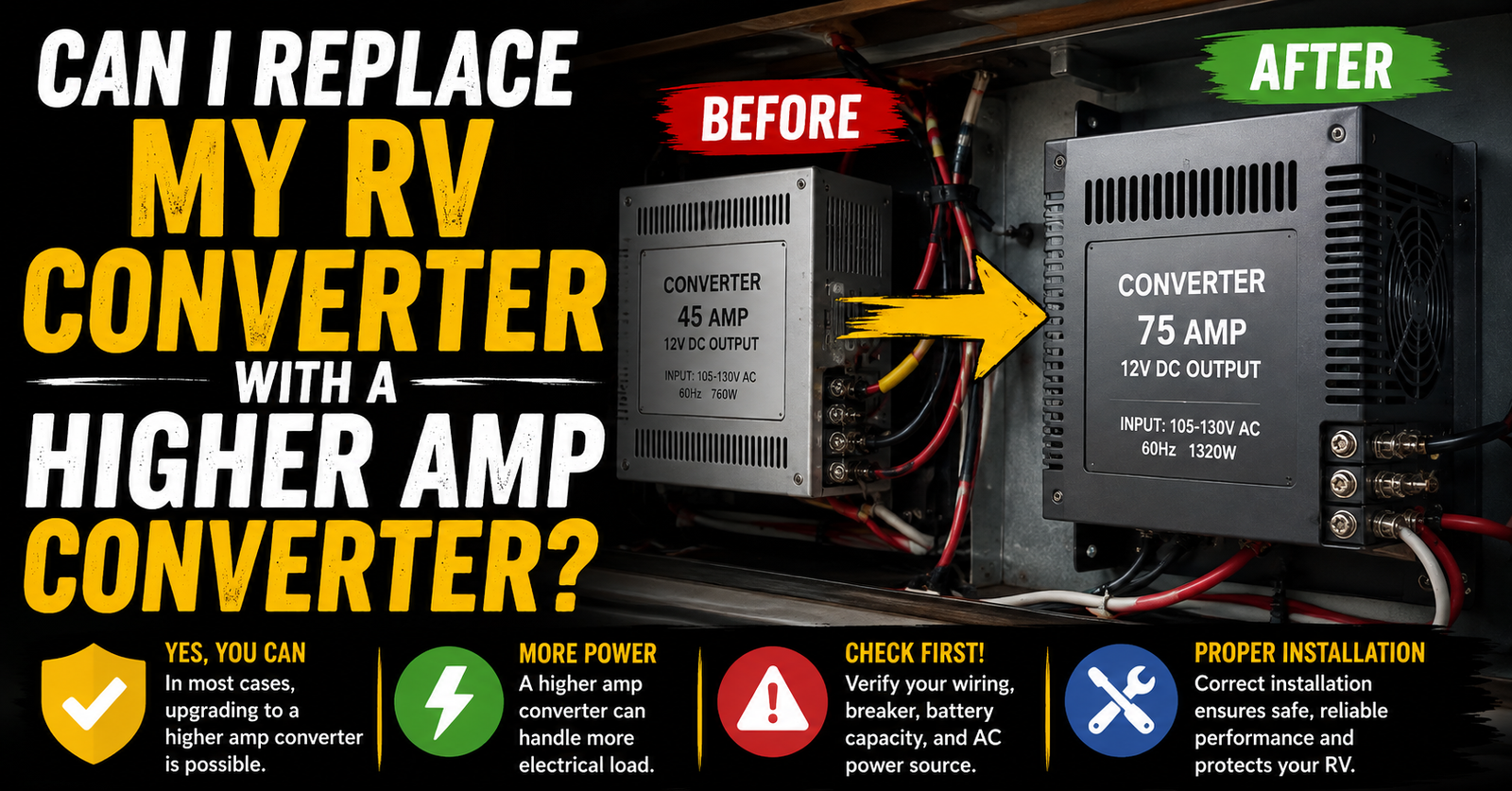
We’ve already gone deep into whether you can safely install a higher-amp RV converter.
The short version is simple.
Changing battery chemistry and increasing charging-system capacity are two different upgrades.
Don’t accidentally turn one into the other.
What If I Want Faster Lithium Charging?
Now increasing charging capacity might make sense.
But I would evaluate the whole system.
Battery specifications.
Battery-bank size.
Converter capacity.
Positive charging cable.
Negative return path.
Cable length.
Circuit protection.
Connections.
Available AC power.
Generator capacity if that’s how you’re charging off-grid.
If those pieces support higher charging current, then upgrading can be worthwhile.
But we’re no longer talking about a simple lithium battery swap.
We’re designing a higher-capacity charging system.
Can an Old Converter Damage a Lithium Battery?
There isn’t a useful universal yes-or-no answer without knowing the converter and battery.
That’s why I’d never tell someone:
“Any lead-acid converter is perfectly safe for lithium.”
I also wouldn’t say:
“An old converter will automatically destroy a lithium battery.”
You need to compare actual specifications.
Lithium batteries generally include a battery management system, commonly called a BMS, but that doesn’t mean you should intentionally use an incompatible charger and expect the BMS to clean up every mistake.
The BMS is protection.
It’s not an excuse to ignore charging requirements.
What Does the Lithium Battery BMS Do?
The battery management system monitors and protects the cells inside the battery.
Depending on the battery, it may protect against conditions such as excessive voltage, excessive current, excessive discharge, high temperature, low temperature, or other unsafe operating conditions.
If conditions move outside the battery’s programmed limits, the BMS can disconnect charging or discharging.
That protection is one of the major differences between a modern drop-in LiFePO4 battery and an old flooded lead-acid battery.
But again, I don’t design a charging system around deliberately triggering the BMS.
I want the charger and battery to work together normally.
Low-Temperature Charging Matters With Lithium
This is something RV owners coming from lead-acid batteries can easily miss.
Many LiFePO4 batteries should not be charged below their specified low-temperature charging limit unless the battery includes appropriate internal heating or another system designed for cold-weather charging.
The exact limit and protection behavior depend on the battery.
Some batteries have low-temperature charging cutoff built into the BMS.
Some have internal heaters.
Some systems use external temperature controls.
This isn’t specifically an “old converter” problem.
It’s a lithium battery installation problem.
Changing battery chemistry means learning the requirements of the new battery, not just changing the charging voltage.
Does My Old Converter Know It’s Cold Outside?
Probably not.
An older converter designed around lead-acid batteries generally isn’t sitting there thinking:
“Hey, that’s a lithium battery and the cells are too cold to charge.”
The battery’s BMS or another component may provide protection, depending on the system.
That’s another reason I want to understand the entire lithium setup rather than focusing solely on whether the converter produces enough voltage.
What If the BMS Keeps Shutting Off Charging?
That’s a clue, not normal behavior to ignore.
If a lithium battery repeatedly disconnects charging through its BMS, I’d find out why.
Possible causes depend on the battery but can involve voltage, charging current, temperature, battery condition, or another protection threshold.
Don’t simply keep resetting things.
Read the battery’s app or diagnostic information if available.
Check the manufacturer’s documentation.
Then find the underlying cause.
Will My Old Converter Overcharge a Lithium Battery?
Again, this depends on the converter’s actual output and the battery specifications.
The bigger issue with many older lead-acid converters isn’t necessarily that they’re going to violently overcharge the lithium battery.
It may be that the charging profile isn’t optimized for lithium at all.
That’s why modern manufacturers specifically provide lithium charging profiles.
Progressive Dynamics’ LiFePO4 profile, for example, uses a 14.4-volt charge mode followed by a 13.6-volt idle mode.
That’s deliberate charging behavior designed around LiFePO4 rather than simply leaving the converter at one arbitrary voltage forever.
Lithium Doesn’t Need the Same Storage Treatment as Flooded Lead-Acid
Traditional flooded lead-acid batteries have their own maintenance concerns, including self-discharge and electrolyte loss.
Lithium behaves differently.
WFCO’s converter documentation specifically notes that lithium batteries don’t require the same storage-mode behavior used for lead-acid batteries. Its compatible converter changes its behavior based on the detected battery chemistry.
This is another reason a charger designed around one battery chemistry isn’t automatically ideal for another.
The differences aren’t limited to one maximum-voltage number.
What About Equalization?
This is something I’d pay close attention to with older charging equipment.
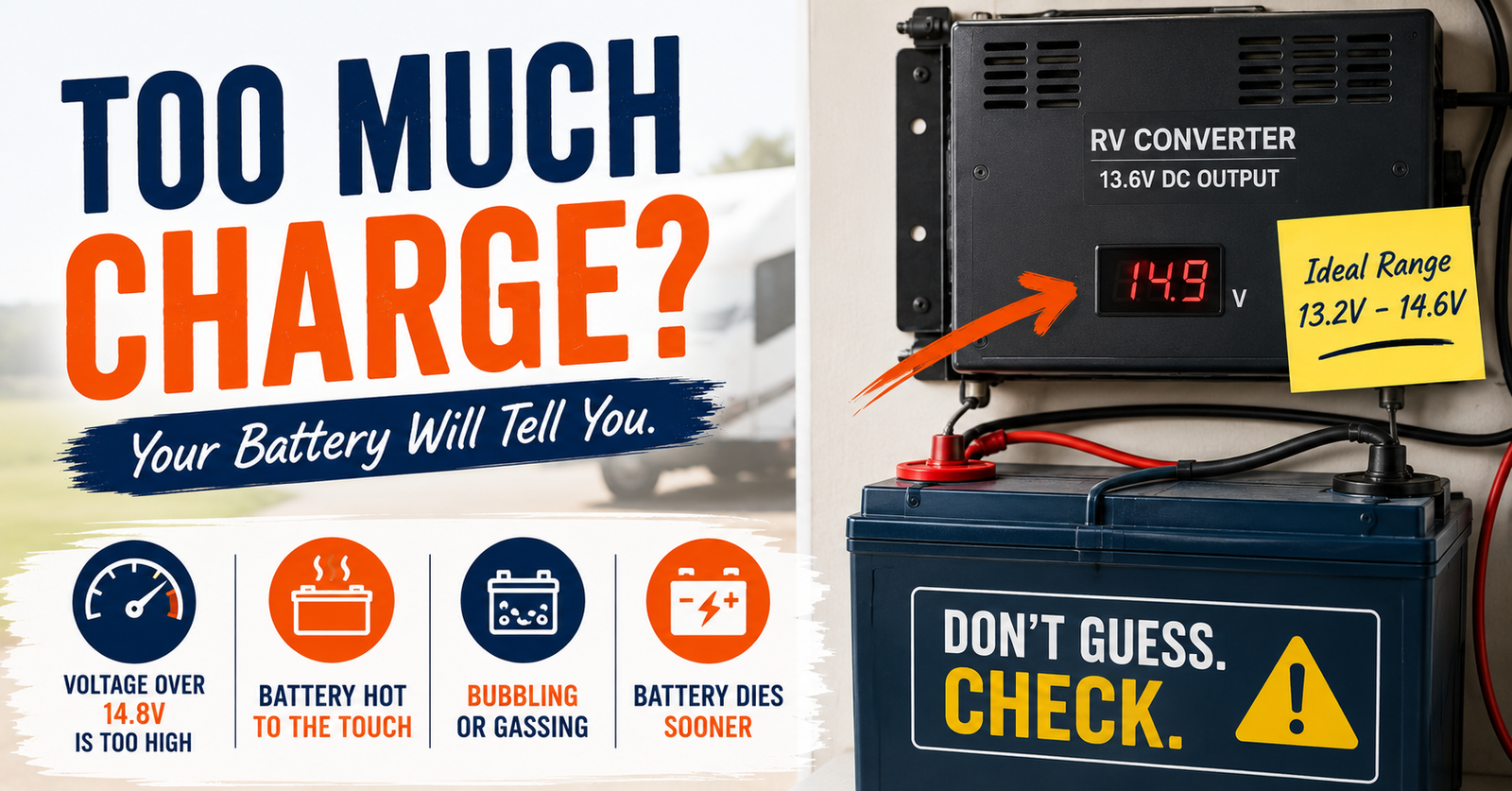
Some lead-acid charging systems use periodic higher-voltage behavior intended for lead-acid battery maintenance. That behavior matters when evaluating battery chemistry, and how charging voltage can damage a battery covers the warning signs to watch for.
You need to know exactly what your converter does and whether that behavior is compatible with your lithium battery.
Don’t assume a mode that was beneficial to your old flooded batteries is appropriate for LiFePO4.
Check both manuals.
If the specifications don’t line up clearly, that’s where I’d stop experimenting and install appropriate charging equipment.
My Old Converter Only Charges My Lithium Battery to 80 Percent. Is That Bad?
First, verify that it’s actually only reaching 80 percent.

Lithium state-of-charge estimation from voltage alone can be tricky because LiFePO4 has a relatively flat voltage curve through a large part of its usable capacity. The broader differences between battery types are outlined in battery chemistry and voltage, which helps explain why lead-acid voltage charts do not transfer directly to lithium.
If your battery has a reliable internal monitor or you’re using a properly configured shunt, you’ll have a much better picture.
But suppose the converter genuinely isn’t bringing the battery to full charge.
Whether that bothers me depends on how the camper is used.
If you spend nearly all your time plugged in and have more capacity than you need, maybe it doesn’t matter much in day-to-day use.
If you paid for 200Ah of lithium capacity because you boondock for days at a time, I’d want the charging system working properly.
Why Lithium State of Charge Can Fool You
Lead-acid owners get used to looking at voltage and making rough judgments about battery charge.
LiFePO4 doesn’t behave exactly the same way.
Its voltage stays relatively flat through much of the discharge curve.
That makes voltage alone less useful for estimating precise remaining capacity.
So before blaming your converter because the battery voltage “doesn’t look full,” make sure you’re evaluating the battery correctly.
The converter could be doing more than you think.
Or less.
Good measurements matter.
My Lithium Battery Charges Fine From Solar but Not the Converter
That’s a fantastic troubleshooting clue.
Remember, those are two different charging paths.
Your solar charge controller may have a properly configured LiFePO4 profile.
Your old converter may not.
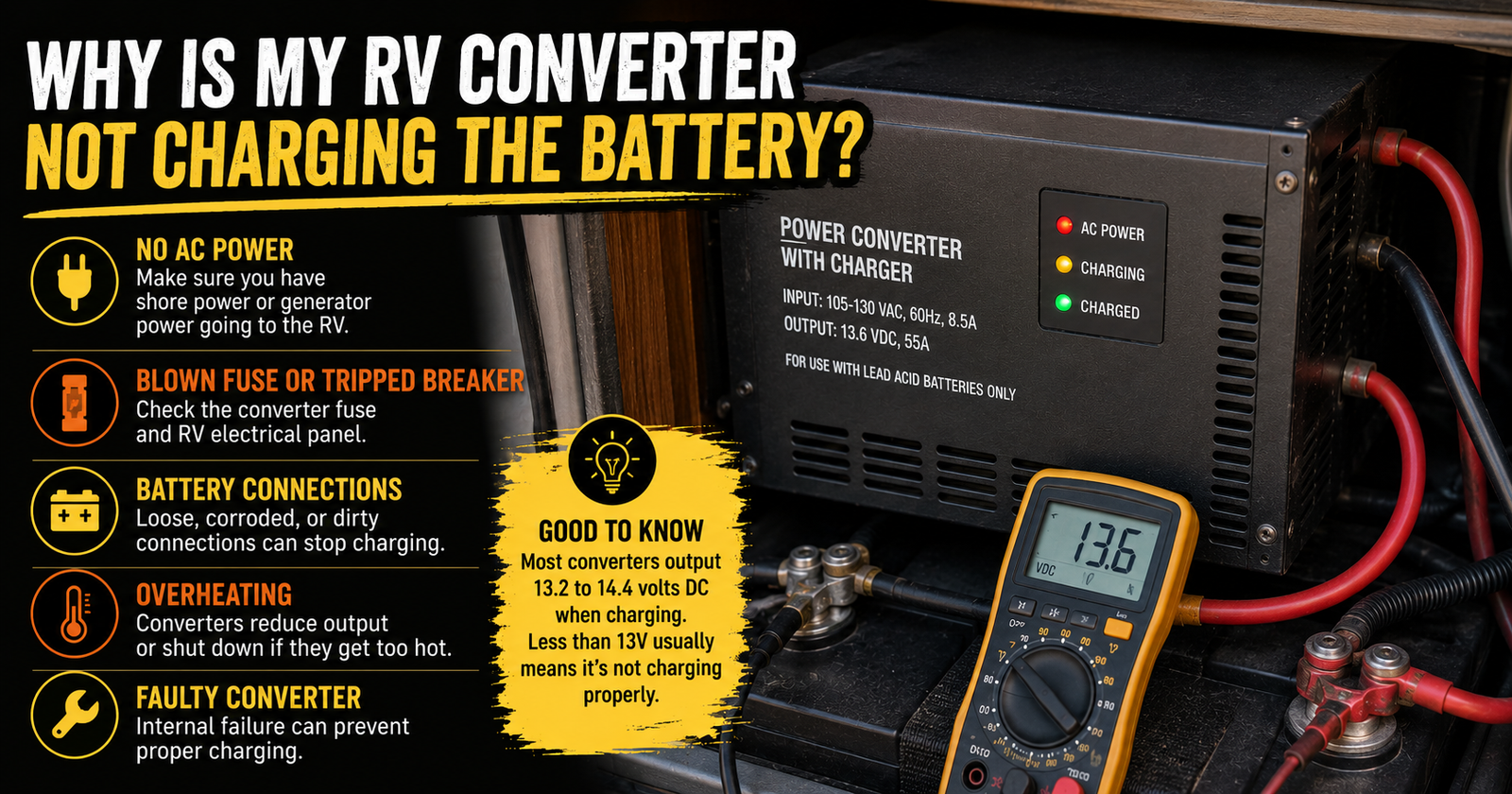
If solar brings the battery to the expected state of charge but shore-power charging doesn’t, I’d compare the solar controller’s charging settings with the converter’s output and the battery manufacturer’s requirements. A direct battery-voltage test can help you verify whether charging voltage is actually reaching it when the two charging sources behave differently.
That’s much more useful than simply saying:
“My lithium battery won’t charge.”
My Lithium Battery Charges From the Converter but Not Solar
Then I wouldn’t blame the converter.
Now I’d investigate the solar side.
Solar controller settings.
Panel input.
Fuses.
Disconnects.
Wiring.
Battery connection.
Controller configuration.
This is why understanding the different charging paths is so useful.
One battery can have several different ways of receiving energy.
What About Charging From the Tow Vehicle?
That’s another separate charging path.
A travel trailer or fifth wheel may receive some charging through the tow vehicle.
A motorhome may have an alternator-based charging arrangement.
Lithium conversion can affect those systems too.
The converter being lithium-compatible does not automatically mean every other charging source in the RV is properly configured for lithium.
This is where lithium conversions can become much bigger projects than swapping one battery.
Don’t Forget the Alternator
This matters especially in motorhomes and other systems where the alternator can meaningfully charge the house battery bank.
Lithium batteries can present different charging demands than the lead-acid batteries the original system was designed around.
Depending on the RV, a DC-to-DC charger or other charging-control equipment may be appropriate.
That’s beyond the converter itself, but it’s absolutely something I’d investigate during a complete lithium conversion.
You want all charging sources working properly with the new battery system.
What About the Battery Monitor?
Another worthwhile upgrade.
A good battery monitor with a properly installed shunt can tell you far more about a lithium battery than a basic four-light RV battery gauge.
You can see charging current.
Discharging current.
Amp-hours used.
State of charge when properly configured.
That becomes especially useful when you’re trying to determine whether an old converter is actually doing an acceptable job.
Instead of guessing, you can watch what’s going into the battery.
How Can I Test What My Existing Converter Is Doing?
Start by identifying the exact converter and reading its documentation.
Then measure appropriately.
You may want to observe battery-terminal voltage while charging and, ideally, charging current with suitable equipment.
But remember that voltage at the converter and voltage at the battery can differ because of wiring resistance.
That’s especially noticeable at higher current.
And don’t start disconnecting high-current battery wiring unless you know what you’re doing and have followed the manufacturer’s safe shutdown procedure.
Converter Voltage at the Battery Matters
Suppose the converter is producing an appropriate charging voltage.
Great.
But what voltage actually reaches the battery under load?
A long run of undersized charging cable can create voltage drop.
That can reduce charging performance even with a perfectly good lithium-capable converter.
So don’t automatically blame the converter’s charging profile if charging is slow.
The wiring between converter and battery matters too.
Can I Just Flip My Converter to Lithium Mode?
If the converter manufacturer specifically provides a lithium setting and your battery is compatible with that charging profile, that’s exactly what the feature is there for.
But read the instructions.
For example, Progressive Dynamics warns on its selectable PD9300 equipment to select the proper battery profile before connecting the battery to prevent battery damage.
Don’t randomly flip switches because one position says “LI.”
Know what the setting does.
Know what your battery requires.
Then configure it properly.
What If My Converter Has No Lithium Switch?
That alone doesn’t tell us whether it can be used.
Some equipment automatically detects battery chemistry.
Some dedicated lithium converters don’t need a user switch.
Some older converters weren’t designed for lithium at all.
The model number matters more than whether you can see a switch.
Look it up.
What If I Can’t Find the Converter Manual?
Search the exact manufacturer and model number.
Not just:
“RV converter manual.”
You want the specifications for the equipment actually installed.
If the converter is so old that you can’t find trustworthy charging specifications, and you’re investing serious money in a lithium battery bank, I’d personally lean toward installing known compatible charging equipment rather than guessing.
Lithium batteries aren’t cheap.
I’d rather know exactly how they’re being charged.
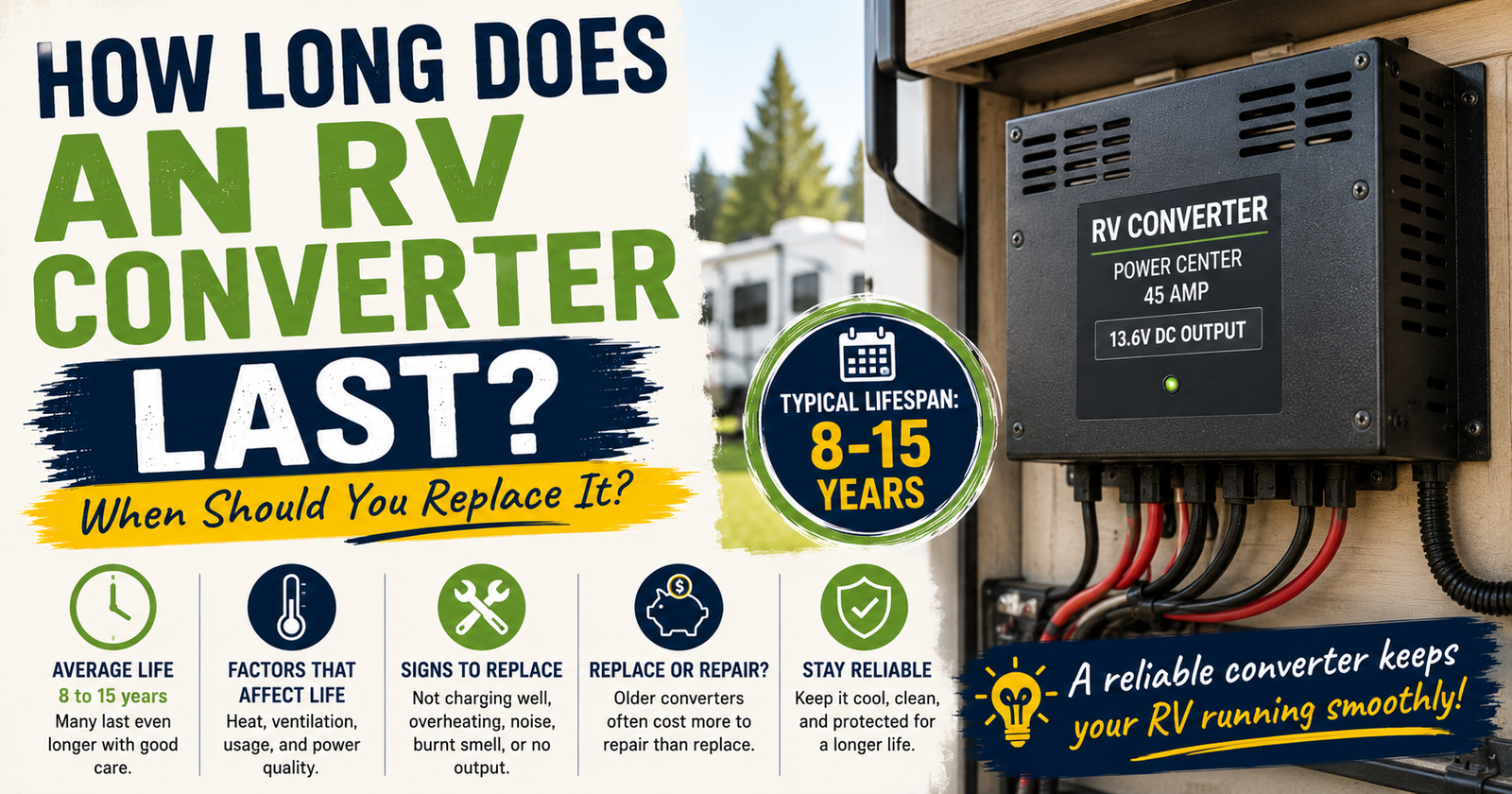
Should I Replace a Working Converter Just Because It’s Old?
Not automatically.
Age alone isn’t my deciding factor.
Compatibility is.
If the old converter:
Meets the battery manufacturer’s charging requirements.
Produces stable output.
Charges at an acceptable speed.
Is in good condition.
And works safely with the rest of the electrical system.
Then I don’t replace equipment merely because the calendar says it’s old.
But if its charging behavior is a poor match for lithium, that’s different.
When I Would Keep the Old Converter
I’d seriously consider keeping it if the battery manufacturer approves the charging parameters, the converter operates properly, and charging performance meets how I use the camper.
For someone who camps almost entirely with full hookups, charging speed may not be a major issue.
You may plug in Friday evening and remain connected all weekend.
Who cares if charging takes somewhat longer if the battery stays where you need it?
Use case matters.
When I Would Replace the Old Converter
I’d lean toward replacement if the existing converter’s charging specifications don’t match the lithium battery requirements.
I’d also consider replacement if charging performance is frustratingly slow for how I camp.
Boondocking is the obvious example.
If I have to run a generator significantly longer because the converter isn’t taking good advantage of the lithium battery’s charging capability, that’s money, noise, fuel, and time.
A proper lithium-capable converter starts making a lot more sense.
When I’d Definitely Stop Using the Old Converter
If the converter’s output or charging behavior falls outside what the battery manufacturer allows, I’m done experimenting.
Same if the converter has other problems.
Unstable output.
Overheating.
Burning smell.
Repeated shutdown.
Electrical damage.
A lithium upgrade isn’t a reason to keep questionable old charging equipment alive.
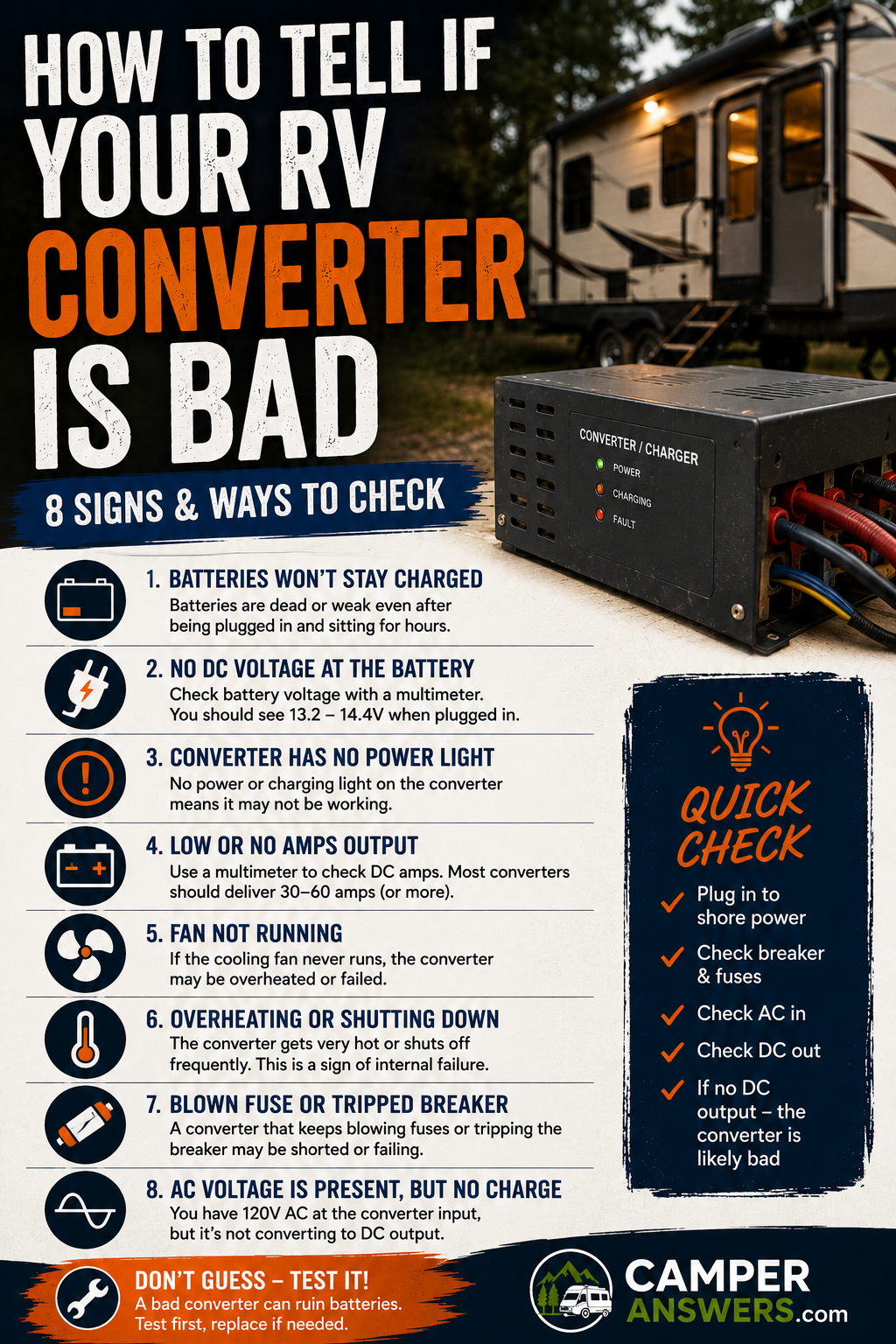
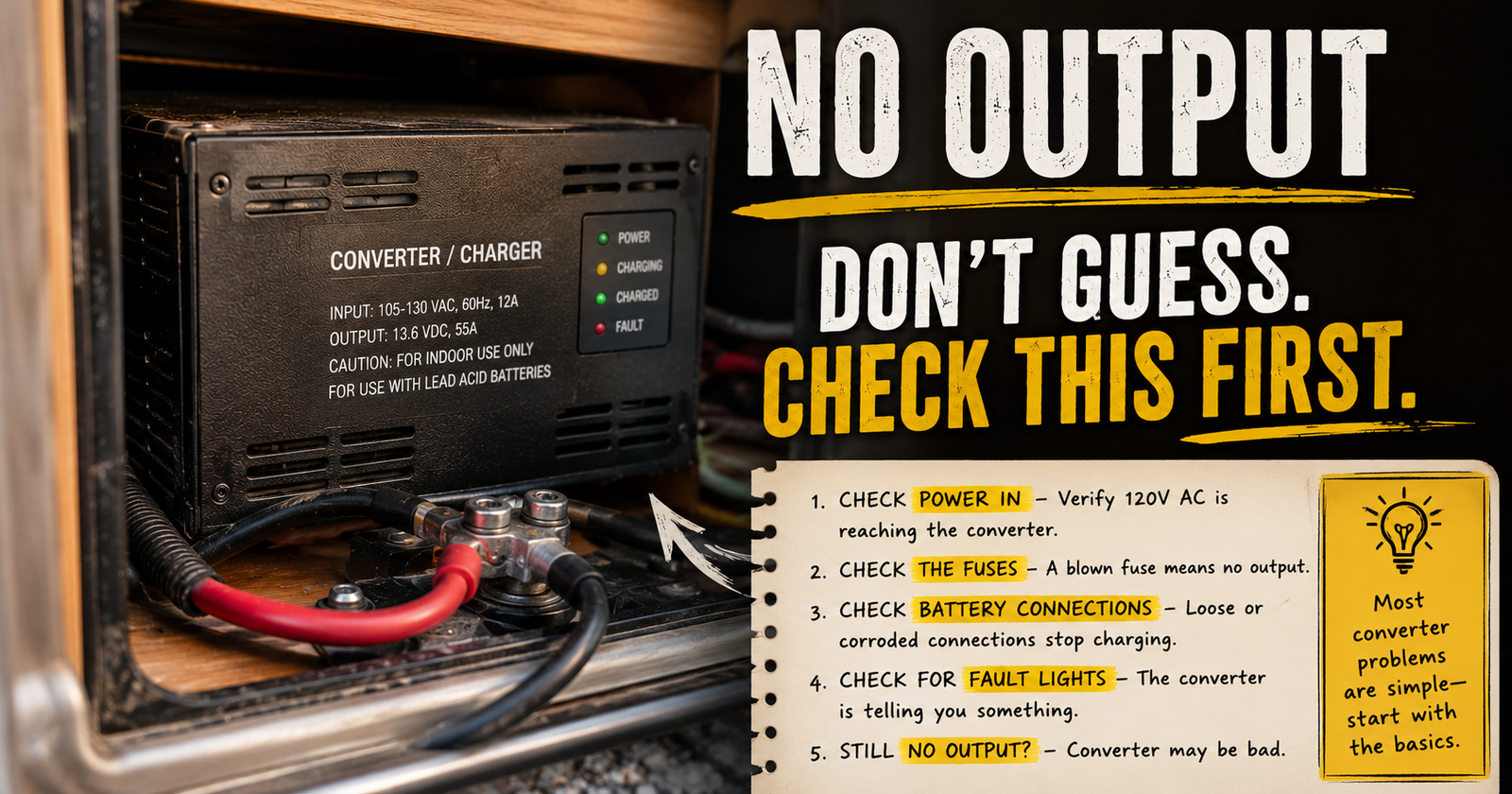
If you’re unsure whether the converter itself is healthy, use our guide to checking whether an RV converter is bad before deciding what stays.
Can I Replace Only the Converter Section?
Often, yes.
This is good news because you may not need to tear out the entire RV power center.
WFCO, for example, sells replacement converter assemblies for existing power centers that add its lead-acid/lithium Auto-Detect charging technology.
Other manufacturers offer retrofit converter sections too.
So if the AC breakers and DC fuse panel are perfectly fine, you may be able to replace only the charging/converter portion.
That can make a lithium upgrade much less intimidating.
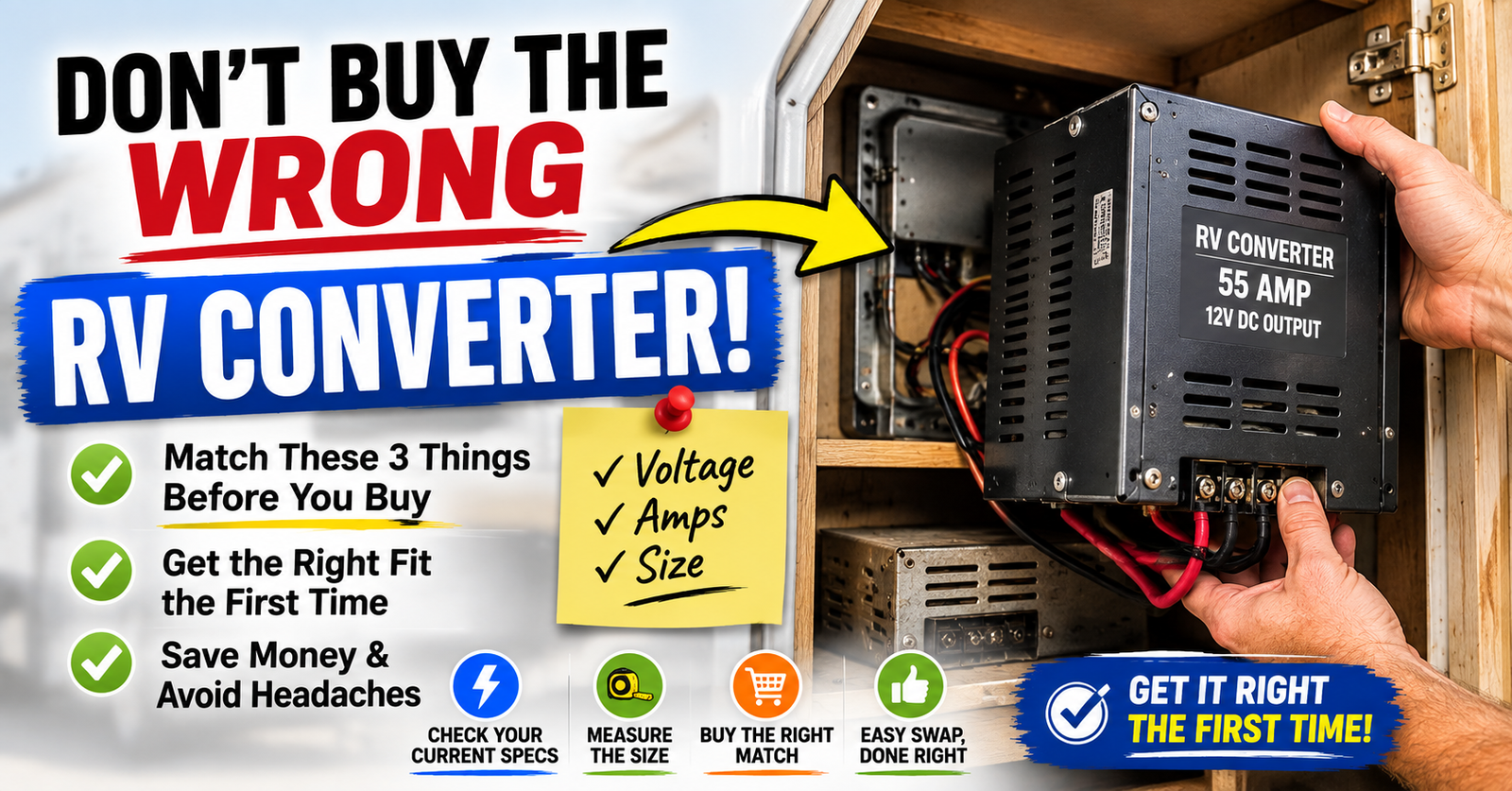
Don’t Buy a Replacement Until You Know What You Have
I can’t emphasize this enough.
Get the old converter model.
Get its amp rating.
Determine whether it’s deck-mounted or integrated into a power center.
Check physical compatibility.
Check electrical compatibility.
Check battery compatibility.
Then choose a replacement.
Ordering a “55 amp lithium RV converter” because yours happens to say 55 amps isn’t enough research.
Should the New Lithium Converter Have the Same Amps?
For a straightforward retrofit, that’s where I’d start.
If you’re replacing a 55-amp converter, look at the manufacturer’s approved 55-amp lithium-capable replacement.
If you’re intentionally increasing amperage, then treat that as a separate electrical-system upgrade.
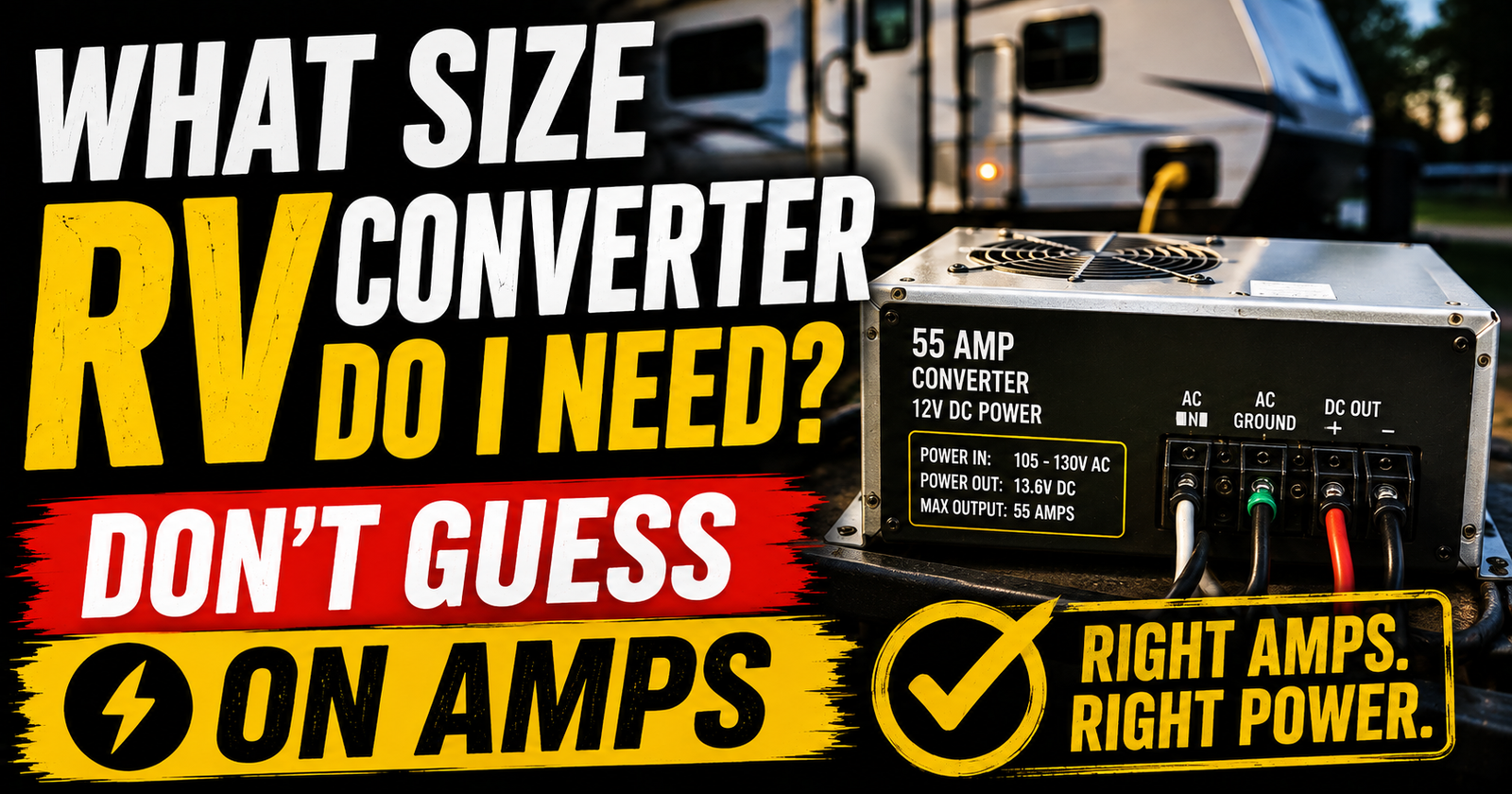
Our guide to what size RV converter you actually need explains why simply choosing the largest converter isn’t a good strategy.
What If I’m Installing Several Lithium Batteries?
Now the situation gets more interesting.
A larger battery bank can store much more energy.
Your original converter may technically charge it but take longer to replace a large amount of used capacity.
Suppose you go from one modest lead-acid battery to several LiFePO4 batteries.
You’ve dramatically changed the battery bank.
That’s when I’d reevaluate charging capacity rather than automatically carrying over the original setup.
But I’d still start with battery specifications and wiring capacity before increasing converter amperage.
Bigger Lithium Bank Doesn’t Automatically Mean Bigger Converter
This is another distinction worth making.
You could install a huge battery bank and charge it with a relatively modest charger.
It may simply take longer.
Whether that’s acceptable depends on how you use the RV.
Full hookups most nights?
Maybe fine.
Generator charging while boondocking?
Probably much more annoying.
The “correct” converter isn’t determined by battery capacity alone.
It’s also about how quickly you need to replace the energy you use.
What About Shore Power?
Your converter normally gets its AC input from shore power when you’re plugged in.
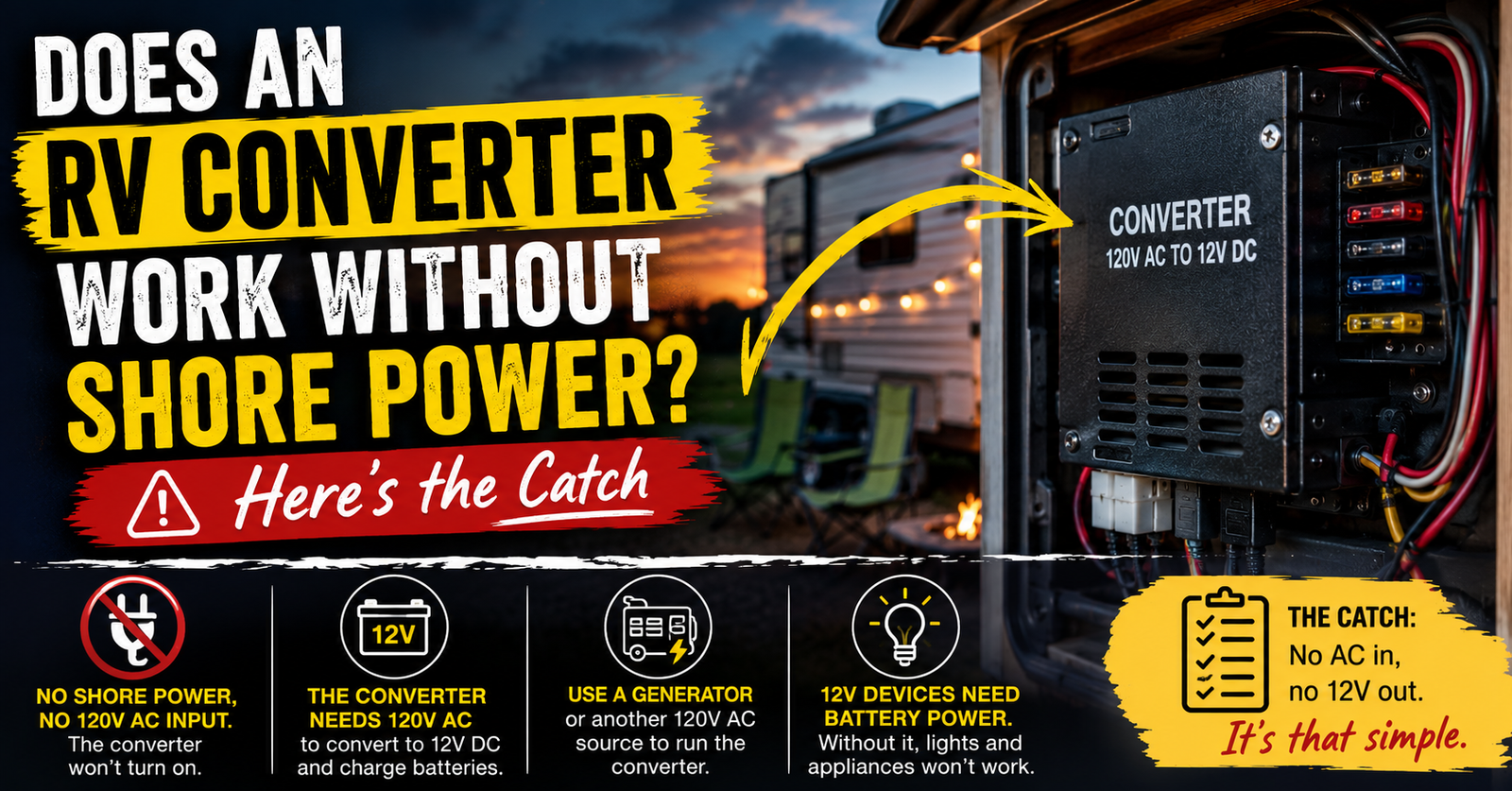
We recently covered whether an RV converter works without shore power because this becomes particularly important with lithium and boondocking.
Without shore power, a conventional converter needs another suitable AC source, commonly a generator, to operate.
Solar normally charges through a solar charge controller instead.
So when planning a lithium system, think beyond the converter.
How will you recharge the batteries when you’re actually camping?
If You Mostly Use Shore Power, Don’t Overbuild This
It’s easy to watch videos of giant lithium battery banks, massive inverters, huge solar arrays, and high-output chargers and suddenly think your travel trailer needs all of it.
It might not.
If your camper spends most nights connected to shore power and your electrical needs are modest, a simple lithium battery and compatible charging setup may be plenty.
You don’t need to build a rolling power station just because lithium makes it possible.
Build around how you actually camp.
If You Boondock, Charging Speed Matters Much More
This is where I’d put more thought into the system.
Imagine using 150Ah overnight.
You need to put that energy back somehow.
Solar may handle some of it.
Generator charging may handle the rest.
If your converter is the bottleneck, you’re going to notice.
That’s when a well-designed lithium-capable charging system can be worth every penny.
What I Would Do Before Installing a Lithium Battery
I’d identify every major charging source first.
Converter/charger.
Solar controller.
Alternator or tow-vehicle charging system.
Any inverter/charger.
Then I’d compare each one with the battery manufacturer’s specifications.
That prevents the classic mistake of upgrading one piece while forgetting that the battery gets charged from three different directions.
What I Would Do With an Older Travel Trailer
If I had an older travel trailer with a basic lead-acid converter and wanted one LiFePO4 battery, I’d first look up the converter specifications.
If the battery manufacturer said those charging parameters were acceptable, I’d decide whether the charging performance was good enough for my camping style.
If it charged too slowly or couldn’t provide the behavior I wanted, I’d install a lithium-capable replacement.
I wouldn’t replace it blindly.
But I wouldn’t keep it blindly either.
What I Would Do With a Large Lithium Upgrade
If I were installing several hundred amp-hours of LiFePO4 capacity, solar, an inverter, and generator charging, I’d stop thinking of the project as a “battery swap.”
I’d design an electrical system.
That’s different.
Converter output.
Cable sizing.
Fusing.
Busbars.
Battery protection.
Solar charging.
Alternator charging.
Inverter capacity.
AC loads.
Everything needs to make sense together.
That’s where professional design or installation becomes worthwhile if you’re not comfortable with high-current DC electrical work.
The Answer Is Usually Written on Two Labels
If you’re trying to decide whether your old converter can stay, you need two pieces of information.
The converter model and specifications.
And:
The lithium battery charging specifications.
Compare them.
That’s much more useful than asking whether “old RV converters work with lithium” as if every old converter and every lithium battery were identical.
They’re not.
So Can You Use Your Old RV Converter With a Lithium Battery?
Possibly.
An older lead-acid converter may still put a meaningful charge into a LiFePO4 battery, and in some installations the performance may be acceptable.
But don’t assume that means it’s an ideal long-term lithium charger.
Identify the converter.
Find its actual charging specifications.
Check the requirements published by your battery manufacturer.
Determine whether charging speed meets your needs.
And remember that changing to lithium does not automatically mean increasing converter amperage.
If your current converter already has a lithium mode, selectable battery profiles, or automatic battery detection, you may already have everything you need. Current converter manufacturers specifically offer these features because the proper charging profile depends on battery chemistry.
If the old converter isn’t a good match, then replace it with equipment designed for the battery you’re actually using.
Lithium batteries are too expensive to base the charging system on:
“Well, it seems to be charging.”
I’d rather know that the battery and converter were actually designed to work together.
Written by Evan Mercer
Evan Mercer writes about RV batteries, converters, shore power, charging systems, and practical camper troubleshooting for CamperAnswers.com. He focuses on making RV electrical upgrades understandable so owners can figure out what actually needs changing before buying a pile of new equipment.