
Leaving a campsite is when I think I’m most likely to do something stupid.
Not setting up.
Not backing in.
Leaving.
Everybody’s packing. Somebody needs to use the bathroom one more time. You’re trying to remember where you put the keys. Chairs are getting thrown into storage. Kids are asking questions. You’re thinking about checkout time and the drive home.
And somewhere in the middle of all that is a camper with about 20 things that absolutely need to be put away before it starts rolling.
That’s why there’s one thing I wouldn’t skip anymore:
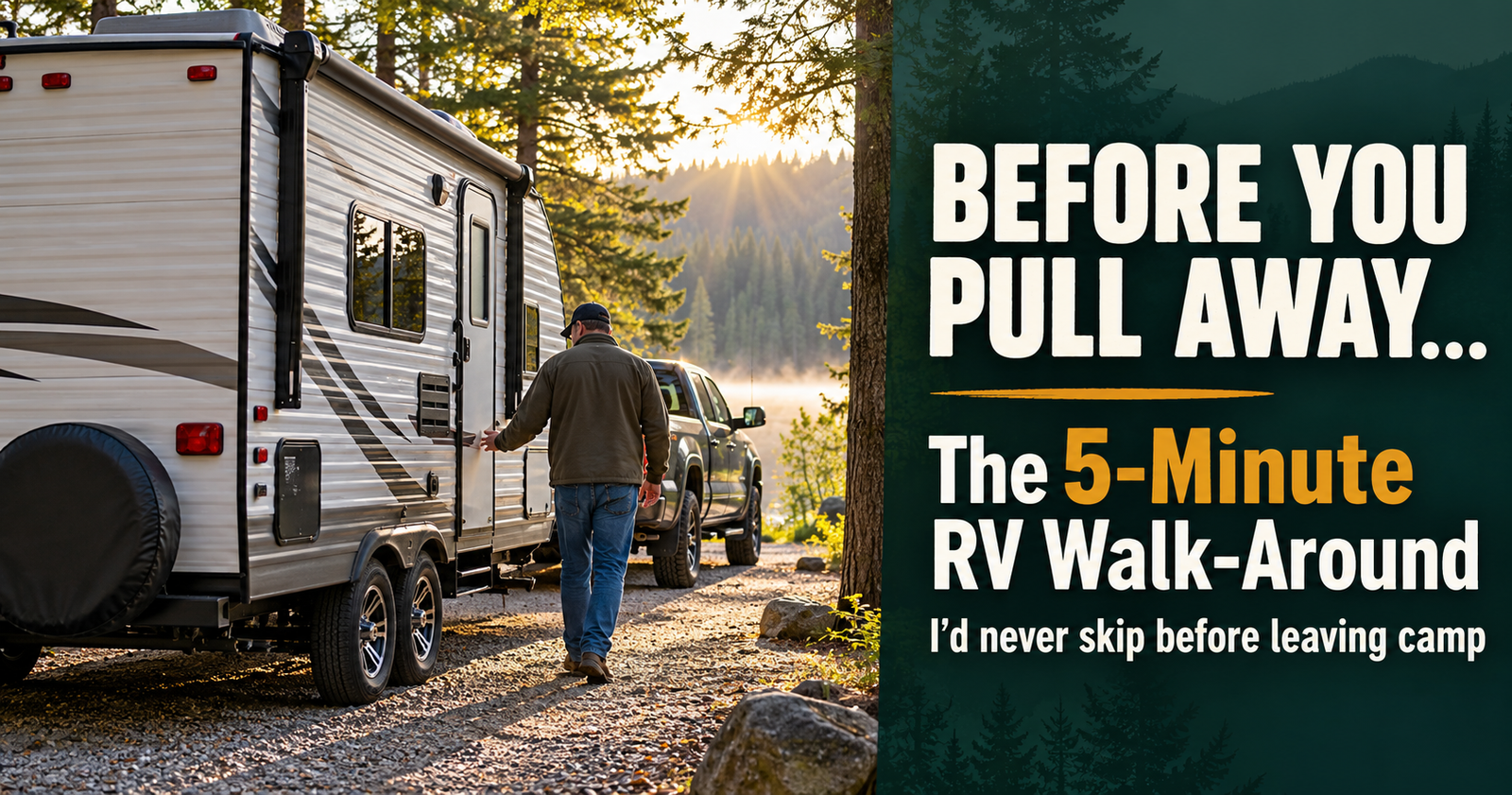
I walk completely around the RV before we move. Every single time.
It takes maybe five minutes when I’m being slow about it.
Those five minutes can catch some really expensive mistakes.
I Don’t Trust Myself to Remember Everything
That’s really the reason for the walk-around.
I could make a mental list.
Awning in.
Power disconnected.
Water disconnected.
Steps up.
Compartments closed.
Chocks removed.
Slides in.
Hitch checked.
Everything good.
But departure morning is exactly when somebody interrupts you halfway through doing something.
You start putting the shore cord away.
Someone asks where their shoes are.
You find the shoes.
Then you start doing something else.
Twenty minutes later the cord is still sitting there.
So I don’t rely on remembering what I already did.
I physically look at everything again.
I Start With the Stuff That Can Still Be Attached to the Campsite
This is probably my biggest fear because it’s such an easy mistake.
Shore-power cord.
Water hose.
Sewer hose.
Cable connection if you’re using one.
Anything else physically connecting the camper to the campsite needs to be disconnected and put away.
The shore cord is especially easy to overlook if somebody else handled part of the teardown.
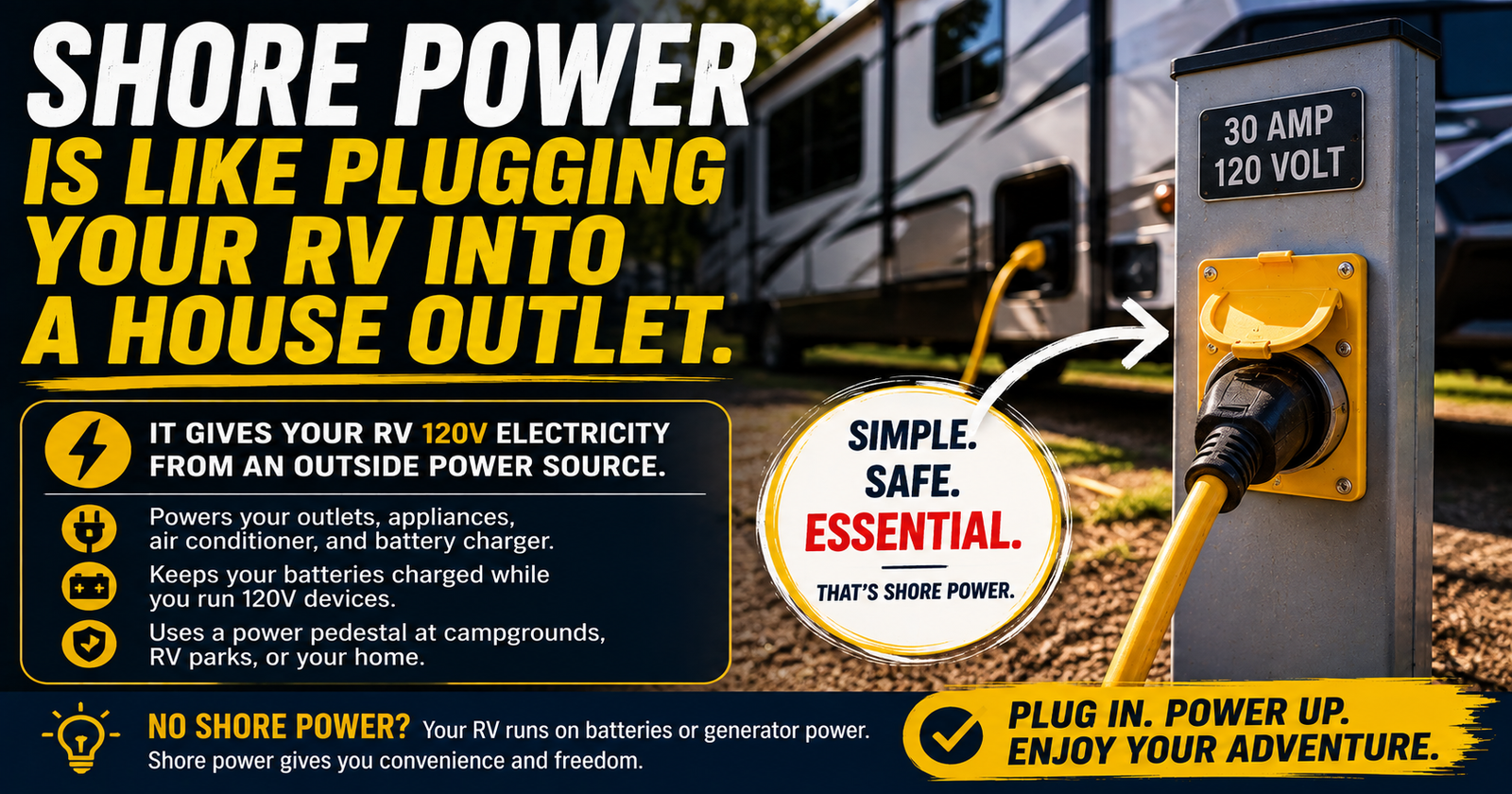
And after everything we’ve learned about how RV shore power actually works, I like shutting the pedestal breaker off before disconnecting and then putting the cord completely away.
I don’t want it lying beside the camper waiting to become tomorrow’s expensive story.
Then I Look Up
This is the part that’s easy to miss if you’re only staring at eye level.
Awning.
Antenna.
Anything mounted high that needs to be retracted or lowered.
The awning is the obvious one.
An extended awning makes the camper look so normal at a campsite that I can see how somebody could simply forget it’s there.
Then the camper starts moving.
Now you’ve got a giant piece of fabric and hardware hanging off the side of an RV that was never intended to travel that way.
That’s a mistake I’d much rather catch standing still.
I Physically Look at Every Slide
I don’t just remember bringing them in.
I look.
Fully retracted?
Nothing sticking out?
Everything appears seated the way it normally does?
This is where having the same walk-around routine every time helps.
I’m not trying to remember whether I checked the slide.
I know I’m going to reach that side of the camper during my loop and look at it.
The routine does some of the remembering for me.
The Steps Are Another Easy One
Depending on the camper, steps may retract automatically or require more involvement.
Either way, I look.
Steps hanging out while you’re traveling can meet curbs, posts, uneven ground, or whatever else gets close enough.
It’s such a dumb thing to damage because it takes about two seconds to verify.
So I verify it.
Every Storage Door Gets a Tug
Closed doesn’t always mean latched.
That’s why I don’t just glance at storage compartments.
I give them a quick check.
A door can look closed while the latch hasn’t actually caught.
Then road vibration and airflow get involved.
That’s not when I want to discover it.
Same idea with exterior access panels and anything else that needs to remain secured while traveling.
I Look Under the Camper Too
This is where the forgotten stuff hides.
Leveling blocks.
Wheel chocks.
Hose fittings.
Tools.
Random toys.
Dog bowls.
Whatever somebody shoved under there because it was shady.
I’ve found that looking underneath also forces me to slow down enough to notice things I might otherwise walk right past.
And chocks are particularly important because the teardown order matters.
I don’t want to remove the things keeping the trailer where it belongs before the tow vehicle and hitch are ready to take over that job.
The Hitch Gets More Than a Glance
If we’re towing, this is not the part where I say:
“I’m pretty sure I hooked that up.”
I want to see it.
Coupler or fifth-wheel connection properly secured.
Safety chains connected correctly where applicable.
Breakaway cable attached correctly.
Electrical connector installed.
Jack or landing gear where it belongs.
Nothing obviously wrong.
If somebody interrupted me during hitching, I don’t assume I came back and finished every step.
I check.


I Like Checking the Lights Before Pulling Away
Brake lights.
Turn signals.
Running lights where appropriate.
This is much easier with another person, but however you do it, I’d rather discover a lighting problem at the campsite than after somebody behind me discovers it on the highway.
It also gives me one more reason to look at the tow-vehicle electrical connection before leaving.
Then I Go Inside One More Time
This isn’t really part of walking around the outside, but I make one final pass through the camper.
Cabinet doors shut.
Drawers secured.
Refrigerator secured.
Loose things off counters.
Bathroom stuff put away.
Nothing heavy sitting somewhere it’ll become a projectile during the first turn.
Roof vents and windows where they need to be for travel.
Water pump off if appropriate.
Basically, I imagine somebody shaking the camper for the next three hours.
Because that’s pretty much what the road is going to do.
I Don’t Want to Hear the First Turn Tell Me What I Forgot
You know the sound.
You pull out.
Take the first turn.
BANG.
Something inside just moved.
Now everybody looks at everybody else.
“What was that?”
That’s not my favorite way to discover a cabinet wasn’t latched.
A minute inside before leaving can prevent a lot of that.
Then I Walk Around Again
Yes, again.
The second lap is faster.
At this point I’m not packing anything.
I’m not adjusting anything unless I find a problem.
I’m just looking.
Awning in.
Slides in.
Steps up.
Compartments closed.
Utilities disconnected.
Nothing underneath.
Hitch looks right.
Lights good.
Tires look normal.
Campsite empty.
Done.
Current RV departure guidance commonly recommends this kind of repeatable perimeter check because the expensive mistakes are usually simple things left open, extended, or connected.
I Also Look Back at the Campsite
This one has saved plenty of chairs, toys, and random camping gear.
Before leaving, I look at the actual site.
Picnic table empty?
Fire ring area clear?
Nothing hanging from a tree?
No hose fitting sitting beside the spigot?
No leveling block hiding in the gravel?
No trash?
I’d rather spend another minute looking than realize 80 miles down the road that my favorite chair is still sitting beside the fire pit.
The Walk-Around Gets More Important When I’m in a Hurry
That’s the exact time I’m most tempted to skip it.
We’re late.
Weather is coming.
Everybody wants to leave.
Long drive ahead.
Those are also the conditions where I’m most likely to forget something.
So being rushed isn’t a reason to skip the walk-around.
It’s probably the best reason to do it.
I Don’t Care If I Look Overly Cautious
If somebody watches me walk around the camper twice and thinks:
“Didn’t he already check that?”
Yep.
I did.
I’d rather look overly cautious than drive away with the shore cord connected.
There’s no prize for leaving the campsite three minutes faster.
This Also Catches Problems That Aren’t About Forgetting Something
Maybe I notice a tire looks low.
Maybe something underneath is hanging differently.
Maybe there’s water dripping where I don’t expect it.
Maybe a compartment won’t latch correctly.
Maybe a plug looks overheated.
That gives me a chance to investigate while the RV is still parked.
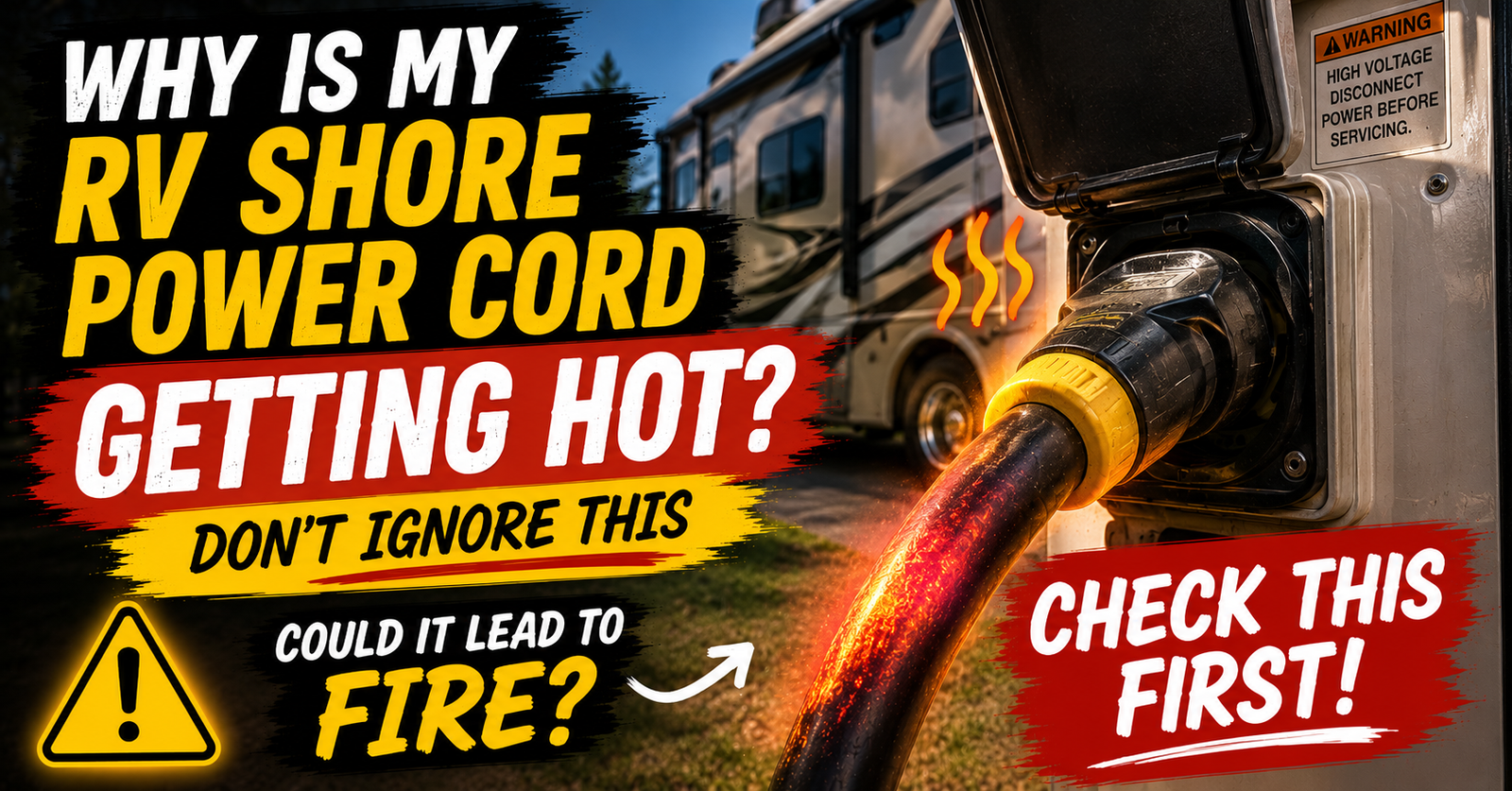
If something electrical catches my attention, especially heat or discoloration around the shore connection, I don’t ignore it just because we’re trying to leave. We’ve already seen why an RV shore-power cord getting hot can be a warning worth taking seriously.
The road isn’t going to improve a questionable connection or loose part.
The Best Routine Is the One You Actually Repeat
I don’t think everybody needs my exact order.
Motorhomes and travel trailers aren’t identical.
Neither are fifth wheels, toy haulers, pop-ups, and truck campers.
Your RV may have equipment mine doesn’t.
That’s why I like building the walk-around around your actual camper.
But whatever order you choose, I’d use the same one every time.
Start at the same spot.
Walk the same direction.
Look at the same things.
That turns a checklist into a habit.
Five Minutes Is Cheap
That’s what it comes down to for me.
Five extra minutes at the campsite costs almost nothing.
An awning ripped off the camper doesn’t.
A damaged step doesn’t.
Dragging a shore cord doesn’t.
Losing a storage door on the highway doesn’t.
Leaving a favorite piece of camping gear behind doesn’t.
And a hitch problem definitely doesn’t.
So before the RV moves, I walk around it.
Even when I know everything is ready.
Especially when I think everything is ready.
Because the mistake that gets you usually isn’t the thing you didn’t know you were supposed to do.
It’s the thing you’ve done a hundred times and somehow forgot once.
Written by Caleb Warren
Caleb Warren writes about real-world RV ownership, campsite routines, camper systems, and the little mistakes that can turn into expensive lessons for CamperAnswers.com. He focuses on practical habits that make camping less stressful and help RV owners catch problems while they’re still easy to fix.