
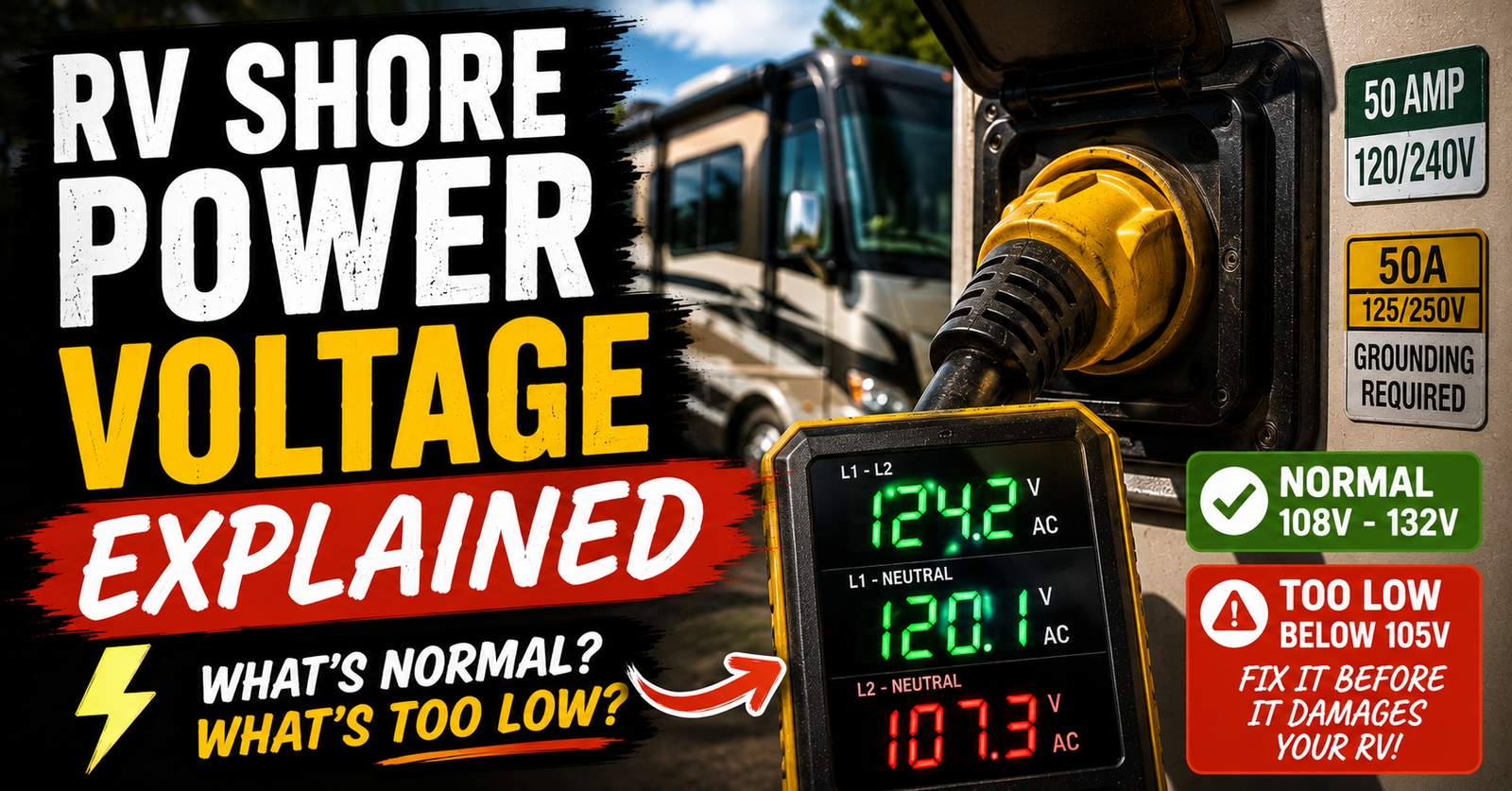
One of the first times you actually look at the voltage coming into an RV, the numbers can make you wonder whether something is wrong.
Maybe you expect exactly 120.0 volts because that’s what everybody calls it.
Instead, your meter says 117 volts.
Then the air conditioner kicks on and you’re seeing 111.
Later that afternoon, when every camper in the park seems to have both air conditioners running, you glance again and see 106.
So which number is normal, and when should you actually start worrying?
Here’s the simple answer I use:
RV shore power is nominally 120 volts, but it won’t sit at exactly 120 volts all day. Small changes are normal. What concerns me is voltage that drops substantially under load, stays unusually low, or reaches the cutoff point of an RV electrical management system. Some popular RV protection systems disconnect power at 104 volts or below and at 132 volts or above.
And low voltage isn’t just about dim lights.
It can be hard on some of the most expensive electrical equipment in your camper.
What Voltage Should I See on RV Shore Power?
For normal campground shore power, I expect a reading somewhere around 120 volts.
Don’t get hung up on seeing exactly 120.
A reading of:
118 volts
121 volts
117 volts
123 volts
doesn’t immediately concern me.
The number naturally moves around as electrical demand and supply conditions change.
What I’m much more interested in is the trend.
If you’re sitting comfortably around 119 volts and the air conditioner starts, maybe the voltage dips a little and settles.
That’s one thing.
If you’re at 116 volts with almost nothing running and the voltage falls toward 105 when the air conditioner starts, I’m paying attention.
My Simple RV Shore Power Voltage Guide
Since this is one of those subjects that’s much easier to understand when you can see the numbers together, here’s the general way I think about it.
Around 120 volts: Exactly what I’d expect.
115 to 125 volts: Nothing about that range alone would make me nervous.
110 to 114 volts: I’m watching it, especially if large appliances are running.
105 to 109 volts: Now I’m concerned about the quality of the incoming power and what happens when additional loads start.
104 volts or below: That’s low enough that some RV electrical management systems automatically disconnect the camper.
132 volts or higher: That’s also beyond the acceptable range used by some RV protection equipment and can trigger a high-voltage shutdown.
Those aren’t magic numbers that mean an appliance instantly explodes one volt beyond them.
They’re practical reference points.
And there’s another number I personally care about quite a bit:
What does the voltage do when the RV is actually under load?


Why Isn’t My RV Getting Exactly 120 Volts?
Because campground electricity isn’t a laboratory power supply sitting on a bench.
You’re sharing an electrical system with other people.
Demand changes.
Wiring has resistance.
Connections have resistance.
Distance matters.
The campground’s electrical infrastructure matters.
The number and size of RVs drawing power matter.
Even the electrical load inside your own camper affects the voltage you measure at a particular receptacle.
Hughes Autoformers notes that voltage measured inside the RV can be lower than voltage measured at the campground pedestal because of line loss through wiring and connections.
So don’t expect one voltage reading to remain frozen all weekend.
Why Does My RV Voltage Drop When the Air Conditioner Turns On?
Now we’re getting into something useful.
Large electrical loads can expose voltage drop that isn’t obvious when the camper is barely using electricity.
Suppose you’re sitting at:
118 volts
with very little operating.
Then the air conditioner starts and you’re seeing:
114 volts.
That’s information.
Maybe you add another large load and see:
110 volts.
Now I’m watching more carefully.
Hughes specifically recommends checking voltage while the electrical system is under load because an unloaded measurement can hide voltage-drop problems. It notes that a significant drop when loads are added can point toward undersized wiring, excessive load, or a loose connection.
That’s why a voltage reading with nothing running doesn’t tell the whole story.
The Campground Can Have Good Voltage Until Everyone Gets Hot
This is one of the classic campground situations.
Morning comes.
Weather is nice.
Half the campground is outside drinking coffee.
Your shore power looks great.
Then 4:00 in the afternoon rolls around.
It’s 96 degrees.
Every fifth wheel, motorhome, and travel trailer in the park is trying to turn itself into a refrigerator.
Now campground electrical demand is completely different.
If the campground electrical infrastructure struggles with that demand, voltage can sag.
That’s why somebody can truthfully say:
“My voltage was fine this morning.”
It may have been.
The conditions changed.
Low Voltage Can Be Hard on Air Conditioners
This is one reason I care so much about low campground voltage.
Motors and compressors don’t particularly enjoy operating under poor voltage conditions.
Hughes says low-voltage campground conditions can cause problems with RV air-conditioning and refrigeration equipment and notes that motors can experience increased current draw under low voltage.
Your rooftop air conditioner is expensive.
I’d rather have electrical protection shut the camper down temporarily than keep forcing the compressor to operate on terrible incoming power.
Low Voltage Doesn’t Mean “Not Enough Amps”
Volts and amps get mixed together constantly in RV discussions.
They’re related, but they’re not interchangeable.
Voltage is essentially the electrical pressure available to push current through the system.
Amperage describes current flow.
Wattage represents electrical power.
The basic relationship is:
Watts = Volts × Amps
So on proper 30 amp RV service at 120 volts:
120 × 30 = 3,600 watts
That’s where we get the familiar 3,600-watt capacity of 30 amp RV service.
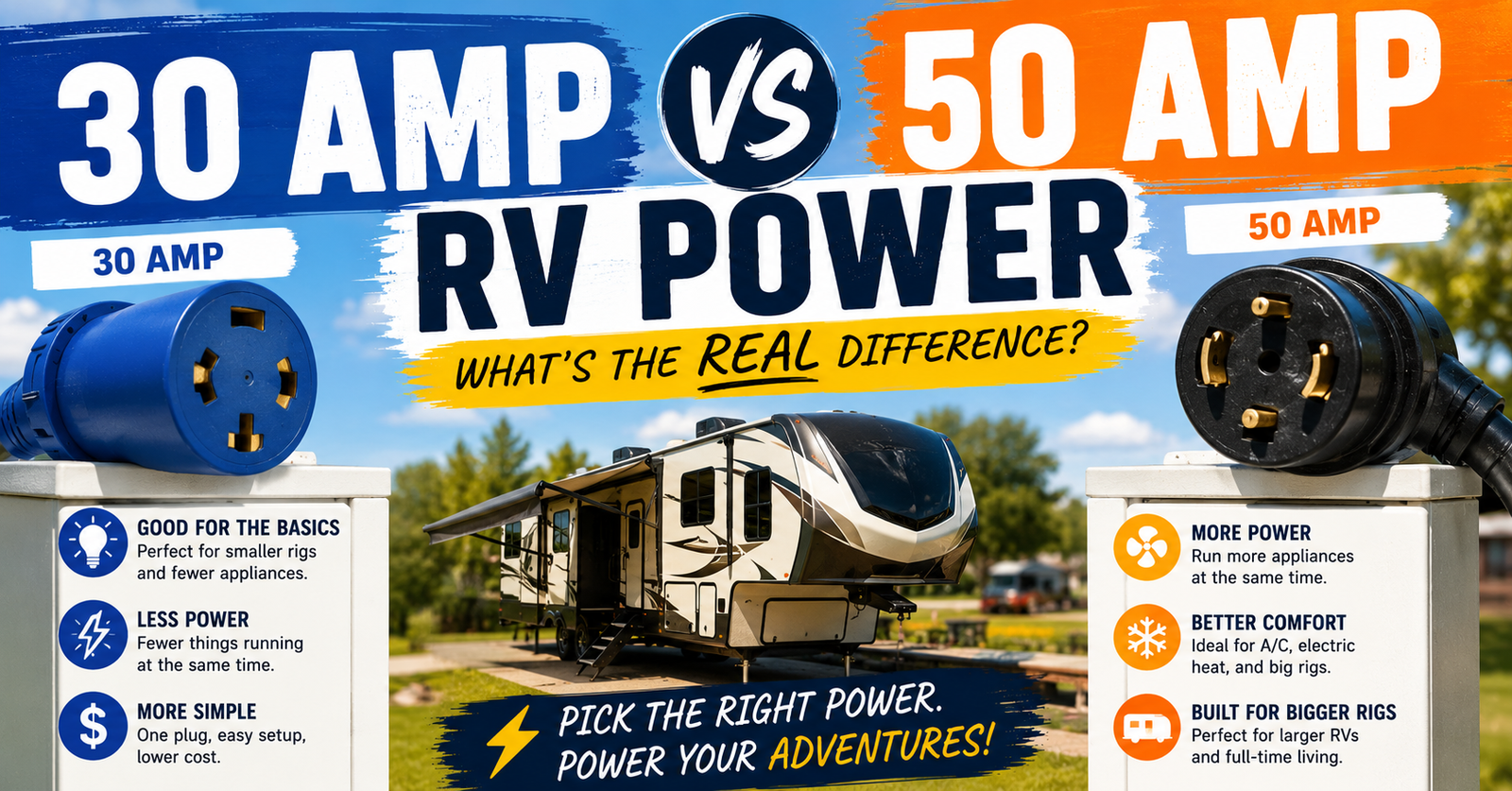
Our 30 amp vs 50 amp RV power explanation goes deeper into those differences if amps, volts, and watts are still blending together in your head.
What Happens When Shore Power Voltage Falls?
Imagine your campground voltage falls significantly.
Certain electrical loads still need to perform work.
Motors in particular can draw more current under low-voltage conditions, increasing heat and stress.
That’s why I don’t think of low voltage as:
“Well, my air conditioner might run a little slower.”
I think of it as a power-quality problem.
And if the voltage becomes bad enough, I’d rather disconnect from the questionable power source than pretend everything is okay because the lights are still on.

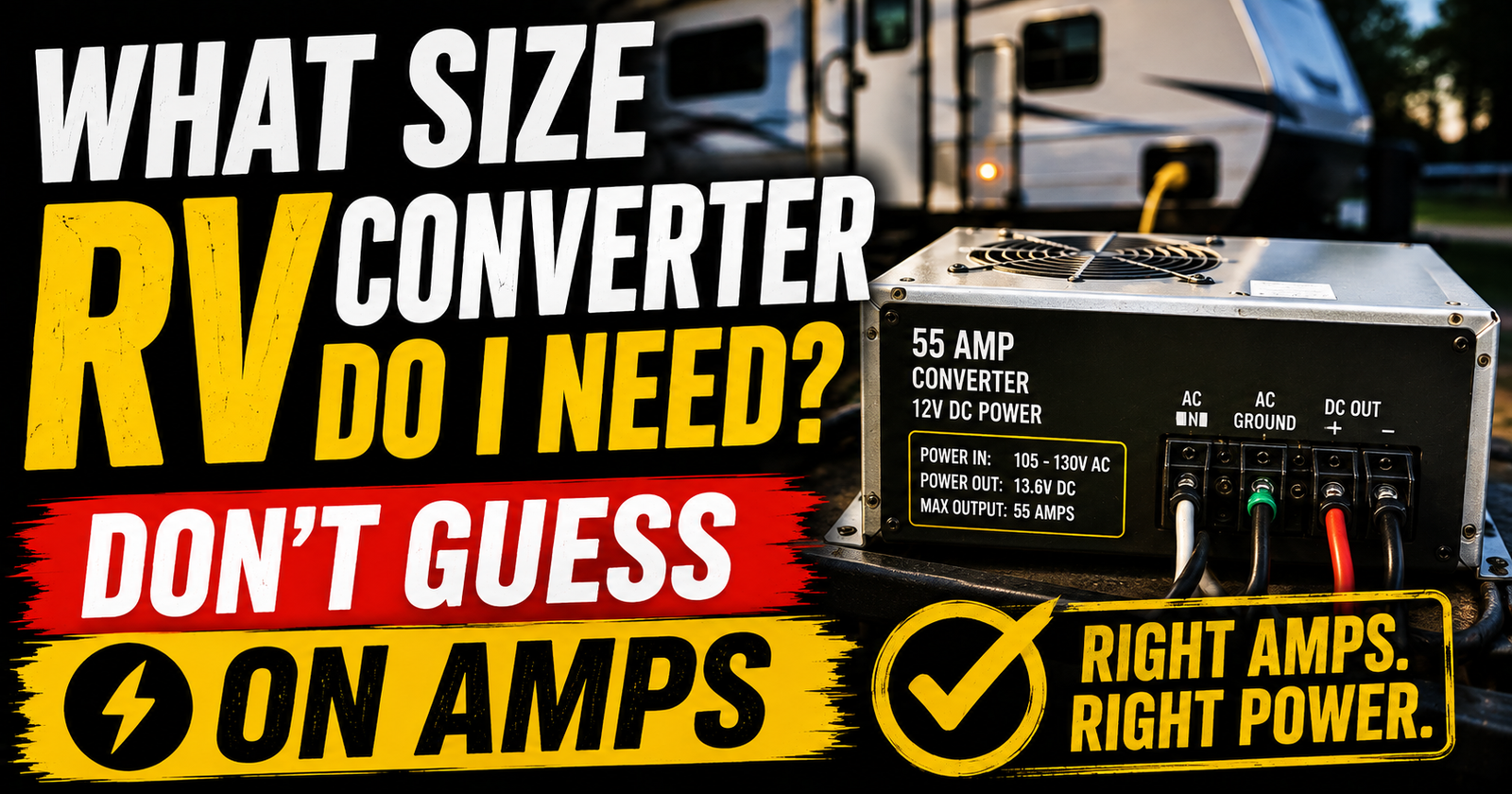
Why Are My Lights Dim When Shore Power Voltage Is Low?
Here’s where RV electrical systems get interesting.
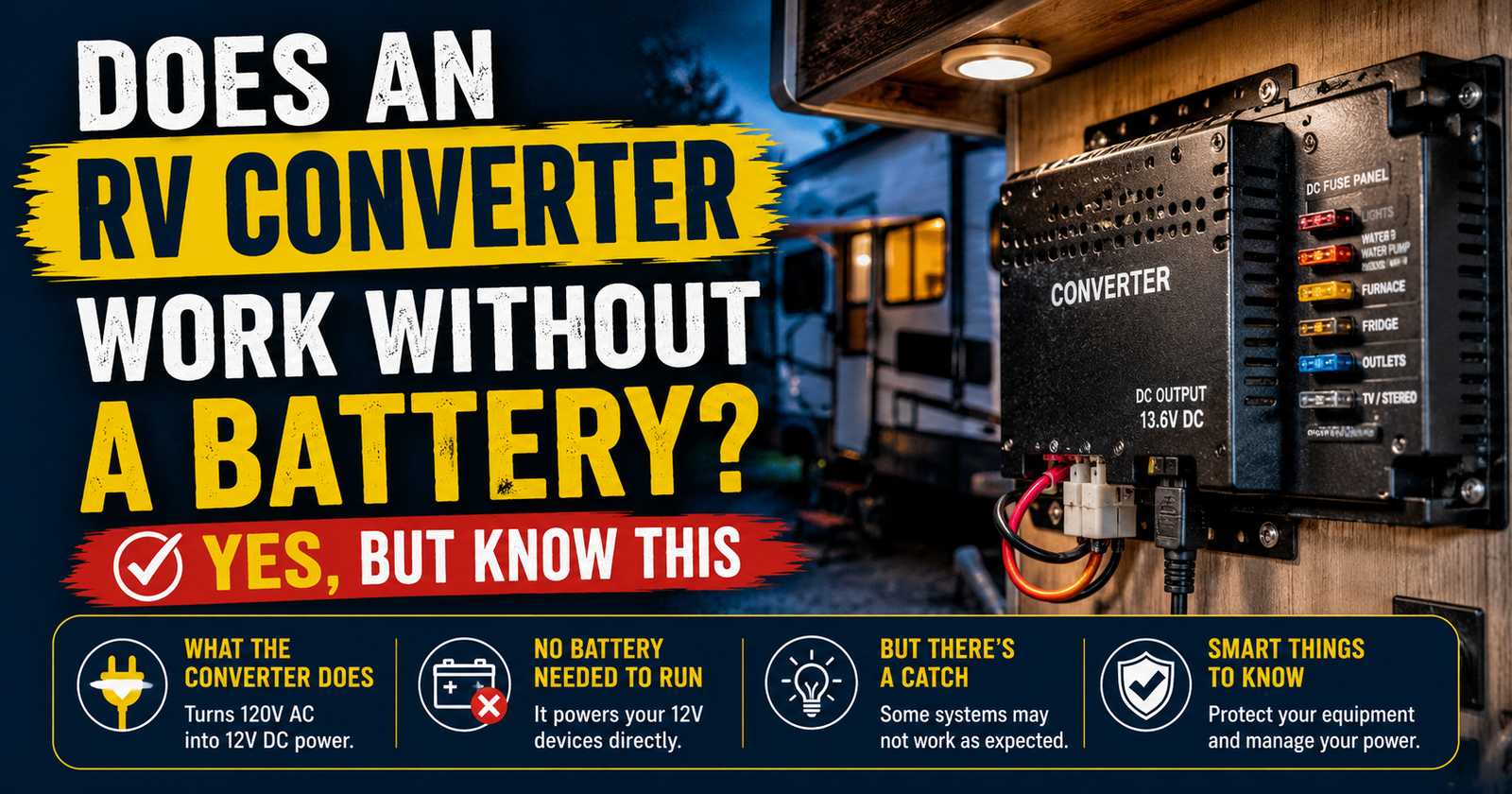
Most RV ceiling lights operate on 12-volt DC power, not directly from the 120-volt campground supply.
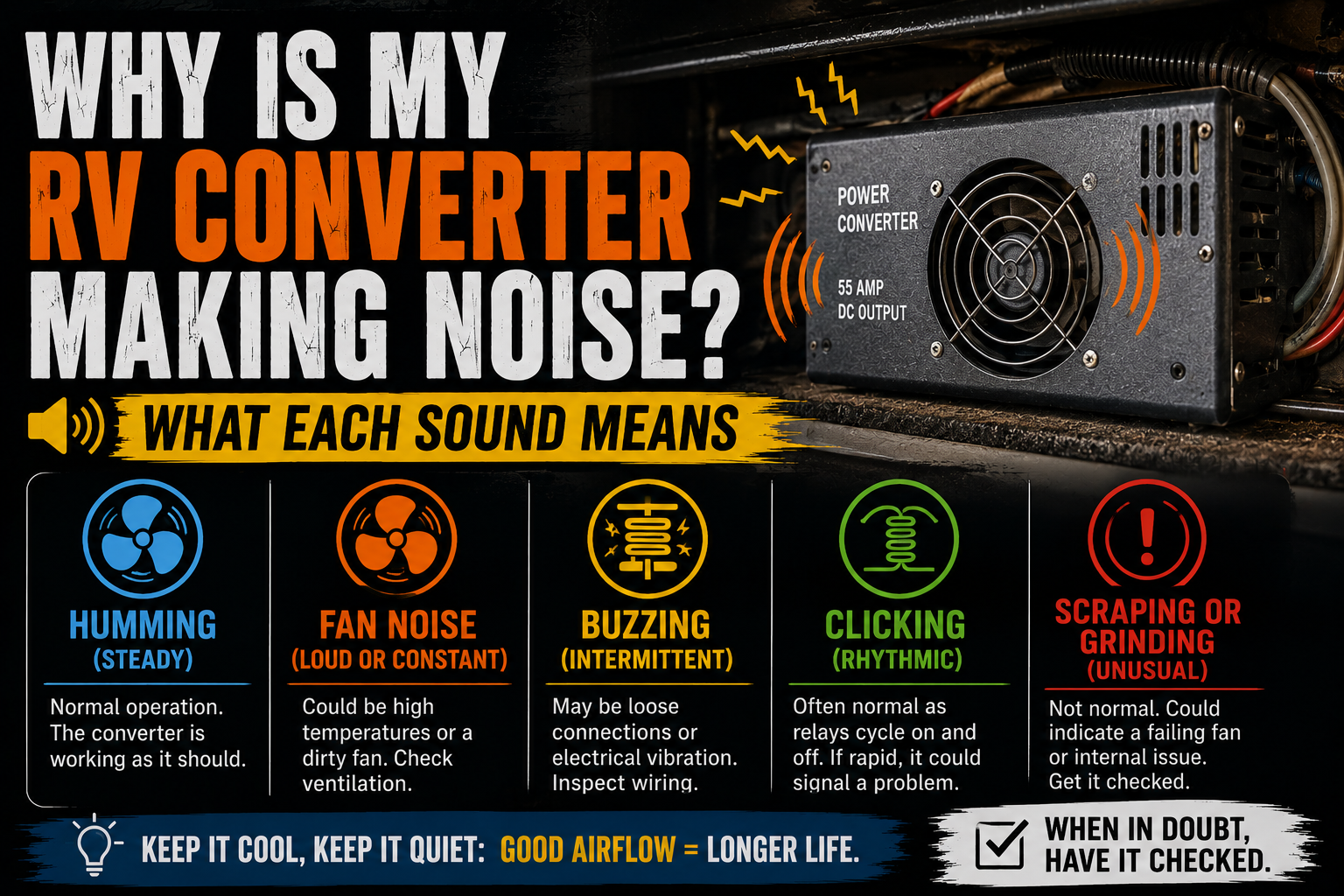
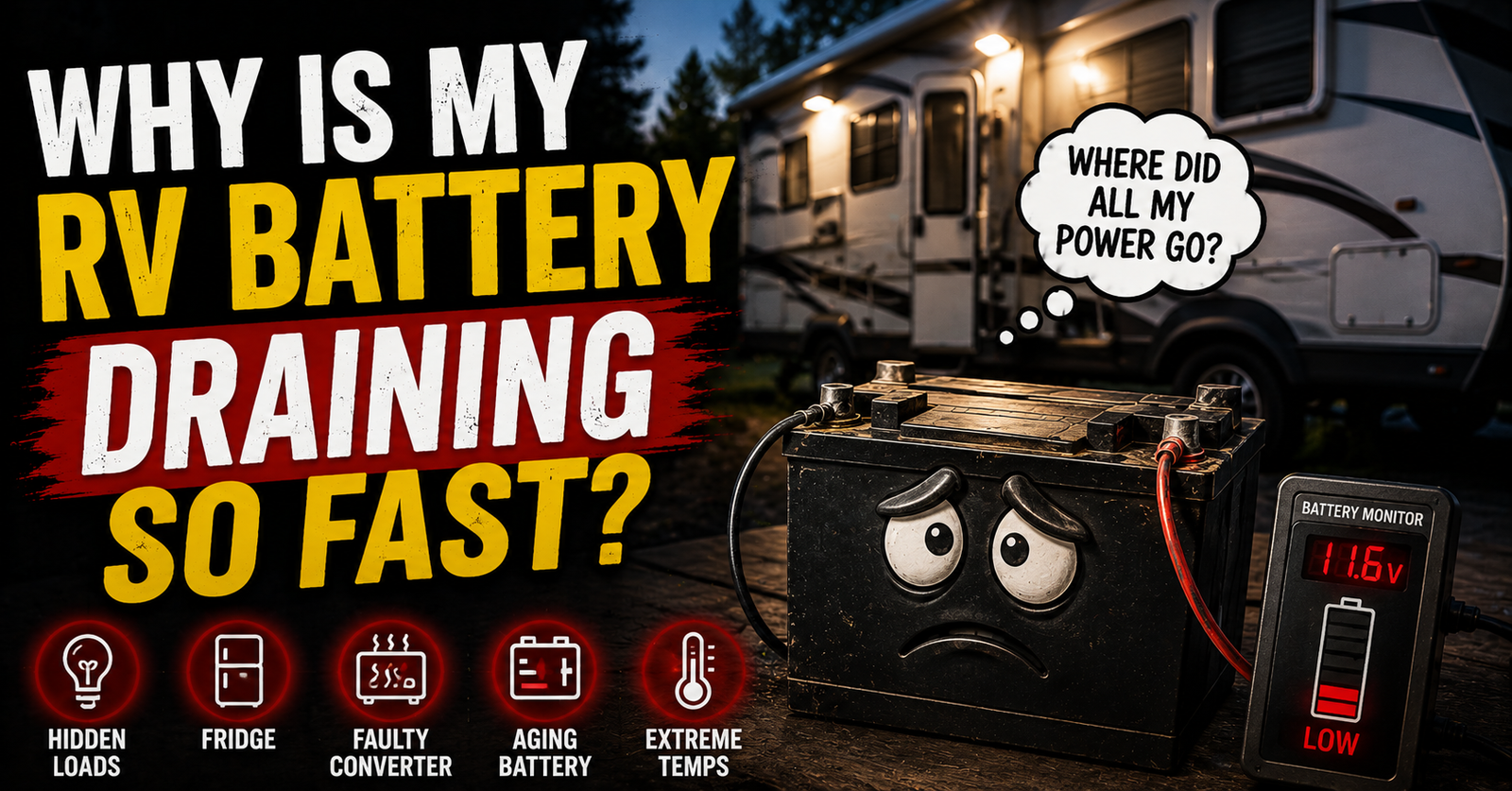
Shore power feeds the converter/charger, which supplies DC power and charges the house battery.
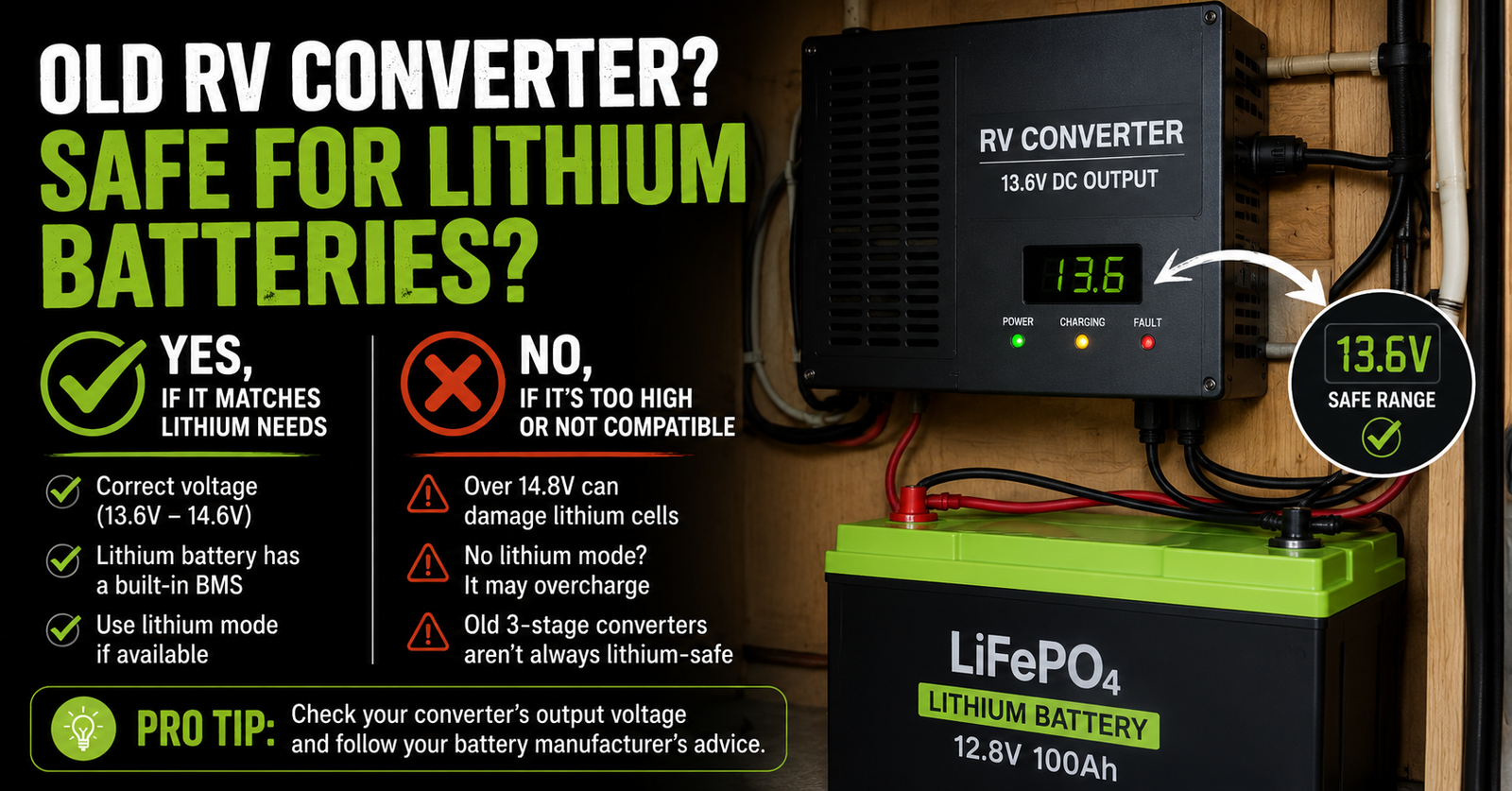
So dim 12-volt lights can involve the converter, battery, DC wiring, or charging system rather than simply telling you the campground pedestal is at 108 volts. If the converter is part of the suspected problem, converter and battery compatibility can help separate a voltage issue from an unsuitable charging profile.
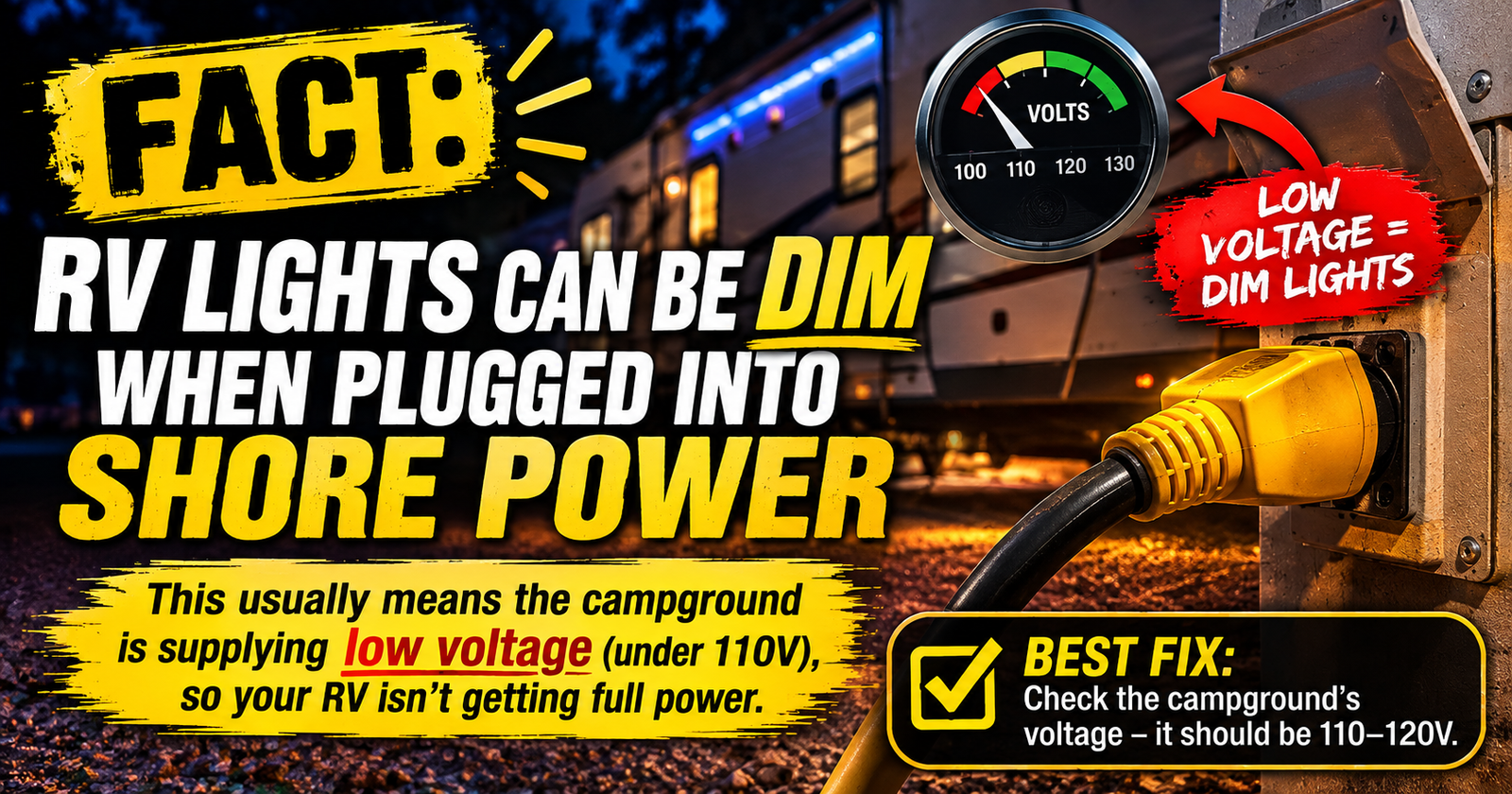
We’ve already built a dedicated guide for RV lights that are dim while plugged into shore power.
That’s a better troubleshooting path if dim lighting is your main symptom.
Where Should I Measure RV Shore Power Voltage?
There are a few places that can tell you different things.
You can measure at the campground pedestal.
You can measure inside the RV at an outlet.
You may also have an electrical management system that continuously displays incoming voltage.
The interesting part is comparing readings.
Suppose you measure:
Pedestal: 119 volts
Inside RV with little load: 117 volts
Inside RV under heavy load: 108 volts
That tells me something different than:
Pedestal: 107 volts
Inside RV: 106 volts
In the first example, I’m interested in voltage drop between the pedestal and the interior circuit.
In the second, the campground supply itself already looks poor.
Why Is Voltage Lower Inside My RV Than at the Pedestal?
Some voltage loss between the source and load can occur because wiring and connections have resistance.
The shore cord has length.
The RV has internal wiring.
Adapters may be involved.
Connections exist at the pedestal and camper.
Hughes gives an example where park voltage can read 117 volts while the voltage measured inside the RV is 111 volts or lower, depending on wiring losses and load.
The bigger the difference becomes, particularly under load, the more interested I become in the electrical path.
This Is Where a Hot Shore Power Plug Becomes Really Interesting
We just covered why an RV shore power cord or plug gets hot.
That problem and voltage drop can be connected.
A poor connection creates resistance.
Resistance can produce heat.
And voltage can drop across that bad connection.
So imagine you discover:
The pedestal has decent voltage.
Voltage inside the RV drops badly under load.
The shore plug is extremely hot.
One blade is discolored.
That’s not something I’d dismiss as normal campground voltage variation.
You’ve got multiple clues pointing toward the electrical connection.
Check the Voltage With a Real Load Running
If I’m trying to understand whether a campground connection is healthy, I’m much more interested in voltage while the camper is actually using electricity.
You might see 120 volts with practically no load.
Great.
Now start a meaningful load.
What happens?
Does it stay around 117 or 118?
Or does it fall to 108?
That’s why Hughes advises testing under load when diagnosing voltage-drop problems.
A system can look wonderful until you ask it to do some work.
Don’t Create a Giant Load Just for Testing
I don’t mean you should turn on every appliance in the camper simultaneously to “stress test” the campground.
Use normal equipment.
If you’re already camping in hot weather, your air conditioner gives you a pretty meaningful load.
Observe what happens.
You don’t need to deliberately overload the pedestal to learn something useful.
What Voltage Is Too Low for an RV Air Conditioner?
This is where people understandably want one exact number.
I’d rather be a little more careful.
The equipment manufacturer ultimately determines the acceptable operating voltage for a particular appliance.
However, 104 volts is a useful red-line reference because some RV electrical management systems disconnect the camper when incoming voltage reaches 104 volts or below.
Personally, I’m not waiting until 104 volts to start paying attention.
If I’m seeing sustained voltage in the upper 100s while my air conditioner is running, I’m already asking why.
And if the voltage keeps dropping as campground demand increases, I’m not adding more large electrical loads.
What Voltage Is Too High for an RV?
High voltage doesn’t get talked about as much because campground low voltage is such a familiar problem.
But high voltage isn’t something I want either.
The Hughes Power Watchdog EPO documentation lists 132 volts as its high-voltage disconnect point.
So an electrical management system may shut your RV down for power that’s too high just as it can for power that’s too low.
If your EMS suddenly disconnects the camper and reports high voltage, don’t assume the device is malfunctioning.
Check what it’s actually telling you.
Why Did My Surge Protector Shut My RV Off at 104 Volts?
It may not be a simple surge protector.
This terminology causes a lot of confusion.

A basic surge protector and an electrical management system, or EMS, aren’t necessarily the same thing. That distinction is explained in this RV surge protector and EMS guide.
An EMS can actively monitor incoming campground conditions.
For example, Hughes’ Power Watchdog EPO models monitor for low voltage, high voltage, reverse polarity, open ground, open neutral, and other faults. If voltage drops to 104 volts or below, the unit disconnects power to the RV.
So if your camper suddenly goes dark and the campground breaker didn’t trip, look at your electrical protection equipment.
It may have intentionally disconnected you.
That’s Actually What I Want My EMS to Do
Think about the alternative.
Campground voltage gets terrible.
Your expensive air conditioner keeps trying to run.
Your refrigerator is operating.
Other equipment is connected.
Your protection device notices the incoming power is outside its acceptable range and says:
Nope.
That’s not an inconvenience I’d be angry about.
That’s why I bought the thing.
The important step is figuring out why it disconnected before bypassing anything.
What If the Voltage Comes Back Up?
Some electrical management systems automatically reconnect after acceptable power returns and a delay period passes.
For example, Hughes lists a 90-second air-conditioner time delay on its EPO protection equipment.
That delay helps avoid immediately restarting certain equipment as soon as power returns.
So if your RV doesn’t come back to life the exact second voltage improves, don’t automatically assume something else broke.
Check how your particular protection system operates.
Can I Just Keep Camping at 105 Volts?
That’s not something I’d be comfortable recommending as normal operation.
You’re extremely close to the low-voltage shutdown point used by some RV protection equipment.
I’d reduce large electrical loads and investigate.
Check voltage at the pedestal.
Compare it with voltage inside the camper.
Look for hot or damaged connections.
Talk to campground management if the pedestal voltage itself is low.
If the campground cannot provide acceptable power, I don’t think sacrificing an air-conditioner compressor is worth keeping the campsite.
Can a Long RV Extension Cord Cause Low Voltage?
Absolutely, especially if the cord isn’t properly sized.
Longer conductors create more opportunity for voltage drop, and undersized wiring makes the problem worse.
Hughes recommends using larger wire for longer extension runs and specifies 10-gauge or larger for 30 amp extension service and 8-gauge or larger for 50 amp service in its Autoformer guidance.
I wouldn’t feed an RV through a long, lightweight household extension cord and then blame the campground when voltage inside the camper looks terrible.
Everything between the pedestal and appliance matters.
Can an RV Adapter Cause Voltage Drop?
The fact that you’re using an adapter doesn’t automatically cause a major problem.
A properly rated adapter with good connections should do its job.
But every additional connection is another place where poor contact, corrosion, wear, or damage can create resistance.
If voltage is good before an adapter and noticeably worse after it under load, I’d inspect that adapter and its connections.
And if the adapter is unusually hot, now you’ve got another clue.
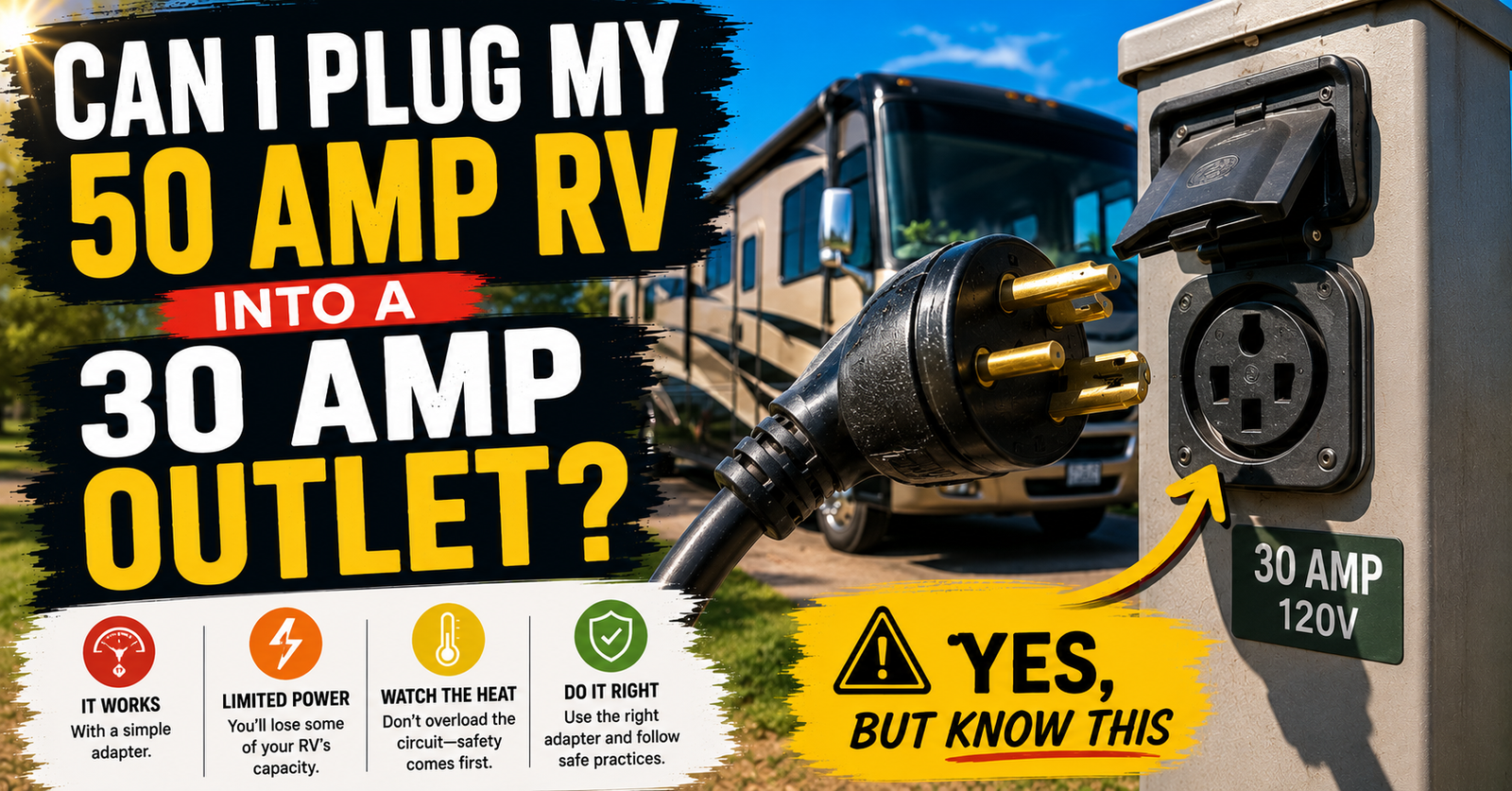
What About Plugging a 30 Amp RV Into 50 Amp Service?
That doesn’t inherently give the camper higher voltage.
Your 30 amp RV still needs normal 120-volt service.
The 50 amp pedestal simply has more available electrical capacity than your 30 amp camper can use.

With the proper adapter, a 30 amp RV can use a 50 amp campground outlet.
You don’t suddenly feed 240 volts into your camper because the pedestal says 50 amps.
The proper RV adapter provides the connection the 30 amp camper needs.
Does a 50 Amp RV Have 240 Volts?
Technically, a standard 50 amp RV service has two 120-volt hot legs with approximately 240 volts measured between those two hot legs.
But most RV equipment uses 120 volts from one hot leg to neutral.
For basic troubleshooting, I want a 50 amp RV owner to understand something important:
You have two incoming 120-volt legs.
That means you should care about the voltage on both.
One 50 Amp Leg Can Have a Problem While the Other Looks Fine
This is another reason a 50 amp RV can produce strange symptoms.
One side of the camper works.
Another group of circuits acts strange or loses power.
If one incoming leg has a voltage problem or disappears entirely, you can get partial-power symptoms.

That’s why our guide to some RV outlets working while others have no power discusses a lost 50 amp leg as one possibility.
Don’t assume one good voltage reading proves the entire 50 amp service is healthy.
A Bad Neutral on 50 Amp Service Is Something I Take Seriously
This is where I don’t want somebody experimenting if they don’t understand AC electrical systems.
The neutral plays an important role in 50 amp RV service.
A loose or open neutral can create abnormal voltage conditions across the RV’s two legs, potentially exposing equipment to damaging voltage.
That’s exactly the kind of campground wiring fault a quality EMS is intended to detect.
Hughes lists open-neutral detection among the faults monitored by its Power Watchdog EPO equipment.
If your protection device reports an open neutral, don’t bypass it and see what happens.
What If Voltage Is Fine at the Pedestal but Bad Inside the RV?
Now I’m looking between those two points.
Pedestal connection.
Surge protector or EMS.
Adapter.
Shore cord.
RV inlet.
Transfer switch if equipped.
Internal connections.
Distribution panel.
Branch circuit wiring.
The bigger the voltage drop becomes under load, the more useful this comparison is.
Hughes specifically notes that large voltage drops under load can be associated with wiring size, excessive circuit load, or loose connections.
Follow the electricity instead of randomly replacing components.
What If Voltage Is Bad Right at the Pedestal?
That’s campground territory.
I wouldn’t open the pedestal and start tightening things.
Tell campground management.
They may be able to inspect the pedestal, move you to another site, or determine whether there’s a larger electrical issue affecting the campground.
If another pedestal provides healthy voltage with the same RV, same cord, and same normal electrical loads, that’s valuable troubleshooting information.
Can I Fix Low Campground Voltage With an Autoformer?
This is where an RV voltage booster, often called an autoformer, enters the conversation.
These devices are designed to raise low incoming voltage rather than simply disconnecting the camper.
For example, Hughes says its Autoformer monitors incoming park voltage and boosts output when the campground supply drops below its switching threshold. Its current models are designed around roughly a 10 percent voltage boost when needed.
That’s different from an EMS.
An EMS may say:
“Voltage is too low. I’m disconnecting the RV.”
A voltage booster is designed to raise low incoming voltage within its operating capabilities.
Different jobs.
An Autoformer Doesn’t Create Free Electricity
This is important.
A voltage booster isn’t a magic box that turns a terrible campground electrical system into unlimited power.
Hughes specifically explains that its Autoformer doesn’t create electricity or take extra power from the campground. It changes the voltage-amperage relationship to raise voltage supplied to the RV.
You still have the amperage limitations of your campsite connection.
Don’t plug into 30 amp service, add a voltage booster, and assume you’ve somehow built 50 amp service.
Should I Use an EMS Even If Campground Voltage Looks Good?
I like the idea of continuously monitoring power rather than checking once when I arrive.
Here’s why.
You could plug in at 10:00 in the morning and see:
121 volts.
Perfect.
Then leave for the afternoon.
Campground demand skyrockets.
Voltage falls.
Without monitoring equipment, you may have no idea what happened while your air conditioner was trying to keep the camper cool.
An EMS can watch the electrical supply continuously rather than relying on the one measurement you happened to take when setting up.
Don’t Forget About High Voltage
Most of this article naturally focuses on low voltage because it’s such a familiar campground issue.
But I want both ends of the range protected.
Too low isn’t good.
Too high isn’t good.
Incorrect wiring isn’t good.
An open neutral isn’t good.
Reverse polarity isn’t good.
That’s why a proper electrical management system is more useful than simply knowing that the pedestal has “power.”
Electricity being present isn’t the same thing as electricity being good.
What If My RV Voltage Jumps Around Constantly?
A small amount of movement doesn’t bother me.
Large swings do.
If you’re seeing voltage repeatedly bounce from healthy to extremely low, I’d look at whether the change corresponds with large RV loads.
Does it drop when your air conditioner starts?
Does it recover when you shut the AC off?
Does it change when the microwave runs?
Or does it jump around regardless of what your RV is doing?
Those observations help separate an internal voltage-drop problem from changing campground supply conditions.
What If Voltage Is Low Only at One Outlet?
That’s another important distinction.
One low outlet doesn’t necessarily mean the entire RV is receiving low shore voltage.
Hughes notes that voltage measured at an interior outlet reflects conditions on that particular circuit, including its load and wiring.
If one circuit has a large load or poor connection, its voltage reading can differ from another circuit.
Compare readings.
Patterns matter.
What If Voltage Drops and My Shore Cord Gets Hot?
Now I stop treating these as separate problems.
A poor connection can cause both voltage drop and heat.
Inspect the connection.
If there’s visible melting, discoloration, burning, or a dangerously hot plug, disconnect safely and get the problem corrected.
Don’t keep running the air conditioner just to gather more data.
We’ve already gone through the specific hot-connection troubleshooting in our RV shore power cord overheating guide.
Voltage readings are another clue that can help explain what you’re seeing.
What If My RV Keeps Losing Shore Power but the Breaker Isn’t Tripping?
Check your electrical management system.
This is one of the first things I’d look at now that you understand voltage.
If the EMS sees unacceptable incoming voltage, it may intentionally disconnect the RV.
The campground breaker remains on.
The RV main breaker remains on.
But the camper suddenly goes dark.
Then campground voltage recovers.
After the protection device’s delay, the camper comes back.
That can look like a mysterious intermittent electrical failure until you realize the EMS is doing exactly what it’s designed to do.
My Favorite Way to Think About RV Shore Voltage
Don’t obsess over getting exactly 120.0 volts.
Instead, ask three questions.
What is the voltage with a light load?
What happens when a major appliance starts?
Does the voltage remain comfortably away from the protection system’s shutdown limits?
That tells me much more than one random number.
If I see 119 volts and it stays around 116 or 117 with the air conditioner running, I’m not losing sleep over it.
If I see 113 volts unloaded and it dives toward 105 as soon as the compressor starts, I’m investigating.
And if my EMS disconnects the RV because campground voltage fell to its low-voltage threshold, I’m not bypassing the protection so I can keep running.
I’m finding out why the incoming power is that bad.
Shore Power Is More Than Just “Plugged In”
This is really the lesson behind this entire section of our RV electrical cluster.
Plugging your camper into a pedestal doesn’t automatically mean you’re receiving healthy electricity.
The pedestal can have power but still have:
Low voltage.
High voltage.
A bad neutral.
A worn receptacle.
A poor connection.
A missing leg on 50 amp service.
Other wiring problems.
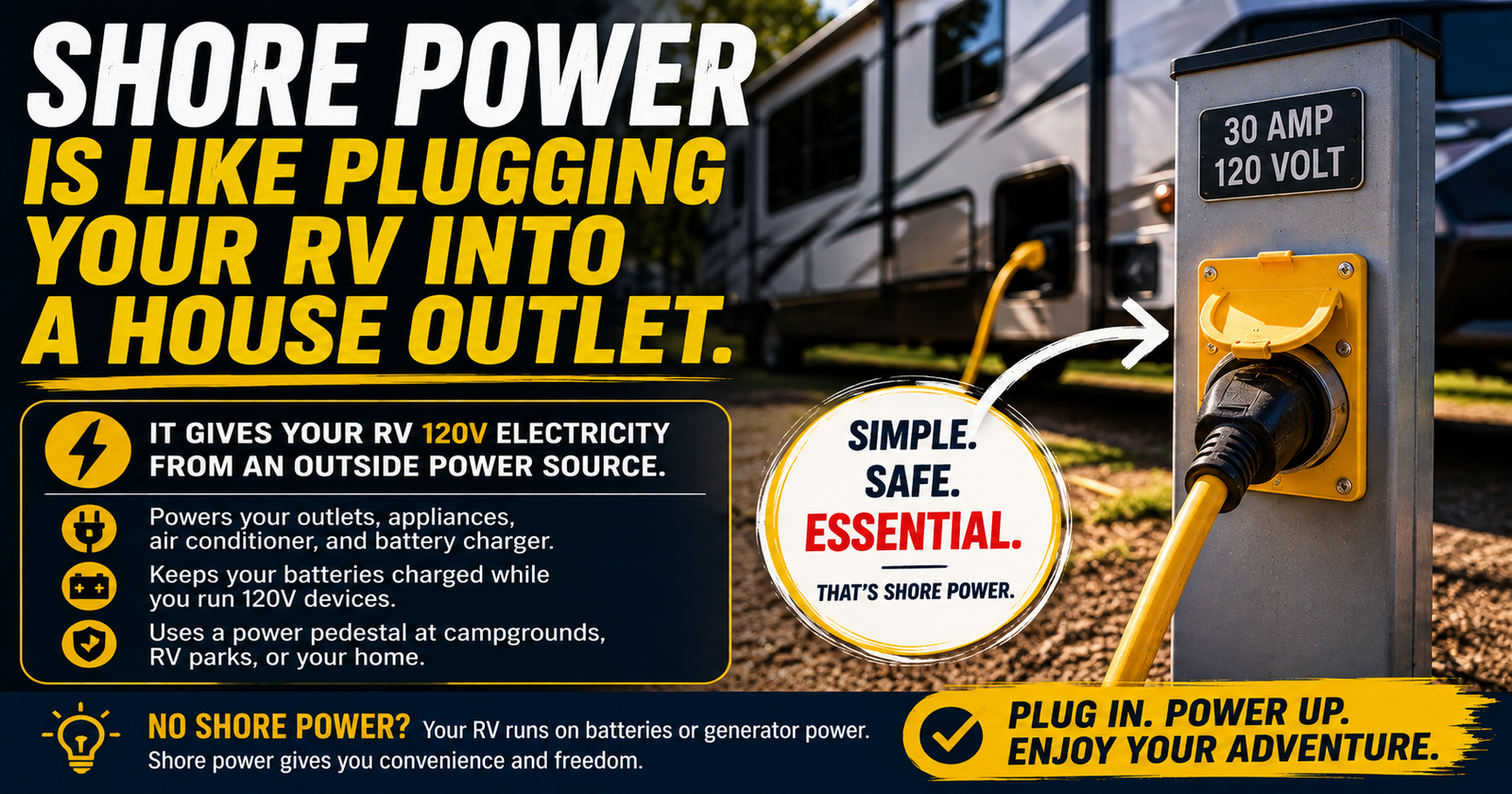
That’s why understanding what RV shore power actually is is only the beginning.
Once you’re comfortable looking at voltage, amperage, connections, and electrical protection as separate pieces, campground electrical problems become a whole lot easier to make sense of.
You don’t need to become an electrician.
But knowing the difference between 119 volts and 105 volts can potentially save you from asking an expensive air conditioner to run on power it really shouldn’t be seeing.
Written by Evan Mercer
Evan Mercer writes about RV electrical systems, shore power, campground hookups, batteries, converters, and practical camper troubleshooting for CamperAnswers.com. He focuses on explaining the numbers and electrical terms RV owners actually encounter at campsites so they can recognize when campground power looks normal and when it’s time to stop plugging things in.