
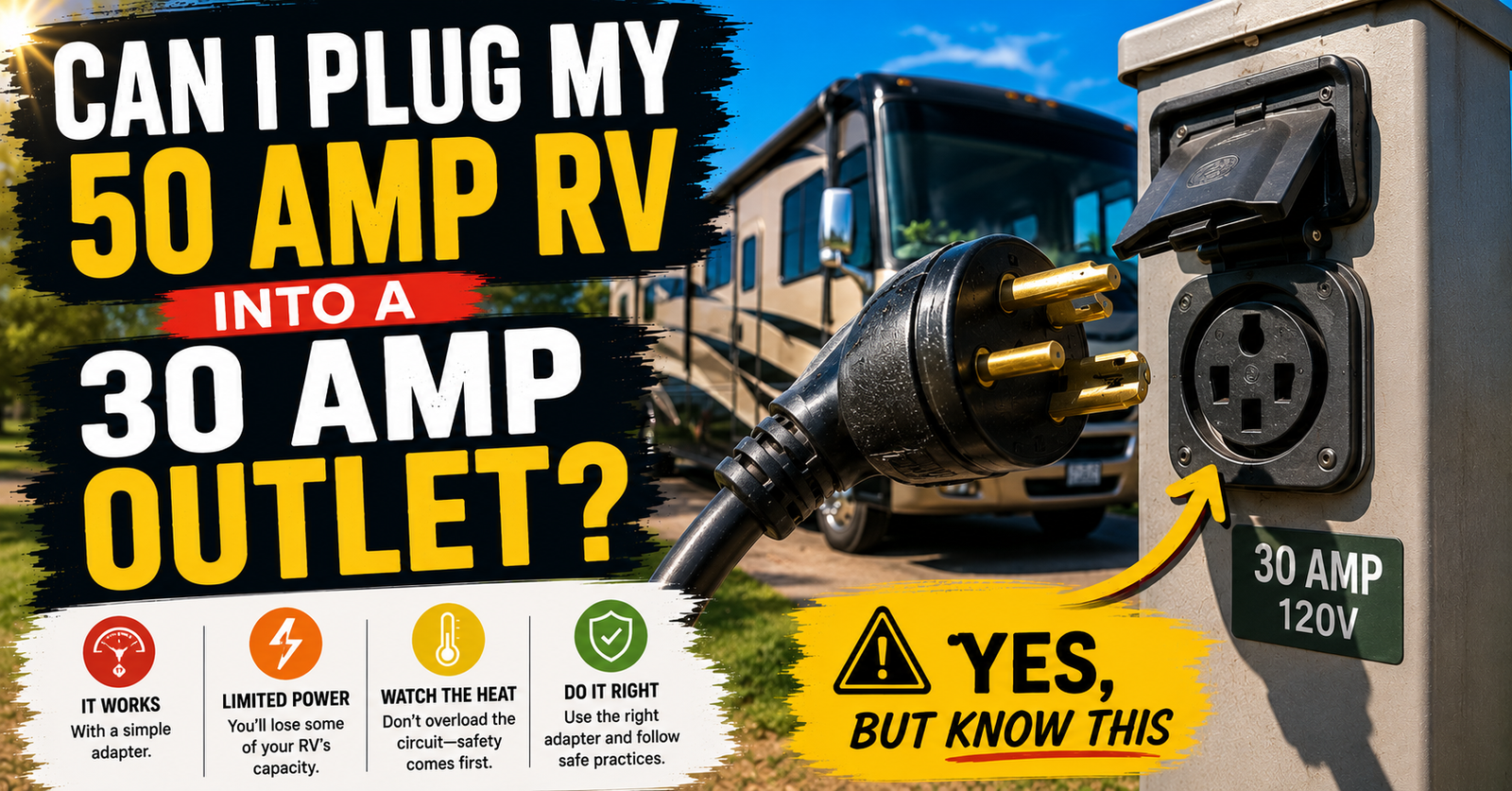
You pull into a campground with a big 50 amp fifth wheel or motorhome, get everything situated, and then notice the electrical pedestal only has a 30 amp hookup available.
Now what?
Yes, you can plug a 50 amp RV into a 30 amp campground outlet using the proper 30 amp male to 50 amp female RV adapter. But there’s a pretty big catch: your RV normally has access to as much as 12,000 watts on full 50 amp service, while that 30 amp hookup can supply only about 3,600 watts. Understanding RV shore power first makes the difference between the campground pedestal, adapter, and RV electrical system much clearer.
So the camper can work. You can run the lights, charge the batteries, use outlets, run appliances, and camp normally within reason.
What you can’t do is pretend you’re still connected to full 50 amp service.
That’s the part that gets people.
What Adapter Do I Need?
For this situation, you need an RV adapter with:
30 amp male end → 50 amp female end
The 30 amp male plug goes into the campground pedestal.
Your RV’s 50 amp shore-power cord plugs into the 50 amp female end.
These are commonly called 30-to-50 amp RV adapters or 50 amp RV to 30 amp pedestal adapters.
The naming can get confusing because people describe the adapter from opposite directions, so I pay more attention to the actual ends.
You need:
30 amp male for the campground
and
50 amp female for your RV cord.
Adapters specifically designed for this purpose are common RV equipment.
Is It Safe to Plug a 50 Amp RV Into 30 Amp Service?
Yes, when you’re using the proper RV adapter and the electrical equipment and connections are in good condition.
You’re not doing anything unusual.
Campgrounds don’t always offer 50 amp service at every site, so this is exactly why these adapters exist.
But there’s a major difference between:
“Can I connect it?”
and
“Can I use the RV exactly like I’m connected to 50 amps?”
The answer to the first is yes.
The answer to the second is definitely no.

The Biggest Thing to Understand Is 12,000 Watts vs 3,600 Watts
This is what makes stepping a 50 amp RV down to 30 amp service much more noticeable than doing the opposite.
A 30 amp RV hookup provides:
120 volts × 30 amps = 3,600 watts
A 50 amp RV hookup has two 120-volt, 50 amp hot legs:
120 × 50 = 6,000 watts per leg
Two legs give you:
12,000 watts total
That’s more than three times as much total available power.
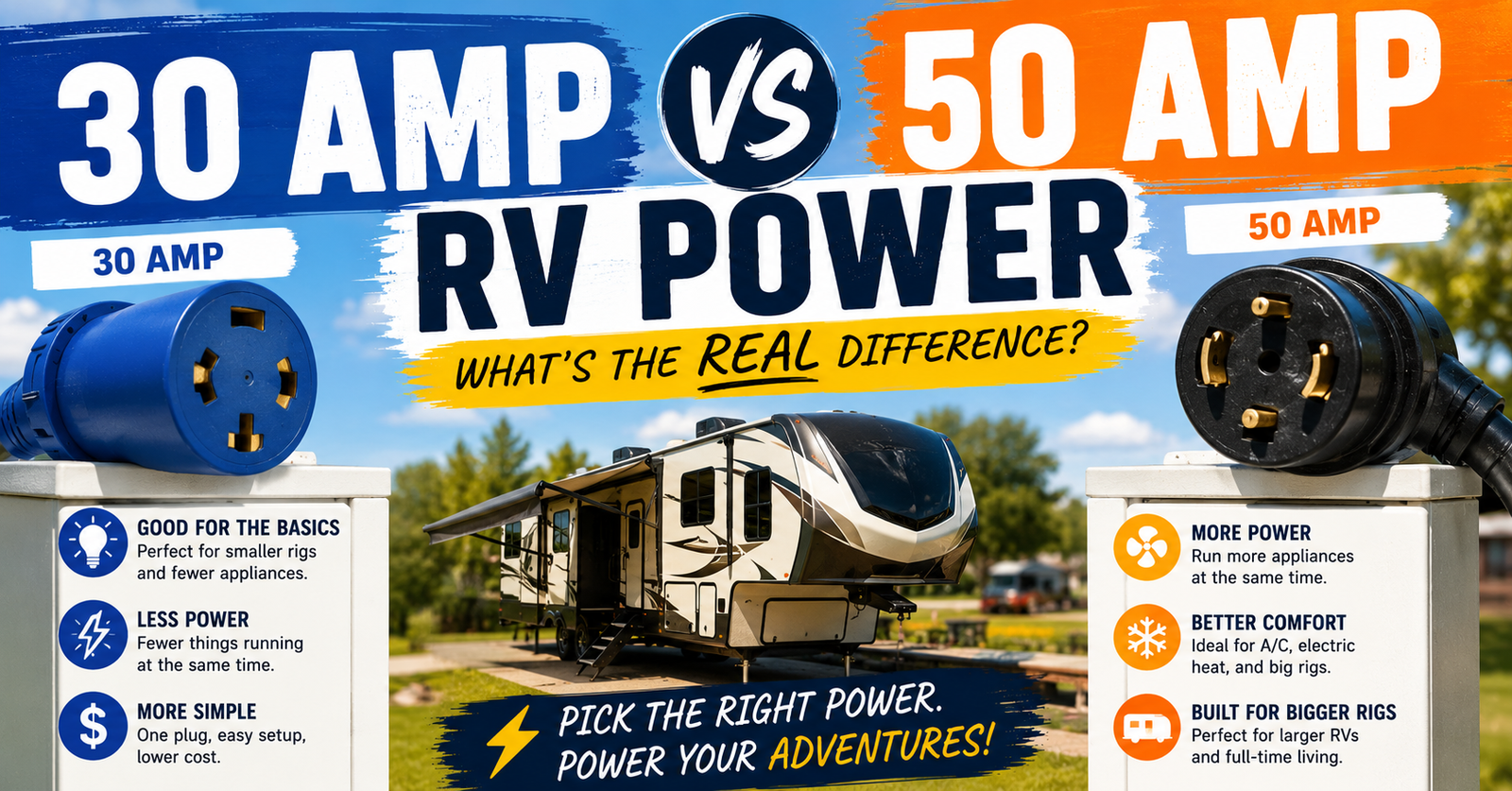
If you haven’t seen why RV electrical service works this way, our 30 amp vs 50 amp RV power explanation goes much deeper into the difference.
For this article, the important part is simple:
Your big 50 amp RV is temporarily living on a 3,600-watt electrical budget.
Does the Adapter Turn 30 Amp Power Into 50 Amp Power?
No.
And this is probably the single most important thing to remember about RV electrical adapters.
An adapter changes the connection. It does not create electricity.
If the campground pedestal can supply 30 amps, that’s what you have available.
You aren’t converting 30 amps into 50 amps.
You’re allowing an RV designed to connect with a 50 amp plug to use a smaller 30 amp electrical source.
Etrailer similarly notes that a 50 amp RV connected through a 30 amp adapter will work, but you won’t have full power and will have to limit how many high-demand appliances operate simultaneously.
Will Both Sides of My 50 Amp RV Have Power?
This is where people understandably get confused.
A 50 amp RV normally receives two separate 120-volt hot legs.
A 30 amp campground connection only provides one 120-volt hot leg.
A properly wired RV adapter is designed to allow the 50 amp RV’s electrical system to receive power from that 30 amp source.
That does not mean you’ve recreated true 50 amp service.
You’re still drawing everything from that one limited 30 amp supply.
So while circuits throughout the RV may have power, their combined demand has to stay within what that 30 amp pedestal connection can provide.
Can I Run Both Air Conditioners?
This is where I’d immediately start managing power.
A large 50 amp RV may have two air conditioners specifically because its normal electrical system has enough capacity to support multiple large loads.
On 30 amp service, things change.
Depending on the particular air conditioners and what else is operating, you may be limited to running one air conditioner at a time.
Etrailer specifically uses a two-air-conditioner RV as an example of where stepping down to 30 amp service can mean running only one unit while being cautious with other high-demand appliances.
Could a particular setup manage more under certain conditions?
Possibly.
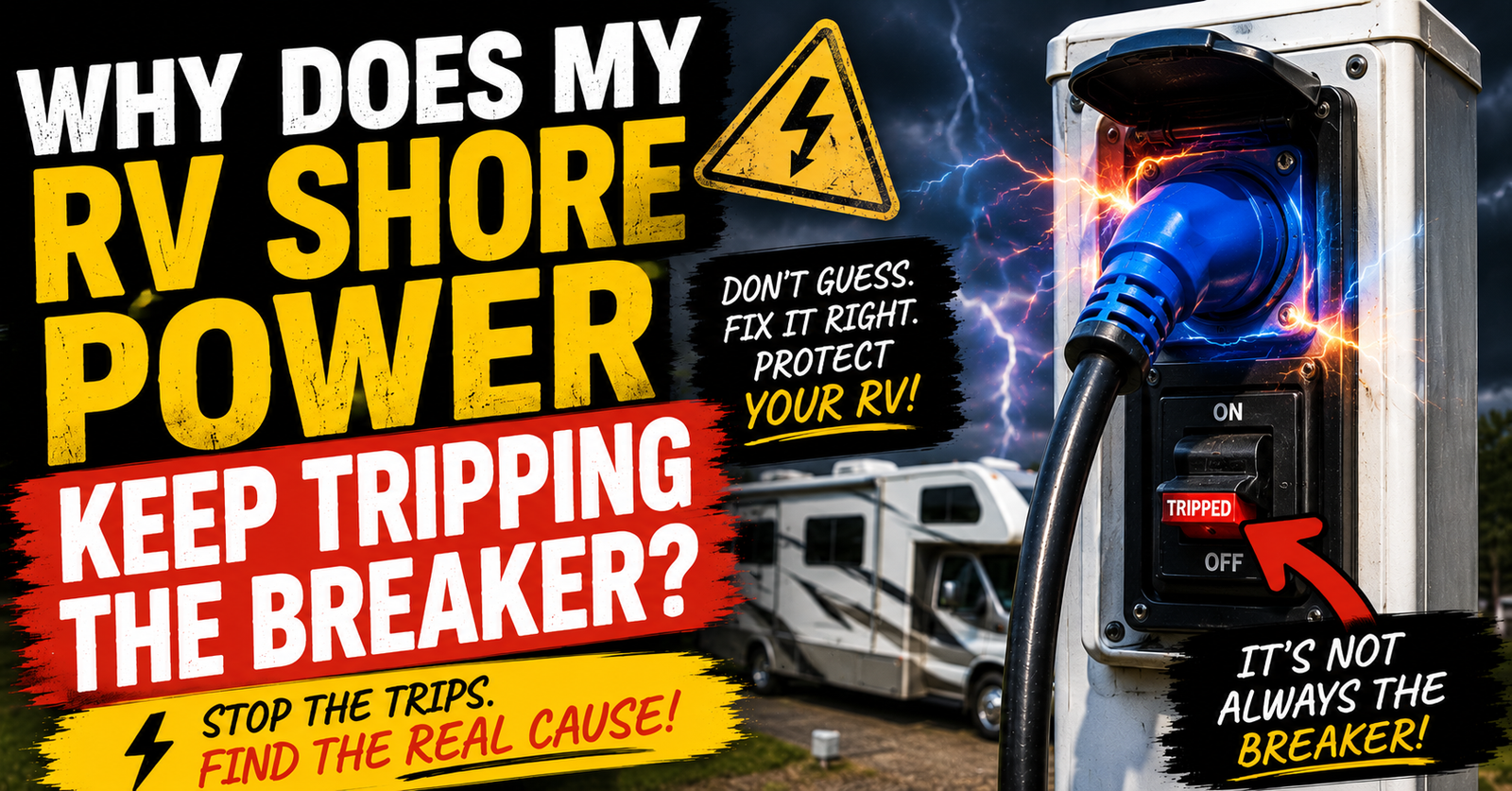
But I wouldn’t arrive at a 30 amp campsite and assume I can run two air conditioners, the microwave, electric water heater, and coffee maker like I normally do on 50 amp service. If the pedestal breaker opens under that combination of loads, why an RV shore-power breaker trips explains how to work through the overload before assuming the equipment has failed.
This Is Where Power Management Becomes Important
On full 50 amp service, you’ve got a lot of breathing room.
On 30 amps, you start thinking about what’s running.
Suppose the air conditioner is operating.
Then the electric water heater kicks on.
The converter is charging a depleted battery bank.
Someone turns on the microwave.
Another person plugs in a hair dryer.
You can see how quickly that 3,600-watt budget gets crowded.
There’s nothing necessarily wrong with the camper.
You’re simply asking a smaller electrical connection to supply a large RV.
Can I Run One Air Conditioner and the Microwave?
Possibly, depending on the actual electrical draw and what else is operating.
But I wouldn’t give every RV owner a blanket yes.
Air-conditioner power consumption varies.
Microwave consumption varies.
The converter may be charging.
Your refrigerator may be operating electrically.
The water heater may be using its electric element.
Other equipment may be running in the background.
That’s why I like thinking in terms of a total power budget instead of memorizing rules like:
“One AC plus one microwave is always okay.”
Your particular combination of equipment determines whether it works.
Don’t Forget About Things Running in the Background
This is one reason people trip a 30 amp breaker and swear they weren’t using anything.
Maybe you weren’t actively using much.
But the RV might have been.
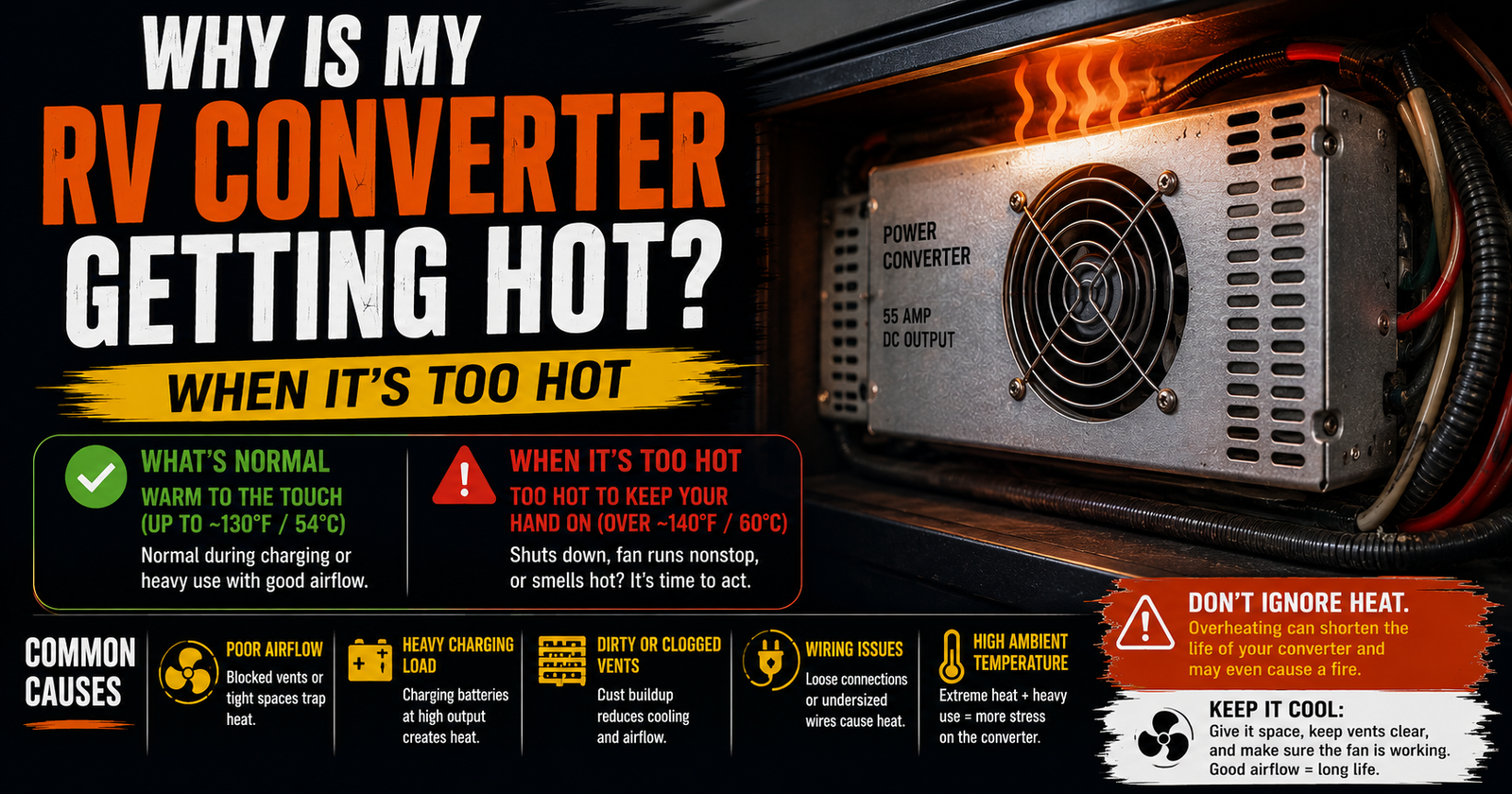
Your converter/charger could be charging a low battery.
The refrigerator may be on electric.
The water heater may be heating electrically.
An air conditioner compressor may kick on.
Then you start the microwave.
All those loads count.
The pedestal doesn’t care whether you consciously turned them on five seconds ago or they started automatically.
Switching the Water Heater to Propane Can Help
If your RV has a water heater capable of operating on propane or electricity, using propane while you’re stuck on limited shore power can free up some electrical capacity.
The same general principle applies to other equipment that gives you a choice of energy source.
You’re trying to move some of the load away from that limited 30 amp electrical supply.
That’s one of the nice things about RV systems.
Sometimes you can adjust how you use them rather than simply going without.
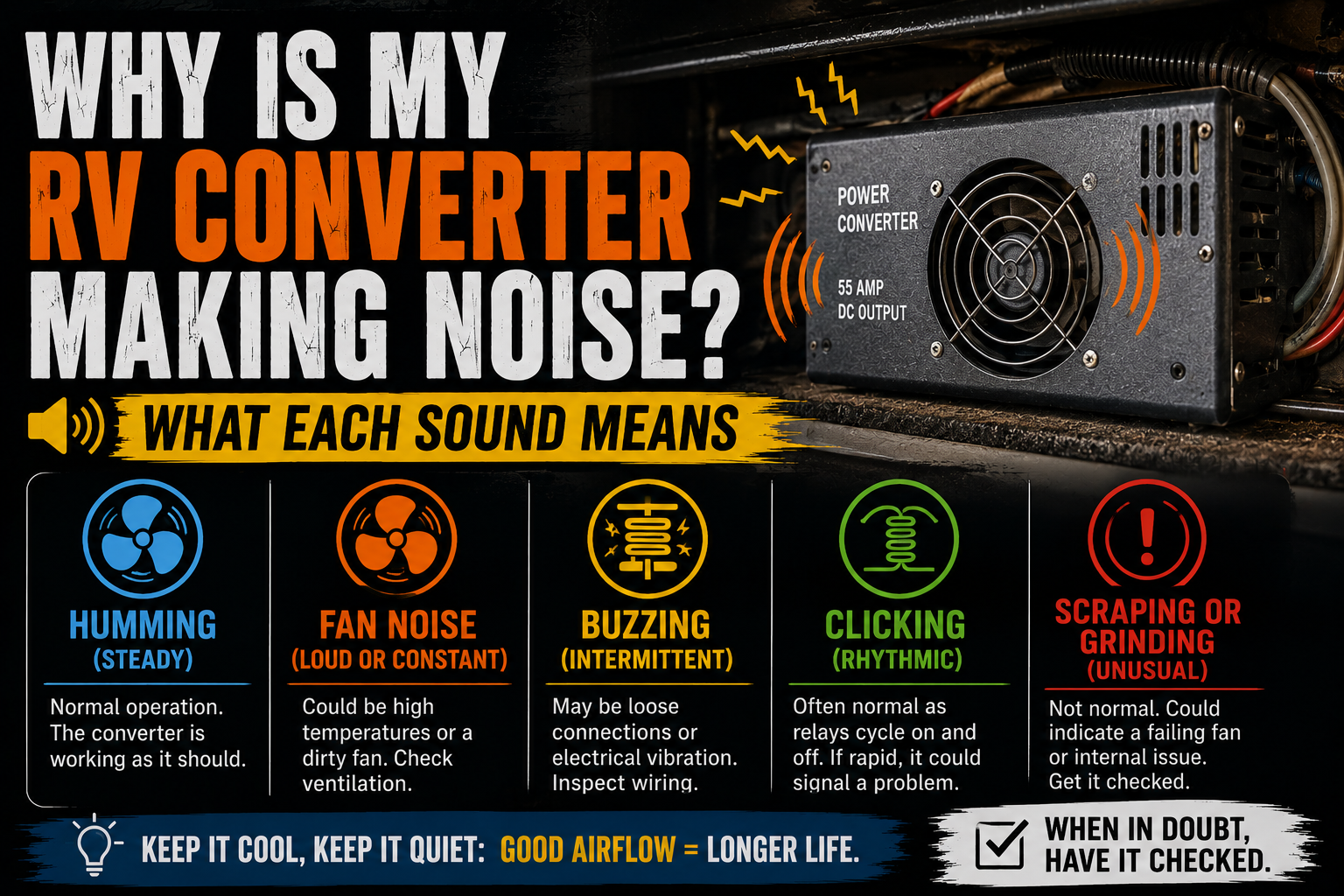
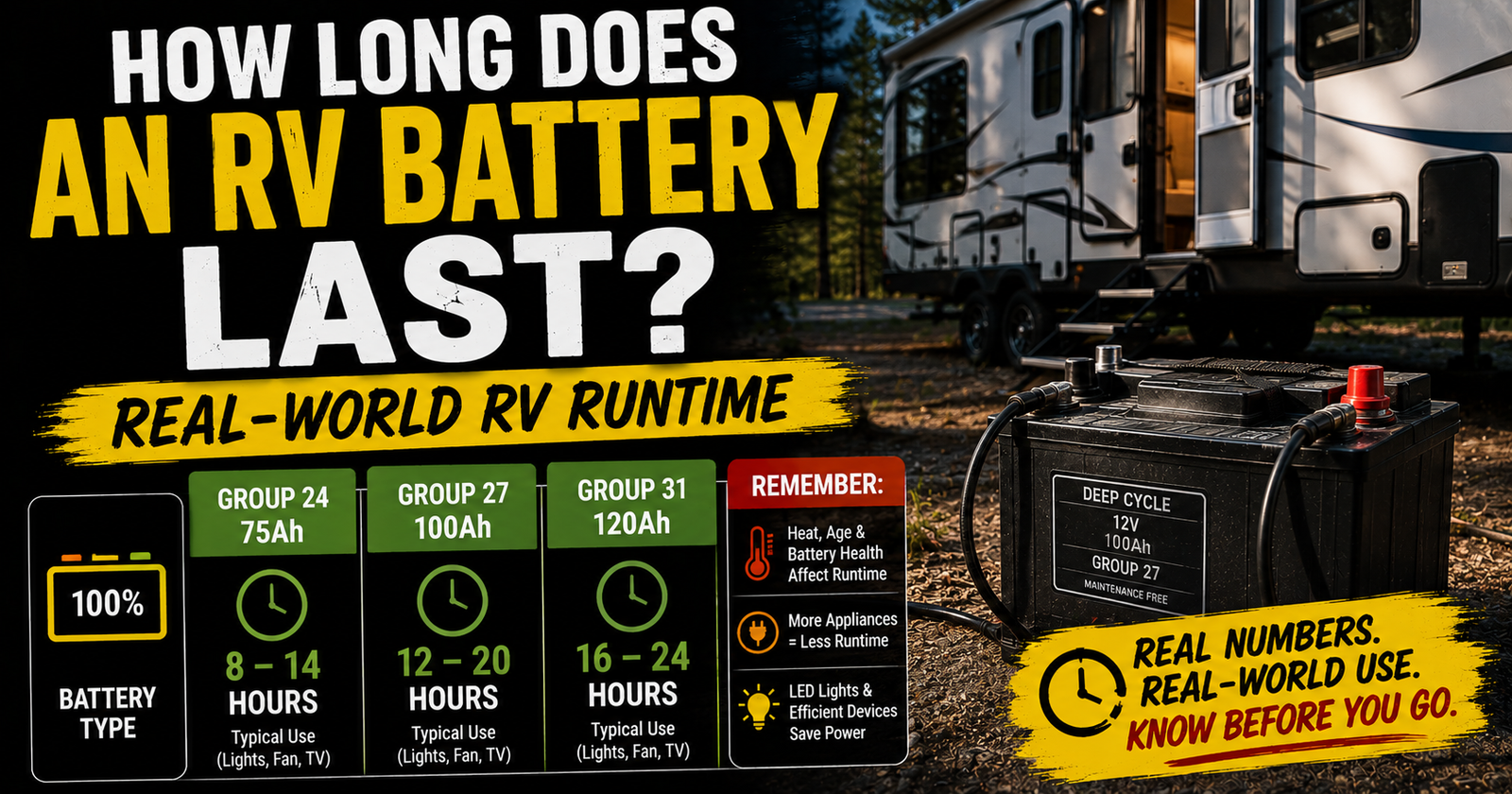
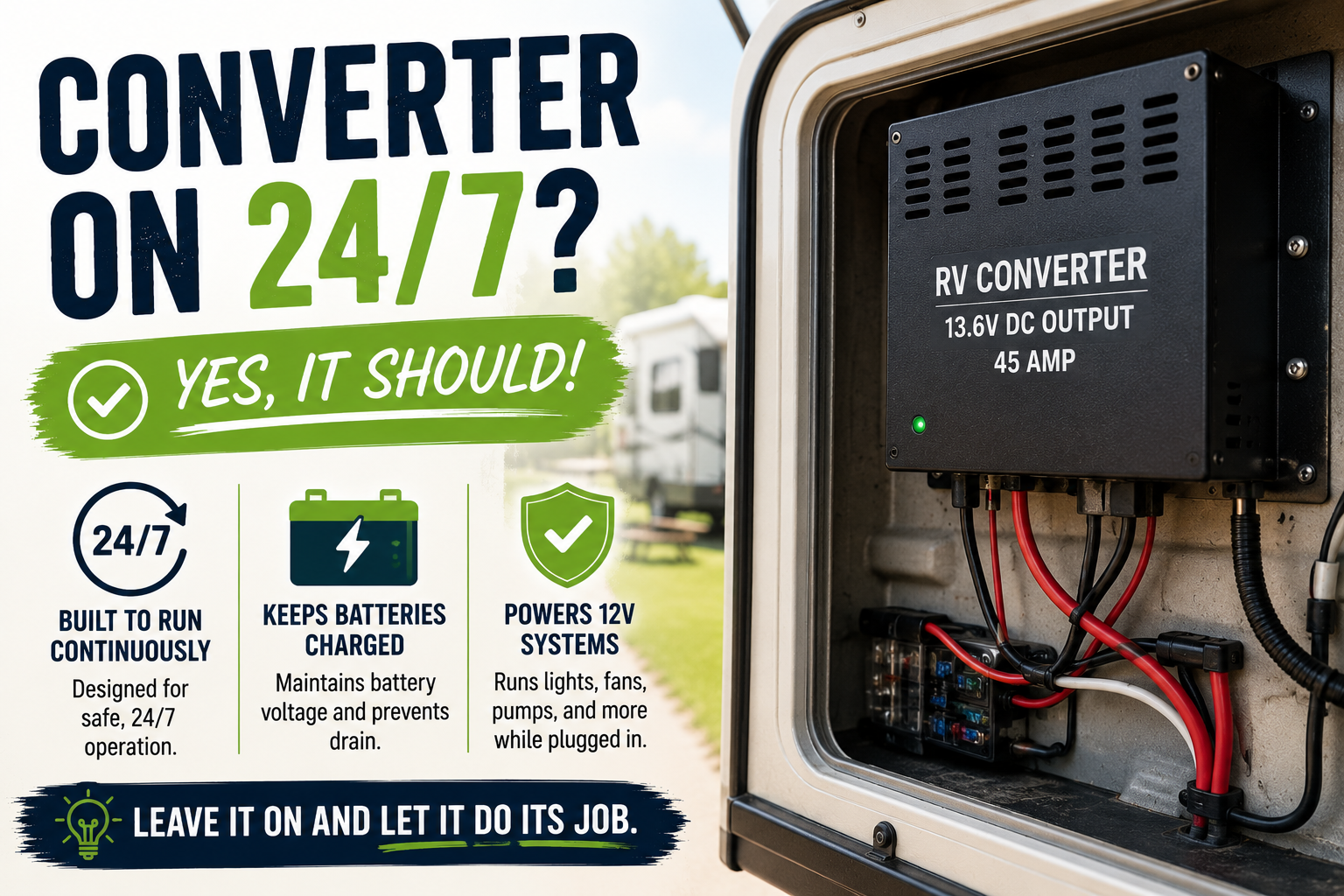
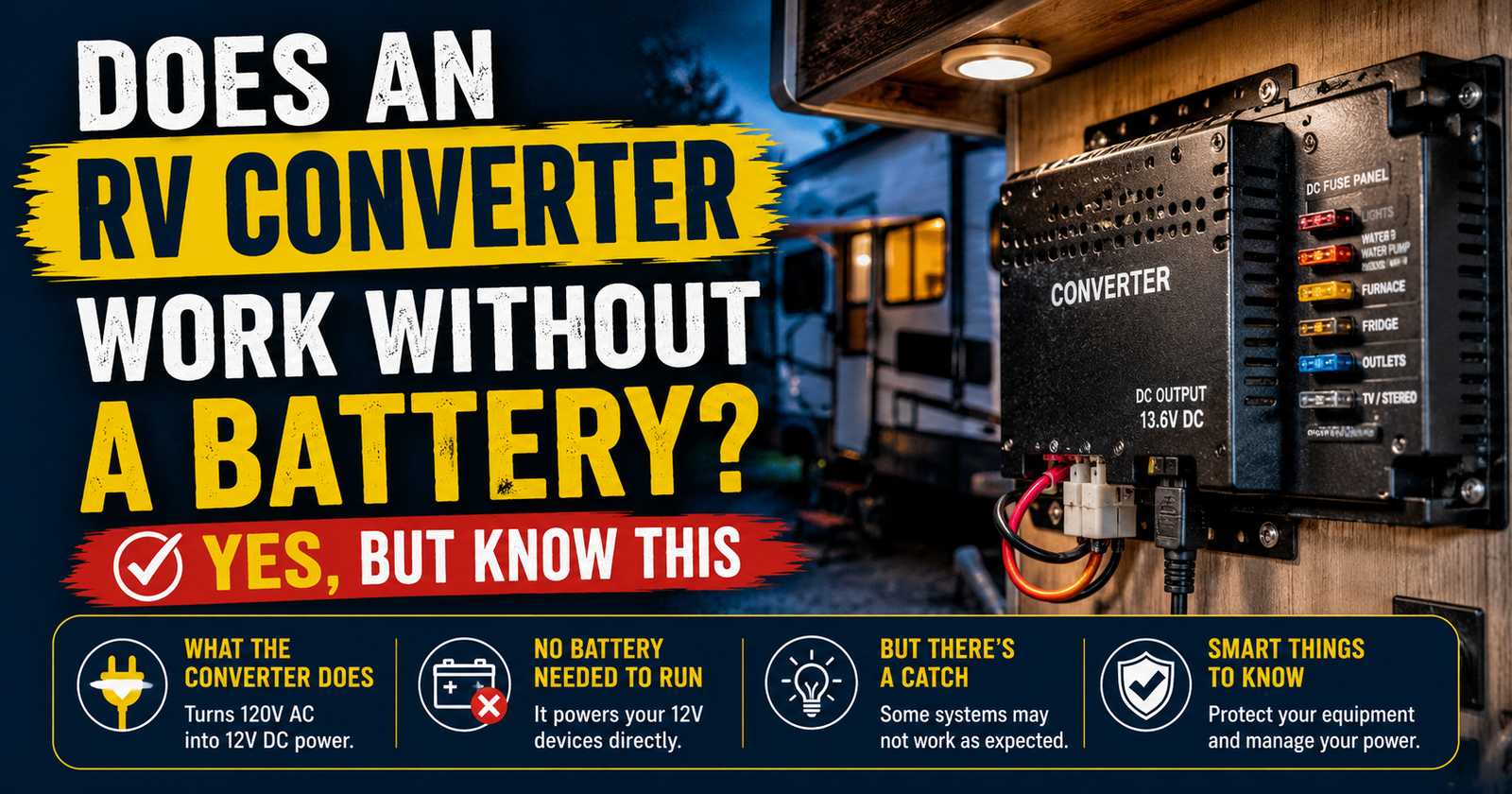
Your Converter Still Works on 30 Amp Shore Power
Your RV converter doesn’t require the campground pedestal to match the camper’s full 50 amp capability just to operate.
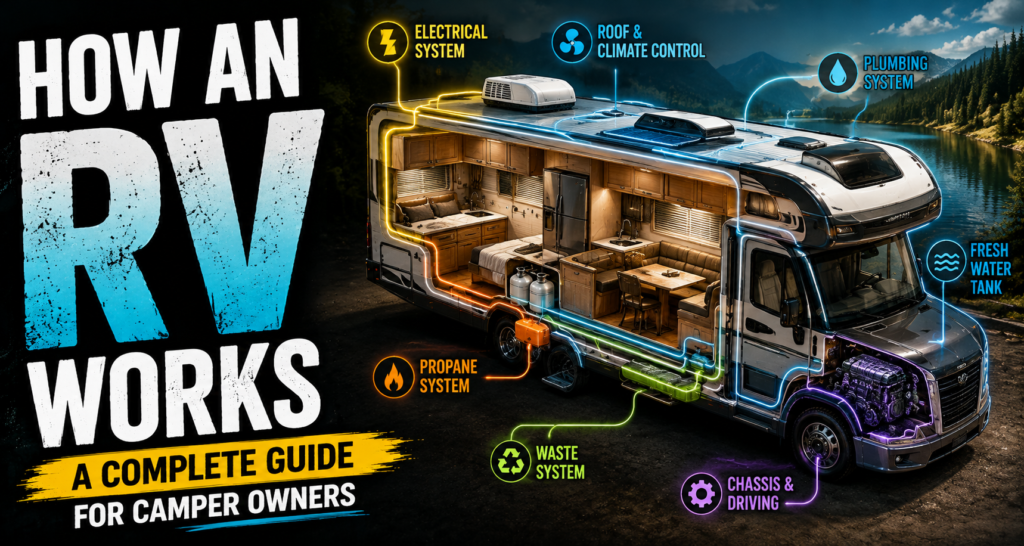
With proper 120-volt AC power available through the RV’s electrical system, the converter can still do its job supplying DC power and charging the battery. A broader explanation of how AC power becomes usable DC power appears in the RV's electrical systems.
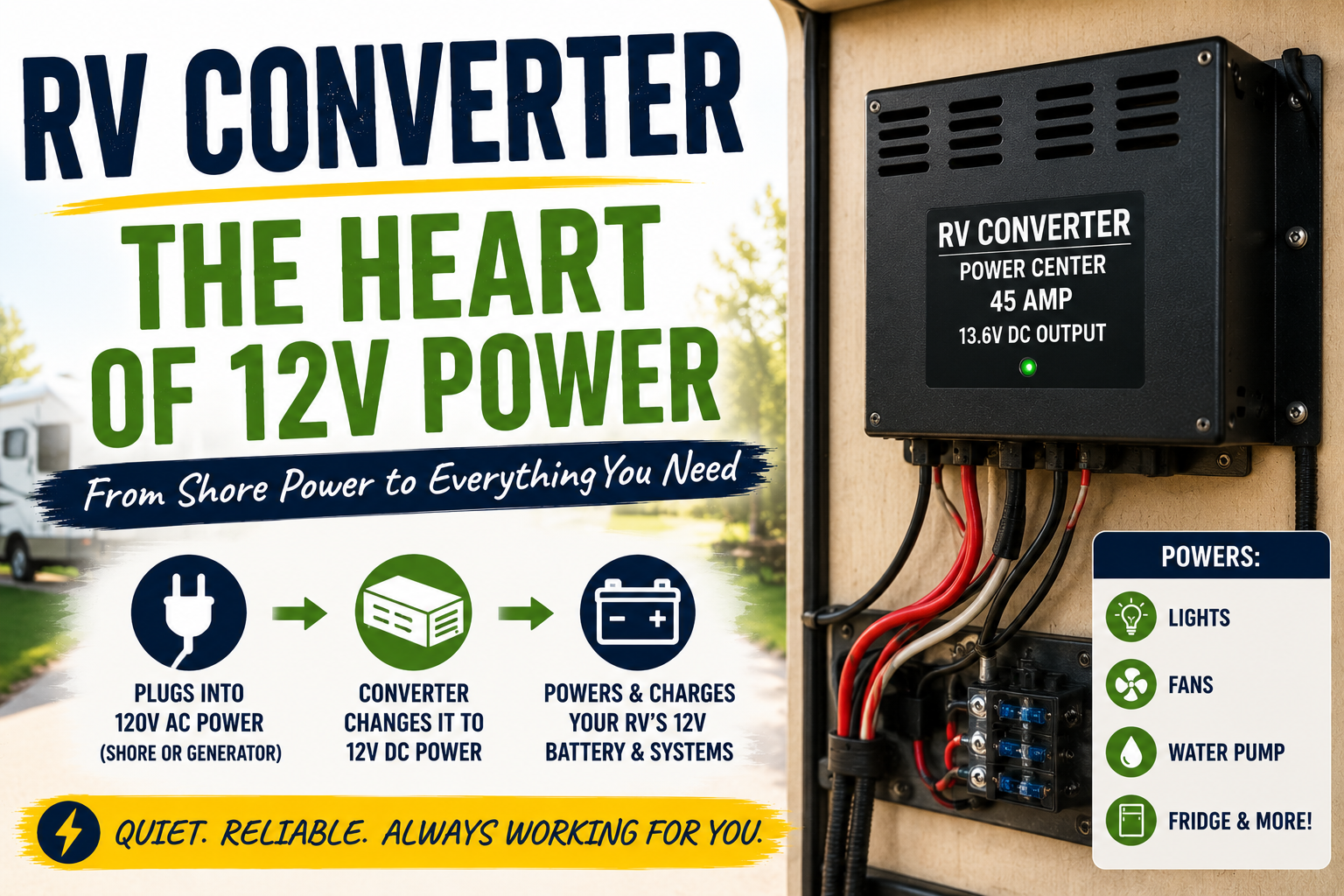
If you’re still sorting out how the AC and DC sides work together, our guide to what an RV converter actually doesexplains that part without assuming you’re an electrician.
The important thing here is that converter operation itself doesn’t require you to have 12,000 watts available.
It’s simply another electrical load that counts toward your smaller 30 amp budget.
Will My RV Battery Still Charge?
Yes.
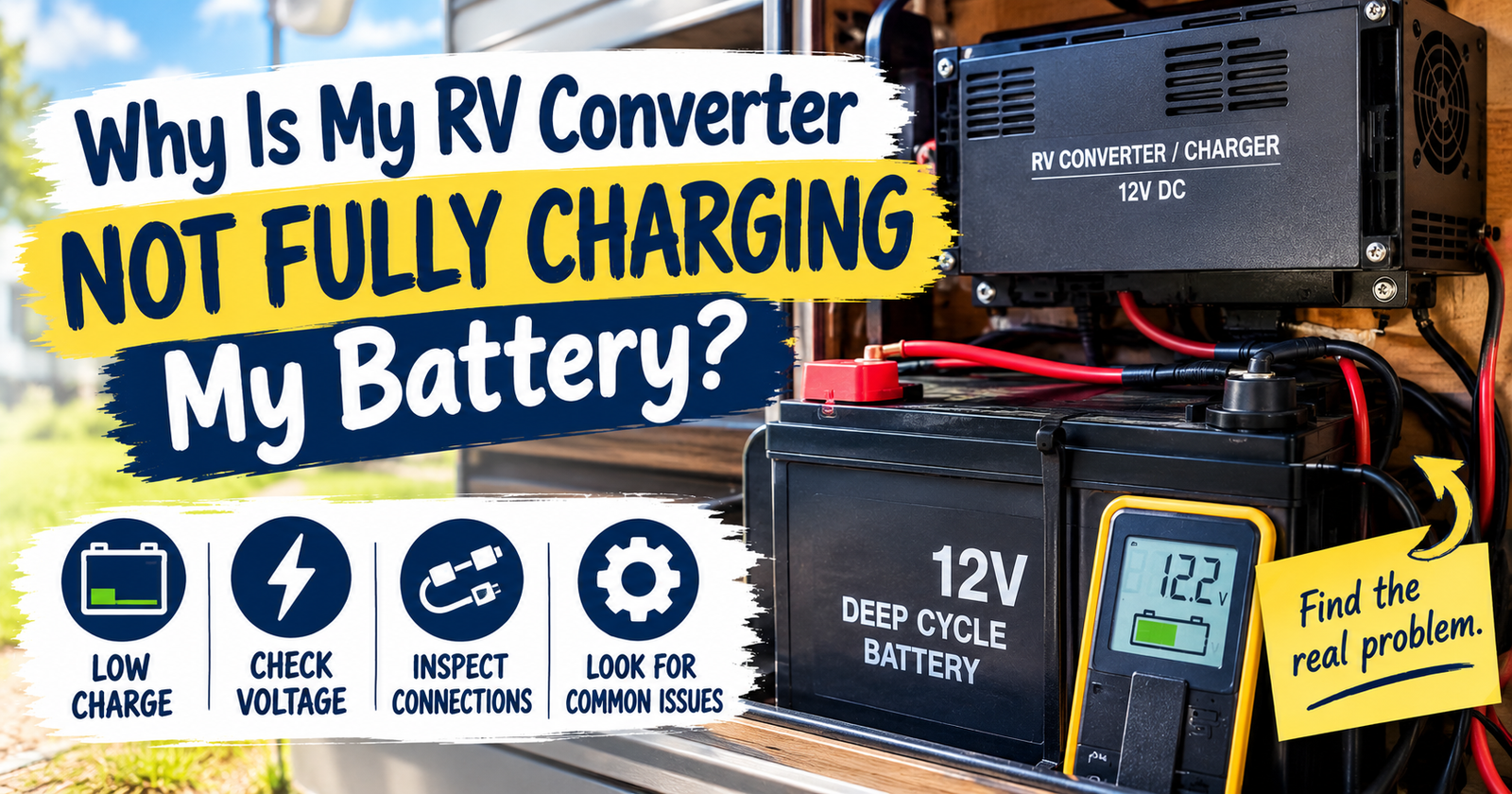
Assuming the charging system is operating normally and adequate AC power is reaching the converter/charger, your house battery can still charge while you’re connected through the adapter.
You’re not suddenly limited to battery power just because the campground doesn’t have 50 amp service.
This is still shore power.
It’s just less available shore power than your RV can normally use.
Will My Battery Charge Slower?
Not automatically.
The fact that you’ve stepped down from 50 amp shore service to 30 amp doesn’t by itself dictate the DC charging rate.
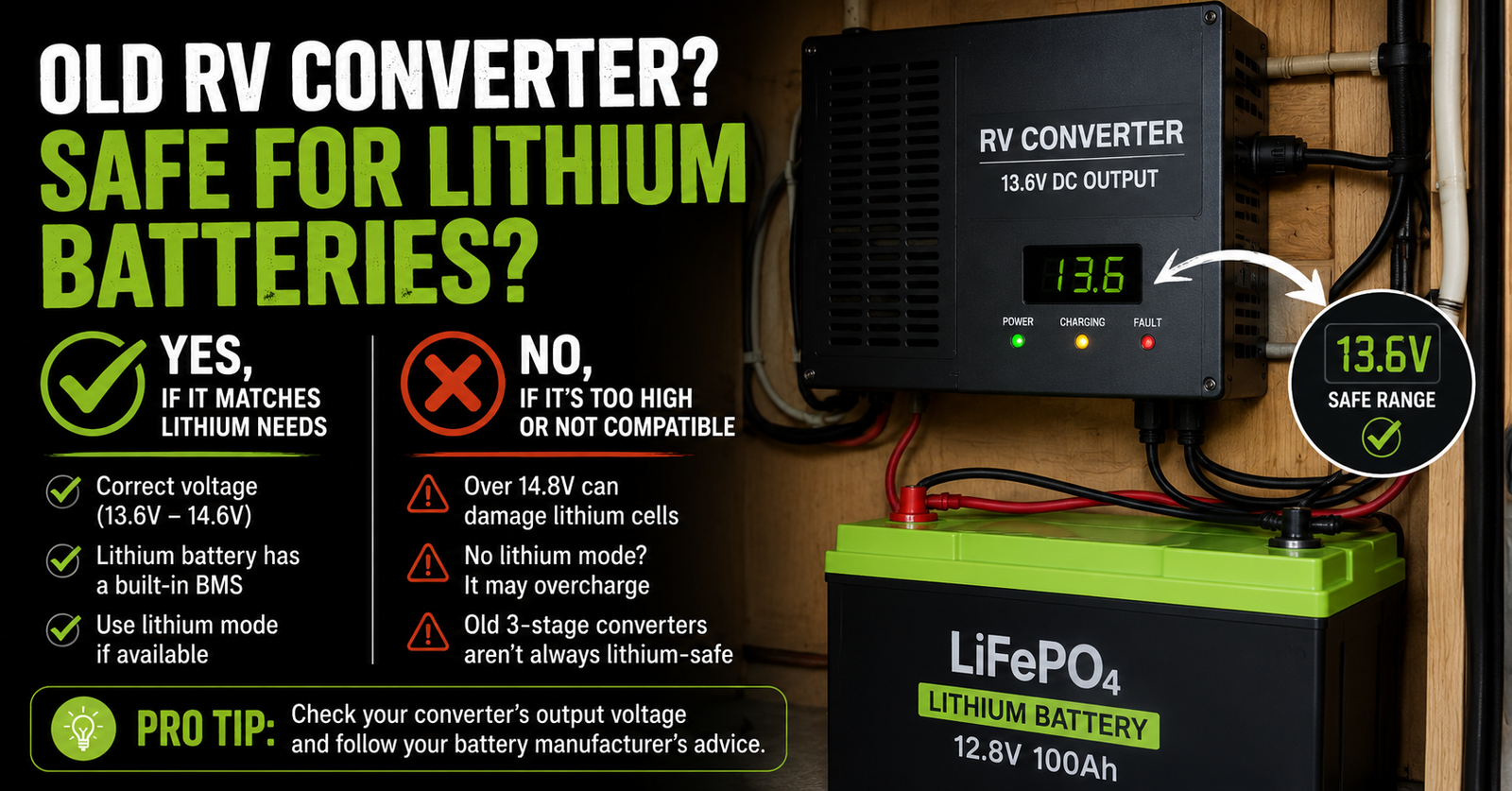
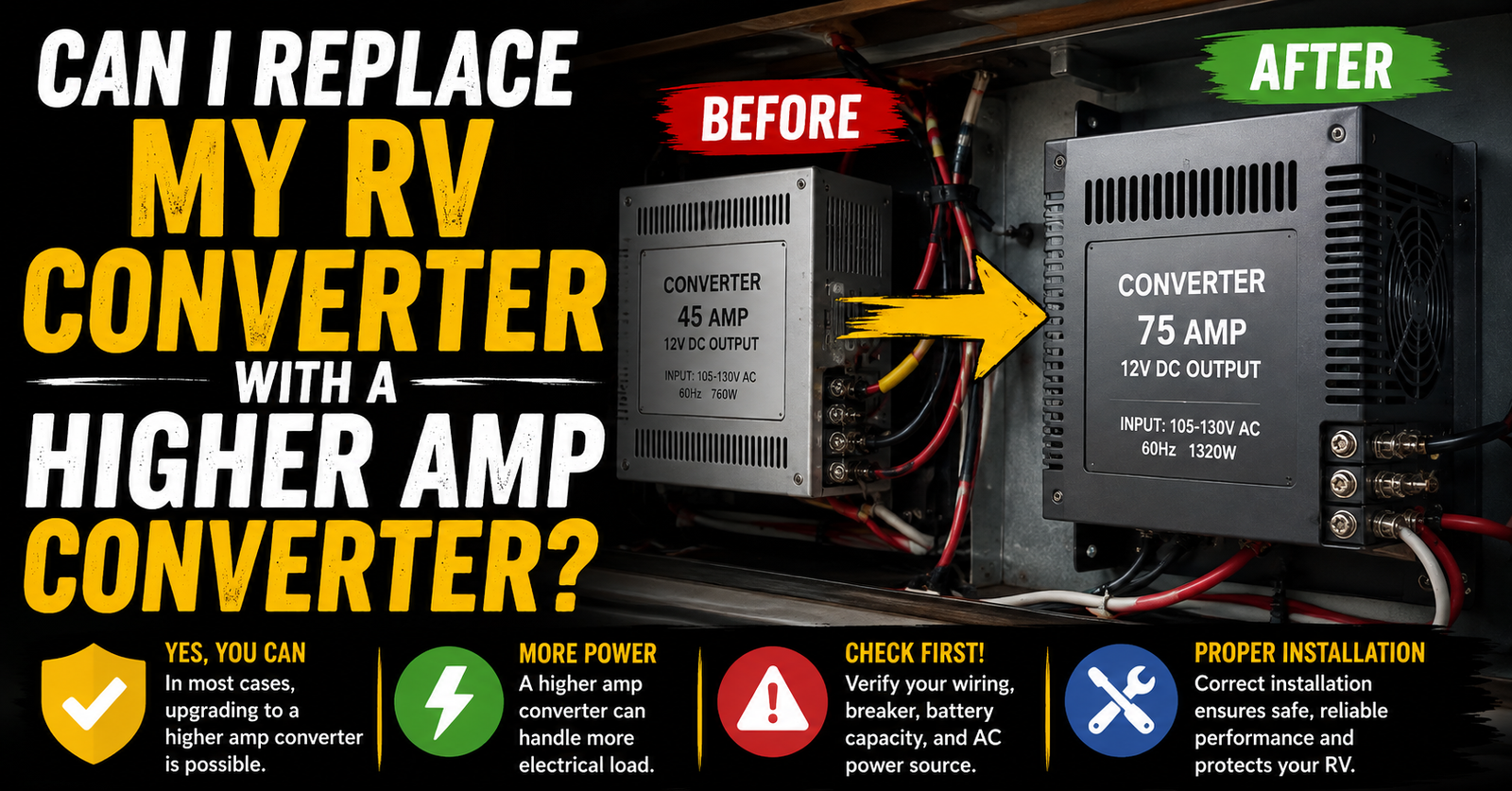
Your converter/charger, battery chemistry, state of charge, wiring, and charging system still determine how much charging current actually reaches the battery. Because chemistry affects that process, battery chemistry and converter matching before assuming the existing charger is adequate.
However, the converter’s AC consumption is part of your overall 30 amp load.
So if you’re heavily loading the camper while the converter is also trying to recharge deeply discharged batteries, you have less electrical headroom available for everything else.
What Happens If I Try to Use Too Much Power?
Ideally, you trip the appropriate breaker.
That’s the electrical system telling you:
Enough.
If the 30 amp pedestal breaker trips, turn off some high-demand equipment before resetting it.
Don’t just walk outside, reset the breaker, return inside, and turn everything right back on.
You haven’t fixed anything.
You’ve recreated the same overload.
What Should I Turn Off First?
If I’m trying to reduce electrical load quickly, I look at the big consumers.
Air conditioners.
Electric water heating.
Electric space heaters.
Microwave.
Hair dryers.
Electric fireplace.
Portable cooking appliances.
Those are the types of loads I’d pay attention to before worrying about an LED light bulb.
You don’t need to live in the dark.
You need to stop trying to run several high-wattage appliances simultaneously.
Can I Damage My RV by Using 30 Amp Service?
Using the proper RV adapter to connect a 50 amp camper to appropriate 30 amp RV service isn’t inherently damaging.
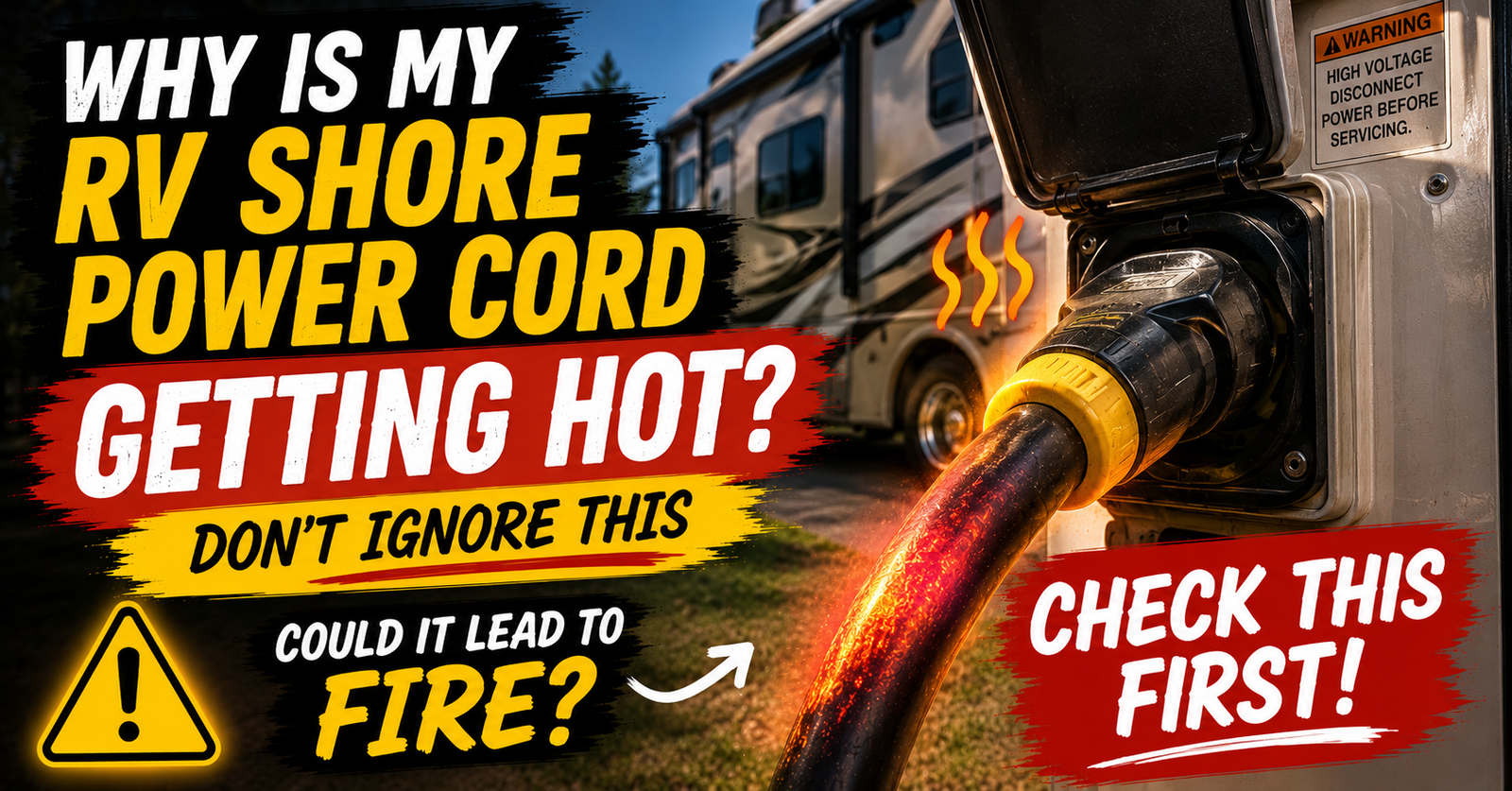
The bigger concerns are improper connections, damaged electrical equipment, excessive heat, bad campground power, or trying to improvise connections that aren’t intended for RV use. For help separating improper RV shore-power connections from a simple capacity limitation, check the heat, damage, and connection symptoms described in the troubleshooting guide.
You also don’t want to repeatedly overload connections or ignore a plug that’s getting unusually hot.
If everything is properly connected and you’re respecting the available electrical capacity, stepping down to 30 amps is a normal RV practice.
Does a 30 Amp Pedestal Send the Wrong Voltage to My 50 Amp RV?
A proper 30 amp RV pedestal connection supplies nominal 120-volt power.

Your 50 amp RV normally uses 120-volt branch circuits supplied from the two hot legs of its 50 amp service. If only some of those branch circuits are dead, troubleshooting dead RV outlets can help you determine whether the issue is a GFCI, breaker, connection, or missing power leg.
The adapter is specifically designed to make the appropriate connection between the 30 amp source and the 50 amp RV cord.
What you lose isn’t the normal 120-volt operating voltage.
You lose available electrical capacity.
That’s a huge distinction.
Why Does a 50 Amp RV Have Four Prongs but 30 Amp Has Three?
Because the electrical services are different.
A 30 amp RV connection has:
One hot
One neutral
One ground
A 50 amp RV connection has:
Two hots
One neutral
One ground
That’s also why 50 amp service can provide so much more total power.
You’re normally feeding the RV with two 120-volt, 50 amp legs instead of one 120-volt, 30 amp supply.
The adapter allows the different connections to work together, but it can’t magically add that missing electrical capacity.
Is This the Same as Plugging a 30 Amp RV Into 50 Amp Service?
No, and this difference matters.

We’ve already covered plugging a 30 amp RV into a 50 amp campground outlet.
In that situation, the pedestal has more capacity than the RV can use.
The 30 amp camper still operates within its normal 30 amp limitation.
Here we’re doing the opposite.
Your 50 amp camper is capable of using substantially more electricity than the pedestal can provide.
That’s why 50 amp RV into 30 amp service requires much more attention to what you’re running.
What About My RV Surge Protector or EMS?
If you have a 50 amp RV, you may already have a 50 amp electrical protection device.
Whether and how it should be used with an adapted connection depends on the particular equipment and manufacturer instructions.
Don’t assume you need to buy a completely separate electrical protection system every time you use an adapter.

There are 50 amp protection setups that can be used while the RV is adapted to 30 amp campground service with the proper adapter arrangement. The difference between surge protection and broader EMS coverage is outlined in this guide to RV protection for adapted shore power.
Follow the instructions for your particular surge protector or electrical management system.
We’ll cover RV surge protection separately because it’s important enough that I don’t want to bury it inside an adapter article.
Should the Adapter Go Before or After the Surge Protector?
This depends on the specific protection equipment and adapter arrangement you’re using.
For a typical 50 amp RV with compatible 50 amp portable protection equipment, one common arrangement is:
30 amp campground pedestal
↓
30-to-50 amp RV adapter
↓
50 amp surge protector/EMS
↓
50 amp RV shore cord
But don’t treat that as universal instructions for every device ever made.
Check the manufacturer’s directions for your specific equipment.
Electrical protection devices can behave differently depending on how they monitor incoming legs and wiring conditions.
Should I Use a Dogbone Adapter?
That’s generally what I prefer for this type of campground connection.
A dogbone has a short length of heavy cable between the 30 amp male and 50 amp female ends.
That gives the connection some flexibility and avoids hanging a large rigid adapter plus the weight of a heavy 50 amp cord directly from the campground receptacle.
And if you’ve ever wrestled with a cold 50 amp RV cord, you already know those things aren’t exactly phone-charger cables.
A little flexibility at the pedestal is nice.
Why Is a 50 Amp RV Cord So Much Heavier?
Because the electrical service it normally handles is substantially larger.
A 50 amp cord needs conductors appropriate for that service.
That’s why these cords can feel especially stiff and heavy in cold weather.
The adapter doesn’t change your shore cord.
You’re simply connecting that heavy 50 amp RV cord to a smaller campground supply through the appropriate adapter.
Should I Turn the Pedestal Breaker Off Before Connecting?
That’s how I prefer to do it.
Turn the appropriate pedestal breaker off.
Make your connections securely.
Then turn the breaker on.
When disconnecting, turn the pedestal breaker off before pulling the plug.
I also like reducing major loads inside the camper before connecting or disconnecting shore power.
There’s no benefit to deliberately plugging in while the RV is immediately demanding everything it can get.
Check the Adapter and Plug for Heat
This becomes especially important when you’re operating near the limits of a 30 amp connection.
After you’ve been running significant electrical loads, pay attention to the adapter, pedestal connection, and plugs.
A little warmth doesn’t necessarily mean something is wrong.
But a plug that’s extremely hot, smells burnt, shows discoloration, or starts melting is not normal.
Poor electrical connections create resistance.
Resistance creates heat.
Don’t ignore it.
A Worn Campground Receptacle Can Cause Problems
Campground outlets get used constantly.
Plug in.
Unplug.
Plug in.
Unplug.
Year after year.
Contacts can wear.
Connections can loosen.
Weather can take a toll.
If the 30 amp campground receptacle looks burned, cracked, badly discolored, or physically damaged, I’d contact campground staff rather than forcing my adapter into it and hoping for the best.
The fact that you can make the plug fit doesn’t mean the receptacle is healthy.
What If the RV Has No Power After I Connect It?
Start at the beginning rather than immediately blaming the adapter.
Check the pedestal breaker.
Check the adapter connection.
Check your electrical protection equipment.
Check the shore cord.
Check the RV’s main breaker.
Determine whether you’re missing all AC power or only certain circuits.
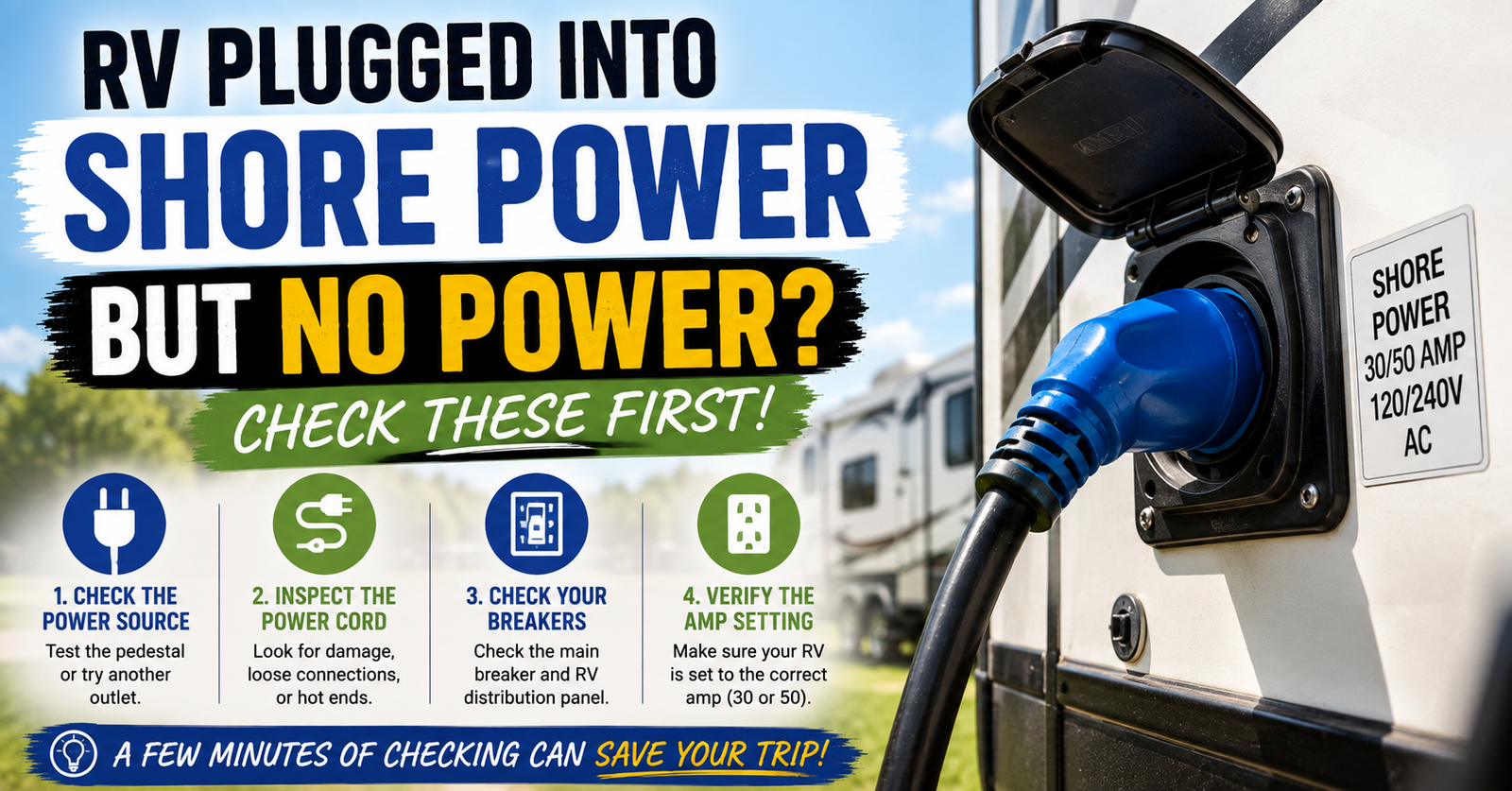
We’ve already built a complete guide for an RV that’s plugged into shore power but still has no power, so that’s where I’d go if the problem is no longer simply about using the adapter.
What If Some Things Work but Others Don’t?
That deserves diagnosis rather than assuming it’s normal because you’re on 30 amps.
Being limited to 30 amp service means you can’t use as much equipment simultaneously.
It doesn’t necessarily mean random outlets and appliances should permanently stop receiving electricity.
If certain circuits remain dead even when you’re well below the available load, investigate.
That’s a different symptom from simply tripping the pedestal breaker when too many appliances are operating.
Can I Run My Refrigerator on 30 Amp Service?
Normally, yes.
A refrigerator by itself isn’t a reason I’d say a 50 amp RV can’t use 30 amp shore power.
Remember, you’ve got roughly 3,600 watts available.
That’s enough to operate plenty of normal RV equipment.
The trouble starts when you stack several large electrical loads together.
That’s why a 50 amp RV can still be perfectly usable on 30 amp service.
You simply have to be more intentional.
Can I Use My Microwave?
Yes, provided your total electrical load stays within the available service.
If the air conditioner is running and several other large loads are active, I may shut something off before starting the microwave.
Again, you’re not dealing with an RV that has almost no electricity.
Thirty amp RV service is perfectly capable of powering a camper.
Your problem is that your particular camper was designed with much more electrical capacity available.
What About an Electric Fireplace?
That’s another load I’d watch closely.
Electric fireplaces commonly use a substantial amount of power when they’re producing heat.
Combine that with an air conditioner, electric water heater, microwave, or other large load and you’re chewing through your 30 amp budget quickly.
The visual flame effect alone may consume much less, depending on the unit.
The heating element is what I’d pay attention to.
Check the actual electrical rating of your appliance rather than guessing.
Can I Use a Washer and Dryer?
Potentially, but this is exactly the type of equipment where I’d carefully manage other loads.
Large RVs equipped with washers and dryers are often 50 amp rigs for a reason.
If you’re temporarily camping on 30 amps, you may need to avoid operating laundry equipment alongside other high-demand appliances.
This isn’t the weekend to see how many electrical heating elements you can turn on simultaneously.
Can I Stay on 30 Amp Service for Weeks?
Sure, if you’re comfortable managing the reduced electrical capacity and everything is properly connected.
This doesn’t have to be an emergency one-night workaround.
A 50 amp RV can remain connected to appropriate 30 amp RV service through the proper adapter.
Your lifestyle inside the camper is what changes.
If the weather is mild and you aren’t running multiple air conditioners and large electric appliances, you might barely care.
If it’s 102 degrees outside and you own a giant fifth wheel with three AC units, you’re going to care a whole lot more.
Hot Weather Is Where You’ll Really Miss 50 Amp Service
This is probably the situation where the limitation becomes most obvious.
You bought a large RV with multiple air conditioners because you want to cool a large living space.
Then the campground gives you 30 amps.
Now you’re trying to cool that same space while working with less than one-third of the total electrical capacity your RV normally has available.
That’s when I’d be very deliberate about other electrical loads.
Run the air conditioning you can support.
Move water heating to propane if appropriate.
Avoid stacking cooking appliances and other big electrical loads.
Manage the power you’ve got.
Don’t Try to “Cheat” the Pedestal
If the campground only provides 30 amp service, accept that you have 30 amp service.
Don’t start inventing homemade adapters or trying to combine random campground receptacles unless you’re using equipment specifically designed and approved for the application and the campground allows it.
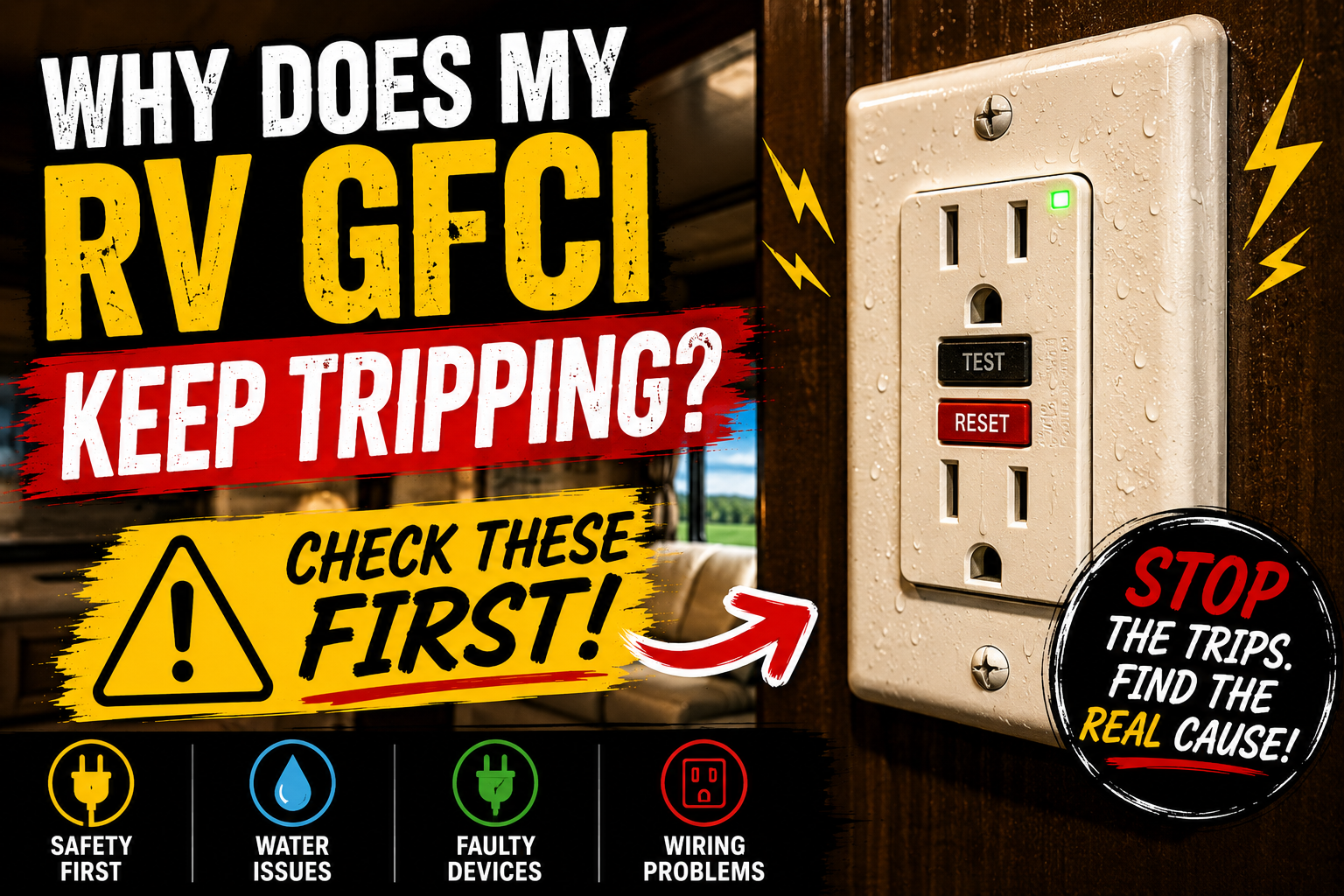
There are specialized products designed to combine certain available sources under specific conditions, but even those have limitations. For example, some power-maximizer arrangements depend on a separate 15 amp receptacle and may not work when that receptacle is GFCI protected. If that receptacle trips rather than simply lacking capacity, GFCI-protected receptacle explains how to isolate the cause.
For the normal RV owner, the straightforward answer is easier:
Use the proper 30-to-50 adapter and live within 30 amps.
Should I Specifically Book 50 Amp Campsites?
If you own a 50 amp RV and expect to use its full electrical capabilities, yes, that’s what I’d choose whenever practical.
That’s especially true if:
You have multiple air conditioners.
You camp in extreme heat.
You use an electric fireplace.
You have washer/dryer equipment.
You regularly use several large appliances.
You’re a full-time RVer.
Thirty amp service is a great backup option.
It isn’t a true substitute for the electrical capacity your 50 amp RV was designed around.
This Adapter Is Worth Keeping in a 50 Amp RV
If I traveled regularly with a 50 amp camper, a good 30 amp male to 50 amp female dogbone adapter would live in my storage compartment.
You may book 50 amp sites almost every time.
But campgrounds aren’t always predictable.
Maybe the only site left is 30 amp.
Maybe the 50 amp receptacle at your site has a problem.
Maybe you’re staying somewhere older where 50 amp hookups are limited.
Having the adapter means you still have options.
And once you understand the limitation, there’s really nothing mysterious about using it.
Your RV will work. You just don’t have all the electricity it normally has available.
A proper 50 amp RV hookup can provide about 12,000 watts.
A 30 amp hookup gives you about 3,600 watts.
The adapter bridges the plugs.
You manage the difference.
That’s really all there is to it.
Written by Evan Mercer
Evan Mercer writes about RV shore power, electrical systems, batteries, converters, campground hookups, and practical camper troubleshooting for CamperAnswers.com. He focuses on explaining RV electrical systems in everyday language so camper owners understand what their hookups can actually handle before they start flipping breakers.