
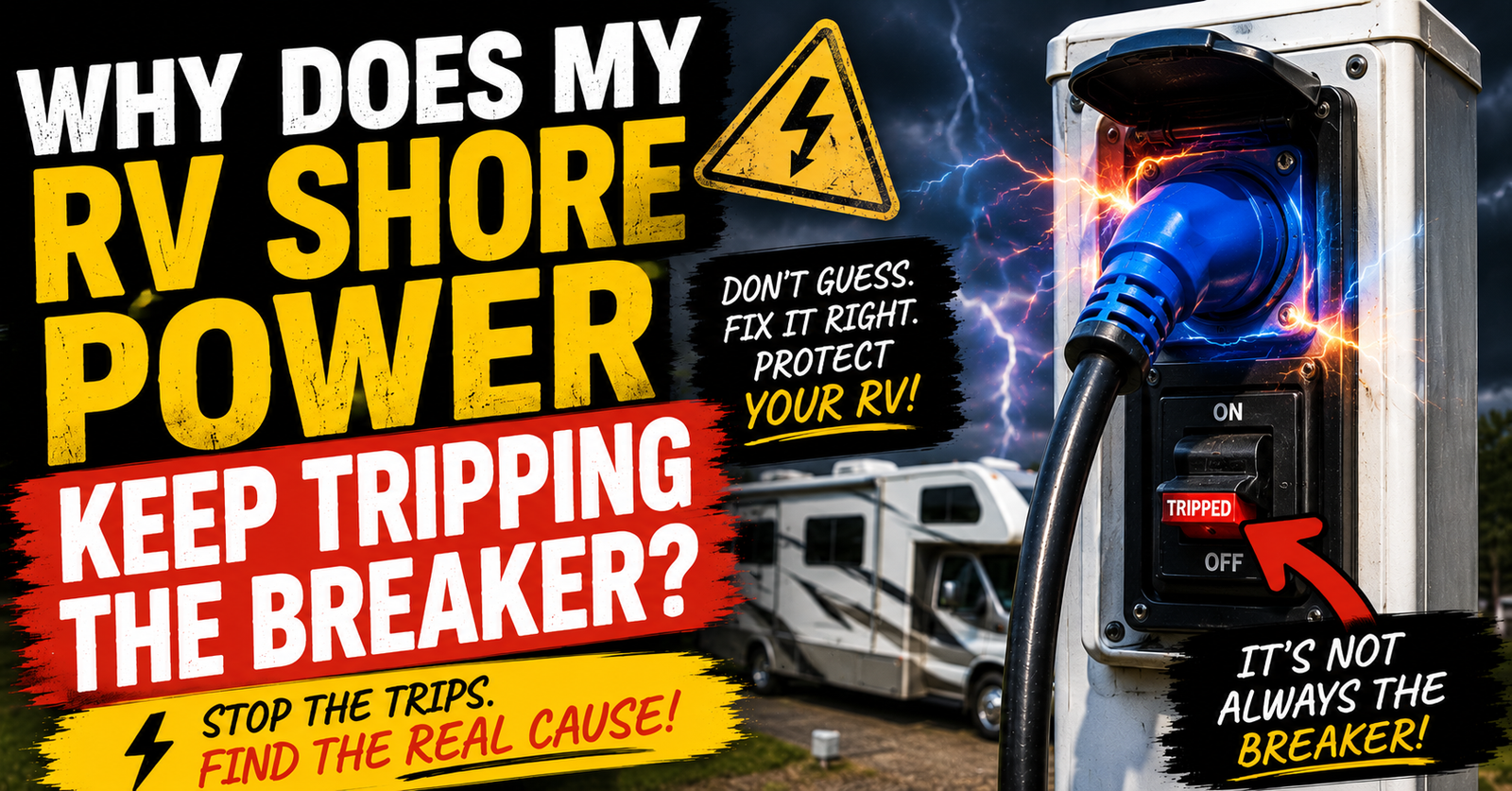
Nothing makes you start counting watts faster than an RV breaker that keeps kicking off. The air conditioner is humming, somebody starts the microwave, everything suddenly goes quiet, and now you’re walking outside in the dark to reset the campground pedestal again.
Sometimes the answer really is that simple: you’re trying to use more electricity than the hookup can provide.
But if the breaker keeps tripping with hardly anything running, trips the instant you plug the camper in, or suddenly starts doing it after months of trouble-free camping, I wouldn’t shrug it off as “just an RV thing.” These basic breaker troubleshooting steps can help you distinguish an overload from a fault: basic breaker troubleshooting steps
An RV shore-power breaker can repeatedly trip because of an electrical overload, a problem with a high-draw appliance, a weak or faulty breaker, damaged wiring, a shore-power connection problem, or an electrical fault somewhere inside the camper. The point at which the breaker trips gives you one of your best clues. When the device opening is a household GFCI rather than the shore-power breaker, this guide explains why an RV trips a GFCI at home and how to narrow down the cause.
That’s where I’d start.
First, Which Breaker Is Actually Tripping?
Before troubleshooting anything, figure this out.
Is it the breaker on the campground pedestal?
Is it the RV’s main breaker?
Is it one individual branch breaker inside the RV?
Or is what you’re calling a breaker actually a GFCI receptacle that’s tripping?
Those are four different clues.
If the campground’s 30 amp breaker trips, I’m thinking about the total load the RV is pulling and the incoming shore-power connection.
If the RV’s air-conditioner breaker trips but everything else stays powered, I’m looking much harder at that circuit and the equipment connected to it.
If a GFCI trips, that’s another troubleshooting path entirely.
Don’t lump every electrical trip together.
If It Trips Only When You Run Too Much Stuff, Start With the Load
This is especially common in a 30 amp camper.
A 30 amp RV connection gives you approximately:
120 volts × 30 amps = 3,600 watts
That’s your whole AC power budget.
Not just the air conditioner.
Not just the outlets.
Everything drawing from shore power has to share it.
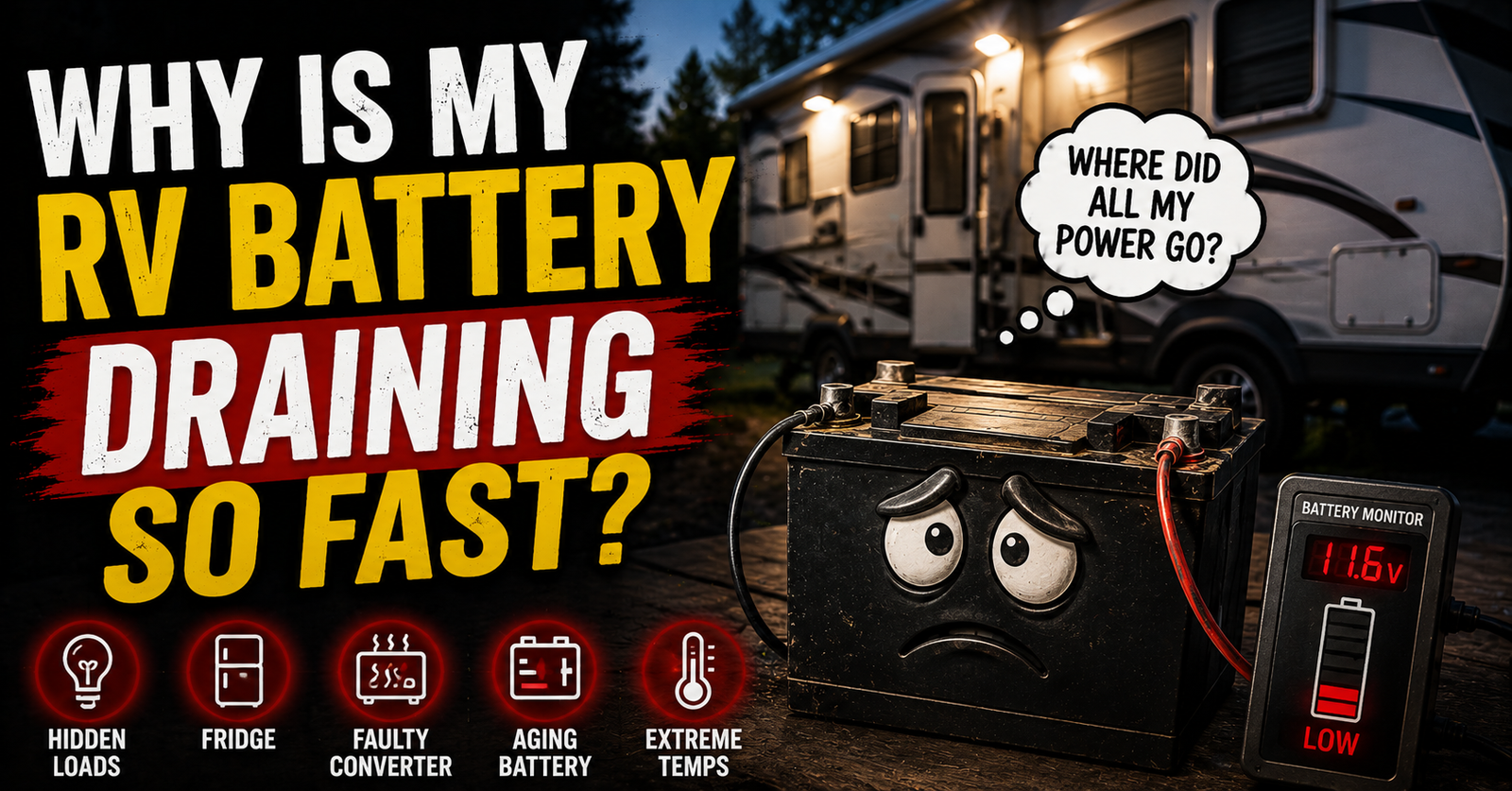
Now imagine you’ve got the air conditioner running, the electric water heater heating, the refrigerator operating on electric, and the converter charging a low battery. Those combined demands can help explain battery power disappearing quickly once the RV is no longer receiving enough charging support.
Everything seems fine.
Then somebody turns on a 1,500-watt hair dryer.
Click.
Breaker trips.
There may be absolutely nothing wrong with the RV.
You simply ran out of available electrical capacity.
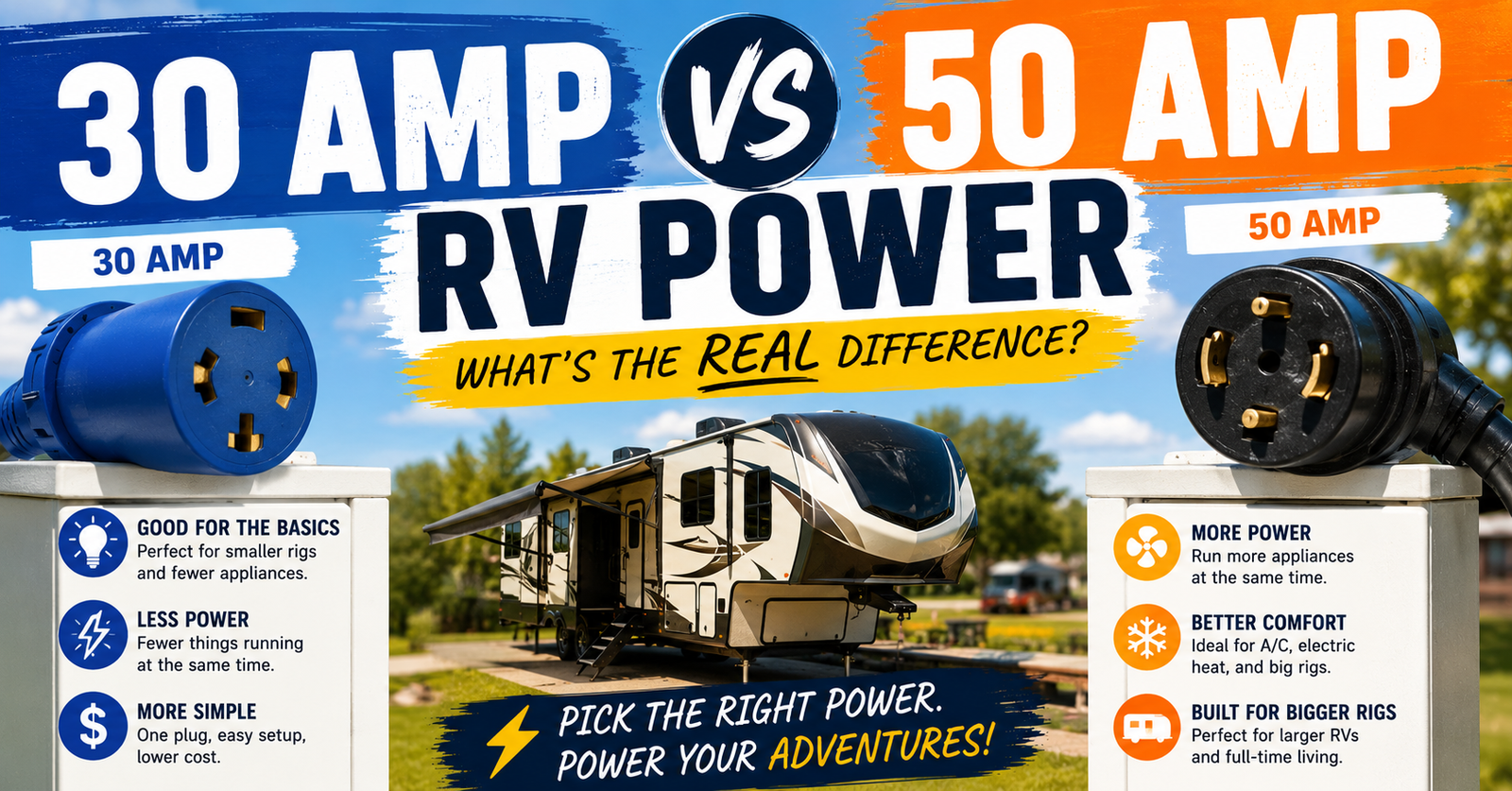
Our 30 amp vs 50 amp RV power guide explains why this happens so much more easily on a 30 amp camper.
The Appliances You Don’t Notice Still Count
This catches people all the time.
You look around and think:
“I’m barely running anything!”
But what’s happening in the background?
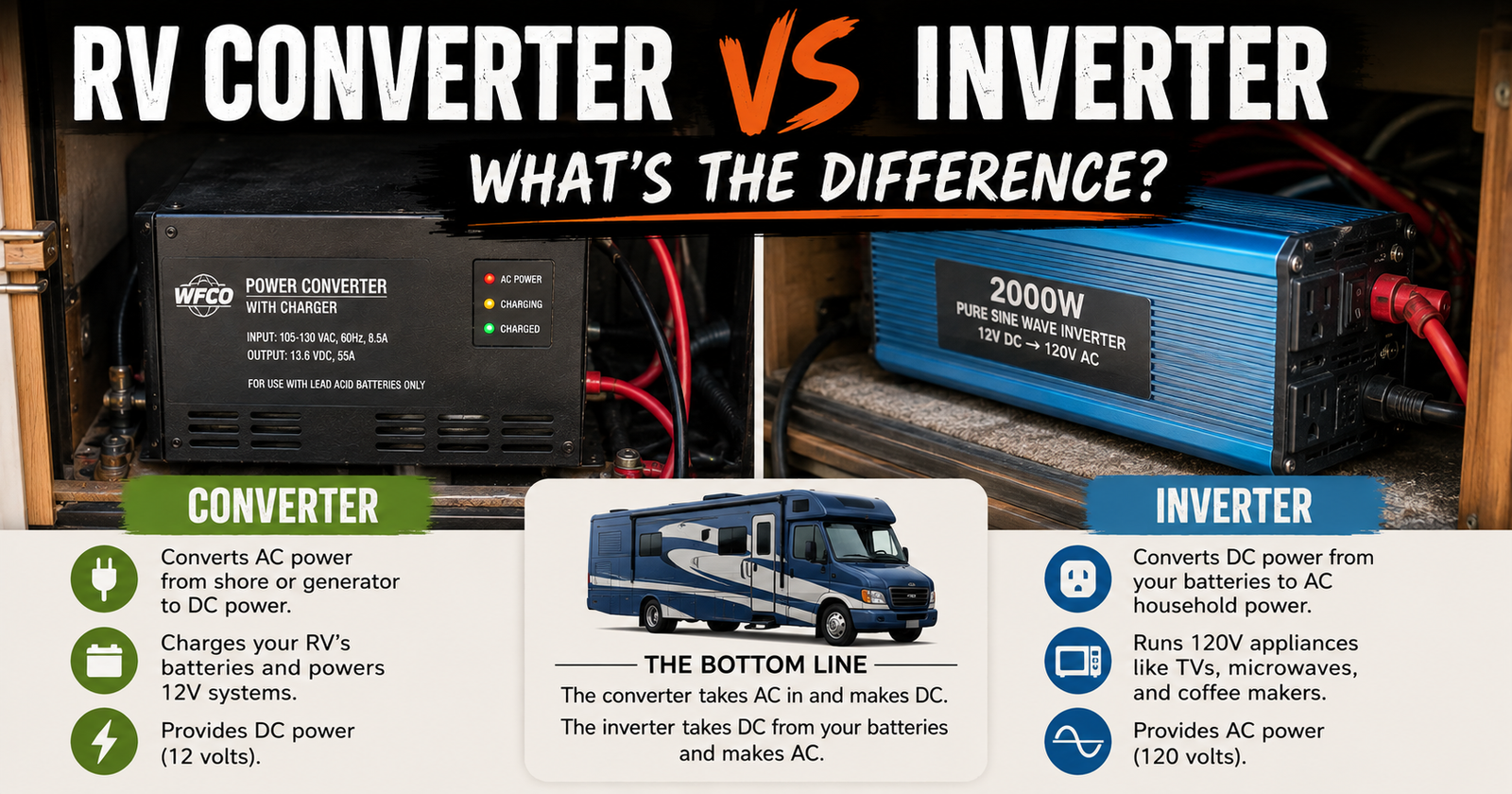
The converter might be charging the batteries.
The refrigerator might be on electric.
The water heater might be using its electric heating element.
The air conditioner compressor may be running.
A residential refrigerator may be cycling.
Then you start the microwave.
The breaker sees the total electrical current, not how many appliances you remember turning on.
A Low RV Battery Can Add More Load Than You Realize
This is one of those neat connections between the converter cluster we just finished and the shore-power cluster we’re building now.
Suppose you arrive at a campsite with a deeply discharged house battery.
You connect to shore power.
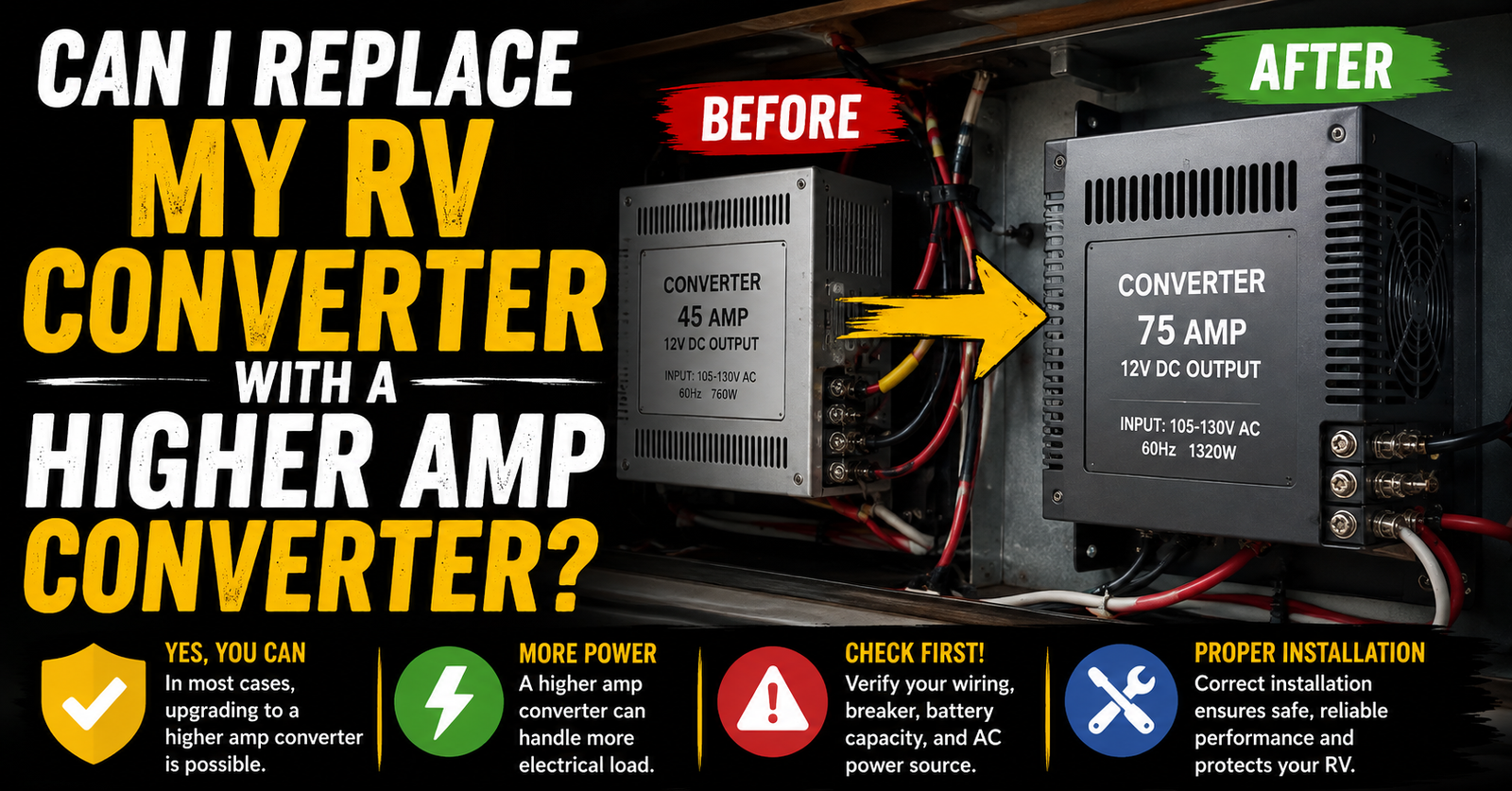
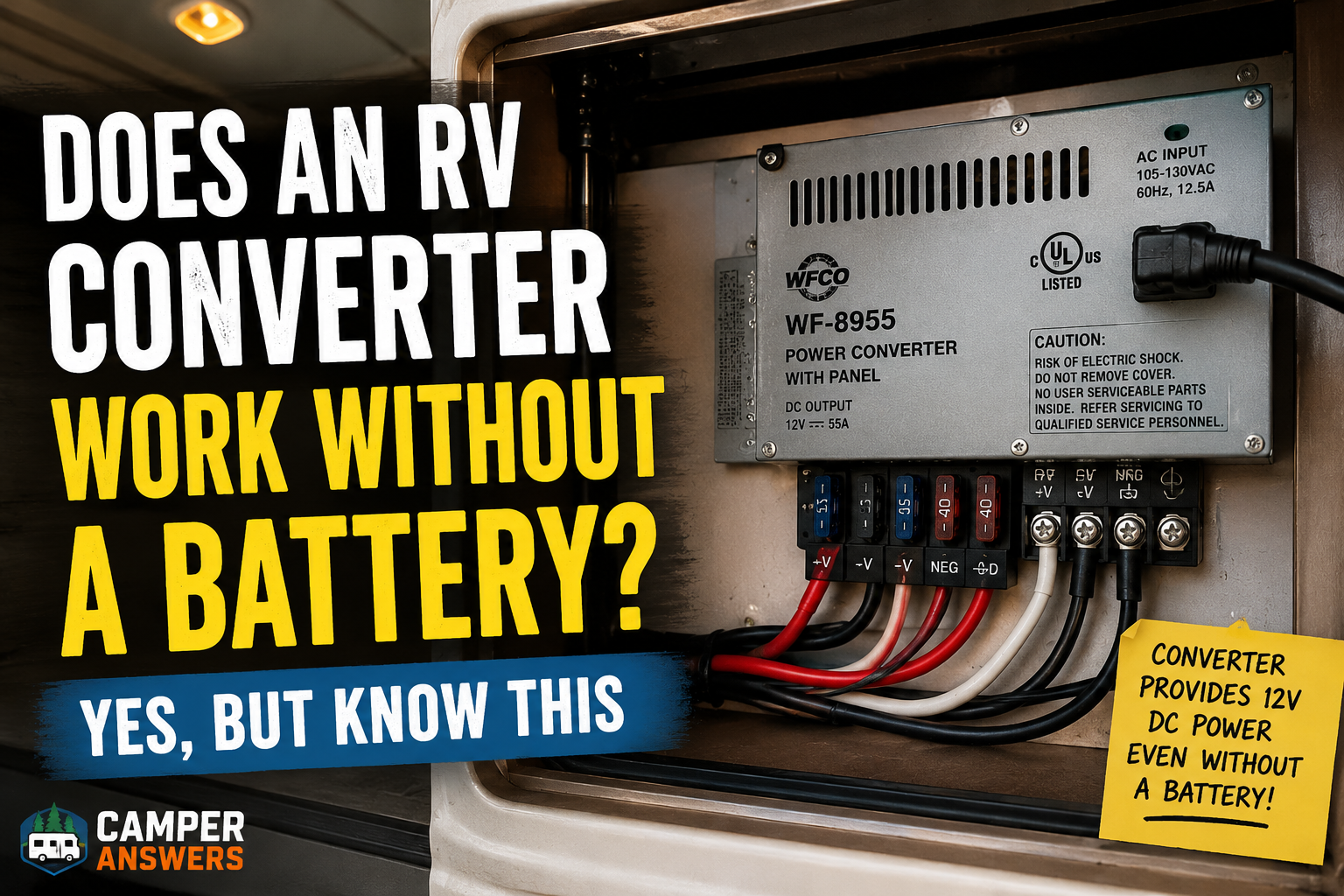
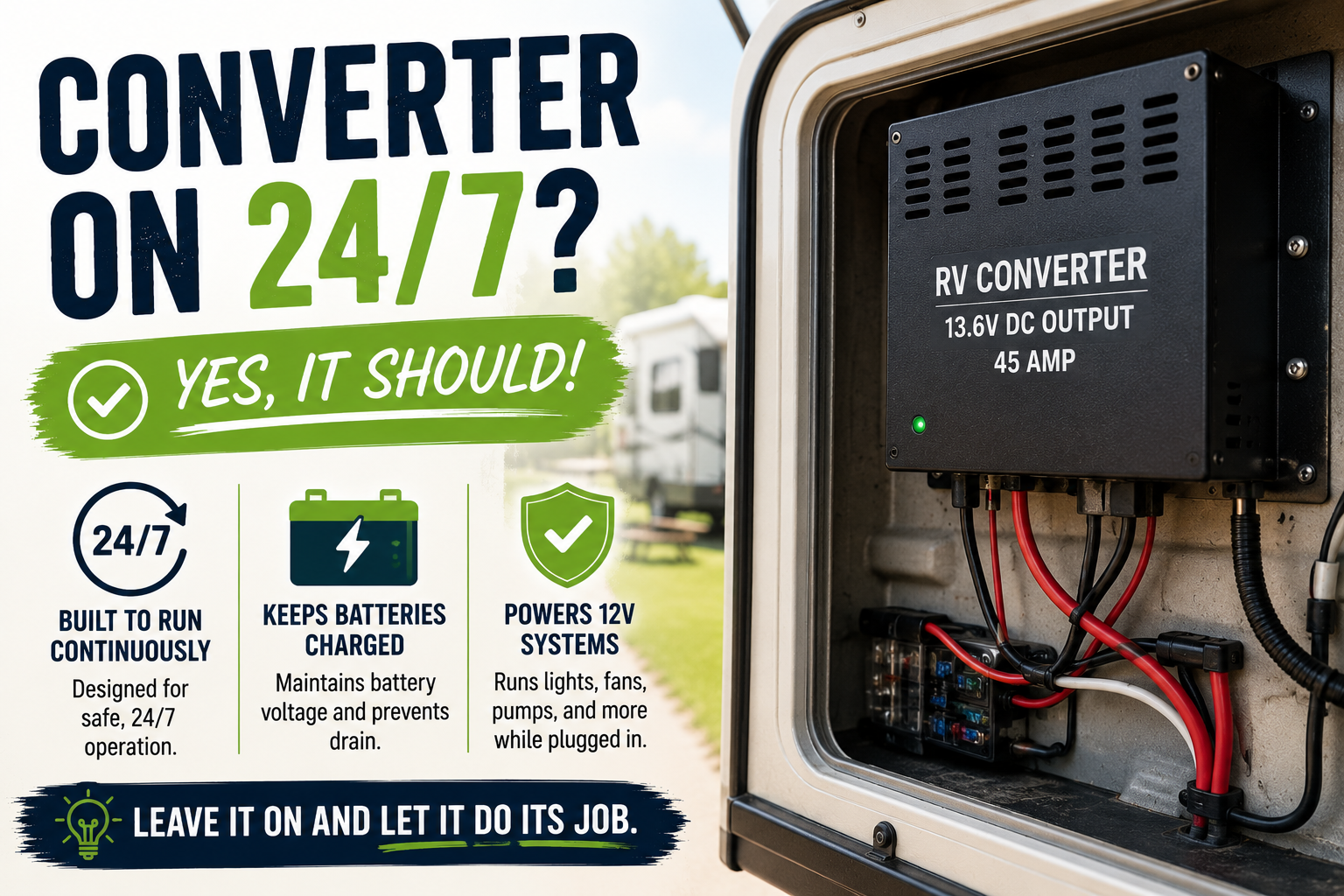
Now your converter/charger may start working considerably harder than it does when the battery is already full. That changing electrical demand is one reason checking RV wiring before a converter upgrade matters before installing a converter with more output.
That charging demand becomes part of the RV’s overall electrical load.
It may not be enough by itself to trip the breaker, but combine it with the air conditioner, water heater, microwave, and other equipment and suddenly your electrical headroom is smaller than you expected.
That doesn’t necessarily mean the converter is bad.
It’s doing its job.

Why a 50 Amp RV Usually Has More Breathing Room
A proper 50 amp RV connection has dramatically more total capacity than 30 amp service.
You’re dealing with two 120-volt, 50-amp hot legs, which can provide up to about 12,000 watts total.
That’s why a large fifth wheel can have:
Two or three air conditioners
Electric fireplace
Washer and dryer
Large microwave
Residential-style appliances
Electric water heater
and all the other equipment you’d expect in a big RV.
But even a 50 amp RV isn’t immune from electrical problems.
And there’s one situation where 50 amp owners suddenly find themselves tripping breakers much more often.
Your 50 Amp RV Might Be Running on 30 Amp Power
If you’ve connected a 50 amp camper to a 30 amp campground pedestal using an adapter, your camper does not still have its normal 12,000 watts available.
You’re working with approximately 3,600 watts from that 30 amp supply.
That’s a huge reduction.
Etrailer specifically notes that a 50 amp RV connected to 30 amp service will be limited in how many high-demand appliances can operate simultaneously.
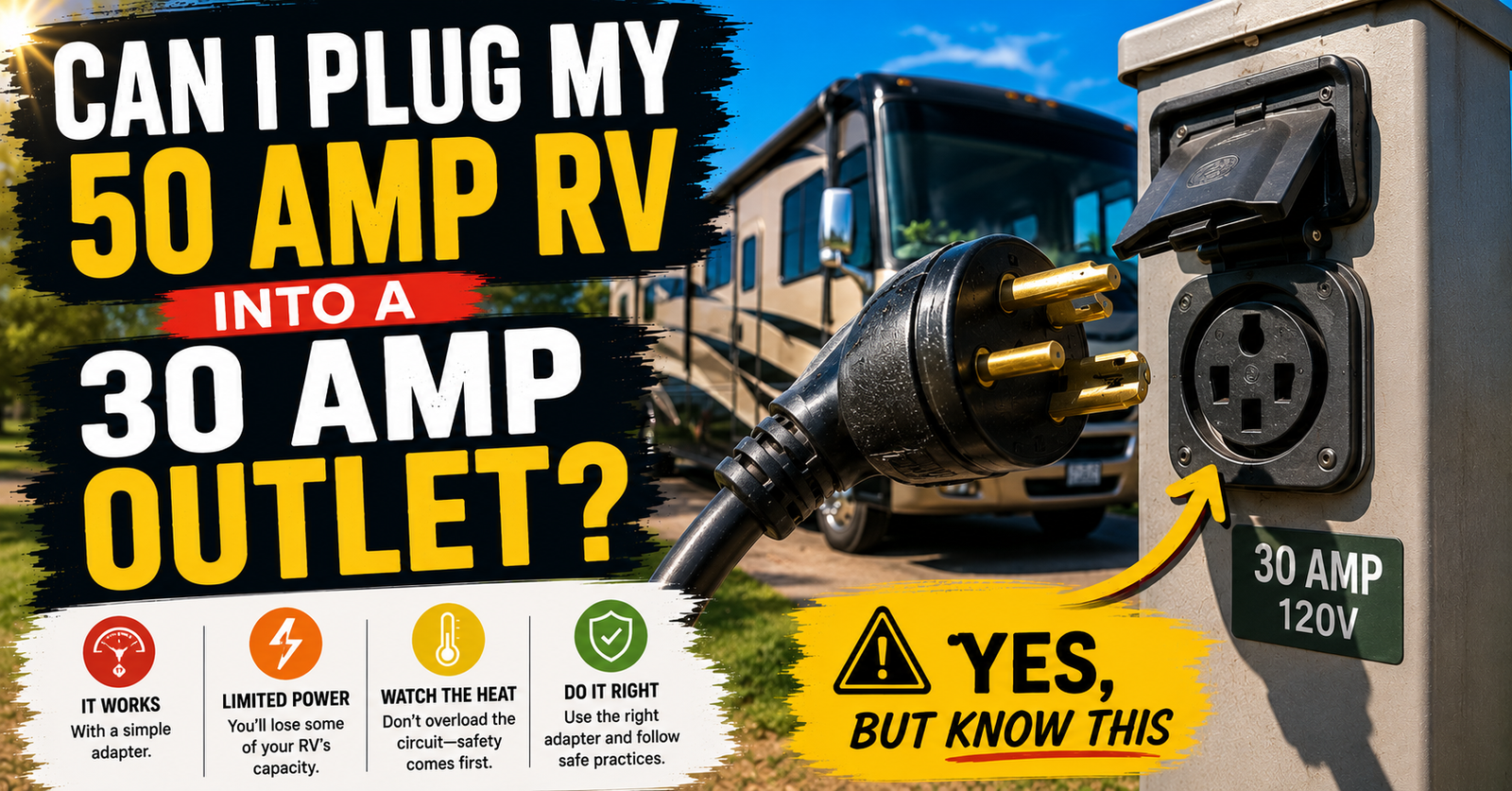
If that’s your situation, our guide to using a 50 amp RV on a 30 amp hookup explains exactly what changed.
The short version is simple:
The adapter changed the plug. It didn’t create more electricity.
Start Turning Off the Big Loads
If I suspect a straightforward overload, I don’t start pulling the electrical panel apart.
I reduce the load.
Turn off the air conditioner.
Put the water heater on propane if your particular system allows it.
Turn off the microwave.
Turn off portable heaters.
Turn off the electric fireplace.
Stop using the hair dryer.
Give the system a minute, properly reset the breaker, and see what happens with only light loads operating.
If everything suddenly works normally, that’s useful information.
Now start adding major loads back gradually.
You may find the combination that causes the trip.
This basic process of reducing the load and seeing whether the breaker holds is also consistent with manufacturer troubleshooting guidance when circuit protection repeatedly opens.
What If the Breaker Trips the Instant I Plug In?
Now I’m much less interested in normal power management.
If you’ve turned major appliances off and the breaker immediately trips when shore power is connected, something else may be happening.
Possible areas I’d investigate include the shore cord, plug, RV inlet, transfer switch if equipped, electrical protection equipment, main wiring, distribution equipment, or a fault on one of the circuits.
This isn’t the time to walk outside and reset the breaker 14 times.
A breaker is opening for a reason.
Find the reason.

What If It Holds Until I Turn on the Air Conditioner?
Excellent clue.
That doesn’t automatically mean the air conditioner is bad, but we’ve narrowed things considerably.
Maybe the campground service is already heavily loaded.
Maybe other RV loads are consuming most of your available capacity.
Maybe the air conditioner has a problem.
Maybe the breaker is weak.
Maybe there’s an issue with the AC circuit.
Air conditioners also have a startup demand when the compressor starts, which can make marginal electrical situations more noticeable.
Instead of saying “shore power keeps tripping,” you can now say:
“Everything works until the air-conditioner compressor starts.”
That’s a much better diagnostic starting point.
What If It Trips When I Use the Microwave?
Same idea.
Turn the microwave off.
Reset the breaker.
See whether everything else operates normally.
Then look at what else was running when you started it.
A microwave can be the load that finally pushes an already heavily loaded 30 amp circuit over its limit.
That doesn’t necessarily make the microwave defective.
Maybe the air conditioner, converter, water heater, and refrigerator had already used most of the available capacity.
The microwave was simply the last straw.
Electric Water Heaters Are Easy to Forget
This one deserves special attention because you don’t necessarily hear the water heater working.
An electric water-heater element can be consuming substantial power while you’re going about your business inside.
Then you turn on another large appliance.
Breaker trips.
If your RV has both propane and electric water-heating options, moving the water heater to propane can be a useful way to reduce shore-power demand when you’re on limited electrical service.
That’s particularly handy if you’re temporarily running a 50 amp camper from a 30 amp hookup.
Electric Space Heaters Can Eat Up a 30 Amp Budget Fast
A typical portable electric heater on high can be a substantial load.
Now put two of them inside a camper.
Add the converter.
Add the refrigerator.
Start the microwave.
You don’t have to be an electrician to see where this is going.
This is why cold-weather camping can create breaker problems even though the air conditioner hasn’t run once.
The season changed.
Your electrical load changed with it.
What If the Breaker Trips With Almost Nothing Running?
That’s when I stop assuming you’re simply using too much power.
Turn off or unplug as many loads as practical.
If the breaker continues tripping, I’d start considering:
A weak or failing breaker
A short circuit
A ground fault
Damaged wiring
A bad appliance or component
A damaged shore-power cord or connection
A transfer-switch problem
A problem with the campground pedestal
Other electrical faults
At that point, we’re diagnosing an actual problem rather than teaching somebody not to run the microwave and hair dryer together.
The Campground Breaker Can Be the Problem
Campground electrical equipment gets used hard.
Think about how many campers come and go from a popular site.
Breakers cycle.
Plugs get inserted and removed.
Connections experience heat.
Weather happens.
Equipment ages.
A breaker itself can eventually become unreliable.
If your RV works flawlessly on other known-good hookups but repeatedly trips one particular campground pedestal under loads you’ve used many times elsewhere, I would absolutely involve campground staff.
Don’t open their pedestal and start repairing it yourself.
It’s their electrical equipment.
Try a Known-Good Power Source
This can tell you a tremendous amount.
Suppose your camper trips the breaker at Site 32.
Campground staff moves you to another site.
Same RV.
Same cord.
Same appliances.
Same basic electrical load.
Now everything works perfectly.
That doesn’t prove every component in the RV is flawless, but it certainly moves the original pedestal higher on my suspect list.
On the other hand, if the problem follows the RV from pedestal to pedestal, I’d start looking harder at the camper.
What If My RV Works Fine at Home but Trips at the Campground?
Again, compare the conditions.
Are you using the same adapter?
Same surge protector?
Same appliances?
Same air conditioner?
Same total electrical load?
Same type of service?
Maybe you’re using a 50 amp hookup at home but only 30 amps at the campground.
That’s a completely different power budget.
Or maybe the campground pedestal has a problem.
Don’t assume location alone tells you the answer.
Figure out what actually changed.
What If the Pedestal Breaker Stays On but My RV Main Breaker Trips?
That’s another valuable clue.
The upstream campground breaker is holding.
The main breaker inside your RV isn’t.
Now I’m paying closer attention to the RV side.
It could still be an overload, especially depending on the breaker ratings and electrical arrangement, but we’ve learned where the protection is opening.
That’s useful.
The more precisely you can describe which breaker trips and when, the less guessing you’ll have to do.
What If Only One Branch Breaker Trips?
That’s even more specific.
Suppose the camper stays powered, but the breaker labeled A/C trips.
Or the water-heater breaker trips.
Or a receptacle circuit trips.
Now you’ve isolated the problem to a much smaller portion of the electrical system.
I’d identify everything powered by that circuit and investigate there.
That’s very different from losing the RV’s entire incoming shore-power supply.
A GFCI Trip Isn’t the Same Thing
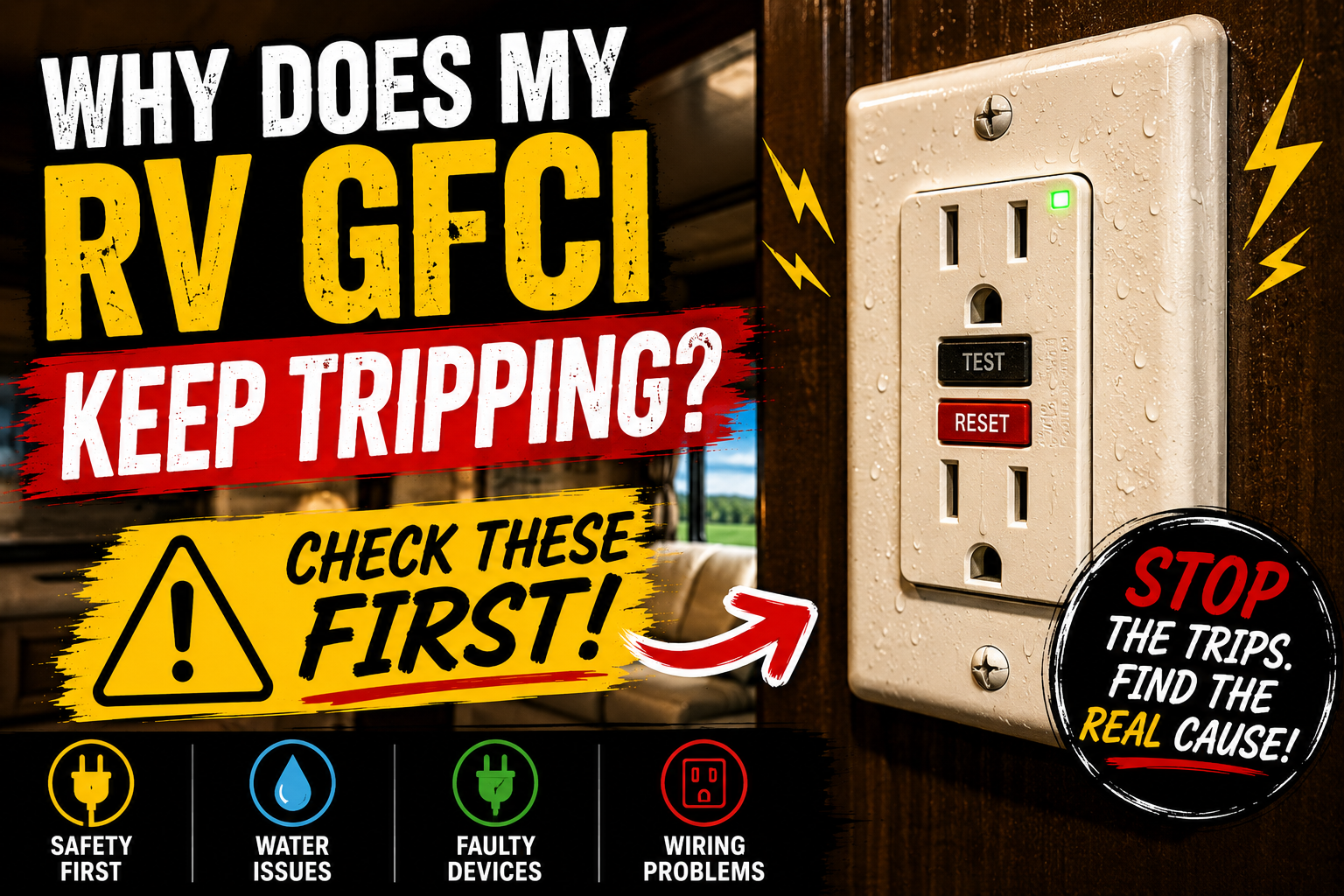
If an outlet with TEST and RESET buttons keeps tripping, you’re dealing with GFCI protection rather than a normal overcurrent breaker. When that protection keeps opening, use GFCI protection to troubleshoot the affected outlet and anything downstream from it.
A GFCI is watching for current going somewhere it shouldn’t.
That’s why simply saying:
“My RV breaker keeps tripping”
can send troubleshooting in the wrong direction if what’s actually tripping is a GFCI receptacle.
We’ll handle repeated RV GFCI trips separately rather than stuffing that entire subject into this article.
Check the Shore-Power Cord and Plug
I’d inspect the shore connection whenever breaker problems appear.
Look for:
Burning
Melting
Discoloration
Loose contacts
Damaged blades
Corrosion
Cracks
A connection that won’t stay firmly seated
Don’t keep using a visibly damaged shore-power cord because it still technically carries electricity.
A high-current connection needs to be solid.
Pay Attention to Heat
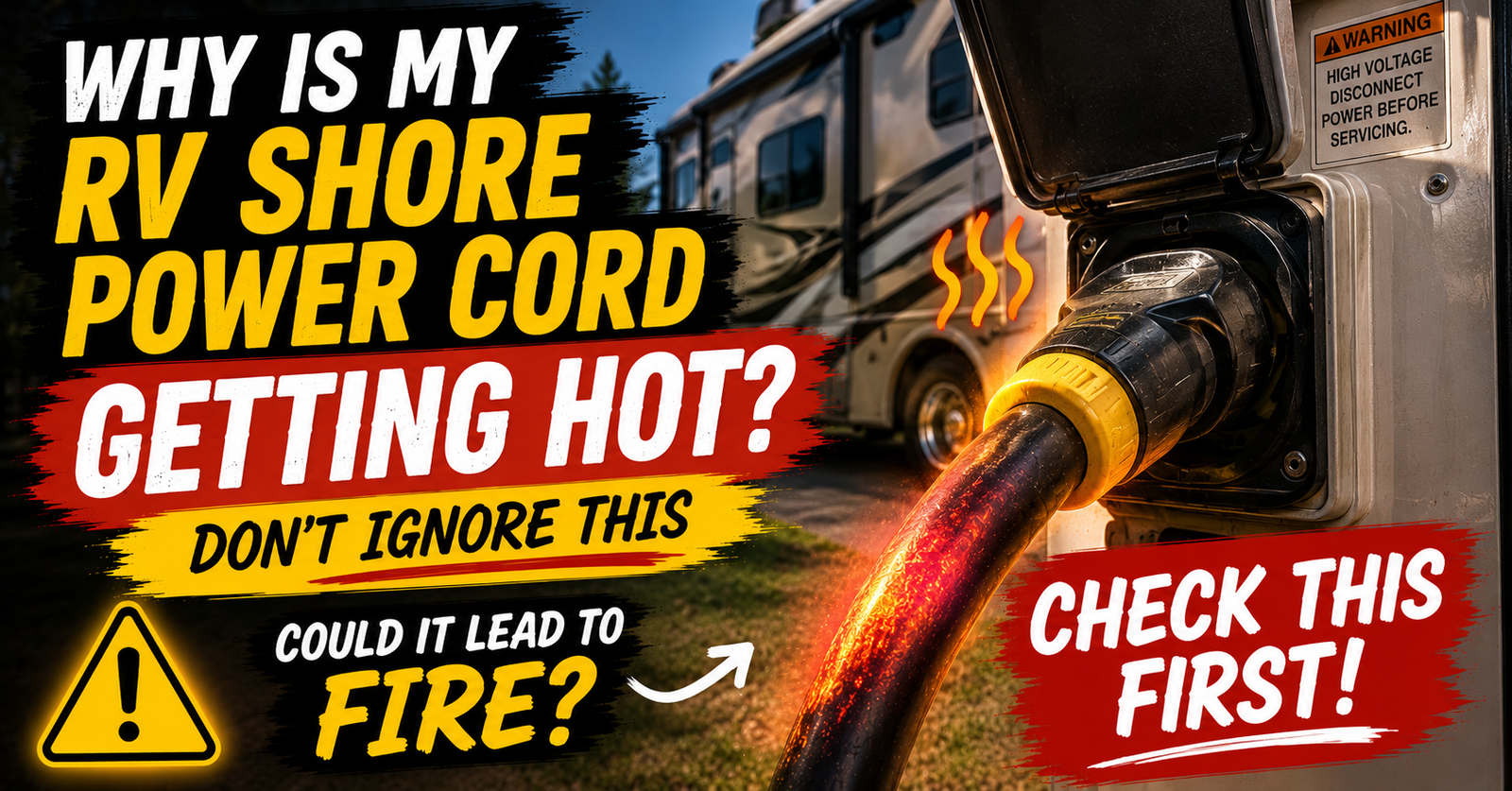
After the camper has been under a substantial electrical load, carefully pay attention to the shore-power connections. If one of those shore-power connections feels unusually hot, stop treating the issue as an ordinary overload and investigate the connection itself.
Is the plug mildly warm?
Or is it hot enough that you immediately know something isn’t right?
Excessive heat can indicate a poor electrical connection.
And poor connections can get worse over time.
A worn campground receptacle that doesn’t grip the plug tightly can be part of the problem too.
We’re giving hot shore-power cords and plugs their own article because there’s enough going on there that it deserves more than a paragraph.
What If My Surge Protector Keeps Shutting the RV Down?
First make sure it’s actually a surge protector and not a more advanced electrical management system.

Some RV electrical protection devices monitor incoming voltage and wiring conditions and disconnect the RV when those conditions fall outside acceptable limits. The equipment that performs this monitoring is explained in the guide to RV electrical management systems.
That can feel exactly like the campground breaker tripped because everything suddenly goes dark.
But the breaker may still be on.
Check the display or error code on your protection equipment.
If the device says it’s protecting you from an electrical problem, don’t immediately bypass it because you want the air conditioner back.
Find out what it’s seeing.
Low Voltage Can Be a Different Problem Entirely
A crowded campground on a brutally hot afternoon can put heavy demand on electrical infrastructure.
Everybody’s air conditioners are running.
Voltage conditions may become something worth watching.
Don’t confuse low voltage with a simple breaker overload.
They’re related to shore-power quality, but they’re not the same problem.
Our upcoming article on normal RV shore-power voltage will deal specifically with what voltage readings mean and when I’d start getting concerned.
Your Converter Can Trip Its Own Breaker Too
Yes, we’re technically done with the converter cluster, but the converter still exists inside the camper.
If the breaker supplying the converter trips repeatedly while the rest of the RV’s AC system stays powered, that points us in a different direction than the campground main breaker tripping under a massive combined load.
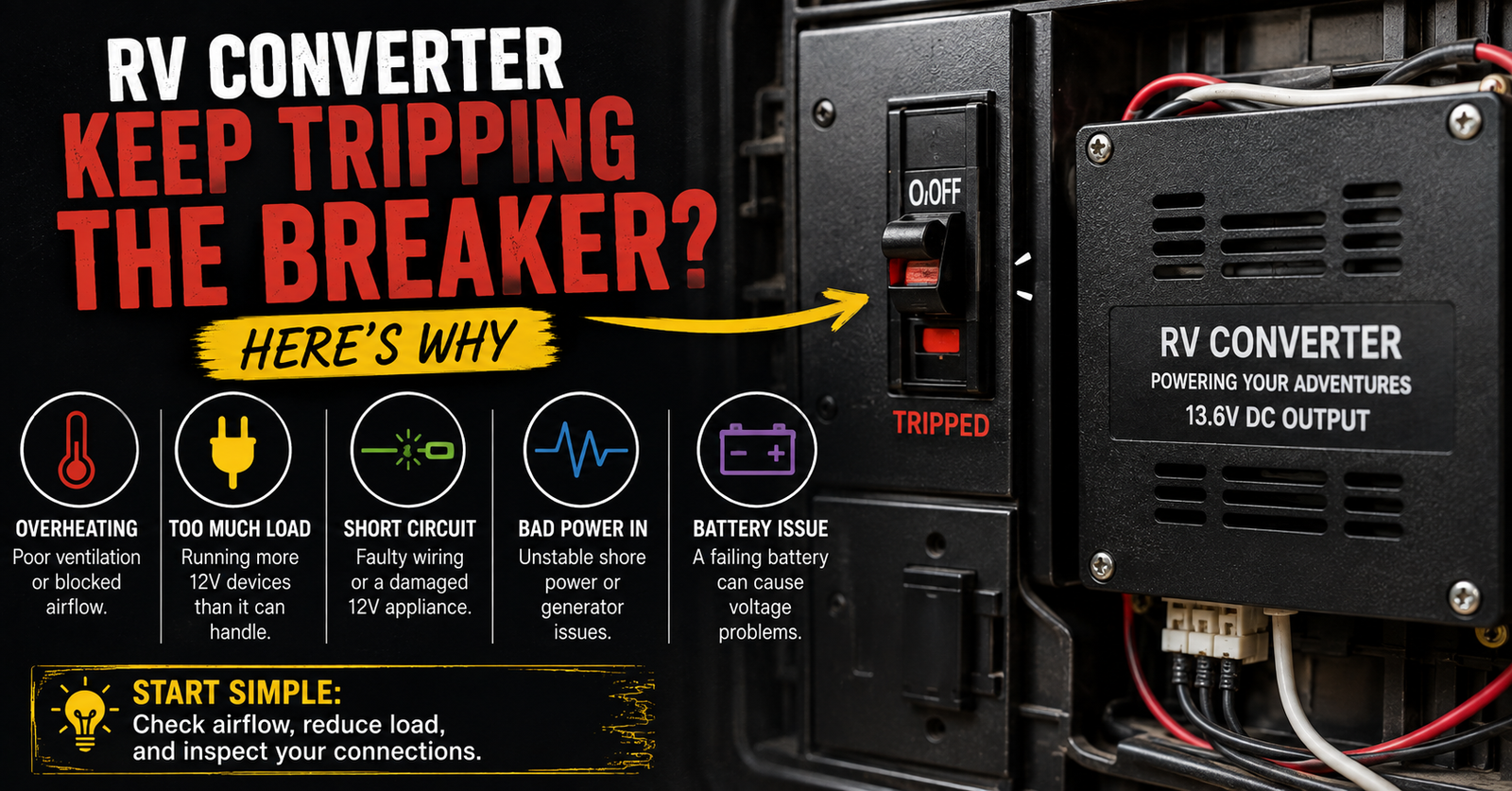
We’ve already covered why an RV converter keeps tripping its breaker, so I wouldn’t duplicate that troubleshooting here.
That’s exactly why we’re building these articles as a connected library.
Don’t Forget the Transfer Switch
If your RV has a generator, it may also have an automatic transfer switch that determines whether the RV receives AC power from shore power or the generator.
Transfer equipment is rated to match the electrical system it serves. For example, 30 amp and 50 amp transfer switches are designed around their respective RV electrical services.
A problem in that area can create strange AC symptoms.
But I wouldn’t immediately blame the transfer switch because a campground breaker tripped when you ran four high-draw appliances on 30 amp service.
Troubleshoot the obvious load problem first.
What If Shore Power Works but My Generator Doesn’t Trip Anything?
That’s useful information, but compare the electrical conditions carefully.
The generator may supply a different amount of power.
The transfer path may be different.
Your appliances may not have been operating under exactly the same conditions.
Still, if a breaker problem occurs consistently on shore power but never on another AC source, that helps narrow the investigation.
Good troubleshooting is basically a process of changing one thing and watching what happens.
Don’t Keep Resetting a Breaker That Immediately Trips
I can’t emphasize this one enough.
If you overloaded the circuit because you accidentally ran too many appliances, turn some loads off and reset the breaker.
That’s reasonable.
But if the breaker immediately trips again with the loads removed, stop.
Don’t stand there going:
Click.
Trip.
Click.
Trip.
Click.
Trip.
The breaker isn’t being stubborn.
It’s telling you something isn’t right.
When I Would Stop Troubleshooting It Myself
There’s a point where basic RV troubleshooting becomes electrical diagnosis.
If you’ve established that:
The pedestal supply is appropriate.
Your normal electrical loads are off.
The breaker still trips.
Connections don’t show an obvious simple problem.
And you suspect wiring, the breaker panel, transfer equipment, or another internal electrical fault.
I’d get someone qualified involved.
Working around live 120-volt RV electrical equipment can seriously hurt you.
You don’t need to open a live panel to successfully narrow the problem down.
Being able to tell a technician:
“The campground pedestal has been checked, the problem follows the RV, and the main RV breaker trips immediately even with all the branch breakers turned off”
is already incredibly useful information.
What If the RV Loses Power but Nothing Actually Tripped?
That’s another situation entirely.
If the camper suddenly goes dead and both the pedestal breaker and RV main breaker remain on, don’t keep treating it as a breaker problem.
Now I’d follow the incoming power path.
Pedestal.
Electrical protection.
Adapter.
Shore cord.
RV inlet.
Transfer equipment if equipped.
Main distribution panel.
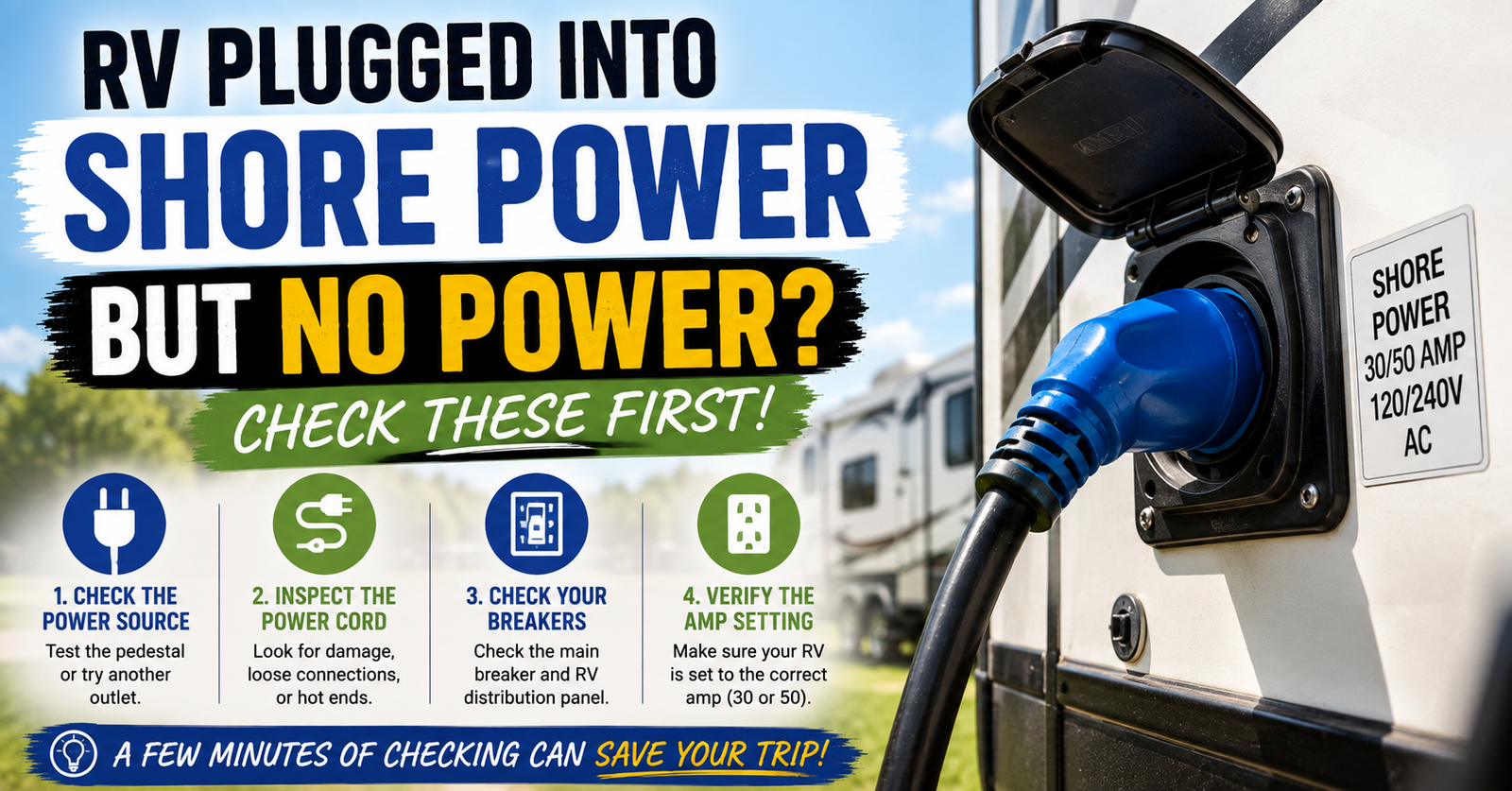
We’ve already built a step-by-step guide for an RV that’s plugged into shore power but has no power specifically for that situation.
WFCO’s own troubleshooting information similarly begins a no-AC-power diagnosis by checking whether the RV is actually connected to AC power at the pedestal, whether the main breaker has tripped, and whether there are wiring problems.
The Timing of the Trip Usually Tells You Where to Look
This is the easiest way I know to simplify the whole problem.
Trips after you turn on several large appliances: Think overload first.
Trips when one particular appliance starts: Investigate that load and its circuit.
Trips immediately when you connect shore power: Think electrical fault rather than ordinary power management.
Trips only at one campsite: Investigate the campground power source.
Trips at every campground: Look harder at the RV.
Only one branch breaker trips: Focus on that circuit.
Nothing trips but the RV loses power: Follow the incoming shore-power path instead.
You don’t need to understand every wire in the camper to make those observations.
Sometimes the Fix Really Is Changing How You Use Power
There’s a tendency to assume every repeated breaker trip means something is broken.
Sometimes it doesn’t.
If you’re camping on 30 amp service and everything works perfectly until you simultaneously run the air conditioner, electric water heater, microwave, coffee maker, and hair dryer, I don’t need much more evidence.
You’re asking for too much power.
Turn something off.
Use propane for the water heater if your system allows it.
Wait until the microwave is finished before running another big appliance.
That’s normal 30 amp RV life.
But Don’t Normalize a Breaker That Trips for No Reason
That’s the other side of this.
A breaker that suddenly starts tripping under ordinary loads you’ve used hundreds of times deserves investigation.
A breaker that won’t stay reset deserves investigation.
A breaker associated with a burning smell deserves immediate attention.
A shore plug that’s melting deserves immediate attention.
Electrical protection exists because excessive current and electrical faults can become dangerous.
Don’t defeat the protection just because resetting it is annoying.
My Simple Rule for a Breaker That Keeps Tripping
I ask one question first:
What changed immediately before it tripped?
If the answer is:
“I turned on the microwave while the AC, water heater, and coffee maker were already running.”
I’m looking at load management.
If the answer is:
“Nothing. I plugged the RV in with everything turned off and the breaker immediately kicked.”
I’m looking for a fault.
That’s a completely different troubleshooting path.
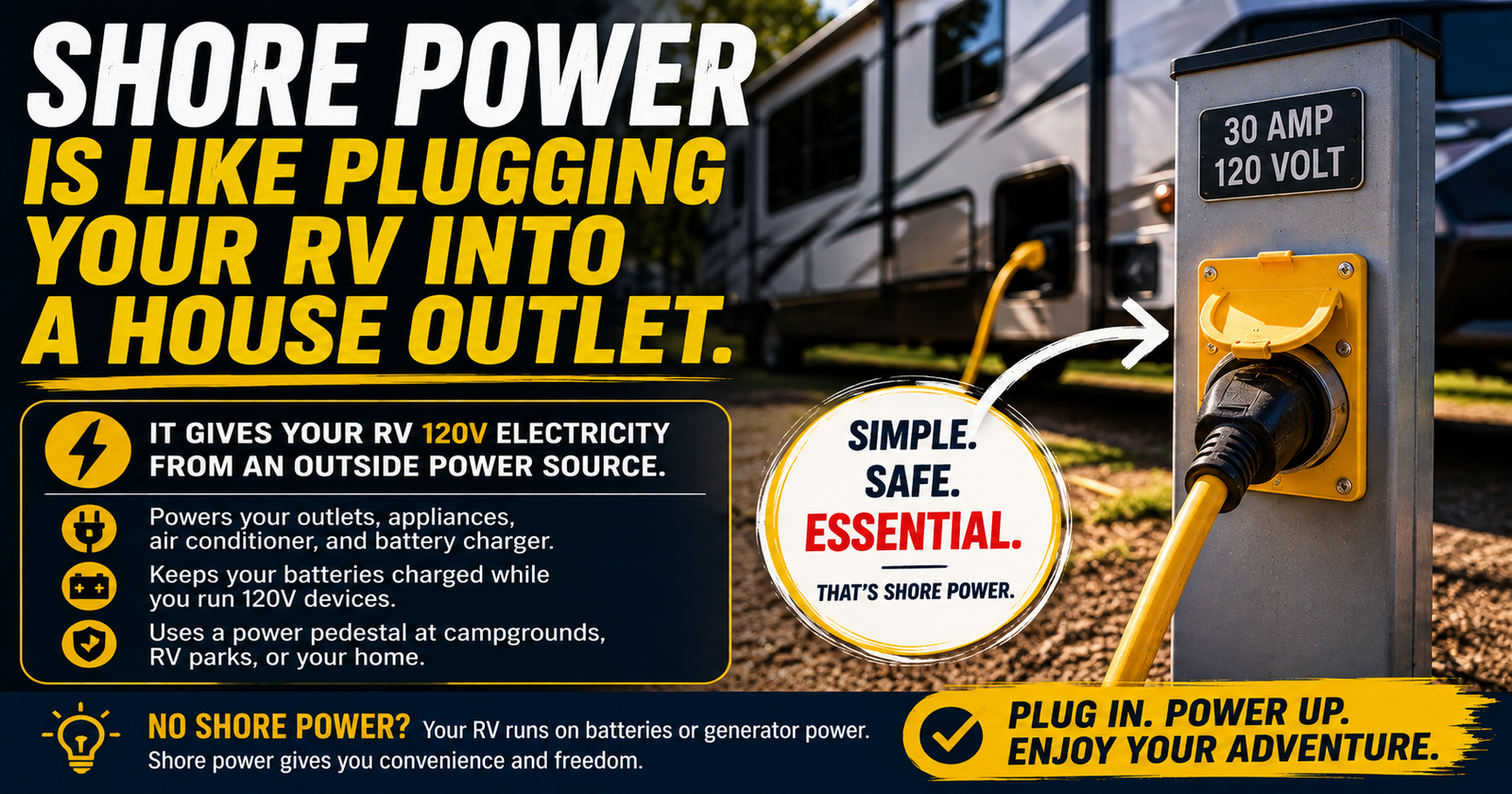
And if you’re still learning your camper’s electrical system, don’t feel like you need to understand everything at once. Start with how RV shore power actually works and build from there.
Once you understand that the pedestal supplies the RV, the RV distributes that AC power to different circuits, and every appliance contributes to the total load, breaker problems become much less mysterious.
A breaker that keeps tripping isn’t something to ignore.
But it also doesn’t automatically mean your RV has a major electrical failure.
Figure out which breaker is tripping, pay attention to exactly when it happens, reduce the electrical load, and let the symptoms tell you where to look next.
That’s a whole lot better than spending the rest of your camping trip walking back and forth to the pedestal wondering why the darn thing won’t stay on.
Written by Evan Mercer
Evan Mercer writes about RV electrical systems, shore power, campground hookups, batteries, and practical camper troubleshooting for CamperAnswers.com. He focuses on helping RV owners understand what their electrical systems are telling them so they can narrow down problems without immediately replacing expensive parts.