

Few RV electrical problems are more confusing than plugging into shore power and discovering that some outlets work perfectly while others are completely dead.
The microwave has power. The TV works. One kitchen outlet works. Then you walk over to the bathroom, bedroom, or outside receptacle and get absolutely nothing.
At first, that can make it seem like the camper has some major electrical problem.
Usually, I don’t start there.
When some RV outlets work and others don’t, I first check for a tripped GFCI and individual branch breaker. If those are good, I start looking at which outlets share the dead circuit, whether one receptacle or connection has failed, and, on a 50 amp RV, whether both incoming power legs are actually present. If the branch breaker will not reset, branch breaker troubleshooting steps can help you identify the likely cause and next step.
The fact that some outlets still work is actually helpful.
It tells us we’re probably not dealing with the same problem as an RV that’s completely lost shore power.
Now we can start narrowing down exactly where the electricity stops.
First Make Sure You Really Have Shore Power
Before chasing individual outlets, I want to establish one thing.
Does the RV clearly have 120-volt AC power?
Look for equipment that normally requires shore power, generator power, or an inverter to operate.
For example, your microwave display may be lit. Your rooftop air conditioner may operate. Several regular wall outlets may work.
If those things are working while a few outlets are dead, shore power is obviously making it into at least part of the RV’s AC electrical system.
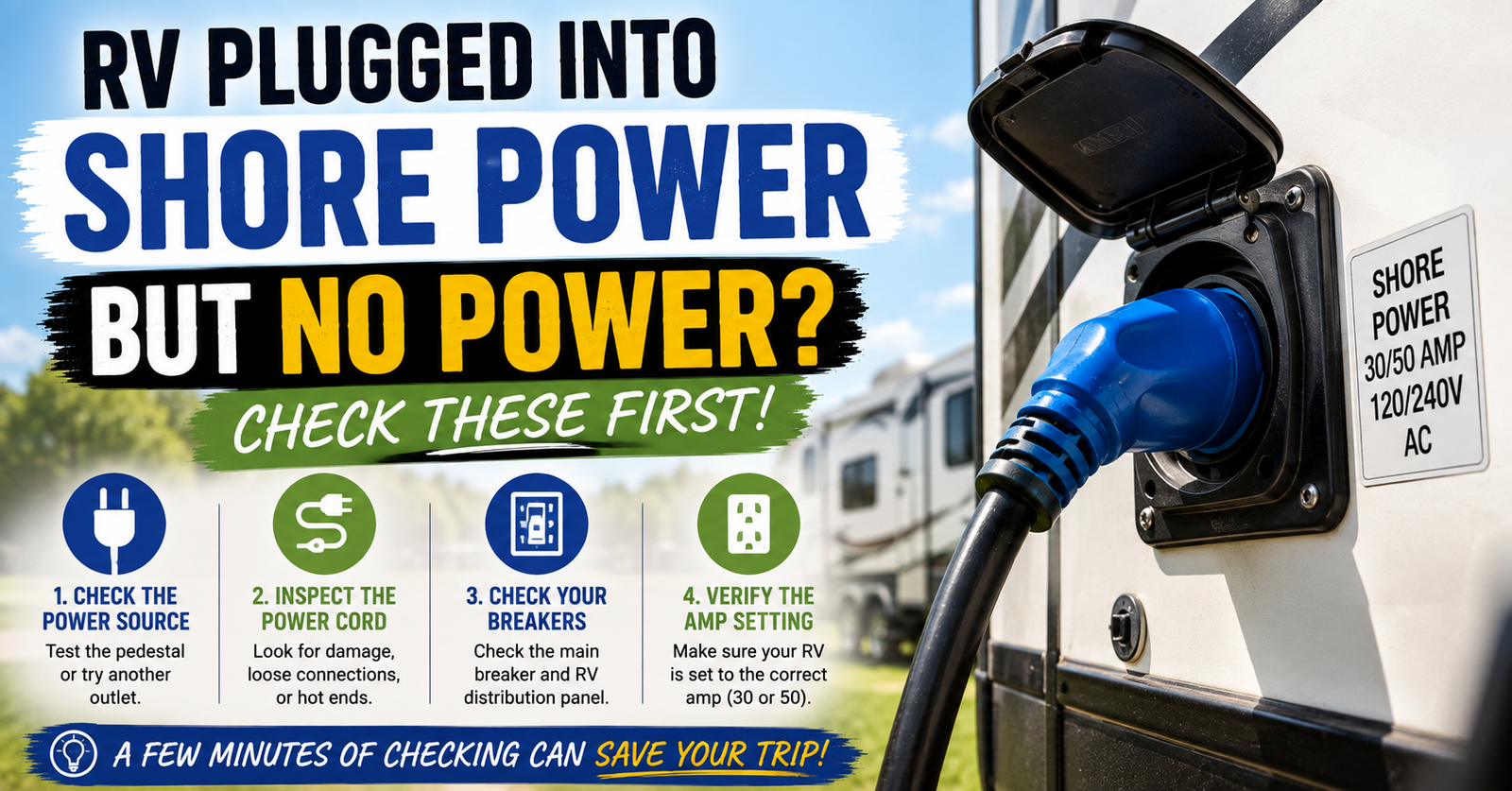
That’s very different from an RV that’s plugged into shore power but has no power anywhere.
Here, we’re troubleshooting partial power.
And the first place I’d look is surprisingly simple.
Check Every GFCI Outlet You Can Find
If several RV outlets suddenly stopped working, this is my first easy check.
A GFCI outlet has those familiar:
TEST
and
RESET
buttons on the face.
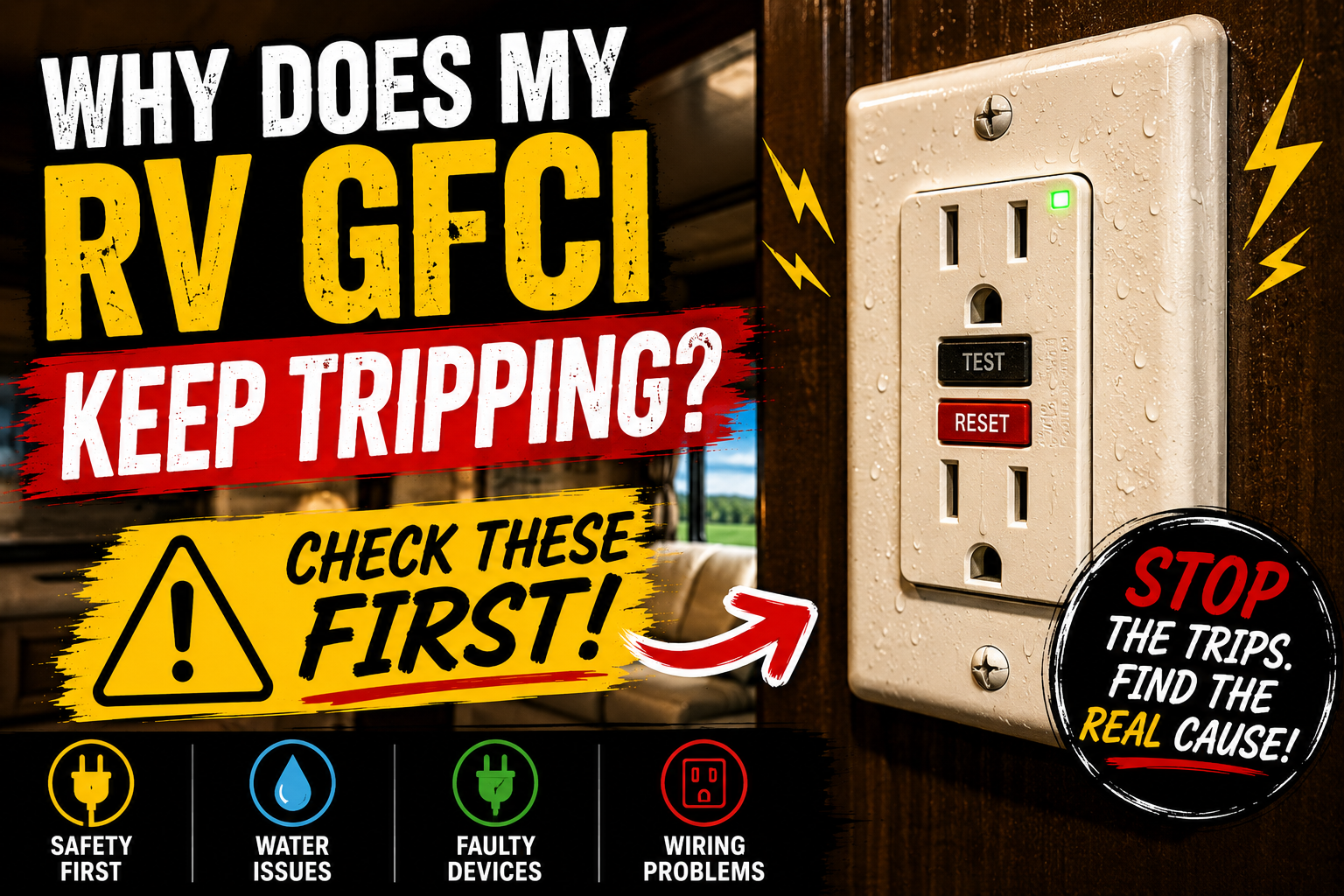
The important thing beginners don’t always realize is that one GFCI can protect other outlets farther down the same circuit. That downstream relationship is explained in one GFCI can protect other outlets, including why a dead outlet may not be the source of the trip.
That means the dead outlet you’re trying to fix may not have a RESET button at all.
The GFCI controlling it could be somewhere else.
So don’t just look at the dead outlet and say:
“Well, this isn’t a GFCI.”
Go find the GFCI that may be upstream from it.
Where Are GFCI Outlets Usually Located in an RV?
I’d start looking anywhere electricity and moisture are likely to meet.
Common places include the:
Bathroom
Kitchen
Exterior
Wet bay
Basement or storage area
Depending on the RV, there may be more than one.
And don’t assume the GFCI closest to the dead outlet is necessarily the one protecting it.
RV wiring layouts can surprise you.
You might discover that resetting a GFCI in the bathroom suddenly brings an outside receptacle back to life.
That’s why I check them before doing anything complicated.
Press RESET Firmly
Sometimes the fix really is that easy.
Make sure the RV has the appropriate AC power available and press the RESET button on the GFCI.
If it resets and all your outlets come back:
Great.
But I’d still ask why it tripped.
Maybe there was a temporary condition.
Maybe something plugged into the circuit caused it.
Maybe moisture was involved.
If the GFCI immediately trips again, don’t stand there pressing RESET over and over.
Now it’s giving you useful information.
Something needs to be investigated.
Unplug Everything From the Dead Circuit
If the GFCI won’t stay reset, I start removing variables.
Unplug appliances and devices from the affected outlets.
That includes things you may have forgotten about.
Coffee maker.
Toaster.
Hair dryer.
Outdoor extension cord.
Phone chargers.
Space heater.
Kitchen appliance.
Anything plugged into those receptacles.
Then try resetting the GFCI again.
If it suddenly stays reset, one of those devices becomes suspicious.
Plug things back in individually and see whether the problem returns.
That’s a much cleaner way to troubleshoot than assuming the RV wiring is bad.
Moisture Can Cause GFCI Trouble
Remember what GFCI protection is intended to do.
It’s especially important around areas where electricity and water can come together.
So if your outside outlet quit after a rainstorm, or the bathroom GFCI started tripping after something got wet, I pay attention to that timing.
Don’t defeat the GFCI just to restore power.
If moisture has entered a receptacle or electrical box, let the problem be properly addressed.
The protection device may be doing exactly what it’s supposed to do.
What If the GFCI Won’t Reset at All?
Don’t immediately assume the GFCI itself is bad.
Some GFCIs won’t reset if they aren’t receiving incoming power.
So now we need to move upstream.
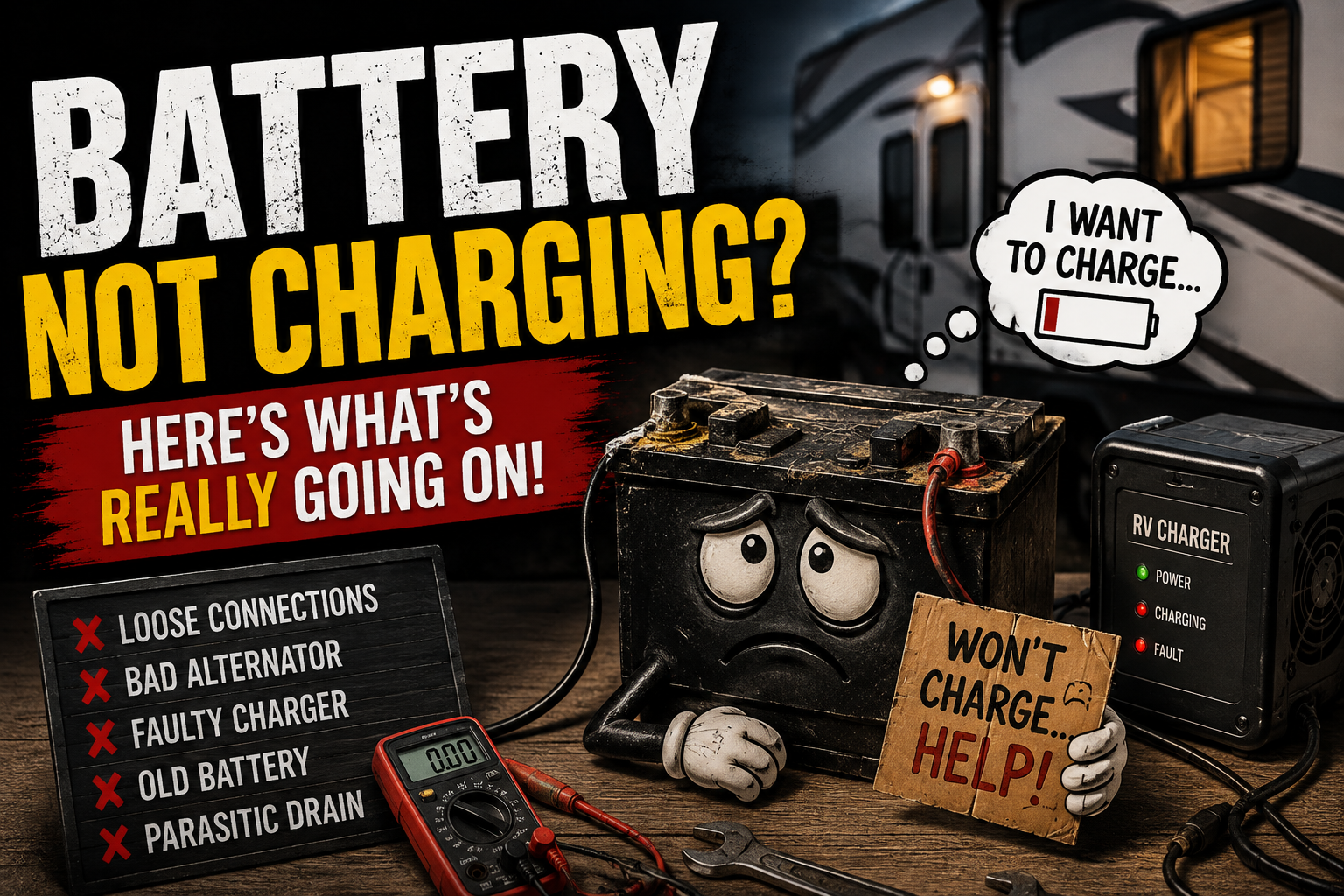
That’s when I check the AC breaker panel.
Find your RV’s electrical distribution center and identify the breaker supplying that receptacle circuit.
A breaker can trip without looking dramatically different from the others.
I like to reset it properly.
Move it completely to OFF.
Then back to ON.
If the outlets come back, you’ve found the immediate problem.
Now you still need to determine why the breaker tripped.
One Branch Breaker Can Kill Several Outlets
Your RV’s AC electrical system isn’t normally one giant circuit.
The distribution panel contains individual branch breakers feeding different portions of the camper. Progressive Dynamics documentation, for example, describes RV AC distribution panels as having a main input breaker along with individual breakers for branch circuits.
That matters.
Suppose your air conditioner works.
Microwave works.
Some outlets work.
But five receptacles are dead.
Those five outlets may all be connected to one branch circuit.
If that branch breaker opens, everything else in the RV doesn’t have to go dark.
Only that circuit loses power.
That’s exactly why partial power is such a useful symptom.


Don’t Assume Every Outlet Has Its Own Breaker
It usually doesn’t.
Several receptacles may share one branch circuit.
Think of the electricity traveling from the electrical panel through a series of connections.
That means one problem can affect multiple outlets.
And here’s where troubleshooting gets interesting.
Sometimes the problem isn’t actually at one of the dead outlets.
It can be at the last working outlet before them.
The Last Working Outlet Can Be Your Best Clue
Imagine a simplified circuit like this:
Panel → Outlet 1 → Outlet 2 → Outlet 3 → Outlet 4
Outlet 1 works.
Outlet 2 works.
Outlet 3 is dead.
Outlet 4 is dead.
Where would I become very interested?
Around the connection between Outlet 2 and Outlet 3.
If electricity isn’t continuing downstream, the problem could involve the wiring leaving the last working receptacle, the first dead receptacle, or a connection between them.
This is why replacing the farthest dead outlet first isn’t necessarily logical.
The failure may be upstream.
A Loose Connection Can Kill Everything Downstream
This is one reason an RV can have several dead outlets even though the breaker and GFCI seem fine.
A connection somewhere along that circuit may have failed.
RVs don’t live gentle lives.
They bounce.
They vibrate.
They flex.
They travel thousands of miles over roads that occasionally seem designed to shake the cabinets off the walls.
Electrical connections can develop problems.
If one connection opens in a circuit that continues to additional receptacles, everything downstream can lose power.
The Dead Outlet Might Not Be the Bad Outlet
This is worth repeating because it can save a lot of frustration.
Suppose your bedroom outlet is dead.
You replace it.
Still dead.
Why?
Because the problem might be at another receptacle upstream.
The dead outlet was only showing you the symptom.
This is where figuring out which outlets work and which don’t becomes useful.
I like to map them out.
You don’t need anything fancy.
Plug a small lamp or outlet tester into each receptacle and figure out exactly where power exists.
Now you’re looking for a pattern rather than randomly replacing outlets.
Check Both Sides of the RV
Sometimes the physical layout gives you clues.
Maybe every kitchen receptacle works but everything on another circuit doesn’t.
Maybe the bathroom and exterior receptacles are both dead.
Maybe all the outlets in one slide are dead.
Maybe one entire group suddenly stopped working after moving the slide.
Those patterns matter.
They can help identify whether you’re dealing with a shared GFCI circuit, branch circuit, wiring path, slide connection, inverter-fed circuit, or another specific portion of the electrical system.
Slide-Out Outlets Deserve Extra Attention
If the only dead outlets are located in an RV slide, I pay attention to the wiring associated with that slide.
Those electrical connections have to accommodate movement.
That doesn’t automatically mean the slide wiring is broken, but it’s a more specific clue than:
“Some outlets don’t work.”
If the outlets worked before operating the slide and suddenly don’t afterward, that timing is worth noting.
Don’t keep cycling the slide hoping electricity magically returns.
Inspect or have the circuit properly diagnosed.
What If Only the Outside Outlet Doesn’t Work?
I’d still check the GFCI first.
Exterior RV outlets are exactly the type of location where GFCI protection makes sense.
If every other receptacle works and only the exterior outlet is dead, then I narrow the troubleshooting farther.
Is there voltage reaching the receptacle?
Is the receptacle damaged?
Has moisture gotten into it?
Is it downstream of another GFCI?
Is there a wiring connection problem?
Again, don’t assume the visible outlet is automatically the failed component.
What If the Bathroom and Outside Outlets Are Both Dead?
Now I’d become even more suspicious of a shared GFCI-protected circuit.
That’s the kind of pattern I want you looking for.
Two apparently unrelated outlets can be electrically related even though they’re physically far apart.
Find the GFCI receptacles in the camper.
Reset them.
Check the appropriate branch breaker.
Unplug devices.
Then test again.
Those simple checks solve a surprising number of partial-outlet problems.
What If My Breaker Keeps Tripping?
Now we’re dealing with something beyond a breaker that happened to trip once.
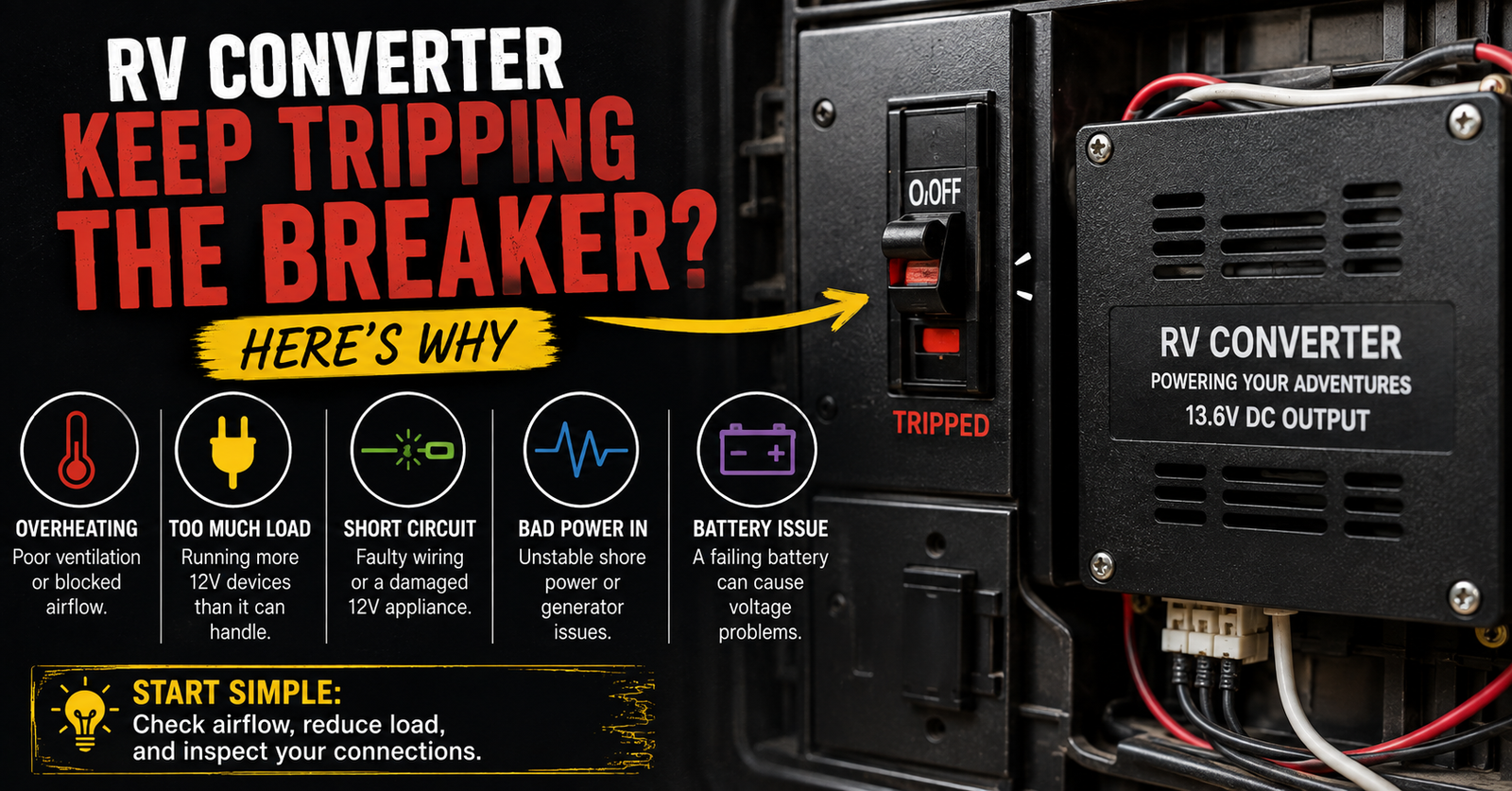
If you reset the branch breaker and it immediately opens again, don’t keep resetting it. If the branch breaker feeds the converter, RV converter breaker trips explains what that immediate repeat trip can indicate.
Likewise, if the RV’s main or campground breaker keeps opening, the timing and electrical loads become extremely important.
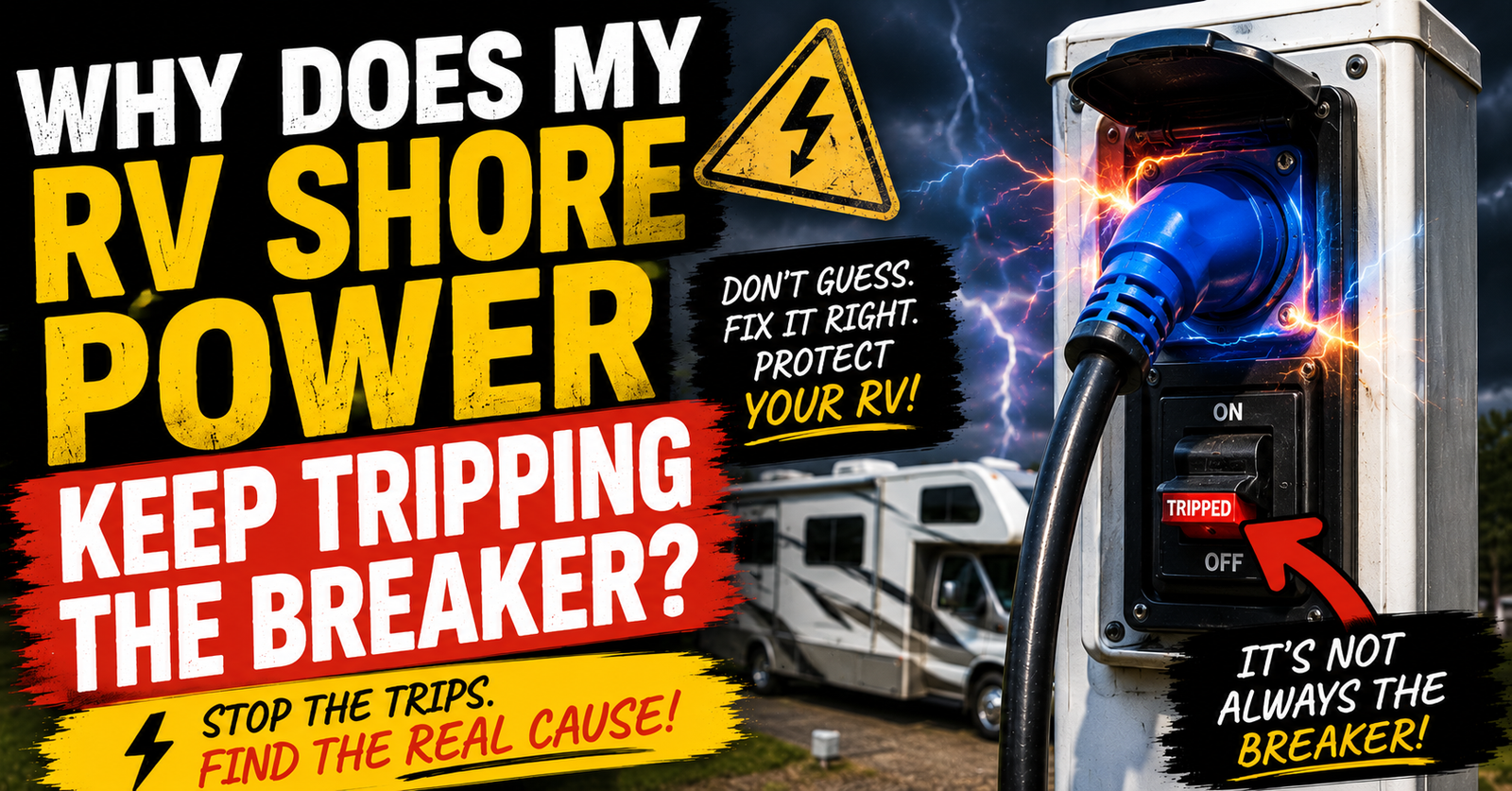
We already have a dedicated guide explaining why RV shore power keeps tripping the breaker, so I wouldn’t duplicate that entire troubleshooting process here.
For this problem, the important point is:
A breaker that won’t stay reset is telling you something.
Listen to it.
What If Half My 50 Amp RV Has No Power?
Now we’ve got a different possibility.
Remember how 50 amp RV service works.
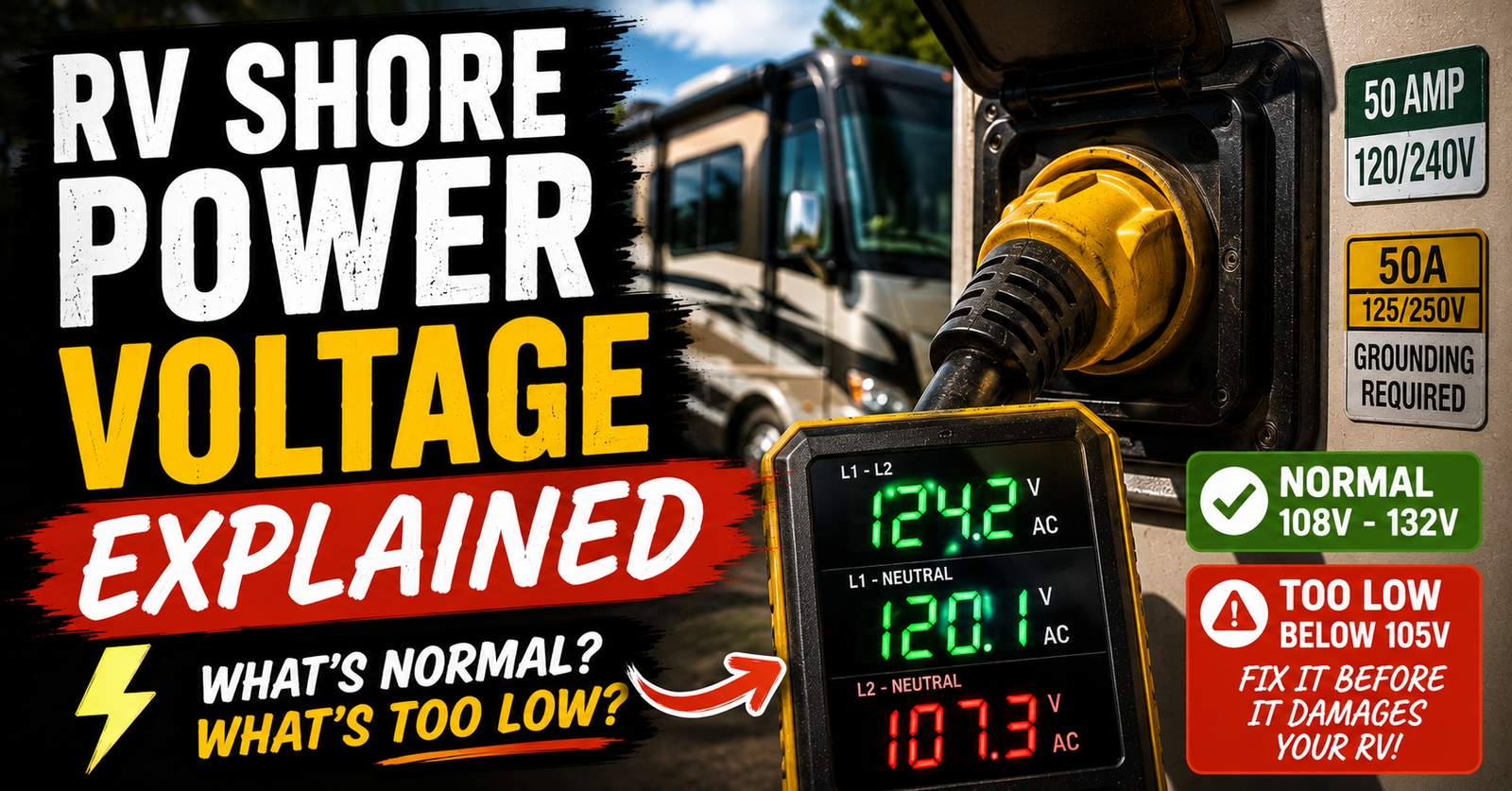
A standard 50 amp RV connection has two 120-volt hot legs.
Each leg can supply up to 50 amps.
That’s how a 50 amp RV gets approximately 12,000 watts of total available shore-power capacity.
If one incoming leg is lost, circuits supplied by that side of the electrical system can lose power while equipment supplied by the other leg continues working.
That’s one reason “half my camper has power” can be an especially important symptom on a 50 amp RV.
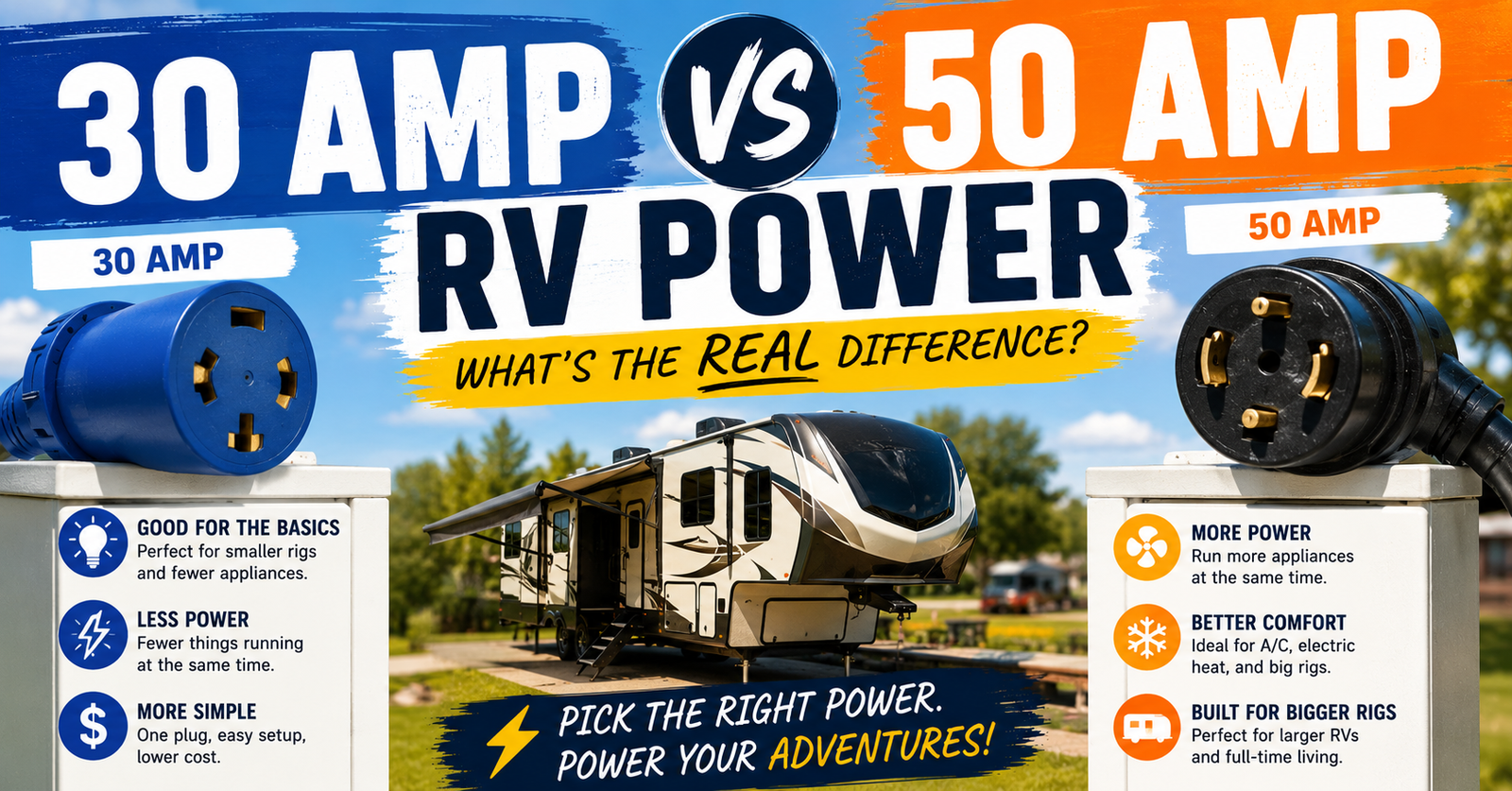
If the whole two-leg idea sounds strange, our 30 amp vs 50 amp RV power guide explains exactly how the two services differ.
A Lost Leg Can Start at the Campground Pedestal
Don’t immediately tear into the RV.
If you’re on 50 amp service and suspect one leg is missing, the problem could potentially be upstream.
Campground pedestal.
Receptacle.
Shore cord.
Plug.
Electrical management system.
Transfer equipment.
Connection.
RV distribution equipment.
This is another situation where following the electricity in order is much smarter than buying parts.
If you’re qualified to perform AC electrical testing, voltage measurements can help identify where a leg disappears.
If you’re not, campground staff or a qualified RV technician/electrician can perform those checks.
A 50 Amp RV on a 30 Amp Adapter Is Different
Don’t confuse a missing electrical leg with intentionally connecting your 50 amp RV to 30 amp service.
A proper RV adapter is designed specifically to let the camper operate from the smaller available source.
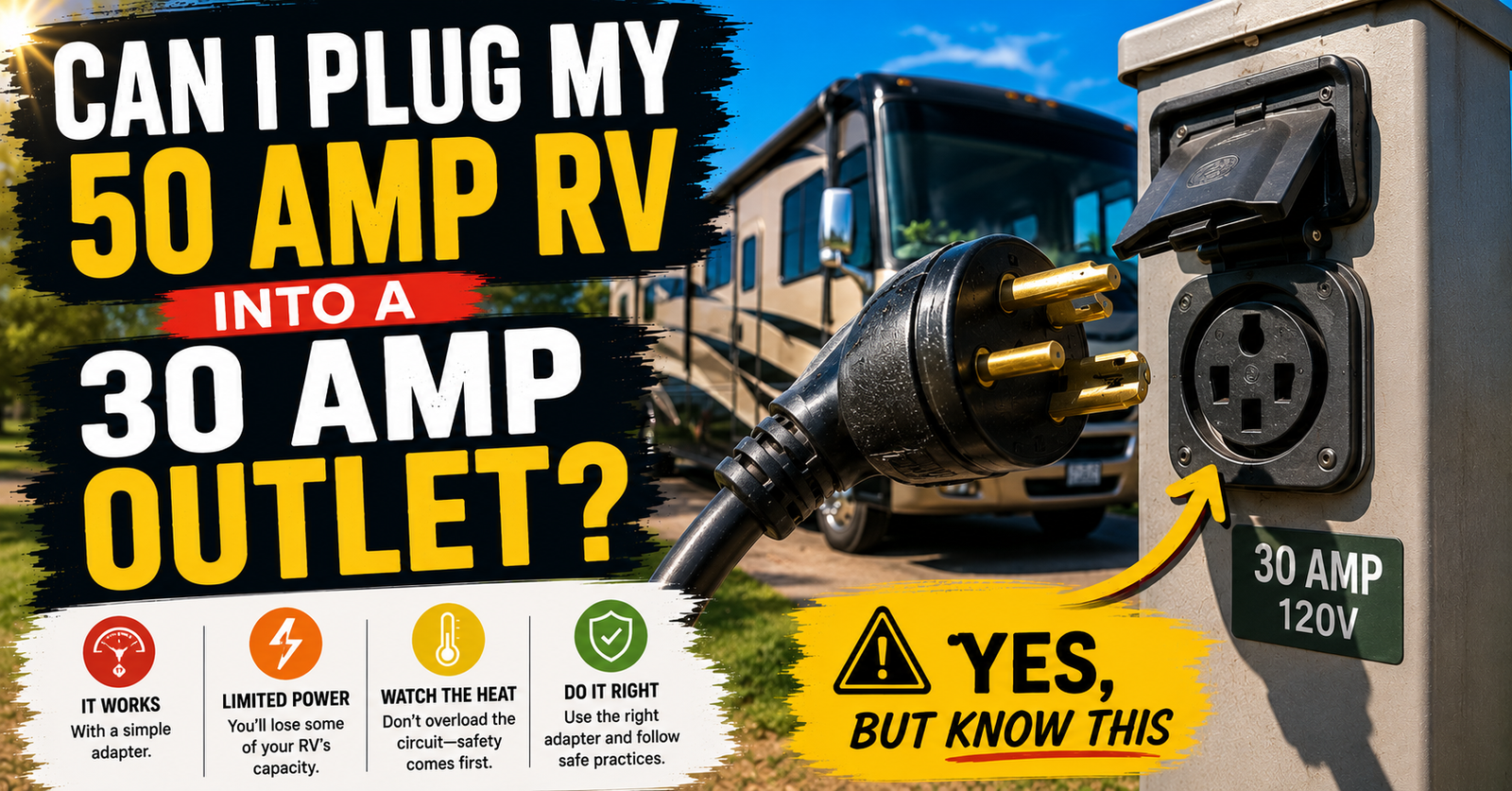
We’ve already explained what happens when a 50 amp RV is plugged into a 30 amp outlet.
The big limitation there is available capacity.
You only have about 3,600 watts from the 30 amp supply instead of the roughly 12,000 watts available from full 50 amp service.
That doesn’t mean random outlets should simply be dead.
If particular circuits have no power, I still investigate.
What If Some Outlets Work on the Inverter but Others Don’t?
This can actually be completely normal.
If your RV has an inverter, it may be wired to power only selected AC circuits when you’re away from shore power.
Maybe the entertainment outlets work.
Maybe certain kitchen receptacles work.
Maybe a CPAP outlet in the bedroom works.
Other receptacles may remain dead until shore or generator power is available.
Progressive Dynamics’ inverter documentation, for example, describes inverter installations with specifically designated receptacles or appliances supplied by the inverter.
So if your question is:
“Why don’t all my RV outlets work from the battery?”
we may not have a failure at all.
Your inverter may simply not be wired to power every outlet.
Shore Power and Inverter Power Aren’t the Same Thing
This distinction becomes really important in newer RVs with larger inverter systems.
On shore power, AC electricity comes into the camper and is distributed to the appropriate circuits.
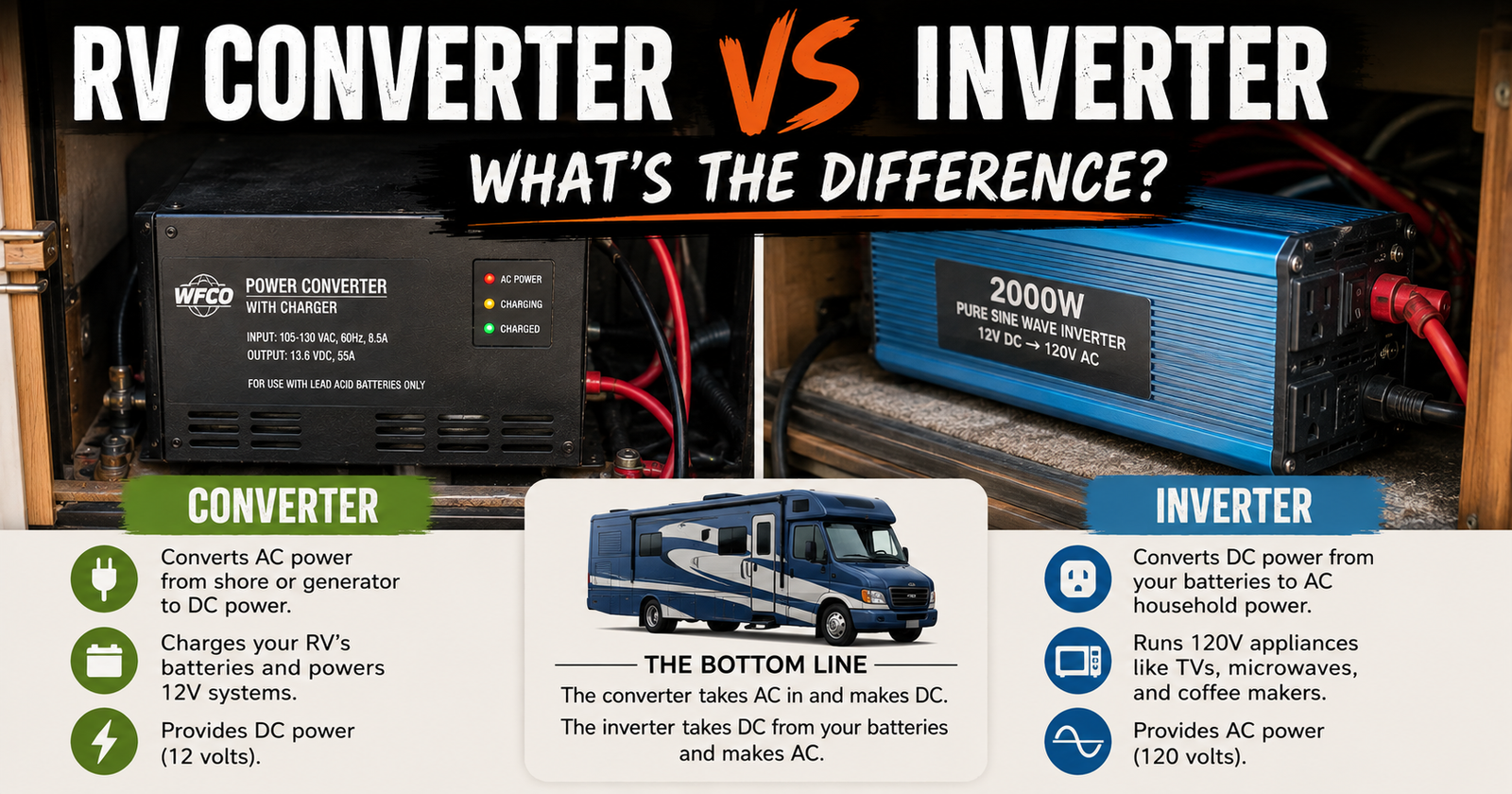
Without shore power, an inverter can take DC electricity from the battery bank and create AC electricity. That opposite relationship is illustrated more fully in RV converter and an inverter.
But the RV manufacturer doesn’t necessarily wire the inverter to supply the entire electrical panel.
That’s why I’d always check the particular RV’s wiring diagram and inverter configuration before assuming an unpowered outlet is broken.
What If Every Outlet Is Dead but the Lights Still Work?
That’s no longer the same problem as this article.
Remember that most RV ceiling lights are part of the 12-volt DC system.
They can operate from the house battery even when you’ve completely lost 120-volt shore power.
So:
Lights work.
Water pump works.
Maybe furnace controls work.
But microwave and every normal wall outlet are dead.
I start questioning whether you have AC shore power at all.
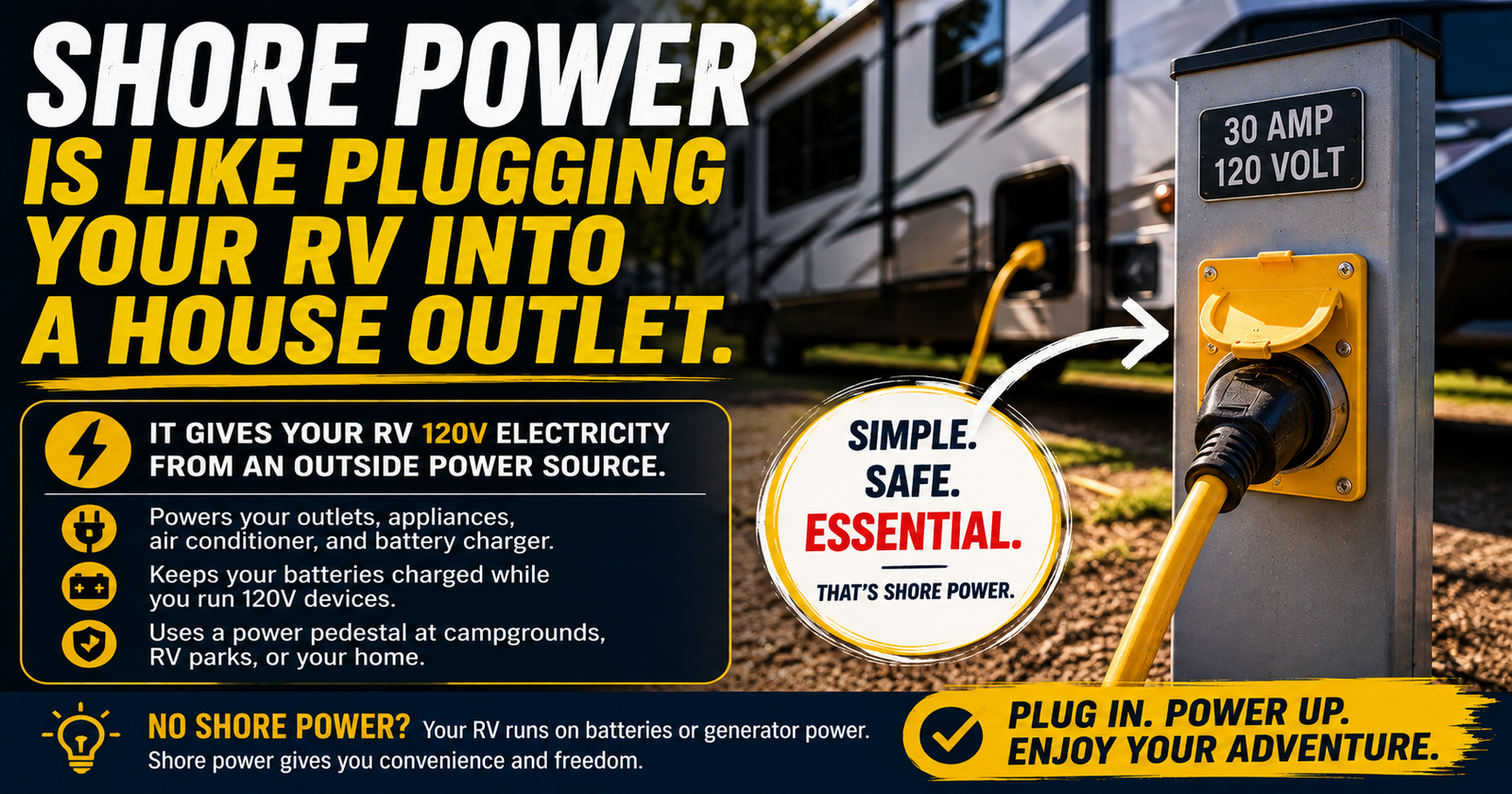
This is where understanding what shore power actually does in an RV makes troubleshooting much easier.
Don’t use the ceiling lights as proof that campground electricity is reaching the RV.
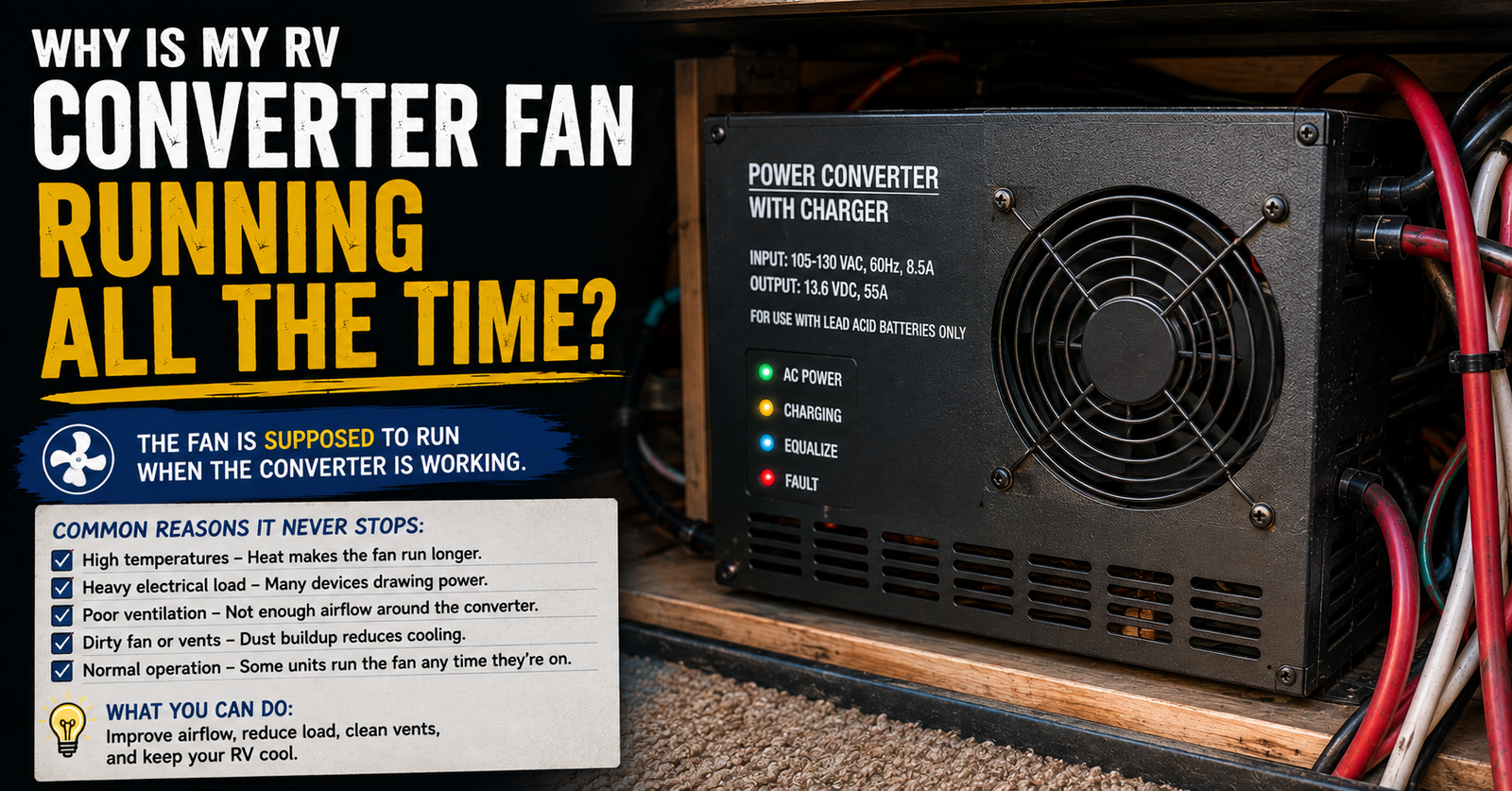
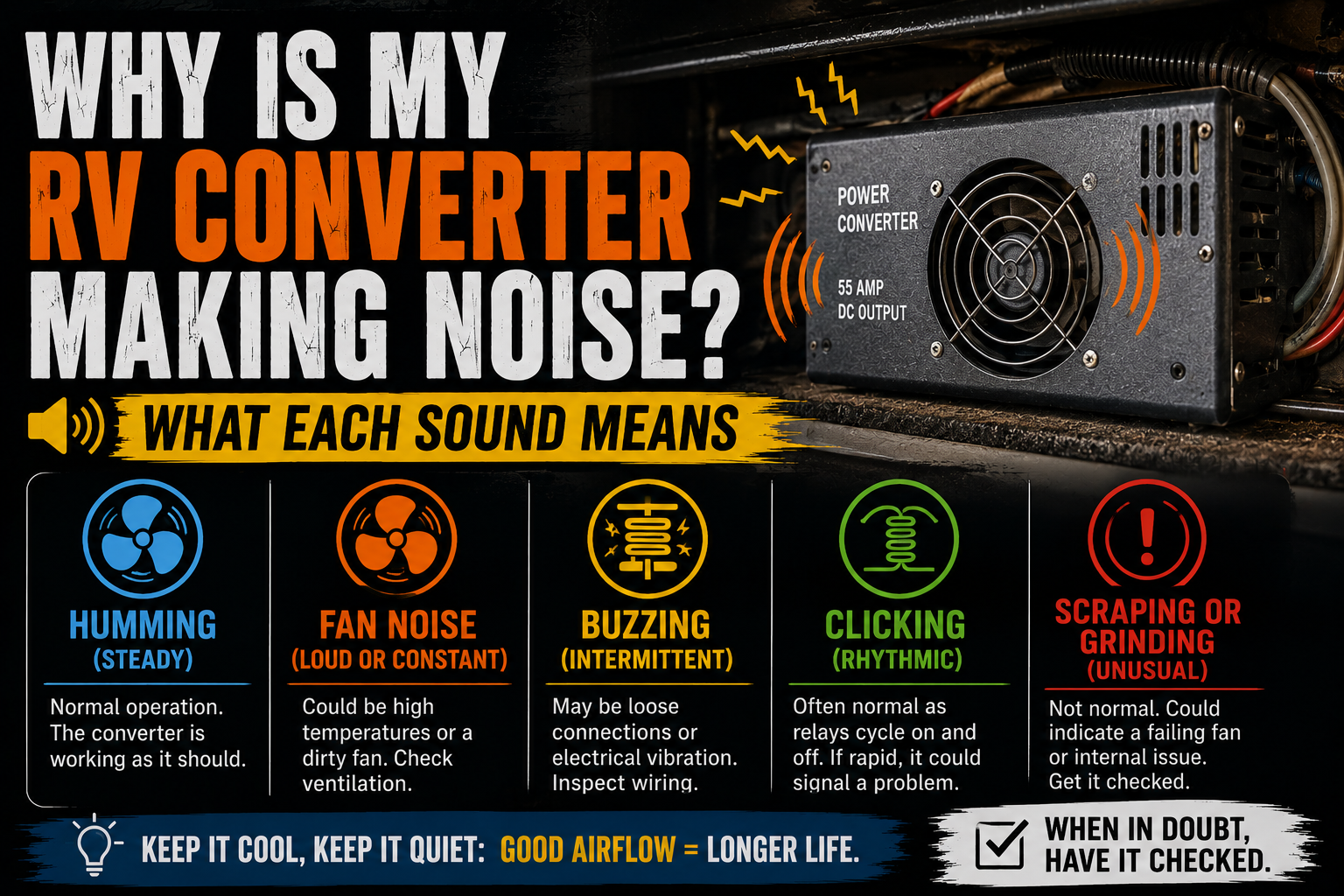
The Converter Doesn’t Normally Power Your 120-Volt Outlets
This is another common misunderstanding.
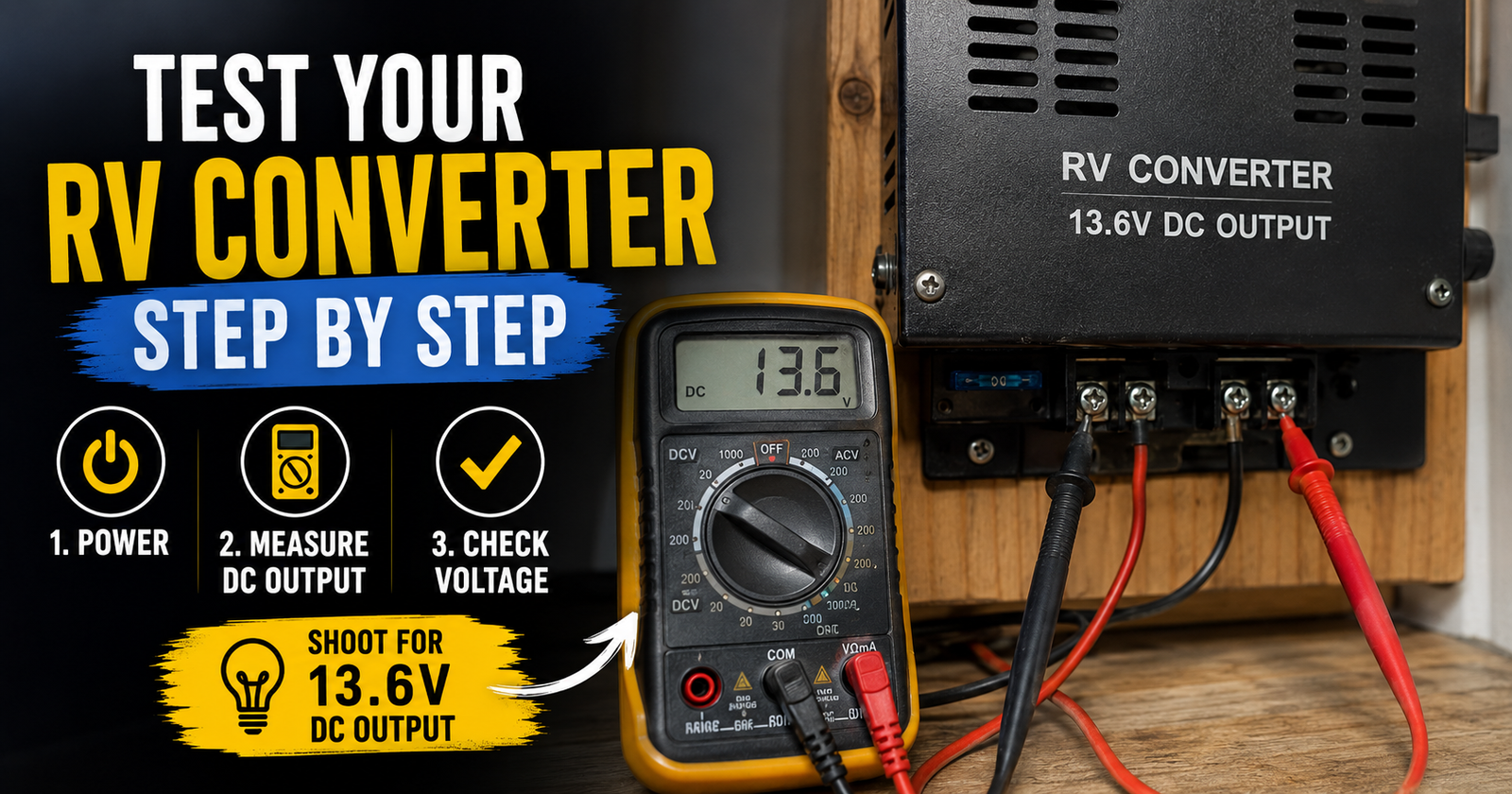
Your converter takes 120-volt AC electricity and converts it into DC electricity for the RV’s 12-volt system and battery charging.
It doesn’t normally create the 120-volt AC electricity used by your household-style outlets.
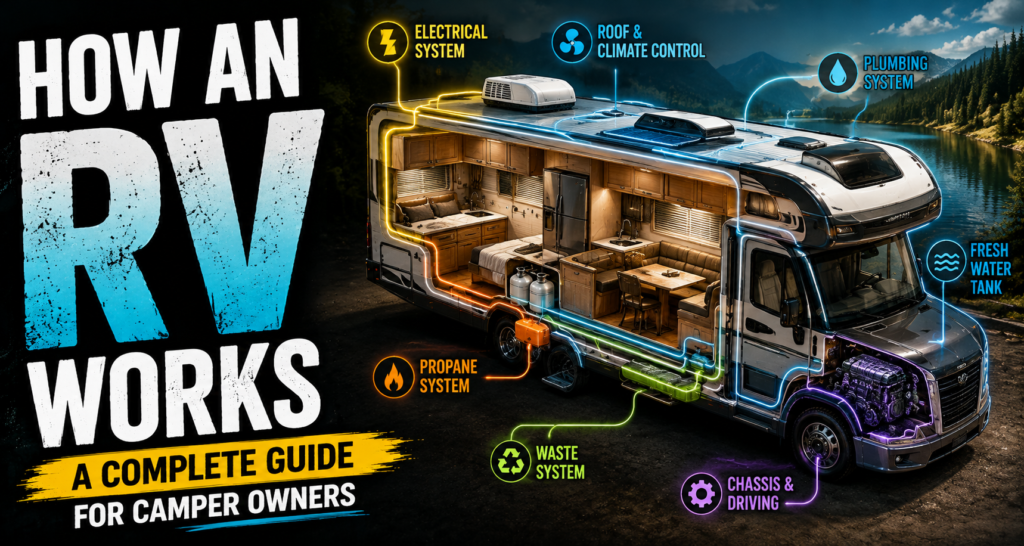
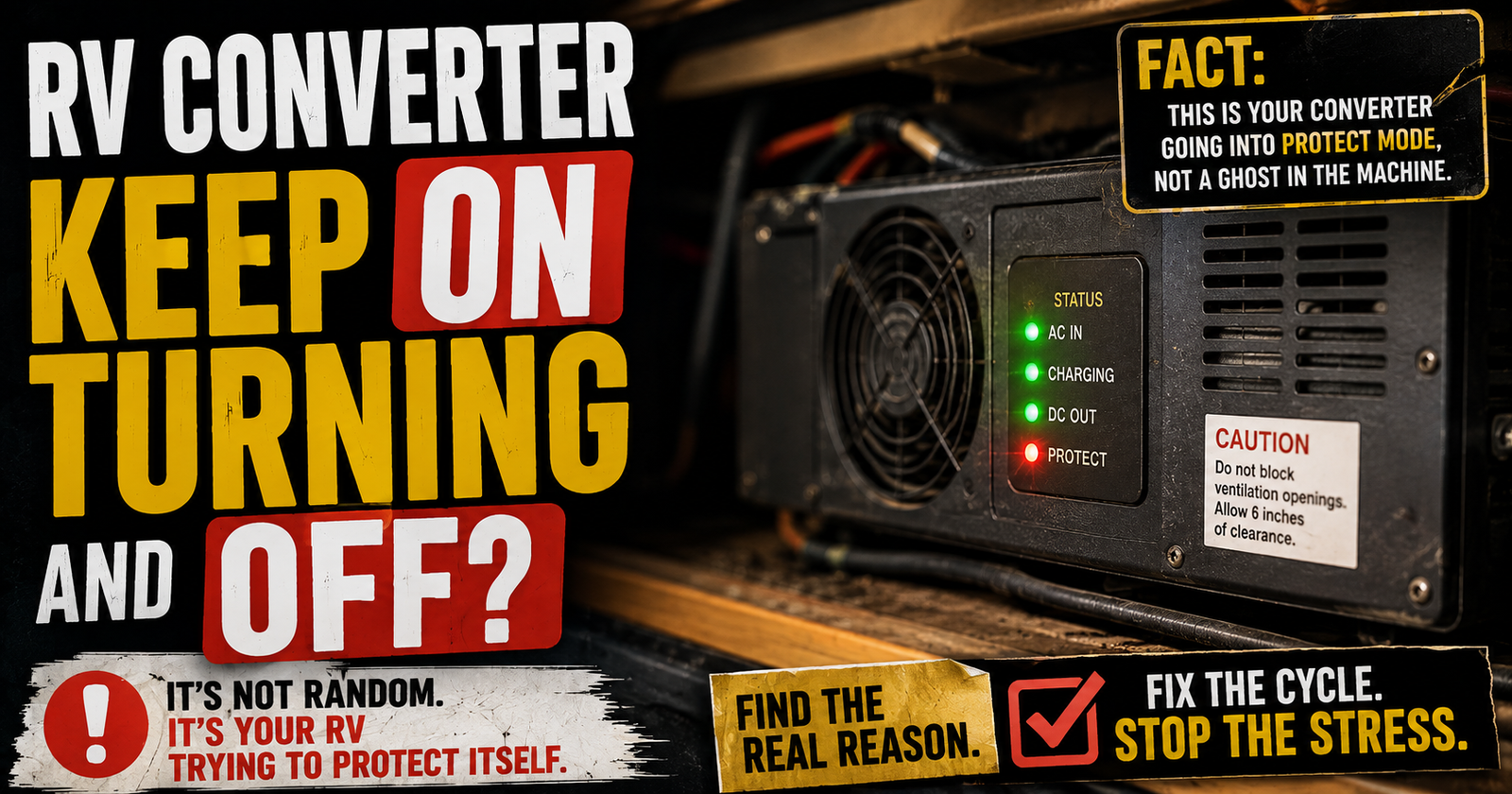
Progressive Dynamics describes its converter equipment as using incoming 120 VAC shore power to produce DC power for the RV’s DC system. That conversion is one part of how an RV works from the batteries to the holding tanks, which covers how the major electrical and utility systems connect.
So if several regular AC outlets are dead while others work, I don’t start by replacing the converter.
We’re troubleshooting the AC distribution side.
Could the RV Outlet Itself Be Bad?
Absolutely.
Receptacles can fail.
But I wouldn’t make that my first assumption when multiple outlets go dead simultaneously.
One dead receptacle with everything else working?
The receptacle itself becomes more interesting.
Five dead outlets on the same circuit?
I’m looking for something they share.
GFCI.
Breaker.
Upstream connection.
Wiring.
Lost supply.
That’s a much more efficient way to think about it.
How Can I Tell If an Outlet Has Power?
A simple plug-in outlet tester can be handy for checking standard receptacles.
A multimeter can provide much more information in knowledgeable hands.
But here’s where I want to draw a line.
Testing an outlet with a properly designed plug-in tester is one thing.
Opening electrical panels and probing live 120-volt connections is another.
Progressive Dynamics specifically warns that troubleshooting RV electrical equipment can involve dangerous live AC voltage and says diagnosis and replacement should be performed by someone who understands the risks.
You don’t have to become an electrician to diagnose the basic pattern.
Check for a Burned or Loose Outlet
If you’re comfortable safely inspecting a receptacle with all AC sources disconnected, look for obvious signs of trouble.
Burning smell.
Discoloration.
Melted plastic.
Heat damage.
Loose receptacle.
Cracking.
Anything that looks cooked.
If an outlet or connection has overheated, I wouldn’t continue using that circuit until the problem is corrected.
And remember that an RV may have multiple possible AC sources.
Shore power needs to be disconnected.
Generator off.
Inverter off where applicable.
Don’t assume unplugging the campground cord automatically means every possible AC circuit is dead in every RV.
What If the Outlet Gets Hot?
That’s not something I’d ignore.
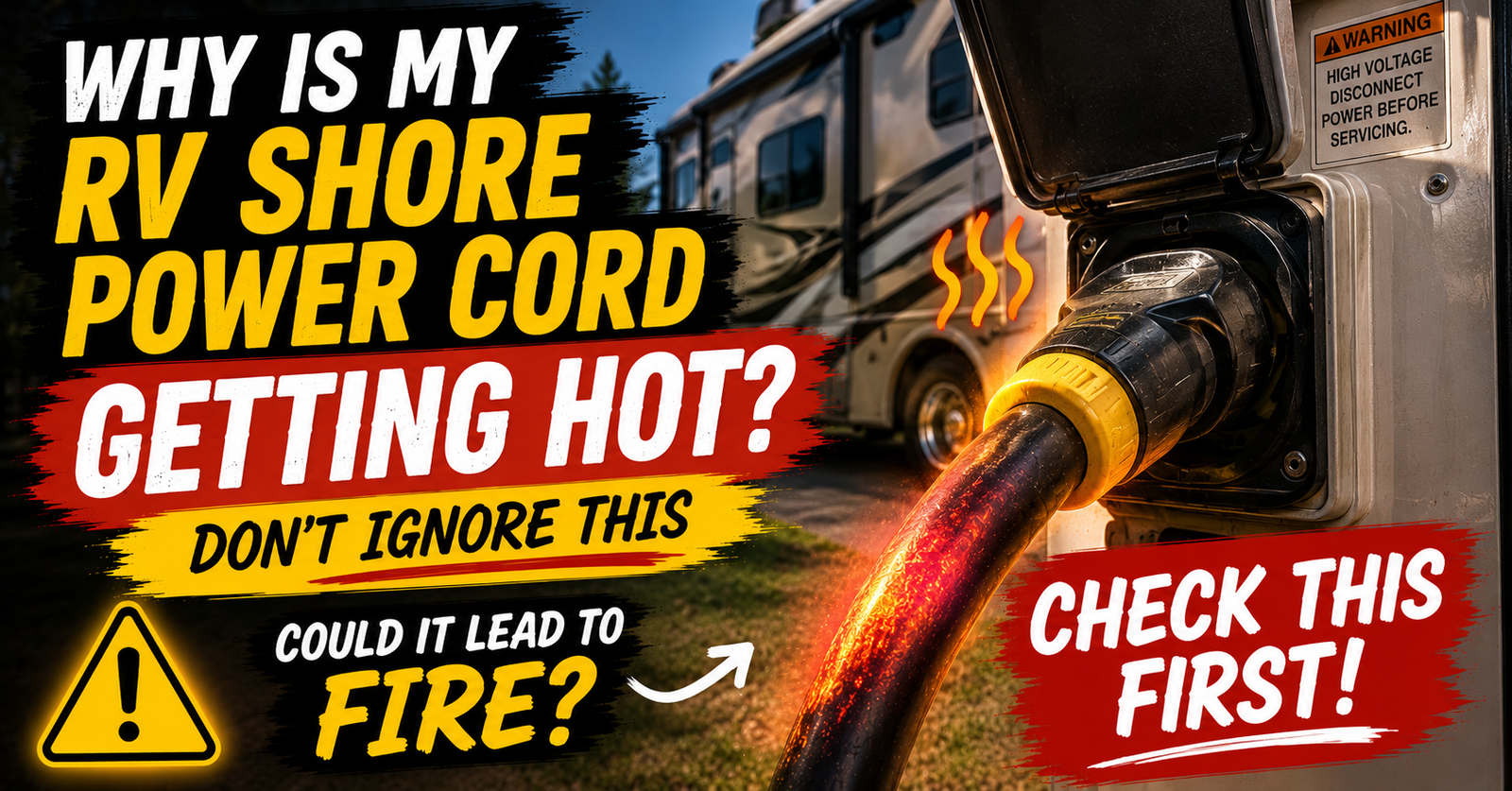
An outlet can get warm because of the load and connection conditions, but abnormally hot, discolored, melted, or burning-smelling electrical equipment needs attention. The same warning signs at the shore cord or plug are covered in abnormally hot electrical equipment.
A poor connection creates resistance.
Resistance creates heat.
If a receptacle is getting hot while running a substantial appliance, stop using it until you understand why.
This is particularly important with portable space heaters and other high-wattage equipment that may run continuously for long periods.
Don’t Test a Questionable Outlet With Your Expensive Electronics
This is one of my little practical rules.
If I’m trying to determine whether an RV outlet has power, I’m not plugging my laptop, television, or expensive appliance into it as my diagnostic tool.
Use appropriate testing equipment.
You don’t need to risk something expensive just to find out whether the receptacle works.
What If the Problem Started After I Plugged Something In?
That’s an excellent clue.
Unplug that device.
Reset the applicable GFCI or breaker if appropriate.
See whether the circuit returns.
If it does, don’t immediately plug the questionable device back in ten times just to prove the point.
Have the appliance, cord, or equipment checked.
Troubleshooting gets much easier when you pay attention to what happened immediately before the failure.
What If the Problem Started After Rain?
Again, useful clue.
I’d pay special attention to exterior receptacles and other areas where moisture may have entered.
A GFCI trip after wet weather isn’t something I’d defeat or bypass.
Find the moisture problem.
Drying out an outlet temporarily doesn’t fix a damaged weather cover, failed seal, cracked receptacle, or another condition allowing water back in.
What If the Outlets Randomly Come Back On?
Intermittent electrical problems make me more suspicious, not less.
If outlets die when the camper moves, come back when you touch something, work after driving, or cut in and out under load, I’d start thinking about connections.
Electricity shouldn’t depend on whether you hit the right pothole.
Intermittent operation can be a clue that something isn’t making reliable contact.
That’s something I want corrected before it progresses into overheating or a complete failure.
My Troubleshooting Order for Some RV Outlets Not Working
I keep this pretty simple.
First, verify that the RV actually has AC shore power.
Then identify every outlet that works and every outlet that doesn’t.
Check and reset the appropriate GFCI.
Check the applicable branch breaker.
Unplug equipment from the affected circuit.
Look for a pattern among the dead receptacles.
If it’s a 50 amp RV and a large group of unrelated circuits is dead, consider whether both incoming legs are present.
Then start thinking about the last working outlet, first dead outlet, wiring connections, and the receptacles themselves.
That order gets you from the easy stuff toward the harder stuff without randomly tearing apart the camper.
When I’d Call an RV Technician or Electrician
I’m comfortable telling somebody to check a breaker or press a GFCI RESET button.
I’m not comfortable telling an inexperienced RV owner to open an energized distribution panel and start probing around until they find 120 volts.
If the easy checks don’t solve it and you suspect:
A lost 50 amp leg
Damaged wiring
Burned connections
A transfer-switch problem
A distribution-panel problem
An intermittent open connection
or another internal AC fault,
that’s when qualified electrical diagnosis makes sense.
The good news is that you’ve already narrowed the problem considerably.
Instead of telling the technician:
“My camper electricity doesn’t work.”
you can say:
“The microwave and kitchen outlets work, but the bathroom, exterior, and bedroom outlets are dead. The GFCI and branch breaker have been checked.”
That’s useful information.
Some Working Outlets Are Actually Good News
Not because dead outlets are fun, but because partial power gives us clues.
If some outlets work, we know electricity is making it into at least part of the AC system.
Now we’re trying to find where it stops.
Most of the time, I start with the boring possibilities because they’re also some of the easiest to fix:
GFCI first. Breaker second. Then figure out which dead outlets share a circuit.
If those checks don’t solve it, don’t start replacing every outlet in the camper.
Find the last place electricity is known to work and work forward from there.
That’s how you turn a frustrating “half my camper is dead” problem into a much smaller electrical problem you can actually track down.
Written by Evan Mercer
Evan Mercer writes about RV electrical systems, shore power, campground hookups, batteries, converters, and everyday camper troubleshooting for CamperAnswers.com. He focuses on helping RV owners understand how their campers actually work so they can narrow down a problem before replacing parts that weren’t broken in the first place.