
You can leave your camper plugged in all day and still end up with a dead battery. That’s the frustrating part about an RV battery that won’t charge: seeing the shore-power cord plugged in makes it feel like charging must be happening. It doesn’t prove that power is actually making it all the way to the battery. That same symptom is examined in detail in this guide to RV battery dying while plugged in.
If your RV battery isn’t charging, the problem can be as simple as a battery disconnect in the wrong position, a blown fuse, a tripped breaker, a loose or corroded connection, or a battery that’s reached the end of its useful life. It can also be farther upstream, including a converter or inverter/charger that isn’t receiving AC power or isn’t producing the DC output the battery needs. If charging checks do not explain the symptom, this guide to battery power disappearing quickly helps broaden the investigation.
Before replacing the battery or converter, I’d figure out exactly where the charging process stops.
First Make Sure You Really Have a Charging Problem
A low battery and a battery that won’t charge aren’t necessarily the same problem.
Suppose you wake up with a nearly dead house battery after camping without hookups. That could be an excessive-use problem rather than a charging failure. We already covered the common reasons an RV battery can lose its charge overnight, including furnace use, inverter loads, parasitic draws and limited battery capacity.
For this problem, we’re looking for something different.
You have a charging source available, but the battery isn’t gaining the charge you expect.
Maybe you’re connected to shore power.
Maybe the generator is running.
Maybe you expect the tow vehicle to charge the trailer while driving.
Maybe you have solar panels producing power.
The first question isn’t simply, “Why isn’t my battery charging?”
It’s:
What source is supposed to be charging it right now?
That distinction can cut the problem in half immediately.
How an RV Battery Normally Charges on Shore Power
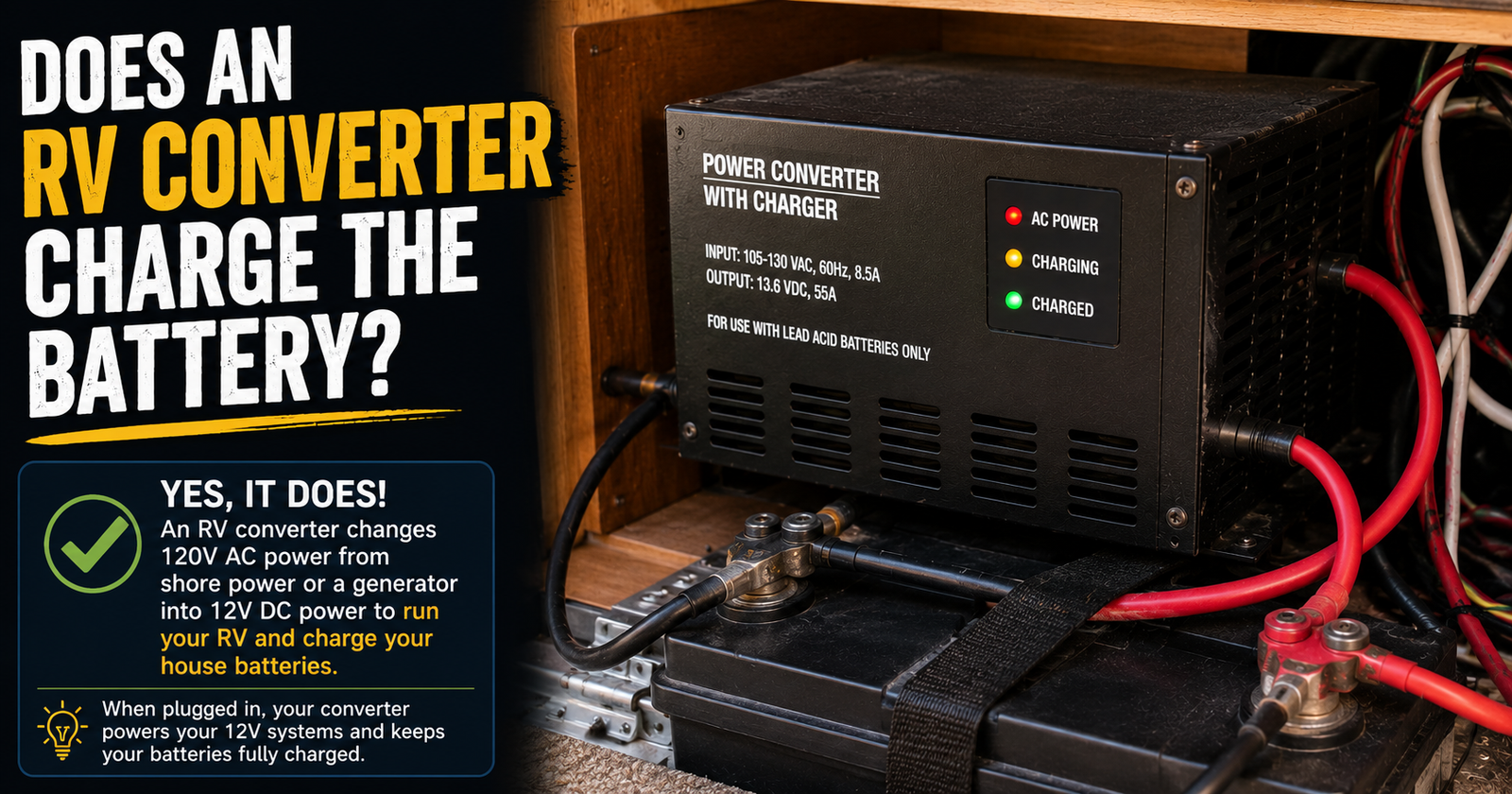
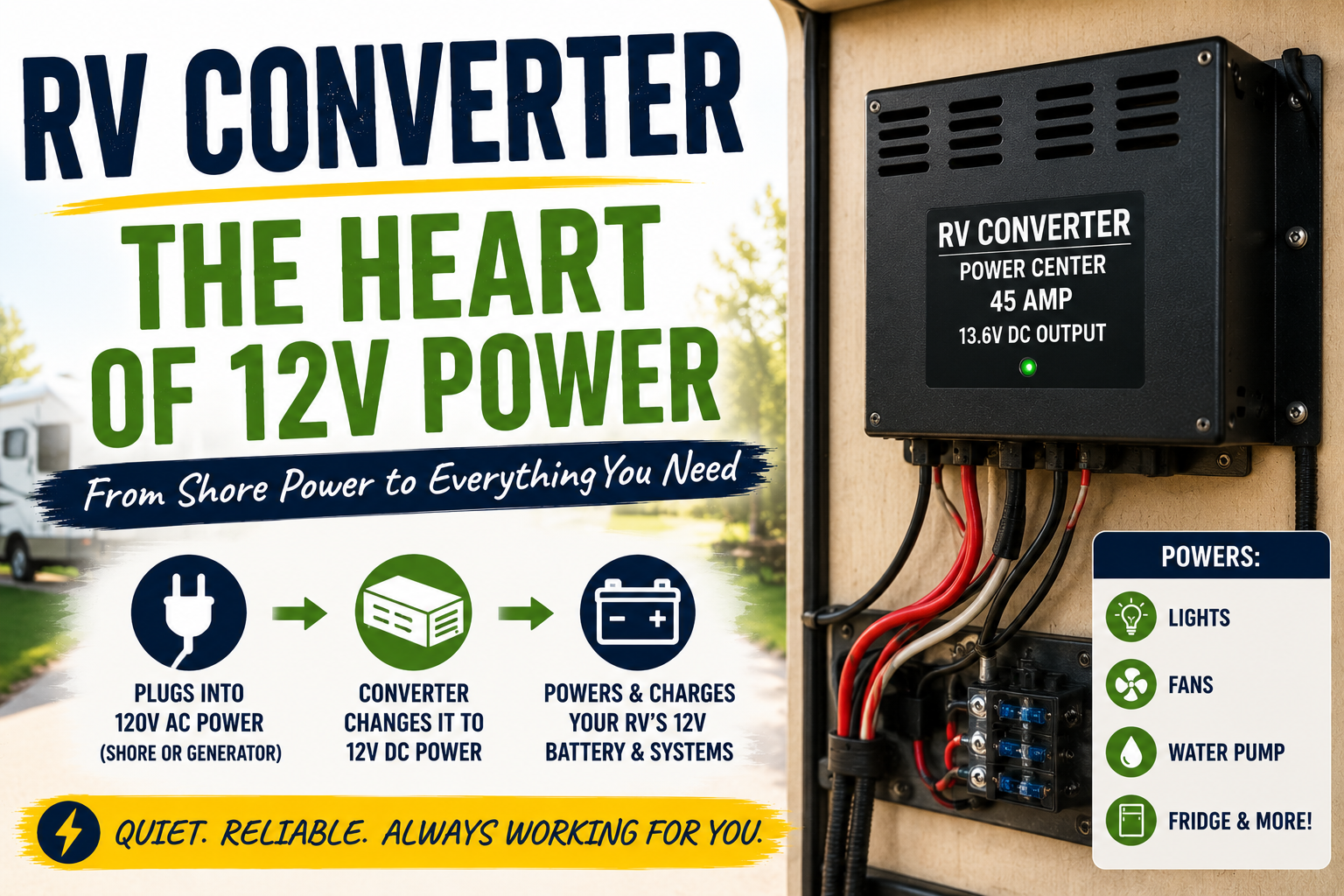
When many conventional RVs are connected to appropriate 120-volt shore power, a converter/charger takes AC electricity and provides DC power for the 12-volt system while also charging the house battery. The full explanation of how an RV converter charges is useful before moving on to voltage tests and fault isolation.
Some RVs use an inverter/charger instead of a standalone converter.
The equipment varies, but the basic troubleshooting logic is similar.
Power has to reach the charging equipment.
The charging equipment has to operate.
Its DC output has to make it through the wiring and protection devices between the charger and battery.
The battery then has to be capable of accepting and storing that energy.
A failure anywhere along that path can leave you with a battery that doesn’t charge.
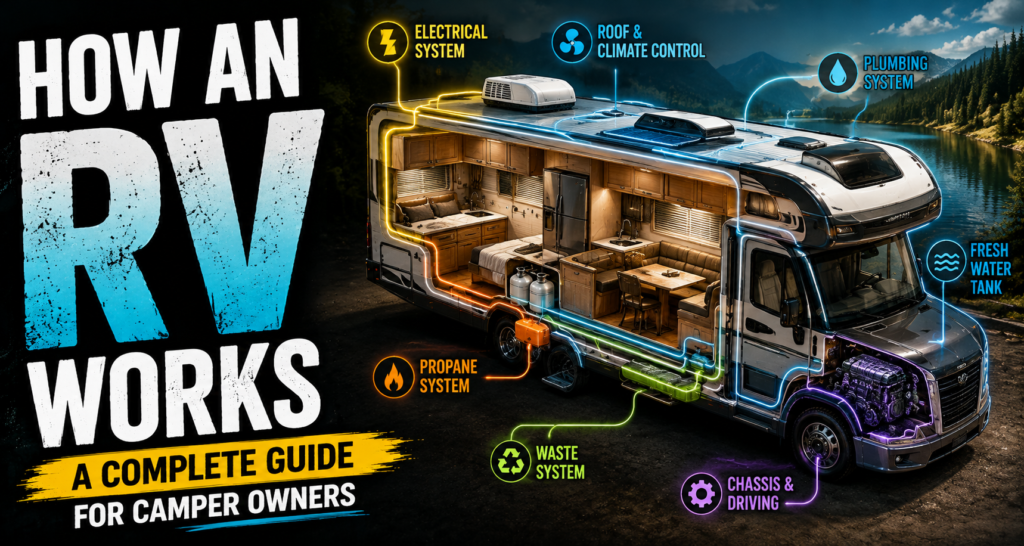
If all those pieces still feel like alphabet soup, our guide explaining how the electrical and other major systems in an RV work together is worth reading before getting deeper into electrical troubleshooting.
Start With the Power Source Instead of the Battery
It’s easy to immediately blame the battery because that’s where you notice the problem.
I like starting at the other end.
If shore power is supposed to be charging the battery, confirm that the RV actually has shore power.
Don’t use the fact that one light works as proof.
Many RV lights operate on 12-volt DC power and can continue working from the battery even when the RV has lost its 120-volt AC supply.
Instead, look at equipment that you know requires 120-volt power on your particular RV.
If the entire 120-volt side is dead, you probably have a larger shore-power problem to solve before worrying about the battery charger.
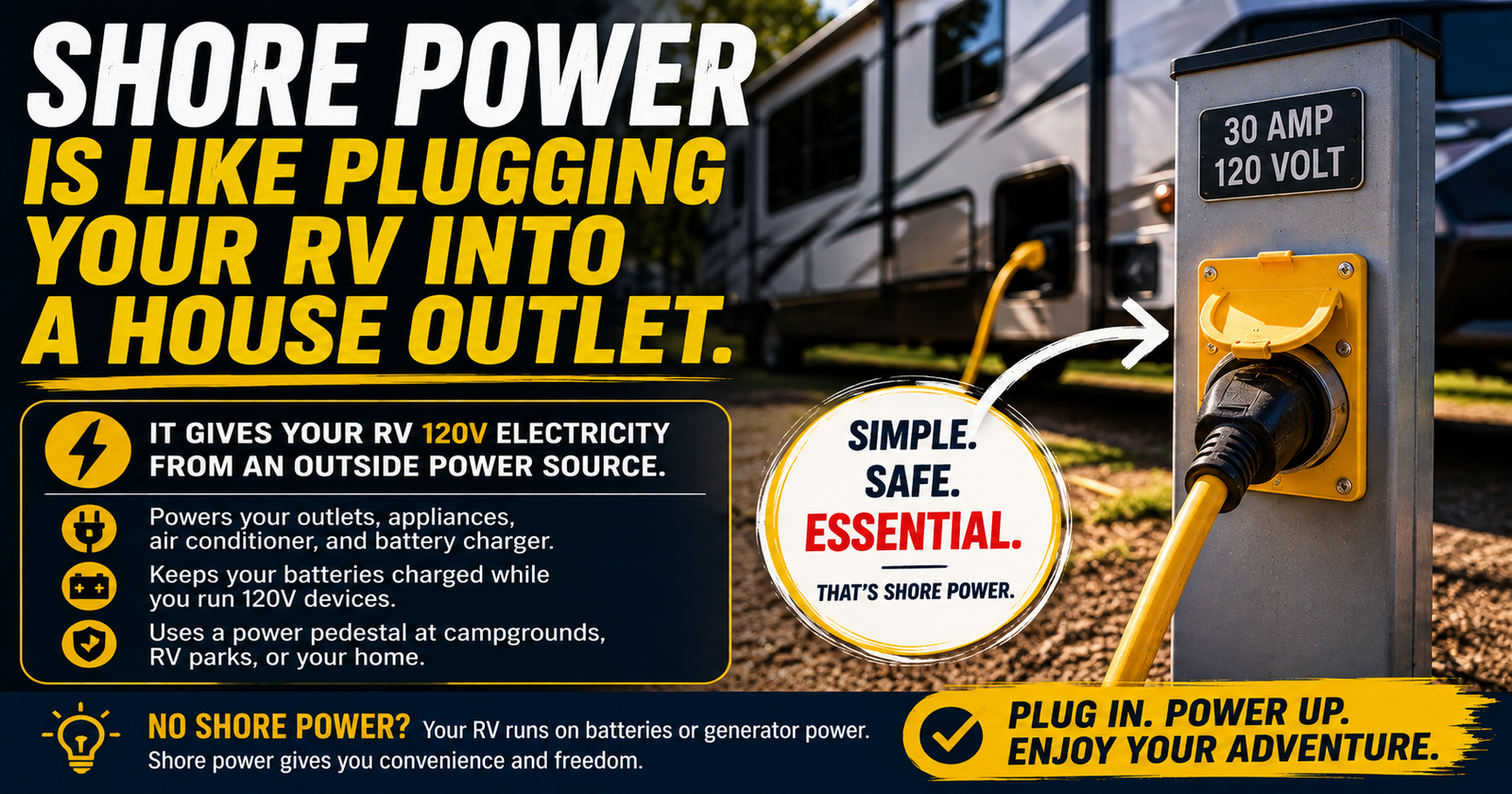
Check the Campground Pedestal and Shore-Power Connection
If you’re at a campground, the problem can begin before electricity ever reaches the camper.
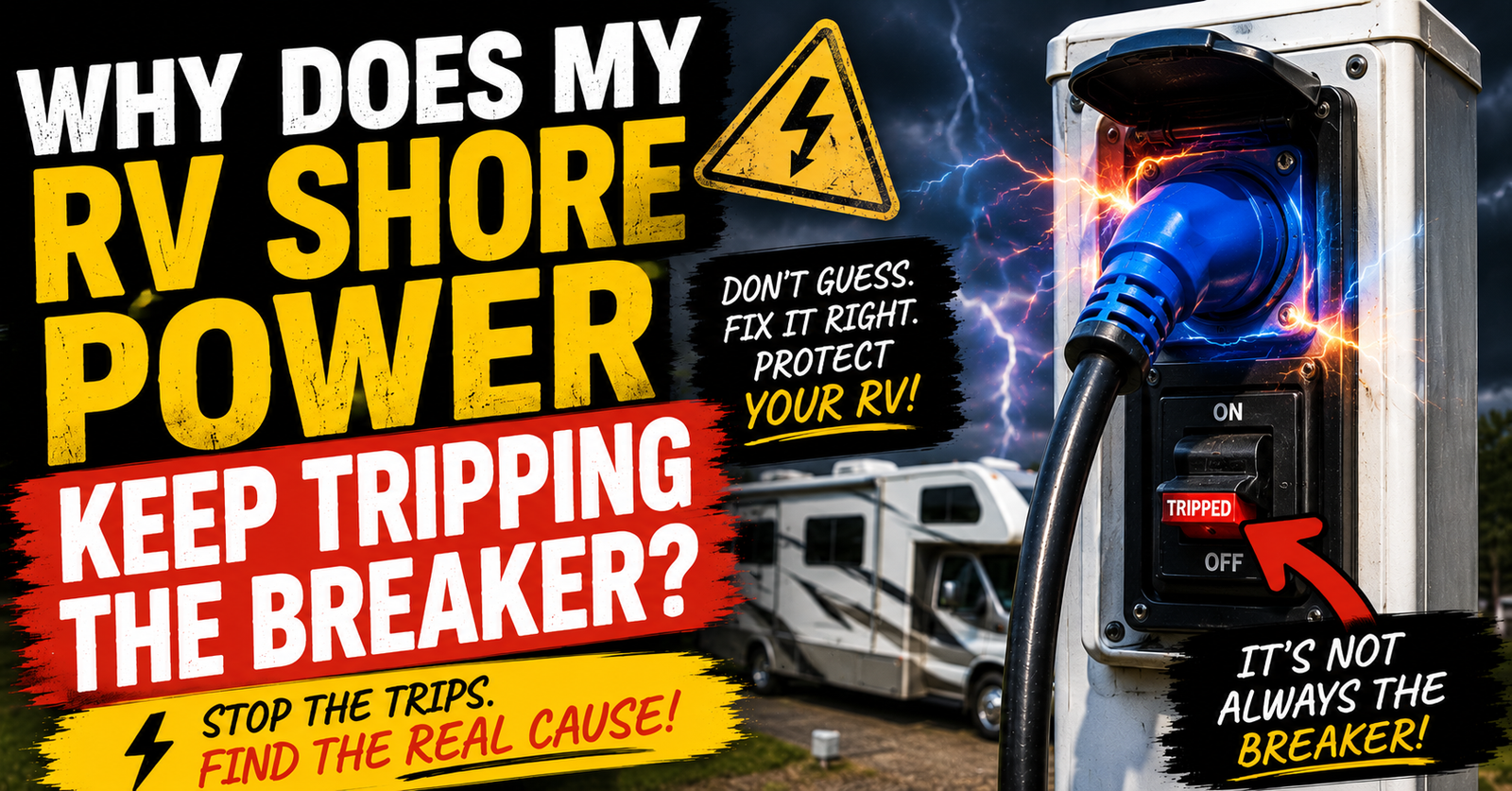
The pedestal breaker may be off or tripped.
There may be a problem with the pedestal itself.
A plug, cord or connection may be damaged.
If you’re using an electrical management or surge-protection device, it may be preventing connection because it has detected an unacceptable power condition.
Look for obvious trouble without opening or working inside energized electrical equipment.
A shore-power plug or cord that is unusually hot, visibly damaged, burned or melted deserves immediate attention rather than continued use.

Check the RV’s Main AC Breakers
Once you know appropriate AC power is available to the camper, look at the RV’s breaker panel.
The converter or charging equipment needs an AC supply of its own.
Depending on the RV, the converter may be supplied by a dedicated breaker or connected through another arrangement.
A tripped breaker can therefore create an interesting situation.
Some parts of the RV may appear to have normal AC power while the converter itself isn’t operating.
Resetting a breaker is only reasonable after considering why it tripped. If it immediately trips again, don’t keep forcing it back on.
A breaker that repeatedly opens is telling you there’s a problem that needs diagnosis.
The Converter May Have Lost Its AC Input
A converter can’t turn AC electricity into DC electricity if the AC electricity never reaches it.
That sounds obvious, but it’s an important distinction.
Imagine replacing a perfectly good converter because it has no DC output, only to discover that the outlet or circuit feeding it had no power.
That’s why proper converter troubleshooting verifies both sides of the equation.
Does it have the AC input it requires?
Does it produce the expected DC output?
Those two answers tell you much more than simply knowing the battery is dead.
What the Converter Is Actually Doing
The converter is the bridge between the RV’s AC supply and much of its DC system.
When 120-volt power is available, the converter changes that power into DC electricity suitable for the RV’s 12-volt system and charging arrangement.
Modern converter/chargers may use different charging stages or profiles rather than applying one fixed charging voltage all the time.
That’s important when you’re looking at voltage readings.
There isn’t one universal voltage number that every RV converter should produce at every moment regardless of battery chemistry, charger design and battery condition.
Use specifications for the converter or inverter/charger actually installed in your RV.
Check Whether the Converter Is Producing DC Power
Once AC input has been confirmed, converter output becomes one of the most useful diagnostic checks.
Some manufacturers provide specific procedures and expected output ranges for their equipment.
For example, certain Progressive Dynamics converter troubleshooting procedures specify approximately 13.6 volts DC for particular standard models, while lithium-specific versions use different values.
That’s exactly why I wouldn’t give every RV owner one magic number and say anything else means the converter is bad.
Identify your converter.
Find its model number.
Find the manufacturer’s troubleshooting information.
Then compare the actual output with what that particular unit is supposed to produce.
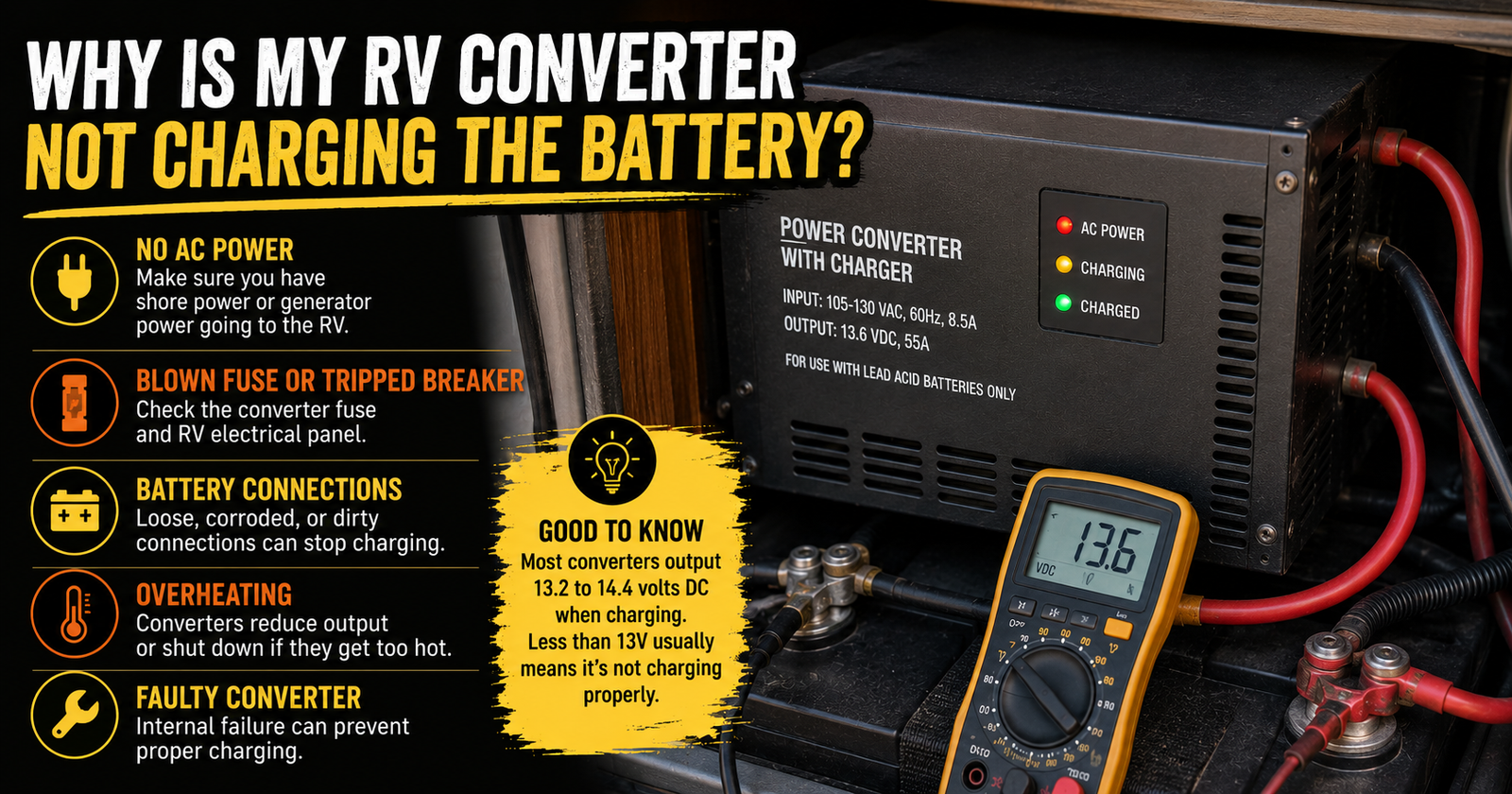
If the converter has correct input and correct output but the battery still isn’t charging, the diagnostic path moves downstream toward the battery circuit.
A Fuse or Breaker Between the Converter and Battery Can Stop Charging
This is one of the first things I’d investigate when the converter appears to be working but the battery isn’t receiving charge.
The positive charging path may contain a fuse, breaker or other protection device.
If that path opens, the converter can potentially continue supplying parts of the RV’s 12-volt system while the battery itself doesn’t receive the charging current it should.
That can make the failure confusing.
Your lights may work beautifully while you’re plugged in.
Everything looks normal.
Then you unplug the camper and suddenly the battery is dead.
That pattern strongly suggests looking beyond “the converter works” and asking whether the converter is actually connected electrically to the battery through an intact charging path.
Look for a Battery-Side Circuit Breaker
Some RVs use DC circuit breakers near the battery.
Depending on the equipment, these may be manual-reset or automatic-reset devices.
They can be easy to overlook because they may not resemble the familiar breakers inside your household electrical panel.
Follow the RV and component manufacturer’s information to identify the protection devices used in your particular charging circuit.
Don’t bypass a fuse or breaker as a permanent “test.”
It’s there to protect wiring and equipment.
Reverse-Polarity Fuses Can Matter
Some converters include reverse-battery protection fuses.
These are designed to protect the converter if battery polarity is accidentally reversed.
That becomes especially worth checking if the charging problem started immediately after a battery was replaced, disconnected, reconnected or serviced.
A momentary reversed connection can create a problem even if the cables are currently installed correctly.
If your converter manufacturer provides a procedure for checking reverse-polarity fuses, follow that procedure and use only the specified replacement fuse rating.
Never install a larger fuse because the correct one keeps blowing.
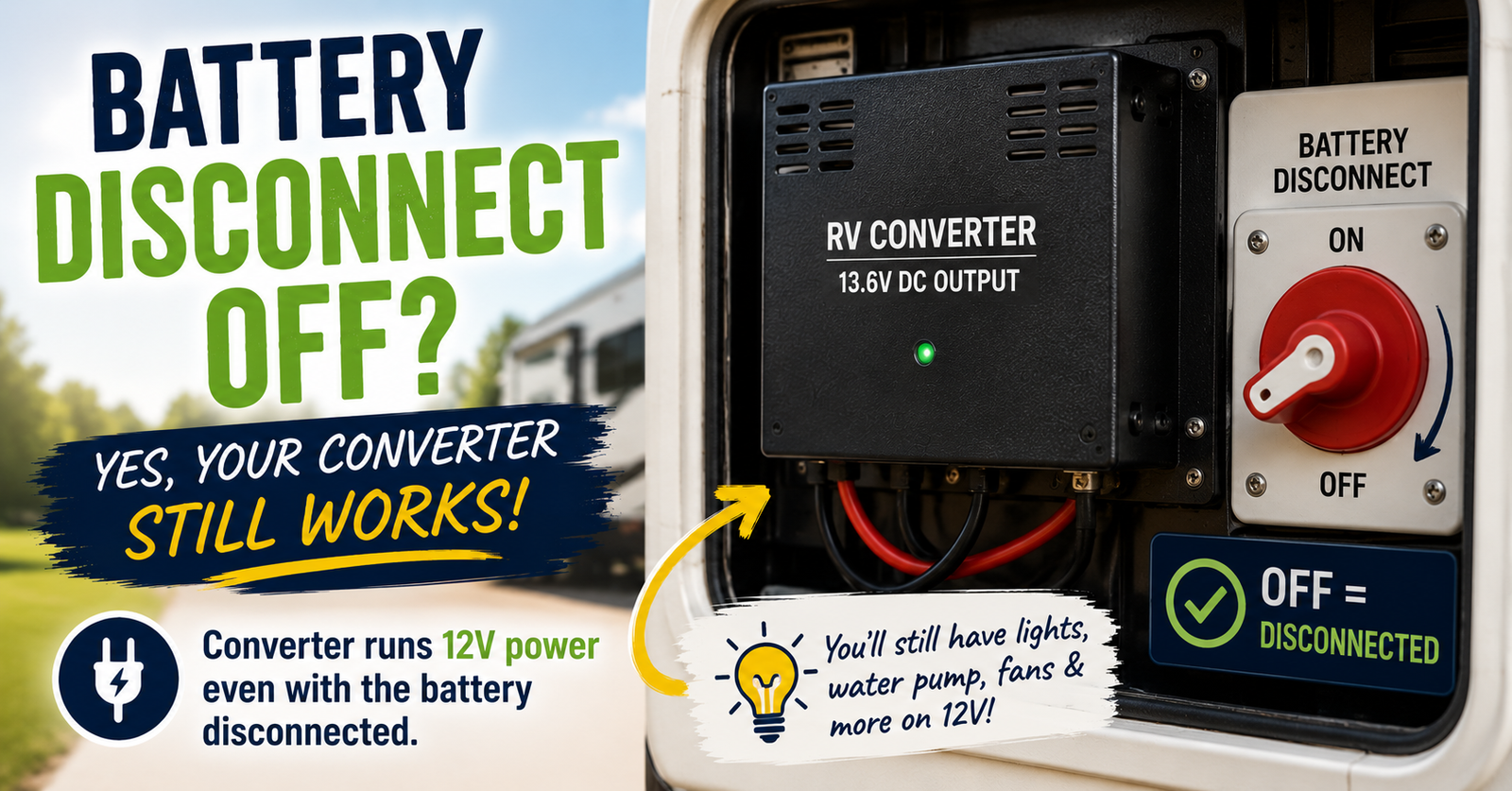
Check the Battery Disconnect
The battery disconnect is another simple thing that can create a surprisingly confusing problem.
Depending on the RV’s design, placing the battery disconnect in its disconnected or storage position may prevent the charging system from reaching the battery normally.
Owners sometimes assume plugging into shore power automatically overrides everything.
That isn’t a safe assumption across every RV.
If the problem started after storage, service work or somebody operated the disconnect, verify its proper position according to your RV’s instructions.
And remember that disconnect arrangements aren’t standardized across every camper.
Inspect the Battery Connections
Electricity needs a complete path.
Loose, corroded or damaged battery connections can interfere with charging and with the battery’s ability to supply power.
Look at both positive and negative connections.
A poor ground connection can be just as troublesome as a problem on the positive side.
Check for obvious corrosion, looseness, damaged cables or connections that don’t look secure.
Don’t work around a battery while wearing conductive jewelry, and be extremely careful not to bridge battery terminals or positive power to ground with a tool.
A 12-volt battery system can supply enough current to create intense heat and sparks during a short circuit.
Don’t Forget the Negative Side of the Circuit
People naturally focus on the positive battery cable because that’s the side where many fuses and breakers are located.
But the circuit needs a return path.
A compromised negative cable or chassis connection can interfere with charging and create other strange electrical symptoms.
If you’re chasing a charging problem that doesn’t make sense, don’t inspect only half of the circuit.
The Battery Itself May Be the Problem
Sometimes the charging system is doing exactly what it’s supposed to do.
The battery simply can’t accept or retain a useful charge anymore.
Battery performance deteriorates with age, use, maintenance history, temperature and other factors.
Lead-acid batteries can suffer from problems related to deep discharge and inadequate charging.
Physical damage can occur.
A battery may develop an internal fault.
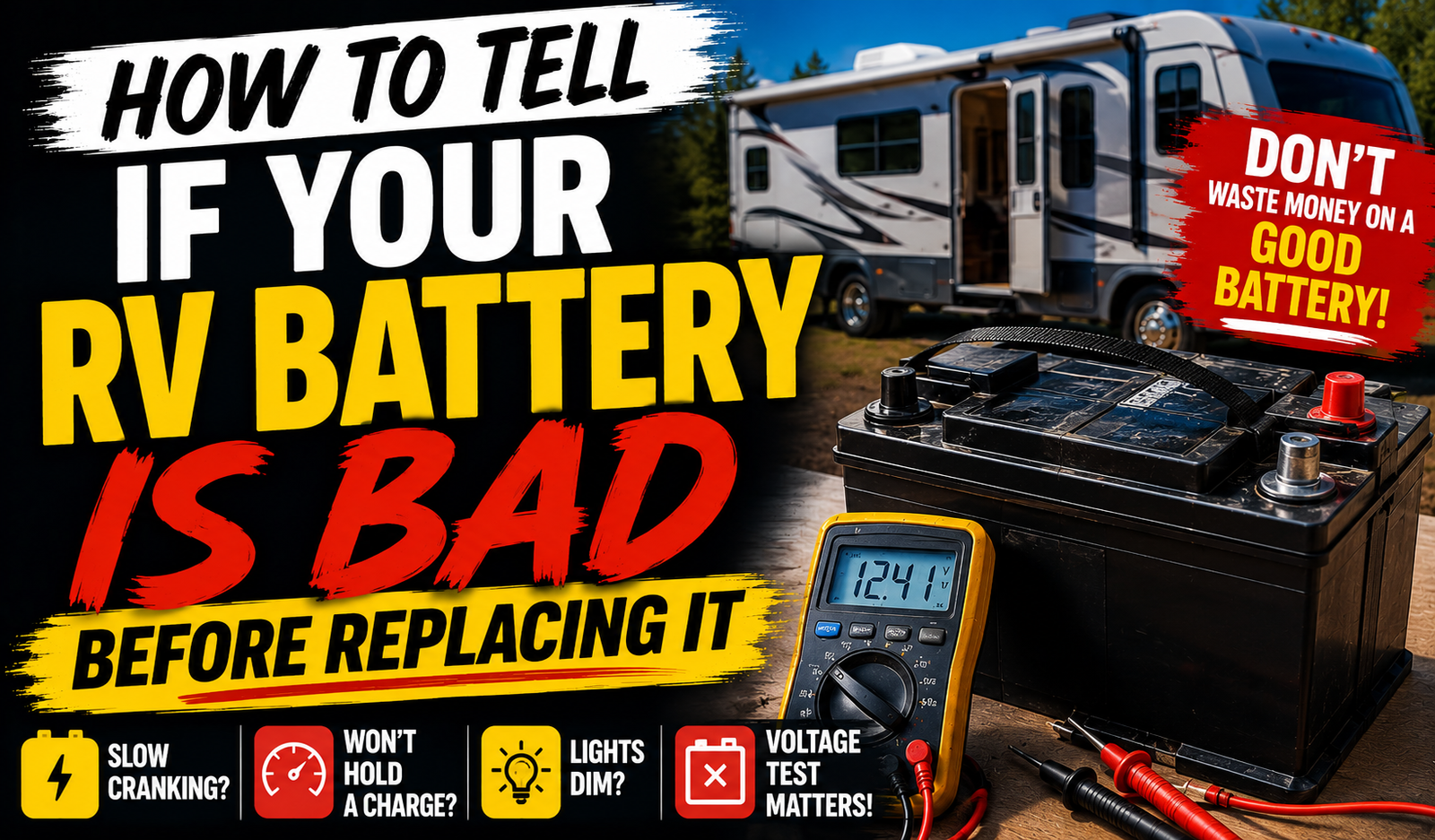
A battery that’s been repeatedly run deeply discharged may no longer provide anything close to its original usable capacity. When capacity has fallen after repeated deep discharges, check whether deep discharge caused lasting damage before deciding what to do next.
That’s why measuring charger output alone doesn’t prove the battery is healthy.
Battery Age Is Useful, but It Isn’t a Diagnosis
An old battery deserves suspicion.
A new battery isn’t automatically innocent.
A recently purchased battery can still be discharged, damaged, incorrectly installed, inappropriate for the charging setup or affected by another system problem.
If a brand-new battery won’t charge, I’d be particularly interested in whether the problem existed before the battery replacement.
If it did, the old battery may have been blamed for a charging-system problem that was there all along.
Battery Chemistry Really Matters
This is increasingly important as more RVs use lithium batteries.

Flooded lead-acid, AGM and lithium batteries don’t necessarily use identical charging requirements. Before comparing readings, review battery chemistry and voltage so the measurement is judged against the right expectations.
A converter designed around one battery chemistry may not be appropriate for another without the proper charging mode or configuration.
Some modern equipment has selectable profiles.
Some detects battery types.
Some is designed specifically for a particular chemistry.
Some older equipment may not provide the charging behavior expected by a newer battery installation.
If the charging problem began after changing battery type, compatibility moves very high on my list.
Lithium Batteries Can Add Another Layer of Troubleshooting
Lithium batteries commonly include a battery management system, usually called a BMS.
The BMS can protect the battery by limiting or disconnecting operation under certain conditions.
That means a lithium battery that appears unwilling to charge isn’t automatically defective.
Temperature, low-voltage protection, battery configuration and charger compatibility can matter depending on the battery.
Cold-weather charging is particularly important.
Some lithium batteries restrict charging at low cell temperatures to protect themselves. Heated battery systems may handle cold conditions differently.
Follow the battery manufacturer’s specifications instead of applying generic lead-acid troubleshooting to a lithium battery.
If It Charges on Shore Power but Not While Driving
Now we’ve isolated the problem much further.
If shore power successfully charges the battery but towing or driving doesn’t, the battery has demonstrated that it can accept at least some charge and the shore-power charging equipment is doing something useful.
The problem is more likely related to the charging path available while traveling.
Towable RVs may receive charging current through the tow vehicle’s trailer connector, depending on the vehicle and trailer configuration.
Motorhomes may use other charging arrangements between the chassis and house electrical systems.
Modern vehicles and lithium battery installations can make this more complicated than simply connecting one wire between two batteries.
The correct diagnosis depends on the actual vehicle and charging equipment.
If It Charges While Driving but Not on Shore Power
That’s another valuable clue.
Now the battery has shown that it can accept energy from at least one source.
I’d focus more heavily on the shore-power charging path.
Confirm AC power.
Check the converter or inverter/charger supply.
Check relevant breakers and fuses.
Verify charger output.
Inspect the connection from the charger toward the battery.
You can see why comparing charging sources is so useful.
Instead of troubleshooting the entire electrical system, you’ve isolated the failure to one branch.
If Solar Charges the Battery but Shore Power Doesn’t
Same idea.
If solar charging works normally, you know something about the battery and at least one charging path.
That doesn’t prove the battery is perfect, but it gives you evidence.
Now concentrate on the shore-power charging equipment rather than tearing apart the solar system.
Conversely, if shore power charges correctly but solar doesn’t, the solar system deserves its own diagnosis.
Solar panels, wiring, protection devices, charge controllers, settings, sunlight conditions and battery state can all influence solar charging.
Don’t Assume Solar Is Broken Just Because Amps Are Low
A solar charge controller doesn’t necessarily send maximum current into a battery every moment sunlight is available.
As a battery approaches full charge, the charging system may reduce current.
Available sunlight also changes constantly.
Shade, clouds, sun angle, season, panel temperature and other factors affect production.
Before diagnosing a solar problem from one number on a display, understand what the controller should be doing under those exact conditions.
If the Generator Runs but the Battery Still Doesn’t Charge
A running generator doesn’t automatically mean usable AC power is reaching the charging equipment.
First determine whether the generator is actually supplying the RV’s AC system.
If the outlets and other appropriate AC equipment are dead too, the issue may be between the generator and the RV’s AC distribution system.
If the generator clearly supplies AC power but the battery doesn’t charge, the problem begins looking more like the same charging path you’d investigate on shore power.
Depending on the RV, shore power and generator power may ultimately feed the same converter or inverter/charger.
What If the RV Has an Inverter/Charger Instead of a Converter?
Larger or more sophisticated RV electrical systems may use an inverter/charger.
This combines functions that might otherwise be handled by separate devices.
It can create AC power from the battery when you’re away from external AC power and charge the battery when an appropriate AC source is available.
Configuration becomes particularly important with these systems.
Charging can be affected by settings, battery type, charge-current limits, operating modes and other system-specific parameters.
Don’t assume troubleshooting instructions written for a basic standalone converter apply directly to a sophisticated inverter/charger.
Identify the equipment first.
Your Battery Monitor Can Help, but Understand What It’s Showing
Modern RVs may have battery monitors ranging from simple voltage displays to sophisticated shunt-based systems.
They’re extremely useful when interpreted correctly.
A voltage display tells you voltage.
It doesn’t automatically tell you exactly how many amp-hours remain in every battery under every operating condition.
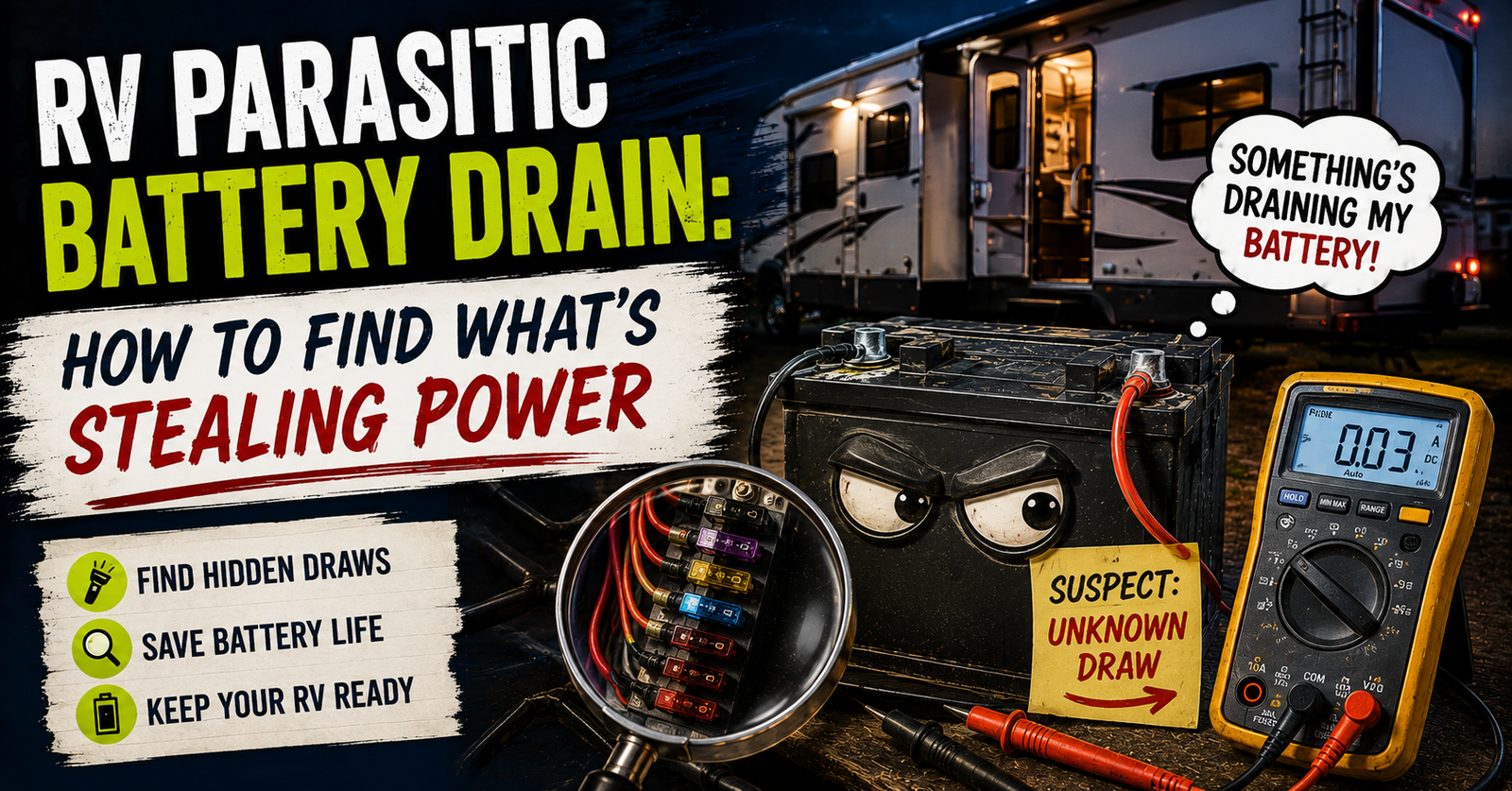
A shunt-based monitor can provide much more information about current flowing into and out of the battery, but it also needs to be installed and configured correctly. When unexplained current continues after the charging path checks out, parasitic-draw testing can help identify what is still using battery power.
When troubleshooting charging, watching whether current is actually flowing into the battery can be extremely informative.
Why the Battery Can Show Higher Voltage but Still Not Be Fully Charged

Seeing voltage rise after connecting a charger is encouraging, but it doesn’t necessarily mean the battery has reached full charge. A battery can appear to charge and then lose usable voltage even when the charging voltage initially looks normal.
Charging takes time.
How long depends on battery capacity, depth of discharge, battery chemistry, charger output, other loads operating during charging and the charging profile.
If the camper is simultaneously using substantial 12-volt power, not all available charger output is necessarily going toward replenishing the battery.
This is another reason “I plugged it in for an hour” doesn’t automatically mean the battery should now be full.
A Converter That Runs Doesn’t Automatically Mean It’s Charging Correctly
You may hear a converter fan.
You may see lights working.
Neither observation alone proves that the battery is receiving an appropriate charge.
The 12-volt loads can operate while a problem exists in the battery charging path.
The converter may also have a problem that requires actual testing rather than listening for operating noise.
Treat symptoms as clues, not proof.
A Converter Fan That Isn’t Running Isn’t Automatically Bad Either
Converter fans often operate according to load and temperature.
A fan may not need to run constantly.
So don’t diagnose a failed converter solely because you don’t hear the fan.
Actual electrical measurements compared with the manufacturer’s specifications tell you much more.
Why a Battery Might Charge Very Slowly
Slow charging is different from no charging.
A large battery bank can take considerable time to replenish.
Charging equipment has a finite output.
Other 12-volt loads can consume part of that available output.
Battery temperature, battery chemistry and charger programming can also affect charge rate.
If the battery is gaining charge but doing so more slowly than expected, measure what’s actually happening before concluding the charger has failed.
Corroded or Undersized Wiring Can Hurt Charging Performance
Resistance matters in low-voltage DC systems.
Long cable runs, poor connections and inadequate conductor sizing can contribute to voltage drop.
That can become particularly noticeable when substantial charging current is involved.
If a charging system has always performed poorly rather than suddenly failing, installation details deserve consideration.
If it worked perfectly for years and suddenly stopped, I’d initially look harder for a failure or changed condition.
What I’d Check Before Buying a New Converter
Converters aren’t something I’d replace simply because the battery is low.
I’d want answers to several questions first.
Is proper AC power reaching the converter?
Are the relevant AC breakers on?
Are the converter’s required fuses intact?
Does the converter produce the DC output its manufacturer specifies?
Is the charging path from the converter to the battery intact?
Are the battery connections good?
Is the battery disconnect configured correctly?
Can the battery accept a charge from another appropriate charging source?
Is the charger configured for the battery chemistry?
If those questions haven’t been answered, replacing the converter is still partly guessing.
What I’d Check Before Buying Another Battery
I’d use similar logic before condemning the battery.
Confirm that it has actually been given an appropriate opportunity to charge.
Verify that the charger is compatible with the battery.
Look for loose or corroded connections.
Consider battery age and history.
Look for physical warning signs.
Determine whether it can accept and retain a charge when tested properly.
If the previous battery developed the same problem, be especially cautious about blaming the replacement battery.
Don’t Ignore a Hot, Swollen or Leaking Battery
A charging problem can sometimes become a battery safety problem.
If a battery is unusually hot, visibly swollen, leaking or producing a concerning odor, stop treating this as ordinary troubleshooting.
Avoid sparks and ignition sources around batteries, particularly where gases may be present.
Follow the battery manufacturer’s safety guidance and have the system inspected when appropriate.
The goal isn’t to squeeze one more camping weekend out of a battery that’s showing signs of a potentially serious problem.
A Simple Symptom Pattern Can Narrow This Down Fast
If the battery won’t charge only on shore power, focus on the shore-power charging path.
If it won’t charge only while driving, focus on the vehicle-to-house charging arrangement.
If it won’t charge only from solar, investigate the solar charging system.
If it won’t charge from any source, battery condition, battery connections, disconnects and shared portions of the battery circuit become much more suspicious.
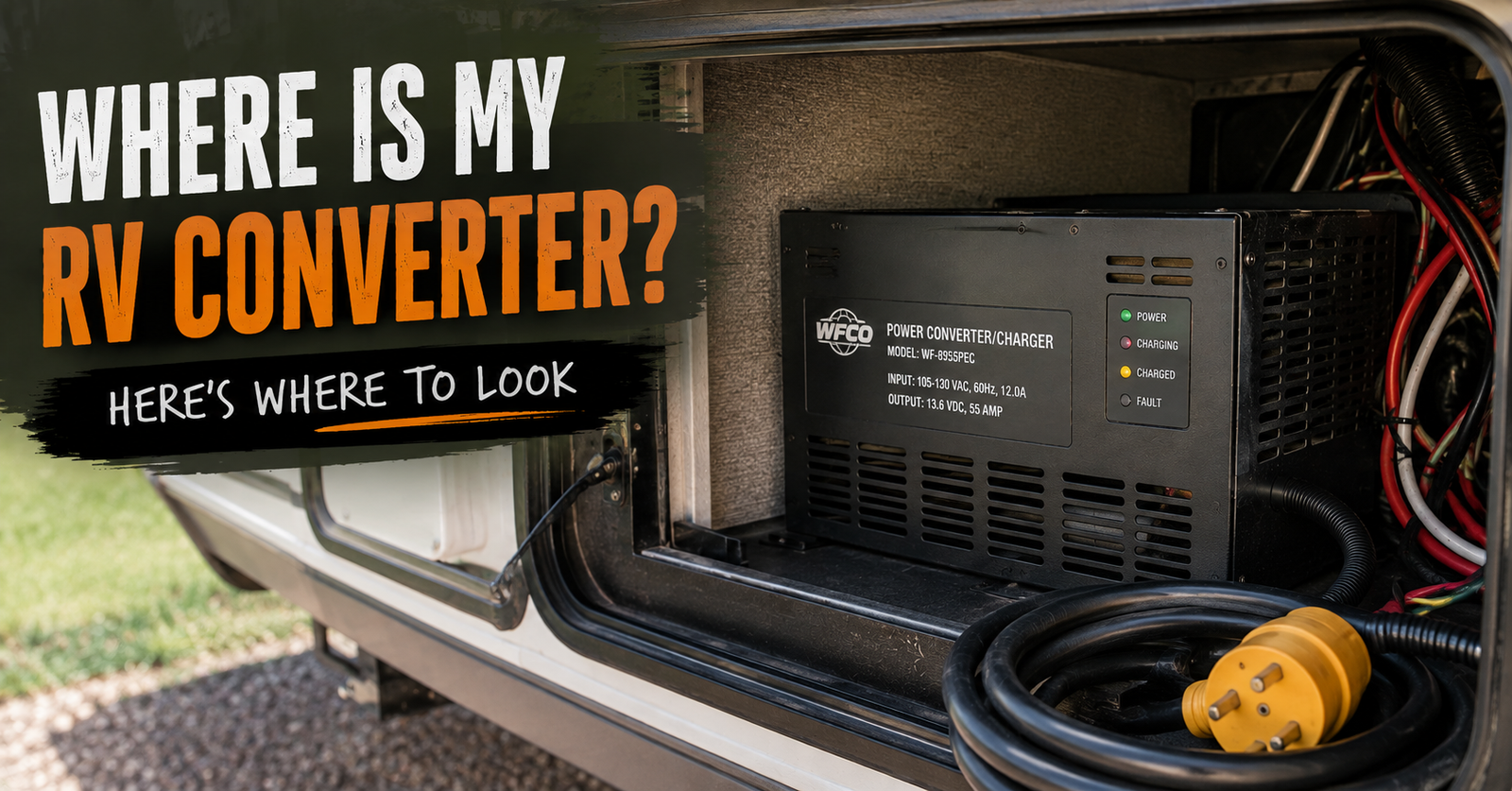
If 12-volt equipment works while plugged in but dies immediately when shore power is removed, investigate whether the battery is actually connected and being charged. Before testing that charging path further, it helps to know the RV converter's location.
If the problem started immediately after battery replacement, check polarity, protection devices, connections and charger compatibility.
Those patterns are far more useful than replacing whichever component happens to be easiest to reach.
When Electrical Testing Becomes Worthwhile
Once the basic checks are exhausted, voltage and current measurements can show where charging stops.
But electrical testing needs to be performed correctly.
Measuring converter output according to its manufacturer’s procedure is one thing.
Opening energized AC equipment or improvising around high-current battery cables is another.
RV batteries can produce extremely high fault current, and the RV’s AC system carries potentially lethal voltage.
If you’re not comfortable identifying the circuits and using a meter correctly, this is where a qualified RV technician or electrical professional becomes worth the money.
A good technician shouldn’t merely tell you the battery is dead.
The useful diagnosis is why it isn’t charging.

Once you identify whether the failure is at the power source, charger, protection device, wiring, connection or battery, you’re fixing the actual problem instead of feeding it another battery every few months. If the battery keeps failing after replacement, RV battery can keep going dead helps separate a bad battery from an unresolved charging or power-use problem.
Written by Evan Mercer
Evan Mercer writes about RV systems, camper troubleshooting, maintenance and everyday ownership questions for CamperAnswers.com. His work focuses on turning technical information and manufacturer guidance into practical answers ordinary RV owners can actually use.