
If somebody pointed at your RV converter and asked what it does, could you explain it?
Don’t feel bad if the answer is no. A converter is one of those camper parts you can use for years without giving it much thought. Plug into the campground pedestal, turn on the lights, run the water pump, and everything just works.
Then one day your battery won’t charge or your 12-volt lights start acting strange and somebody tells you, “You might have a bad converter.”
Okay…what the heck is the converter?
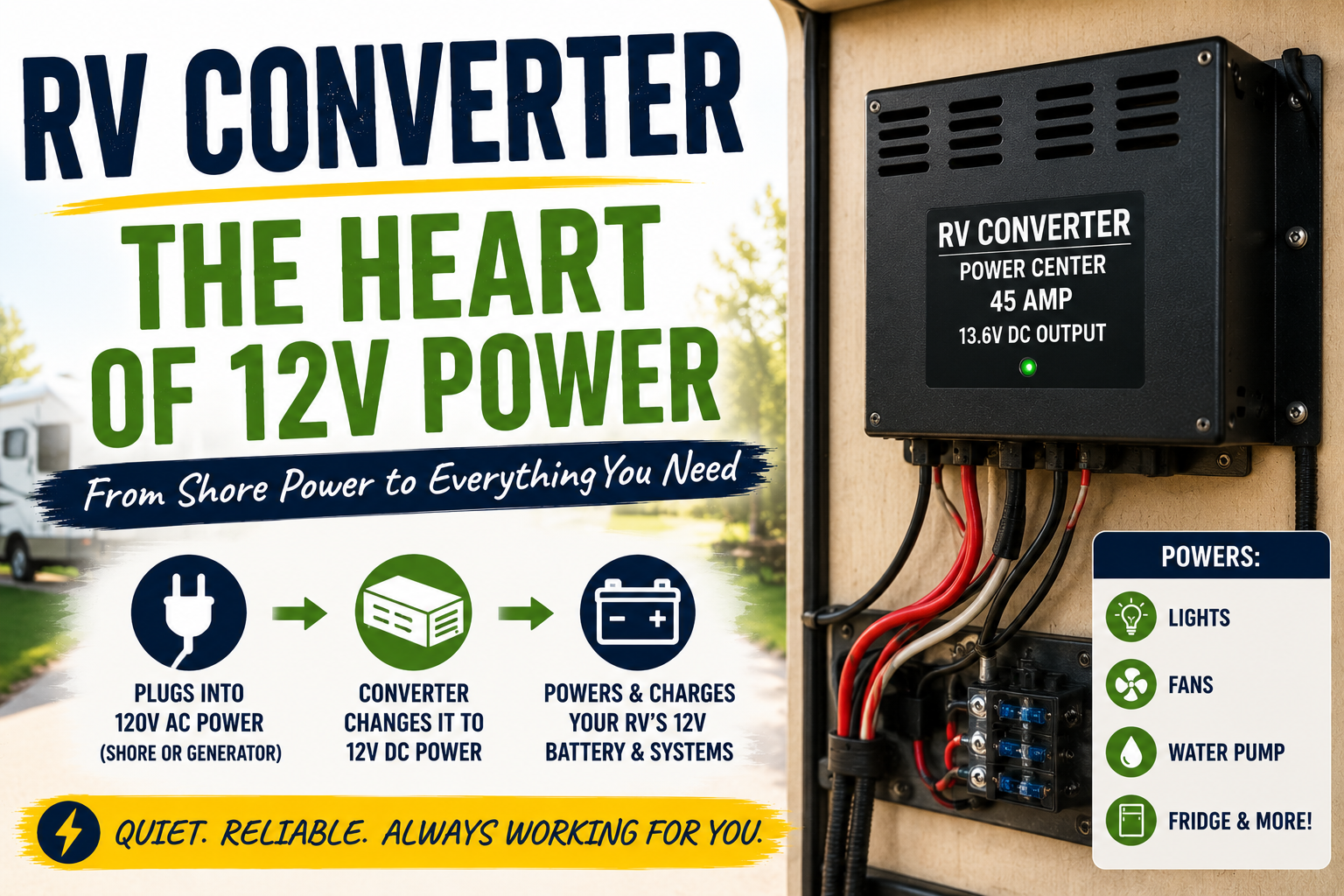
An RV converter is an electrical device that takes 120-volt AC electricity from shore power or a generator and converts it into the roughly 12-volt DC electricity your camper’s low-voltage systems need. Most modern RV converter/chargers also use that power to charge and maintain the house battery.
That’s really the heart of it.
You don’t need to be an electrician to understand your converter. Once you understand where the electricity comes from and where it goes, a huge part of your RV electrical system starts making sense.
Why Does an RV Need a Converter?
Your RV uses two different types of electrical power.
That’s the part I’d understand first.
When you’re plugged into shore power, you’re bringing 120-volt AC electricity into the camper.
That’s basically the household-style electricity used for things such as:
Air conditioner
Microwave
Standard wall outlets
Electric water-heater element on equipped RVs
Other 120-volt equipment
But a large part of your camper doesn’t operate directly on 120-volt AC electricity.
A lot of it uses 12-volt DC power instead.
That includes many of your lights, fans, control boards, water pump, furnace controls and blower, and other low-voltage equipment.
We therefore have a problem.
We’re bringing AC electricity into the camper, but a bunch of the camper wants DC electricity.
That’s where the converter comes in.
Progressive Dynamics describes the purpose of an RV converter/charger as supplying 12-volt power for RV lights and appliances when 120-volt AC is available while also recharging the battery.
The Converter Basically Translates Electricity for the Camper
I think this is the easiest way to picture it.
You plug your camper into a campground pedestal.
120-volt AC electricity enters the RV.
The converter receives AC power.
It converts that electricity into low-voltage DC power.
That DC electricity can then operate the camper’s 12-volt equipment and charge the house battery.
WFCO describes its converter/chargers the same basic way, converting 120-volt AC to 12-volt DC while simultaneously providing power to DC equipment and charging the RV battery when connected to shore power.
So your converter is essentially the bridge between the AC side and DC side of your camper.


What Does an RV Converter Power?
This varies somewhat by camper, but your 12-volt system commonly includes things such as interior lights, vent fans, the water pump, furnace blower and controls, appliance control boards, detectors, and other low-voltage equipment.
That surprises some new RV owners.
Your propane furnace, for example, may burn propane to create heat, but it still needs electricity for things such as the blower and controls.
Your refrigerator may have another primary energy source depending on the model, but its electronics may still depend on 12-volt DC power.
That’s why losing the 12-volt side of an RV can cause some strange symptoms.
Equipment that doesn’t seem like it should have anything to do with the battery suddenly stops working.
What Happens When I Plug My RV Into Shore Power?
This is where the converter gets to work.
Once proper AC electricity is available, the converter can produce DC electricity for the camper.
At the same time, a converter/charger can recharge the house battery.
WFCO says that when an RV is connected to AC power, its converter begins charging the battery as needed while also providing DC electricity to the RV’s appliances.
So while you’re sitting at the campground plugged in, your converter may be doing two things simultaneously:
Running 12-volt equipment.
Charging the battery.
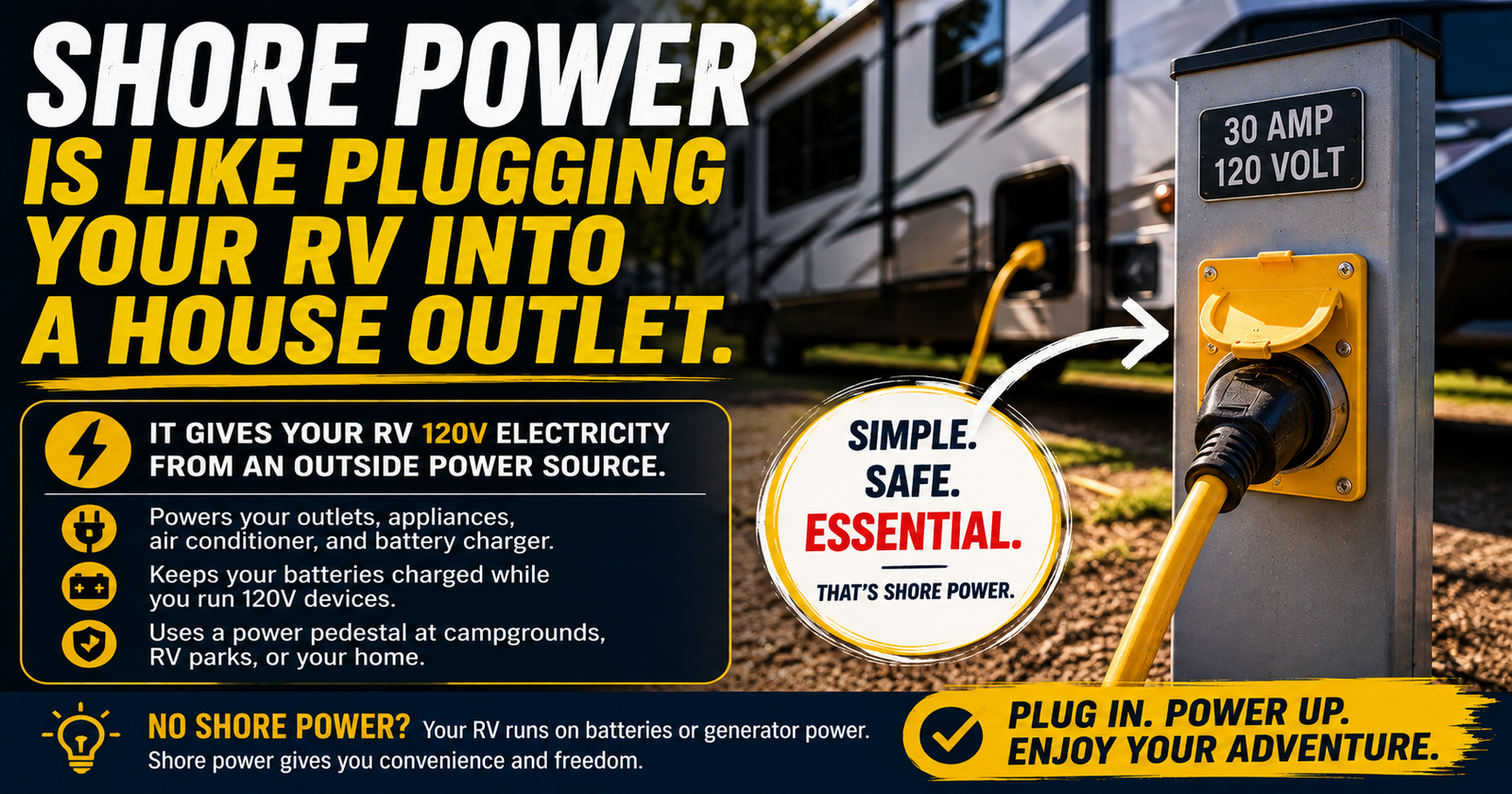
This is why understanding what shore power means in an RV makes understanding the converter much easier.
Shore power gives the converter the AC electricity it needs to do its job.

Does the Converter Charge My RV Battery?
Yes, most modern RV converters are really converter/chargers.
Battery charging is one of their major jobs.
When the RV is connected to AC power, the converter can send charging current to the house battery while also supplying the RV’s active 12-volt loads.
That’s why your battery can recharge while you’re sitting at a full-hookup campsite.
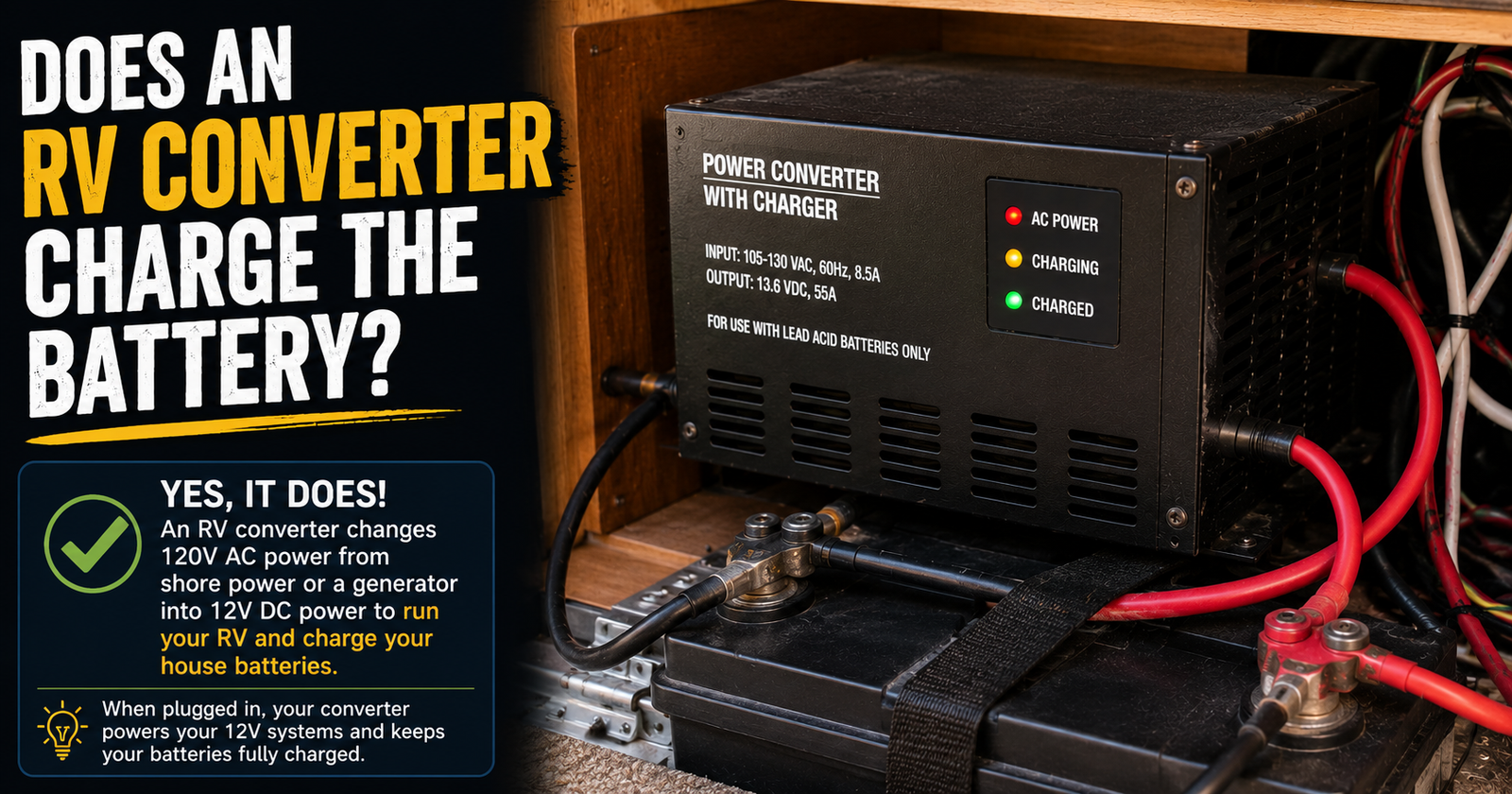
We’ve gone much deeper into exactly how an RV converter charges the battery, but the simple version is this:
Shore power provides AC electricity → converter turns it into DC electricity → DC electricity charges the battery.
Once you see that path, a lot of RV battery problems become easier to understand.
Does My RV Battery Power the Converter?
No.
It’s basically the other way around when AC power is available.
The converter uses AC electricity to produce DC electricity.
The battery stores DC electricity.
When you’re plugged in, the converter can supply your 12-volt system and charge the battery.
When you unplug, the converter loses its AC source and the battery can take over supplying the RV’s 12-volt system.
Think of the battery as your stored supply and the converter as the machine that creates usable DC electricity whenever AC electricity is available.
What Happens When I Unplug the Camper?
The converter stops doing its job because its AC input is gone.
WFCO specifically notes that a converter won’t operate without AC input.
But your 12-volt lights don’t necessarily go dark.
Why?
Because now the battery supplies them.
That’s one of the clever parts of the RV electrical system.
Plugged in:
Converter can supply the 12-volt system.
Unplugged:
Battery supplies the 12-volt system.
As long as the battery has enough charge, a lot of the camper can continue operating without shore power.
What Happens When I Run a Generator?
From the converter’s perspective, this can be very similar to plugging into shore power.
The generator provides AC electricity to the RV.
The converter receives AC electricity.
The converter produces DC electricity.
The converter can then run 12-volt equipment and charge the battery.
That’s why running your generator can recharge your RV house batteries even though the generator itself isn’t necessarily directly connected to them as a dedicated battery charger.
The converter is doing the conversion and charging work.
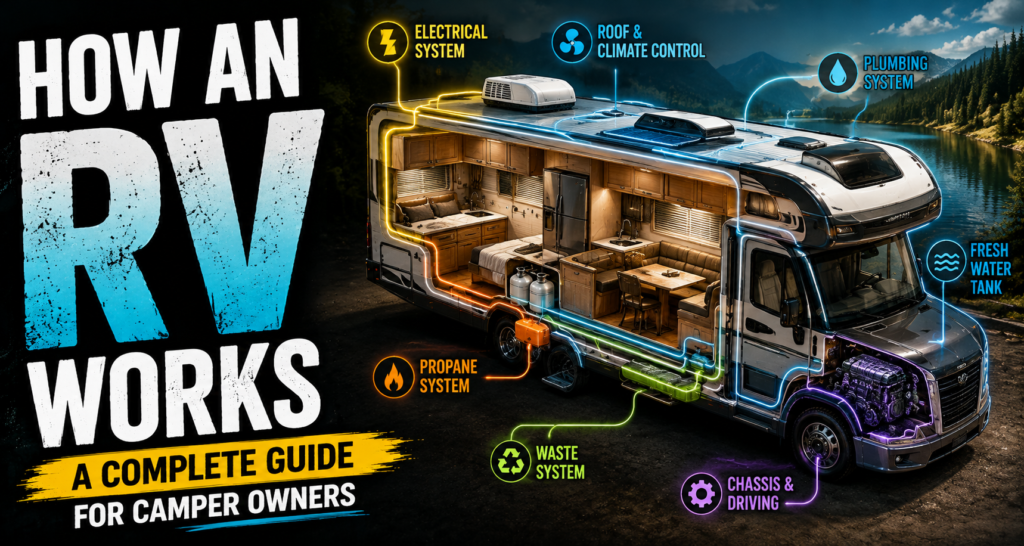
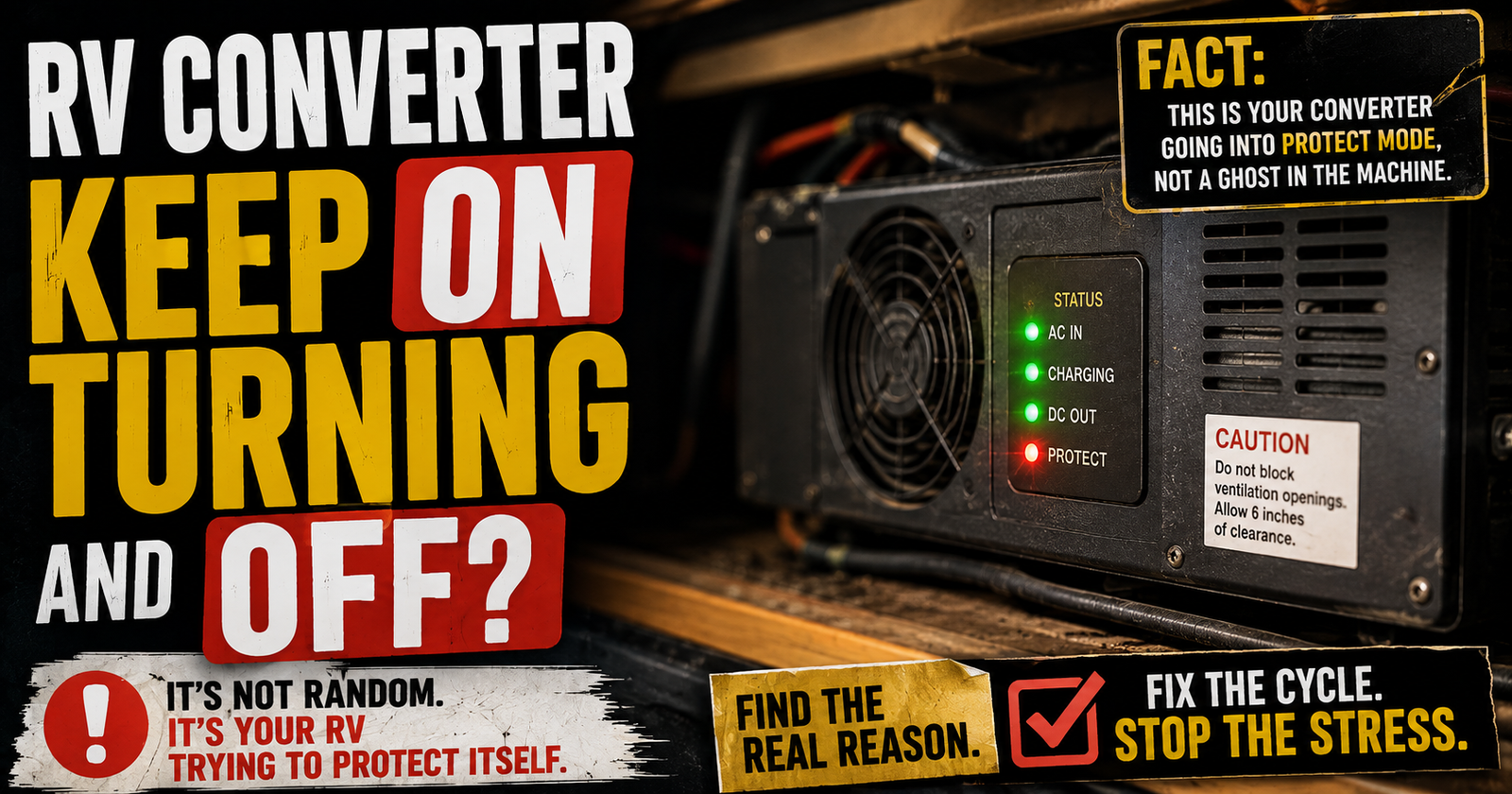
Is an RV Converter the Same Thing as an Inverter?
No, and these two names cause an unbelievable amount of confusion.
They basically do opposite jobs.
A converter takes:
AC → DC
An inverter takes:
DC → AC
Your converter lets AC electricity from shore power become useful to the RV’s 12-volt system.
An inverter lets DC electricity stored in your battery become AC electricity that can power certain household-style equipment.
That’s the simplest distinction.
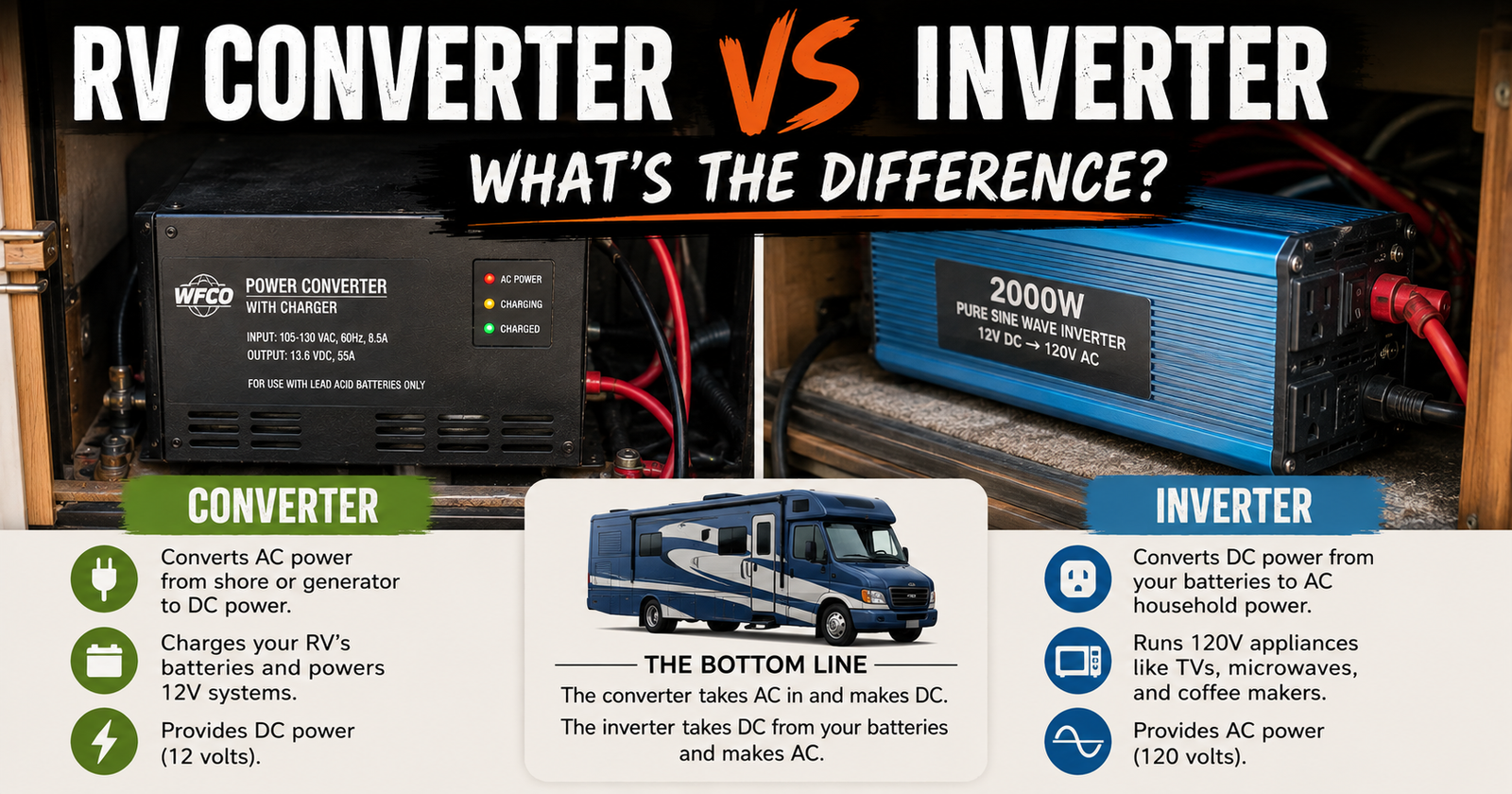
If you keep mixing them up, our RV converter vs. inverter explanation goes through the differences in much more detail.
An Easy Way to Remember Converter vs. Inverter
Here’s how I remember it.
Converter: campground power toward the battery.
Inverter: battery power toward the outlets.
That’s oversimplified because both devices can be involved with more than those exact destinations, but it’s a great mental shortcut.
Converter means you’re generally going from AC to DC.
Inverter means you’re generally going from DC to AC.
If you remember that, you’re already ahead of a lot of new RV owners.
Is the Converter the Same Thing as the RV Power Center?
Not necessarily.
This is another common source of confusion.
The power center may contain your AC circuit breakers, DC fuses, and converter section together in one assembly.
Progressive Dynamics, for example, sells all-in-one RV power centers containing the converter, DC fuse panel, and AC breaker space.
But converters can also be separate units.
So if somebody tells you:
“Check the converter behind the fuse panel.”
that may be exactly where yours is.
But it isn’t guaranteed.
Where Is My RV Converter?
Often it’s around the electrical distribution center, but location varies tremendously between RVs.
Some converter sections are built directly into the power center.
Some standalone converters are mounted behind or below it.
Others may be in a cabinet, storage compartment, under furniture, or somewhere else the manufacturer found room.
Progressive Dynamics describes both floor-mounted converters and wall-mounted power-center converter arrangements in RV applications.
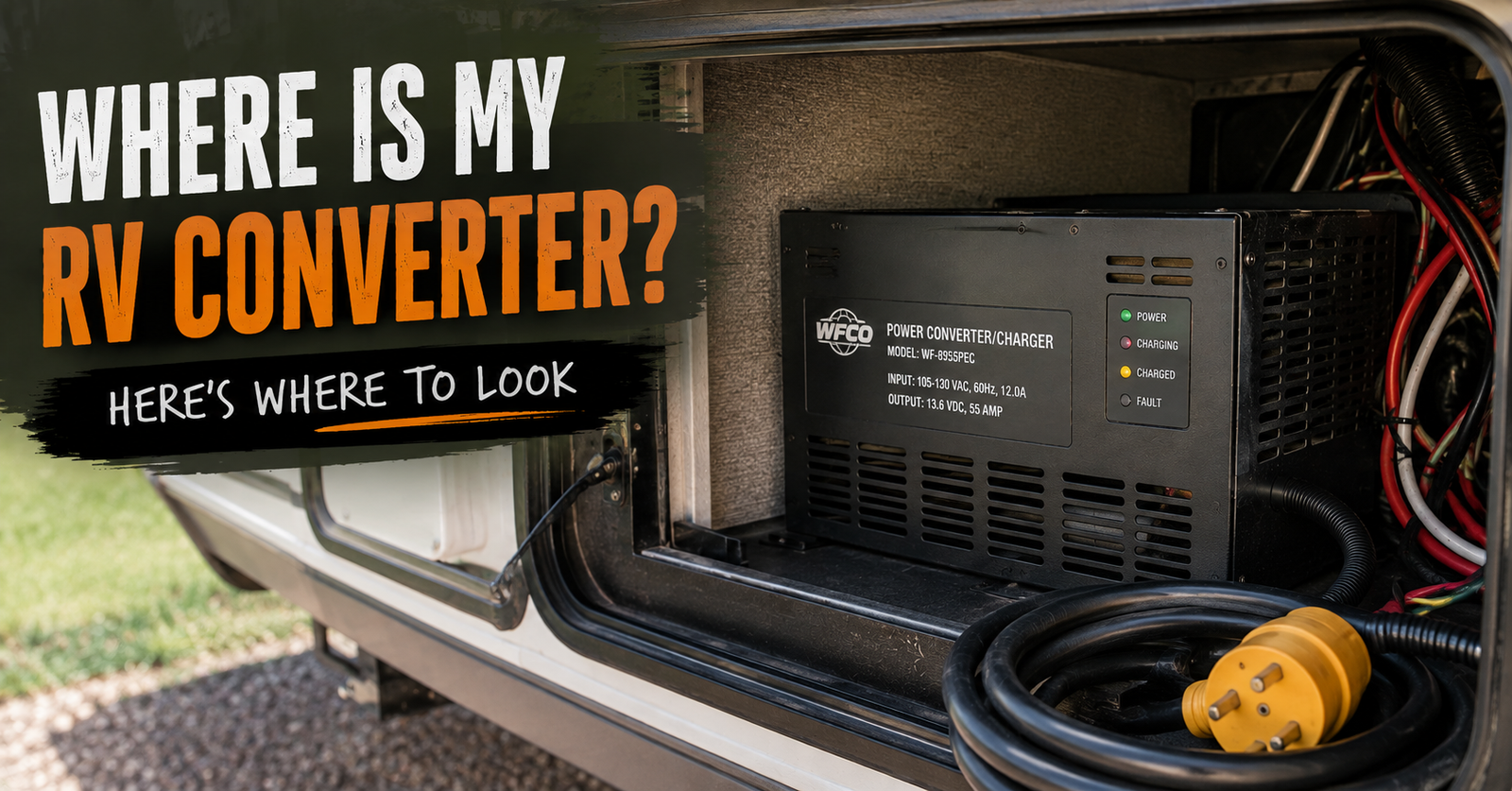
If you’ve never actually found yours, use our guide showing where to look for your RV converter.
Knowing where it is before something goes wrong isn’t a bad idea.
What Does an RV Converter Look Like?
That depends on the design.
A standalone converter may look like a rectangular metal electrical box with cooling vents, wiring connections, and possibly a cooling fan.
An integrated converter may be much less obvious because the converter section sits inside or behind the RV power center.
You may open the power-center door and mostly see breakers and fuses.
The actual converter electronics can be behind that visible panel.
So don’t assume your camper doesn’t have a converter just because you don’t see a box labeled CONVERTER sitting out in the open.
Why Does the Converter Have a Fan?
Converting electricity creates heat.
The converter can also work pretty hard when the RV has significant 12-volt demand or the battery needs substantial charging.
Many modern converters therefore use a cooling fan.
Progressive Dynamics lists intelligent variable-speed cooling fans and thermal protection on applicable converter/power-center equipment.
You may hear that fan turn on when the converter is working hard and shut back off when demand falls.
That’s usually normal.
A fan running doesn’t automatically mean your converter is failing.
Why Does My Converter Make Noise?
A little fan noise can be normal.
A mild electrical hum may also be normal depending on the equipment.
What gets my attention is a new sound.
Loud buzzing.
Clicking.
Rattling.
Grinding fan.
High-pitched whining.
Repeated cycling.
Those deserve investigation.
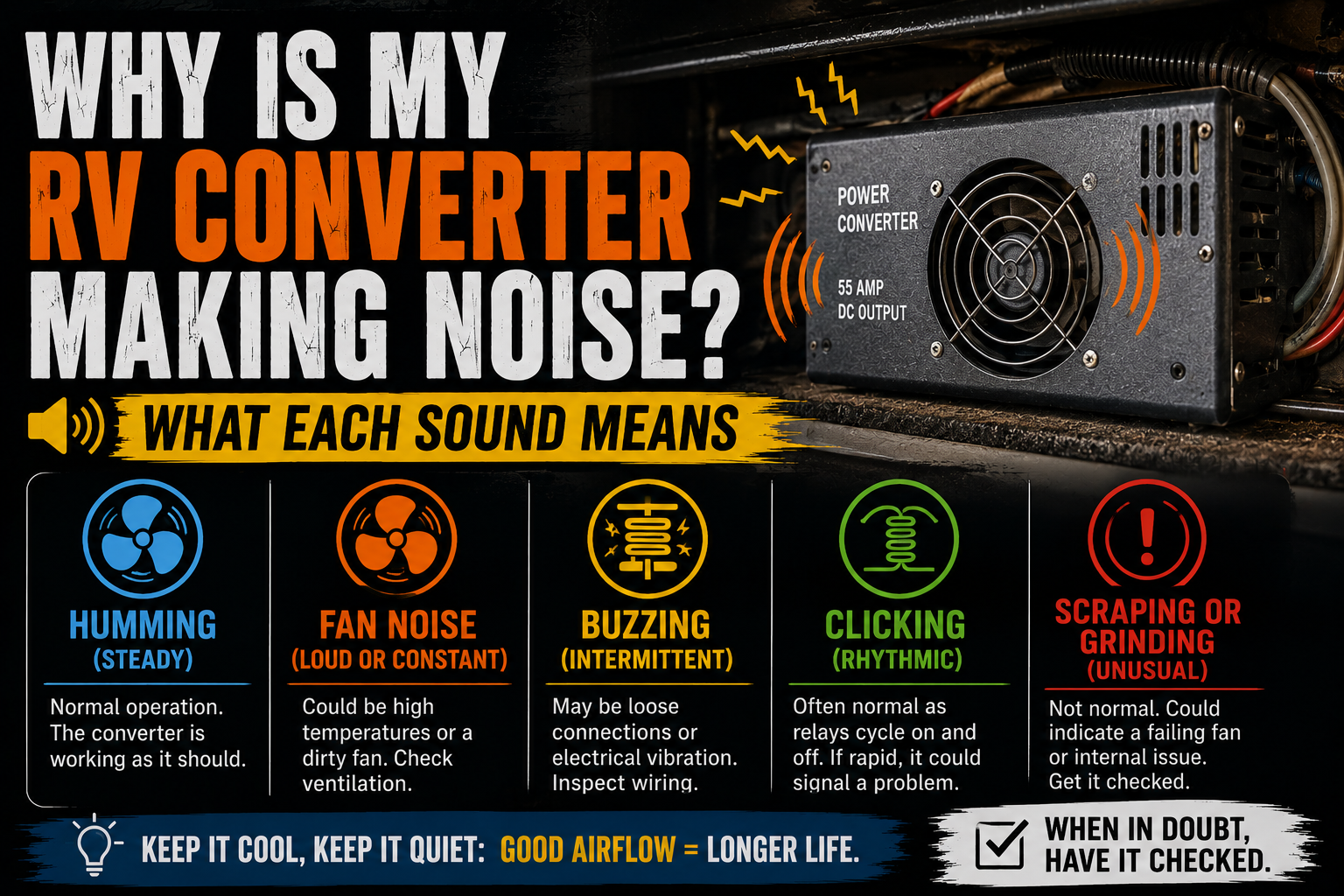
We’ve already broken down what different RV converter noises can mean because the type of noise can provide a surprisingly useful clue.
How Many Volts Does an RV Converter Put Out?
Don’t expect exactly 12.0 volts just because people call it a “12-volt system.”
Charging voltage needs to be higher than the battery’s resting voltage.
The exact output depends on the converter, battery chemistry, charging stage, and electrical demand.
For example, WFCO’s current charging information describes approximately 14.4 volts for lead-acid batteries during its higher charging mode, with lower voltage used during other operating stages. Lithium charging uses a different profile on applicable equipment.
So seeing 13-something or 14-something volts doesn’t automatically mean anything is wrong.
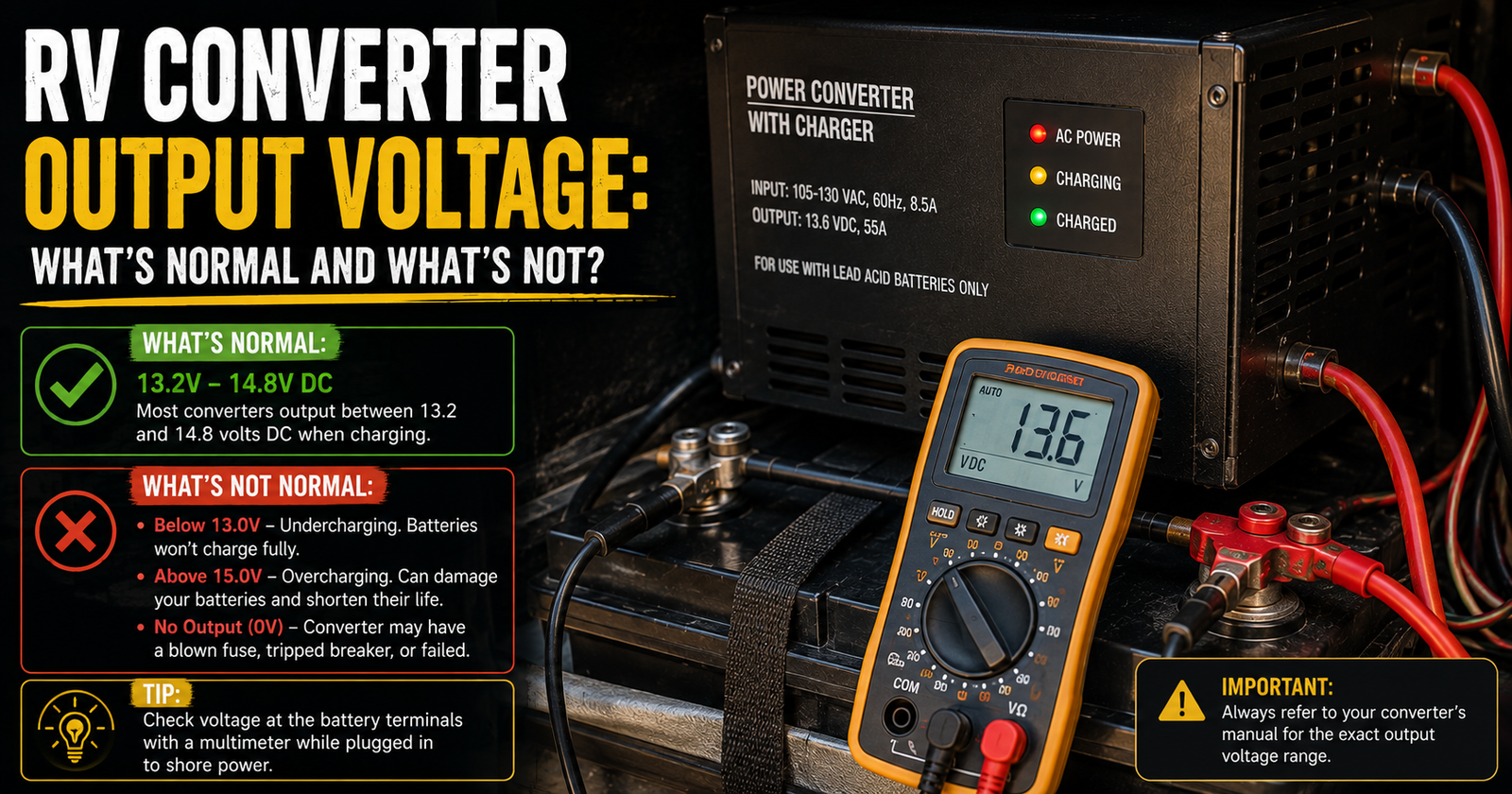
Our guide to normal RV converter output voltage explains those readings in context.
Why Does Converter Amperage Matter?
Converters also have an amperage rating.
You might see:
35 amps
45 amps
55 amps
60 amps
75 amps
or another rating.
Progressive Dynamics notes that RV converter/chargers are available in a variety of DC output ratings, and those ratings represent how much current the unit can supply under appropriate conditions.
That output has to serve the RV’s active DC loads and battery charging.
That’s why converter size matters.
Does a Bigger Converter Charge My Battery Faster?
Potentially, but don’t jump straight to buying the biggest converter available.
The battery has to be able to accept the current.
The wiring has to safely handle it.
The converter has to be appropriate for the RV.
Progressive Dynamics specifically warns against blindly replacing a converter with a higher-amperage model because the existing RV wiring may not be capable of safely carrying the additional current.
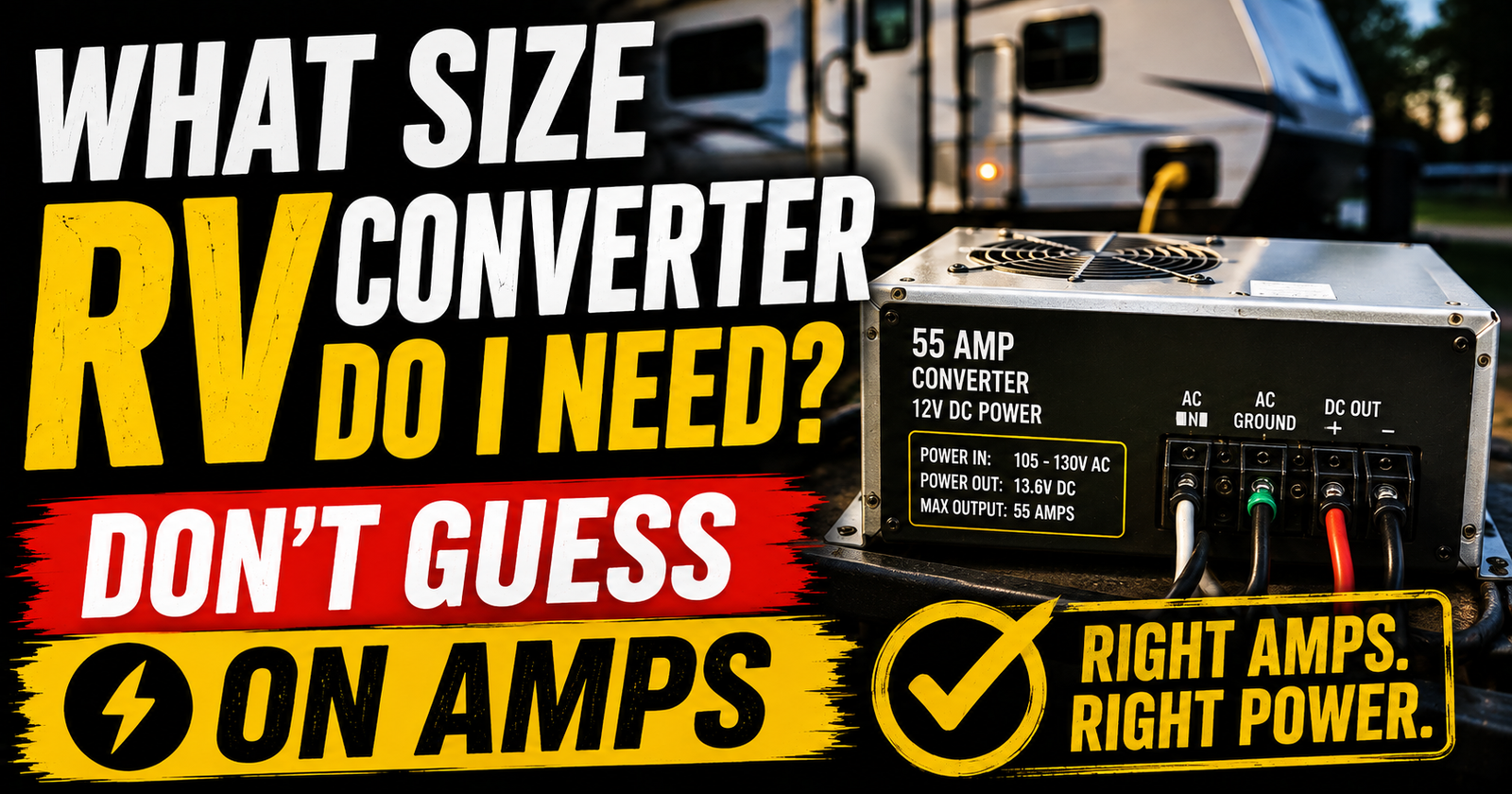
If you’re sizing one, use our guide explaining what size RV converter you actually need.
Bigger isn’t automatically better.
What Is a Smart RV Converter?
Modern converter/chargers can do more than simply produce one fixed voltage forever.
Many use multi-stage battery charging.
The converter monitors battery and system conditions and changes its output accordingly.
WFCO’s current converter/chargers, for example, monitor DC voltage and output current and change charging behavior based on battery demand.
Progressive Dynamics likewise uses its Charge Wizard system to monitor battery conditions and automatically adjust converter output voltage.
That’s why a modern converter may be putting out one voltage now and another voltage later.
It’s not necessarily malfunctioning.
It may be doing exactly what it was designed to do.
Why Is Multi-Stage Charging Useful?
A deeply discharged battery and a fully charged battery don’t need the same thing.
When the battery is low, you want to restore energy efficiently.
When it’s already full, you don’t want to continuously treat it like it’s dead.
That’s the basic idea behind smart charging.
The converter can provide stronger charging when needed and back down when it isn’t.
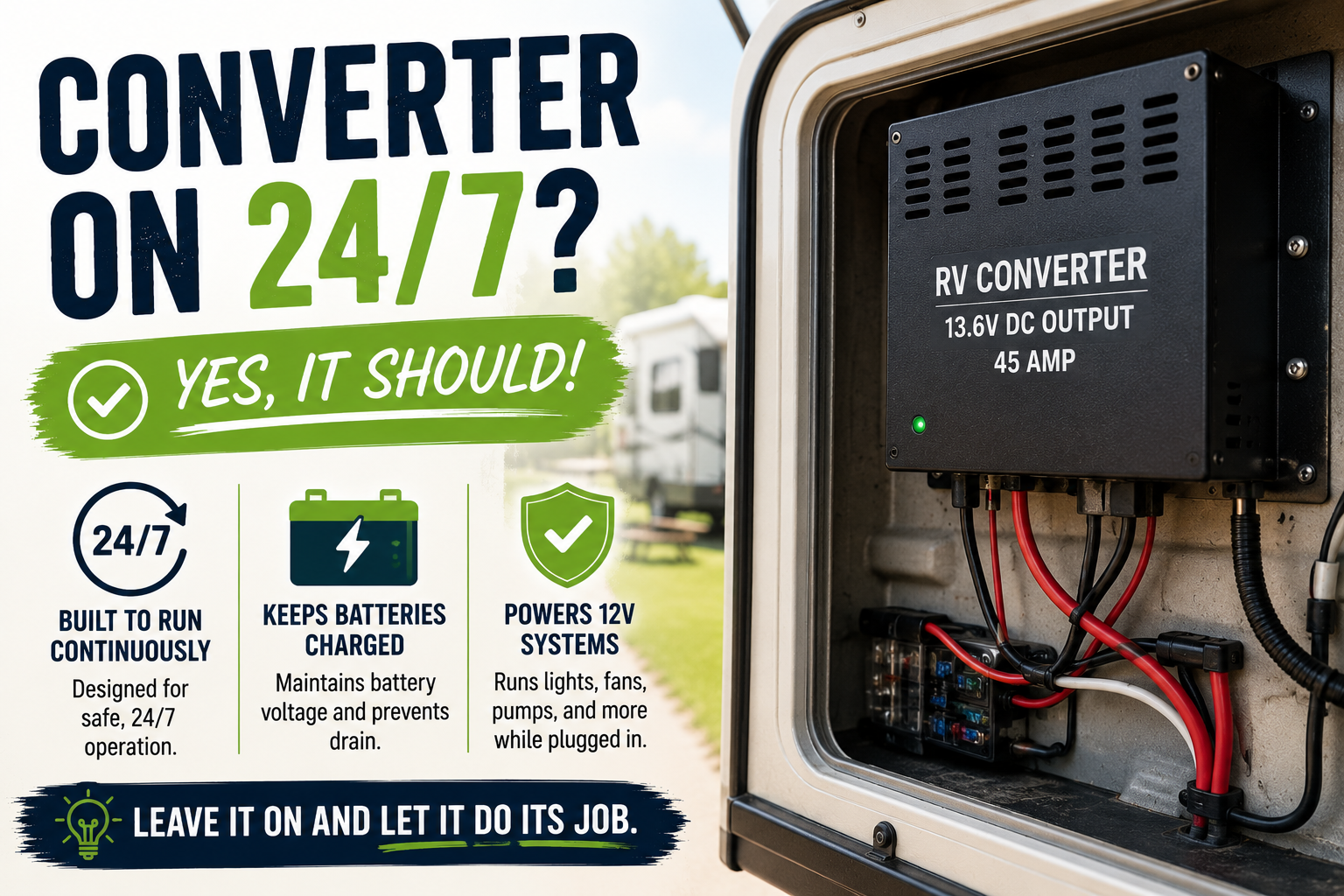
That helps explain why your RV converter can stay on all the time without necessarily hammering the battery at maximum charging output around the clock.
Being powered and aggressively charging are two different things.
Do I Need a Different Converter for Lithium Batteries?
This deserves attention if you’re upgrading from lead-acid to LiFePO4.
Lithium batteries have different charging requirements.
Some newer converter/chargers have lithium settings.
Some automatically detect battery chemistry.
Some older converters were designed around lead-acid batteries.
Progressive Dynamics offers lithium-specific converter/chargers, while WFCO offers applicable Auto-Detect converters that identify lead-acid or lithium battery chemistry and apply the appropriate charging strategy.
So don’t install a lithium battery and simply assume the old charging system is ideal for it.
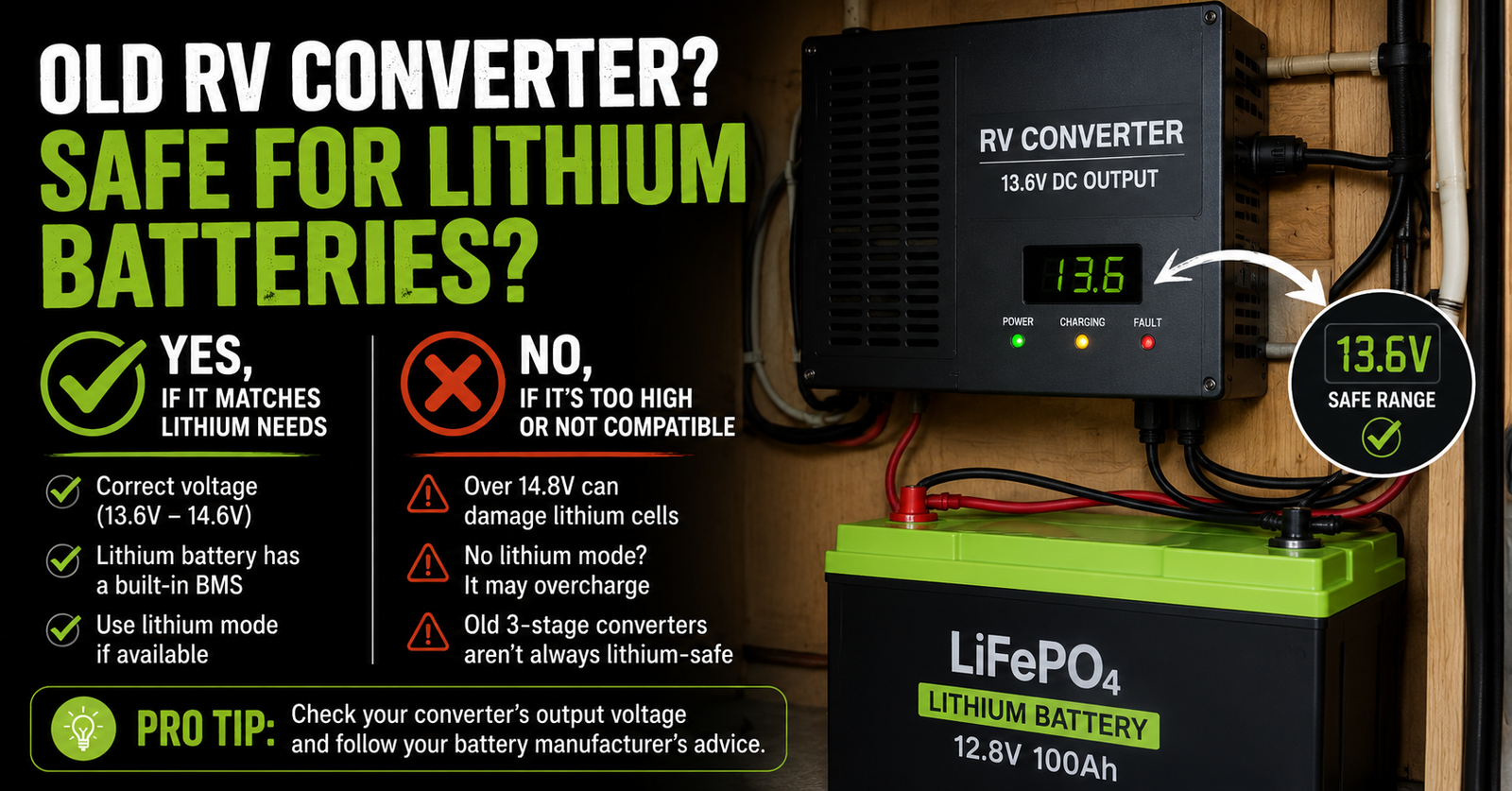
We’ve covered using an older RV converter with a lithium battery separately because there are several things to consider before upgrading.
Can an RV Converter Work Without a Battery?
Many modern converters can.
If proper AC electricity is available, the converter can produce DC power for the RV’s 12-volt circuits.
That means your lights and other DC equipment may work even if the battery is disconnected.
This is also why turning the battery disconnect off doesn’t necessarily make everything inside the camper go dark while you’re plugged in.
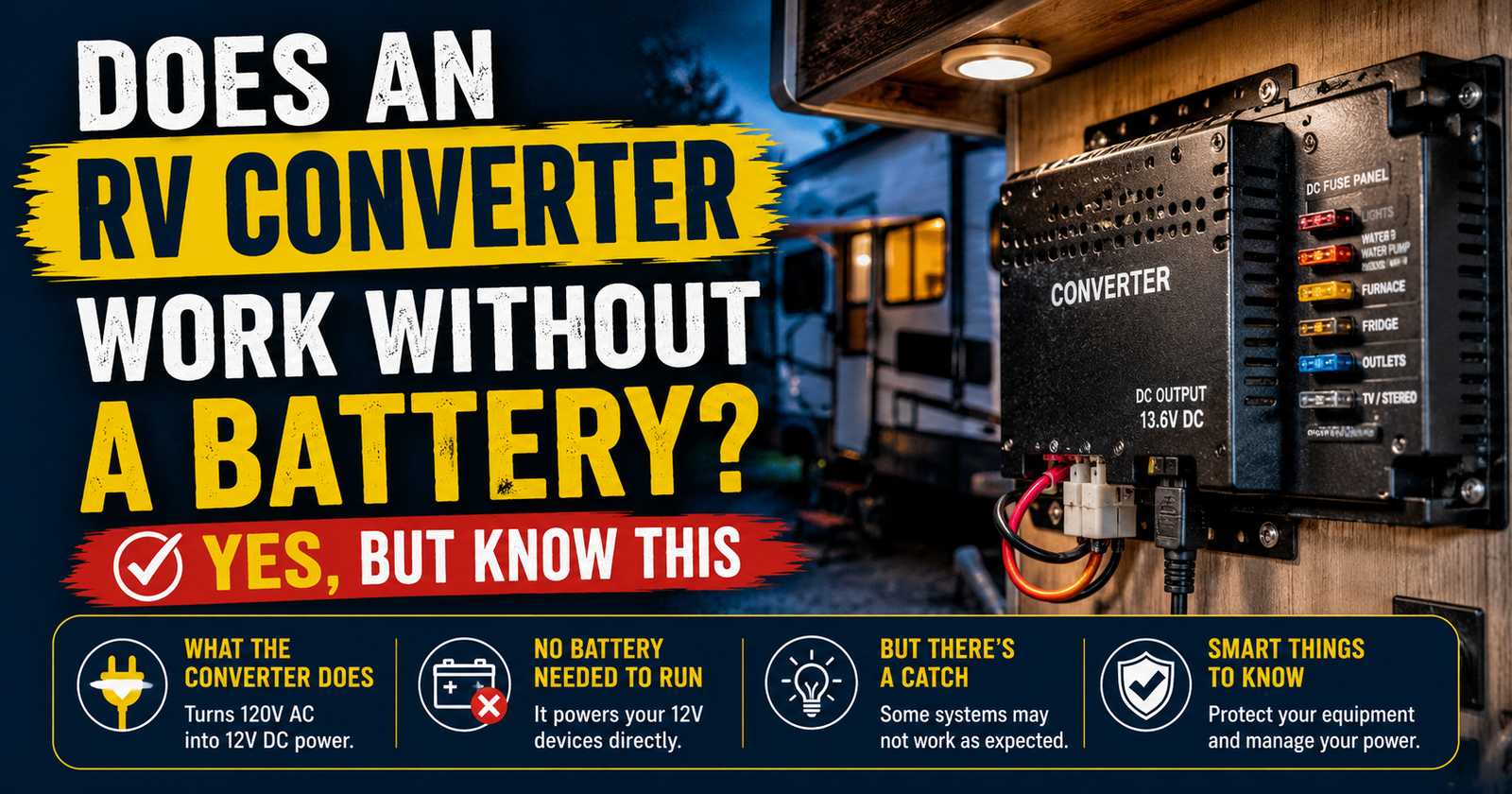
We’ve covered whether an RV converter works without a battery in more detail because older equipment and particular RV systems can behave differently.
Does the Converter Work Without Shore Power?
Not unless it has another suitable AC source, such as a generator.
Remember what the converter needs:
AC in.
DC out.
No AC input means the converter has nothing to convert.
If you’re boondocking without a generator or another AC source feeding the converter, your battery is normally the source supplying the RV’s 12-volt system.
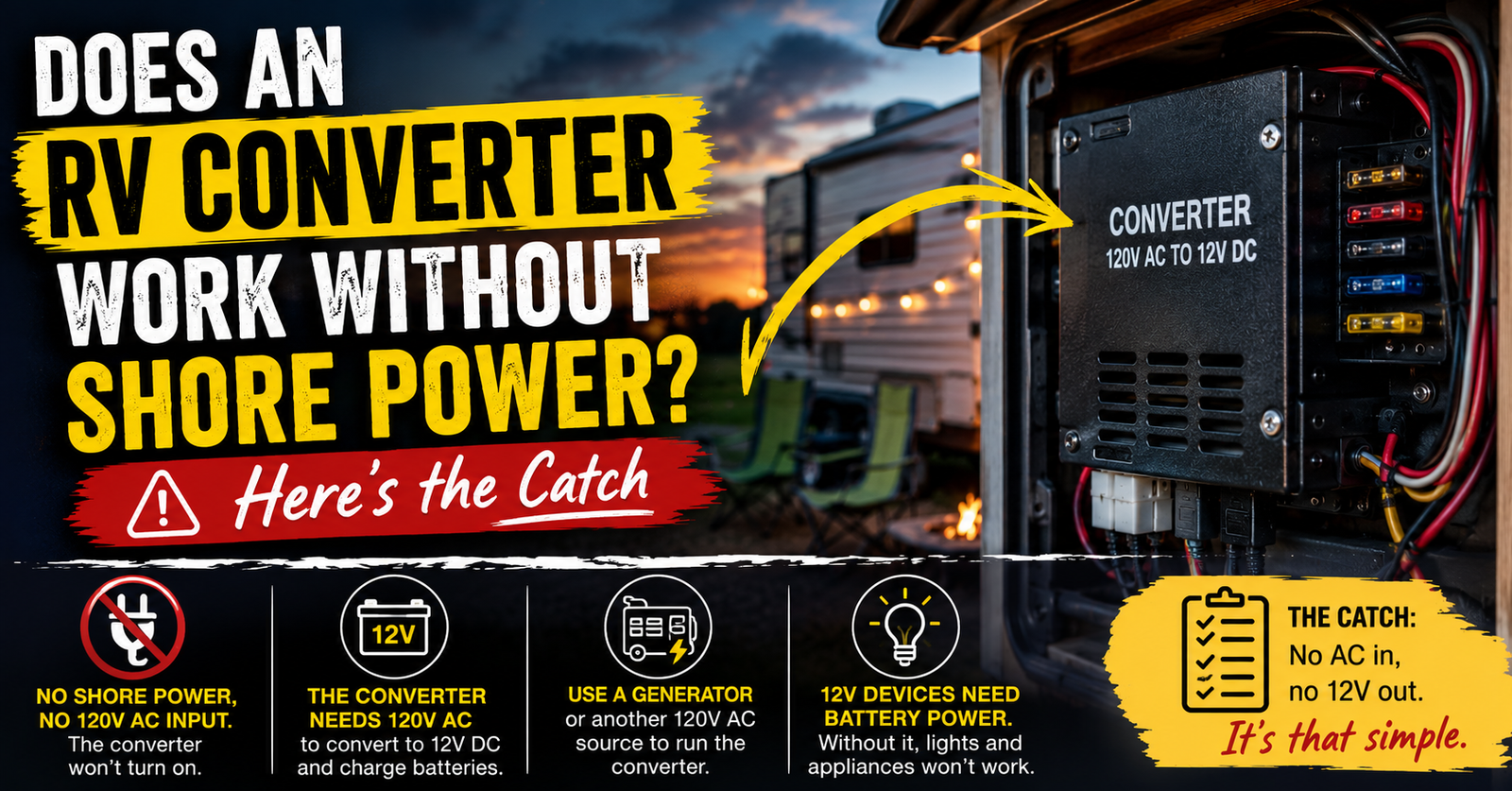
That’s why the answer to whether an RV converter works without shore power depends on whether another AC source is available.
How Do I Know If My Converter Is Working?
One of the simplest clues is battery voltage.
If the battery is sitting at a normal resting voltage with shore power disconnected and then rises into an appropriate charging range after you plug in, that tells you charging voltage is reaching it.
But that’s only a quick check.
You can also measure converter output directly with a multimeter when appropriate.
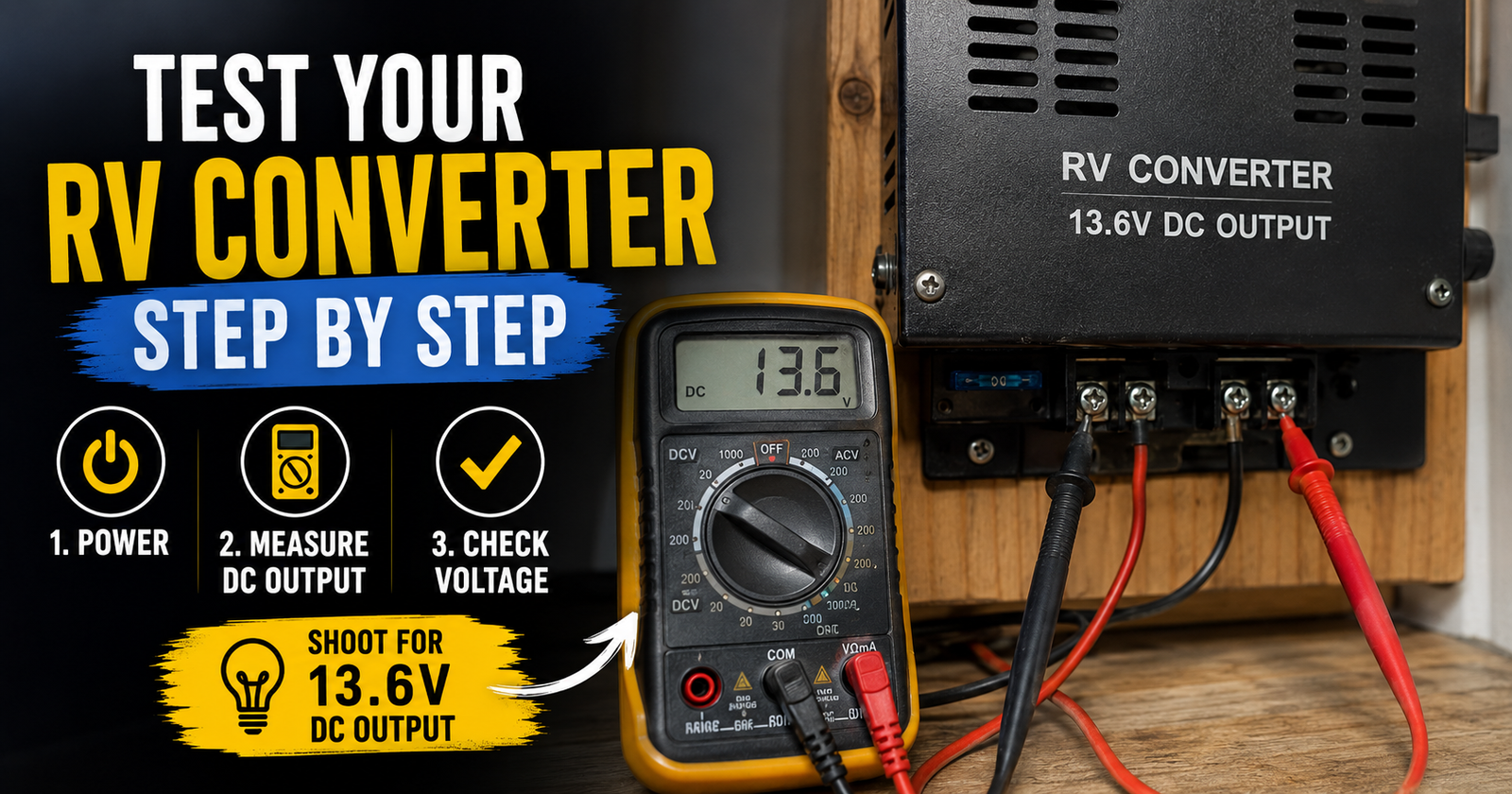
If you’re actually troubleshooting one, follow our step-by-step RV converter multimeter test rather than replacing parts based on guesses.
A $20 meter can save you from buying a converter you didn’t need.
What Happens When an RV Converter Goes Bad?
The symptoms vary depending on how it fails.
You might notice:
The battery stops charging.
12-volt lights become dim.
The converter has no DC output.
Fuses keep blowing.
The converter gets excessively hot.
The fan behaves strangely.
You hear new noises.
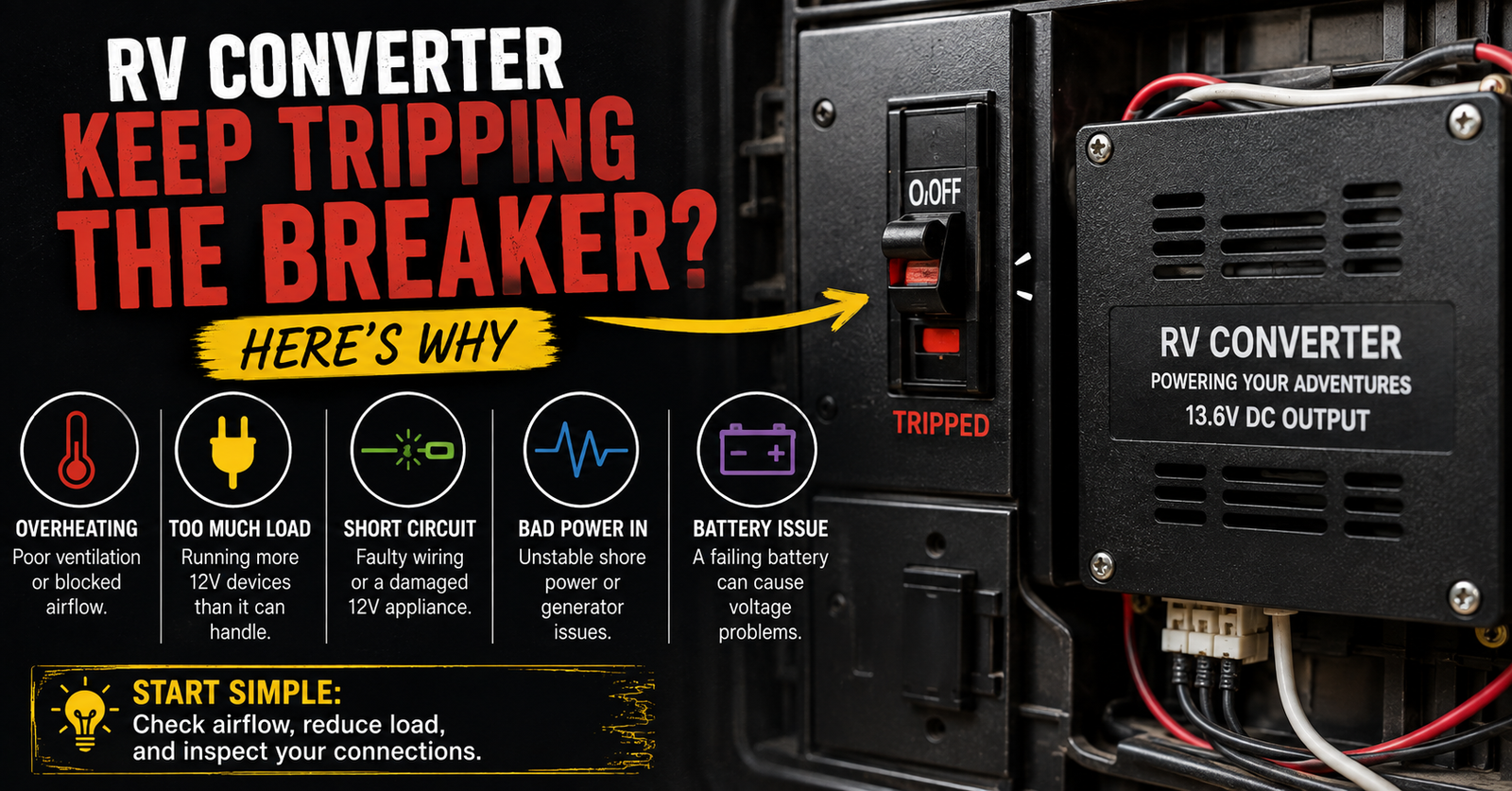
The converter repeatedly shuts down.
A breaker trips.
You smell something burnt.
Or the battery itself starts behaving strangely.
The annoying part is that several other RV electrical problems can cause similar symptoms.
That’s why I don’t diagnose a bad converter from one symptom.
A Dead Battery Doesn’t Automatically Mean a Bad Converter
This one is worth emphasizing.
Your battery can go dead because the battery itself is bad.
Or because something is draining it.
Or because the charging path is interrupted.
Or because the battery disconnect is in the wrong position.
Or because of a blown fuse.
Or a poor connection.
Or because the converter isn’t getting AC power.
Or yes, because the converter failed.
That’s why our guide to telling whether an RV converter is actually bad focuses on proving the failure before spending money.
Parts swapping gets expensive quickly.
What If the Converter Has No Output?
First verify that it actually has AC input.
A converter can’t produce DC electricity if it isn’t receiving the electricity it needs to operate.
Check the appropriate breaker and AC supply.
Progressive Dynamics’ troubleshooting procedure for applicable converters starts by checking the 120-volt AC breaker and verifying AC voltage at the converter’s outlet. If proper AC input is present but the converter has zero DC output, its procedure identifies the converter as failed.
Your particular model may have a different troubleshooting procedure, so follow its documentation.
We’ve also built a dedicated guide for an RV converter with no output.
Is the Converter Always Doing Something?
If it’s receiving AC power, generally yes.
That doesn’t mean it’s always working hard.
If your battery is charged and you’re barely using any 12-volt equipment, converter demand may be tiny.
Turn on several lights, run the furnace blower, and use other DC equipment, and demand increases.
Discharge the battery significantly and plug back in, and now the converter may also have substantial charging work to do.
That’s why its fan, temperature, charging current, and voltage can change throughout the day.
The Converter Is One of the Parts That Makes an RV Feel Like a House
I think this is the part new RV owners don’t appreciate until they understand what’s happening behind the wall.
You pull into a campsite.
Plug in one big cord.
Suddenly your outlets work.
Your air conditioner can run.
Your 12-volt lights work.
Your battery starts charging.
Your water pump works.
Your furnace controls have power.
A bunch of different electrical systems suddenly cooperate.
The converter is a big part of making that happen on the 12-volt side.
You don’t normally interact with it.
You don’t flip a converter switch every time you turn on a light.
It just quietly does its job in the background.
And that’s exactly why most RV owners don’t learn what the heck it is until something quits working.
The Simplest Way to Remember What Your RV Converter Does
If all the electrical terminology starts getting confusing, come back to this:
Your RV converter takes AC electricity and turns it into DC electricity.
When you’re plugged into shore power or supplying the RV with appropriate generator power, the converter can use that AC electricity to run your camper’s 12-volt equipment and charge the house battery.
When that AC source disappears, the converter stops producing power and your battery normally takes over the 12-volt side.
That’s the converter.
Once you understand that one little box, suddenly shore power, batteries, 12-volt lights, charging problems, generator charging, and half the electrical troubleshooting in an RV make a whole lot more sense.
Written by Evan Mercer
Evan Mercer writes about RV electrical systems, batteries, converters, shore power, and hands-on camper troubleshooting for CamperAnswers.com. He focuses on explaining the parts hidden behind the panels in plain English so RV owners can understand what their camper is actually doing.