
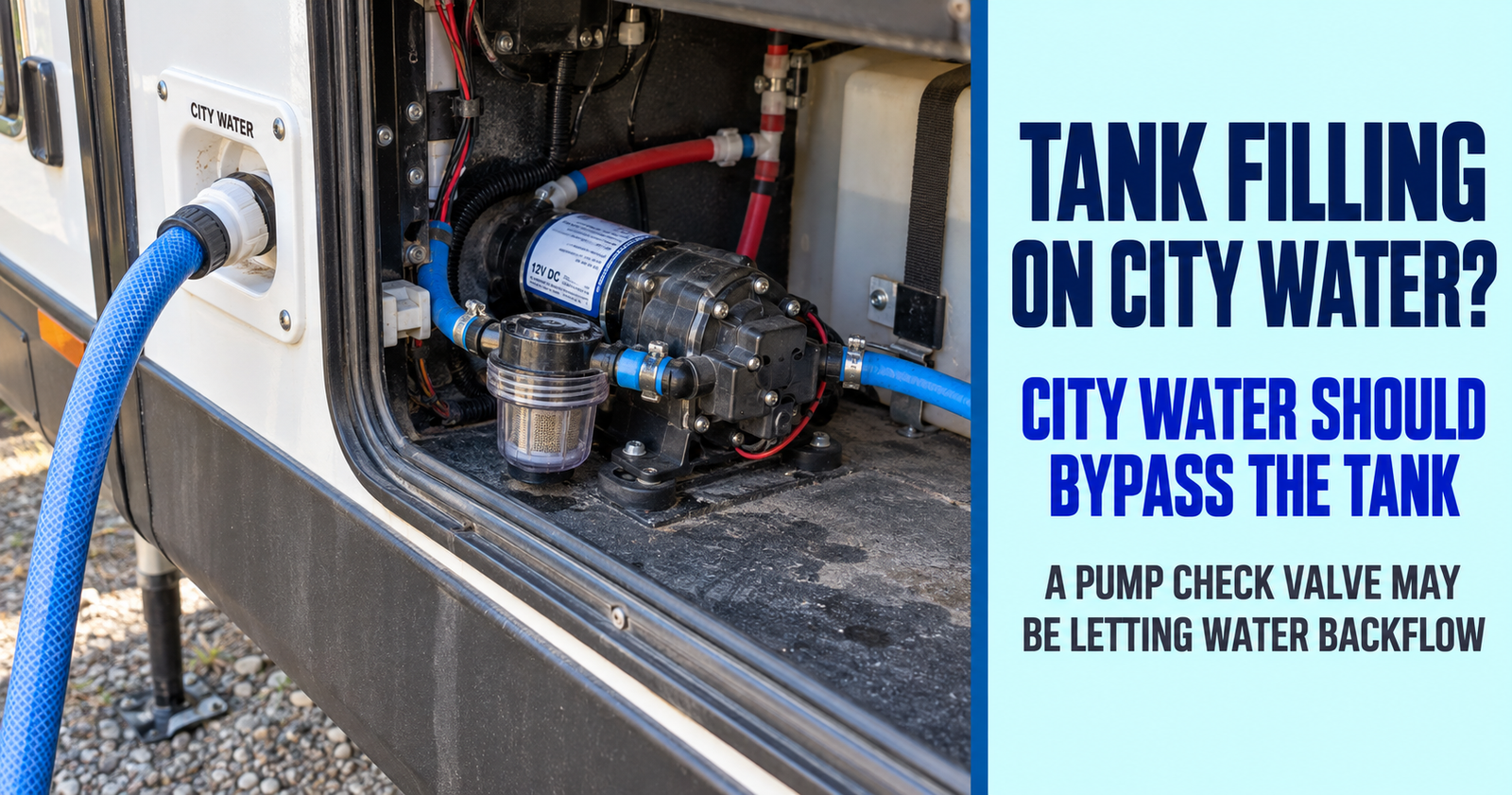
You hook your RV to campground water, leave the water pump turned off, and everything seems completely normal. Then a few hours later you notice water dripping underneath the camper.
Maybe it becomes a steady stream.
You check the monitor panel and somehow your fresh water tank, which was nearly empty when you arrived, is now completely full.
How in the world did that happen when you never filled it?
If your RV fresh water tank fills while you’re connected to city water, pressurized water is getting backward into the fresh tank when it shouldn’t. The two places I’d check first are the water pump’s internal check valve and, on RVs equipped with one, the city-water/tank-fill selector valve. Those are consistently identified as the main causes of this problem.
The good news is that this usually isn’t some impossible plumbing mystery buried underneath the floor.
Once you understand how city water is supposed to flow through the camper, the problem makes a lot more sense.
City Water Shouldn’t Normally Fill Your Fresh Water Tank
This is the first thing to understand.
Your RV essentially has two ways to supply water to the faucets.
When you’re camping without a water hookup, water comes from the fresh water tank. Your 12-volt water pump pulls water from that tank and pressurizes the plumbing.
When you’re connected to city water, the campground’s water pressure normally supplies the RV plumbing directly.
The campground water doesn’t need to enter your fresh tank first.
Winnebago’s operating instructions describe exactly this arrangement. In normal city-water operation, outside water bypasses the storage tank and water pump and supplies the fixtures directly. A check valve at the pump prevents city water from flowing backward into the fresh tank.
So if your tank is mysteriously filling anyway, we’ve learned something important:
Water is finding a path into the tank that should normally be closed.
The Water Pump Check Valve Is My First Suspect
This is probably the most common explanation.
Your RV water pump doesn’t just move water from the fresh tank toward the faucets.
The pump assembly also has to prevent pressurized city water from traveling backward through the pump and into the fresh tank.
That’s where the check-valve function comes in.
When everything is working correctly, water can move:
Fresh tank → pump → RV plumbing
But city water shouldn’t be able to move:
RV plumbing → backward through pump → fresh tank
If the check valve doesn’t seal, that’s exactly what can happen.
Camping World identifies a faulty water-pump check valve as the most common reason an RV fresh tank fills while connected to city water.

What Is a Check Valve?
A check valve is basically a one-way door for water.
Water is allowed to move in the direction the plumbing system was designed for.
Try to push it backward and the valve closes.
At least, that’s what’s supposed to happen.
If debris gets caught in the valve, mineral buildup prevents it from seating properly, a seal wears out, or the valve becomes damaged, city-water pressure can slowly force water backward.
And “slowly” is important.
You may not notice anything for hours.
Why Does the Tank Take Hours to Fill?
Because the failed check valve doesn’t necessarily create a huge open path.
Imagine a small amount of water continuously sneaking backward through the pump.
You probably won’t hear it.
You won’t necessarily see anything leaking inside the camper.
Your faucets work normally.
Meanwhile, gallon after gallon is slowly entering the fresh tank.
Ask the RV Engineer notes that even a relatively small amount of backflow through an aging pump can eventually fill a 20-, 30-, or 50-gallon fresh tank over hours or days.
Eventually the tank reaches full.
Then you notice the symptom that gets everyone’s attention.

Why Is Water Pouring Out Under My RV?
It may simply be coming from the fresh-tank overflow or vent.
Your fresh water tank needs a way to vent as water enters and leaves.
Once the tank becomes full, continued incoming water has to go somewhere.
So you may suddenly see water underneath the camper even though you haven’t opened the fresh-tank drain.
That doesn’t automatically mean the tank itself cracked.
The tank may simply be overflowing because city water keeps entering it.
This is why I wouldn’t immediately crawl underneath looking for a broken tank.
First determine whether the tank is unexpectedly full.
Shut the City Water Off First
If the fresh tank is overflowing, my first move is simple.
Turn off the campground water supply.
We’re not fixing anything yet.
We’re stopping additional water from entering the system.
RV Travel describes the same pattern in a recent troubleshooting example where the fresh tank overflowed while connected to city water and stopped once the campground supply was shut off.
Once the incoming pressure is removed, you can troubleshoot without continuously adding more water to an already full tank.
Check Your City Water and Tank Fill Valve Before Taking Anything Apart
Some RVs have a selector valve that lets one exterior water connection do multiple jobs.
One position might be:
CITY WATER / NORMAL
Another might be:
TANK FILL
Turn the valve to TANK FILL and campground water is intentionally routed into the fresh tank.
That’s convenient.
But it gives us another potential failure point.
If the selector is accidentally left in the fill position, the tank will continue filling.
Winnebago specifically instructs owners to leave its applicable fresh-water selector in the normal position during city-water use because leaving it in TANK FILL allows water to continue entering the tank and eventually flow from the tank vent.
So before diagnosing a bad pump, check the valve position.
The Selector Valve Can Look Correct and Still Leak
This is where things get more frustrating.
You look at the selector.
It’s clearly pointing toward CITY WATER.
Yet the tank continues filling.
The valve itself may not be sealing completely.
RV Travel identifies a leaking city-water/tank-fill valve as one of the two main causes of this problem. Mineral buildup such as calcium or lime can keep the valve from closing completely.
So don’t eliminate the selector valve simply because the handle is pointing in the correct direction.
The handle position tells you what you’re asking the valve to do.
It doesn’t prove the valve is successfully doing it.


What If My RV Doesn’t Have a Tank-Fill Selector Valve?
That makes troubleshooting easier.
Some campers have a separate gravity-fill opening for the fresh tank.
You physically put a hose into the fill port when you want to add water.
The city-water connection is separate.
If that’s your setup, there’s no city-water/tank-fill selector valve to accidentally leave open.
That makes the water-pump check valve an especially strong suspect.
Etrailer notes that a failed check valve can allow city water to fill and even overflow the fresh tank.
Why Does the Water Pump Have Anything to Do With City Water?
This confused me until I pictured the plumbing.
When you’re connected to campground water, you don’t normally need the pump.
City water already provides pressure.
But the pump is still connected to the RV’s plumbing system.
City-water pressure therefore exists on the downstream side of the pump.
The pump’s check-valve function is what prevents that pressure from traveling backward through the pump toward the fresh tank.
That’s why a pump that’s completely turned off can still be involved in the problem.
The electric motor isn’t running.
We’re dealing with water flowing backward through the pump’s plumbing components.
Does This Mean My Entire Water Pump Is Bad?
Not necessarily.
This is an important distinction because a complete water pump costs considerably more than a small valve or repair kit.
The pump can still:
Turn on.
Pull water from the tank.
Build pressure.
Supply the faucets.
Shut off normally.
Yet its check valve may not seal properly against backward city-water pressure.
Love Your RV notes that check-valve kits are available for many pumps and that replacing or servicing the valve can be considerably cheaper than replacing the entire pump.
So I wouldn’t immediately order a new water pump.
Debris Can Keep the Check Valve From Closing
Sometimes the valve isn’t actually worn out.
Something may simply be preventing it from sealing.
Fine sediment can get into the fresh-water system.
Hard water can leave mineral deposits.
Camping World identifies fine sediment as one possible reason the pump check valve stops sealing and also notes that freeze damage from improper winterization can damage it.
Love Your RV similarly identifies debris and hard-water mineral buildup as possible reasons a pump check valve becomes stuck open.
That gives us another reason not to automatically replace the entire pump.
Sometimes Cycling the Water Pump Can Help
Here’s one simple thing I would try before taking the pump apart.
Disconnect the city-water supply.
Make sure there’s enough water in the fresh tank for the pump to operate normally.
Turn the pump on.
Open a faucet and let the pump run.
Close the faucet and allow the pump to build pressure and shut off.
Repeat that a few times.
The idea is that operating the pump may move whatever small piece of debris is preventing the internal valve from seating correctly.
I would consider this a troubleshooting attempt, not a guaranteed repair.
If the problem returns repeatedly, something still needs attention.
Then Reconnect City Water and Watch the Tank
Once you’ve cycled the pump, reconnect city water.
Make sure any tank-fill selector is in the proper city-water or normal position.
Leave the water pump off.
Then monitor the fresh tank.
Don’t wait until tomorrow morning and hope.
If possible, start with the tank partially empty so you’ve got room to observe what happens.
If the tank level begins climbing again without you intentionally filling it, the backflow problem remains.
Could High Campground Water Pressure Cause This?
High water pressure can put additional stress on RV plumbing, which is why I like using appropriate pressure regulation when connecting to campground water.
Pentair’s SHURflo city-water entry equipment, for example, is designed to limit incoming pressure to 50 PSI and includes a check valve.
But I wouldn’t look at excessive campground pressure as an excuse for a check valve that doesn’t seal.
If water can flow backward through the pump under normal regulated pressure, the valve still needs attention.
High pressure may make an existing weakness more obvious.
It isn’t the first thing I’d blame when the tank repeatedly fills itself.
A Water Pressure Regulator Is Still Worth Using
This is actually going to become an important part of our new water-system coverage.
Campground water pressure isn’t under your control.
Your RV plumbing is.
A pressure regulator helps keep excessive campground pressure from reaching the camper’s plumbing system.
But don’t expect a regulator to magically repair a failed check valve.
Think of these as two separate jobs.
Pressure regulator: controls incoming water pressure.
Check valve: prevents water from flowing backward.
Both matter.
They just solve different problems.
How Do I Tell Whether It’s the Pump or the Fill Valve?
This depends somewhat on how your RV is plumbed, but we can still use logic.
If your camper doesn’t have a city-water/tank-fill selector, the pump check valve moves way up the list.
If it does have a selector valve, verify that it’s in the proper position.
Operate the selector according to the RV manufacturer’s instructions and see whether the behavior changes.
If the tank continues filling with the selector properly set, then the pump’s backflow protection becomes more suspicious.
If changing or manipulating the selector affects the problem, I’d investigate that valve closely.
RV Travel documents examples where a faulty selector valve rather than the pump check valve caused the problem.
Listen for Water Moving Into the Tank
Sometimes you can actually hear what’s happening.
With everything inside the camper turned off and city water connected, listen near the fresh tank.
Do you hear water flowing?
If your tank monitor works reasonably well, watch whether the indicated level climbs over time.
Maybe it goes from:
1/3
to
2/3
to
FULL
without you intentionally filling it.
That’s pretty convincing evidence that city water is entering the tank somewhere.
Don’t Trust the Tank Monitor Alone
RV tank monitors aren’t exactly famous for laboratory precision.
So if the monitor suddenly says FULL, I wouldn’t base the entire diagnosis on that one display.
Look for physical evidence too.
Water coming from the fresh-tank overflow.
Water level visibly higher where accessible.
Tank becoming full enough that you can hear or observe overflow.
The monitor is a clue.
The overflowing tank is much harder to argue with.
Can I Keep Using City Water?
If the tank is actively filling itself and overflowing, I wouldn’t leave city water connected unattended.
You’re wasting water.
You’re potentially creating a mess around or underneath the RV.
And depending on how the particular tank and venting system are designed, continuously pressurizing an abnormal fill situation isn’t something I’d deliberately allow.
Winnebago specifically warns not to leave its applicable fresh-tank filling process unattended because overfilling can cause tank expansion and property damage.
Until I fix the backflow problem, I’d use a workaround.
The Easy Temporary Workaround Is Using the Fresh Tank
You already have water in it. Probably more than you wanted.
Disconnect the campground water.
Use the onboard water pump and fresh tank normally.
That stops campground pressure from continuously pushing additional water backward into the tank.
You’ll eventually use the stored water down.
This isn’t a permanent repair.
But if you’re halfway through a camping trip, it may let you continue using the camper without waking up to another overflowing fresh tank.
Can I Just Shut Off City Water at Night?
You can stop the tank from continuing to fill by shutting off the campground supply, but again, that’s a workaround.
It doesn’t fix the failed valve.
And if you forget to turn the water off one evening, you’re right back where you started.
I’d rather correct the actual backflow problem.
Should I Replace the Pump Check Valve?
If testing points toward the pump and cycling it doesn’t solve the problem permanently, servicing or replacing the check-valve components can make sense.
Exactly how that’s done depends on the pump.
Don’t order a generic part before finding the pump model.
Look for the manufacturer’s label.
For example, SHURflo 4008 pumps are extremely common, and replacement valve components are available for applicable models.
Use the pump’s actual model number when finding parts.
Could I Add an Inline Check Valve Instead?
Yes, that’s another approach used in RV plumbing systems.
If the pump’s internal check valve isn’t sealing reliably, an appropriately installed inline check valve can prevent city water from flowing backward toward the tank.
RV Travel describes adding an aftermarket inline check valve at the pump outlet as one possible repair when the pump’s internal backflow prevention has failed.
Etrailer similarly recommends an inline backflow-prevention check valve for this type of problem in applicable systems.
I wouldn’t just buy the first valve I see, though.
Match the plumbing size, fittings, flow direction, pressure requirements, and potable-water application.
Pay Attention to the Arrow on an Inline Check Valve
Check valves have a direction.
That’s kind of their entire job.
If you’re adding one, make sure it’s installed so normal pump flow can travel from the fresh tank and pump toward the RV plumbing, while reverse city-water flow toward the tank is blocked.
Install it backward and you’ve created a whole new problem.
Instead of stopping city water from entering the tank, you may stop the pump from supplying the camper properly.
Follow the valve and pump manufacturer’s installation instructions.
Do I Need to Replace the Whole Water Pump?
I would replace the complete pump when the condition of the pump makes that the sensible repair.
Maybe it’s old.
Maybe it’s noisy.
Maybe it doesn’t build proper pressure.
Maybe it has multiple problems.
Maybe the correct repair components aren’t available.
But if the pump otherwise works beautifully and one serviceable check-valve component is the problem, replacing the whole pump may be unnecessary.
That’s exactly the kind of parts swapping I want CamperAnswers to help people avoid.
Diagnose first.
Buy second.
What If the Tank Still Fills After Repairing the Pump?
Then I’d move the selector valve much higher on the list, assuming your RV has one.
Remember, there are two common pathways we’re dealing with:
Back through the water pump.
Or through a city-water/tank-fill valve that isn’t completely closing.
If you’ve positively corrected the pump’s backflow problem and the tank still fills on city water, don’t keep rebuilding the pump.
Follow the other path.
Could the City Water Inlet Check Valve Cause This?
Be careful here because RV plumbing can contain more than one check valve doing different jobs.
The city-water inlet itself may contain a check valve intended to prevent water from flowing out through the city-water connection when the onboard pump is operating.
That’s a different direction and a different symptom.
Pentair, for example, sells pressure-reducing city-water entries with built-in check valves.
If water sprays backward out of the city-water inlet when you’re using the onboard pump, that’s another troubleshooting problem.
Don’t confuse that check valve with the pump-side backflow problem causing your fresh tank to fill.
Why Does My Water Pump Randomly Turn On Too?
Now you’ve given me another clue.
A leaking check valve or another pressure leak can sometimes allow system pressure to fall enough that the pump briefly starts even though nobody opened a faucet.
RV Travel documented a case where a leaking fill valve caused enough pressure loss to make the on-demand pump start unexpectedly.
That’s going to become its own article in this water cluster because:
“Why does my RV water pump randomly turn on?”
is a great separate troubleshooting question.
But if you’re experiencing both random pump cycling and a fresh tank that fills itself, tell whoever is diagnosing the system about both symptoms.
They may be connected!
What If This Only Happens at Certain Campgrounds?
That’s actually a useful clue.
If your fresh tank fills itself at one campground but doesn’t seem to do it somewhere else, I’d pay attention to the difference in incoming water pressure.
A marginal check valve may appear to behave normally under lower pressure but allow backward flow when connected to a stronger water supply.
That doesn’t necessarily mean the campground is doing anything wrong.
It may simply be exposing a check valve that isn’t sealing as well as it should.
This is another reason I like using a proper RV water-pressure regulator whenever I’m connected to campground water.
Could High Water Pressure Be Causing It?
High campground water pressure can put additional stress on an RV plumbing system, but a properly functioning check valve should still prevent water from flowing backward into the fresh tank.
So I wouldn’t consider excessive pressure the root cause until I checked the valve that’s supposed to stop that backflow.
Think of it this way.
If a door only stays closed when nobody pushes against it, the problem isn’t necessarily the person pushing.
The latch isn’t doing its job.
A marginal pump check valve can behave similarly.
Reducing excessive incoming pressure is smart for the entire plumbing system, but I still want the check valve working correctly.
Check Your Water Pressure Regulator Too
If you already use a regulator, make sure it’s actually doing what you think it is.
An adjustable regulator with a gauge makes this particularly easy because you can see the pressure being supplied to the camper.
If you’ve never used a regulator because campground water has always seemed fine, this problem is a good reminder that water pressure can vary considerably from one campground to another.
Eventually we’ll cover RV water-pressure regulators in their own guide because protecting the plumbing from excessive campground pressure is important even when your fresh tank isn’t mysteriously filling itself.
What If the Fresh Tank Fills Very Slowly?
That still counts.
In fact, a slowly leaking check valve may be harder to notice than one that’s completely failed.
Maybe you arrive with the fresh tank at one-quarter full.
Connect to city water Friday afternoon.
Saturday morning it’s half full.
Saturday evening it’s nearly full.
Sunday morning water is dripping from the overflow.
That’s exactly the kind of gradual backflow a valve that isn’t sealing completely can create.
Don’t dismiss the problem because it takes hours instead of minutes.
City water has plenty of time to move through a tiny unwanted opening while you’re camping.
What If the Tank Fills Almost Immediately?
That’s a much larger flow path.
If the fresh tank level rises quickly after connecting city water, I’d check the tank-fill selector first if your RV has one.
A selector left in FILL or a valve that’s allowing substantial flow toward the tank can fill it much faster than the small amount of seepage I’d expect through a marginal check valve.
Again, knowing how your particular camper routes water matters.
Some RVs make the city-water and tank-fill systems extremely simple.
Others have water-management panels that look like you’re preparing a submarine for launch.
Follow the labels and owner’s manual for your system.
Can I Tell by Listening?
Sometimes.
If the camper is quiet, you may hear water moving when nothing should be using it.
Make sure every faucet is closed.
Toilet isn’t running.
Outside shower is off.
No washing equipment is operating.
Then listen around the fresh tank and plumbing compartment while city water is connected.
Hearing water entering the tank when the RV isn’t intentionally filling it is another clue that you’ve got unwanted flow.
Don’t rely on sound alone, though.
Watching the fresh-tank level is much more convincing.
Make Sure the Toilet Isn’t Quietly Using Water
This won’t normally explain the fresh tank filling, but it’s worth checking when you’re trying to understand unexplained water movement.
An RV toilet valve can leak slowly into the bowl.
A faucet can drip.
An outside shower can be left partially open.
A plumbing fitting can leak somewhere hidden.
Those problems use city water rather than putting it into the fresh tank, but multiple water issues can exist at the same time.
Don’t let one obvious symptom make you ignore another.
What If My Fresh Tank Gauge Is Wrong?
Excellent question.
RV tank-level sensors aren’t exactly laboratory instruments.
Before deciding that the tank is filling itself based solely on the monitor panel, verify what’s actually happening.
If the gauge suddenly says FULL but:
There’s no overflow.
The tank doesn’t appear full.
Nothing else suggests additional water entered.
Then the level sensor or monitor could be misleading you.
But if the gauge climbs and water eventually starts pouring from the fresh-tank overflow, that’s pretty convincing evidence that the tank really is filling.
Trust the physical evidence.
Can I See the Fresh Tank Filling?
Sometimes you can.
Depending on where the fresh tank is mounted and whether it’s visible from a storage compartment or underneath the RV, you may be able to physically inspect it.
Don’t crawl underneath an RV unless it’s safely supported and you’re working in a safe location.
But if the tank is easily visible, watching it can help confirm what’s happening.
Some translucent fresh tanks make the water level surprisingly easy to see.
What If Water Is Coming Out of the Fresh Tank Vent?
That can happen when the tank reaches full.
The vent allows air to move as the tank fills and empties.
Depending on the RV’s design, an overfilled tank may send water through the vent or overflow plumbing.
If you’re connected to city water and water suddenly appears from that area, check the tank level before assuming a line has burst.
The bigger question remains:
Why did the tank become full when you weren’t filling it?
That’s what we need to fix.
Don’t Plug the Overflow or Vent
This is important.
If water keeps coming out of the overflow, the temptation may be to cap it.
Don’t.
The overflow and venting system exists for a reason.
Blocking the escape path doesn’t stop city water from entering the tank.
It can simply create another problem.
Stop the unwanted incoming water instead.
Turn off city water and fix the valve allowing the backflow.
Can an Overfilled Fresh Tank Damage Something?
Potentially, especially if the system isn’t able to relieve the unwanted incoming water normally.
A fresh tank isn’t something I want continually being force-fed by campground pressure.
If it’s overflowing, that’s your sign to shut off the incoming city water rather than seeing how long it can continue.
There’s also the practical issue of having water running underneath the camper for hours.
Depending on where that water goes, you may create a muddy campsite or make it look like your RV has a serious plumbing leak.
Fix the cause rather than letting the overflow manage it indefinitely.
Can I Still Use My Fresh Water Tank Normally?
Usually, yes, assuming the tank, pump, and rest of the plumbing system are otherwise functioning correctly.
That’s actually one of the easiest temporary workarounds.
Disconnect city water.
Drain the fresh tank down to an appropriate level if it’s overfilled.
Turn on the RV water pump.
Use the onboard system.
Now the campground’s pressurized water supply isn’t constantly pushing against the failed backflow protection.
You may need to refill the tank manually as you use water, but you can often continue camping.
Will Using the Water Pump Make the Problem Worse?
Not necessarily.
Remember, the problem we’re discussing occurs when city-water pressure moves backward toward the fresh tank.
When you’re using the onboard pump normally, water is supposed to move the opposite direction:
Fresh tank → pump → RV plumbing
In fact, cycling the pump sometimes helps reseat a sticky internal check valve.
If the pump itself has another mechanical problem, that’s different.
But simply using the pump from the fresh tank isn’t automatically harmful because the check valve leaked under city-water pressure.
What If My Pump Won’t Pull Water After This Happens?
Now we may have another pump-related issue.
Check:
Fresh tank level.
Pump strainer.
Winterization valve position.
Suction line.
Pump prime.
12-volt power.
Pump operation.
Don’t automatically assume the city-water backflow destroyed the pump.
The two symptoms may be related, but they may also be separate problems.
This is exactly why our upcoming water-system cluster will include a dedicated article for an RV water pump that runs but doesn’t produce water.
That problem deserves its own troubleshooting path.
What If My Pump Keeps Running After I Turn the Faucet Off?
That’s another clue I’d pay attention to.
A normal demand water pump should build pressure and shut itself off once the plumbing reaches its shutoff pressure.
If it continues running, the system may not be reaching that pressure.
Possible reasons include a leak, air entering the system, pump problems, an open fixture, or another issue preventing pressure from building properly.
If you have that symptom plus city water filling the fresh tank, definitely mention both when diagnosing the pump.
One failing pump assembly can sometimes create more than one strange symptom.
What If the Pump Randomly Turns On When Nobody Is Using Water?
Same idea.
A pump that briefly cycles every few minutes when every faucet is closed is telling you pressure is slowly disappearing somewhere.
That could be:
A small plumbing leak.
Toilet valve leak.
Fixture leak.
Pump check-valve problem.
Another pressure-system issue.
The pump senses the pressure drop, turns on long enough to restore pressure, and shuts off again.
If you’re experiencing both random pump cycling and a fresh tank that fills itself, tell whoever is diagnosing the system about both symptoms.
They may be connected.
What If This Started Right After I Dewinterized the RV?
That timing would get my attention.
Dewinterizing means valves have been moved, the water system has been repressurized, and the pump may have been used after sitting for months.
Check every valve you touched during winterization.
Make sure the winterization suction valve is back in its normal position.
Make sure any water-heater bypass valves are correctly positioned.
Make sure the city-water/tank-fill selector is set properly.
Then run the pump from the fresh tank for a little while and see whether normal operation helps the pump check valve reseat.
Sometimes a problem that appears after winter storage is nothing more than a valve left in the wrong position.
Could RV Antifreeze or Debris Affect the Check Valve?
Debris certainly can interfere with a valve sealing properly.
After sitting through winter and then being flushed in spring, material in the plumbing can move around.
If something gets caught in the pump’s check valve, city-water pressure may be able to seep backward through it.
That’s another reason cycling clean water through the pump can sometimes make the problem disappear.
If it keeps returning, though, I’d stop treating it as a one-time piece of debris and inspect or service the valve.
What If It Started Right After I Replaced the Water Pump?
Then I would immediately revisit the installation.
Check that the pump is installed in the correct flow direction.
Check the inlet and outlet plumbing.
Make sure any separate check valves were installed in the correct orientation.
Inspect the fittings.
Make sure nothing was altered in a way that created a new path between city water and the fresh tank.
A brand-new part doesn’t automatically mean the installation is correct.
And a new pump can theoretically have a defective component too.
Start with what changed immediately before the problem appeared.
What If It Started After Other Plumbing Work?
Same rule.
If somebody recently worked on:
The water pump.
City-water inlet.
Fresh-tank fill.
Water heater.
Winterization system.
Water-management panel.
Plumbing lines.
And then the fresh tank started filling itself, I want to know exactly what was changed.
Troubleshooting becomes much easier when a new symptom appears immediately after a repair.
Don’t assume the timing is coincidence.
Can a Separate Check Valve Be Added?
Depending on the plumbing design, an appropriate additional check valve can sometimes be installed to prevent unwanted reverse flow.
But I wouldn’t automatically add another valve before understanding why the existing system isn’t working.
If the pump has an internal check valve that’s supposed to perform this job, I’d rather determine whether that component can be serviced or replaced.
Adding parts can sometimes mask the original failure and make the plumbing more complicated for the next repair.
If a separate check valve is the proper manufacturer-approved repair or part of a sensible plumbing modification, that’s different.
Does the Check Valve Have to Be Installed in a Certain Direction?
Absolutely.
A check valve is supposed to allow flow in one direction and stop it in the other.
Install it backward and you’ve got a very different problem.
Most directional check valves have an arrow or marking showing the intended flow direction.
For a pump-related application, you need to understand which direction water is supposed to move during normal pump operation before installing anything.
Don’t guess.
Check the valve markings and the plumbing layout.
Should I Replace the Pump With a Higher-Pressure Pump?
Not because the fresh tank is filling on city water.
That’s solving the wrong problem.
This symptom is about backflow, not a lack of pump pressure.
Installing a stronger pump doesn’t fix a check valve that allows campground water to flow backward.
And changing pump pressure can introduce other considerations involving plumbing ratings and system behavior.
Fix the failed one-way flow protection first.
What If My Fresh Tank Overflows Only When the Water Pump Is Off?
That’s actually consistent with the type of backflow we’re talking about.
When you’re connected to city water, the pump is normally off because campground pressure is supplying the RV plumbing.
The pump’s check valve is supposed to prevent that city-water pressure from pushing backward toward the tank.
If the valve leaks while the pump is sitting idle, the tank slowly fills.
Then you disconnect city water and use the pump normally, and everything seems fine.
That pattern makes the pump’s backflow protection especially interesting.
What If Turning the Pump On Stops the Tank From Filling?
That can happen temporarily if operating the pump helps the internal valve reseat.
But I wouldn’t run the pump continuously while connected to city water just to keep the tank from filling.
You shouldn’t need to.
The city-water supply is already pressurizing the plumbing.
If cycling the pump once or twice makes the problem disappear, monitor it.
If you need the pump running to prevent backflow, something still isn’t operating normally.
Is This an Expensive RV Repair?
Not necessarily.
That’s one of the nice things about this problem.
If the cause is simply:
A selector valve left in the wrong position.
Debris in the pump check valve.
A serviceable check valve.
A relatively inexpensive plumbing component.
The repair may be pretty manageable.
Even replacing a typical RV water pump is generally a much smaller project than tearing into a hidden plumbing leak inside a wall.
The key is identifying the actual cause before buying parts.
Don’t Replace the Water Pump Until You’ve Checked the Easy Stuff
My order would be:
Verify that the fresh tank is genuinely filling.
Confirm the water is coming from the tank overflow.
Check the city-water/tank-fill selector position if equipped.
Turn off city water.
Cycle the water pump from the fresh tank.
Reconnect city water and monitor the tank.
Inspect the pump strainer and accessible plumbing.
Then investigate the pump’s check valve or selector valve more deeply if the problem continues.
That’s a much better progression than seeing water under the camper and ordering a new pump from your phone five minutes later.
The Fresh Tank Filling Itself Is Actually a Really Useful Symptom
As weird as it sounds, this problem tells us quite a bit.
Water doesn’t normally travel from the campground connection into the fresh tank during ordinary city-water use.
So if the tank is filling, we know there is an unintended path connecting those two sides of the system.
On many RVs, that narrows the investigation heavily toward:
The water pump’s check valve
or
The city-water/fresh-tank selector valve.
Once you understand that, the problem becomes much less mysterious.
The Quickest Temporary Fix Is Usually Simple
If you’re standing at the campground right now and water is pouring from your fresh-tank overflow:
Turn off the campground water.
Drain the fresh tank down if necessary.
Use the onboard pump and fresh tank until you can properly diagnose the backflow.
That stops the endless filling and usually lets you keep using the camper’s plumbing.
Then, when you have time to work on it, determine whether the pump check valve or tank-fill selector is allowing city water to go where it shouldn’t.
Your Fresh Tank Isn’t Supposed to Fill Itself
That’s really the bottom line.
When you’re connected to normal city water, campground pressure should supply the RV plumbing directly.
The fresh tank should sit there at whatever level you left it.
If that level slowly rises, water has found an unintended route into the tank.
Start with the selector valve if your RV has one.
Then look hard at the water pump’s check valve.
And don’t ignore the problem simply because the overflow is successfully dumping the extra water outside.
The overflow isn’t fixing anything.
It’s showing you that something upstream isn’t doing its job.
Written by Caleb Warren
Caleb Warren writes about RV water systems, plumbing, pumps, holding tanks, leaks, and practical camper maintenance for CamperAnswers.com. He focuses on helping RV owners understand where their water is supposed to go, and figure out why it’s going somewhere else when the plumbing starts acting strange.