
You walk past the battery compartment and smell something strange. Maybe you hear the battery bubbling harder than usual. You pop the cover and discover the battery is hot, the electrolyte level keeps dropping, or there’s corrosion showing up much faster than it should.
It’s easy to immediately blame the battery.
But I wouldn’t ignore the converter.
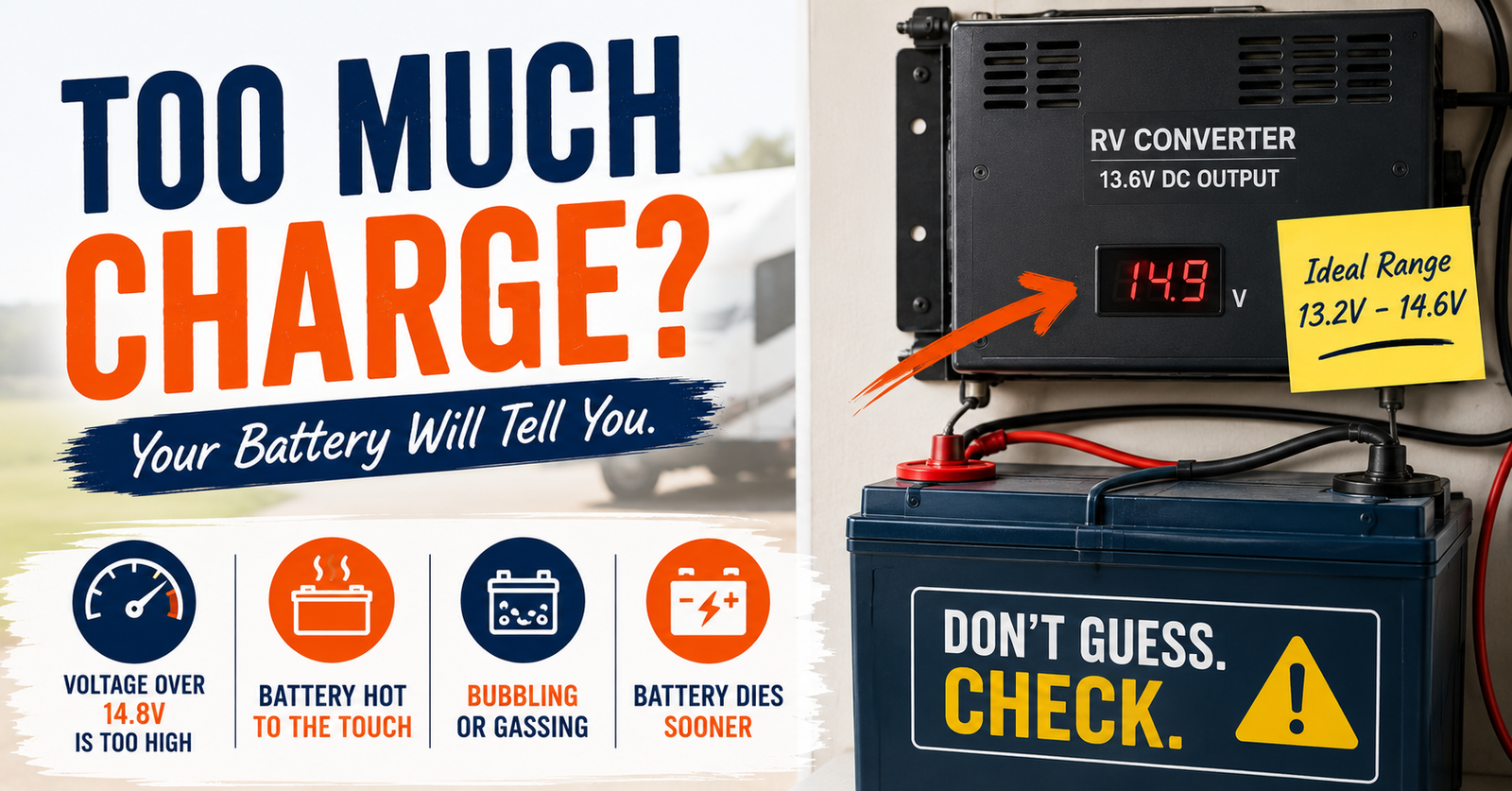
An RV converter can overcharge a battery if it supplies too much voltage or fails to reduce its charging voltage when the battery no longer needs a heavy charge. However, seeing 14 volts or even a little higher on your multimeter does not automatically mean your converter is overcharging.
That’s the part that trips people up.
Modern RV converter/chargers intentionally change voltage. A WFCO converter, for example, can use about 14.4 volts while rapidly charging a discharged lead-acid battery, around 13.6 volts during normal charging, and a lower maintenance voltage on applicable models.
So before deciding your converter is cooking the battery, we need to figure out what voltage you’re actually seeing, how long it’s staying there, and what kind of battery is connected to it.
Yes, an RV Converter Can Overcharge a Battery
The converter isn’t just there to make your lights work when the camper is plugged in.
It also acts as a battery charger.
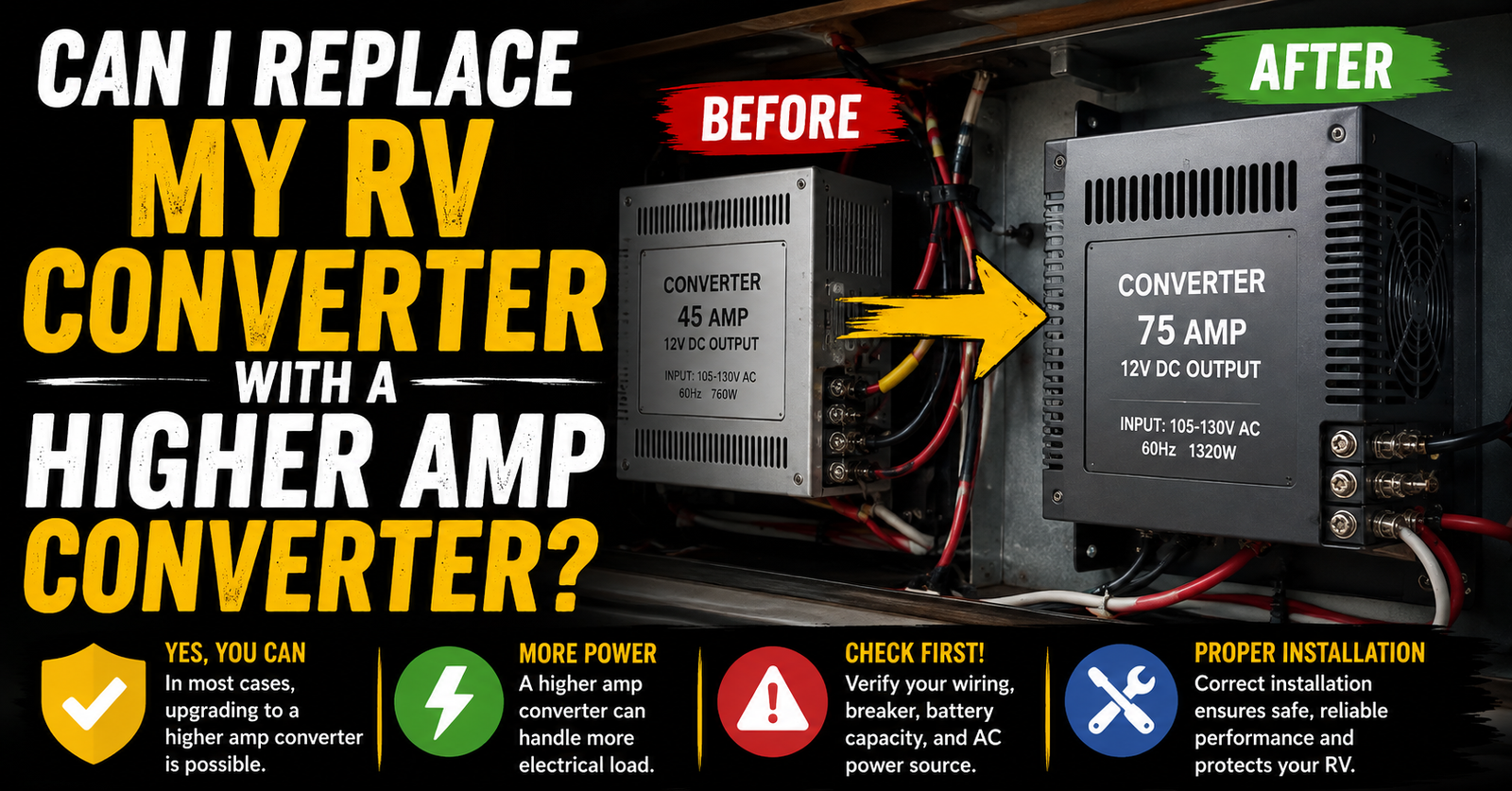
When you’re connected to AC power, the converter supplies the RV’s 12-volt system and can send charging current to the house battery. WFCO describes this same basic operation, with the converter beginning to charge the battery as needed whenever the RV is connected to AC power. That shared role is why replacing an RV converter with a higher-amp converter requires checking both the battery-charging plan and the rest of the 12-volt distribution system.
That’s why converter problems can eventually become battery problems.
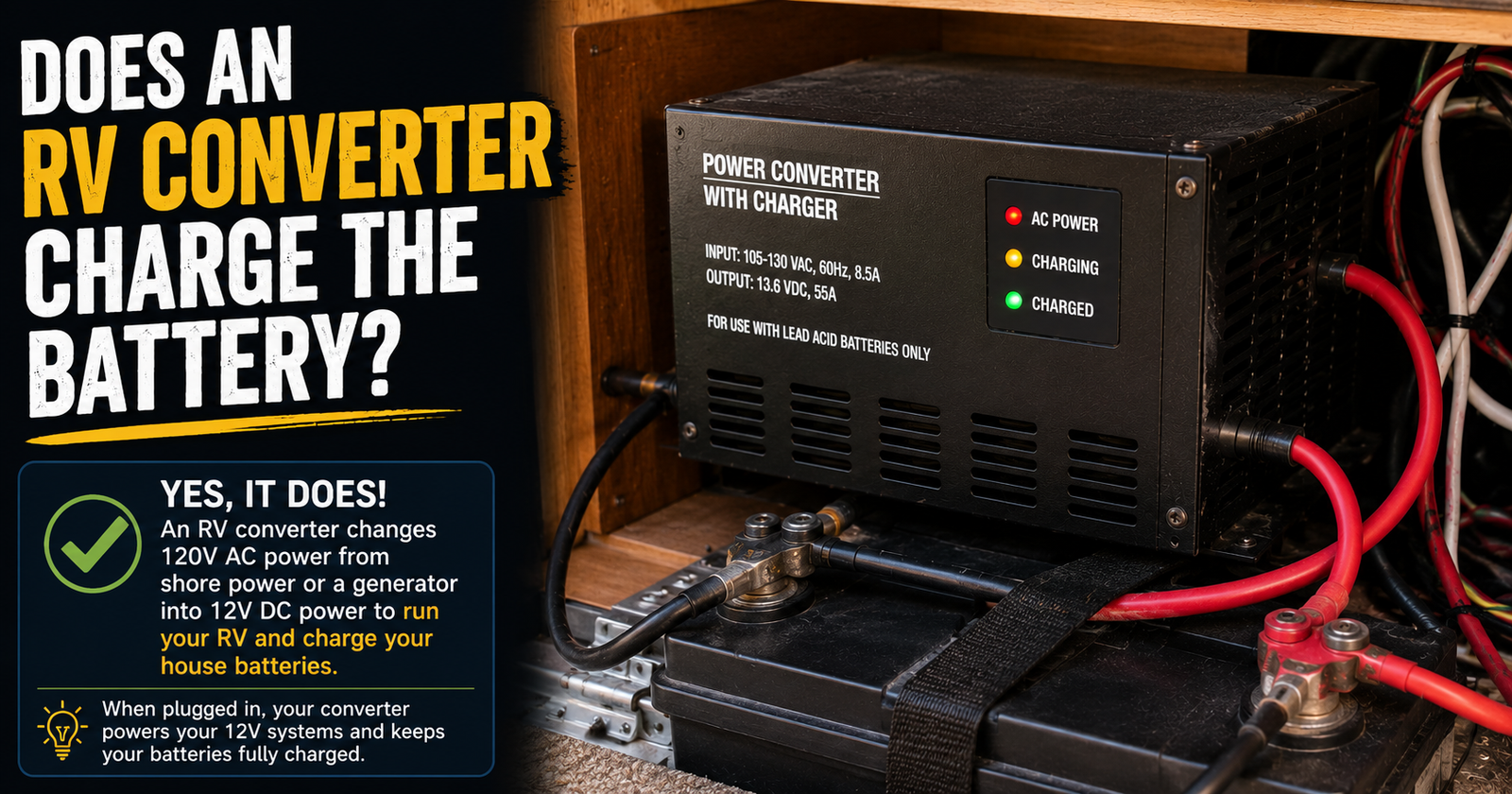
If you want the bigger picture first, our guide explaining how an RV converter actually charges the battery makes the relationship between these two parts much easier to understand.
The important thing here is that the converter controls the charging environment.
If that charging environment is wrong for long enough, the battery pays the price.
What Does Overcharging an RV Battery Actually Mean?
Overcharging isn’t simply:
“The voltage is higher than 12.6 volts.”
It has to be higher.

A typical fully charged 12-volt lead-acid battery rests around 12.6 volts, and charging current only flows into it when the charging source is at a higher voltage. Progressive Dynamics explains this same principle in its battery-management information. To put that 12.6-volt reference into the right measurement context, use RV battery voltage readings alongside the converter's charging specifications.
So seeing:
13.2 volts
13.6 volts
14.4 volts
doesn’t automatically tell me anything is broken.
Overcharging is more about the battery being subjected to an inappropriate charging voltage or charging behavior after it no longer needs it.
That’s when excessive gassing, water loss, heating, and battery damage become concerns.


14.4 Volts Does Not Automatically Mean Your Converter Is Overcharging
This one is worth remembering.
If you grab your multimeter, see 14.4 volts, and immediately unplug the camper because you think the converter has gone crazy, you may be interrupting completely normal charging.
WFCO’s current converter information says its applicable units can maintain approximately 14.4 volts for lead-acid batteries during a higher-output charge mode. Once charging demand falls sufficiently, the converter leaves that higher-voltage mode.
Progressive Dynamics also uses approximately 14.4 volts during boost charging with applicable Charge Wizard systems.
The voltage isn’t suspicious just because it’s higher than 13.6.
The bigger question is whether the converter eventually comes back down when it should.
What Voltage Should My RV Converter Be Putting Out?
There isn’t one number that applies to every converter.
That’s why I always want the model number.
A traditional converter may behave differently from a modern multi-stage converter.
A lithium converter may behave differently from a lead-acid converter.
A converter with automatic battery detection may behave differently depending on what battery it detects.
For certain Progressive Dynamics PD9100 and PD9200 standard models, the manufacturer’s direct converter-output test calls for approximately 13.6 volts, plus or minus 0.3 volts. Lithium versions use a different specified test voltage.
WFCO equipment commonly uses approximately 13.6 volts during normal operation and approximately 14.4 volts during higher-output charging on applicable lead-acid models.
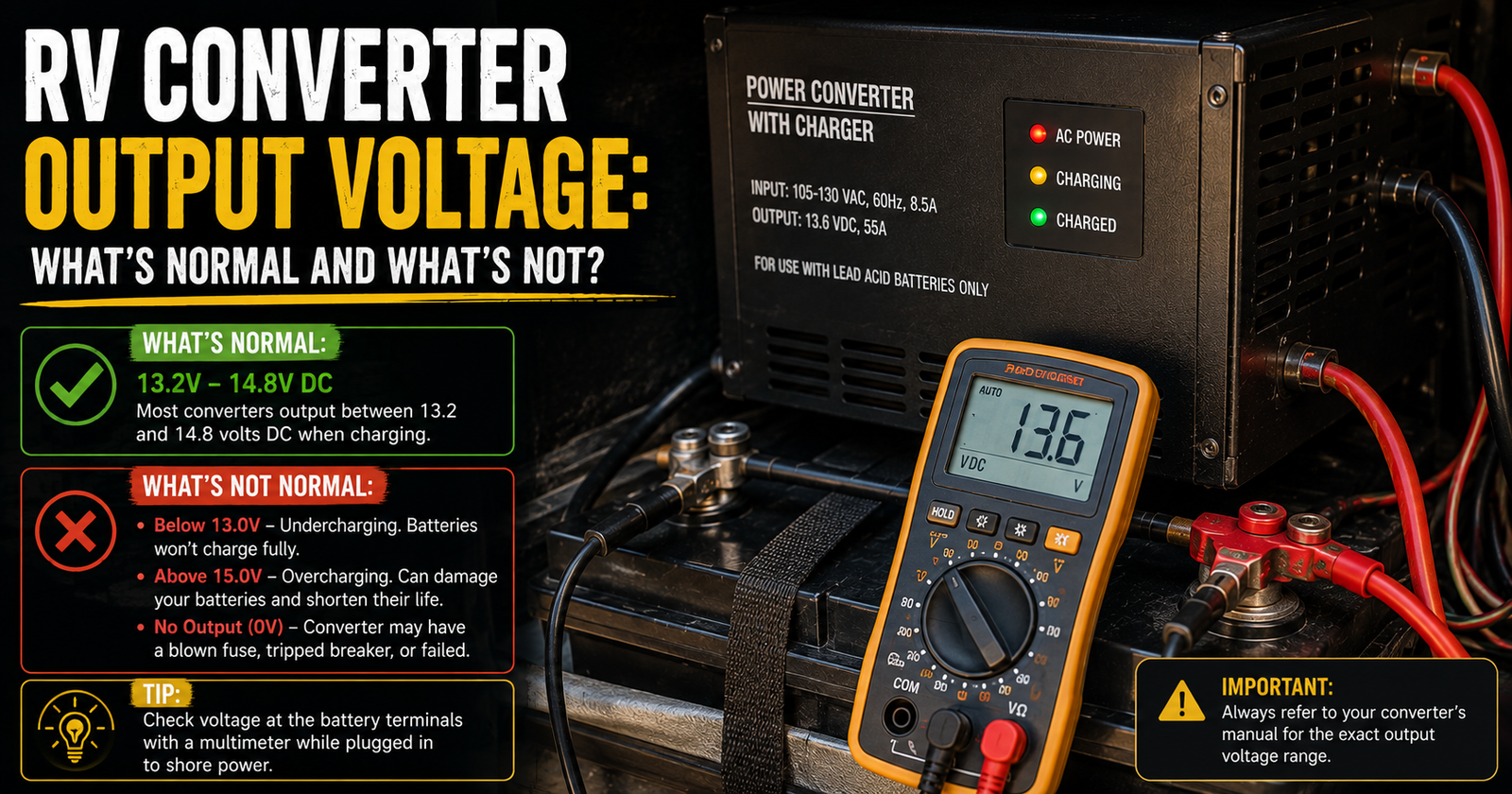
We’ve put the numbers into much more context in our guide to normal RV converter output voltage.
Don’t diagnose overcharging from a generic voltage chart without knowing what converter you actually own.
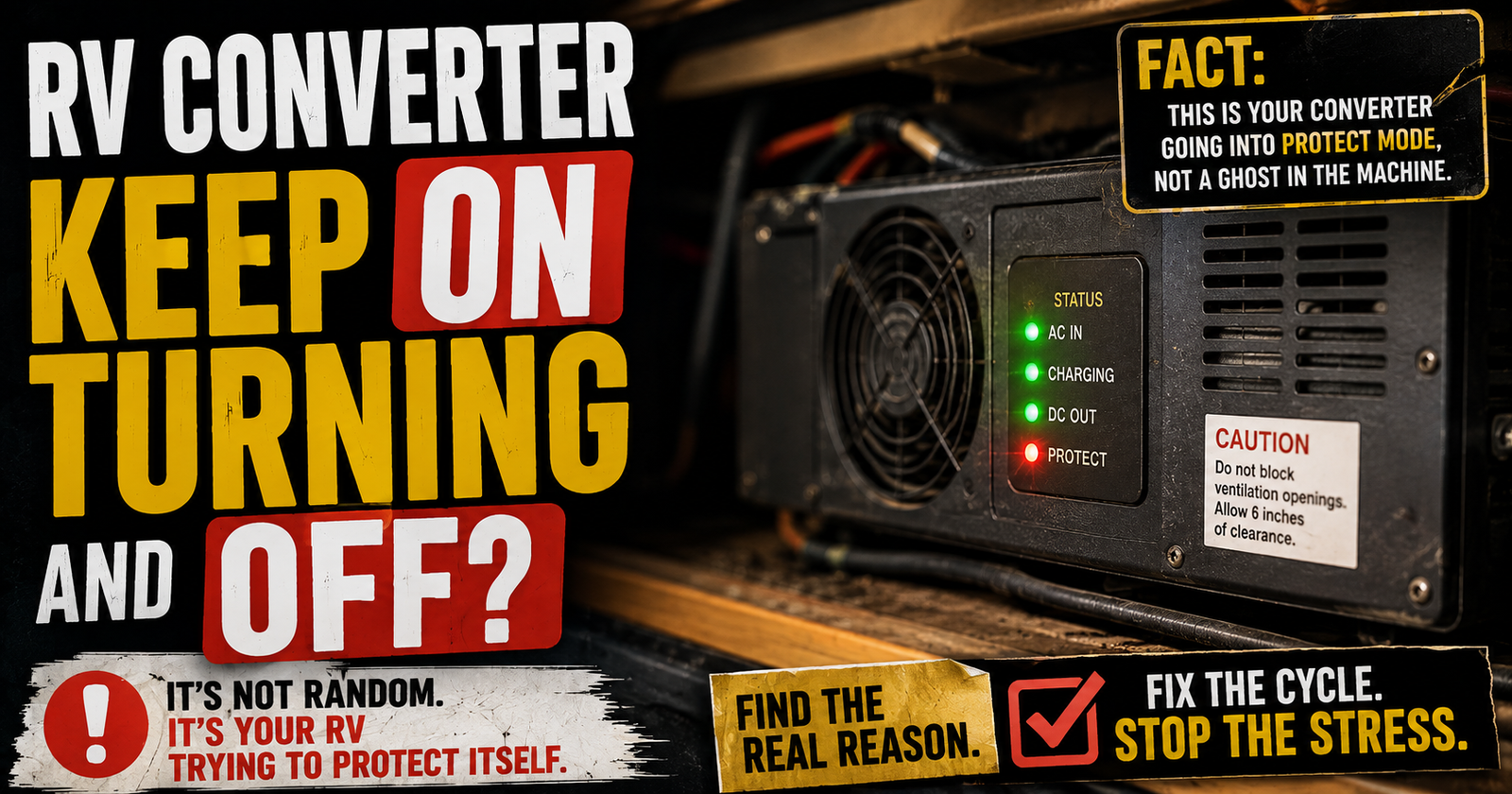
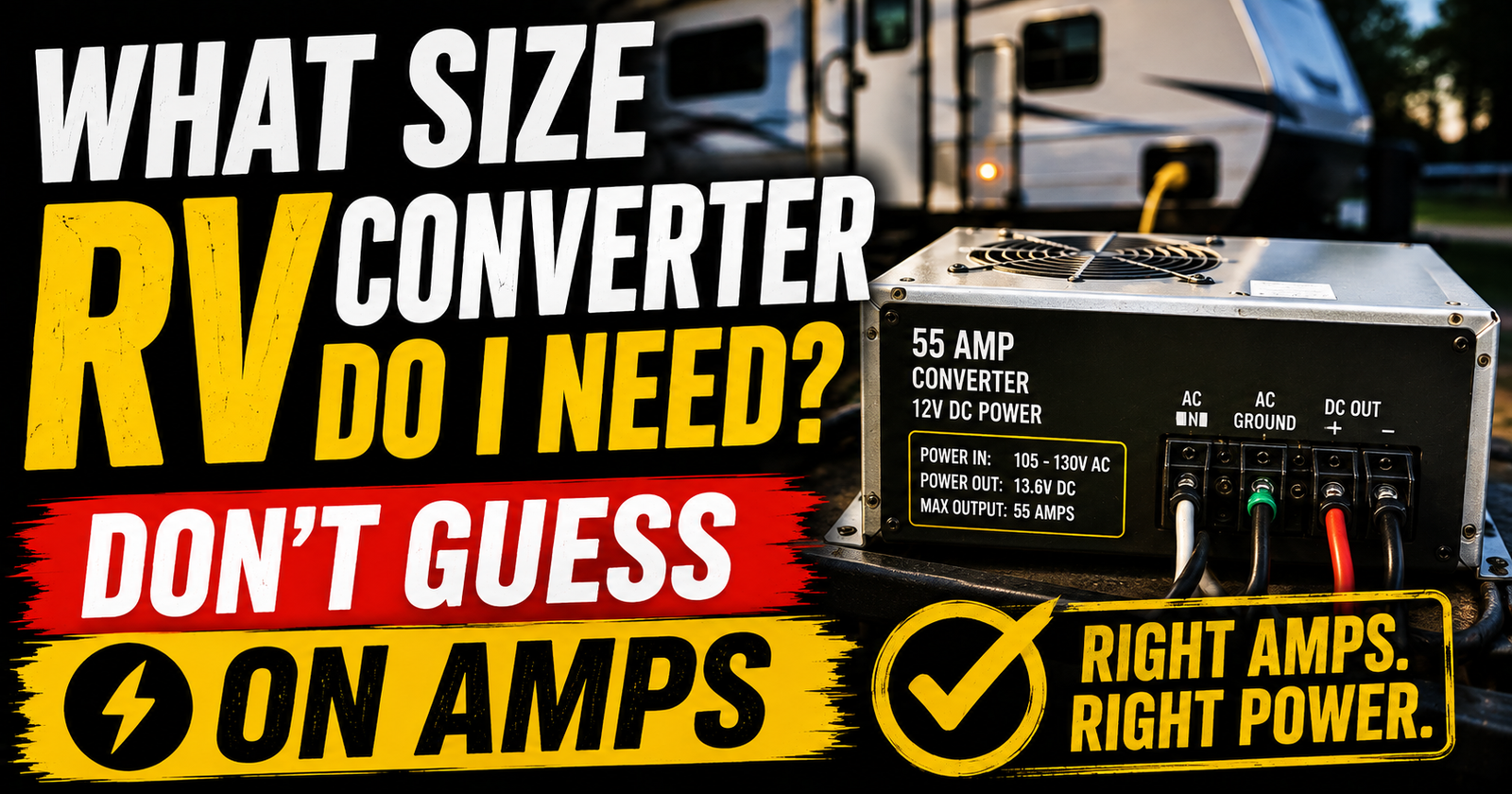
One of the Biggest Clues Is Whether the Voltage Ever Comes Down
This is where I start getting interested.
Suppose your battery was badly discharged.
You plug the camper in.
Converter output climbs to approximately 14.4 volts.
That can make perfect sense.
The battery needs a substantial charge.
Now suppose the battery becomes fully charged, you aren’t using much 12-volt power, and the converter continues hammering away at an inappropriate high charging voltage indefinitely.
That’s when I’d start investigating.
Modern multi-stage converters are designed specifically to change their charging behavior as battery conditions change.
Progressive Dynamics explains that its Charge Wizard reduces charging voltage as a lead-acid battery becomes charged, eventually reaching a lower storage voltage intended to maintain the battery while reducing gassing and water loss.
If your converter isn’t behaving the way its manufacturer says it should, that’s meaningful.
A Battery That Keeps Losing Water Is a Big Clue
This applies to flooded lead-acid batteries where you can actually inspect and replenish electrolyte.
Some water loss is normal.
Charging a lead-acid battery creates hydrogen and oxygen gas, which is one reason flooded batteries need proper ventilation and periodic water checks. Progressive Dynamics explains that charging-related gassing causes water loss and that excessive charging increases that problem.
But there is a difference between:
“I occasionally need to top up my battery.”
and:
“This thing is constantly thirsty.”
If you’re repeatedly adding distilled water to a battery that spends most of its life connected to shore power, I’d want to know exactly what charging voltage it’s seeing.
A Battery Bubbling While Charging Isn’t Automatically Bad Either
Flooded lead-acid batteries can gas during charging.
That isn’t automatically evidence of failure.
Higher-voltage charging stages can intentionally produce more gassing.
The problem is excessive or violent bubbling, especially if it’s accompanied by unusual heat, rapid water loss, strong odor, or charging behavior that doesn’t make sense.
WFCO specifically warns against allowing a battery to become too hot to touch or boil violently while charging.
If that’s what you’re seeing, I wouldn’t leave the camper plugged in and assume it’s normal.
What Does an Overcharged RV Battery Smell Like?
People often describe an overcharging lead-acid battery as having a rotten-egg or sulfur-like smell.
If I smell something unusual around the battery compartment, I don’t go looking for the air freshener.
I go looking for the source.
Lead-acid batteries can produce flammable gases during charging. Progressive Dynamics specifically notes that hydrogen and oxygen are generated during the charging process and that RV batteries need proper outside ventilation.
A battery that’s hot, heavily gassing, or giving off a strong odor deserves immediate attention.
Don’t create sparks around it.
Don’t smoke around it.
Don’t casually disconnect a terminal while it’s violently gassing.
Remove charging power safely and investigate.
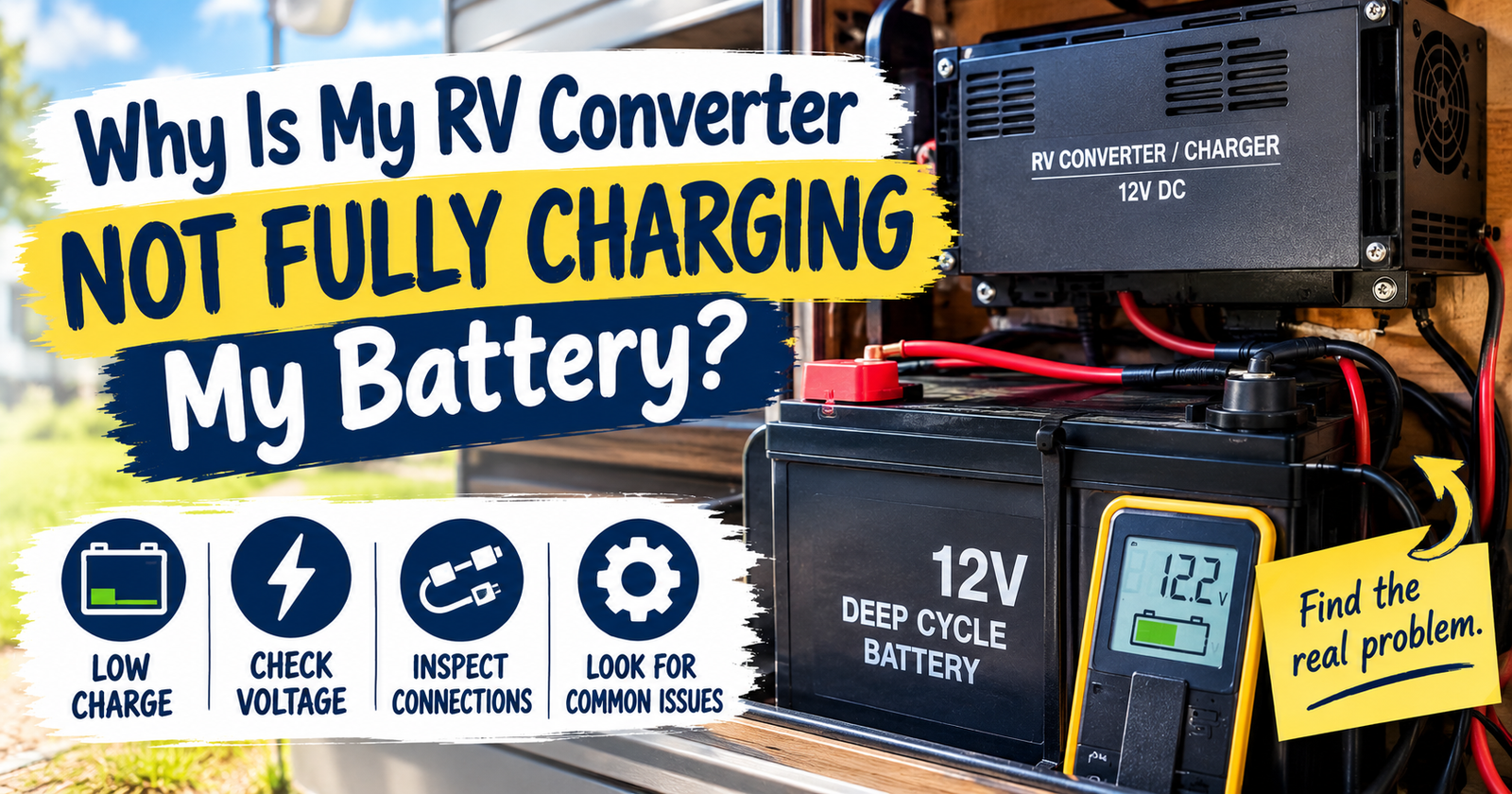

The Battery Getting Hot Is Another Warning
A battery can warm somewhat while charging.
But too hot to comfortably touch isn’t something I’d ignore.
WFCO specifically lists a battery becoming too hot and boiling violently as something to avoid during charging.
If the battery is getting unusually hot, I want to know:
What voltage is reaching it?
How much current is it accepting?
Is the battery damaged?
Does it have a shorted cell?
Is the converter using the correct charging profile?
Is the converter ever leaving its high-charge mode?
Don’t automatically blame the converter, because a damaged battery can create abnormal charging behavior too.
A Bad Battery Can Look Like an Overcharging Converter
This is why diagnosis gets tricky.
Suppose one cell in the battery is damaged.
The converter sees a battery that never behaves the way a healthy battery should.
It keeps trying to charge.
The battery gets warm.
It gases.
You assume:
“My converter won’t stop charging.”
Maybe.
But the battery may be the problem.
WFCO specifically tells owners troubleshooting charging problems to consider battery condition, water level, age, and shorted cells.
Before replacing a converter, I’d test both sides of the relationship.
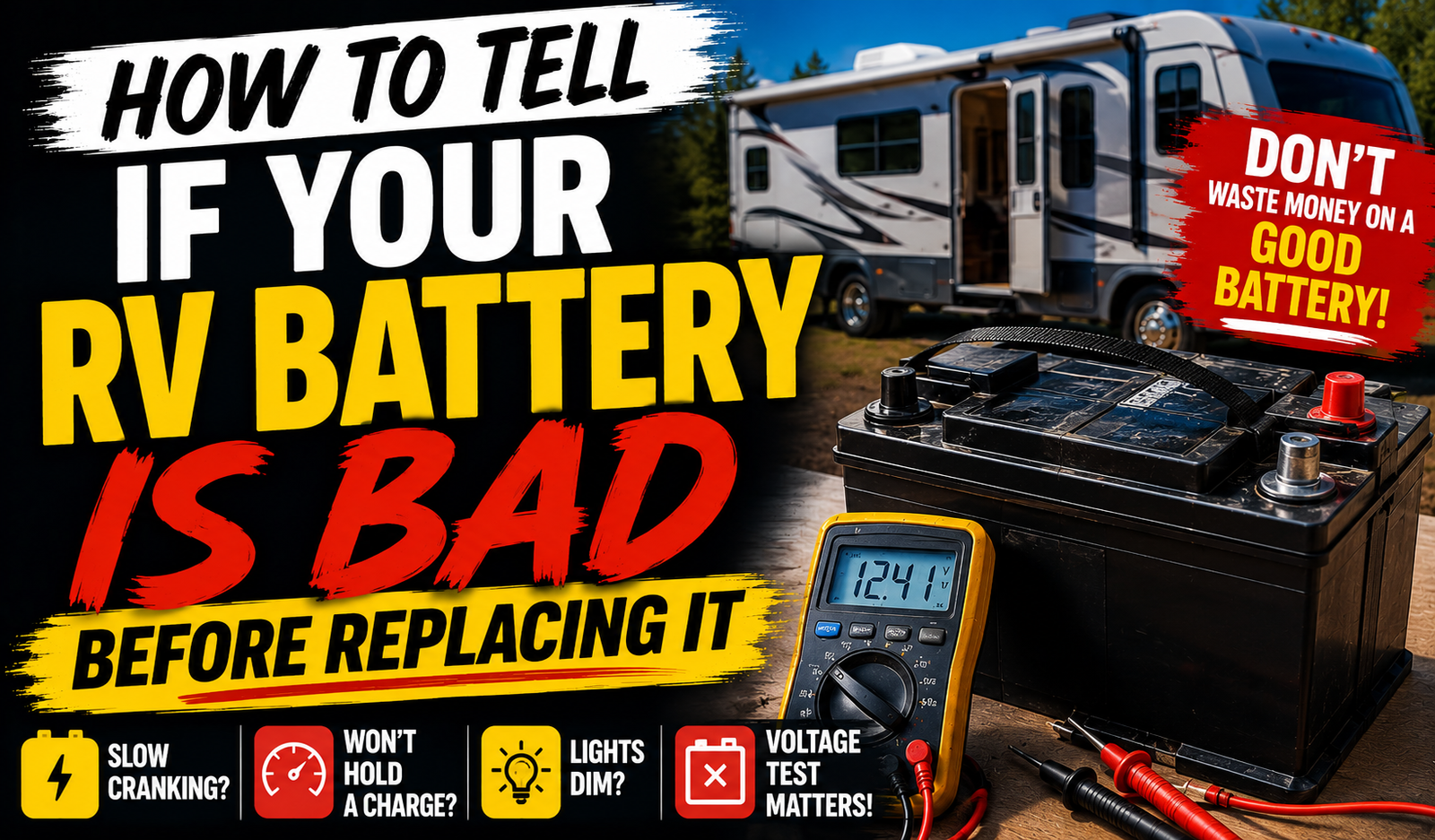
Our guide to checking whether an RV battery is bad is worth working through if the battery itself is acting suspicious.
Here’s the First Test I’d Make
Get a digital multimeter.
Measure voltage directly at the battery terminals.
Do this carefully with the meter set to DC voltage.
I’d want to know the battery voltage under several conditions.
First, with the RV disconnected from shore power after the battery has had appropriate time to settle.
Then with the RV connected to shore power and the converter operating.
Then again later after the battery has been charging.
We’re looking for a pattern.
Not one random number.
Example of Normal-Looking Charging Behavior
Imagine you have a discharged lead-acid battery.
Before plugging in:
12.1 volts
After the converter starts charging:
13.6 volts
Later during an appropriate higher-output charging stage:
14.4 volts
After the battery is charged and the converter transitions to a lower maintenance mode:
Lower maintenance voltage appropriate for that converter
That progression may be completely normal.
The exact sequence and voltages depend on your equipment.
But the important part is that the converter is responding to battery conditions rather than staying at one inappropriate charging level forever.
Here’s the Pattern That Would Make Me Suspicious
You have a lead-acid battery that’s already charged.
Very little DC equipment is operating.
The camper has been plugged in for a long time.
Yet the battery continues seeing a charging voltage that is outside what the converter manufacturer specifies for that condition.
Meanwhile:
The battery is hot.
Water disappears quickly.
It’s heavily gassing.
You smell something unusual.
Now we have several clues pointing in the same direction.
That’s very different from seeing 14.4 volts for an hour while recharging a dead battery.
Test at the Converter Too
Battery-terminal voltage tells us what the battery is receiving.
Converter-output voltage tells us what the converter is producing.
Ideally, I want both.
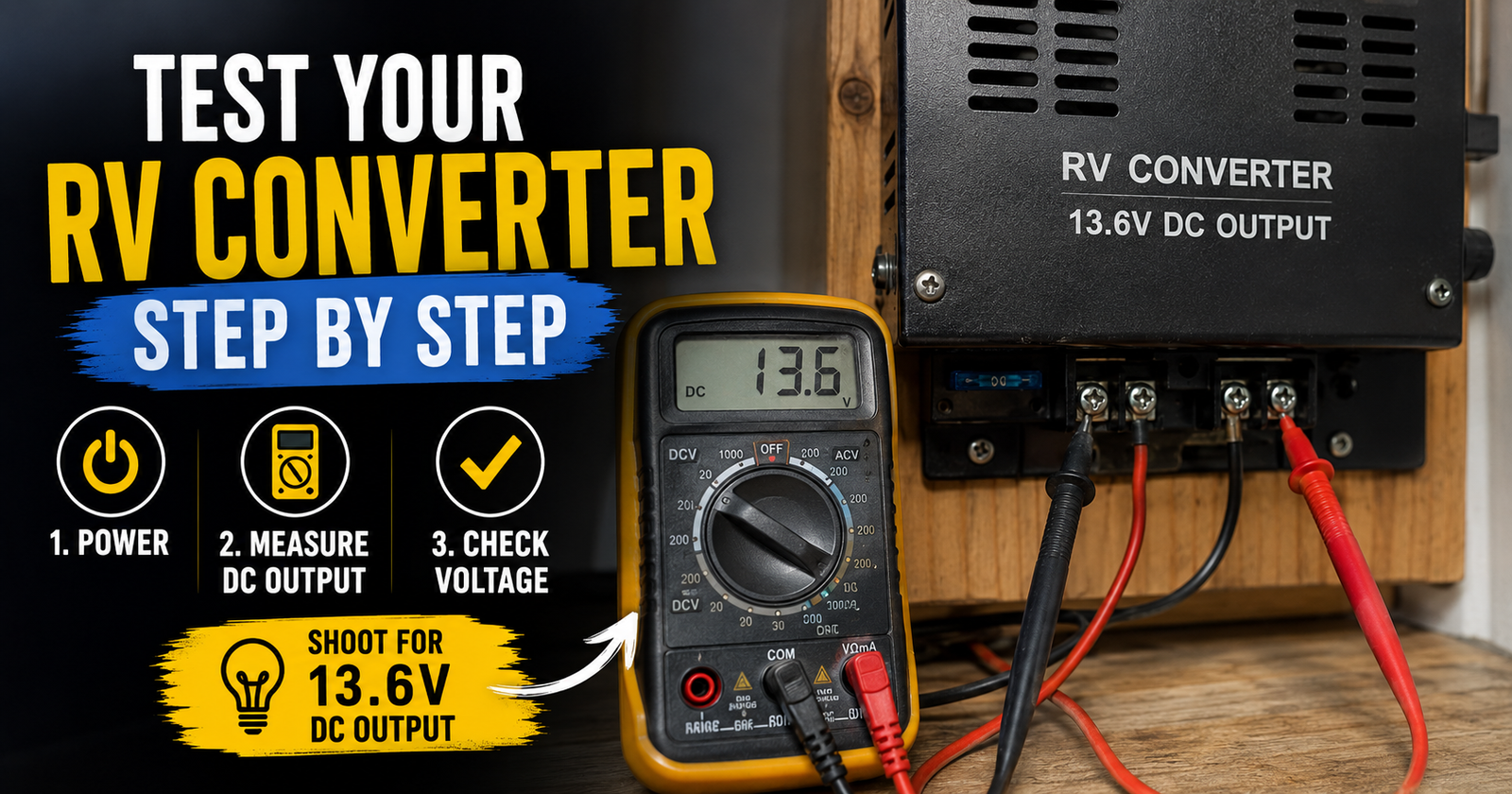
If you aren’t sure where or how to measure converter output safely, use our step-by-step RV converter multimeter testing guide.
Follow the manufacturer’s test procedure for your exact converter.
For applicable Progressive Dynamics models, the manufacturer has you isolate the battery connection in a specific way and measure directly at the converter output terminals.
That gives you a much cleaner picture of what the converter itself is doing.
Why Might Converter Voltage and Battery Voltage Be Different?
Because they’re connected by wire.
That wire has resistance.
So do:
Connections.
Fuse holders.
Breakers.
Disconnect switches.
Ground connections.
Terminals.
The more charging current flowing through the circuit, the more noticeable voltage drop can become.
That’s why I don’t expect converter-terminal voltage and battery-terminal voltage to always be identical down to the hundredth of a volt.
A large difference, though, deserves investigation.
Check Your Converter’s Actual Charging Modes
This is where the owner’s manual becomes extremely useful.
Find the converter model.
Then determine what the manufacturer says it should do.
For example, WFCO’s three-stage charging documentation describes approximately:
14.4 volts in Bulk Mode
13.6 volts in Absorption Mode
with applicable models also using a lower float strategy for battery maintenance.
Progressive Dynamics uses a similar concept with its Charge Wizard, adjusting voltage based on battery condition and usage rather than leaving the battery permanently at maximum charging voltage.
Your numbers may differ.
That’s why the manual wins over a random forum post.
Older RV Converters Can Behave Differently
This becomes particularly relevant in older campers.
Not every RV converter has modern multi-stage battery charging.
Progressive Dynamics explains that a fixed 13.6-volt charging source can recharge a lead-acid battery, but leaving a fully charged battery at that fixed voltage can cause considerably more gassing and water loss than reducing the voltage to an appropriate storage level.
That doesn’t necessarily mean your old converter is broken.
It may be operating exactly as designed.
The design just may not maintain the battery as intelligently as newer charging equipment.
So Can an Old Converter Slowly Cook a Battery?
Potentially, yes, especially a flooded lead-acid battery left connected for long periods with a charging strategy that isn’t ideal for long-term maintenance.
That’s why older RV owners sometimes become very familiar with checking battery water.
A modern multi-stage converter is designed to reduce charging voltage once aggressive charging is no longer necessary.
Progressive Dynamics specifically says its lower storage-mode voltage is intended to maintain full charge while reducing gassing and water loss.
If your camper spends months plugged into shore power, charging strategy becomes especially important.
Does Leaving My RV Plugged In Overcharge the Battery?
Not necessarily.
This is one of those old RV rules that gets repeated without enough context.
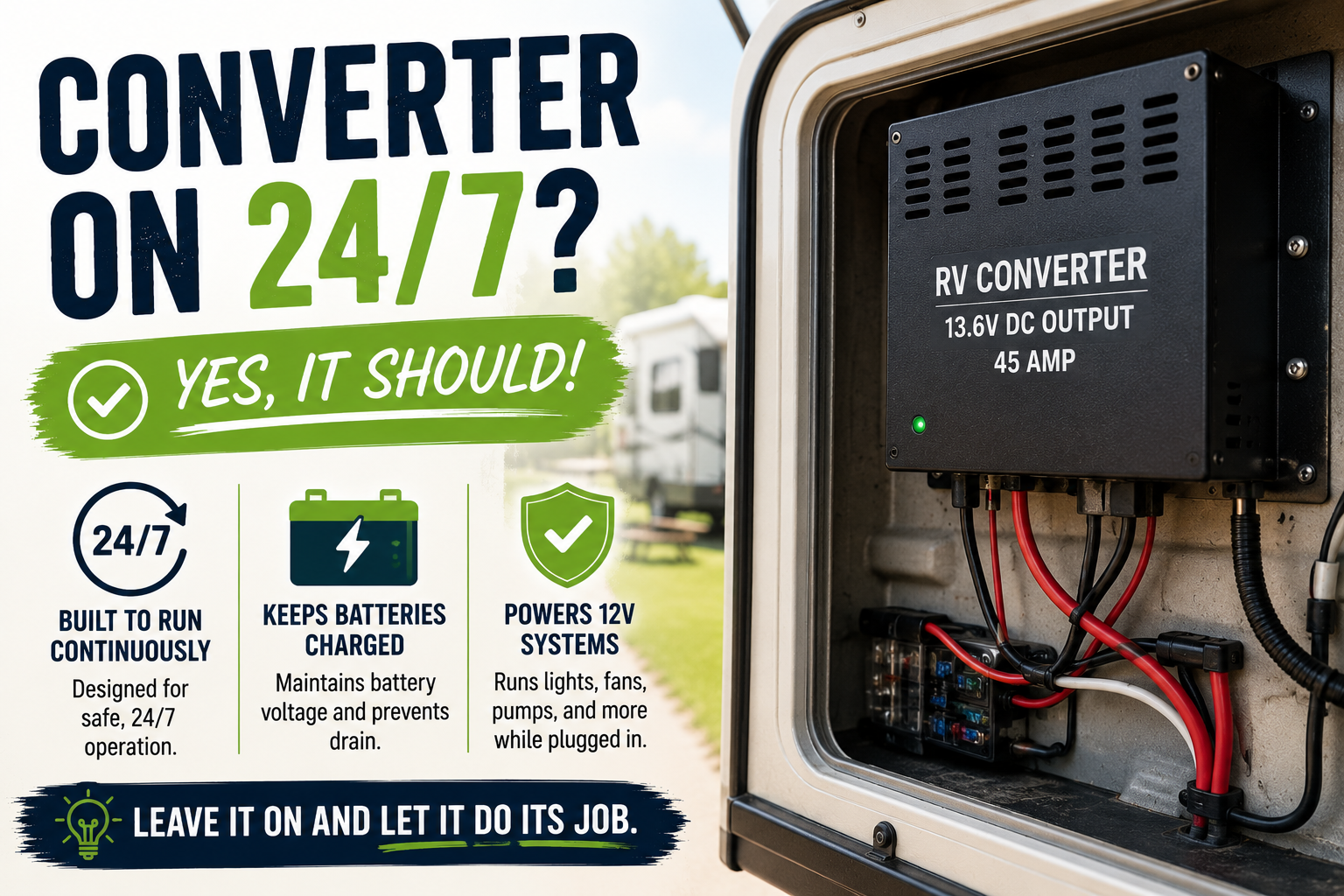
With a properly functioning modern converter/charger that’s compatible with the battery, staying connected to shore power does not automatically mean the battery is being overcharged. The practical question of leaving an RV converter on continuously depends on how its charging stages behave.
The converter is supposed to manage charging.
That’s the whole point of multi-stage charging.
The real questions are:
Is the converter functioning correctly?
Is it compatible with the battery?
Is the battery healthy?
Is the correct charging mode being used?
If those answers are yes, being plugged in isn’t automatically a problem.
But I Still Check Flooded Battery Water
Even with a good charging system.
Flooded lead-acid batteries lose water.
Progressive Dynamics recommends checking water levels regularly because charging naturally produces gassing.
If the RV stays plugged in for long periods, don’t forget the battery exists simply because everything seems to be working.
Pop the compartment open periodically.
Inspect it.
Look for corrosion.
Check water according to the battery manufacturer’s instructions.
Watch for unusual heat.
A five-minute check can tell you a lot.
What About AGM Batteries?
AGM batteries are sealed lead-acid batteries, so you don’t top them up with distilled water like a traditional flooded battery.
That doesn’t make charging voltage irrelevant.
A sealed battery can still be damaged by inappropriate charging.
Progressive Dynamics notes that sealed lead-acid batteries retain and recombine much of the charging gas internally, but excessive overcharging can cause pressure relief valves to open and vent, resulting in electrolyte loss.
And unlike a flooded battery, you can’t simply pop the caps and replace that lost water.
Use a charging profile appropriate for the AGM battery.
Lithium Changes the Conversation Again
LiFePO4 isn’t lead-acid.
Don’t use lead-acid symptoms and charging expectations to diagnose a lithium system.
WFCO’s current charging documentation, for example, uses approximately 14.6 volts during its lithium Charge Mode versus approximately 14.4 volts for lead-acid.
So if someone tells you:
“14.6 volts means your converter is overcharging!”
I’d immediately ask:
“What battery and what converter?”
For the right lithium charging system, that voltage may be intentional.
But Lithium Overcharging Is Something I Take Seriously
A quality LiFePO4 battery normally has a battery management system, or BMS, that provides protection against conditions including excessive charging voltage.
But I don’t treat the BMS as permission to use whatever charger happens to be lying around.
The converter should still be appropriate for the battery.
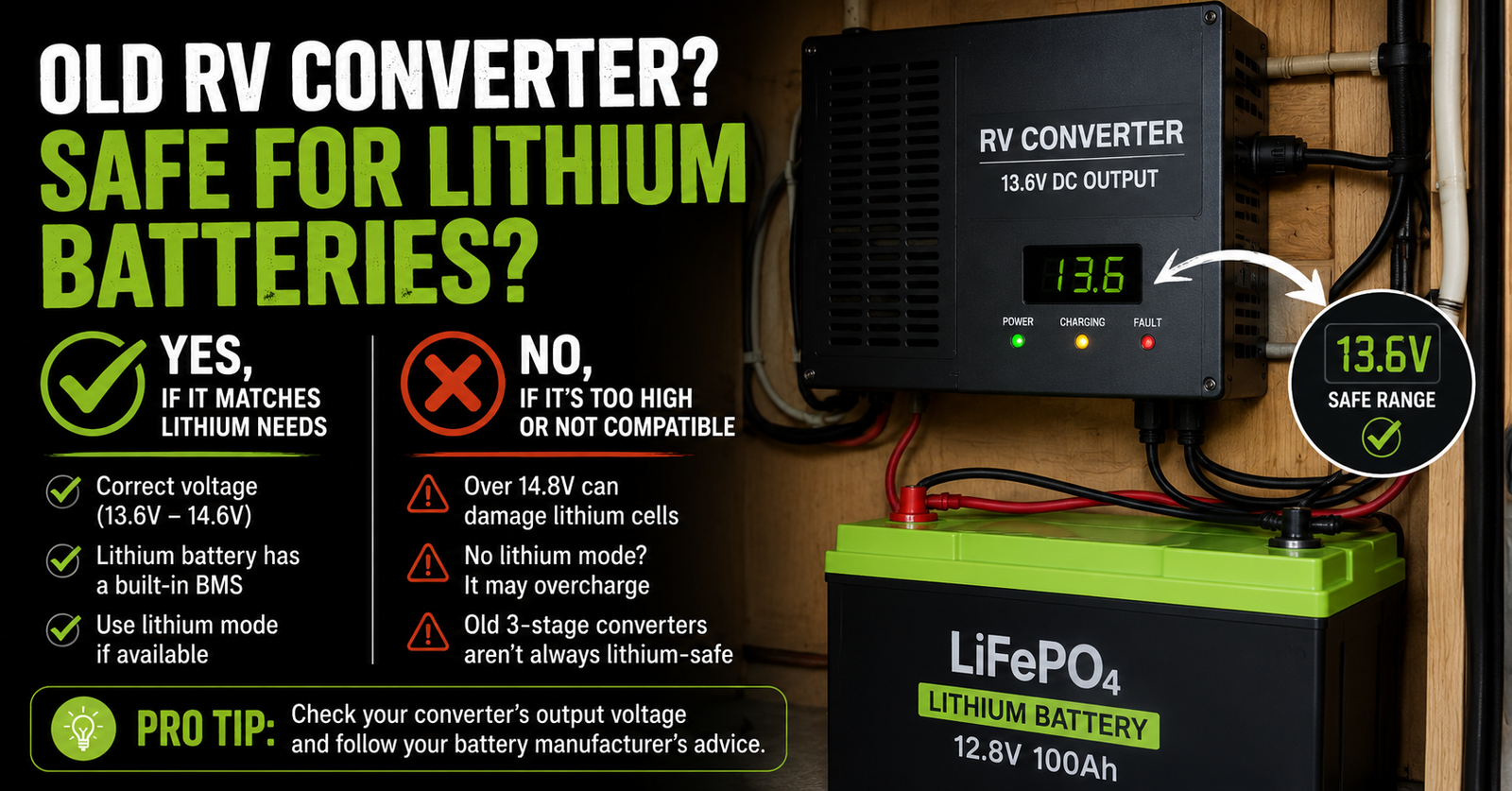
We’ve already covered using an older RV converter with a lithium battery, and that’s particularly relevant if your charging problems started immediately after switching battery chemistry.
Changing the battery without thinking about the charger can create confusing behavior.
What If My Converter Has an Auto-Detect Battery Mode?
Verify that it’s actually detecting or configured for the correct battery type according to the manufacturer’s instructions.
Don’t assume.
Some modern converter systems are designed to change charging behavior based on battery chemistry.
That’s useful, but it also means the charging voltage you see may depend on what the converter believes is connected.
If you recently changed batteries and suddenly notice unfamiliar charging voltages, check the converter documentation before diagnosing a failure.
Could a Wrong Battery Setting Cause Overcharging?
Potentially, yes.
If a charger uses charging parameters that aren’t appropriate for the connected battery, you’re no longer charging the battery according to its intended profile.
How serious that becomes depends on the battery chemistry, charger, voltage, duration, and battery’s own protective systems.
This is why I always want the converter and battery identified together.
Don’t troubleshoot one without knowing the other.
What If the Battery Is Boiling?
If by “boiling” you mean a flooded lead-acid battery is violently bubbling, getting extremely hot, venting heavily, or throwing electrolyte around, I would not consider that normal maintenance charging.
WFCO specifically warns against allowing a battery to become too hot to touch and boil violently during charging.
Safely remove the charging source.
Keep sparks and flames away.
Allow the battery to cool.
Then determine whether the battery itself is damaged or the charging system is behaving incorrectly.
Don’t lean directly over a violently gassing battery.
What If the Battery Case Is Swollen?
That’s another stop sign.
A battery case that’s visibly bulging or swollen isn’t something I’d keep charging while I experiment with converter settings.
Disconnect charging safely according to the equipment manufacturers’ instructions.
Then evaluate the battery and charging system.
At that point, I’d be much more concerned with avoiding additional battery damage than proving exactly which charging stage the converter thinks it’s in.
What If Battery Water Keeps Disappearing?
Now I’d start recording actual measurements.
Don’t rely on:
“It seems like I’m adding a lot.”
Write down the date.
Check the electrolyte properly.
Record converter voltage.
Record battery-terminal voltage.
Pay attention to how long the RV stays connected to shore power.
If you’re adding significant amounts of distilled water frequently while the camper mostly sits plugged in, I’d investigate the charging system.
The pattern matters.
What If Only One Battery in My Bank Is Getting Hot?
That’s a different clue.
If you have multiple batteries connected together and only one is overheating, heavily gassing, or behaving strangely, I become suspicious of that individual battery.
A weak or internally damaged battery can cause trouble throughout a bank.
WFCO recommends batteries used together be the same type and preferably the same age.
Don’t assume the converter is overcharging the entire bank because one battery has failed.
Test the batteries individually when appropriate.
Can Overcharging Ruin an RV Battery?
Absolutely.
For flooded lead-acid batteries, excessive charging can accelerate water loss and gassing.
Progressive Dynamics explains that once a lead-acid battery reaches a high state of charge, charging voltage needs to be reduced to control gassing and water loss.
Repeatedly losing electrolyte isn’t just annoying maintenance.
If the plates become exposed, battery damage can result.
That’s why I don’t ignore a battery that’s constantly thirsty.
Overcharging Can Also Make Corrosion Worse
If you’ve suddenly noticed a lot more corrosion around the battery compartment, take a closer look at the charging system.
Heavy gassing and electrolyte contamination around terminals can contribute to corrosion.
Clean and protect the terminals properly, but don’t stop there.
If corrosion returns unusually quickly, figure out what’s causing the battery environment to become so aggressive.
Treating the white or green crust isn’t the same as fixing the reason it’s forming.
Can Overcharging Damage 12-Volt RV Equipment?
Potentially.
Remember, the converter isn’t necessarily connected only to the battery.
It’s also supplying the RV’s 12-volt electrical system.
If converter output becomes abnormally high beyond what the RV equipment is designed to tolerate, sensitive electronics may be affected.
That’s another reason I don’t treat an obviously abnormal converter voltage as merely a battery-maintenance issue.
The entire 12-volt system depends on reasonable DC voltage.
Very Bright Lights Can Be a Clue
Most people associate converter trouble with dim lights.
But unusually bright 12-volt lights can also make me curious about system voltage.
If the lights suddenly look brighter than normal while connected to shore power, grab the multimeter.
Don’t diagnose from your eyeballs alone.
Measure.
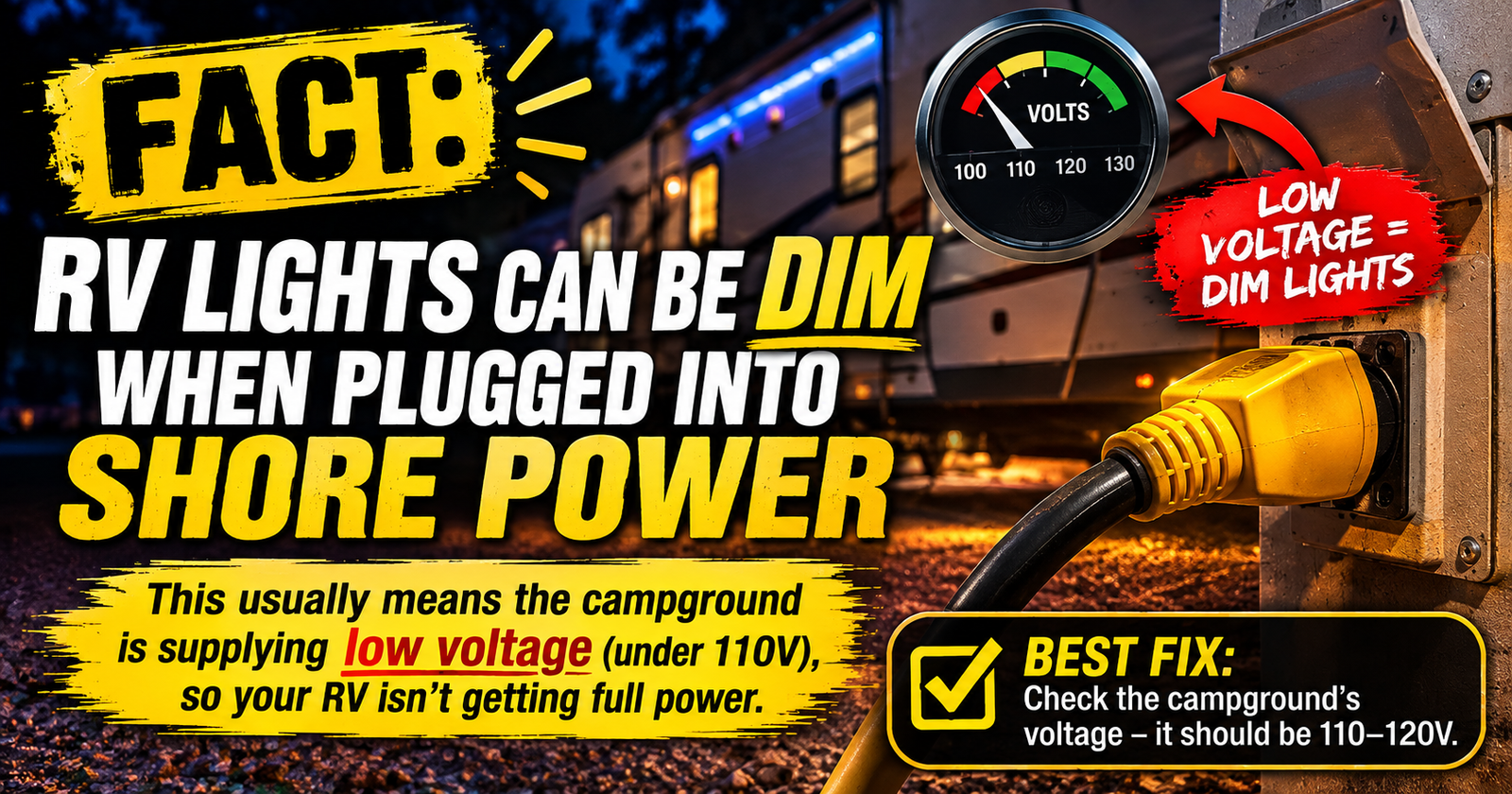
Our article about dim RV lights while plugged into shore power deals with the opposite symptom, but both situations show why your lights can provide clues about what the 12-volt system is doing.
What If My Battery Gets Hot Only on Shore Power?
That’s useful information.
If the battery behaves normally while disconnected but heats excessively whenever the camper stays plugged into shore power, the charging system moves higher on my list.
But I still don’t automatically blame the converter.
The battery may have an internal problem that only becomes obvious when charging current is applied.
That’s why I want voltage measurements and battery testing.
We need to know what the converter is sending and how the battery is responding.
What If It Happens on Generator Power Too?
Remember what the converter does.
Whether AC electricity comes from campground shore power or an appropriate generator supply, the converter can still operate.
So if the battery exhibits the same overcharging symptoms when the converter is powered by either source, that makes sense if the problem is downstream in the converter or battery system.
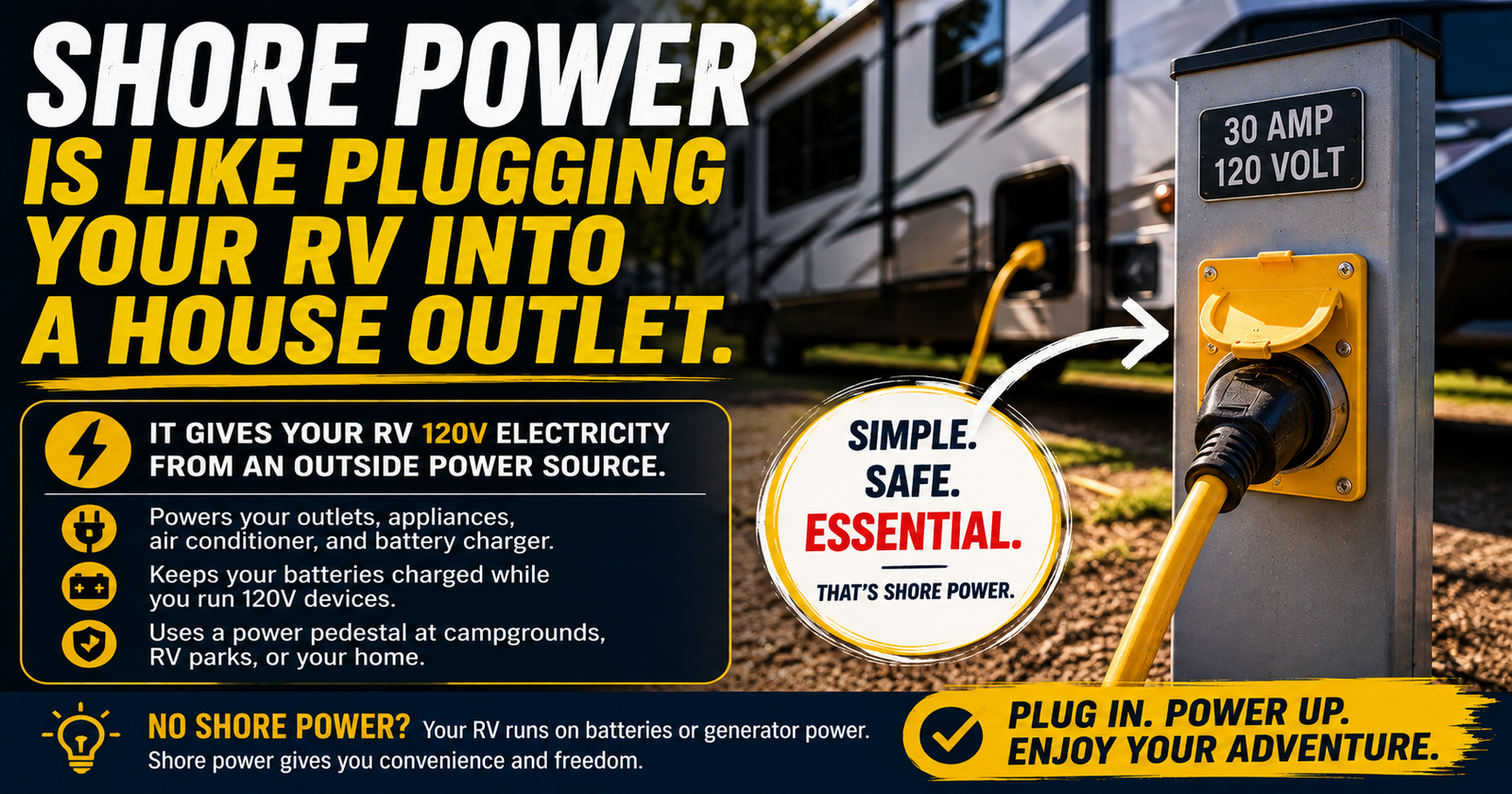
If you haven’t gotten comfortable with this relationship yet, our beginner guide to what RV shore power actually meanswill make the AC-versus-DC side of the camper much easier to picture.
The generator doesn’t normally bypass the converter and magically become the battery charger.
It can provide the AC electricity that allows the converter to do its job.
Could the Converter Just Be Stuck in Boost Mode?
That’s certainly something I’d investigate on a multi-stage converter if the voltage remains at the boost level far longer than the manufacturer’s charging logic says it should.
But don’t diagnose “stuck in boost” just because you catch the converter at 14.4 volts.
WFCO’s current documentation allows its lead-acid Charge Mode to remain active while charging demand remains high, subject to its control logic and time limits.
The battery may genuinely still need the higher charging stage.
Watch what happens over time.
A Huge Battery Bank Can Stay in Heavy Charging Longer
This is another situation that can fool you.
If you’ve installed a large battery bank and run it down significantly, the converter may have a lot of energy to put back.
That means high charging demand can continue much longer than it would with one small RV battery.
WFCO notes that larger battery banks may require additional fast-charging time.
So duration needs context too.
A converter charging a 400Ah battery bank doesn’t necessarily behave exactly like one charging a single small house battery.
What If My Converter Never Drops Below 13.6 Volts?
This depends heavily on converter design.
Some older converters operate at a fixed voltage around that range.
Progressive Dynamics explains that fixed 13.6-volt charging can maintain and recharge a lead-acid battery, but keeping a fully charged battery continuously at that voltage causes more gassing and water loss than reducing voltage for storage.
So the converter may not technically be malfunctioning.
You may simply have older charging technology.
If you spend a lot of time plugged in, a modern multi-stage converter may offer better battery maintenance.
Don’t Replace the Converter Until You Test It
We’ve reached the point in this cluster where I probably sound like a broken record about testing.
There’s a reason.
RV electrical symptoms overlap constantly.
A battery won’t charge.
Could be converter.
Could be wiring.
Could be battery.
Battery gets hot.
Could be converter.
Could be battery.
Lights behave strangely.
Could be converter.
Could be battery.
Could be wiring.
Measurements separate guesses from diagnoses.
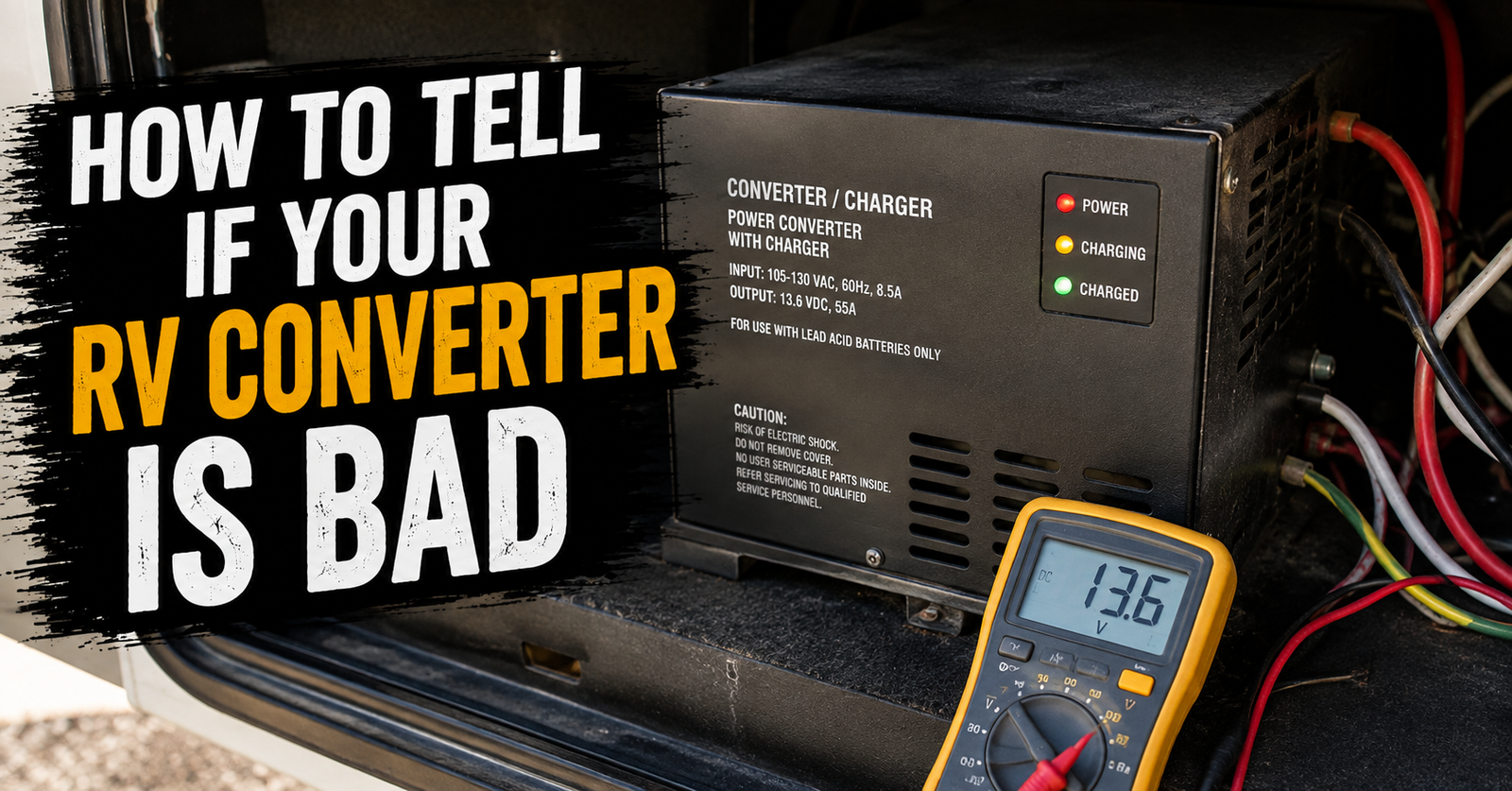
If you think the converter is actually failing, work through our guide on how to tell if an RV converter is bad before ordering another one.
What I’d Check Before Replacing Anything
I’d identify the battery chemistry.
Then the converter model.
Then I’d look up the manufacturer’s specified charging voltages.
I’d measure voltage at the converter.
I’d measure voltage at the battery.
I’d watch what happens as the battery charges.
I’d check battery temperature and physical condition.
For a flooded battery, I’d inspect electrolyte levels according to the battery manufacturer’s procedure.
I’d also test the battery itself.
Only then would I decide whether the converter is actually overcharging.
What If the Converter Really Is Overcharging?
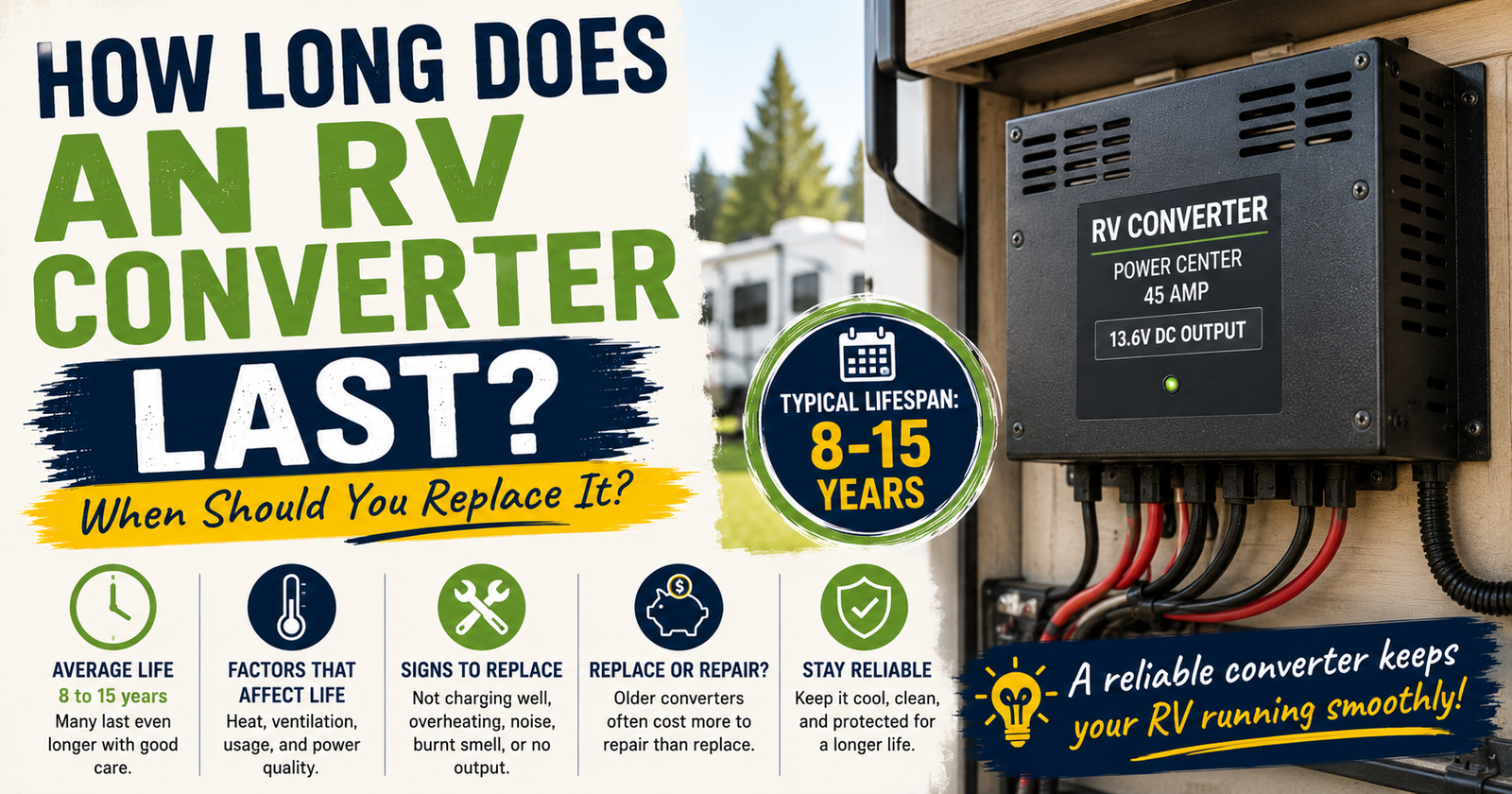
If testing confirms that the converter output is outside its manufacturer’s specifications, or it isn’t transitioning between charging modes as designed and the converter manufacturer identifies that behavior as a failure, I’d stop using it as a battery charger until it’s repaired or replaced. For additional perspective on whether replacement is warranted, compare those results with these signs an RV converter may be failing.
A converter that’s actually malfunctioning can cost you batteries.
And batteries aren’t cheap.
If replacement becomes necessary, we’ve already put together a complete guide on replacing an RV converter without buying the wrong one.
Match the replacement to the camper, wiring, converter capacity, and battery chemistry.
Don’t Forget to Check the Battery After Fixing the Converter
This is important.
Suppose the converter really did overcharge the battery for weeks.
You replace the converter.
Problem solved?
Maybe only half solved.
The battery may already have been damaged.
A flooded battery may have lost substantial water.
An AGM battery may have vented.
A weak battery may have deteriorated further from excessive heat.
So after correcting the charging problem, test the battery too.
Don’t expect a new converter to reverse damage that’s already happened.
If You Catch It Early, You May Save the Battery
This is why I pay attention to the little clues.
Adding water more frequently.
Battery compartment smells different.
Battery seems warmer than usual.
Lights suddenly look brighter.
Converter stays at an unexpected voltage.
Battery corrosion seems to return quickly.
None of those by itself proves overcharging.
Together, they tell me it’s time to get the multimeter out.
The best outcome is finding the problem before the battery is swollen, dry, or ruined.
The Number on the Meter Needs Context
This is the biggest thing I want you to remember.
14.4 volts can be normal.
13.6 volts can be normal.
13.2 volts can be normal.
And depending on a lithium converter and its charging profile, a voltage around 14.6 volts can also be intentional.
What matters is:
Your converter model.
Your battery chemistry.
The charging stage.
Battery state of charge.
How long the voltage remains there.
And whether the battery is showing signs of distress.
If a healthy lead-acid battery is already charged but your converter continues subjecting it to an inappropriate high charging voltage, the battery is overheating, electrolyte is disappearing, and the charging behavior doesn’t match the converter manufacturer’s specifications, then yes, I’d be very suspicious of the converter.
But don’t replace it because you saw 14.4 on the meter once.
Test the system.
Watch what the voltage does over time.
And make the converter prove it’s guilty before you spend money replacing it.
Written by Evan Mercer
Evan Mercer writes about RV batteries, converter/chargers, shore power, 12-volt electrical systems, and hands-on camper troubleshooting for CamperAnswers.com. He focuses on helping RV owners understand what their electrical system is actually doing before replacing expensive parts.