
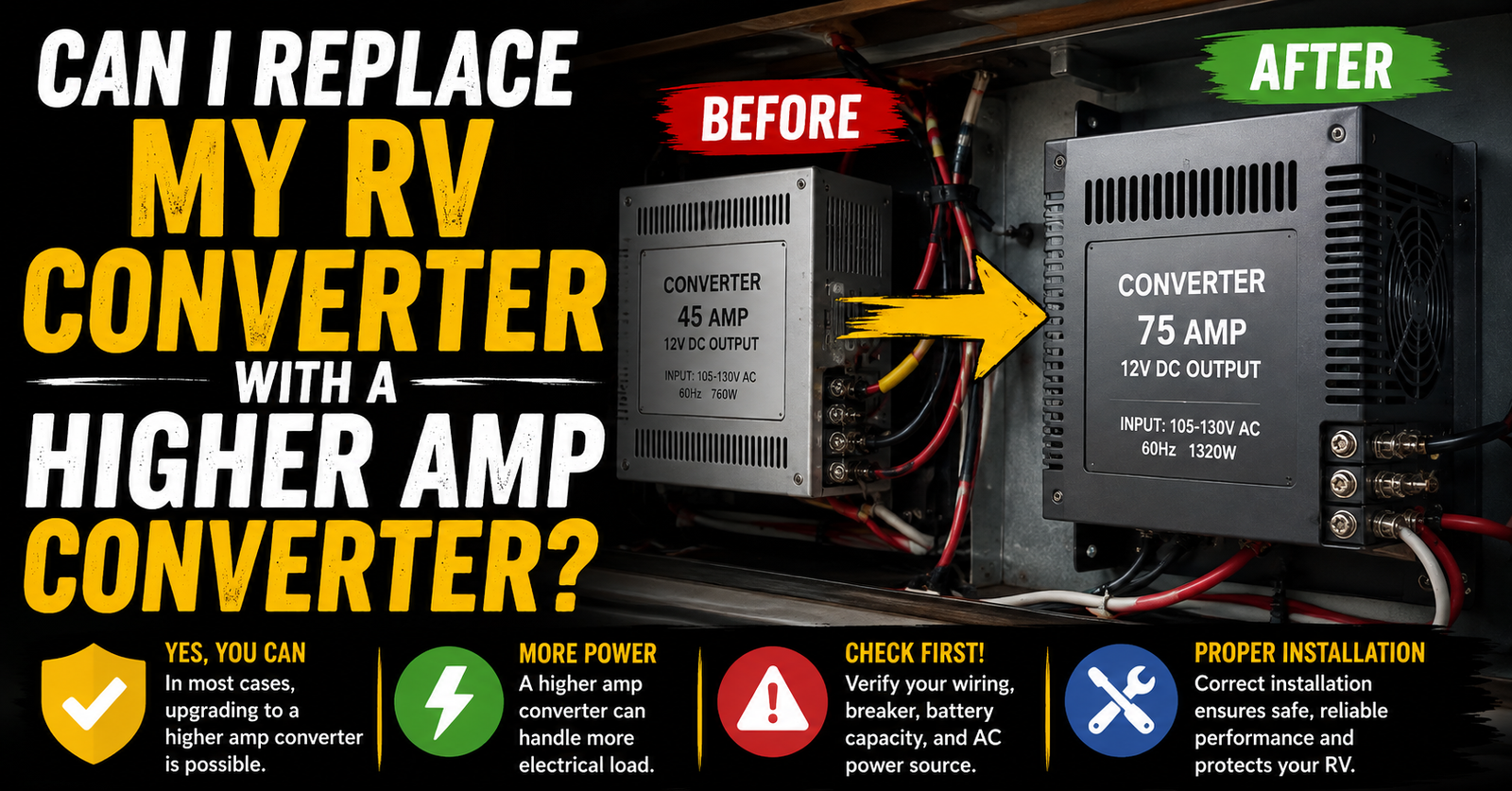
Seeing a 45-amp converter in your RV and finding a shiny new 60-amp or 80-amp model for sale naturally raises a question: why not just buy the bigger one?
I wouldn’t make that jump without checking the rest of the camper first.
You can sometimes upgrade an RV to a higher-amp converter, but you should not simply replace the original converter with a higher-output model unless the RV’s wiring, circuit protection, battery system, and installation are designed to safely handle the additional current. Before treating this as a simple upgrade, choose a compatible RV converter explains how to match the replacement to the existing installation.
In fact, Progressive Dynamics gives a very direct warning about this. Its replacement instructions say not to install a converter with a higher amperage rating than the one originally installed because the existing RV wiring may overheat, potentially damaging components or creating a fire hazard.
So if your camper came with a 45-amp converter, that doesn’t automatically mean a 60-amp converter is a drop-in upgrade.
But it also doesn’t mean you’re stuck with 45 amps forever.
There’s an important difference between replacing a converter and upgrading an electrical system.
Let’s get into that difference because it can save you from buying the wrong converter.
Why Would Anyone Want a Higher-Amp RV Converter?
There are legitimate reasons.
Maybe you’ve installed a much larger battery bank.
Maybe you’ve converted from lead-acid batteries to lithium.
Maybe you boondock frequently and want to recharge your batteries faster while the generator is running.
Maybe you’ve added significant 12-volt equipment.
Or perhaps you’re replacing an old converter and figure this is the perfect opportunity to improve the charging system.
Those aren’t crazy ideas.
The mistake is assuming the converter is the only component that needs to change.
It isn’t.
What Does a Higher-Amp Converter Actually Give You?
The amp rating represents the converter’s maximum DC output capability.
A 45-amp converter can supply up to roughly 45 amps under appropriate conditions.
A 60-amp converter has more DC output capacity.
An 80-amp converter has even more.
That available output gets used by the camper’s 12-volt loads and battery charging.
WFCO explains that RV loads get supplied first, with the remaining converter capacity available to the battery. It also notes that reducing the RV’s electrical load can leave more converter output available for battery charging.
So a larger converter can potentially give you more available DC capacity.
But that doesn’t mean the battery is constantly going to receive every amp printed on the converter.
A 60-Amp Converter Doesn’t Force 60 Amps Into the Battery
This is worth clearing up right away.
A converter rated for 60 amps doesn’t sit there continuously shoving 60 amps into your battery.
The actual current depends on several things, including battery condition, battery chemistry, state of charge, charging voltage, active RV loads, wiring resistance, and the converter’s charging logic.
WFCO specifically explains that the battery draws the amperage it requires from the available converter output, subject to the converter’s capacity.
So the danger of installing a larger converter isn’t simply:
“The battery will instantly get blasted with too many amps.”
The bigger concern is whether the electrical system between that converter and battery is capable of safely carrying the higher current that can now become available.
Your Existing Wiring Is the First Thing I’d Worry About
This is the big one.
Let’s say your RV was built with a 35-amp converter.
The manufacturer installed wiring appropriate for that system.
Now you remove the 35-amp converter and install an 80-amp converter.
You’ve more than doubled the converter’s potential output.
Can the existing wiring safely carry it?
Maybe not.
That’s exactly why Progressive Dynamics warns against installing a higher-output converter as a simple replacement. Its PD4600 replacement instructions state that doing so may overheat the RV wiring and potentially cause component damage or fire.
That’s enough for me to take the issue seriously.
Wire Gauge Isn’t the Only Thing That Matters
People tend to ask:
“What gauge wire do I need?”
That’s important, but it’s not the whole story.
You also need to consider how far the converter is from the battery.
Longer cable runs create more resistance and voltage drop.
Connections matter.
Grounding matters.
Fuse and breaker protection matter.
The way the RV manufacturer routed and protected the charging circuit matters.
You can’t evaluate a converter upgrade by looking at one wire and deciding that it looks thick enough.
Voltage Drop Can Defeat the Purpose of the Upgrade
Imagine spending money on a high-output converter because you want dramatically faster battery charging.
The converter produces the proper charging voltage.
But there’s a long run of undersized wire between it and the battery.
Voltage drops across that wiring when charging current rises.
Now the battery doesn’t see the same voltage being produced at the converter.
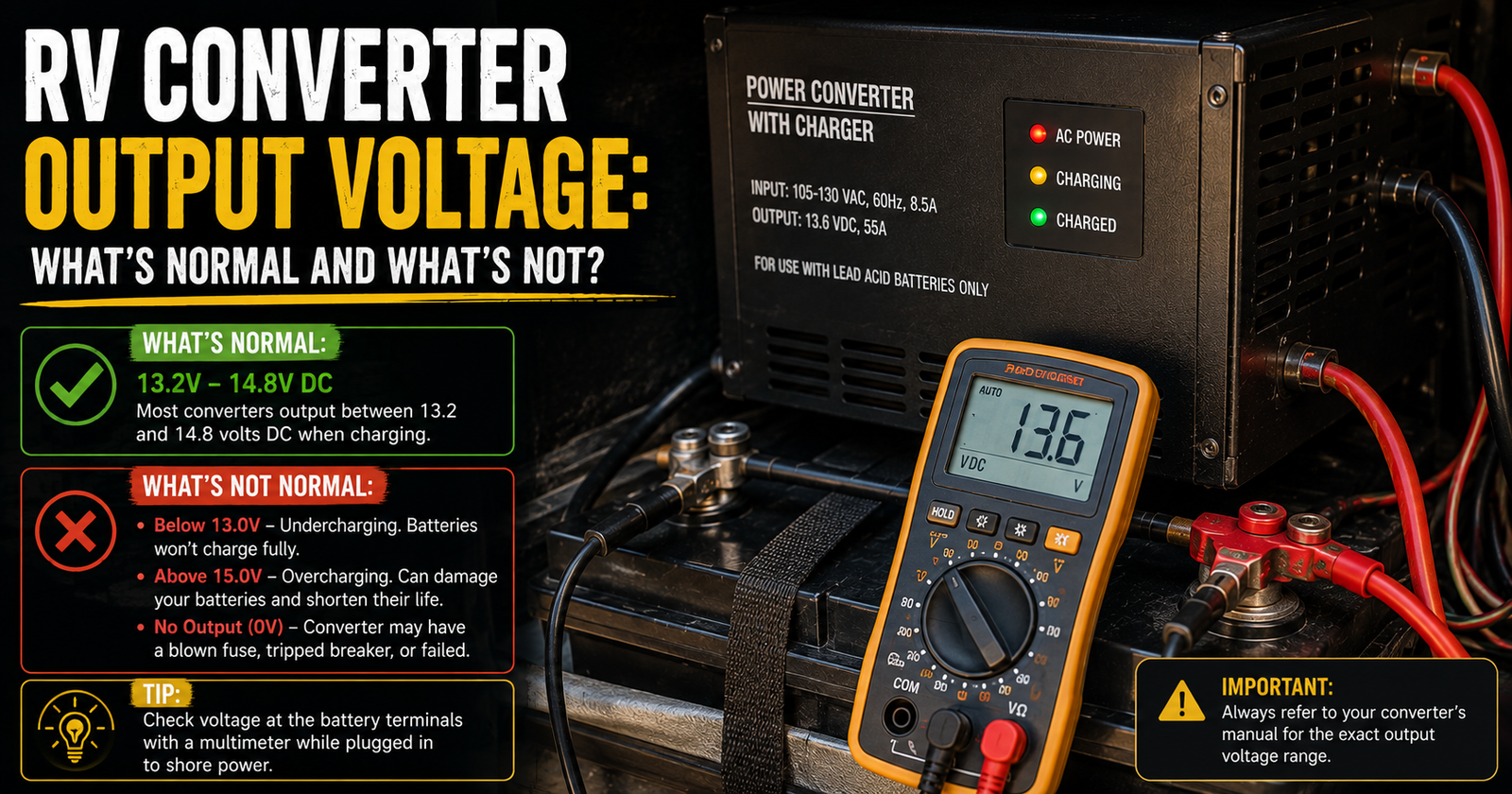
Progressive Dynamics’ technical charging information gives an example where converter voltage measures 14.2 volts while the battery receives 13.8 volts because of voltage drop through the wiring. That difference is easier to assess with the normal RV converter output voltage and what different readings mean alongside the wiring-drop issue.
That’s why a serious converter upgrade may also require looking at the charging cables.
Start With the Converter You Already Have
Before deciding you need more amps, find the existing converter.
Get the manufacturer.
Get the model number.
Get the DC output rating.
Determine whether it’s a standalone converter or a replaceable converter section inside a power center.
And figure out what battery chemistry it’s designed to charge.
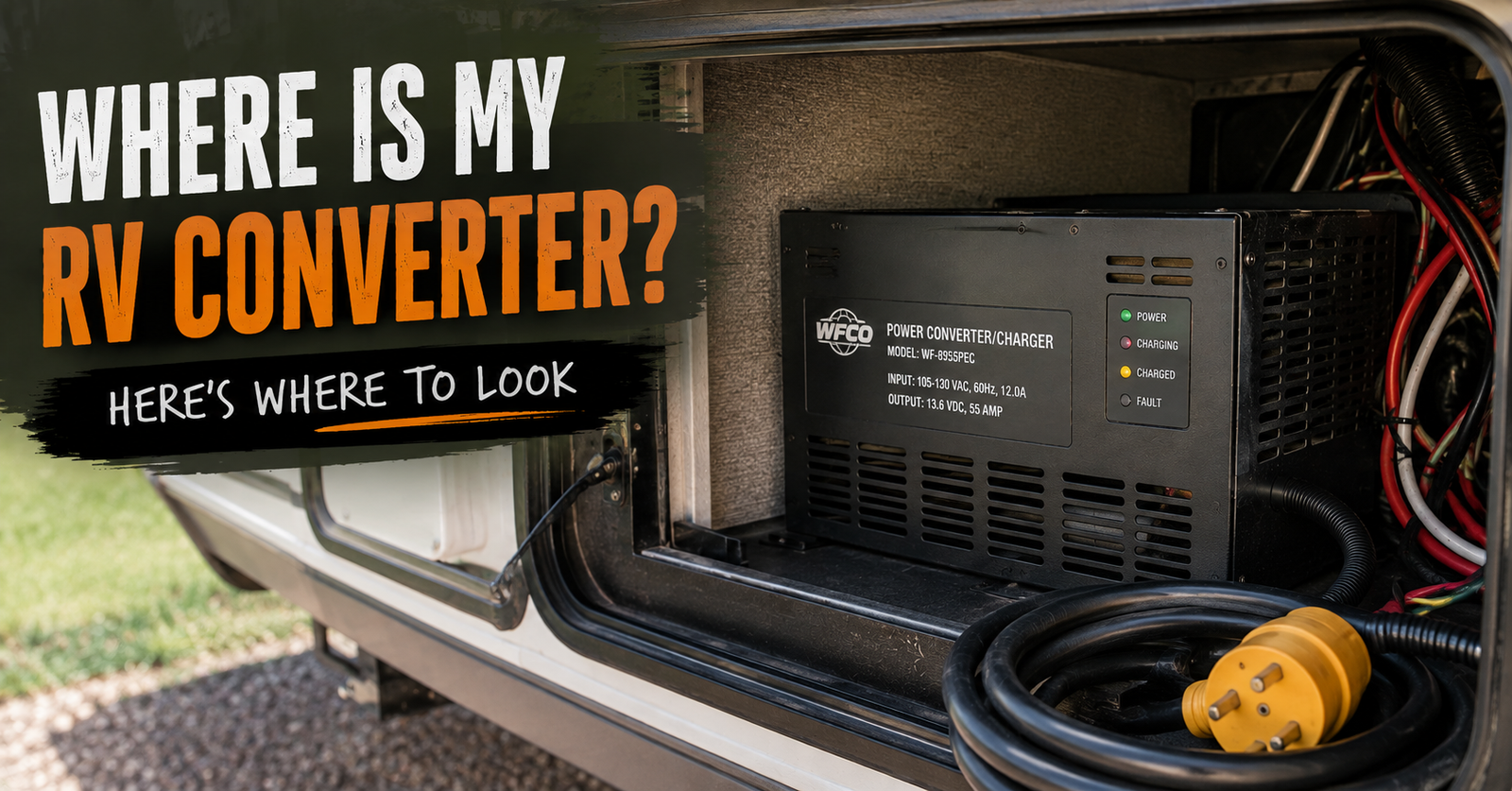
If you’re not sure where the converter is hiding, our guide to finding your RV converter will help you track it down.
Take a picture of the label once you find it.
That little picture can answer a surprising number of questions later.
Know What Size Converter Your RV Already Has
If the label says 45 amps, you now have a baseline.
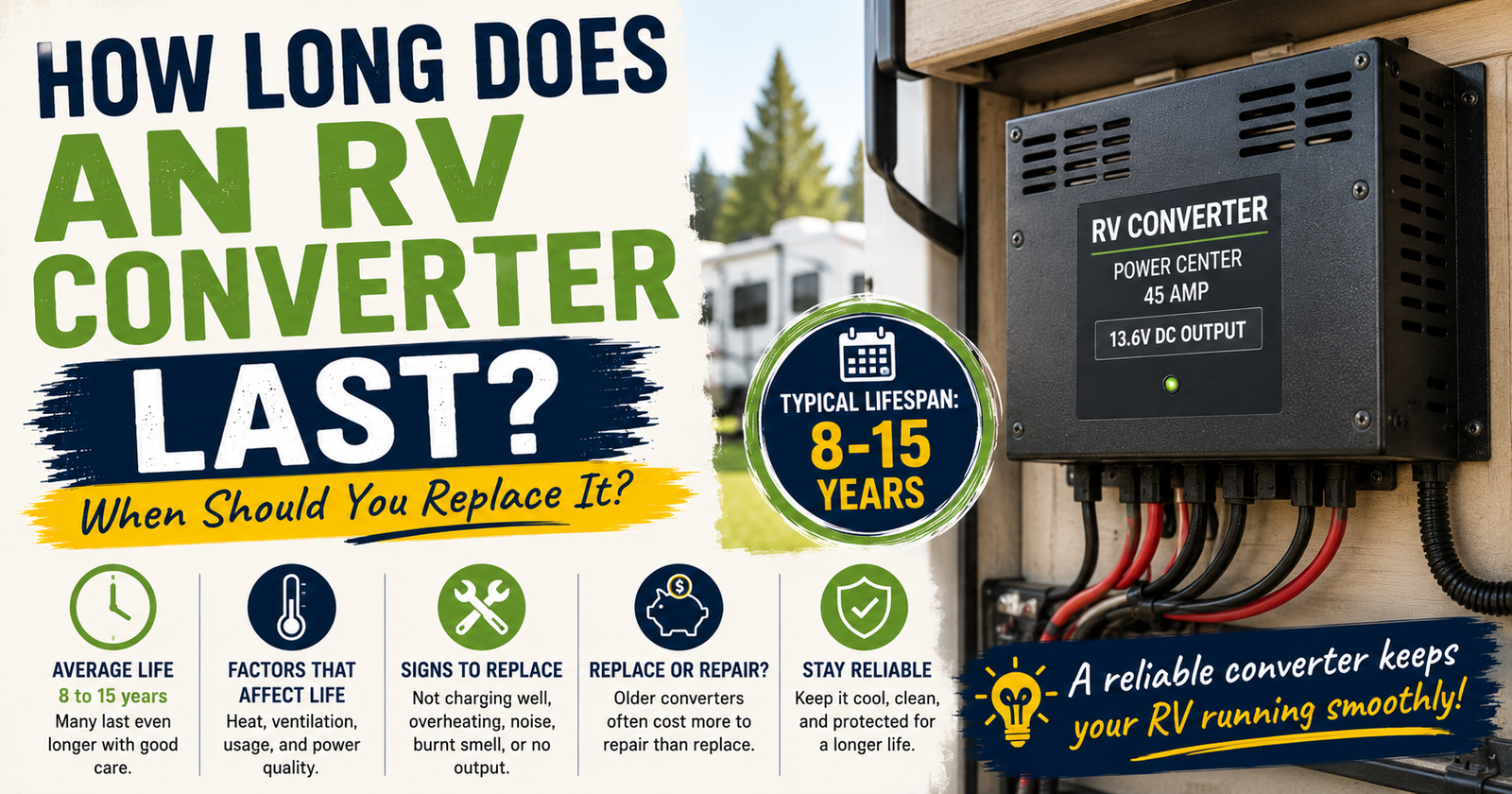
If all you’re doing is replacing a failed converter in an otherwise stock RV, my first choice would normally be the appropriate manufacturer-recommended replacement in that same output range. Before selecting that replacement, review whether a failed converter needs replacement rather than relying on age alone.
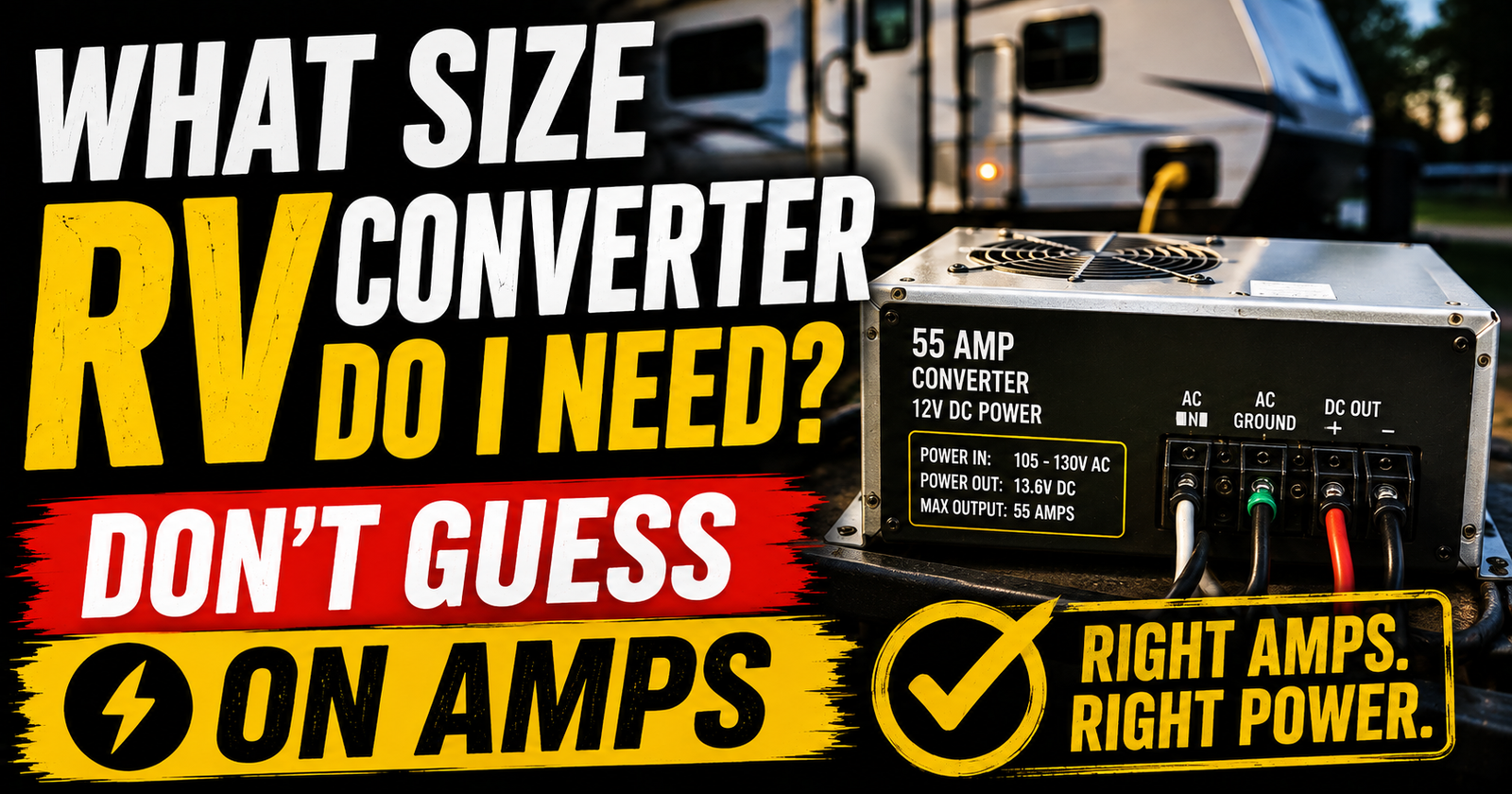
We went much deeper into this in our guide to choosing the right RV converter size.
A same-size replacement and an electrical-system upgrade are two very different projects.
Why Did the RV Manufacturer Pick That Converter?
Because converters are sized around more than battery charging.
The converter also has to support the camper’s normal 12-volt loads.
WFCO explains that manufacturers calculate expected low-voltage loads when determining converter size, including continuous loads and allowances for other loads.
Think about what may depend on the 12-volt system.
Lights.
Water pump.
Furnace.
Vent fans.
Control boards.
Various appliances.
Then there are intermittent loads such as slides and electric steps.
The converter installed at the factory was selected as part of an overall electrical design.
Does That Mean the Factory Converter Can Never Be Upgraded?
No.
And this is where I want to make the distinction really clear.
The warning is against blindly replacing the original converter with a higher-output unit without making sure the rest of the system can safely support it.
An RV electrical system can be upgraded.
You can install larger properly sized conductors.
You can change appropriate circuit protection.
You can upgrade the battery bank.
You can install charging equipment compatible with the new batteries.
You can redesign parts of the system to safely handle more charging current.
But now you’re upgrading the system, not simply swapping converters.
Can I Replace a 35-Amp RV Converter With a 45-Amp Converter?
I wouldn’t assume so.
Even though ten amps doesn’t sound like a massive jump, check the converter manufacturer’s replacement information and the RV’s electrical design.
Progressive Dynamics’ PD4600 retrofit instructions specifically match its 35-amp replacement to certain original 35-amp applications, its 45-amp replacement to 45-amp applications, and its 55-amp replacement to 55-amp applications.
That tells you something.
Replacement converters aren’t supposed to be selected by saying, “This one is close enough.”
Can I Replace a 45-Amp Converter With a 55-Amp Converter?
Same answer.
Maybe the RV’s wiring and electrical system can be upgraded to support it.
But don’t assume the existing installation already does.
If the manufacturer provides an approved cross-reference or replacement converter section, that’s where I’d start.
For a straightforward repair, I want the replacement to match the system rather than forcing the system to accommodate a random replacement.
Can I Replace a 55-Amp Converter With a 60-Amp Converter?
The five-amp difference may look tiny.
I’d still verify it.
Electrical ratings aren’t something I like rounding up because the numbers happen to be close.
If the manufacturer specifically approves a particular replacement, great.
If not, investigate before buying it.
Can I Replace a 45-Amp Converter With a 60-Amp Converter?
Now we’re talking about a more meaningful increase.
This is where I’d absolutely look at the charging cables, battery bank, circuit protection, converter specifications, physical installation, and manufacturer guidance.
If you’re making the jump because you want faster battery charging, I’d also determine whether the battery can actually make use of that additional capacity.
Otherwise you may be modifying the RV without gaining much.
Can I Replace a 55-Amp Converter With an 80-Amp Converter?
I would treat that as an electrical-system upgrade.
Not a routine converter replacement.
An 80-amp converter has substantially more potential DC output than a 55-amp converter.
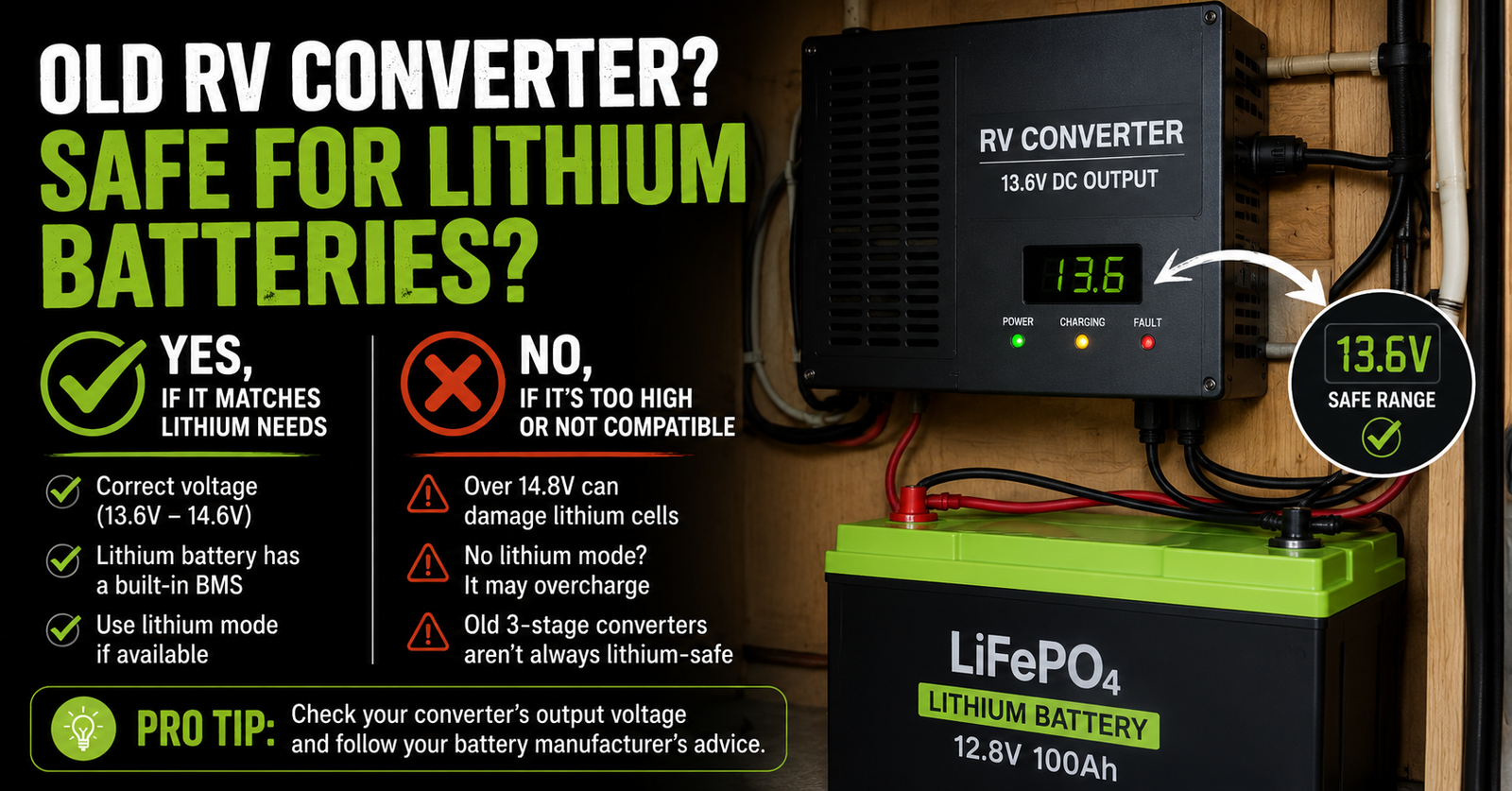
Progressive Dynamics’ own replacement guidance lists typical converter ratings from 30 through 80 amps but specifically warns owners not to replace an existing converter with a higher-rated lithium unit unless the RV wiring is capable of safely handling the additional current. Before treating a higher-rated lithium unit as the answer, replacing an RV converter with a higher-amp converter should also account for its charging profile and the battery maker's requirements.
That’s exactly the situation we’re talking about.
Why Lithium Batteries Make People Want Bigger Converters
Lithium batteries have changed RV electrical systems quite a bit.
A large LiFePO4 battery bank can often accept charging current differently from a traditional lead-acid setup, depending on the battery specifications.
That makes faster charging attractive.
Suppose you’re boondocking and running a generator specifically to recharge the batteries.
If your battery bank can safely accept substantially more charging current and the electrical system supports it, increasing charging capacity can reduce how long you need to run that generator.
That’s a real benefit.
But Lithium Compatibility Comes Before Converter Amperage
Don’t buy a larger converter and then discover it doesn’t have the charging profile your battery requires.
Modern converters may have selectable battery profiles.
For example, Progressive Dynamics’ current PD9300 line supports flooded lead-acid, AGM, and LiFePO4 battery settings and is available in multiple output ratings.
So when you’re changing batteries, you have two separate questions:
Is this converter’s charging profile appropriate for my battery?
And:
Is this converter’s amperage appropriate for my electrical system?
You need good answers to both.
Your Battery Manufacturer Gets a Say Too
Look at the charging specifications for the actual batteries you’re installing.
Don’t assume every 100Ah lithium battery has identical charging requirements.
Look for recommended charging current.
Maximum charging current.
Charging voltage.
Temperature limitations.
Battery-management-system specifications.
If you’ve connected multiple batteries into a larger bank, consider the specifications for that complete configuration.
Converter size should make sense for the batteries you’re actually using.
Bigger Doesn’t Automatically Mean Faster
Here’s where people can spend a bunch of money and be disappointed.
Let’s say you replace a 45-amp converter with an 80-amp converter.
But your battery won’t accept anywhere near 80 amps under the conditions you’re using it.
Or your wiring causes substantial voltage drop.
Or the camper is consuming a big portion of the converter’s output.
Or the converter never enters the charging mode you expected.
You now own an 80-amp converter without necessarily getting dramatically faster charging.
That’s why I want to identify the actual bottleneck first.
Your RV Loads Get Part of the Converter’s Output
Remember that converter output isn’t necessarily dedicated entirely to the battery.
WFCO says converter amperage supplies the RV load first, with the remaining output available to the battery.
Imagine your converter can provide 60 amps.
The RV itself is consuming 20 amps of DC power.
That doesn’t leave the full 60 amps available for charging.
This becomes particularly important when you’re evaluating charging performance while you’re actively using the camper.
A Higher-Amp Converter May Help With Large DC Loads
This is another legitimate reason to evaluate an upgrade.
Maybe you’ve added significant 12-volt equipment that wasn’t part of the original camper.
WFCO notes that aftermarket low-voltage accessories or a desire to operate more continuous low-voltage loads can make upsizing a replacement converter necessary.
But notice what’s happening there.
The load calculation changed.
That means the system needs to be reevaluated.
It doesn’t mean every RV benefits from the largest converter available.
What Happens If the Converter Is Too Small?
If the converter can’t support the DC demand being placed on it, performance can suffer.
Some converters include current-limiting protection.
Progressive Dynamics says its 9100 and 9200-series converters can shut down when the connected 12-volt load exceeds their designed output and resume once enough load is removed. It also notes that an installed battery can help supply additional current during short periods of high demand.
So yes, there are situations where converter capacity matters beyond charging speed.
But first find out why the system is exceeding the converter’s capacity.
A Bigger Converter Won’t Fix a Bad Battery
I wouldn’t upgrade converter amperage because a worn-out battery takes forever to charge or dies quickly.
That’s treating the symptom rather than the cause.
A battery with poor usable capacity isn’t magically restored because you connect a larger charger.
Before blaming converter size, make sure the battery itself is healthy.
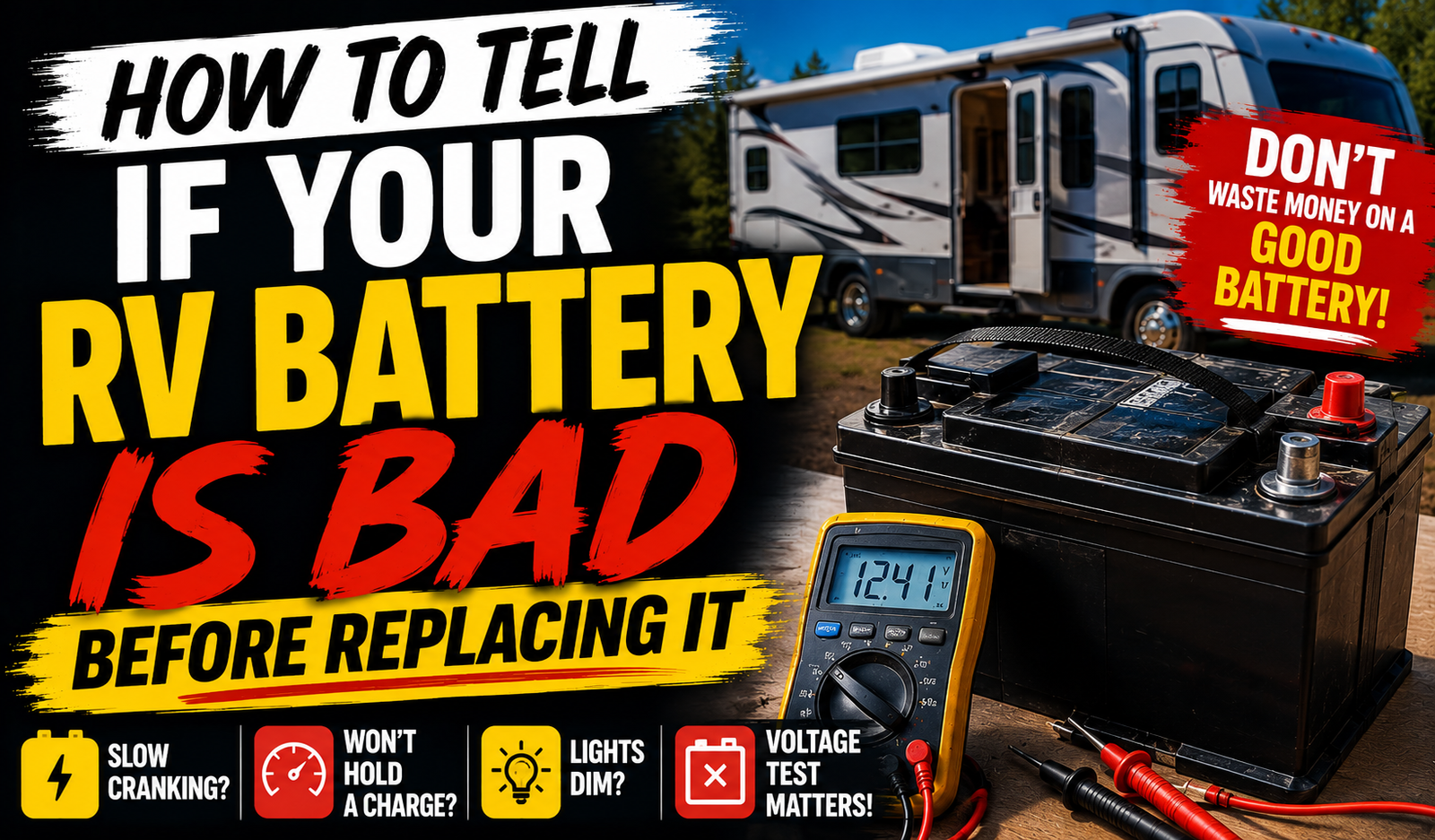
Our guide to telling whether an RV battery is actually bad is where I’d start if battery condition is questionable.
A Bigger Converter Won’t Fix a Converter That Isn’t Working
Same principle.
If your existing converter has no output, overheats, repeatedly shuts down, or isn’t charging the battery, don’t immediately conclude that it’s undersized.
It could simply have a problem.
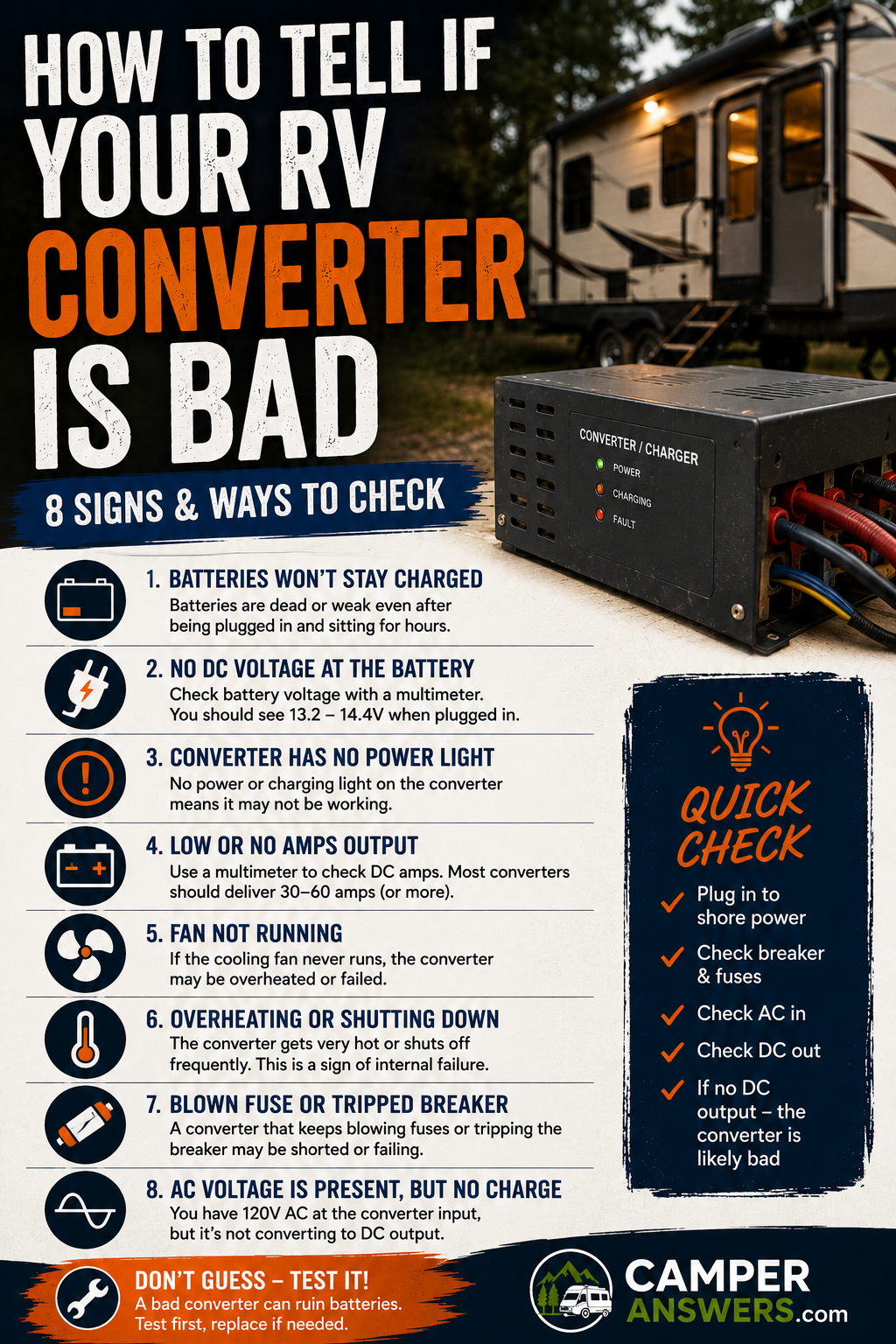
We’ve built a complete troubleshooting guide for determining whether an RV converter is bad before you spend money replacing or upgrading it.
Diagnose first.
Upgrade second.
A Bigger Converter Won’t Fix Bad Connections
This one is easy to overlook.
Corroded battery terminals.
Loose connections.
Damaged wiring.
Poor grounds.
Bad crimps.
Failing circuit protection.
Those can all interfere with charging performance.
Installing a more powerful converter upstream doesn’t repair a bad connection downstream.
If anything, increasing available current makes proper high-current connections even more important.
Check Your Fuses and Circuit Protection
A converter upgrade may change the current the system is capable of carrying.
That means existing protection needs to be evaluated as part of the upgrade.

Don’t just install a larger fuse because the new converter keeps blowing the old one. Before changing the fuse again, see RV converter fuse problems for a safer way to narrow down the fault.
The fuse is there to protect the circuit.
Fuse or breaker sizing has to be appropriate for the conductors and equipment being protected.
If a converter upgrade requires changes here, I’d want the entire circuit evaluated correctly rather than guessing at fuse sizes.
What About the AC Side?
Don’t forget that a converter doesn’t create DC electricity out of thin air.
It consumes AC power.
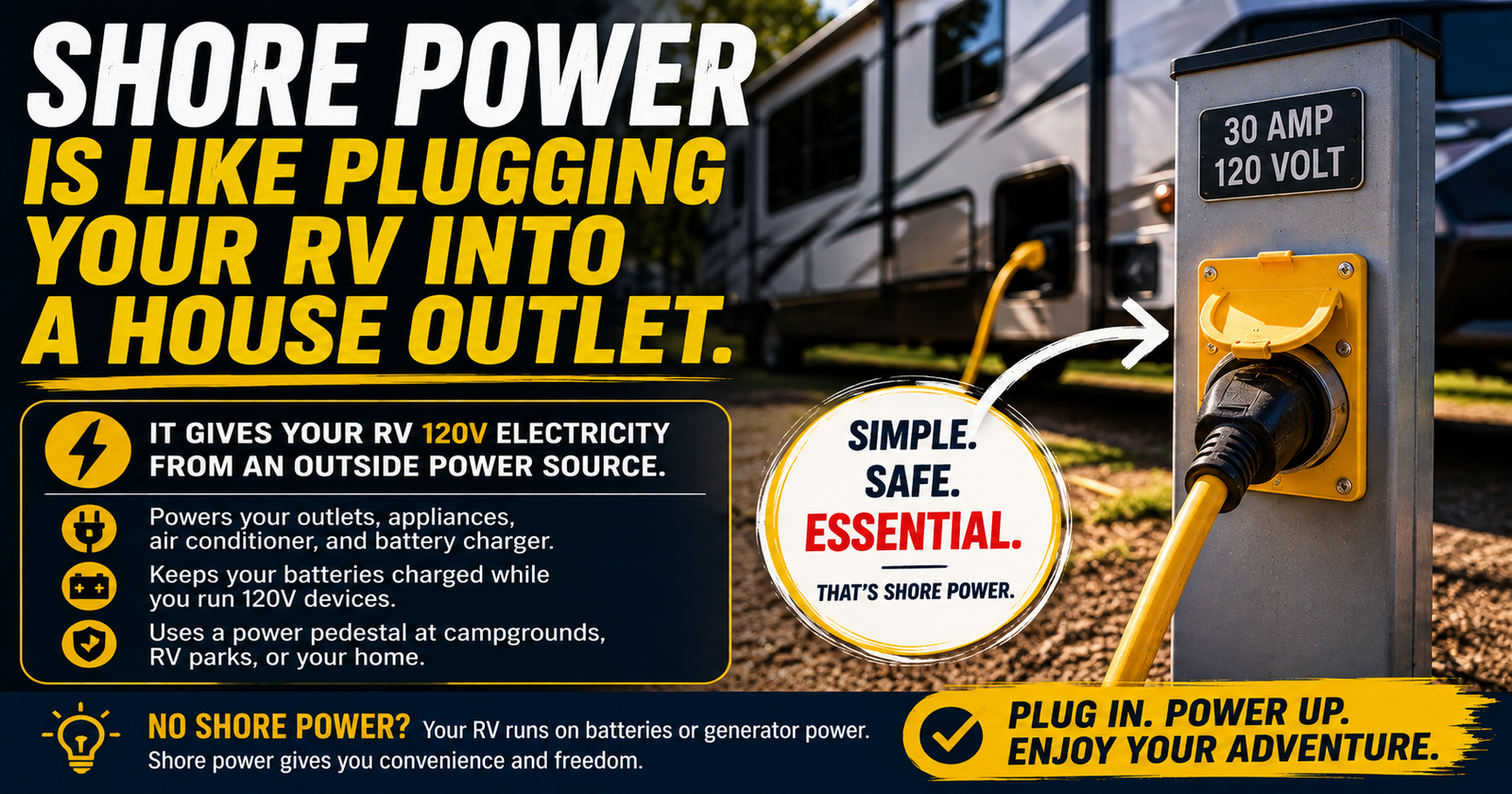
That AC may come from RV shore power, a generator, or another appropriate AC source.
A larger converter operating at high output can require more AC input than a smaller one.
So when you’re significantly increasing converter capacity, verify the AC requirements too.
The DC side isn’t the only side of the converter.
Generator Size Can Matter
This becomes particularly relevant for boondockers.
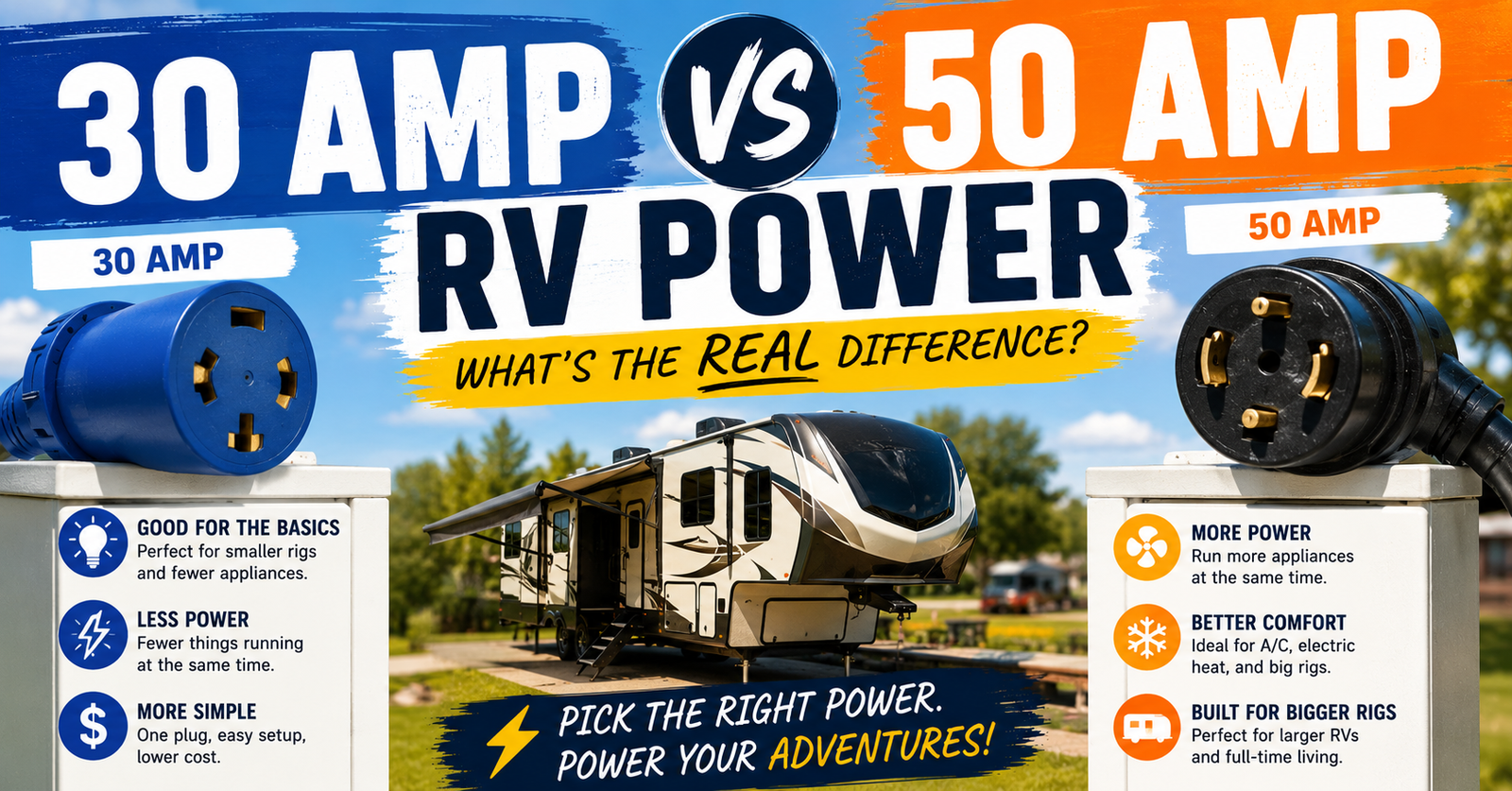
If you’re upgrading to a larger converter specifically to reduce generator charging time, make sure the generator can comfortably supply the converter and whatever other AC loads are operating. Before evaluating that generator setup, RV AC power capacity can help clarify how much shore-power capacity the RV has available.
The converter itself is an AC load.
Run the air conditioner, microwave, water heater element, converter at high charging output, and other equipment simultaneously, and the generator sees all of it.
Again, everything connects.
Should I Upgrade the Converter When Adding More Batteries?
Not automatically.
Adding battery capacity means you’ve increased how much energy the battery bank can store.
Your existing converter may still charge it perfectly well.
It may simply take longer.
If you spend most of your time connected to shore power overnight, that additional charging time may not bother you at all.
If you boondock and recharge with a generator, it may matter a lot.
That’s when I’d evaluate whether a higher-output charging system makes sense.
Should I Upgrade When Going From One Battery to Four?
This is where I’d definitely evaluate charging time.
You’re dramatically increasing storage capacity.
That doesn’t automatically make the old converter unsafe or incapable of charging the batteries.
But restoring a heavily discharged large bank through a relatively small converter could take a long time.
If that becomes a practical problem, then yes, I’d investigate a properly designed converter and wiring upgrade.
Should I Upgrade the Converter When Switching to Lithium?
Maybe.
But I wouldn’t assume the converter has to become larger just because the battery chemistry changed.
First determine whether your existing converter provides an appropriate charging profile.
Some modern power centers and converter replacement sections already include selectable lithium charging modes. Progressive Dynamics, for example, lists replacement sections with lithium-selectable capability across several of its current power-center families.
If your existing converter is compatible and the charging speed meets your needs, there may be no reason to increase amperage.
What If My Old Converter Isn’t Lithium Compatible?
That’s different.
Now replacement or modification may make sense.
But I’d still separate the two decisions.
First:
What converter or charging profile does this battery need?
Then:
What output amperage should the new converter have?
We’ll be building a dedicated guide on using older RV converters with lithium batteries because that question deserves much more detail than we can reasonably squeeze into this one.
Do I Have to Replace the Whole Power Center?
Not always.
Some RV power centers have replaceable converter sections.
Progressive Dynamics currently lists replacement converter modules for several of its power-center families, allowing the converter section to be changed without necessarily replacing the entire AC/DC distribution center.
That’s another reason to identify the exact equipment before ordering parts.
You may need a converter module, not an entirely new power center.
What If the Higher-Amp Converter Physically Fits?
Physical fit is only one requirement.
A converter can slide beautifully into the existing space and still be electrically inappropriate.
I want to know:
Is it an approved replacement?
Is the output rating appropriate?
Is the battery charging profile correct?
Can the wiring handle it?
Is the circuit protection appropriate?
Is there adequate ventilation?
Does the AC supply meet the converter’s requirements?
Then I care whether the screw holes line up.
Ventilation Still Matters
Higher-output charging equipment can produce heat.
Don’t cram a new converter into a compartment where it can’t cool properly.
Progressive Dynamics specifies adequate airflow around its 9100/9200-series converters and recommends sufficient ventilation around the installation.
Follow the installation requirements for the converter you actually purchase.
A powerful converter that continually overheats isn’t an upgrade.
What If My Current Converter Runs Hot?
Don’t assume you need a bigger converter.
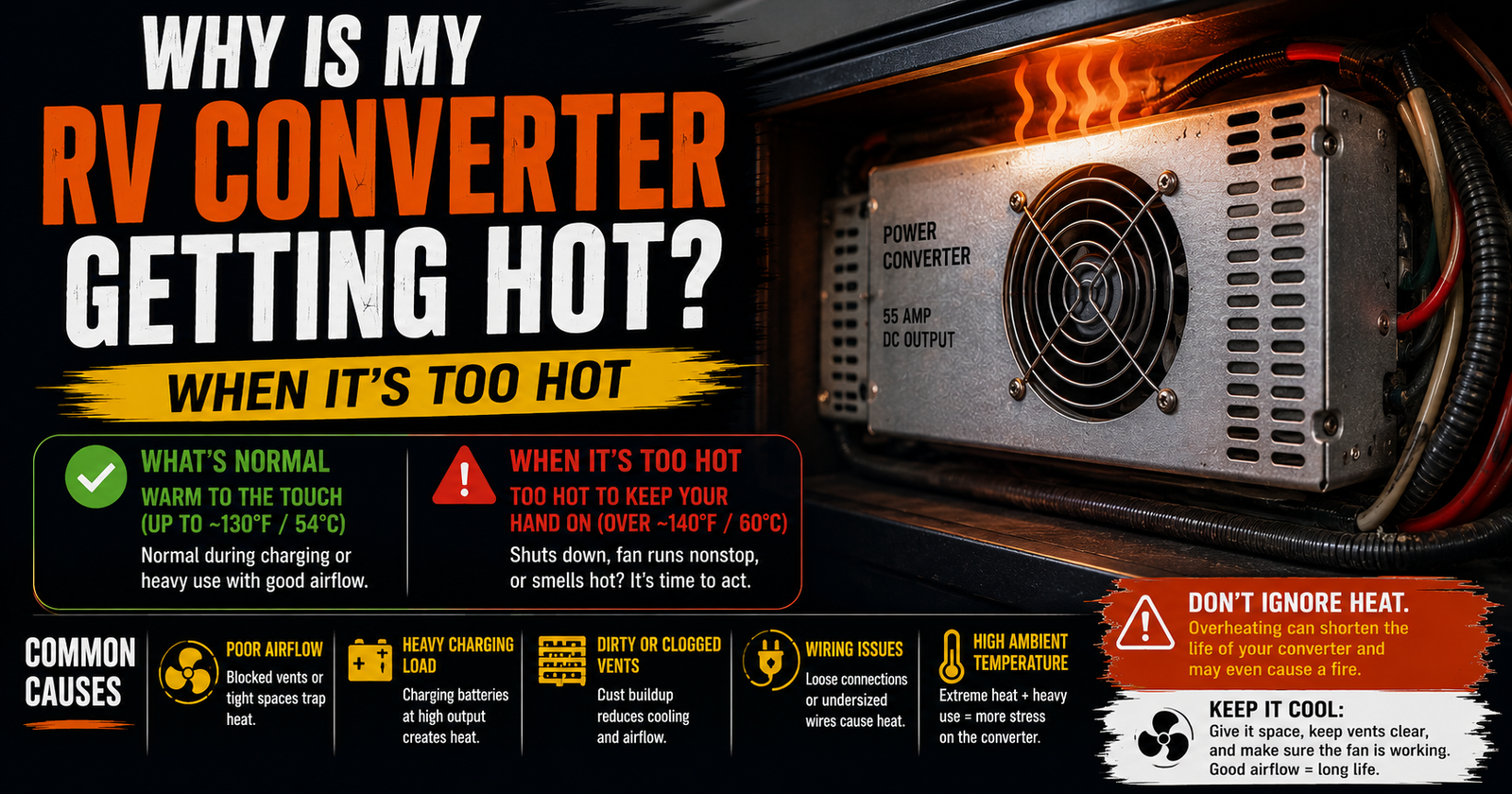
We’ve already covered this problem in our guide to an RV converter that’s getting too hot.
The cause could be heavy load.
But it could also involve ventilation, fan operation, wiring, battery condition, connections, or an internal converter problem.
Find the cause before redesigning the system.
What If My Converter Keeps Turning On and Off?
Same deal.
Repeated cycling doesn’t prove the converter is undersized.
It can be related to overheating, overload, unstable AC input, shorts, poor connections, or converter failure.
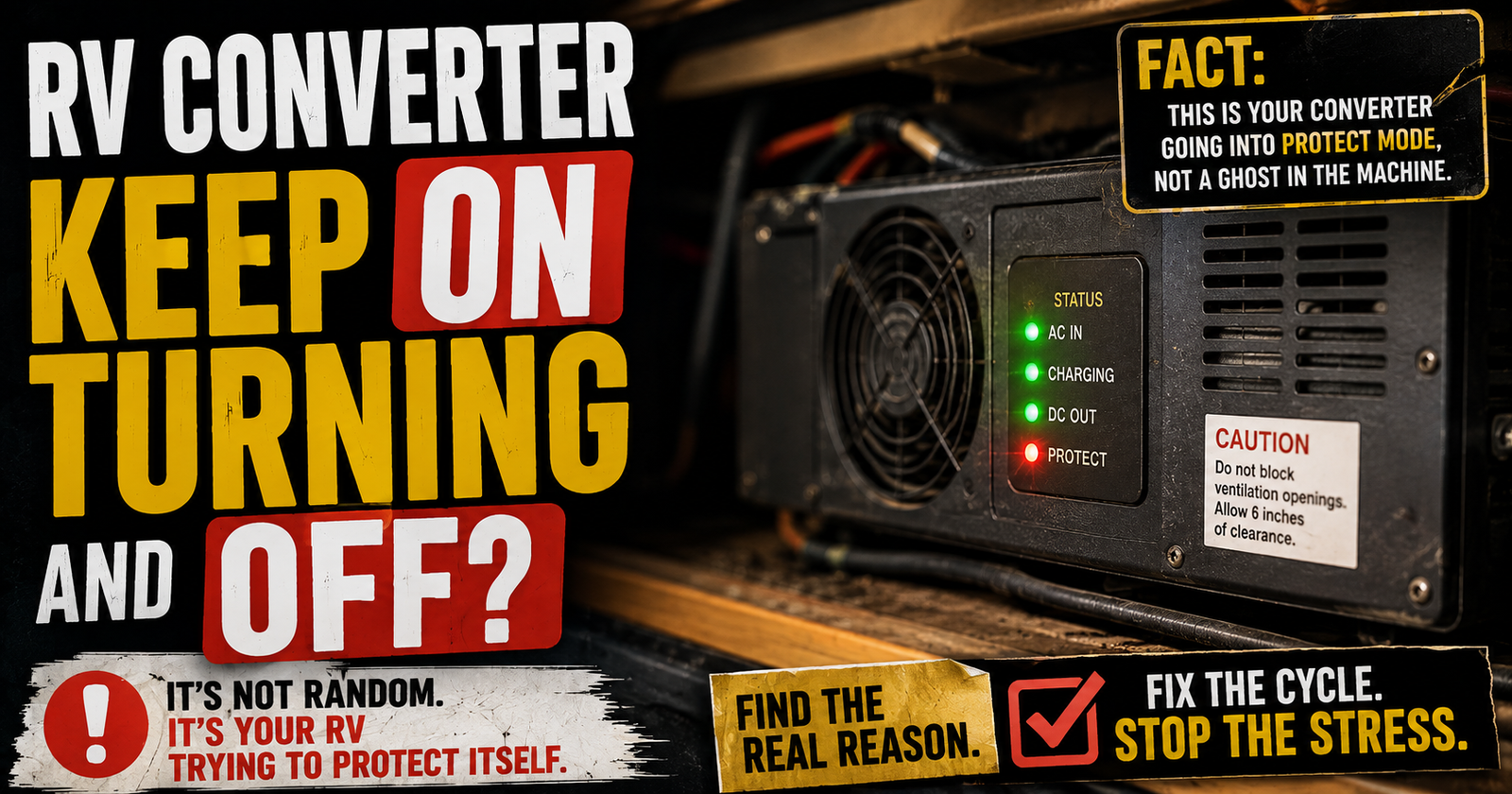
Our guide to an RV converter that keeps turning on and off walks through those possibilities.
Don’t treat a larger converter as a universal cure.
What If I Just Want Faster Battery Charging?
This is probably the most compelling reason to investigate higher converter output.
But I’d work backward from the battery.
How much charging current does the battery manufacturer recommend?
How much can the complete bank accept?
How quickly do you actually need it charged?
How much converter capacity is consumed by other DC loads?
What size charging conductors are installed?
How long is the wiring run?
What circuit protection is required?
Can the AC source support the larger converter?
Once you know those things, converter amperage becomes much easier to choose.
The Charging Cable May Be the Real Upgrade
This is especially important when the converter sits a long way from the batteries.
Higher charging current through a marginal cable can create voltage drop and poor performance.
That means somebody chasing faster charging may need an appropriately engineered cable upgrade along with the converter.
And that isn’t something I’d size from a generic internet chart without knowing cable length, conductor material, temperature ratings, installation conditions, protection, and the equipment specifications.
Once we’re modifying high-current wiring, I want the installation designed correctly.
Should I Upgrade From 45 Amps to 60 Amps for Faster Charging?
Maybe, if there’s a real reason and the system supports it.
I’d want the battery bank capable of benefiting from the extra charging current.
I’d verify wiring and circuit protection.
I’d check the converter manufacturer’s specifications.
I’d make sure the charging profile matches the battery.
I’d verify AC requirements.
If all of that checks out, then a higher-output converter can make sense.
What I wouldn’t do is order the 60-amp unit simply because it costs $30 more.
What About Going From 45 Amps to 80 Amps?
That’s a substantial enough jump that I would consider it a system modification.
I’d expect to carefully evaluate the high-current DC wiring and protection.
I’d also want to understand exactly what we’re trying to accomplish.
If you’re building a large lithium bank for boondocking and want fast generator charging, there may be a perfectly good reason.
If you spend 355 nights a year connected to campground shore power and the existing 45-amp converter charges everything fine, I don’t see much point.
How Do I Know Whether My Wiring Can Handle the Bigger Converter?
This is where I don’t want to give somebody a dangerously oversimplified answer.
You need to identify the conductor size and type, length of the run, terminations, circuit protection, converter requirements, and how the wiring is installed.
You also need to consider both positive and negative current paths.
If you aren’t comfortable evaluating a high-current DC circuit, this is a good place to involve a qualified RV technician or electrician familiar with RV systems.
There’s nothing wrong with knowing where DIY ends.
What I Would Do With a Stock Camper
If I had an otherwise stock camper with a failed 45-amp converter, I’d look for the correct 45-amp replacement or manufacturer-approved equivalent.
That’s the simple answer.
I’m not gaining much by redesigning a functioning electrical system just because the converter happened to fail.
Match the battery chemistry.
Verify the model.
Verify fit.
Follow the manufacturer’s installation instructions.
Get camping again.
What I Would Do With a Heavily Modified Camper
Now I’d think differently.
Let’s say I’ve added:
A large lithium battery bank.
An inverter.
Solar.
Additional DC loads.
Generator charging.
Upgraded battery cabling.
Now the original converter may no longer be the best fit for the system I’ve created.
That’s when I’d evaluate the charging system as a whole.
The converter shouldn’t be chosen in isolation.
What I Would Do With a Boondocking Camper
Charging time would matter much more to me.
If I’m running a generator primarily to recharge batteries, I don’t want it idling around unnecessarily for hours because the charging system is badly matched to the battery bank.
I’d determine what charging current the battery bank can safely accept.
Then I’d see whether increasing converter capacity, along with any necessary wiring and protection upgrades, would materially reduce charging time.
That’s an upgrade with a purpose.
What I Would Do With a Full-Hookup Camper
Probably nothing unless there’s a problem.
If I’m connected to campground power most of the time, the battery stays charged, the converter comfortably supports the DC loads, and everything works correctly, I don’t care that somebody on a forum has an 80-amp converter.
My 45-amp converter doesn’t become inferior because a larger one exists.
Electrical upgrades should solve problems or add useful capability.
When I’d Bring in a Professional
If the project changes from replacing a converter module to modifying high-current DC wiring, AC wiring, circuit protection, grounding, or the power center itself, I’d strongly consider having a qualified RV technician or electrician handle or at least verify the work.
Progressive Dynamics’ PD4600 replacement instructions specifically say installation should be completed by a licensed electrician or certified RV technician. They also require disconnecting shore power, generator power, and battery power before replacement.
Remember that an RV can have multiple electrical sources.
Unplugging the shore cord doesn’t necessarily mean every circuit in the camper is dead.
So Can You Install a Higher-Amp RV Converter?
Potentially, yes, but don’t treat a higher-amp converter as a drop-in upgrade unless the manufacturer specifically approves it for the existing installation.
For a straightforward replacement, I would generally stay with the original converter’s DC output rating or the manufacturer’s approved replacement.
If you have a legitimate reason to increase converter output, such as a larger battery bank, substantial additional DC loads, or faster generator charging, then evaluate the entire charging system.
That means the battery.
The converter.
The charging profile.
The positive and negative wiring.
Wire length.
Connections.
Circuit protection.
AC supply.
Ventilation.
And the actual reason you want more amperage.
Sometimes the right answer really is a bigger converter.
Sometimes the right answer is bigger wiring and a bigger converter.
And plenty of times the best answer is leaving a properly sized converter exactly the size it already is.
That’s why I wouldn’t ask only, “Will a bigger converter fit?”
I’d ask:
“Was my RV’s electrical system designed to safely use it?”
That question can save you money, disappointing charging performance, overheated wiring, and a much bigger problem than the converter you started with.
Written by Evan Mercer
Evan Mercer writes about RV electrical systems, batteries, converters, shore power, and practical camper troubleshooting for CamperAnswers.com. His goal is to make RV electrical upgrades understandable so owners know when a simple replacement is enough and when changing one component means looking at the entire system.