
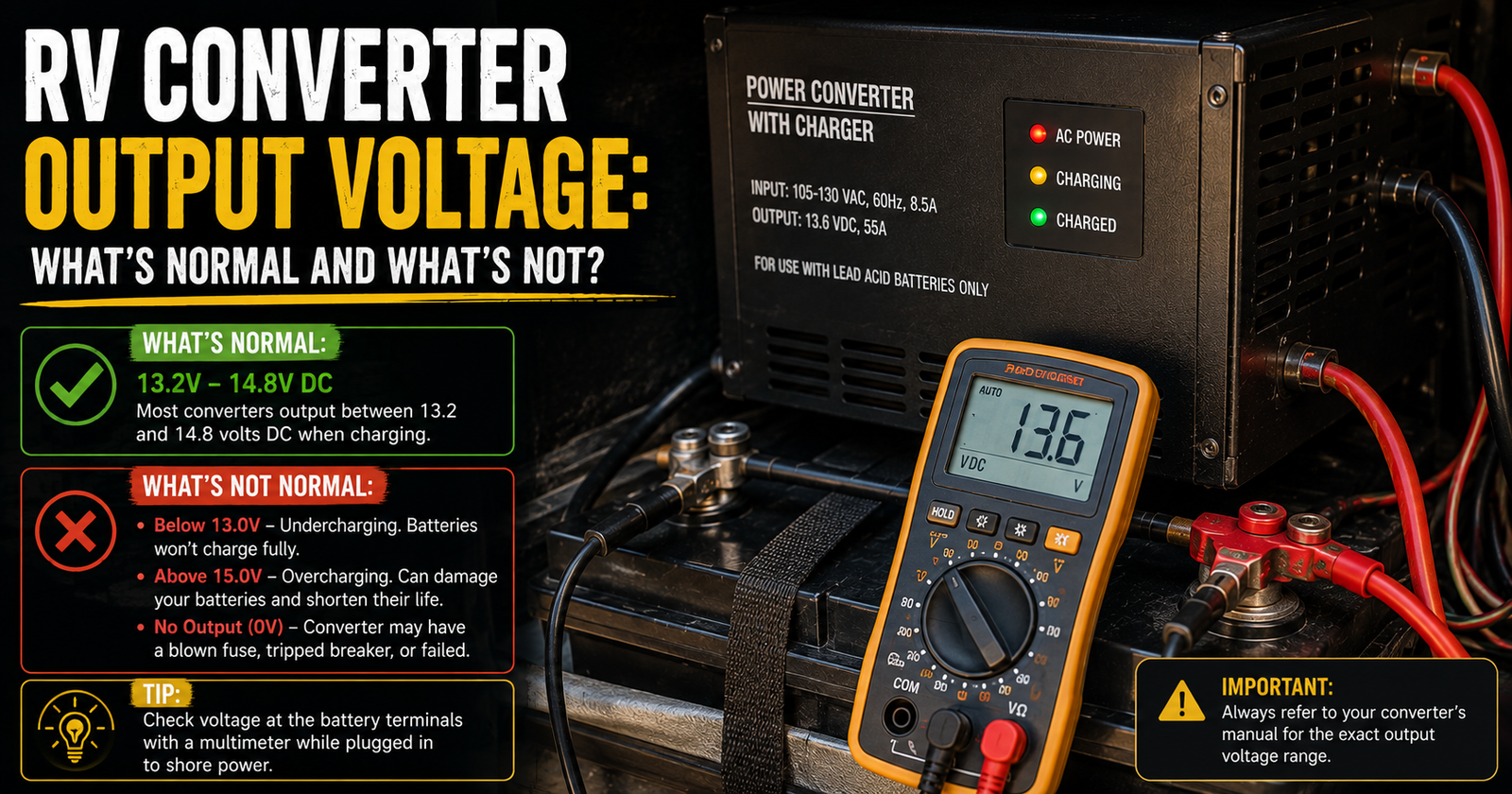
If you put a multimeter on your RV converter or house battery and see 13.6 volts, you probably want to know one thing: Is that good or bad?
Most of the time, a reading somewhere in the 13-volt range while you’re plugged into shore power is a sign that charging is happening. But I wouldn’t diagnose an RV converter from one magic voltage number because modern converter/chargers don’t necessarily stay at the same voltage all day. Those voltage readings also help explain why lights may remain dim despite a shore-power connection; voltage readings while plugged into shore power covers the other clues to check.
You might see around 13.2 volts at one point, around 13.6 volts at another, and roughly 14.4 volts when the charger is trying to bring a discharged battery back up more aggressively.
Depending on the converter and battery system, all three can be perfectly normal.
What matters is knowing why you’re seeing that voltage, where you’re measuring it, and what your particular converter is designed to do.
What Voltage Should an RV Converter Put Out?
For many traditional 12-volt RV converter/chargers designed for lead-acid batteries, you’ll commonly encounter charging voltages in roughly the 13.2 to 14.4-volt range during different charging modes.
For example, Progressive Dynamics lists three main Charge Wizard operating voltages for many of its lead-acid converter/chargers:
BOOST Mode: 14.4 volts
NORMAL Mode: 13.6 volts
STORAGE Mode: 13.2 volts
It also uses a periodic 14.4-volt equalization cycle for certain lead-acid charging applications.
That gives us a useful reference point, but don’t turn those numbers into a universal rule for every converter ever installed in an RV.
Different manufacturers, converter models, battery chemistries, charging algorithms, and operating conditions can call for different voltages.
The specifications for your equipment always win.
Is 13.6 Volts Normal for an RV Converter?
Yes. 13.6 volts is a very common RV converter output voltage.
In fact, Progressive Dynamics specifies 13.6 volts, plus or minus 0.3 volts, as the proper no-load output test for several of its standard converter models when tested according to its troubleshooting procedure.
That doesn’t mean your converter must remain at exactly 13.600 volts every second it’s plugged in.
A smart charging system can deliberately change voltage.
But if you’re troubleshooting a conventional lead-acid converter and seeing something around 13.6 volts under conditions where the manufacturer says you should, that’s generally a much more encouraging reading than seeing ordinary resting battery voltage.

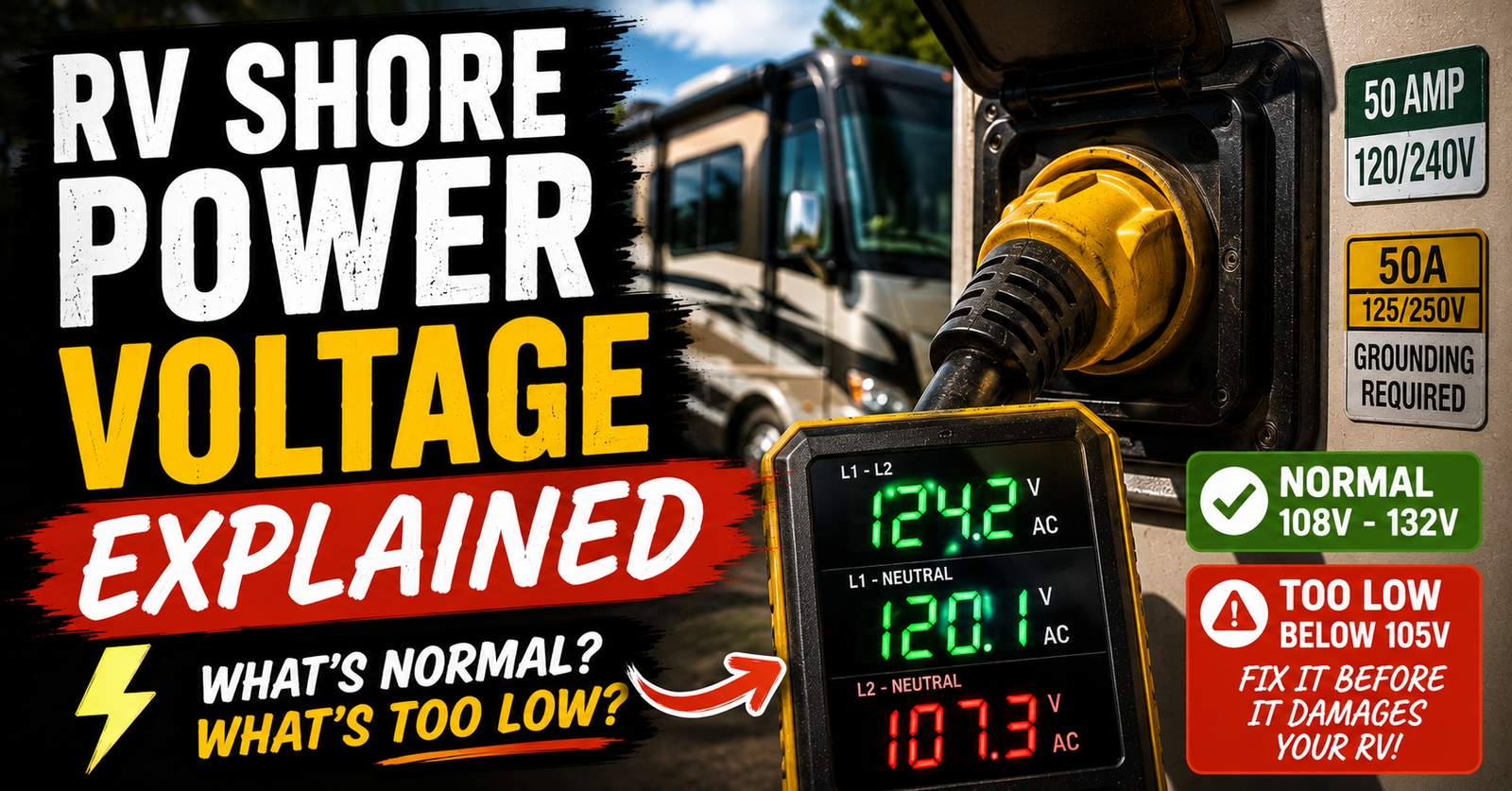

Is 14.4 Volts Too High for an RV Battery?
Not automatically.
This is where people sometimes see a higher number and immediately think the converter is overcharging the battery.
A multi-stage lead-acid charger may intentionally increase charging voltage when the battery needs a stronger charge.
Progressive Dynamics’ Charge Wizard, for example, uses approximately 14.4 volts during BOOST Mode to help bring a battery toward full charge more quickly.
So seeing 14.4 volts temporarily isn’t enough for me to say:
“Your converter is bad.”
I want to know the battery chemistry, converter model, charging stage, how long it’s been operating that way, and what the manufacturer says the system should be doing.
Is 13.2 Volts Too Low?
Again, not necessarily.
On the same Progressive Dynamics multi-stage system, approximately 13.2 volts is the STORAGE Mode voltage used after the battery has remained fully charged with no significant usage for a period of time.
That’s intentional.
The charger doesn’t need to hammer a full battery with maximum charging voltage indefinitely.
So imagine this situation.
Your camper has been plugged into shore power for several days.
The batteries are charged.
You measure around 13.2 volts.
You search online and somebody says:
“Converter should be putting out 14.4 volts!”
Now you’re shopping for a converter that might be doing exactly what it was designed to do.
That’s why context matters.
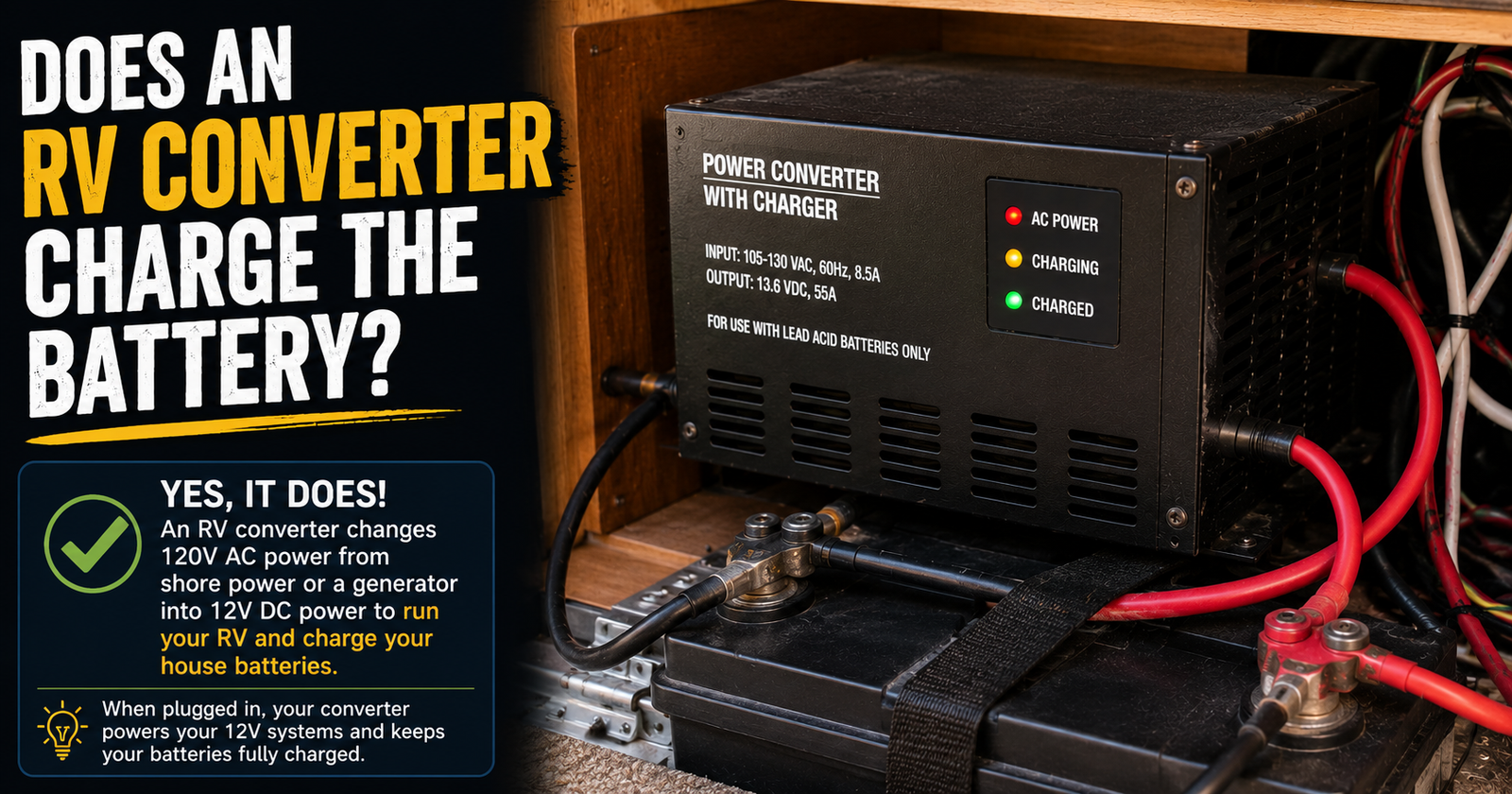
Don’t Confuse Converter Voltage With Battery Resting Voltage
This is probably the biggest source of confusion.
A 12-volt battery isn’t literally sitting at exactly 12.00 volts whenever everything is healthy.
And a battery being actively charged isn’t in the same condition as a battery that has been disconnected from charging and allowed to rest.
If you’re measuring at the battery while the converter is operating, the converter influences the voltage you’re seeing.
That means you shouldn’t compare an actively charging battery directly with a resting battery voltage chart and assume something is wrong.

I’ve gone much deeper into this in our guide to understanding RV battery voltage readings.
Knowing whether you’re measuring resting voltage or charging voltage makes a huge difference.
Where Should I Measure RV Converter Voltage?
There are two measurements I really care about when troubleshooting:
Voltage at the converter output
and
Voltage at the battery terminals
They answer different questions.
Measuring at the converter tells me what the converter is producing.
Measuring at the battery tells me what’s actually reaching the battery.
That difference can expose a problem that would otherwise be easy to miss.
Why Measure Directly at the Converter?
Suppose the battery isn’t charging.
You measure at the battery while plugged in and get 12.2 volts.
That’s definitely interesting.
But it doesn’t prove the converter is bad.
Maybe the converter is producing 13.6 volts and the charging voltage simply isn’t reaching the battery.
There could be a blown fuse.
An open breaker.
A bad connection.
A battery disconnect issue.
Damaged wiring.
Excessive voltage drop.
That’s why testing the source matters.
How Do I Test RV Converter Output?
First, identify the exact converter.
Find the manufacturer.
Find the model number.
Then get the manufacturer’s troubleshooting procedure.
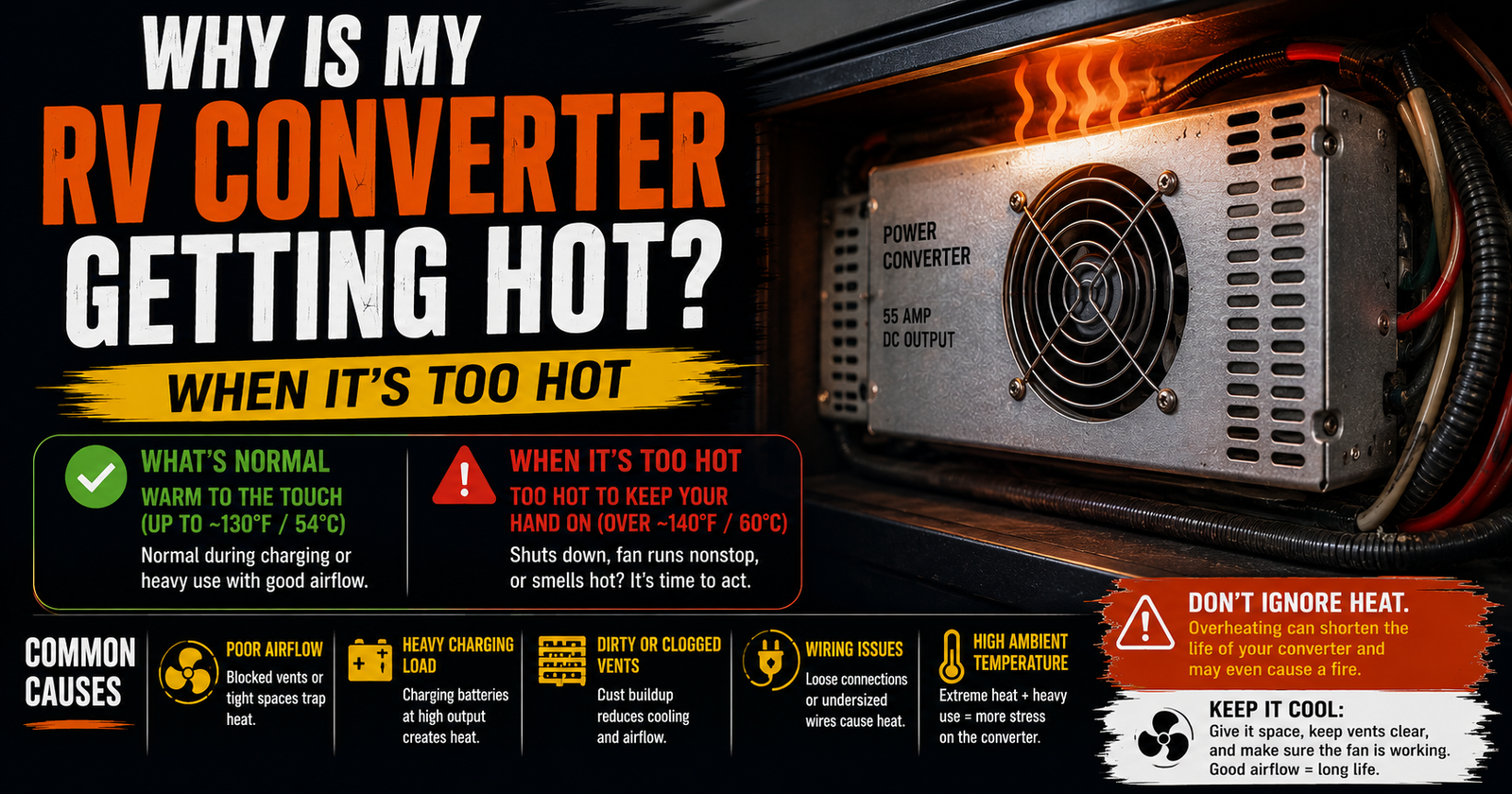
I don’t like giving one generic “stick your meter here” procedure because converter designs vary, and you’re dealing with equipment connected to both the RV’s 120-volt AC and 12-volt DC electrical systems. Those design differences also matter when evaluating why an RV converter gets too hot, since cooling and temperature behavior vary by model.
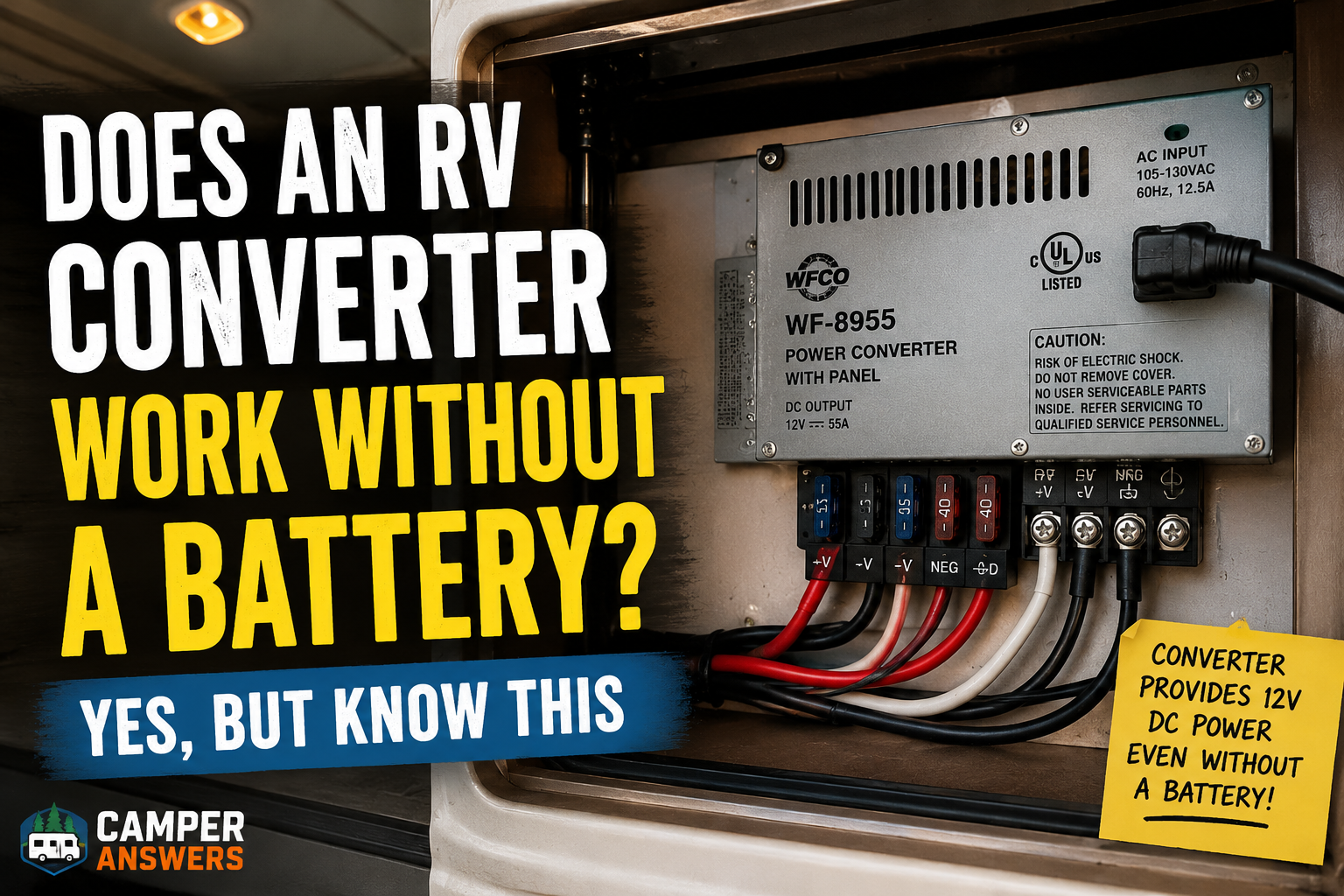
Progressive Dynamics, for example, instructs owners troubleshooting certain converter models to disconnect the battery from the converter and measure converter output under specific conditions. Its specified result for standard PD9100 and PD9200 models is approximately 13.6 volts, plus or minus 0.3 volts. That test relates directly to testing an RV converter without a battery, which explains why measuring converter output with the battery disconnected can still show normal 12-volt operation.
Use the procedure written for your equipment.
Be Careful Around the AC Side
Checking voltage at a 12-volt battery is one thing.
Opening electrical equipment where energized 120-volt AC connections may be exposed is something else.
If the manufacturer’s troubleshooting procedure requires live AC testing and you’re not trained or comfortable doing that safely, I’d stop there and let an RV technician handle that portion.
You don’t need to prove your DIY abilities around energized AC electricity.
There are plenty of useful troubleshooting steps you can perform without exposing yourself to it.
What Should Battery Voltage Do When I Plug the RV In?
This is one of my favorite quick checks.
Measure the house battery voltage before connecting shore power under appropriate conditions.
Then plug the RV into shore power and measure again.
If the converter is operating and charging voltage is reaching the battery, I generally expect the battery-terminal voltage to reflect that charging activity.
For example, if a partially discharged lead-acid battery is sitting around 12-point-something volts and plugging into shore power causes the reading to rise into an appropriate charging range, something is clearly happening.
That’s useful information.
What If Battery Voltage Doesn’t Change When I Plug In?
Now we have a reason to investigate.
Suppose you measure:
Before shore power: 12.3 volts
Then plug in.
After shore power: 12.3 volts
That’s not what I’d expect if an appropriate charging voltage were reaching that battery.
But I still wouldn’t buy a converter.
The next question is:
What’s the converter producing?
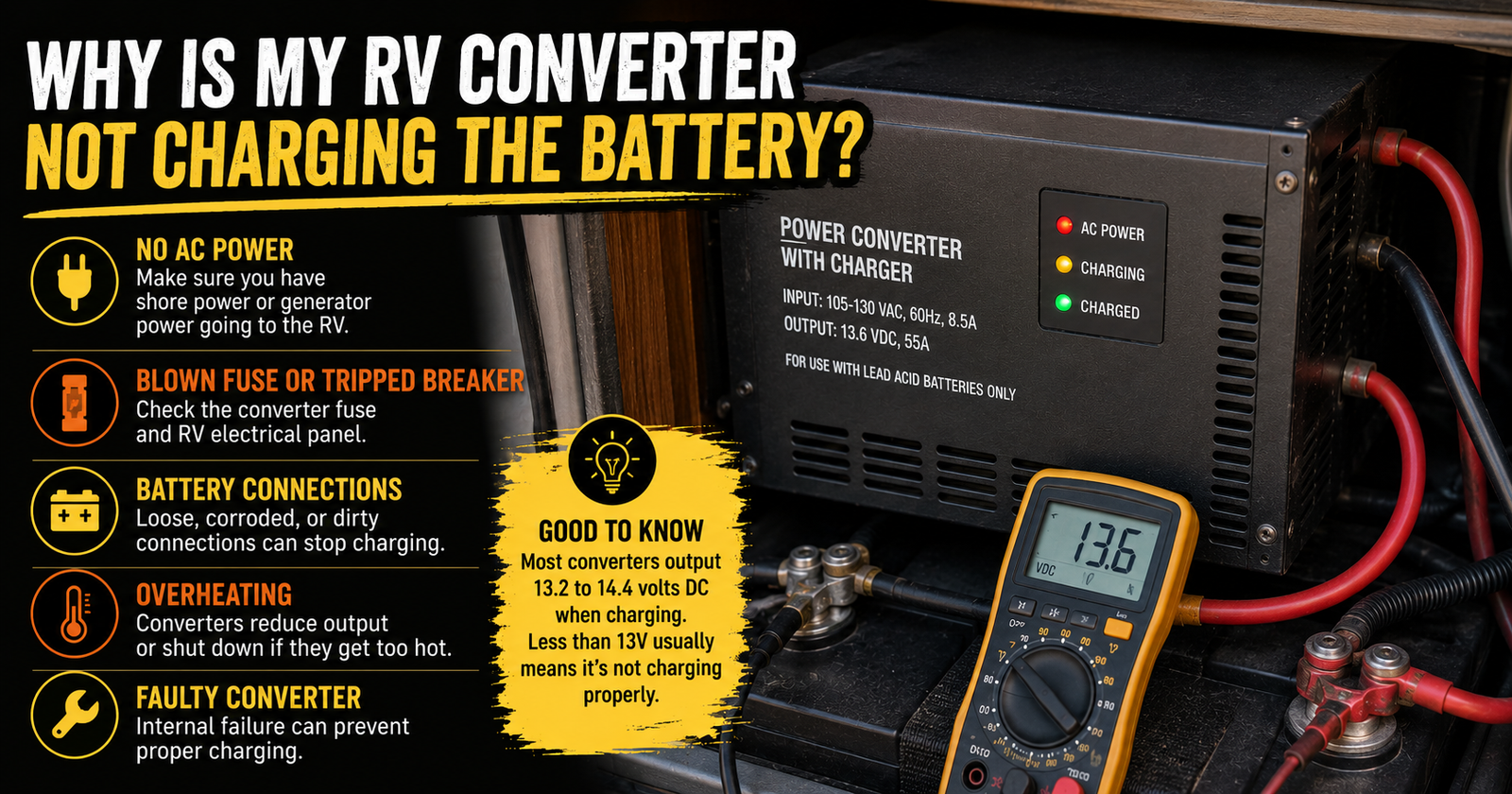
If you haven’t already worked through it, our RV converter not charging the battery troubleshooting guide follows that exact problem from shore power all the way to the battery.
Converter Has Good Voltage but Battery Doesn’t
This is one of the most useful results you can get.
Let’s use simple example numbers.
Converter output: 13.6 volts
Battery terminals: 12.2 volts
Assuming those readings were taken correctly under appropriate conditions, something doesn’t add up.
The converter appears to be producing charging voltage.
The battery isn’t seeing it.
Now I’m much more interested in the path between them.
Check the Battery Charging Fuse or Breaker
Depending on your RV, there may be a fuse, circuit breaker, or other protection device in the charging circuit.

Progressive Dynamics specifically says that if converter output is within specification but the batteries aren’t charging, the fuse or breaker in the battery’s positive lead should be checked. That kind of charging interruption can also point to blown converter fuses, which should be identified before replacing other components.
That’s exactly why I don’t replace converters based solely on a low reading at the battery.
The converter may be innocent.
Voltage Drop Can Tell You Where the Problem Is
Here’s where things get interesting.
Imagine the converter is producing the expected voltage.
Now follow the circuit toward the battery.
If you measure on one side of a connection and then the other and discover an abnormal voltage difference while current is flowing, you’ve found something worth investigating.
Connections matter.
Wire size matters.
Cable condition matters.
Circuit breakers matter.
Grounds matter.
The converter can only send electricity through the path available to it.
Check the Negative Side Too
It’s easy to become obsessed with the positive cable because that’s where we usually think about fuses and breakers.
But the electrical circuit needs a complete return path.
Poor negative connections can create problems too.
So when converter output looks good but battery charging doesn’t, I don’t inspect only half the circuit.
Look at battery terminals, cable connections, grounds where applicable, corrosion, loose hardware, and anything else affecting the complete charging path.
What If My Converter Only Puts Out 12 Volts?
This gets my attention.
If a converter/charger that should be actively charging a 12-volt battery is only producing something around ordinary battery voltage, I’d investigate further.
But again, I don’t diagnose from a generic number alone.
Verify:
What converter do you have?
What mode is it in?
What battery chemistry is selected?
Where are you measuring?
Is the battery connected?
What does the manufacturer specify for that particular test?
The exact test conditions matter.
What If My Converter Puts Out Zero Volts?
Now we have a much more obvious problem to trace.
First, does the converter have AC input power?
Check the appropriate breaker.
Check applicable fuses.
Check reverse-polarity protection.
Verify the converter is actually being supplied with the electricity it needs.
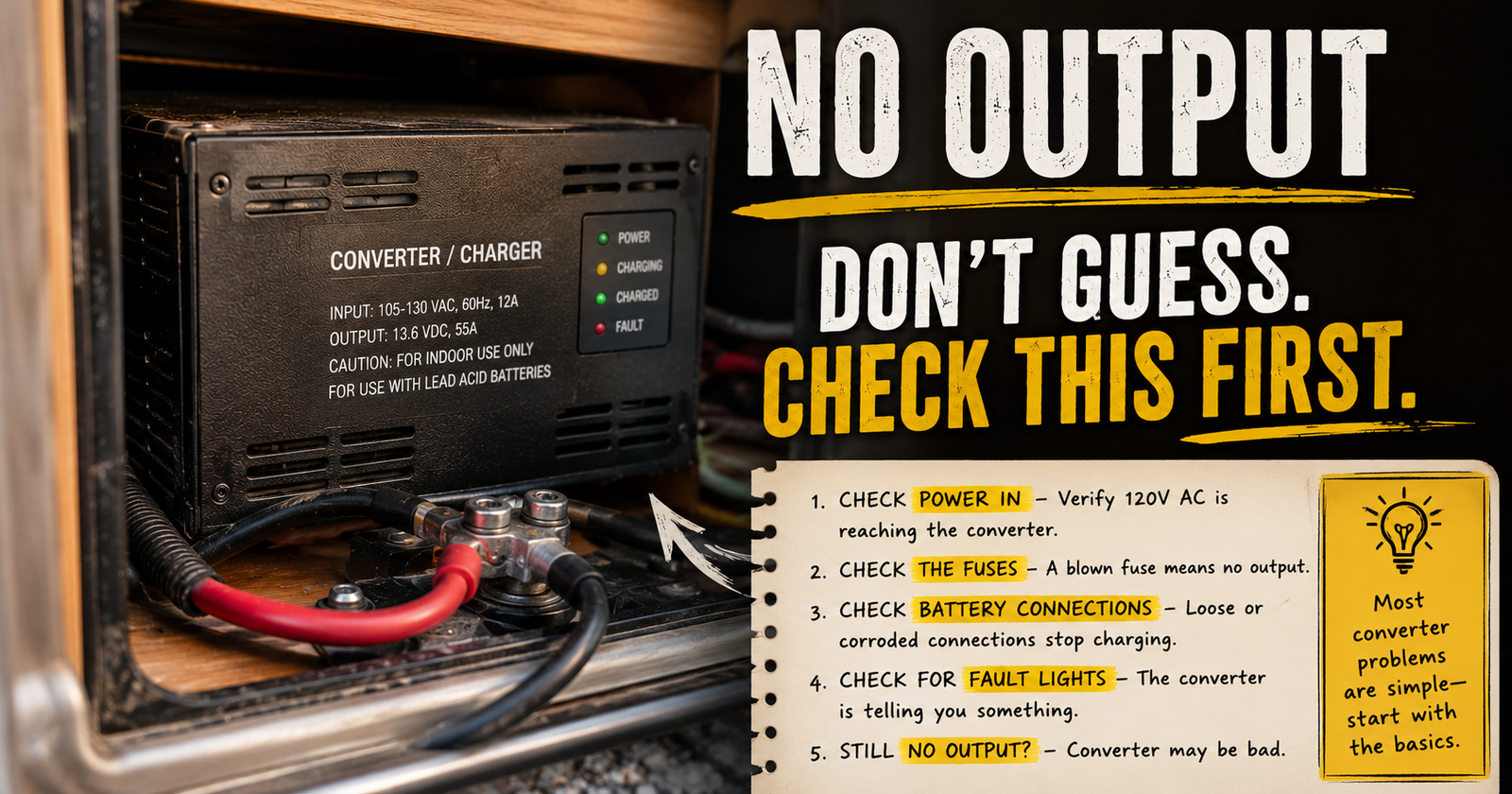
Progressive Dynamics’ troubleshooting guidance specifically tells owners seeing zero converter output to check reverse-battery protection fuses and confirm the converter is receiving AC power. If those checks still leave you with no reading, RV converter has no output lays out the next troubleshooting steps.
Zero output doesn’t automatically mean the internal converter electronics failed.
It means we need to find out why there’s zero output.
Reverse-Polarity Fuses Can Kill Converter Output
This is especially worth checking if the problem started immediately after battery work.
Some RV converters include reverse-polarity protection fuses.
Connect the battery backward, even briefly, and those fuses can open to protect the converter.
Then the battery gets connected correctly.
But suddenly there’s no charging.
The timing gives you a clue.
Before replacing the converter, check the protection devices specified by its manufacturer.
What If Converter Voltage Is Too High?
Now I’m concerned about the opposite problem.
A multi-stage charger intentionally producing a higher charging voltage isn’t necessarily malfunctioning.
But voltage that remains outside the specifications for the converter and battery deserves investigation.
Don’t rely on a random internet number.
Look up the converter charging profile.
Look up the battery manufacturer’s charging requirements.
Then compare those specifications with what you’re actually measuring.
High Charging Voltage Can Hurt a Battery
Battery chemistry matters tremendously here.
A charging voltage that’s appropriate during one stage for one battery chemistry isn’t automatically appropriate indefinitely or for another battery.
With flooded lead-acid batteries, improper overcharging can contribute to excessive water loss and gassing.
AGM batteries have their own charging requirements.
Lithium iron phosphate batteries have different charging characteristics and typically include a battery management system.
The converter and battery need to be compatible.
Lithium Converter Voltage Can Be Different
This is one reason I don’t want you memorizing 13.6 volts as the RV converter number.
Lithium-compatible equipment may use different output and charging behavior.
For example, Progressive Dynamics specifies approximately 14.6 volts, plus or minus 0.3 volts, for the output test on certain lithium versions of its PD9100 and PD9200 converter/chargers.
Compare that with approximately 13.6 volts for the standard versions under the same manufacturer’s troubleshooting procedure.
Same general product family.
Different battery application.
Different expected voltage.
How Do I Know If My Converter Is Set for Lithium?
Find the model number and documentation.
Some converters are specifically designed for lithium batteries.
Some offer selectable charging profiles.
Some older converters were designed around lead-acid batteries and don’t have a lithium mode.
Don’t determine compatibility by looking at the voltage once.
Identify the equipment.
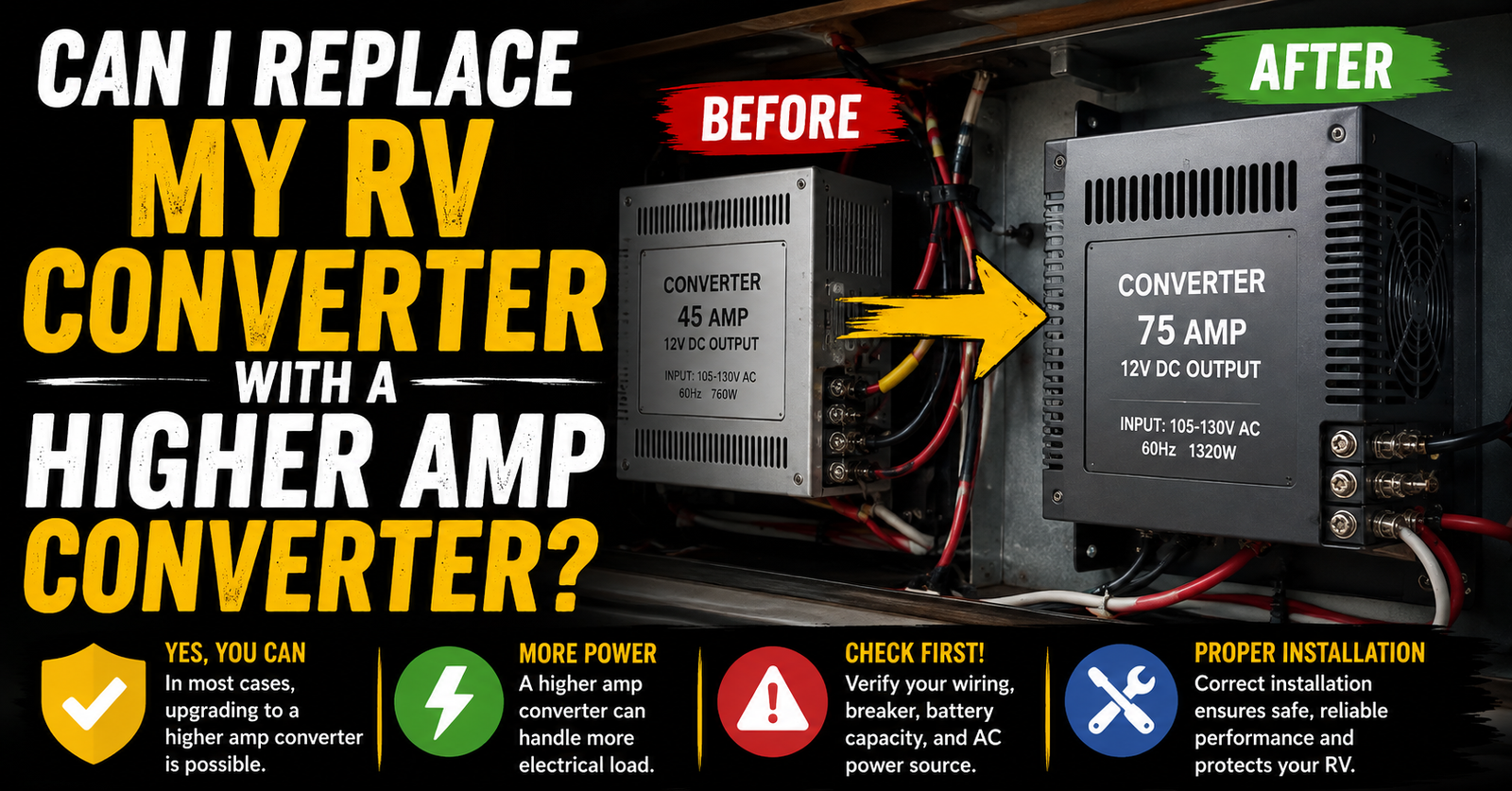
We’re going to build an entire article around how to tell if an RV converter is lithium compatible because it’s becoming an increasingly important question as owners upgrade battery banks. Battery chemistry is also part of the decision when replacing an RV converter with higher amperage, particularly after a lithium battery upgrade.
Can Low Converter Voltage Make the Battery Charge Slowly?
Absolutely.
Charging performance depends partly on the voltage available at the battery and the difference between charger voltage and battery voltage.
But don’t assume the converter itself is producing low voltage until you’ve measured appropriately.
You might have proper voltage at the converter and excessive voltage drop by the time it reaches the battery.
That’s a wiring problem, connection problem, or circuit-path problem rather than necessarily a converter problem.
Measure both ends.
Large DC Loads Can Affect What You’re Seeing
Your converter may be doing more than charging the battery.
It’s also supplying active 12-volt loads.
Lights.
Water pump.
Furnace blower.
Vent fans.
Control boards.
Other equipment.
The operating conditions of the DC system can affect measurements and converter behavior.
That’s another reason standardized manufacturer test procedures are useful when you’re trying to determine whether the converter itself passes or fails.
Battery Condition Can Affect Charging Behavior
A deeply discharged battery creates a different charging situation from a battery that’s nearly full.
A damaged battery can behave differently again.
So if the converter keeps staying in a higher charging mode or seems to work unusually hard, don’t automatically assume the converter is defective.
The battery may be driving that behavior.
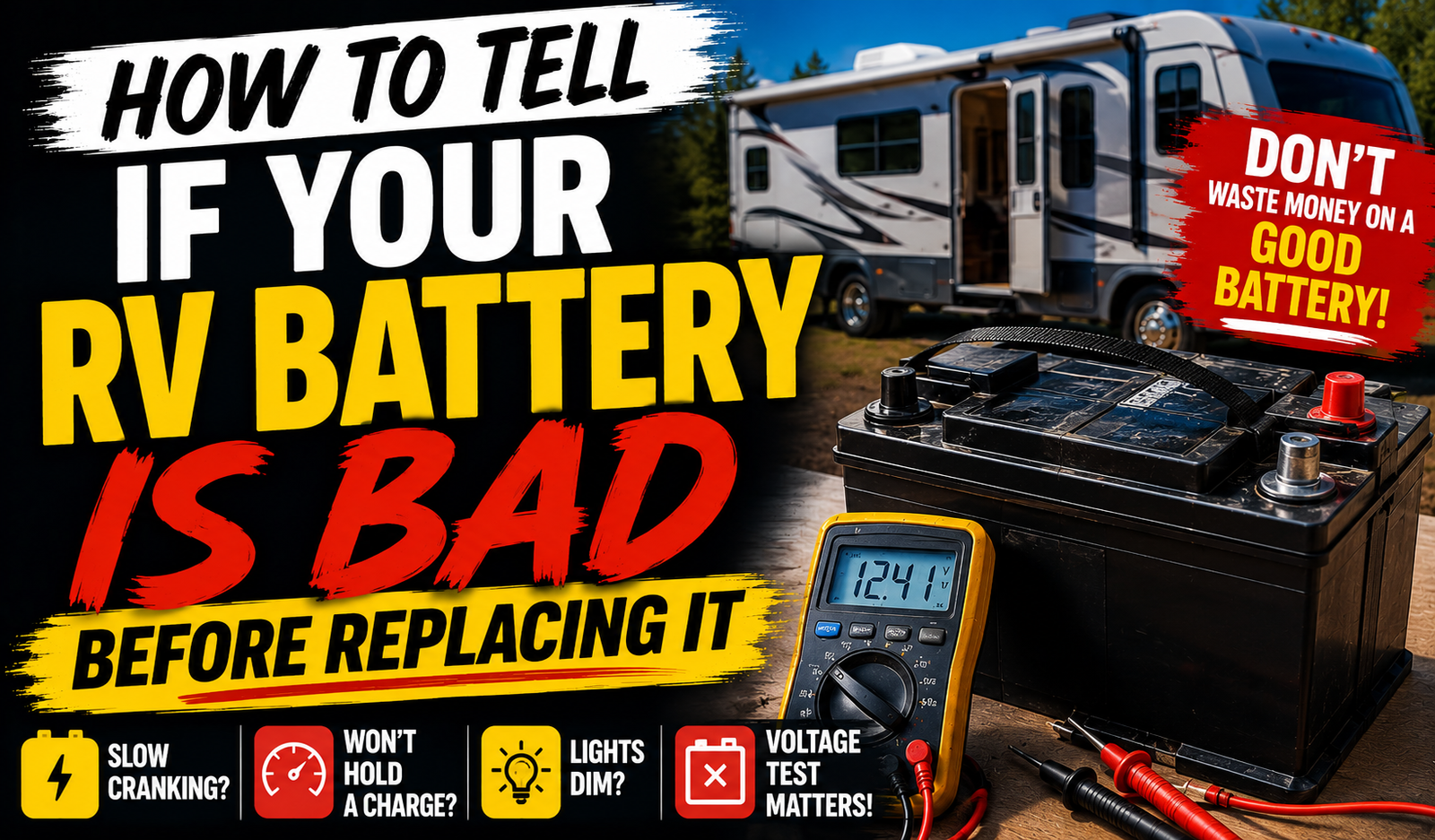
If you’re questioning the battery itself, our guide to telling whether an RV battery is bad is the better diagnostic path.
Why Does My Converter Voltage Keep Changing?
If you’ve got a multi-stage converter, changing voltage may be exactly what you want to see.
The charger isn’t necessarily supposed to sit at one voltage forever.
It can change modes based on battery condition, time, system design, and charging algorithm.
That’s the whole idea behind smarter charging.
Instead of asking why the number moved, ask:
Does the movement match the behavior the manufacturer designed into the charger?
If yes, the changing voltage may be evidence that it’s working properly.
Why Does It Drop to Around 13.2 Volts?
On certain Progressive Dynamics lead-acid systems, that’s the storage mode.
After the battery has remained fully charged without significant use for a period, the Charge Wizard can reduce voltage to approximately 13.2 volts.
That’s not the converter giving up.
It’s intentionally maintaining the battery differently because a heavy charging voltage isn’t needed.
Why Does It Jump to Around 14.4 Volts?
Again, using the Progressive Dynamics Charge Wizard as an example, approximately 14.4 volts corresponds with its boost mode for faster charging when needed.
So you might unplug from shore power, use the battery substantially, plug back in, and see a higher charging voltage than you saw after the camper had been plugged in for several days.
That can make perfect sense.
The battery’s needs changed.
The charger responded.
Why Does It Sit Around 13.6 Volts?
For those same systems, approximately 13.6 volts is normal mode.
That’s one reason 13.6 volts has become such a familiar number in RV converter discussions.
It’s a useful reference.
It’s just not a universal law.
Does 13.6 Volts Mean My Battery Is Full?
No.
It means you need more context.
If the battery is connected to a charger that’s holding the system around 13.6 volts, you aren’t looking at a resting battery voltage that can be interpreted the same way as a battery disconnected from charging influence.
This is one reason those little RV battery indicator panels can be misleading too.
Voltage is useful.
But you need to know what electrical condition existed when you measured it.
Does 14.4 Volts Mean My Battery Is 100 Percent Charged?
No.
Same problem.
Charging voltage isn’t a direct state-of-charge percentage meter.
A charger may be intentionally applying a higher voltage while charging.
Battery state of charge is a different question.

This is particularly important when you’re trying to figure out why an RV battery says full but dies quickly.
A nice-looking voltage number doesn’t prove the battery still has good usable capacity.
What About a Shunt-Based Battery Monitor?
Now we’re getting much better information.
A properly installed battery monitor can show not only voltage but also current entering and leaving the battery.
That helps answer questions voltage alone can’t.
Is the converter actually sending charging current into the battery?
How much?
How much are the RV loads consuming?
Is the battery nearly full and accepting less current?
A good monitor makes the electrical system much easier to understand.
But a Multimeter Is Still One of My Favorite RV Tools
For basic troubleshooting, a decent digital multimeter can tell you an incredible amount.
Battery voltage.
Converter output.
Voltage across connections.
Whether charging voltage reaches the battery.
Whether there’s voltage on both sides of certain circuit points.
You don’t need the fanciest meter on earth.
You need one you understand how to use safely and correctly.
When Converter Voltage Makes Me Suspect a Bad Converter
I don’t call a converter bad because I dislike one random reading.
I get much more suspicious when:
The converter has the proper AC input.
Required fuses and protection devices are good.
The test is performed according to the manufacturer’s procedure.
The meter is known to be working correctly.
And the converter’s DC output is still outside the manufacturer’s specified range.
That’s evidence.
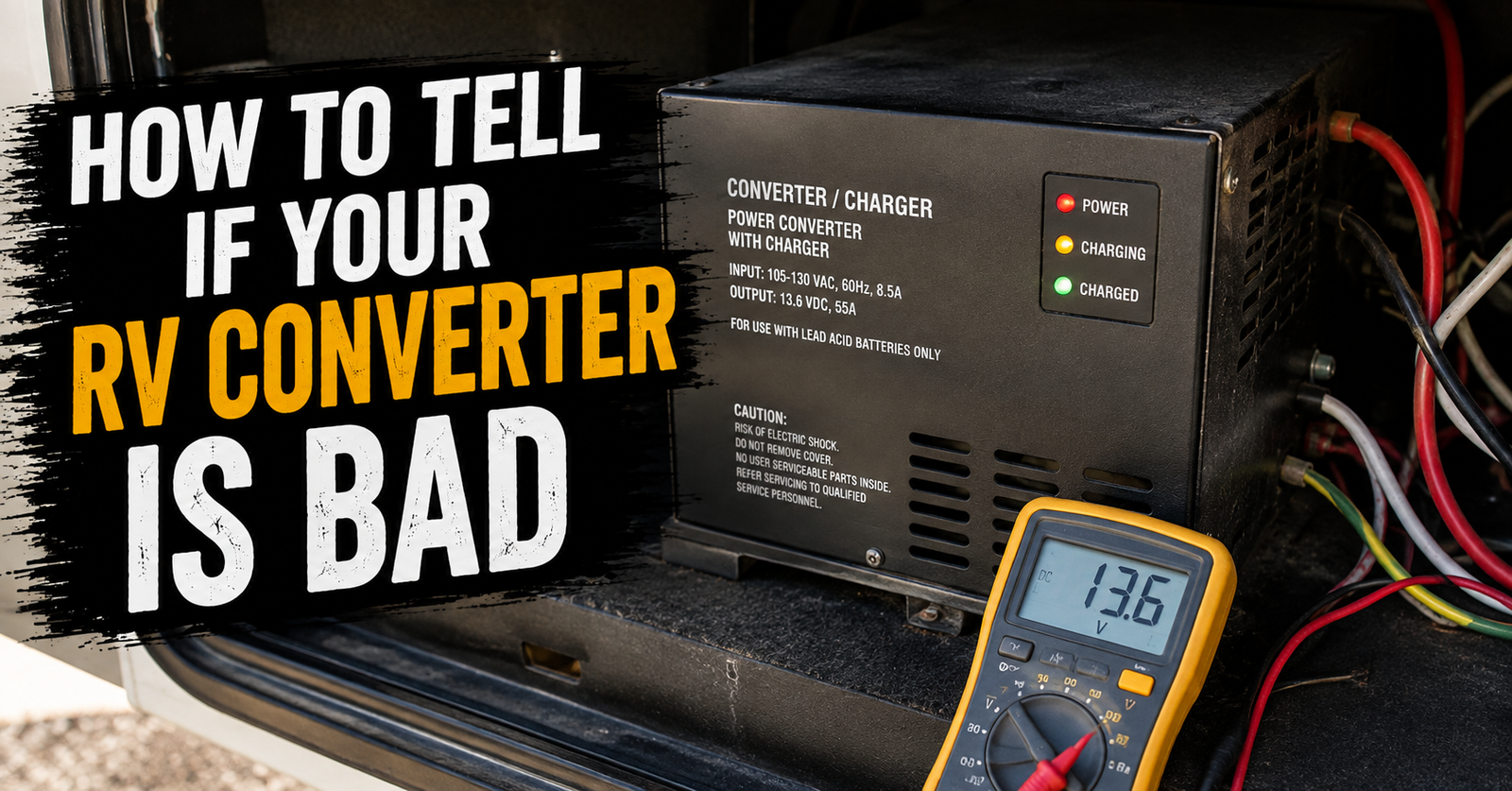
If you’re reaching that point, our guide to determining whether your RV converter is bad goes through the broader diagnosis before you spend money replacing it.
Don’t Forget That Your Meter Can Be Wrong
It happens.
Weak meter battery.
Poor probe contact.
Wrong meter setting.
Damaged leads.
Cheap meter behaving badly.
Operator error.
Before replacing an expensive RV converter because you measured some bizarre voltage, make sure you trust the measurement.
Test the meter against something known if necessary.
Repeat the measurement.
Make good probe contact.
Numbers are only useful when they’re accurate.
The Number Matters Less Than What the Number Is Telling You
That’s the big takeaway I want RV owners to understand.
13.2 volts can be normal.
13.6 volts can be normal.
14.4 volts can be normal.
And with some lithium converter/chargers, a number around 14.6 volts can be expected under the manufacturer’s specified conditions.
None of those numbers should be interpreted completely by themselves.
Ask what converter you have.
Ask what battery you have.
Ask what charging mode the system is in.
Ask where you’re taking the measurement.
Ask whether you’re measuring at the converter or battery.
And most importantly, compare your reading with the actual specifications for your equipment.
That’s how I use converter voltage.
Not as a magic number that instantly tells me what’s broken, but as another clue that shows me where the electricity is going and whether the charging system is doing what it was designed to do.
Written by Evan Mercer
Evan Mercer writes about RV electrical systems, battery charging, converters and hands-on camper troubleshooting for CamperAnswers.com. His work focuses on helping RV owners understand what their electrical readings actually mean so they can diagnose problems without throwing expensive parts at the camper.