
We were at the campground when I first heard it.
It wasn’t some huge bang or anything that immediately made me think something had broken. It was just this odd pulsing sound coming from somewhere in the camper.
I remember stopping and basically saying to my family:
“Uhhh guys…what is that sound?”
Of course, once you hear a new noise in a camper, you can’t not hear it anymore.
So we started figuring out where it was coming from.
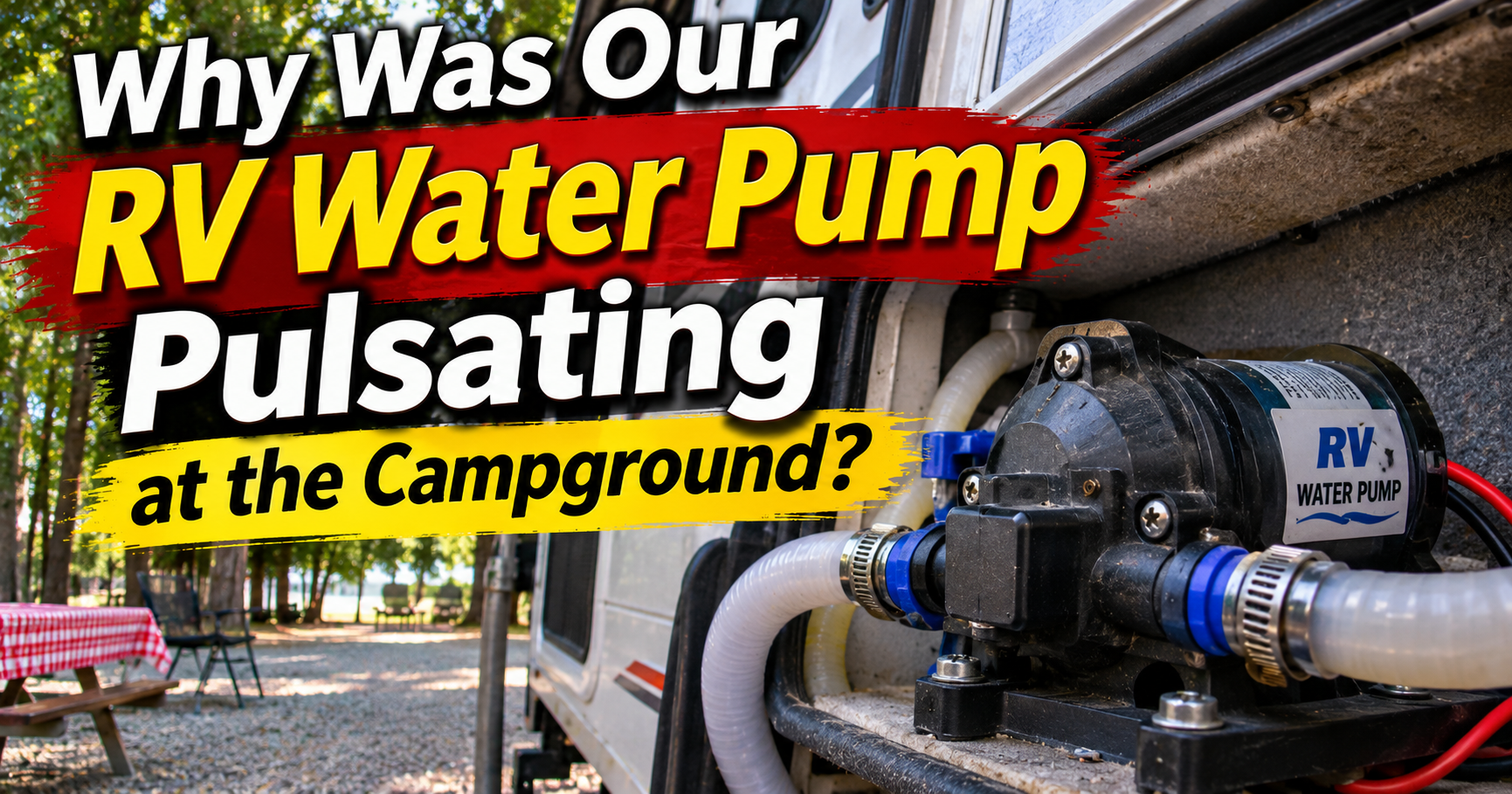
Eventually we tracked the sound down to the area where the RV water pump was located.
Well, great.
Now I knew what was making the noise.
I just didn’t know why the heck the water pump was making it.
What I’ve learned since is that a pulsating RV water pump doesn’t automatically mean the pump is dying. The pump responds to pressure and water flow, so restrictions at a faucet or showerhead, a dirty pump strainer, low-flow conditions, valve positions, and the way the pump itself is adjusted can all affect how often it starts and stops.
And there’s one really easy test I’d do before replacing anything.
What Our Water Pump Sounded Like
The best way I can describe it is that the pump wasn’t simply turning on and humming steadily.
It was more of an:
On…off…on…off…on…off.
You could hear it cycling.
That’s what made the sound stand out enough that we stopped what we were doing and went looking for it.
Once we found the pump area, the mystery noise at least had a name.
It was the water system.
That matters because campers make all kinds of noises at a campsite. Refrigerators cycle. Furnaces start. Water heaters do their thing. Converters have fans. Air conditioners make enough different noises to deserve their own dictionary.
Tracking down where a strange sound is coming from is sometimes half the battle.
The First Test I’d Do Now Is Open the Faucet Farther
Knowing what I know now, I wouldn’t start taking the pump apart.
I’d go to a faucet and change the water flow.
If the pump is going:
ON-OFF-ON-OFF-ON-OFF
while the faucet is barely open, I’d open the faucet farther and listen.
If the pump starts running more steadily with more water flowing, that’s a big clue.
The pump may be building pressure faster than the partially opened fixture is releasing water. It reaches its shutoff pressure, stops, pressure falls, and it starts again.
That can create the pulsing sound that originally made us wonder what was going on.


I’d Also Try More Than One Faucet
This is another simple check that makes a lot of sense to me.
If the pump acts strange at the bathroom sink but runs normally at the kitchen sink, I’m not immediately blaming the pump.
I’d look at the bathroom faucet.
If it pulses at:
The bathroom sink
Kitchen sink
Shower
and every other fixture,
then I’m much more interested in something affecting the entire water system.
That’s a much better clue than the noise by itself.
A Clogged Faucet Aerator Can Make a Difference
Those little screens at the end of a faucet can collect sediment and mineral buildup.
Water still comes out, so you may not immediately think anything is wrong.
But restricted flow changes how water moves through the system.
If one faucet is causing the pump to cycle strangely, I’d remove and inspect that faucet’s aerator before touching the pump.
Clean it.
Run the faucet again.
Listen.
That’s exactly the kind of five-minute check I like because the result tells you something.

Same Thing With the Showerhead
If the strange pulsing happens mainly while somebody is showering, I’d check the showerhead too.
RV showerheads are often designed to limit water use anyway, and mineral deposits or debris can restrict them even further.
Remove the showerhead and briefly run water through the hose.
Does the pump behave differently?
If it suddenly runs smoothly, I’d be much more interested in the showerhead than the pump motor.
Once We Found the Pump, I’d Want to Check the Strainer Too
Many RV water pumps have a small strainer on the inlet side.
That’s there to keep debris from entering the pump.
And like any filter or screen, it can get dirty.
If the problem happens throughout the camper rather than at one fixture, the pump strainer is one of the next places I’d look.
I’d turn the pump off, relieve the water pressure, and inspect the strainer according to the pump manufacturer’s instructions.
Sediment, little pieces of debris, or other junk can restrict water entering the pump.
Clean it and retest before buying anything.
Make Sure There’s Actually Plenty of Water in the Fresh Tank
This sounds ridiculously basic.
But campers have taught me not to skip the ridiculously basic stuff.
If we’re using the onboard water pump, it has to pull water from the fresh tank.
So I’d verify that the tank actually has water rather than blindly trusting the monitor panel.
I’d also check that any valves around the pump and fresh-water system are positioned correctly, especially if the camper was recently winterized or dewinterized.
A pump can’t behave normally if the plumbing isn’t giving it a normal water supply.
There’s One Important Difference I’ve Learned
A pump that pulses while we’re actually using water isn’t necessarily the same problem as a pump that randomly comes on when nobody is touching anything.
That’s something I would’ve lumped together before.
Now I wouldn’t.
If we’re running a faucet and the pump rapidly cycles, I’m thinking about flow, restrictions and how the pump is responding to pressure.
But imagine we’re sitting around the camper at night.
Nobody is showering.
Nobody flushed.
Every faucet is closed.
Then suddenly:
Brrrrrr.
Pump runs for a second.
Stops.
Ten minutes later:
Brrrrrr.
That gets my attention for a different reason.
Pressure may be escaping somewhere.
Now I’d be thinking about a dripping fixture, toilet valve, plumbing leak, pump check valve, or another place where the pressurized water system is losing pressure.
Our Fresh Tank Gave Me Another Lesson About Check Valves
The pump isn’t just responsible for pushing water from the fresh tank into the camper.
There’s also backflow protection involved in keeping pressurized city water from traveling backward toward the fresh tank.
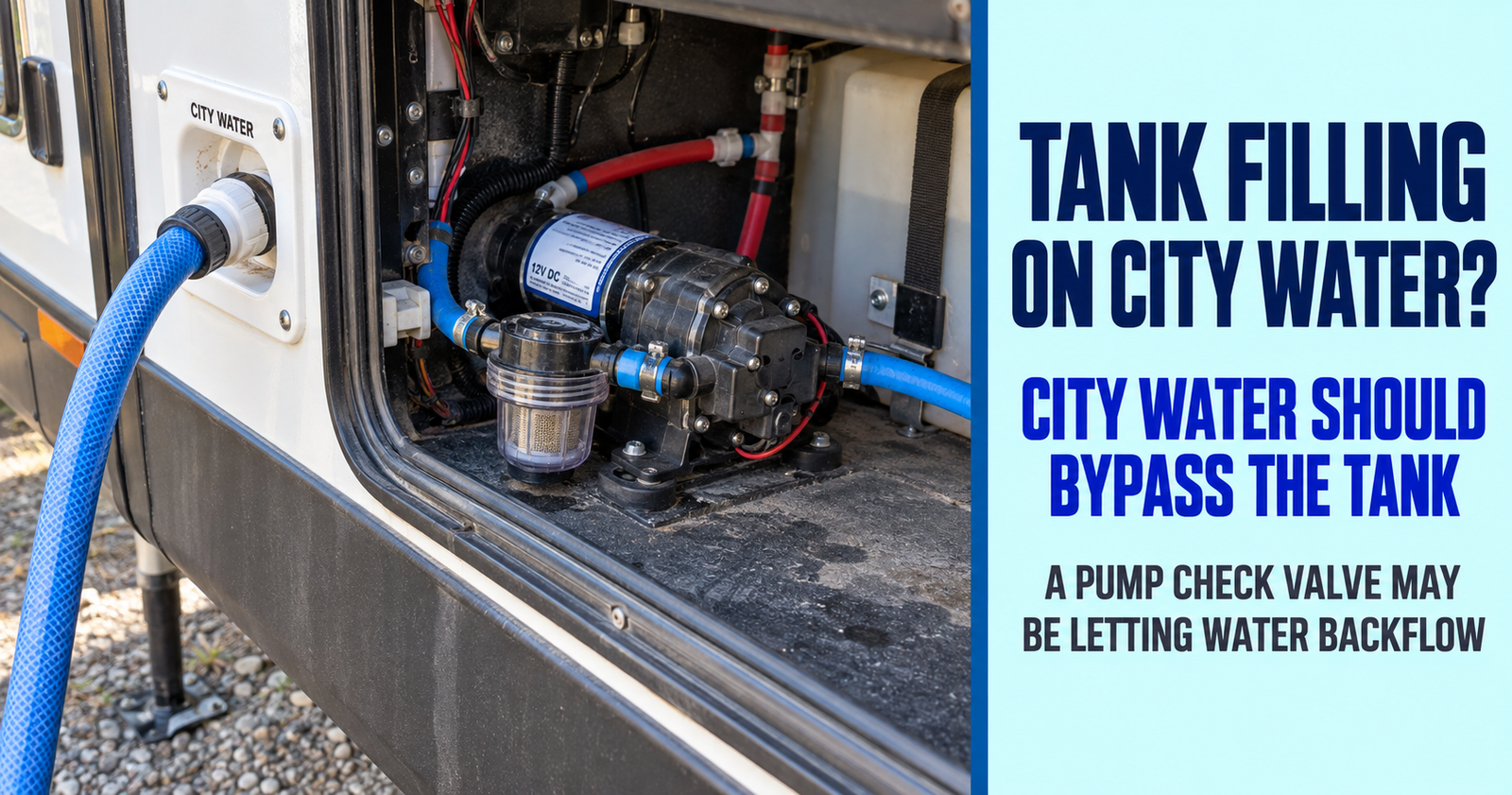
We’ve already dealt with the strange situation where an RV fresh water tank starts filling while connected to city water.
That’s another example of why I pay attention when a water pump starts doing something unusual.
One symptom doesn’t automatically diagnose the pump, but multiple weird water-system symptoms can help narrow down where the problem actually is.
I Wouldn’t Start Turning Adjustment Screws
Once you find the pump, it’s tempting to start messing with it.
There’s the pump.
There are screws.
Something must be adjustable.
Let’s turn stuff!
That’s not how I’d handle it.
Some RV water pumps do have pressure-switch or bypass adjustments, but the correct procedure depends on the exact manufacturer and model.
I’d get the model number first.
Then I’d follow the manufacturer’s adjustment procedure if the simple troubleshooting actually points in that direction.
Randomly turning screws introduces another variable into a problem you haven’t diagnosed yet.
Could an Accumulator Tank Help?
Potentially.
An accumulator can store a small amount of pressurized water and help smooth out pump operation in some RV plumbing systems.
That can reduce rapid cycling and make low-flow water use feel smoother.
But again, I wouldn’t buy one just because we heard the pump pulsing.
First I’d make sure the faucet aerators aren’t clogged.
Showerhead isn’t badly restricted.
Pump strainer is clean.
Valves are positioned correctly.
Water supply is good.
The pump itself is operating properly.
Then upgrades make more sense.
The Noise Doesn’t Automatically Mean the Pump Is Bad
That’s probably the biggest thing I wish I’d known when we first went hunting for that strange sound.
When something mechanical suddenly starts making an odd noise in a camper, my brain immediately goes to:
Great. What do I have to replace now?
But a water pump cycling on and off is responding to what’s happening in the plumbing.
The pump may actually be doing exactly what its pressure switch is telling it to do.
The real question is why it’s cycling that frequently.
That’s a much better question than:
How much does a new RV water pump cost?
What I’d Do If We Heard That Same Sound Again
I’d recognize it a whole lot faster now.
Instead of walking around asking what in the world was making that noise, I’d go straight to the water system.
Then I’d keep it simple.
Open the faucet farther and listen.
Try another faucet.
Check whether it’s only one fixture.
Inspect the aerator or showerhead.
Make sure there’s plenty of water in the fresh tank.
Check the pump strainer.
Look at valve positions.
Only after those checks would I start getting suspicious of the pump itself or its adjustment.
That’s a pretty short troubleshooting list.
And that’s the point.
Sometimes the Weird Camper Noise Is More Helpful Than It Seems
That campground experience taught me something I’ve carried into other RV problems.
Don’t ignore a new sound, but don’t immediately assume the thing making the sound is broken either.
First find it.
Then pay attention to when it happens.
Our pump wasn’t just making some mysterious noise buried inside the camper anymore.
Once we found it, we could connect the sound to what the water system was doing.
And the next time I hear:
brrr-stop-brrr-stop-brrr-stop
coming from that part of a camper, I’m not immediately shopping for another pump.
I’m opening a faucet and seeing what changes.
Sometimes that’s all it takes to turn:
“Uhhh guys…what is that sound?”
into a problem that actually makes sense.
Written by Caleb Warren
Caleb Warren writes about real campground experiences, RV water systems, hookups, pumps, and the strange little camper problems that usually start with somebody asking, “What is that noise?” for CamperAnswers.com. His articles combine what actually happens while camping with practical troubleshooting that helps RV owners figure out what to check before replacing parts.