
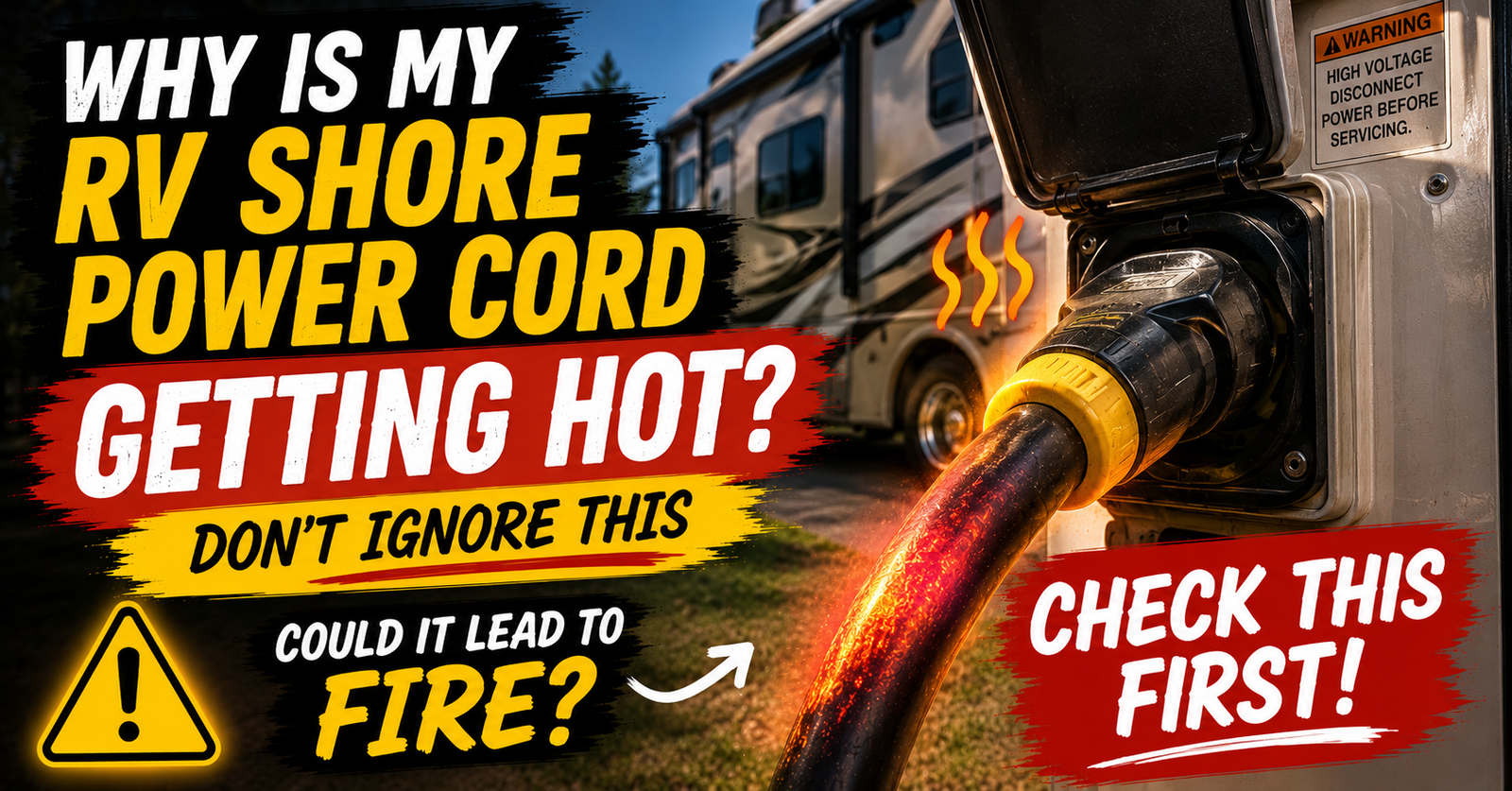
I don’t panic because an RV shore power cord feels a little warm after I’ve been running the air conditioner and other electrical equipment. Electricity moving through a heavily loaded cord can produce some warmth.
But there’s a big difference between warm and hot.
If I grab the shore power plug or connection and immediately think, Man, that’s hot, I don’t ignore it. And if I see brown plastic, melting, a burned-looking blade, or smell that unmistakable hot-electrical smell, I’m disconnecting power and figuring out what’s going on. A similar warning applies when the odor seems to come from the converter or power-center area: burning electrical smell around an RV.
An RV shore power cord or plug can get dangerously hot because of a loose or worn connection, corrosion, damaged contacts, a failing campground receptacle, excessive electrical load, a damaged adapter, or a problem with the cord or RV inlet. Often the hottest spot tells you where to start looking.
That’s the important part.
Don’t just ask why the “cord” is hot.
Figure out what part is actually heating up.
A Warm RV Power Cord Isn’t Automatically a Problem
Let’s clear this up first because I don’t want somebody touching a slightly warm 30 amp cord on a hot summer afternoon and assuming their camper is about to burn down.
An RV shore power cord can carry a substantial amount of current.
A 30 amp RV connection can supply up to about 3,600 watts.
A 50 amp RV connection can supply considerably more.
If you’ve got the air conditioner running, batteries charging, water heater on electric, refrigerator running, and other equipment operating, current is flowing through that cord.
Some warmth isn’t shocking.
What gets my attention is excessive or localized heat.
For example, if most of the cord feels normal but the plug at the campground pedestal is extremely hot, I start thinking about that connection.
If the pedestal end feels fine but the detachable connection at the side of the camper is cooking, I’m looking there.
That distinction matters.

The Plug Is Usually More Interesting Than the Middle of the Cord
When somebody tells me their RV power cord is getting hot, my first question would be:
Where?
Is the entire cable warm?
Is the pedestal plug hot?
Is an adapter hot?
Is the connection at the RV inlet hot?
Is one particular prong discolored?
Connections are especially important because poor electrical contact creates resistance.
Resistance creates heat.
Etrailer specifically notes that a loose-fitting shore-power connection can create heat buildup severe enough to melt the plug.
That’s why I don’t dismiss a hot plug just because the breaker hasn’t tripped.

A Breaker Doesn’t Have to Trip for a Connection to Overheat
This surprises a lot of RV owners.
You might think:
“If something were really wrong, wouldn’t the breaker trip?”
Not necessarily.
A breaker primarily protects against excessive current flowing through the circuit. A poor electrical connection can generate significant heat without the total current exceeding the breaker rating.
That’s a completely different problem.
You might be drawing 25 amps through a 30 amp connection, which doesn’t sound unreasonable by itself.
But if one contact is loose, worn, dirty, or damaged, resistance at that small connection can generate considerable heat.
So don’t use a breaker that hasn’t tripped as proof that a hot plug is safe.
A Worn Campground Pedestal Is High on My List
Think about what campground receptacles go through.
One camper leaves.
Another plugs in.
Then another.
Then another.
People pull plugs out under load.
Heavy cords hang from the receptacle.
Weather gets involved.
Contacts wear.
Eventually, a receptacle that once gripped an RV plug firmly may become loose.
That’s exactly the kind of connection I don’t want carrying a heavy electrical load for hours.
If your plug feels unusually loose in the campground receptacle, I’d involve campground staff.
I wouldn’t bend prongs, jam things into the receptacle, or start repairing campground electrical equipment myself.
Check How Firmly the Plug Fits
This is one of the simplest observations you can make.
When the pedestal breaker is off and you’re connecting the RV, does the plug fit firmly?
Or does it feel sloppy?
Does the cord seem like it could almost fall out?
A badly worn receptacle can make poor contact with the plug blades.
That poor contact can create heat.
If I’m uncomfortable with the connection, I’m not going to run two air conditioners all afternoon and hope for the best.
I’d ask campground staff to inspect the pedestal or move me to another hookup.
Look at the Plug Blades
With power safely disconnected, inspect the shore power plug itself.
I’m looking for anything unusual:
Dark spots.
Pitting.
Corrosion.
Discoloration.
Burn marks.
Deformed blades.
Melted plastic.
If one blade looks dramatically different from the others, that’s information.
Heat leaves evidence.
And once a plug has been significantly overheated or damaged, I don’t treat cleaning it up cosmetically as a repair.
The underlying connection needs to be corrected.
Melted Plastic Is Not Normal RV Wear
I’ve seen people treat a slightly melted electrical plug almost like a scratched bumper.
“Yeah, it got a little hot last summer.”
No.
If the plug has melted, something got hot enough to deform the material surrounding an electrical connection.
That deserves attention.
Etrailer has documented RV shore-power situations where loose-fitting connections produced enough heat to melt plug components even though the issue wasn’t simply an overloaded breaker.
Don’t keep using damaged electrical equipment until it finally fails completely.
The RV Inlet Can Overheat Too
If you have a detachable shore power cord, there are at least two major connections to think about.
The campground pedestal end.
And the RV inlet end.
A lot of people instinctively check the pedestal and forget the camper connection.
If the connection at the RV isn’t fully seated, secured correctly, or making good electrical contact, it can become a heat source too.
Check the inlet and cord connector for the same things:
Burning.
Melting.
Discoloration.
Corrosion.
Loose fit.
Damaged contacts.
A problem doesn’t have to be outside at the pedestal.
Make Sure a Twist-Lock Connection Is Actually Secured
If your camper uses a detachable twist-lock-style shore cord, don’t just push it into the inlet and call it good.
Make sure it’s properly inserted and secured according to its design.
A connection that’s only partially engaged isn’t something I want carrying a large electrical load.
And if the connector no longer fits properly even when you’re using it correctly, I’d investigate the cord end and inlet.
Don’t rely on tape, wedging, or other homemade tricks to hold together a questionable high-current electrical connection.
Your Adapter Is Another Potential Hot Spot
We’ve already talked quite a bit in this cluster about adapting between 30 and 50 amp service.
Every adapter you add creates additional electrical connections.
Suppose you’ve got:
Pedestal
↓
Dogbone adapter
↓
Surge protector or EMS
↓
Shore cord
↓
RV inlet
That’s several places where poor contact could potentially develop.
If something is getting hot, carefully determine which connection is hottest.
The adapter itself may be damaged.
Or the receptacle it’s connected to may be worn.
Don’t Blame the Adapter Just Because You’re Using One
Using a proper RV adapter isn’t automatically a problem.

We already covered how you can safely plug a 30 amp RV into a 50 amp campground outlet with the correct equipment.
The same basic idea applies when adapting the other direction.
What I care about is:
Is the adapter properly rated?
Are the connections tight?
Is anything damaged?
Is anything overheating?
Are you respecting the capacity of the power source?
A quality adapter used correctly is different from a loose, damaged connection that’s been cooking itself for three camping seasons.
Heavy Electrical Load Can Make Heat Problems More Obvious
Let’s say you’ve got a marginal connection.
At light load, you might never notice it.
You’re charging phones and running a few small things.
Then the afternoon gets hot.
Air conditioner starts.
Water heater is on electric.
Converter is charging the batteries.
Microwave starts.
Now you’re drawing substantially more current.
That weak connection starts producing more heat.
This is why somebody may say:
“It only gets hot when the air conditioner is running.”
That doesn’t necessarily mean the air conditioner is defective.
The heavier load may simply be exposing a bad connection.
This Is Especially Important on 30 Amp Service
A 30 amp RV has approximately 3,600 watts of total available shore-power capacity.
It’s easy to operate fairly close to that limit when several large appliances are running.
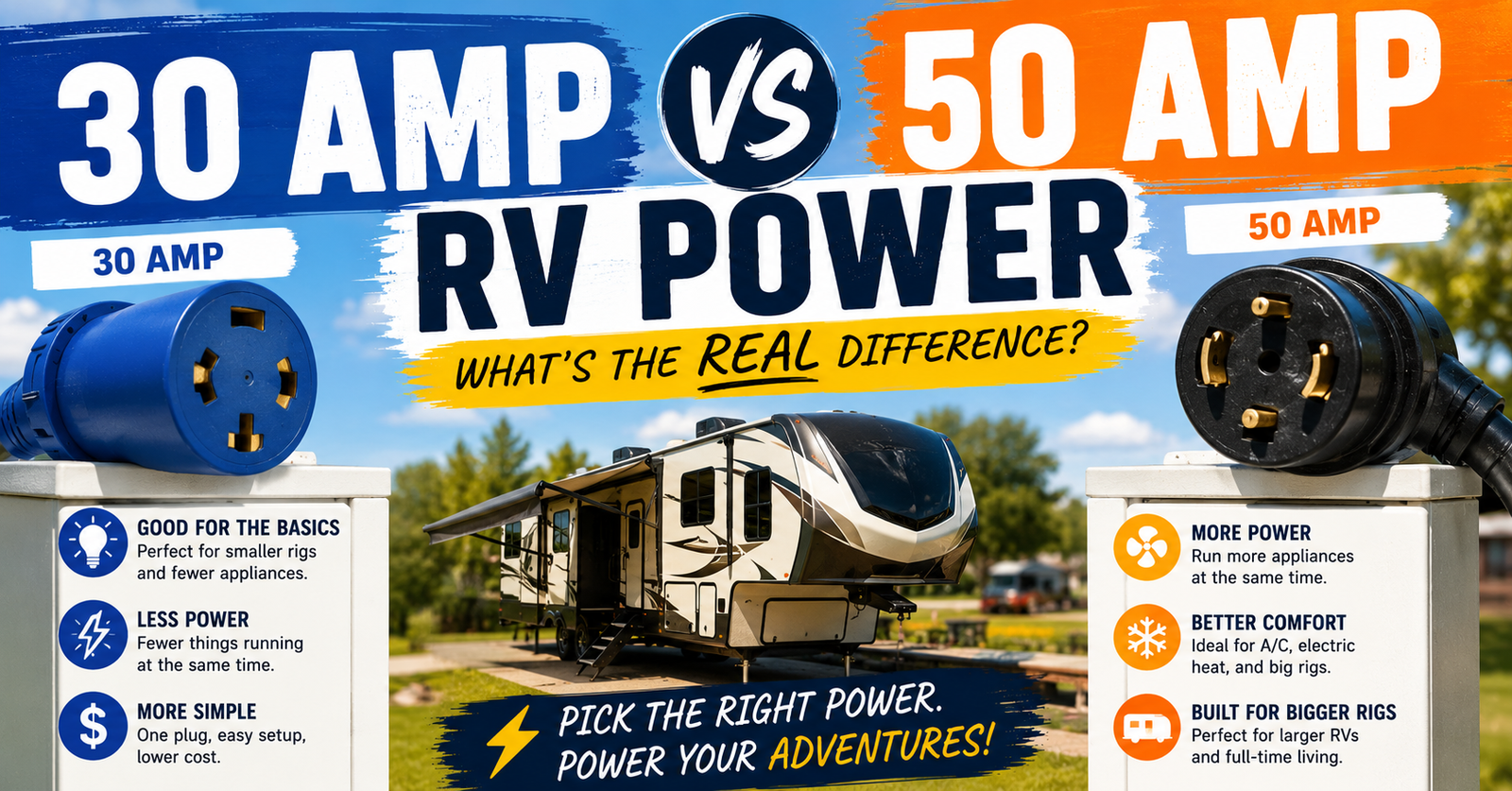
If you haven’t gotten comfortable with how quickly RV electrical loads add up, our 30 amp vs 50 amp RV power explanation makes the difference much easier to picture.
The important thing here is that sustained high current makes connection quality matter even more.
A loose connection carrying a tiny load and that same connection carrying close to 30 amps are very different situations.
A 50 Amp RV on 30 Amp Service Can Run Near the Limit
This is another situation where I’d pay attention.
A big 50 amp RV may normally have plenty of electrical breathing room.
Then you connect it to a 30 amp campground pedestal using the proper adapter.
Now that large RV is sharing approximately 3,600 watts of available shore power.
You start carefully managing appliances, but you may still spend long periods pulling substantial current from that 30 amp connection.
That’s not inherently wrong.
But it means I want the pedestal receptacle, adapter, and connections in good condition.
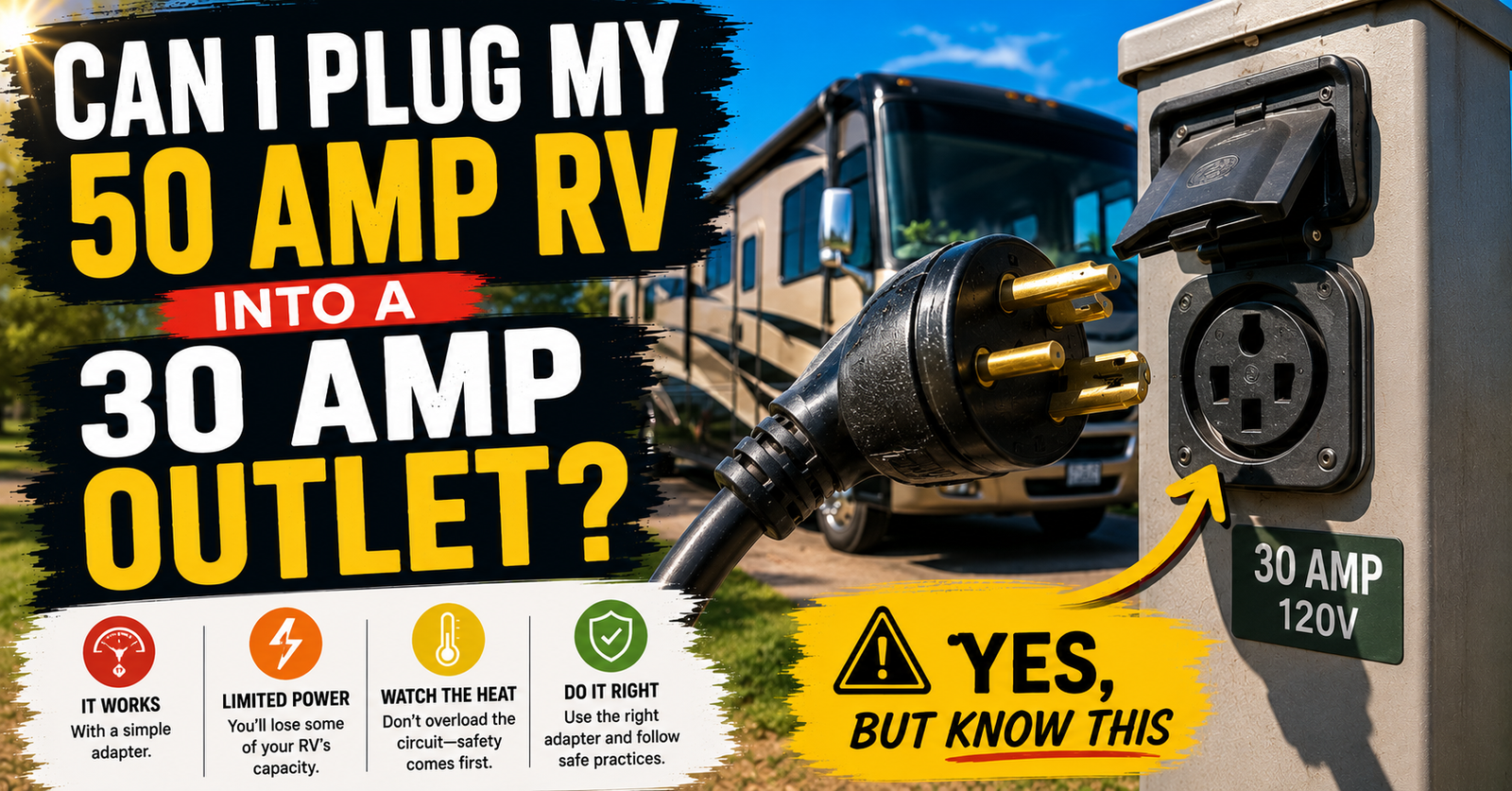
If you’re doing this regularly, our guide to running a 50 amp RV from a 30 amp outlet explains the power limitation in more detail.
Is the Cord Too Small?
With the original properly rated RV shore power cord, this normally shouldn’t be the first thing I suspect.
But extension cords change the situation.
If you’re adding an extension cord, it needs to be appropriate for the electrical load and application.
A light-duty household extension cord isn’t something I’d use to feed a heavily loaded RV.
Longer wire runs and undersized conductors can contribute to voltage drop and heating.
This is another reason I prefer purpose-built RV electrical equipment rather than trying to build a campsite power system from whatever orange extension cord happens to be hanging in the garage.
Don’t Leave Extra Cord Tightly Coiled Under Heavy Load
If you’ve got a lot of excess cord, don’t leave it tightly bundled into a little coil while you’re pulling a heavy continuous load.
Give the cord room.
Keep it where it isn’t being pinched, crushed, driven over, sitting in standing water, or wrapped around something hot.
I don’t obsess over making my shore cord perfectly straight across the campsite, but I do treat it like an electrical supply cable rather than a garden hose.
Low Voltage Can Make RV Electrical Problems Worse
Voltage is another part of the shore-power story.
Your campground connection isn’t just about whether electricity exists.
The quality of that power matters too.
If campground voltage falls, certain electrical equipment can draw more current trying to perform its job, and motors such as air-conditioner compressors don’t appreciate poor voltage conditions.
That’s one reason I like knowing what voltage is actually reaching the camper rather than assuming the pedestal must be fine because the lights came on.
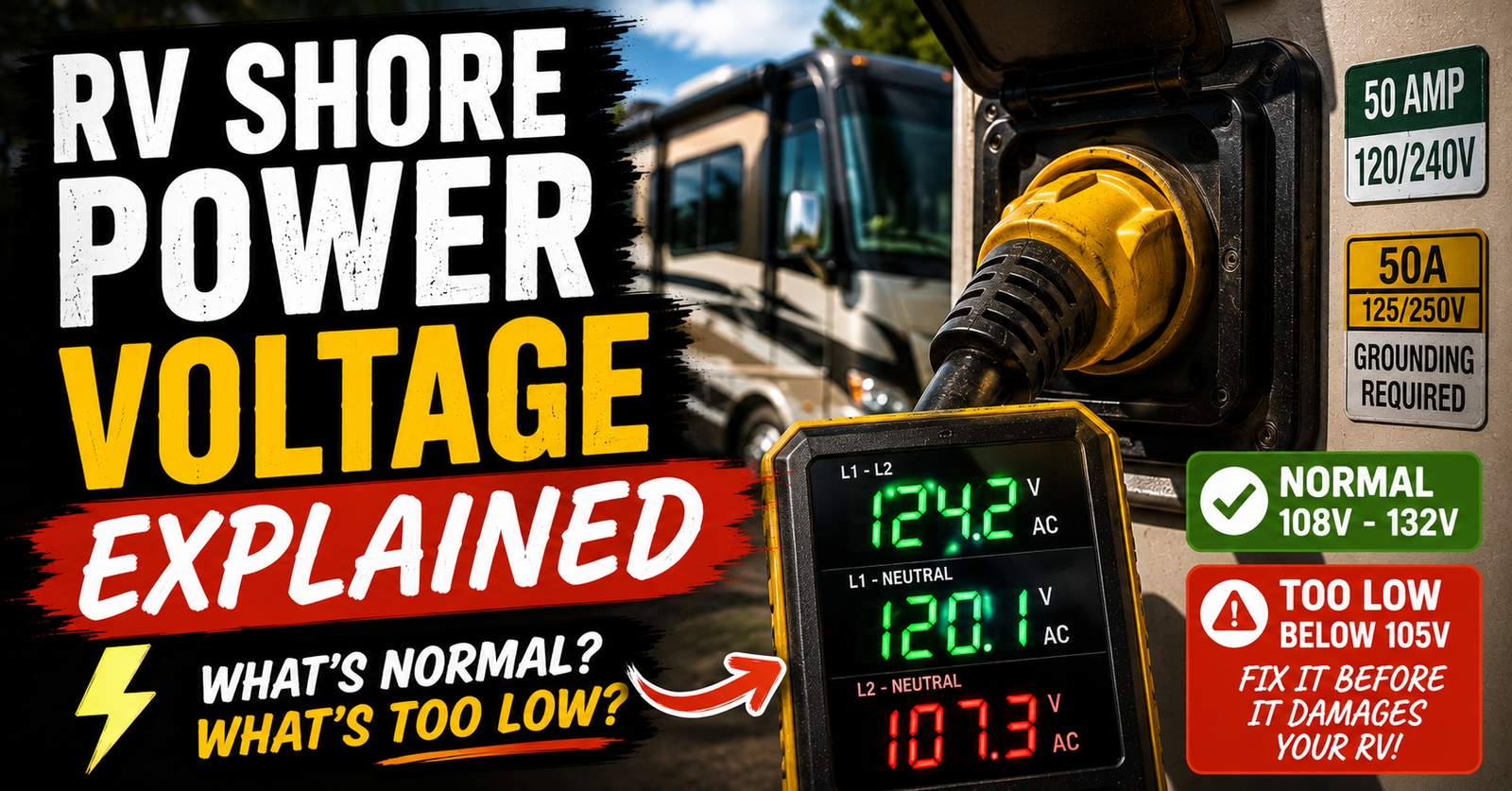
We’re going to cover normal RV shore-power voltage separately because it deserves its own article rather than getting buried here.
A Surge Protector Isn’t Necessarily an Electrical Management System
This distinction matters.
A basic surge protector may protect against certain voltage spikes.

A more advanced electrical management system can monitor additional shore-power conditions and disconnect the RV when incoming power falls outside acceptable parameters. The difference between that equipment and a basic surge protector is covered in this explanation of advanced RV power monitoring.
Etrailer recommends campground electrical protection and voltage monitoring as useful shore-power equipment.
If your equipment displays incoming voltage, that’s useful information when you’re troubleshooting a hot connection.
But electrical protection doesn’t make a physically loose plug connection okay.
Check the Voltage Under Load
This is where an electrical management system with a voltage display can be useful.
Maybe the pedestal looks perfectly fine with almost nothing running.
Then you start the air conditioner and the voltage drops noticeably.
That tells you more about how the electrical supply behaves under load.
I’m not going to set our full acceptable-voltage discussion here because that’s the next part of this shore-power cluster.
But I absolutely wouldn’t ignore unusually low voltage combined with overheating connections or appliances behaving strangely.
What If Only One Prong Is Burned?
That’s a particularly interesting clue.
If the entire cord were simply overloaded uniformly, I’d expect a different pattern than one connection showing obvious localized damage.
A burned blade can point toward a poor contact at that particular connection.
Maybe the receptacle contact is worn.
Maybe there’s corrosion.
Maybe something is loose.
Maybe the plug itself has been damaged.
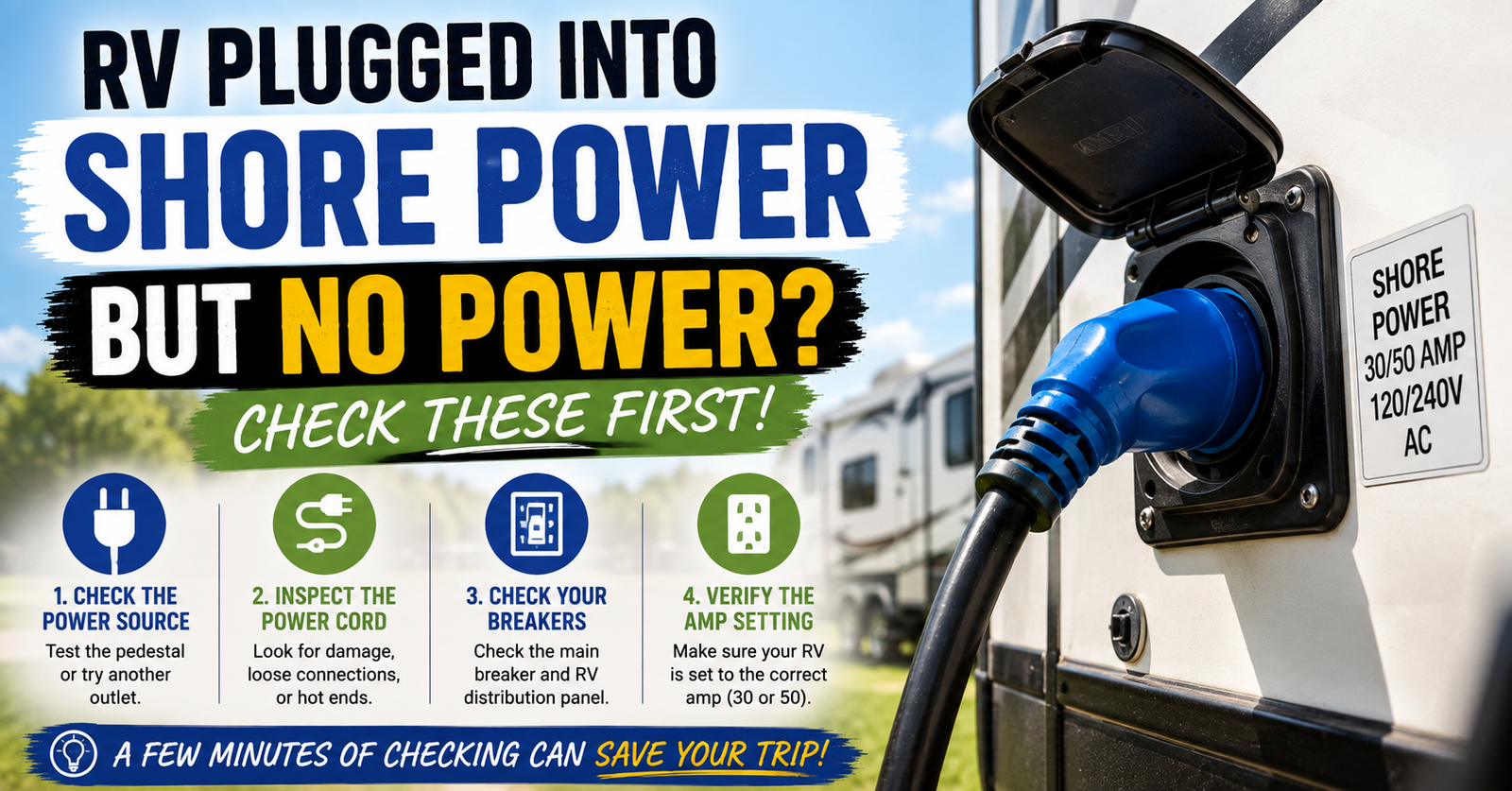
I’d inspect both sides of that connection rather than simply replacing the cord and plugging the new one right back into the same questionable receptacle. If that inspection also reveals a loss of power, checking the campground receptacle gives you the next checks to make at the pedestal and along the shore-power path.
Otherwise, you may damage the replacement too.
Replacing Only the Plug May Not Fix the Cause
Let’s say the campground receptacle has worn contacts.
Your plug overheats.
You replace your damaged plug.
Then you plug the beautiful new connector into the same worn receptacle.
What changed?
You replaced the evidence.
You didn’t necessarily fix the cause.
This is why I want to inspect both halves of an overheated connection whenever possible.
The plug and whatever it plugs into work together.
What If My RV Shore Cord Gets Hot at Home?
Now I’d look closely at how you’re powering the camper.
Are you plugged into a dedicated 30 or 50 amp RV receptacle?
Or are you adapting down to a normal 15 or 20 amp household outlet?
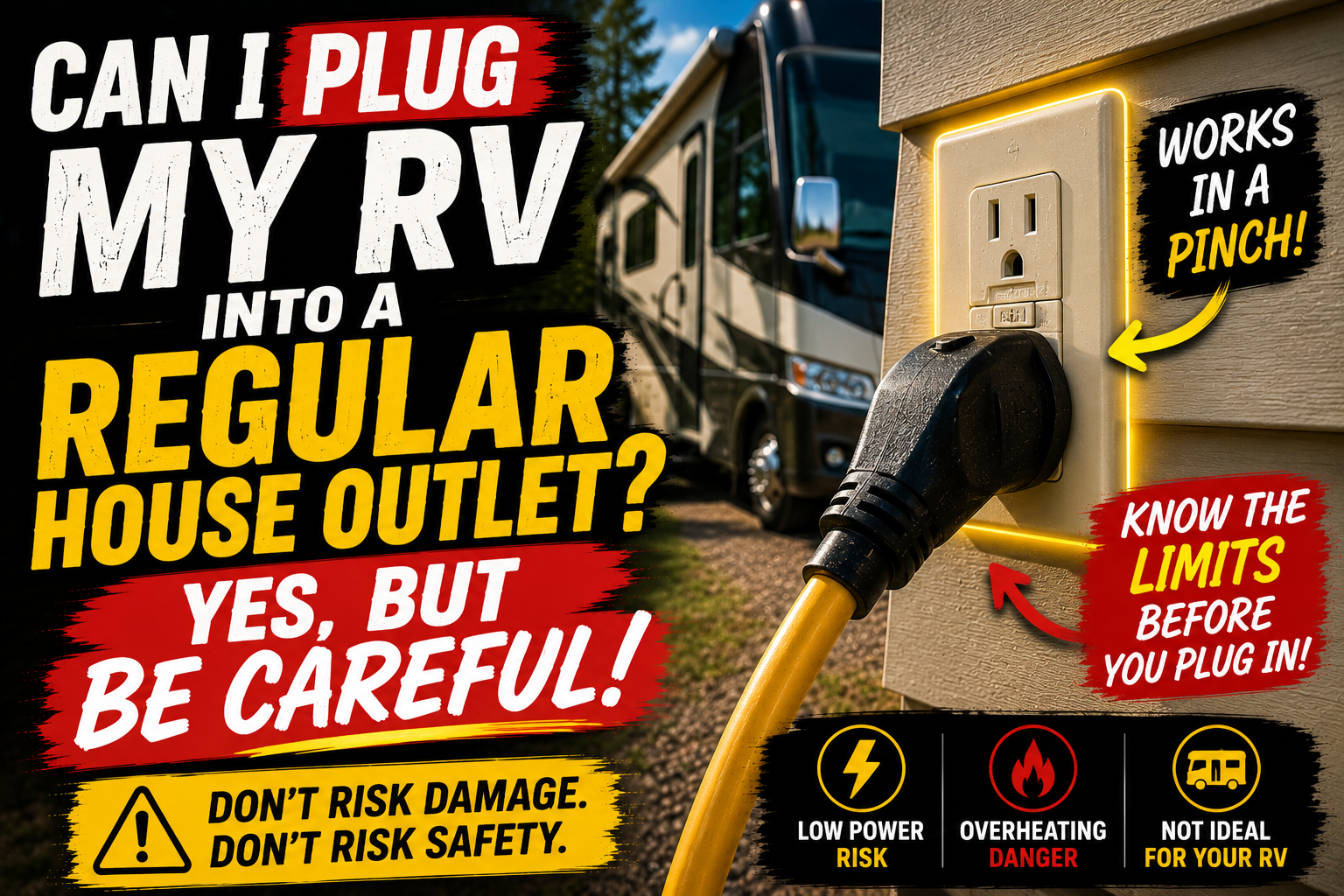
Etrailer notes that RVs can be connected to household 15 or 20 amp service with the appropriate adapter, but the smaller connection doesn’t provide enough capacity to operate the RV the same way you would on full campground service. The limits of that setup are explained in connecting an RV to household power.
If you’re plugged into a household circuit, I keep the RV’s electrical demands modest.
Battery charging and light use are very different from trying to operate every high-draw appliance in the camper.
Don’t Assume Every 30 Amp Outlet Is an RV Outlet
This is another mistake worth repeating.
A standard 30 amp RV TT-30 connection is a specific 120-volt RV service.
A different 30 amp receptacle doesn’t automatically mean it’s compatible.
If you’re installing RV power at home, make sure whoever installs it understands exactly what connection your RV requires.
I don’t want anybody experimenting with unfamiliar receptacles because “the plug almost looks right.”
What If the Cord Is Hot but the Breaker Keeps Tripping Too?
Now we have two symptoms.
And I take that more seriously than either one by itself.
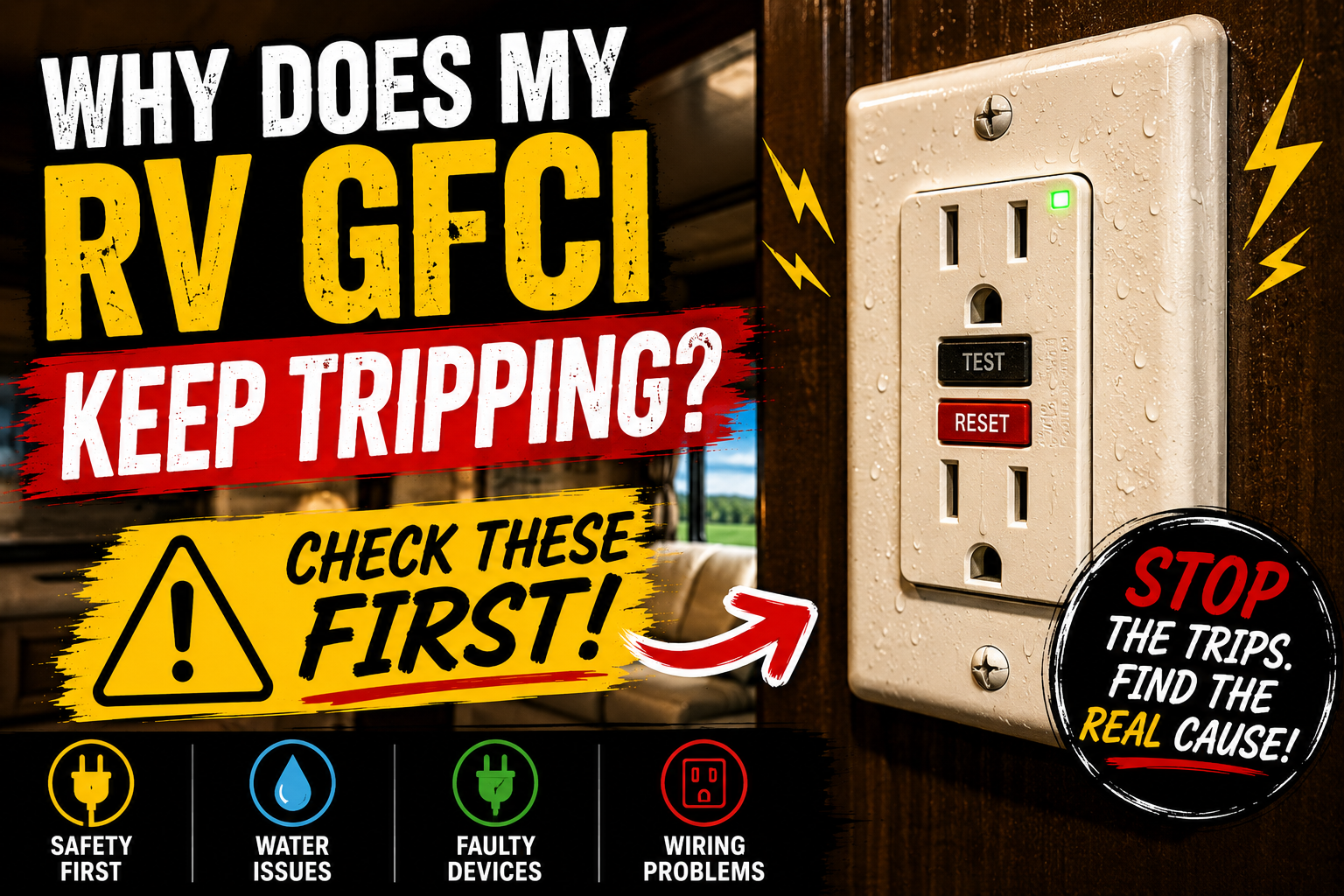
If your RV is also repeatedly tripping the shore-power breaker, start reducing electrical loads and figure out exactly which breaker is opening. If the device opening is a GFCI rather than the main breaker, repeatedly tripping the shore-power breaker explains how to narrow down the cause.
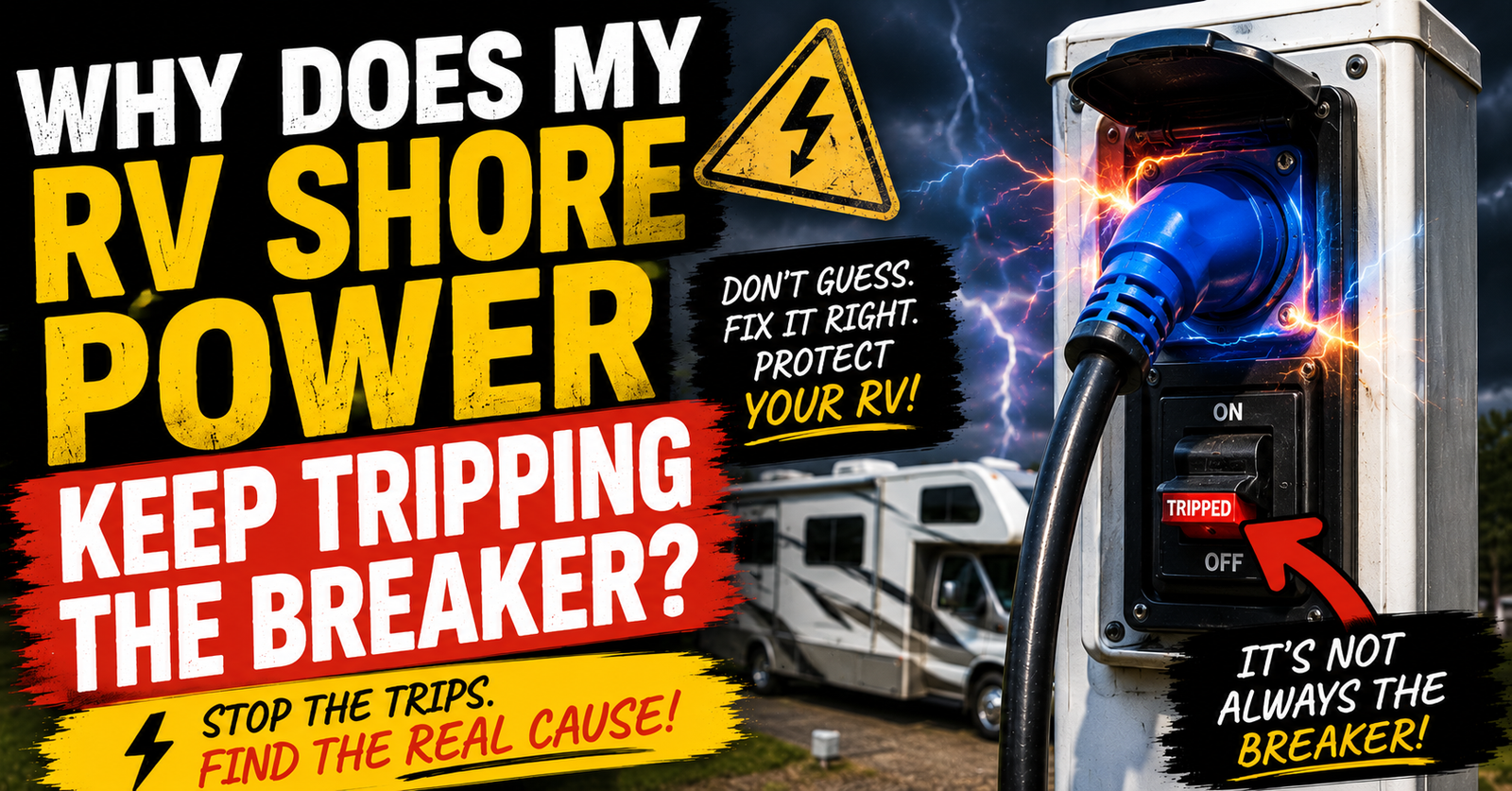
We’ve already built a dedicated guide explaining why RV shore power keeps tripping the breaker.
But if you have breaker trips plus obvious overheating, melting, or a burning smell, I wouldn’t keep resetting the breaker and continuing to camp normally.
Disconnect and investigate.
Can a Bad Shore Cord Cause Partial Power?
Depending on the failure and the RV’s electrical service, yes, electrical connection problems can create some strange symptoms.
This becomes especially interesting with 50 amp service because there are two hot legs.
If one side of the incoming service is lost, parts of the RV can remain powered while others go dead.

We’ve already covered why some RV outlets work while others have no power because that’s a different troubleshooting path.
If you’ve got heat plus partial power, don’t ignore the connection between those symptoms.
Your RV Inlet Wiring Can Be Loose Behind the Connector
This is where the troubleshooting starts moving beyond what I’d recommend a beginner casually poking around.
A shore-power inlet has electrical connections behind it.
Those connections need to remain secure.
Loose electrical terminals can create voltage drop and overheating. Progressive Dynamics warns in its electrical equipment instructions that loose connections can cause excessive voltage drop, overheated wires, and melted insulation.
If the inlet itself is getting hot and the external connector appears healthy, internal connections become something I’d want properly inspected.
But we’re now dealing with wiring that can carry dangerous AC voltage.
Disconnect Every Possible Power Source Before Opening Anything
This matters especially in an RV.
Unplugging the shore cord may not be the end of the story.
Depending on your camper, you could also have:
Generator power.
Inverter power.
Battery-backed inverter circuits.
Solar charging on the DC side.
Different RVs are configured differently.
If you don’t understand exactly what equipment can energize the circuit you’re working on, that’s where I’d stop and use a qualified RV technician or electrician.
Progressive Dynamics specifically warns to disconnect electrical sources before handling wiring because of fire, shock, and energy hazards.
What If the Shore Cord Smells Burnt but Looks Fine?
I don’t dismiss the smell.
Electrical overheating isn’t always immediately visible from the outside.
I’d disconnect the power and inspect the plugs, adapters, inlet, and accessible connections.
If the smell is strongest around one component, that’s useful information.
And if you can’t find the source but the burning smell returns under load, I wouldn’t continue using the system until it’s properly checked.
Electrical problems don’t become safer because they’re hidden.
Should I Replace a Melted Shore Power Plug?
A significantly heat-damaged plug or connector needs to be repaired or replaced properly.
But remember what I said earlier:
Find out why it melted.
Otherwise, you’re treating the symptom.
If the campground receptacle caused the poor connection, a new plug can end up in the same situation.
If the RV inlet is damaged, replacing only the cord may not solve it.
If the adapter is failing, replacing everything except the adapter doesn’t make sense.
Look at the entire connection.
What If the Cord Is Hot Only on Really Hot Days?
Ambient temperature absolutely affects how warm everything feels.
A black electrical cord sitting in direct summer sun is already starting hot.
That’s why I don’t judge the system based solely on whether the outside of the cable feels warmer than my hand.
I’m looking for the bigger picture.
Is one connector dramatically hotter than the rest?
Is plastic discoloring?
Is there a burning smell?
Is the connection loose?
Is voltage dropping?
Are breakers tripping?
Is equipment behaving abnormally?
Those clues matter much more than “the cord was warm on a 98-degree afternoon.”
I Like Checking the Connections After Setting Up
This is a simple habit that can catch problems early.
After I’ve been connected for a while and the RV is running a normal electrical load, I pay attention to the shore-power setup.
Nothing complicated.
Does anything smell wrong?
Does the pedestal plug look normal?
Is the adapter sitting securely?
Is anything obviously overheating?
A quick look costs nothing.
I’d much rather notice a connection getting unusually hot while I’m awake and standing beside it than discover melted plastic the next morning.
When I’d Stop Using Shore Power Immediately
There are a few things I wouldn’t debate.
Visible melting.
Smoke.
Arcing.
A strong burning-electrical smell.
Badly charred or discolored contacts.
A plug or connection that’s painfully hot.
At that point, I’m not troubleshooting it by continuing to run the air conditioner and checking again in two hours.
I’d safely disconnect the electrical supply and get the problem corrected.
Don’t Let a Hot Plug Become “Normal”
This is probably the biggest point I want to make.
RV owners get used to little quirks.
The cabinet door that opens while driving.
The water pump that sounds funny.
The awning that needs a little help.
A shore-power connection that’s getting dangerously hot shouldn’t become one of those quirks.
Electrical connections should be solid.
Plugs shouldn’t be melting.
Plastic shouldn’t be turning brown.
You shouldn’t smell burning insulation when the air conditioner starts.
And a campground pedestal shouldn’t feel like it’s barely holding onto your plug.
The Location of the Heat Usually Points You in the Right Direction
If I were troubleshooting my own RV, I’d start here:
Hot at campground pedestal: Inspect the pedestal receptacle and shore plug.
Hot at adapter: Inspect the adapter and both connections around it.
Hot at RV inlet: Inspect the cord connector, inlet, and potentially the connections behind it.
Entire cord unusually hot: Consider electrical load, cord rating, damage, extensions, and supply conditions.
One blade burned: Investigate that specific contact on both sides.
Heat plus breaker trips: Stop treating it as ordinary warmth and diagnose the electrical problem.
That gets you much farther than simply ordering another shore cord.
A Hot Shore Power Cord Is Giving You a Warning
Sometimes the fix turns out to be simple.
A campground receptacle is worn out.
An adapter has gone bad.
The RV inlet wasn’t fully secured.
A plug has been damaged.
Other times, the problem is farther inside the electrical system.
But excessive heat is one symptom I don’t like ignoring because electrical connections can continue deteriorating once they’ve started overheating.
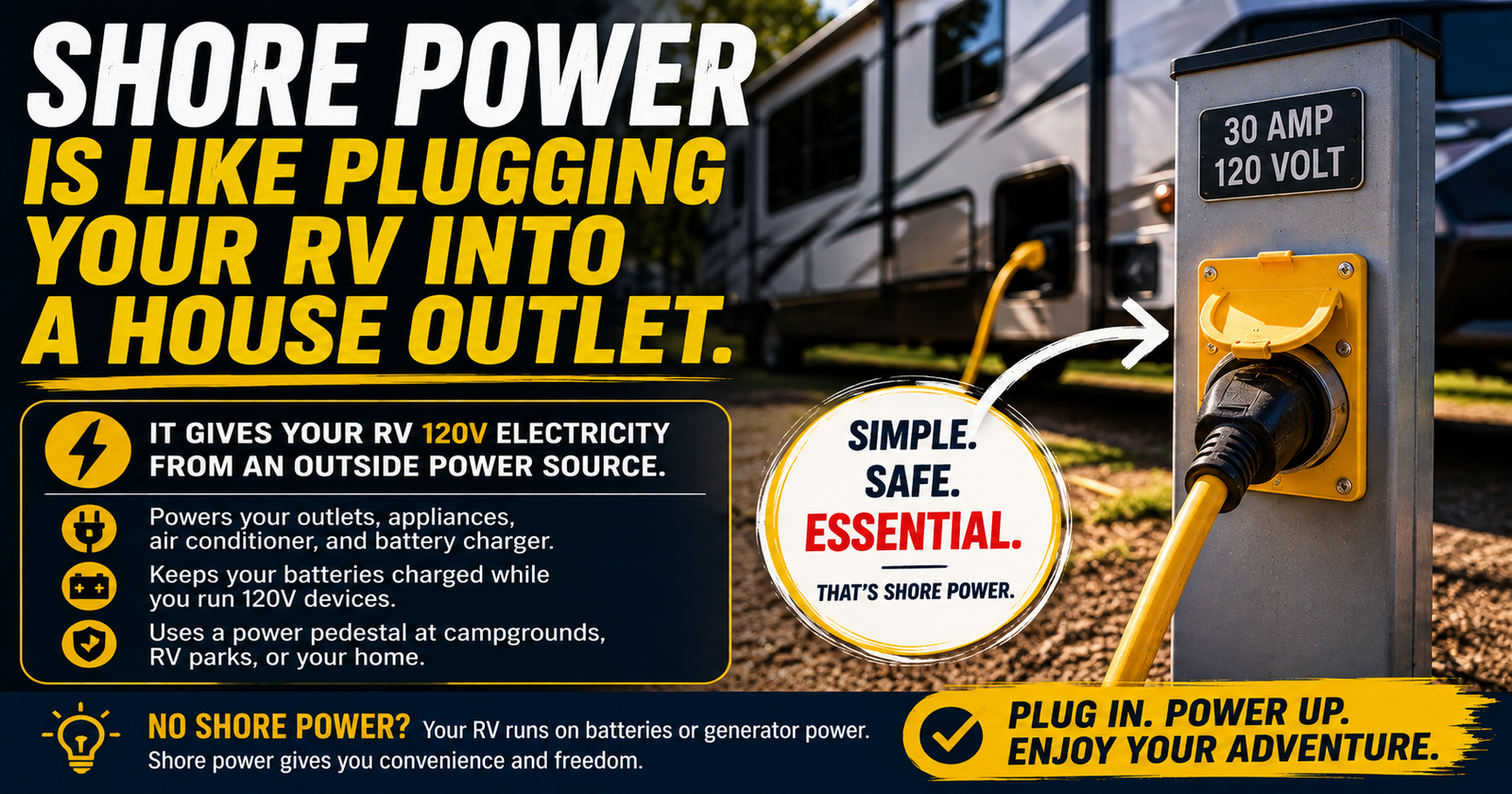
Your RV’s shore cord is the path carrying campground electricity into nearly everything AC-powered in the camper. If you’re still getting familiar with that system, our simple explanation of RV shore power shows exactly where that electricity goes after you plug in.
A slightly warm cable under a substantial load doesn’t automatically scare me.
A hot plug, melting connector, burned blade, or electrical smell does.
Find where the heat is concentrated, reduce or disconnect the load, inspect both sides of that connection, and don’t keep using damaged equipment just because the breaker hasn’t tripped.
That’s one shore-power warning I’d rather catch early.
Written by Evan Mercer
Evan Mercer writes about RV electrical systems, shore power, campground hookups, batteries, converters, and practical camper troubleshooting for CamperAnswers.com. He focuses on helping RV owners understand the warning signs their campers give them before a small electrical problem turns into a much more expensive one.