
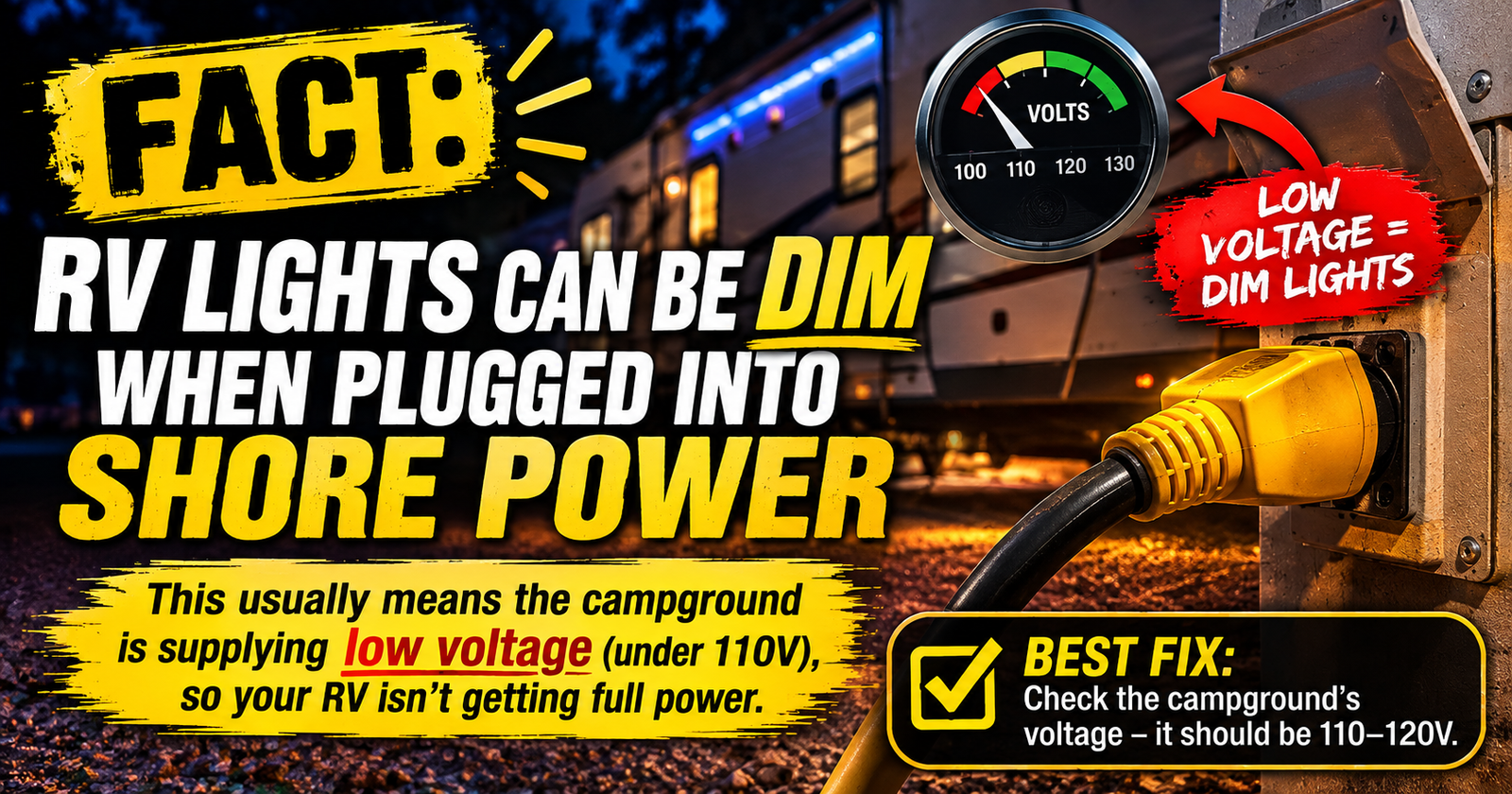
Plugging your RV into shore power should be the moment you stop worrying about weak 12-volt power. So when the camper is plugged in but the interior lights are still dim, something doesn’t add up.
I wouldn’t start by replacing the lights.
Those dim lights may be giving you one of the easiest clues you’ll ever get about what’s happening in the RV’s 12-volt electrical system.
Your converter should normally be supplying DC power while shore power is available and supporting the battery charging system. If that isn’t happening properly, the camper may still be leaning heavily on the house battery. As battery voltage drops, certain 12-volt lights can get noticeably dimmer.
But that’s only one possibility.
An overloaded converter can do it. Low converter output can do it. A weak battery can complicate things. Voltage drop through wiring or a bad connection can do it. And if the converter isn’t actually receiving AC power, being “plugged in” doesn’t necessarily mean the converter is doing anything at all.
So before chasing light fixtures around the ceiling, I want to know what voltage the RV’s 12-volt system is actually seeing.
Should RV Lights Be Brighter When Plugged Into Shore Power?
Depending on the lights and electrical system, you may notice some difference.
A resting 12-volt lead-acid battery might be somewhere around the mid-12-volt range when charged and disconnected from charging sources.
A converter/charger can raise system voltage above that while it’s operating.
Modern LED fixtures may not show a dramatic brightness change across every normal voltage variation, but if your lights become obviously dim while you’re supposedly connected to shore power, I’d investigate.
Especially if they continue getting dimmer.
That can be a sign that the battery is actually discharging.
First Check Whether Your Converter Is Working
This is where I’d start.
The campground pedestal may have power.
Your microwave clock may work.
The air conditioner may run.
Your receptacles may have 120 volts.
And your converter can still have a problem.
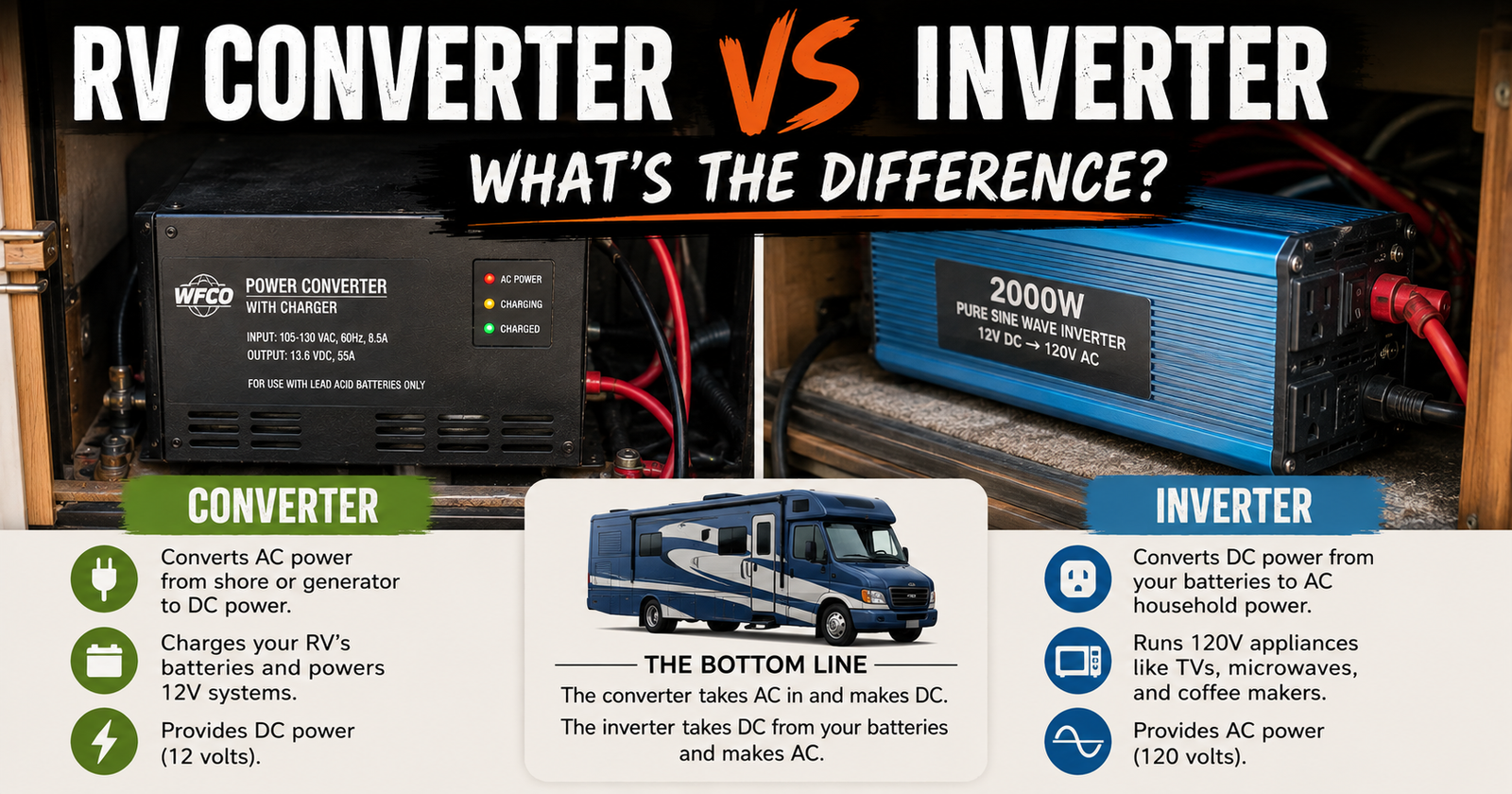
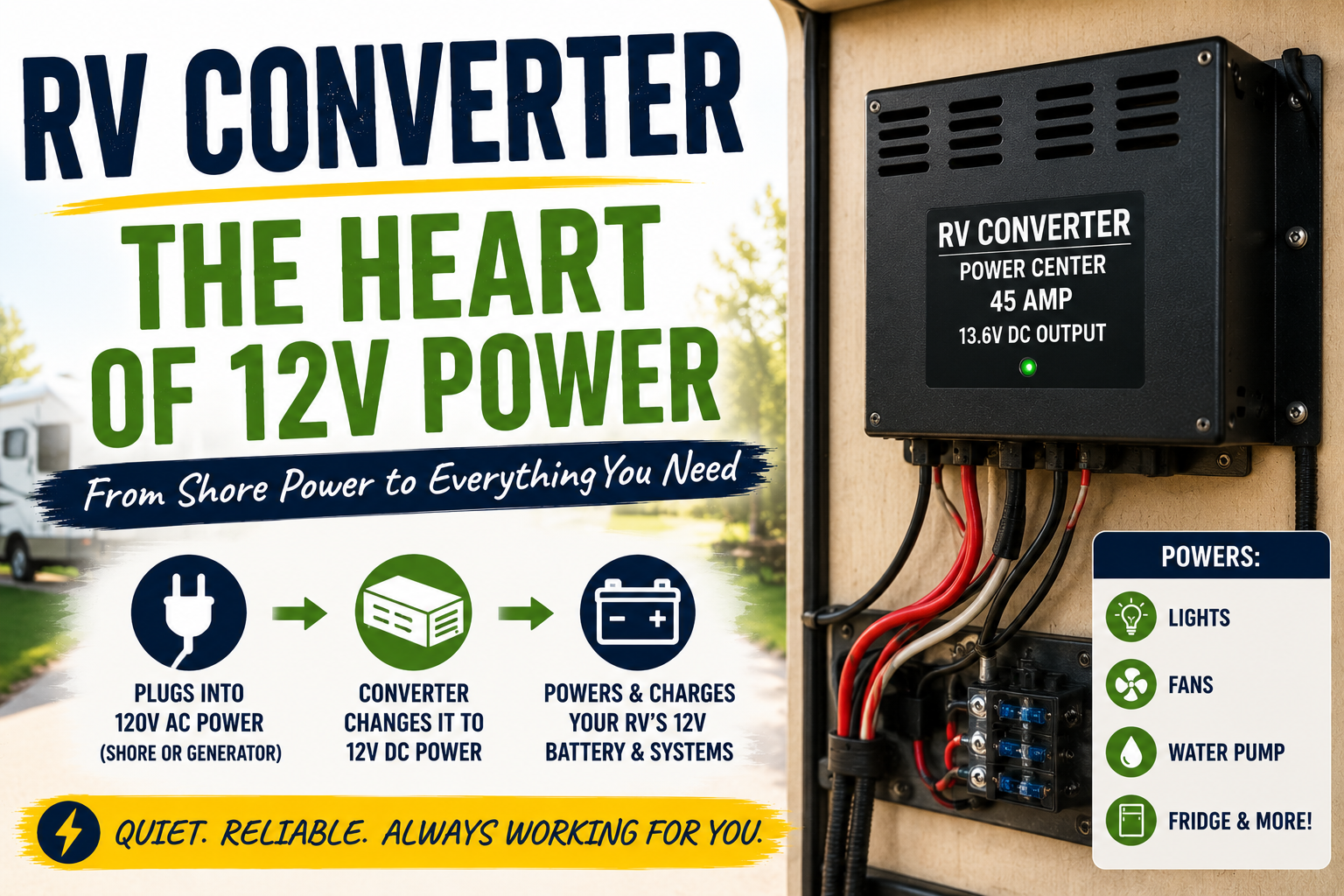
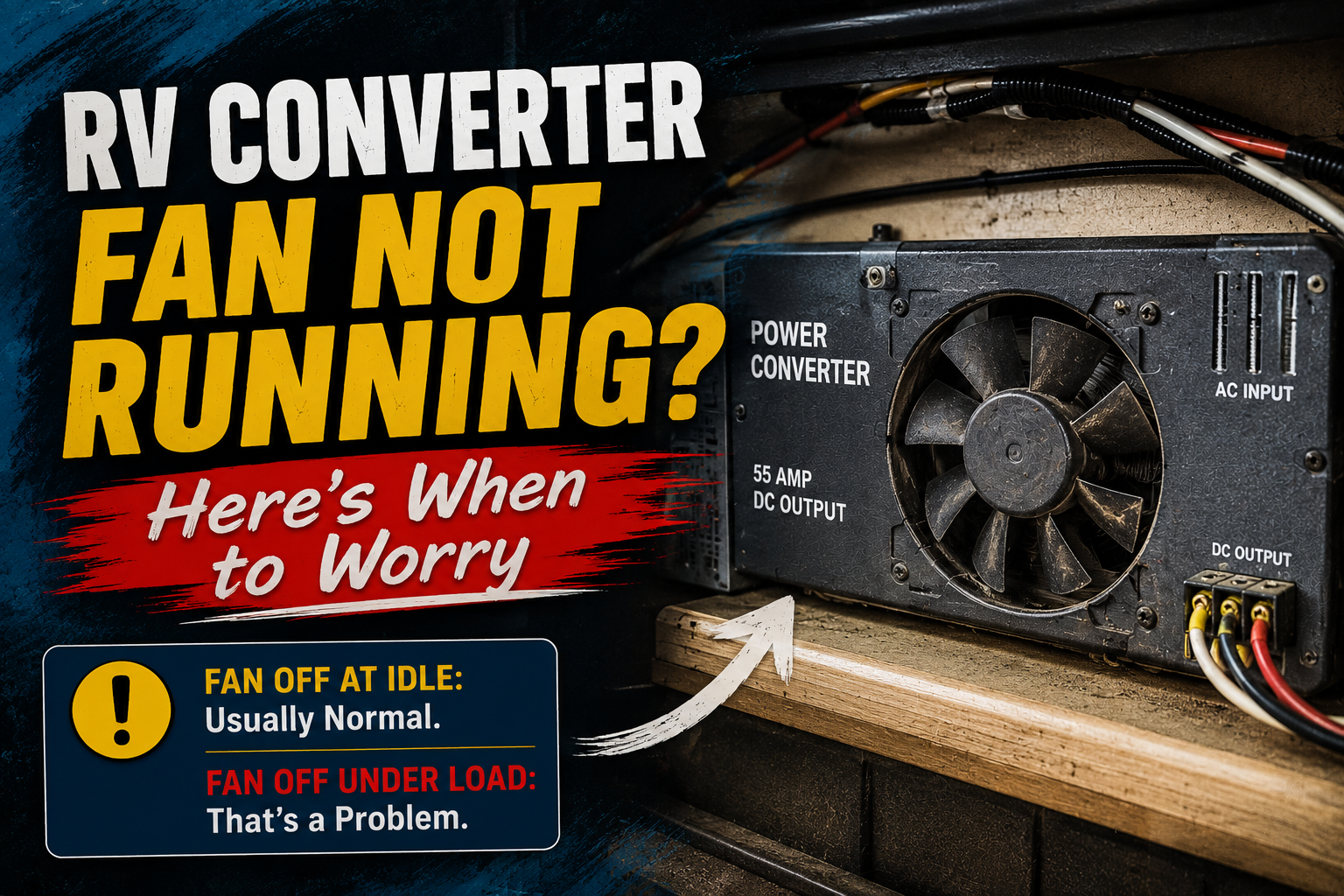
Remember that the converter is taking AC power and producing the DC power your 12-volt system needs.
Progressive Dynamics describes the converter’s basic job as supplying 12-volt power for RV lights and appliances while 120-volt AC power is available, while also recharging the battery.
If the converter isn’t doing that job, your 120-volt equipment and 12-volt equipment can behave very differently.

Your RV Can Have AC Power and Still Have a DC Problem
This confuses a lot of newer camper owners.
Plugging into shore power doesn’t turn everything inside the RV into 120-volt equipment.
Plenty of camper equipment still depends on the 12-volt DC system.
So you could have perfectly functioning wall outlets while the ceiling lights are dim.
That’s not contradictory.
It tells us to look at the DC side.
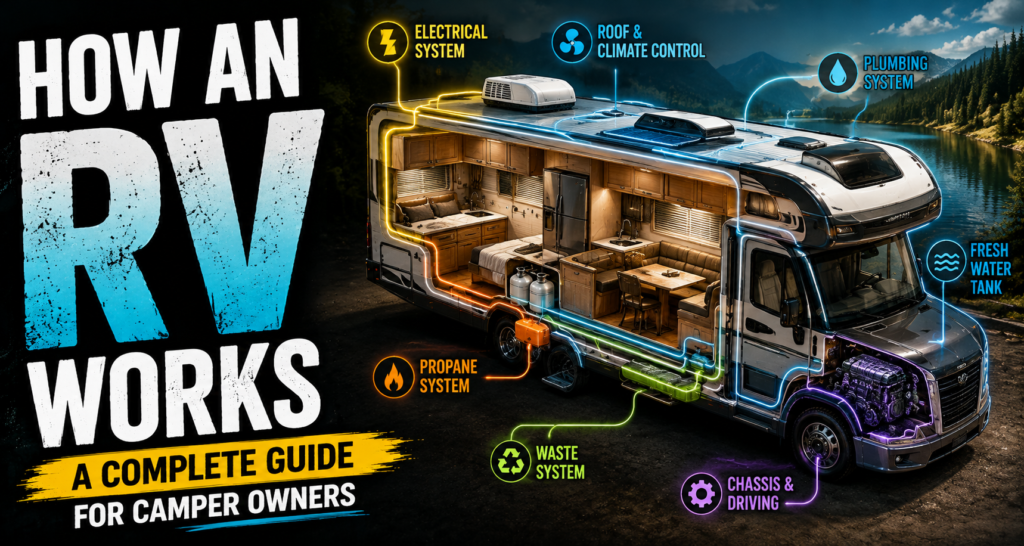
If the whole AC-versus-DC setup still feels confusing, our broader guide to how an RV’s electrical and other major systems work is a good starting point.
Get a Multimeter Before You Start Guessing
For this problem, a cheap digital multimeter can save you from replacing a bunch of perfectly good parts.
I want voltage readings.
Check battery voltage.
Check what happens when shore power is connected.
If you’re qualified to perform the manufacturer’s converter test, check converter output too.
Progressive Dynamics recommends a digital voltmeter as part of basic converter diagnosis, and WFCO likewise uses direct voltage measurements throughout its converter troubleshooting procedures.
The lights are showing you the symptom.
The meter helps tell you why.
Check Battery Voltage Before Plugging In
Start by seeing where the battery stands.
If you’re checking resting battery voltage for battery-condition purposes, remember that recent charging or loads can affect the reading.
But we’re mainly looking for the bigger picture here.
Is the battery already severely discharged?
Is it somewhere around a normal charged range?
Is it suspiciously low?
Write the number down.
Then connect shore power and see what changes.
Battery Voltage Should Usually Rise When the Converter Charges
Once the converter is operating and charging the battery, I’d generally expect battery-terminal voltage to rise above the battery’s uncharged resting voltage.
Exactly what you see depends on the converter, battery chemistry, charging mode, load, wiring, and other factors.
For example, current WFCO converter documentation shows charging outputs in roughly the 13.6 to 14.6-volt range on one modern series, depending on operation and battery type.
Don’t take those exact numbers and apply them blindly to every converter ever installed.
The important question right now is:
Did plugging into shore power produce a meaningful charging-voltage change at the battery?
What If Battery Voltage Doesn’t Change?
Now we’ve found something worth chasing.
Suppose the battery reads 12.2 volts.
You plug the RV into shore power.
Wait.
Still 12.2.
The lights remain dim.
That doesn’t prove the converter itself is dead, but it strongly suggests the battery isn’t seeing the charging voltage we’d expect.
Now I’d start checking the charging path.
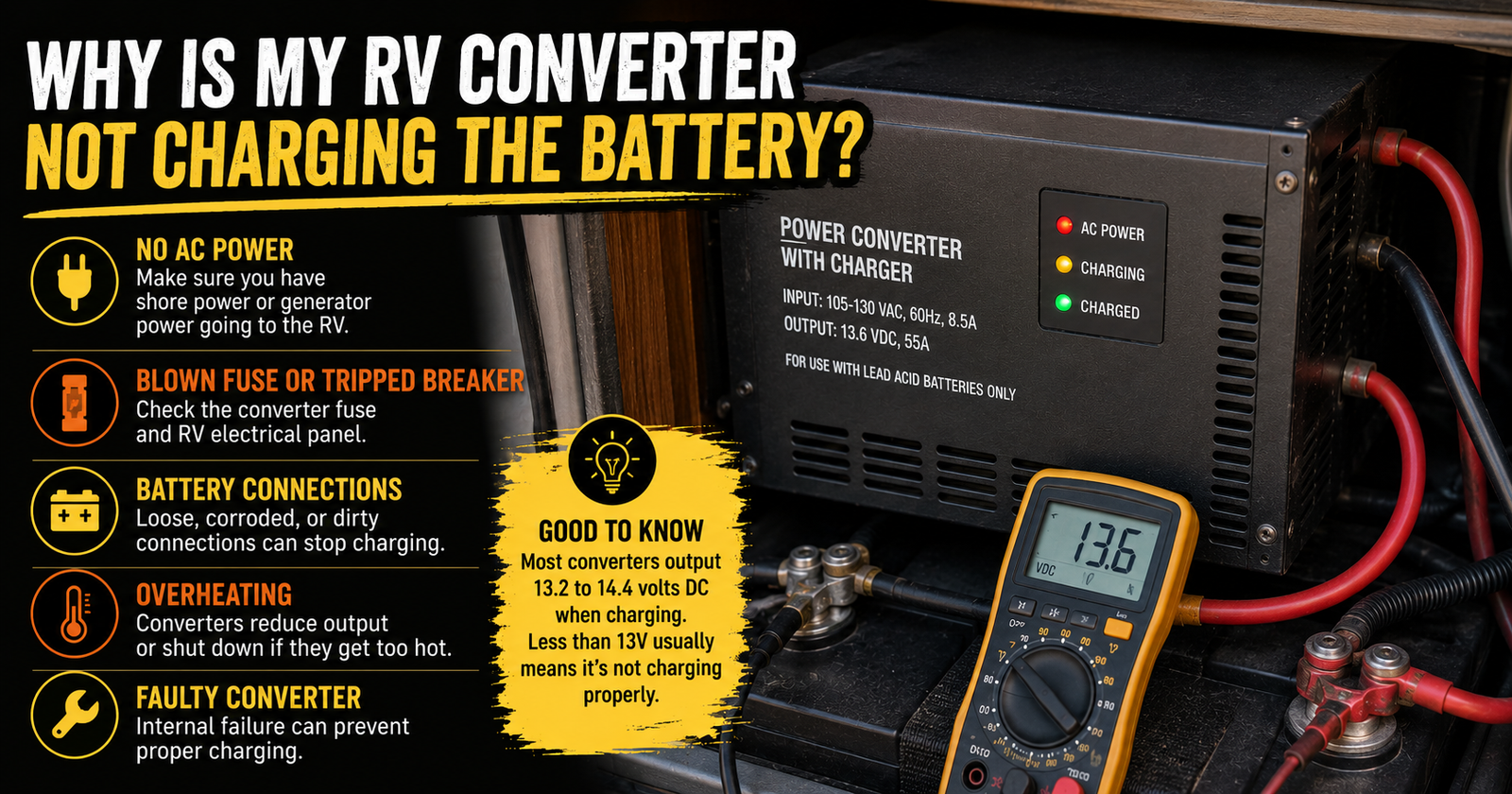
We’ve already built a dedicated troubleshooting guide for an RV converter that isn’t charging the battery.
That may be the better path than messing with individual light fixtures.
Make Sure the Converter Actually Has AC Power
Don’t overlook the obvious stuff.
Find the converter or power center.
Check the breaker that supplies it.
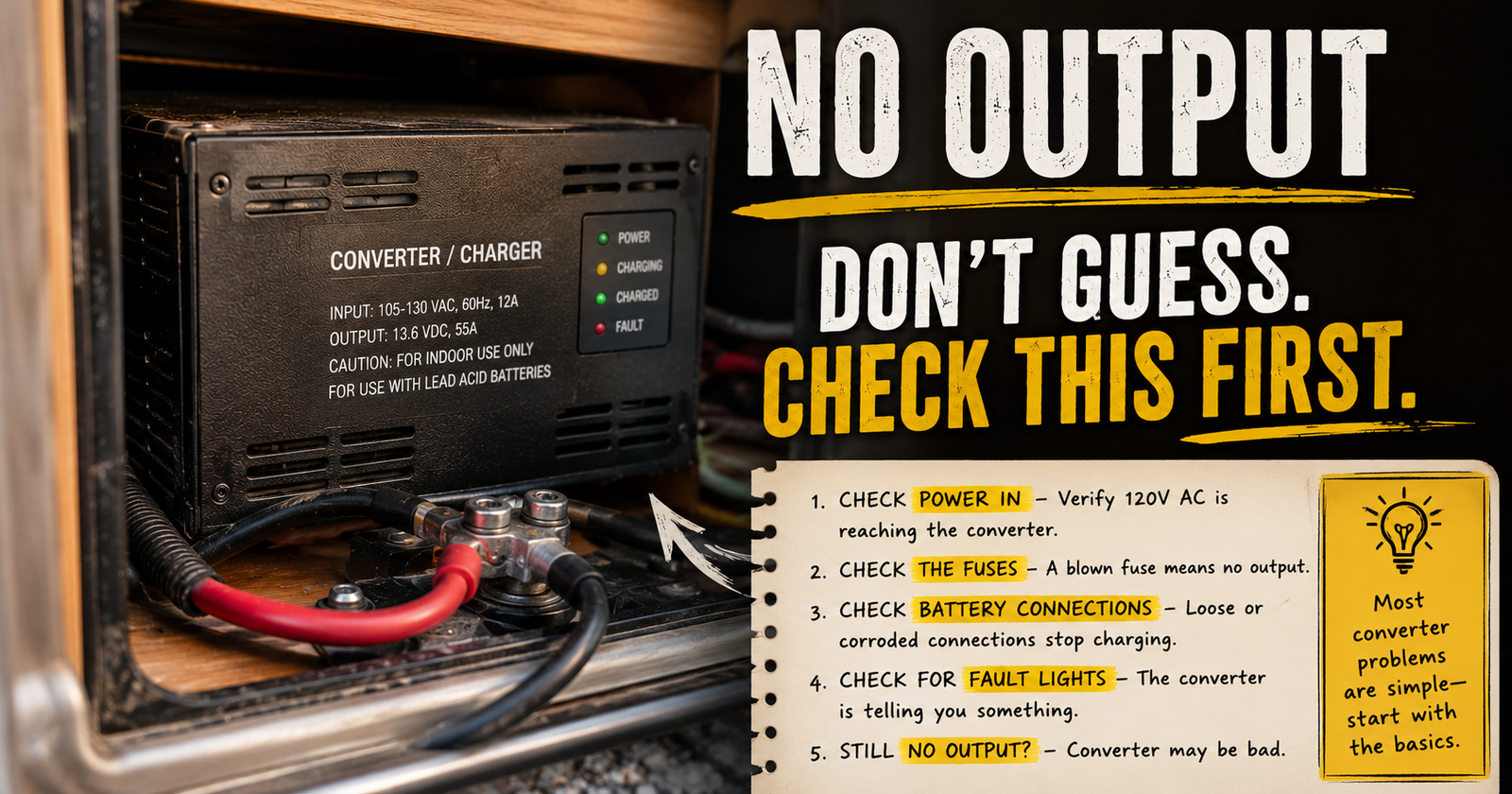
A tripped converter breaker can leave you in a weird situation where other AC equipment in the camper still works but the converter doesn’t.
Progressive Dynamics’ troubleshooting procedure specifically starts by checking the 120-volt circuit breaker supplying the converter and verifying AC power is actually available at the converter.
That’s why “the RV is plugged in” isn’t enough information.
We need to know whether the converter is powered.

What If the Converter Breaker Is Tripped?
Don’t immediately assume the breaker itself is bad.
Resetting a breaker once after identifying and correcting an obvious reason may be appropriate according to the equipment instructions.
But if it immediately trips again, stop.
On its PD9100 and PD9200 converters, Progressive Dynamics says an AC breaker that immediately retrips during its specified troubleshooting procedure points to a bad converter that needs replacement.
That’s model-specific guidance, so check the documentation for yours.
Don’t repeatedly force a tripping circuit back on.
Check the Converter’s Output
If AC power is reaching the converter but the DC side is still weak, converter output becomes our next big clue.
Your exact testing procedure depends on the model.
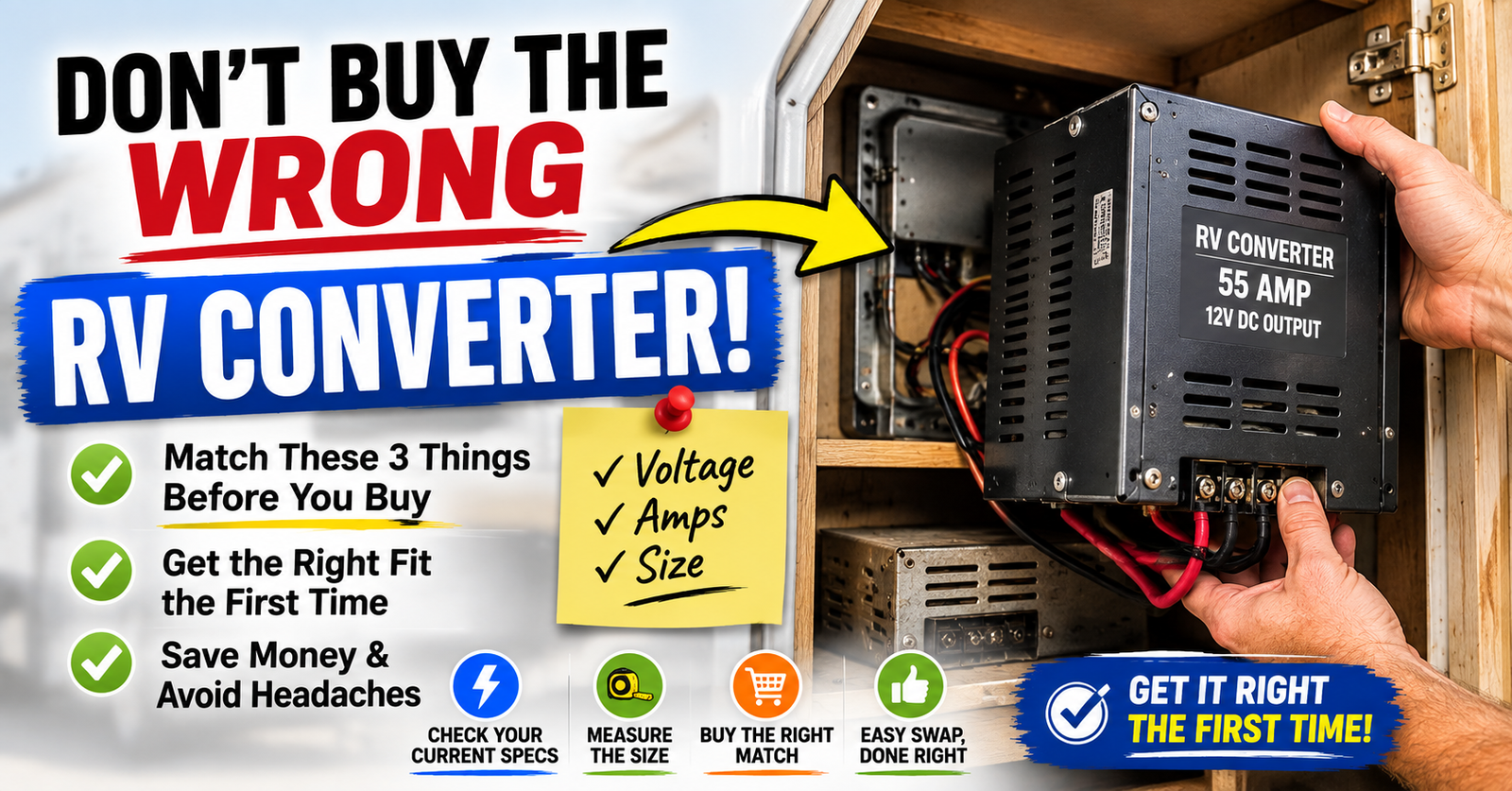
For example, Progressive Dynamics specifies approximately 13.6 volts DC, plus or minus 0.3 volts, during its particular no-load output test for standard PD9100 and PD9200 models. WFCO’s current WF-68100-AD documentation specifies 13.6 to 14.6 volts during its converter test.
Those aren’t universal numbers.
Use the specification for your converter.
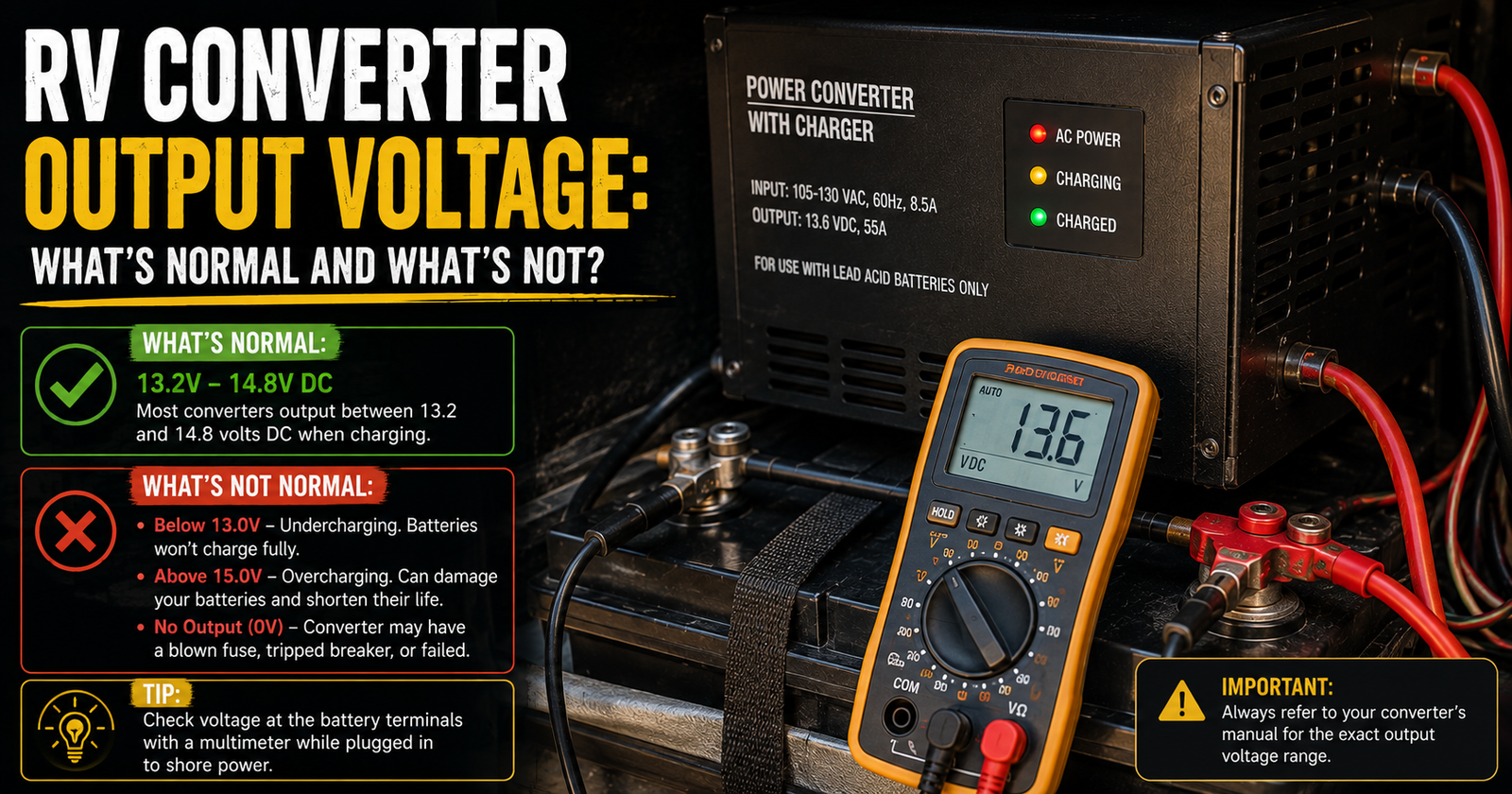
Our RV converter output voltage guide explains this in much more detail.
Good Converter Output but Low Voltage at the Battery?
Now things get interesting.
Let’s say the converter tests correctly.
But the battery still isn’t receiving appropriate charging voltage.
That means I’d start looking between the converter and battery.
Depending on the RV, that path can include:
Battery disconnect equipment.
Fuses.
Circuit breakers.
Connections.
Wiring.
Ground connections.
Manufacturer-installed inline protection.
WFCO specifically tells owners to check for an open inline fuse in the battery circuit and loose wiring when converter output exists but the battery isn’t charging correctly.
That’s why replacing a good converter wouldn’t fix the problem.
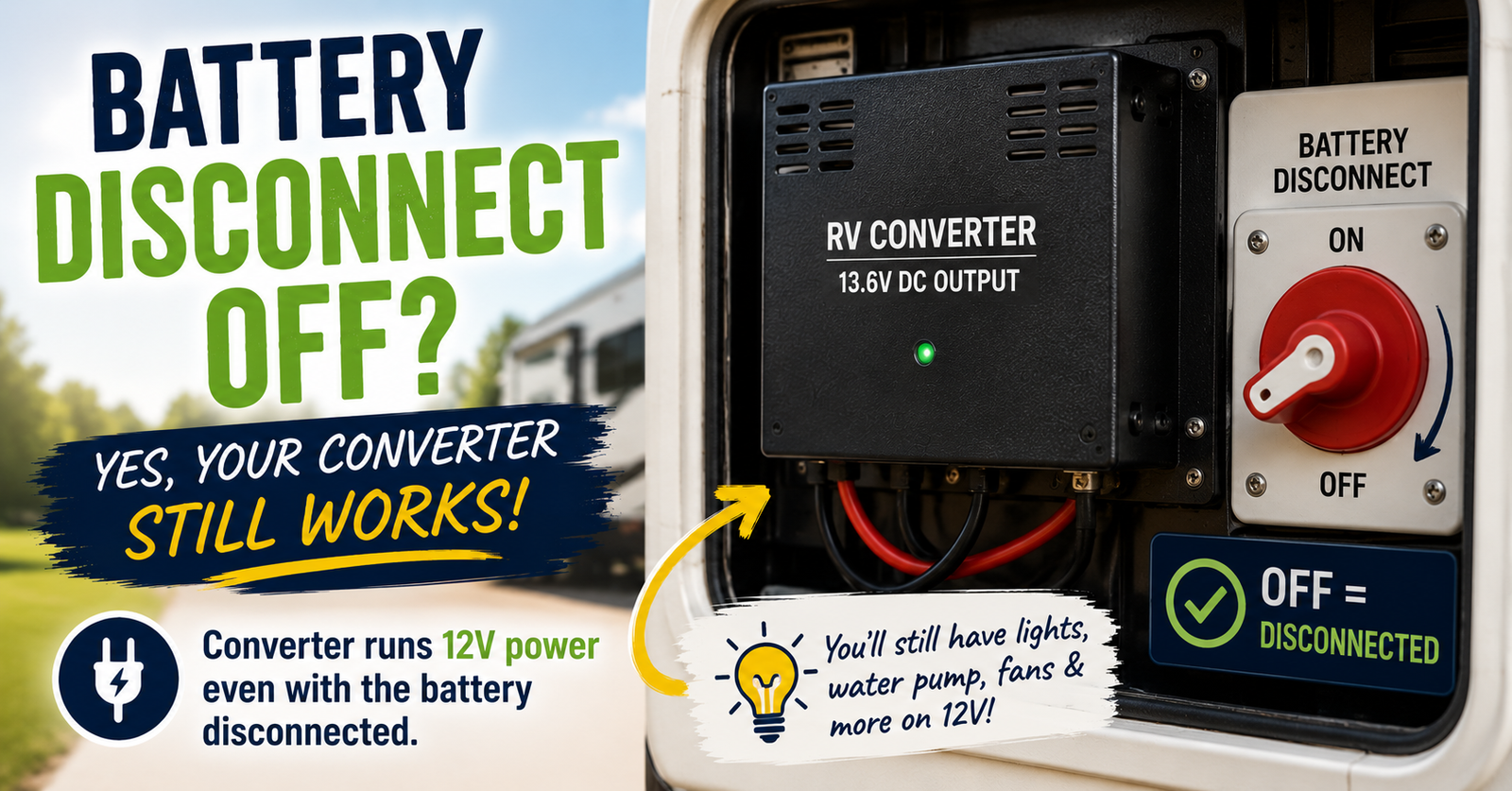
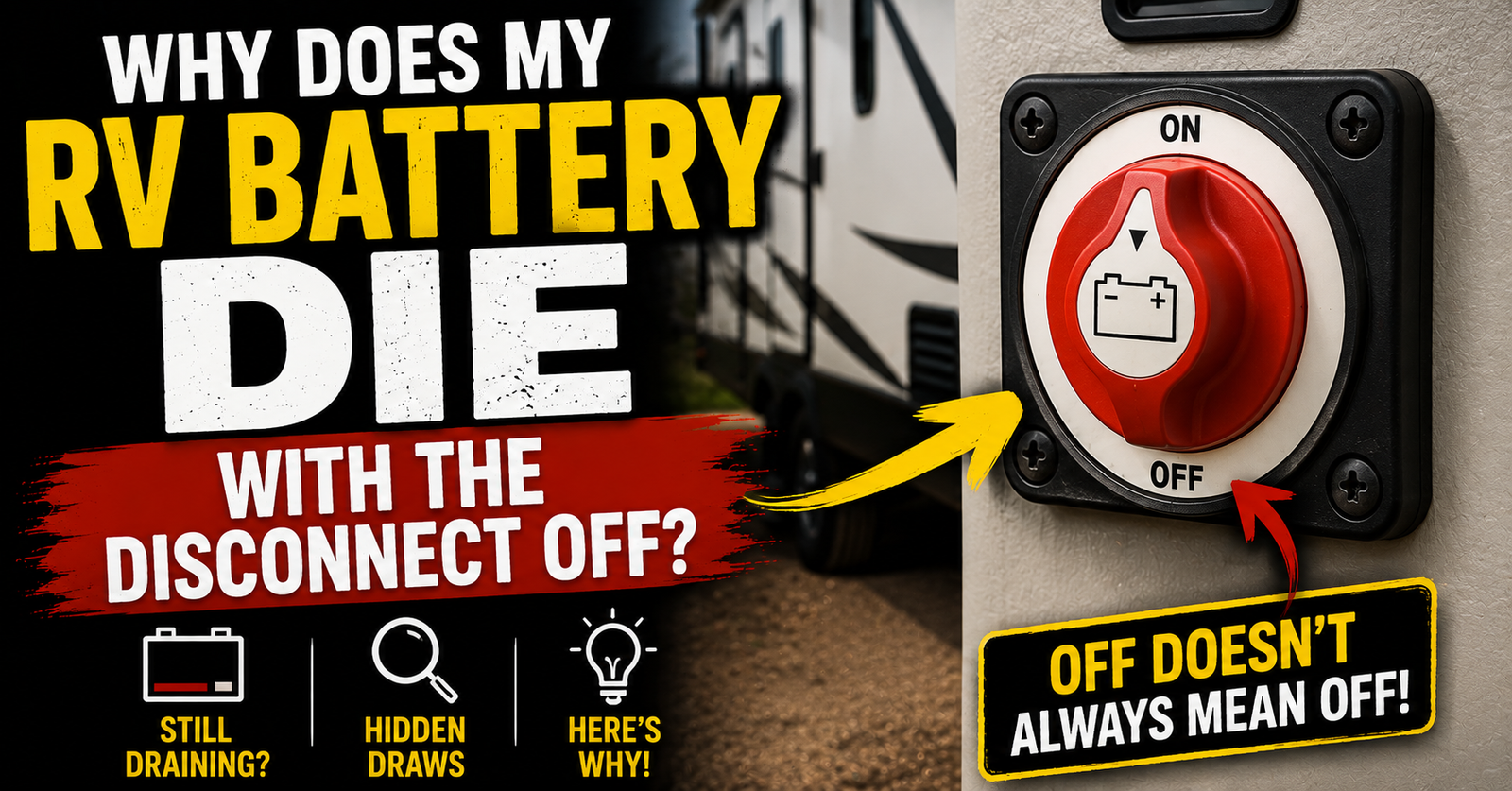
Check the Battery Disconnect
This one catches people all the time.
The exact way an RV’s battery disconnect is wired varies, so I don’t like making blanket statements about every camper.
But a disconnect in the wrong position can interfere with the battery’s connection to portions of the DC system or charging path, depending on how the manufacturer designed it.
If the problem started after storage, battery service, or somebody flipping switches around, verify the disconnect position.
And don’t trust the label blindly if you’re dealing with a used RV that’s been modified.
Look for an Inline Battery Fuse or Breaker
Some RVs have circuit protection between the converter and battery that isn’t immediately obvious.
It may be near the battery.
Under the tongue.
Inside a compartment.
Mounted near the power center.
WFCO’s troubleshooting instructions specifically mention that an RV manufacturer may have installed an inline fuse in the battery-wire circuit.
If that protection opens, the converter may work while the battery doesn’t receive the charge you’re expecting.
Loose Connections Can Create Voltage Drop
Here’s where a system can technically still be connected but perform badly.
A loose or corroded connection adds resistance.
Under load, that resistance can produce voltage drop.
Now the converter may be producing healthy voltage at one end of the camper while the lights see something considerably worse at the other end.
This is why voltage measurements at multiple points can be so useful.
You’re looking for where the voltage disappears.
Check the Ground Side Too
People naturally chase positive wires.
Don’t forget the negative side.
A poor ground connection can cause weak or erratic 12-volt operation too.
Inspect accessible battery terminals and ground connections with the system safely isolated.
Look for corrosion, looseness, damaged conductors, heat damage, or questionable previous-owner repairs.
A circuit needs a complete path.
The positive side isn’t the whole story.
What If Only One RV Light Is Dim?
That’s different.
If every 12-volt light in the camper looks normal except one fixture, I’m much less suspicious of the converter.
Now I’d look locally.
The fixture.
Bulb or LED assembly.
Switch.
Connector.
Ground.
Wiring feeding that particular light.
Converter problems tend to affect the broader DC system rather than magically selecting one ceiling light to annoy you.
What If All the Lights Are Dim?
Now system voltage becomes much more interesting.
Especially if other 12-volt equipment seems weak too.
Maybe the water pump sounds slower.
Vent fans don’t spin as fast.
The furnace blower sounds lazy.
Lights are dim throughout the camper.
That’s when I’d stop thinking “bad light bulb” and start thinking low DC voltage.
Measure it.
What If the Lights Slowly Get Dimmer While I’m Plugged In?
This is one of the biggest clues in the article.
If the lights gradually get dimmer over several hours even though shore power remains connected, the battery may be discharging because the converter isn’t replacing the energy the RV is using.
Eventually the battery gets low enough that you notice.
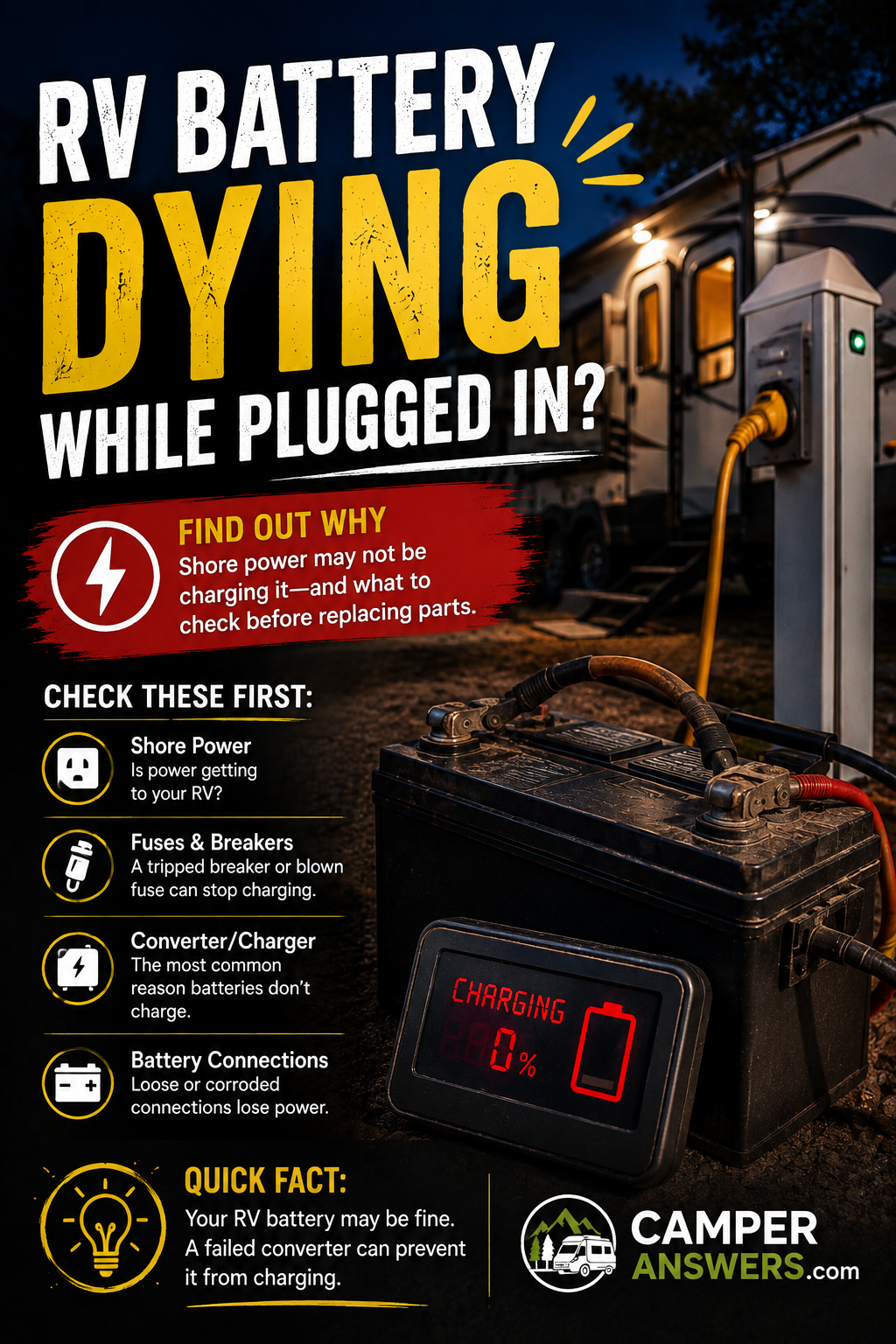
This is closely related to the problem we covered in why an RV battery can die while plugged into shore power.
The dim lights may simply be the first visible warning.
An Overloaded Converter Can Make Lights Dim
Here’s another possibility.
The converter may be working.
You’re simply asking too much from it.
WFCO’s troubleshooting material specifically says dimming lights can indicate that the converter is overloaded or that the coach is running from the batteries. It recommends reducing 12-volt loads and checking converter output.
That’s a pretty useful troubleshooting clue straight from a converter manufacturer.
So look around the RV.
What’s turned on?
Turn Off Some 12-Volt Loads
Try reducing unnecessary DC demand.
Interior lights.
Vent fans.
Other optional 12-volt equipment.
Don’t turn off anything required for safe operation.
Then watch the remaining lights.
Do they brighten?
Does system voltage rise?
Does converter behavior change?
If reducing load noticeably improves things, we’ve learned that current demand is part of the problem.
A Nearly Dead Battery Can Be a Huge Load Too
Don’t forget that charging the battery consumes converter capacity.
WFCO notes that a battery can draw 30 amps or more from the converter under some conditions.
So imagine a converter trying to recharge a deeply discharged battery while also supplying a camper full of active 12-volt equipment.
That’s a very different workload from maintaining a charged battery with two LED lights turned on.
Battery state matters.
What If the Lights Are Dim Only Right After Plugging In?
I’d watch what happens as the battery charges.
If the battery was heavily discharged, the converter may initially be under substantial load.
As the battery recovers and charging current changes, the rest of the DC system may settle down.
If everything returns to normal, that’s useful.
If the lights stay weak indefinitely and battery voltage never reaches an appropriate charging level, something else is wrong.
A Weak Battery Can Complicate the Diagnosis
Don’t assume every battery that reads 12-something volts is healthy.
A battery can have decent open-circuit voltage and terrible usable capacity.
It can collapse under load.
It can have a damaged cell.
It can simply be worn out.
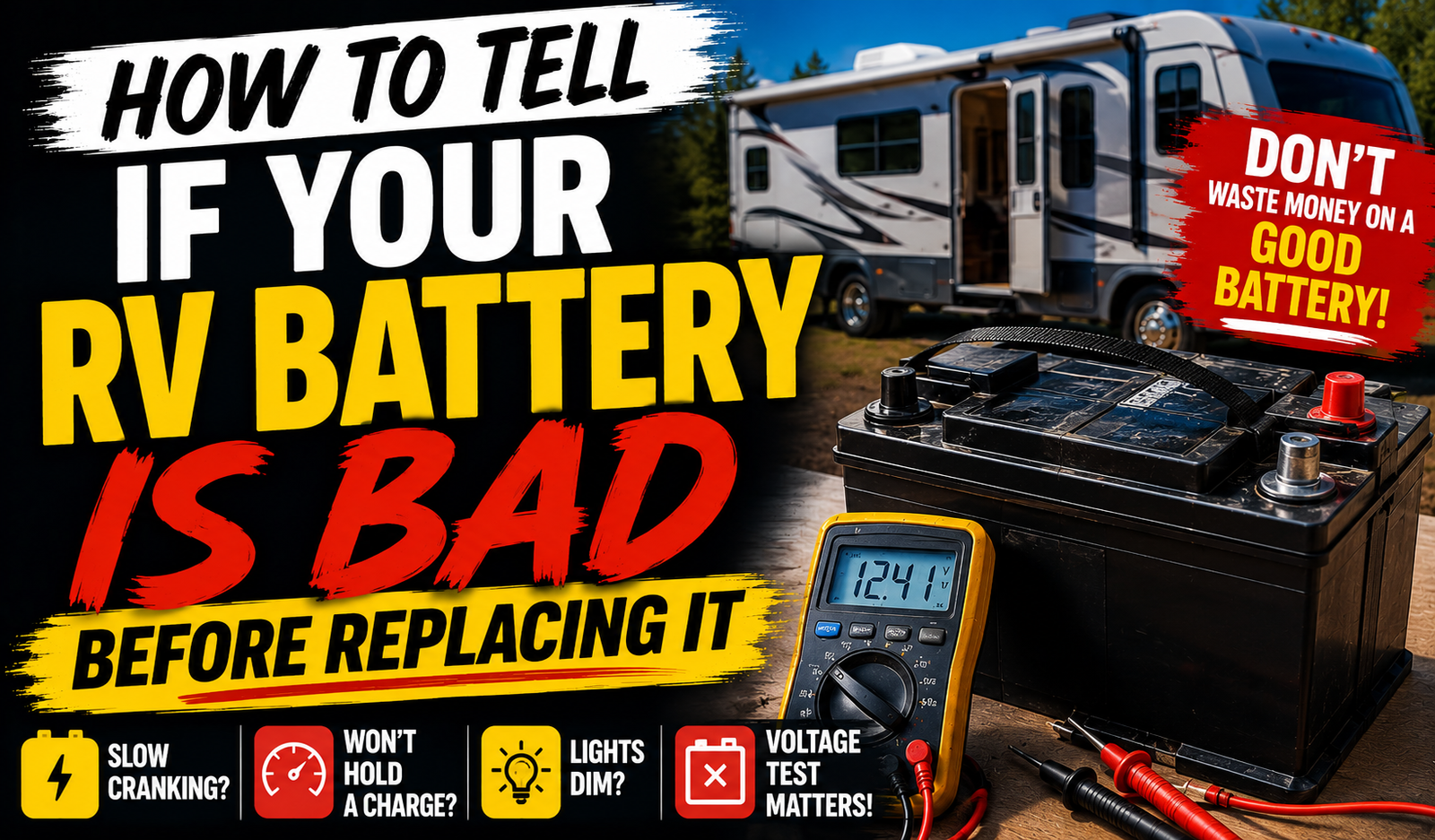
We’ve already covered how to tell whether an RV battery is actually bad.
Converter and battery problems can imitate each other surprisingly well.
What If My Battery Says Full but the Lights Still Dim?
Don’t trust the monitor panel as your final answer.
Those simple RV battery indicators usually aren’t sophisticated battery-capacity testers.
Voltage itself can also be misleading immediately after charging.

We’ve got a whole guide about an RV battery that says full but dies fast because this causes so much confusion.
Use actual measurements and battery testing.
What If the Lights Flicker Instead of Staying Dim?
That’s a slightly different symptom.
Flickering can point toward intermittent voltage, a loose connection, a failing component, a particular LED fixture problem, or converter behavior that needs investigation.
If the entire camper’s 12-volt lighting changes together, I want to see whether system voltage is moving at the same time.
If only one LED fixture flickers, I’m much more interested in that fixture and its local wiring.
Follow the scope of the symptom.
What If the Lights Go Bright, Dim, Bright, Dim?
Now I’d check whether the converter is actually cycling.
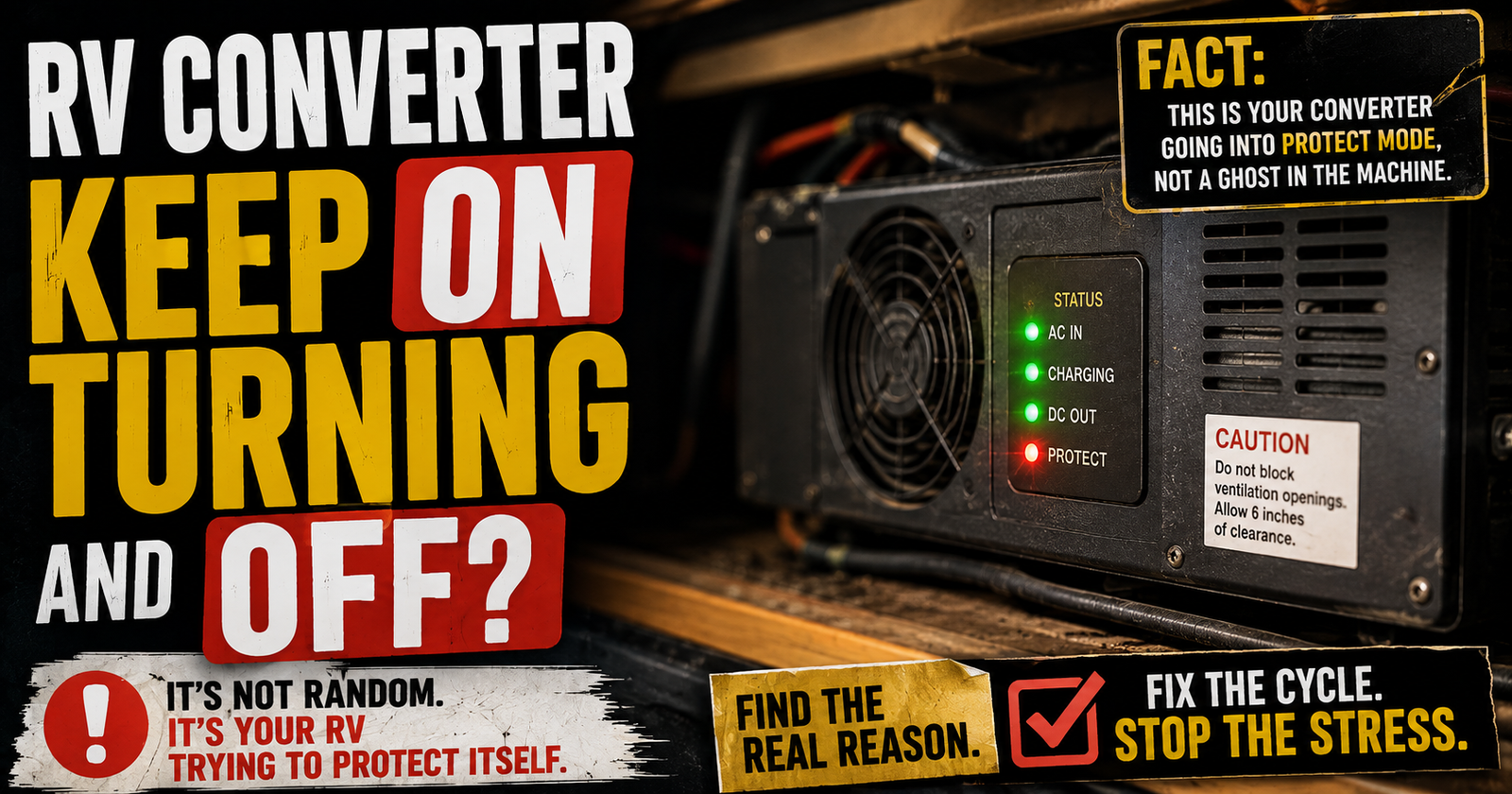
We just built a complete guide to why an RV converter keeps turning on and off.
If converter output disappears, the battery may temporarily take over the DC load.
Then the converter returns and system voltage rises again.
That can potentially create a noticeable change in lighting.
Put a meter on the system and see whether voltage changes with the lights.
Don’t Confuse Normal Charging-Mode Changes With Failure
Modern smart converters can intentionally change output voltage as the battery charges.
WFCO documentation for its three-stage converters describes Bulk, Absorption, and Float modes, with the target voltage changing as charging conditions change. It even notes that lights powered from converter output may change brightness slightly when the charging mode changes.
That’s important.
A slight brightness change during a charging-mode transition isn’t the same as the whole RV becoming obviously dim because DC voltage is collapsing.
Context matters.
Could the Converter Be Too Small?
Possibly, but don’t jump straight to an upgrade.
Converters are rated for a maximum output current.
If the camper’s DC demand repeatedly approaches that capacity, performance can be affected.
Progressive Dynamics says its PD9100 and PD9200 converters use current limiting and can shut down if loads exceed their designed capacity.
But before buying a larger converter, find out why demand is so high and whether the RV’s wiring can safely support a higher-output unit.
Bigger isn’t automatically better.
What If the Converter Gets Hot While the Lights Are Dim?
Now we’ve got two symptoms.
High converter load can generate heat.
Poor ventilation can make that worse.
A converter that’s overloaded, overheating, and struggling to maintain the DC system deserves closer attention.
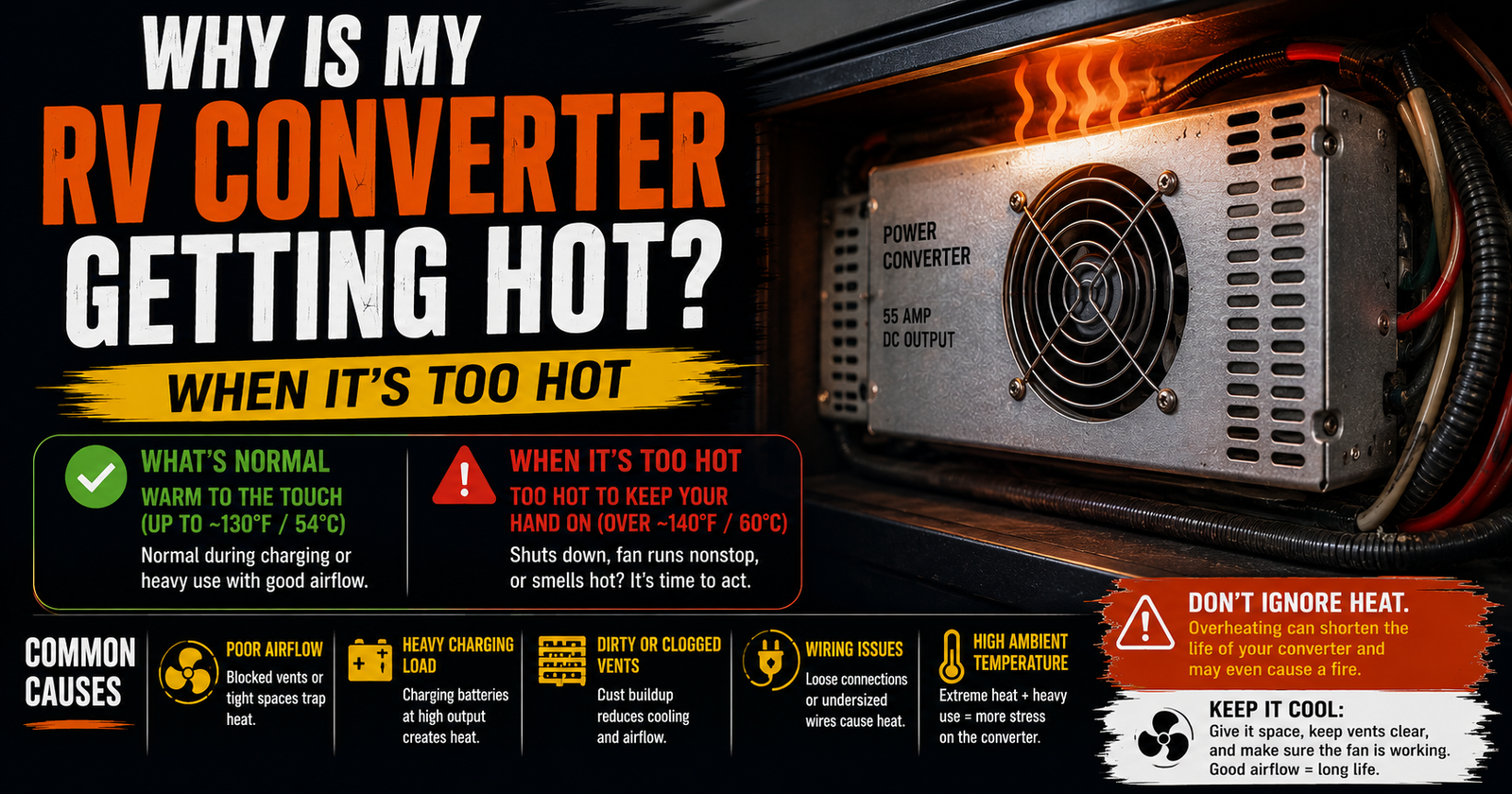
We’ve already covered when RV converter heat becomes excessive.
Combining symptoms helps us narrow the cause.
Listen to the Converter Too
Is the fan running hard?
Buzzing?
Clicking?
Rattling?
Cycling?
Those sounds don’t diagnose the problem by themselves, but they’re useful clues.
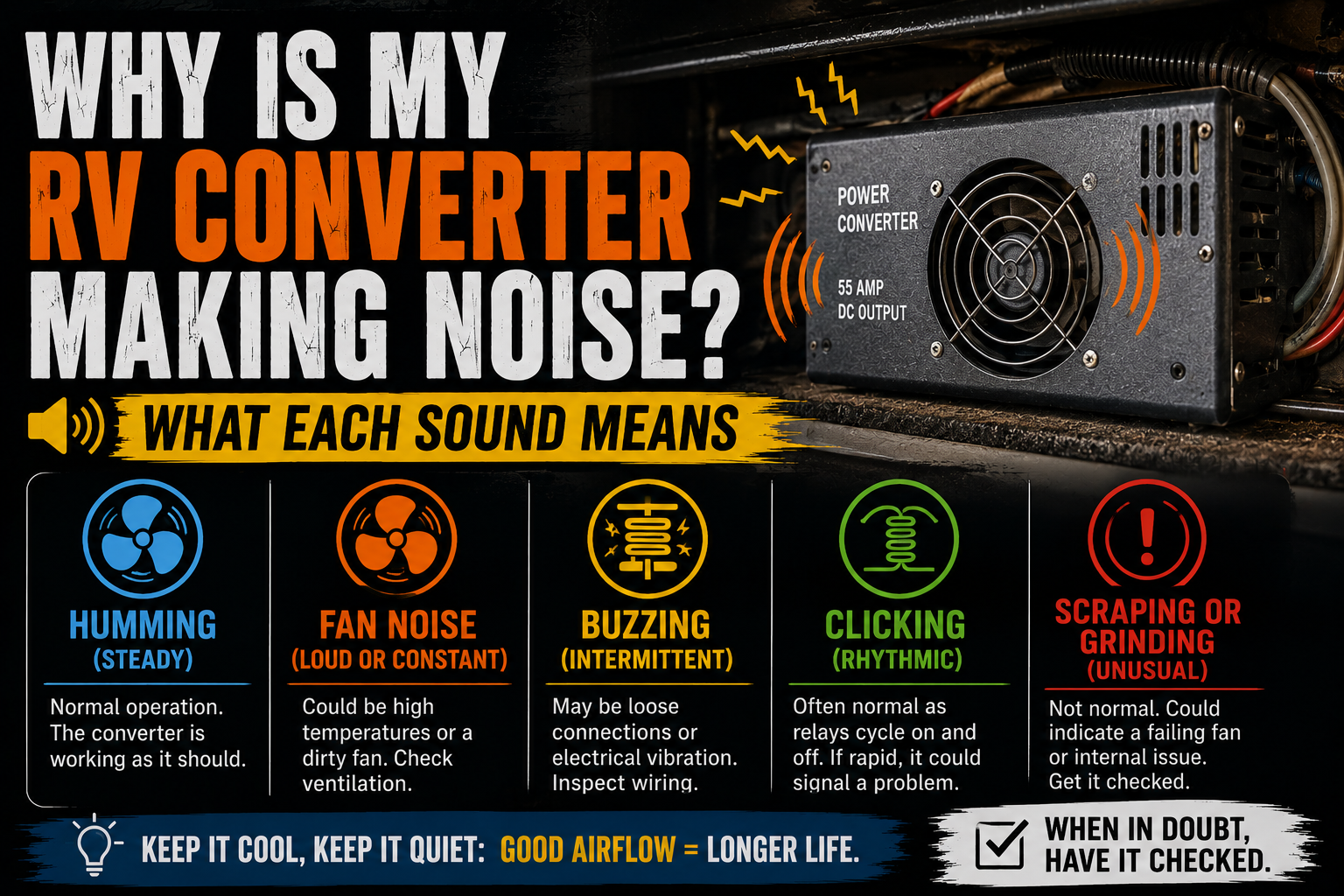
Our guide to what different RV converter noises can mean can help separate ordinary cooling noise from something that deserves more investigation.
The more clues we collect, the less guessing we have to do.
What If the Converter Smells Burnt?
Stop normal operation and investigate.
Dim lights aren’t worth risking overheated electrical equipment.
A burnt-plastic, burning-wire, or overheated-electronics smell changes the urgency of the situation.
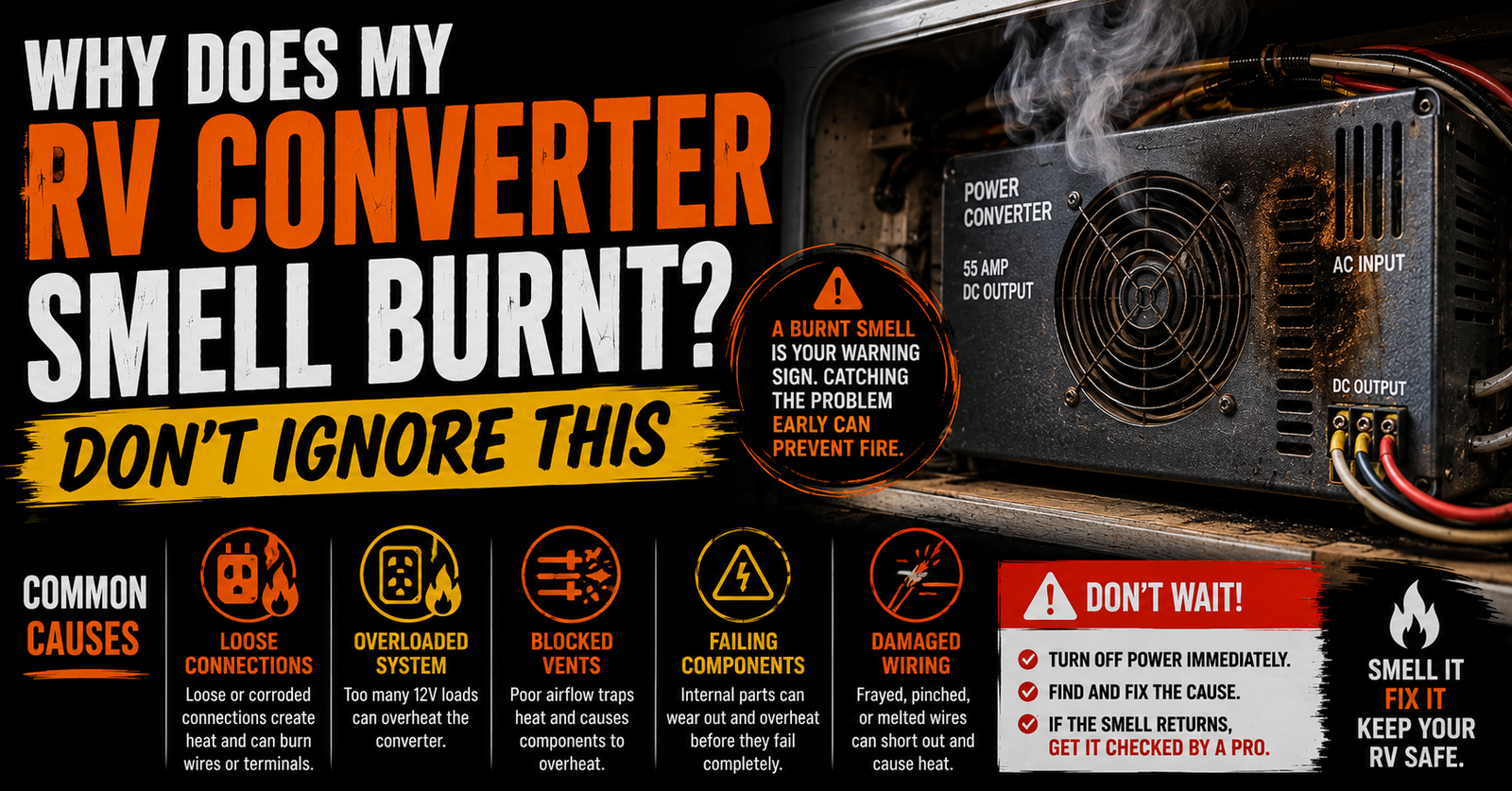
We’ve got a separate guide for an RV converter that smells burnt because I don’t recommend repeatedly powering up something that’s giving you an electrical-burning warning.
Find the source first.
What If the Lights Are Fine on Battery but Dim on Shore Power?
That’s a fantastic clue.
It tells us the battery can apparently supply the DC system better than whatever is happening when shore power and converter operation enter the picture.
Now I’d check converter output and system voltage carefully.
Depending on the RV’s design, there may also be relays or other equipment involved.
Older converter systems can operate very differently from modern electronic converter/chargers. Progressive Dynamics’ documentation for older equipment, for example, describes systems using a relay to switch RV branch circuits between battery and converter power.
Identify what equipment you actually have before applying modern-converter assumptions to a 30-year-old camper.
What If They’re Bright on Shore Power but Dim on Battery?
That’s the opposite clue.
Now the converter may be doing its job just fine.
I’d investigate the battery and its connection to the DC system.
Weak battery.
Poor battery terminal connection.
Bad ground.
Battery disconnect issue.
Wiring problem.
Low state of charge.
That’s much more of a battery-side problem than a “dim while plugged in” problem.
Shore Power Quality Still Matters
The converter needs acceptable AC input to operate properly.
For example, WFCO specifies a live 105 to 130 VAC source during troubleshooting of its current WF-68100-AD converter.
Your converter may specify a different range.
If the problem happens only at one campground, don’t ignore the pedestal or incoming AC supply.
Changing locations and changing symptoms is valuable information.
What If It Only Happens on Generator Power?
Same idea.
If the lights are perfect on campground shore power but dim or fluctuate when the generator is supplying the RV, investigate the generator side too.
Don’t automatically replace the converter because it reacts differently to a different AC source.
Check generator voltage and stability according to the generator manufacturer’s procedures.
The power feeding the converter matters.
Don’t Start Replacing Lights
This is probably the biggest practical point.
If one light is dim, investigate the light.
If every 12-volt light in the RV is dim, don’t replace twelve bulbs.
They’re probably telling you about the electrical system feeding them.
That’s actually useful.
The camper is giving you a giant visual voltage indicator.
Take advantage of it.
The Fastest Way I’d Troubleshoot This
I’d begin at the battery with a meter.
See what voltage is there before shore power.
Plug in.
See what changes.
Then determine whether the converter has AC input and proper DC output.
If converter output is good but voltage isn’t making it to the battery or DC system, follow the wiring and protection between them.
If converter output itself is low, investigate converter load and condition.
If reducing 12-volt loads makes the lights noticeably brighter, investigate excessive demand.
And if the converter tests correctly but the battery collapses whenever it’s asked to do anything, investigate the battery.
That’s a much cleaner process than replacing things until the lights get bright again.
When I’d Start Suspecting a Bad Converter
The converter moves high on my list when it has proper AC input but repeatedly fails its manufacturer’s DC-output test.
Especially if you’ve already ruled out overloads and followed the proper test procedure.
Progressive Dynamics’ PD9100/PD9200 troubleshooting guidance says that if proper AC power is present and the converter still has zero output after the required checks, the converter is bad and should be replaced.
Your converter’s procedure may differ.
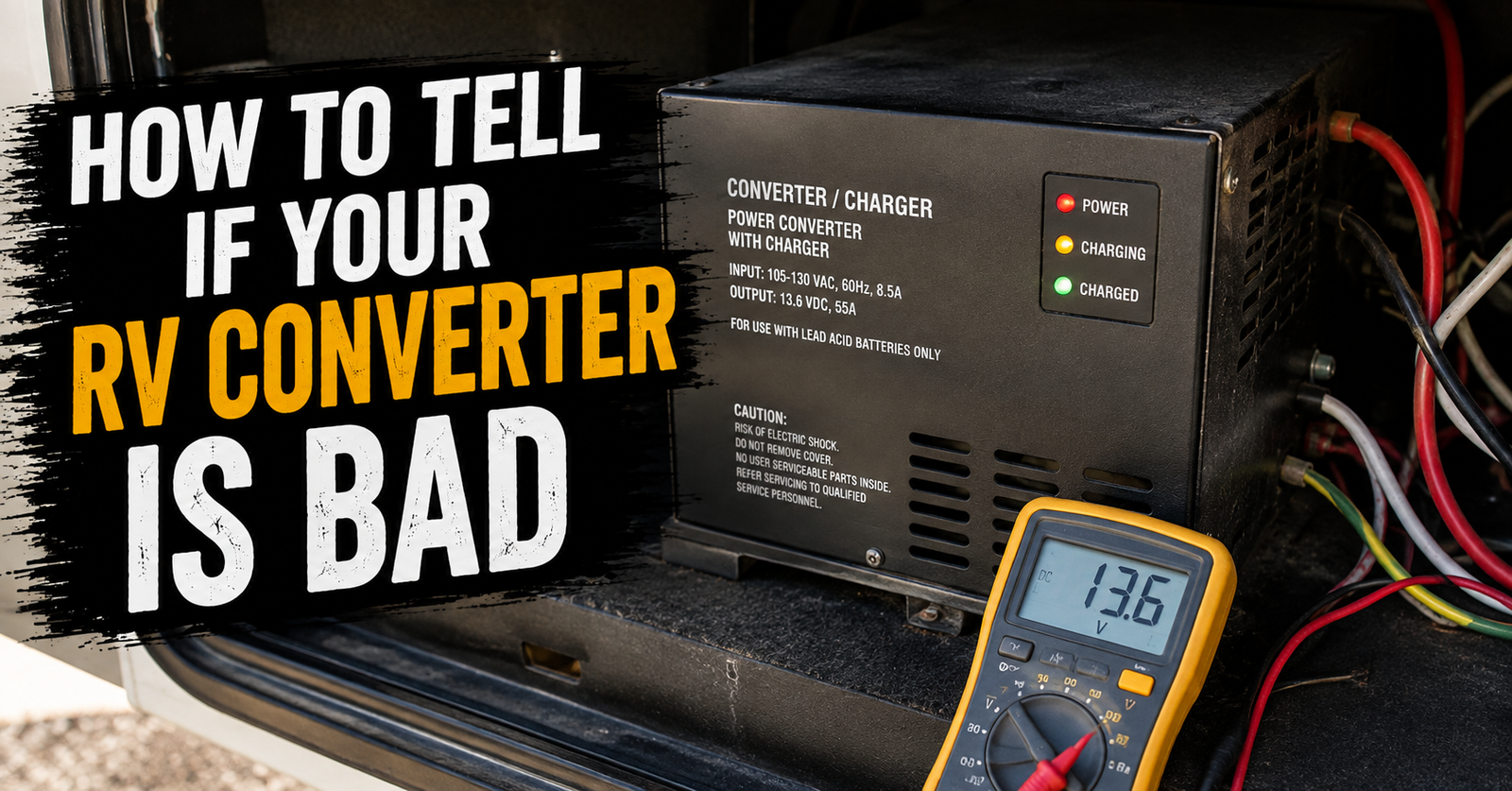
If you’re getting to that point, use our broader guide for determining whether an RV converter is actually bad before ordering a replacement.
Those Dim Lights Are Telling You Something
That’s how I’d look at this problem.
The lights themselves may be perfectly fine.
They’re simply showing you that the voltage reaching them isn’t what it normally is.
Start with the big question:
Is the converter actually supplying the RV’s 12-volt system and charging the battery?
Then work outward.
Check voltage.
Check converter input and output.
Check the battery.
Check the charging path.
Look for excessive DC demand.
Look for poor connections.
And pay attention to whether the problem affects one fixture or the entire camper.
Once you know where the voltage is being lost, those dim lights stop being a mystery and become one of the most useful troubleshooting clues in the RV.
Written by Evan Mercer
Evan Mercer writes about RV electrical systems, converter troubleshooting, batteries, and practical camper problems for CamperAnswers.com. His work focuses on helping RV owners understand what their camper is actually doing electrically so they can track problems down without blindly replacing parts.