
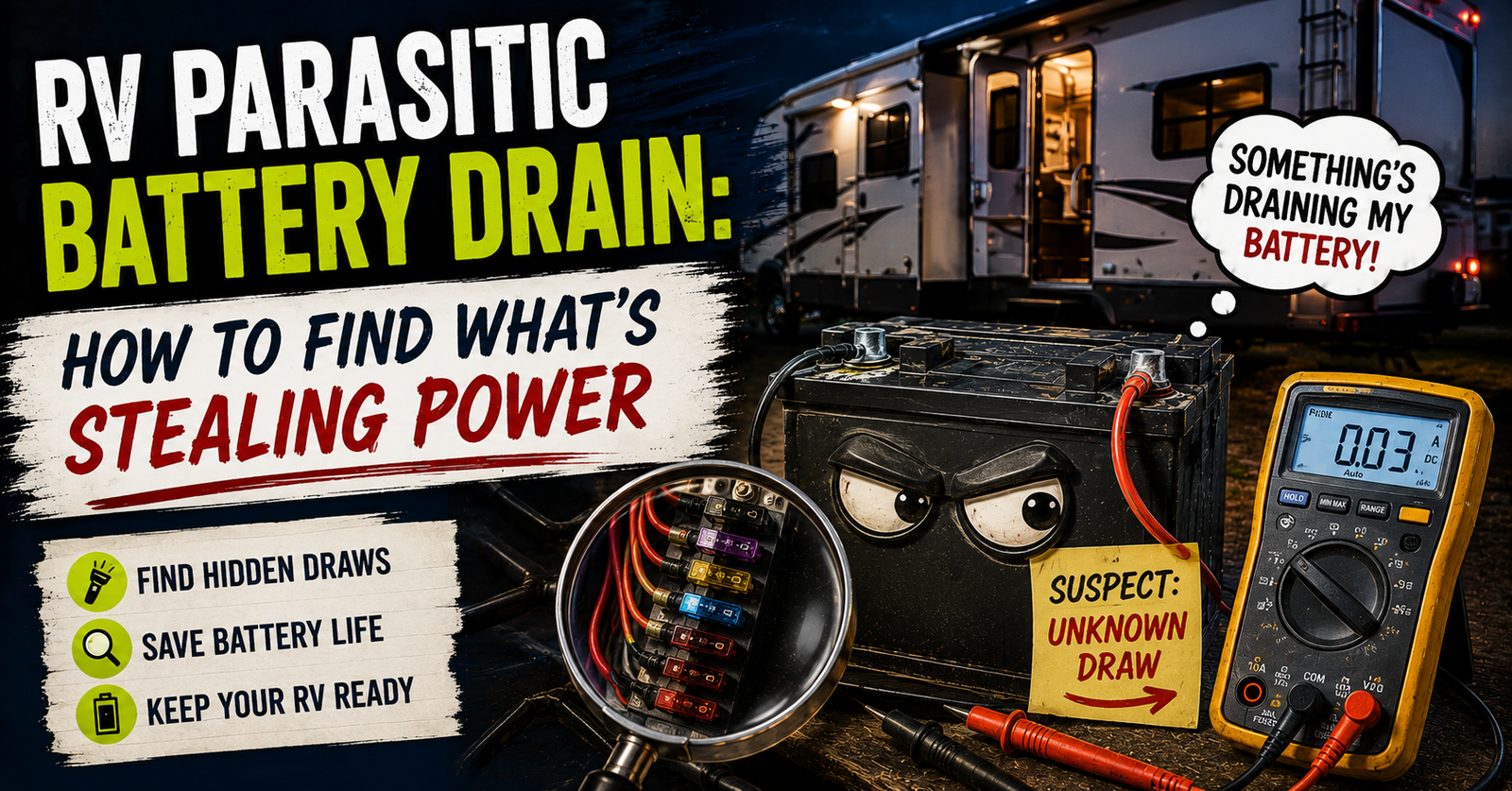
There’s a special kind of frustration that comes with walking out to your camper and finding a battery you know you charged sitting dead again. No lights were left blazing. Nobody ran the furnace all night. The camper may have been sitting there untouched. Yet somehow, that battery lost its charge.
That’s when I start looking for a parasitic battery drain.
The name makes it sound more complicated than it really is. A parasitic draw is simply electrical power being consumed when you don’t expect it to be. The tricky part with an RV is that some small 12-volt loads are completely normal, even when the camper looks like it’s shut down. Those unexpected loads are one possible explanation for overnight RV battery drain.
So my goal isn’t to make the ammeter read zero at all costs.
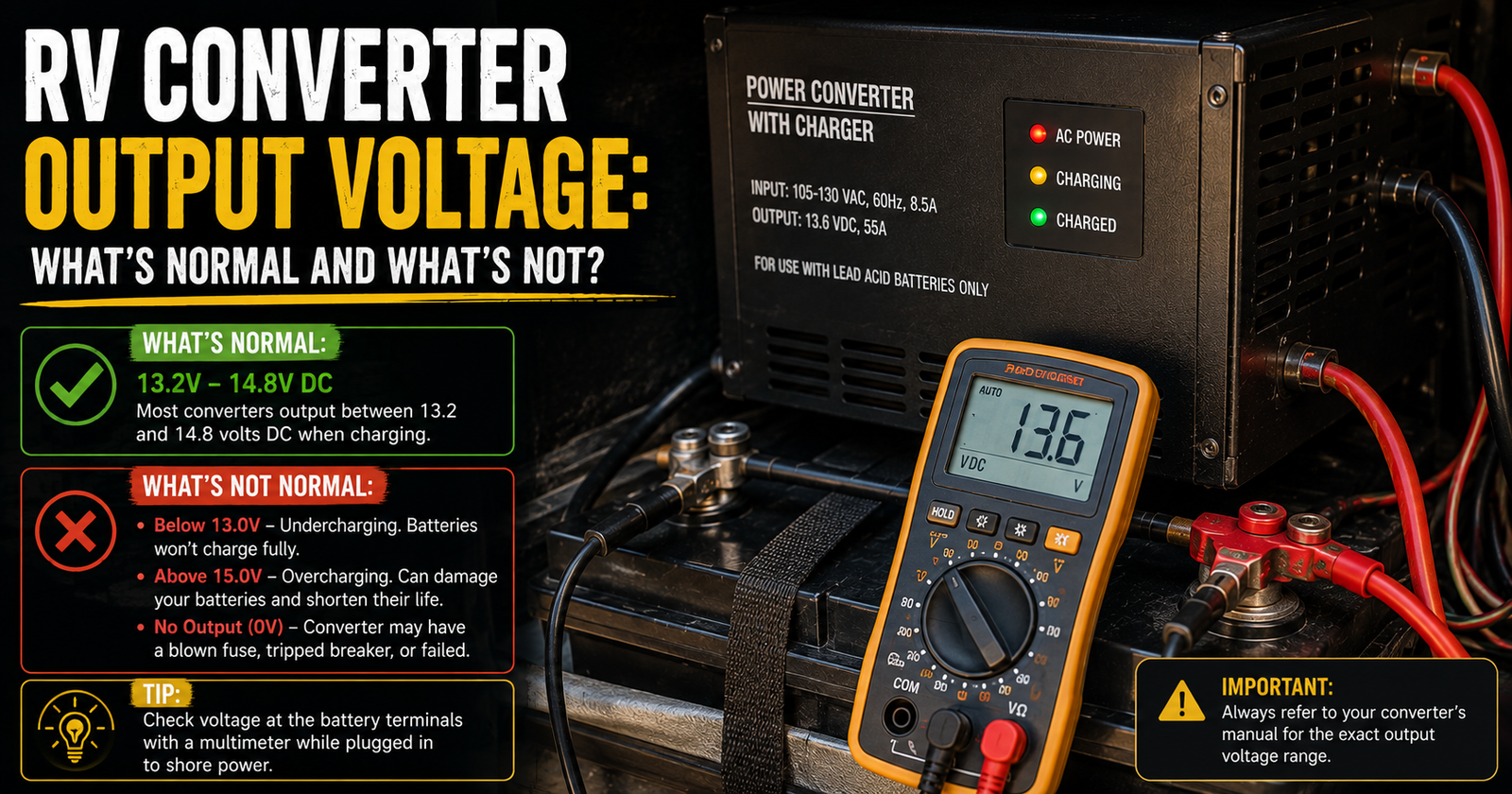
I want to find out what is using power, how much it’s using, whether it should be using it, and whether that amount is enough to explain the dead battery. Before assuming the battery is being drained, compare that investigation with cases where batteries appear to charge and then lose usable voltage.
That’s a much better way to attack this problem.
First, Make Sure You’re Actually Chasing a Parasitic Drain
I wouldn’t start pulling fuses just because a battery went dead once.
There are too many other possibilities. A car-battery parasitic-draw guide explains how to distinguish a true draw from a failing battery or charging problem: car-battery parasitic-draw guide
Maybe the battery wasn’t fully charged.
Maybe it’s old and has lost most of its usable capacity.
Maybe somebody left the inverter on.
Maybe the furnace ran far more than expected.
Maybe the charging system isn’t working.
Maybe you simply used more electricity than the battery bank could supply.

We’ve already covered the broader reasons an RV battery can keep going dead, and I would rule out those obvious explanations before spending an afternoon searching for a hidden draw.
A parasitic-drain test becomes especially useful when the battery repeatedly loses charge while the camper is supposedly inactive.
RVs Are Never Quite as “Off” as They Look
Walk through a parked camper and it can seem completely dead quiet.
That’s deceptive.
Behind the silence can be detectors, control boards, stereo memory, monitoring equipment, antenna equipment and other electronics still connected to the 12-volt system.
Your particular RV may have more or fewer of these.
That’s why I don’t automatically call every small current draw a problem.
Some standby consumption is simply part of owning a modern camper.
The question is whether your total standby consumption is reasonable for your setup.

Normal Standby Draw and Parasitic Drain Aren’t Exactly the Same Thing
This distinction matters.
Suppose an electronic device is designed to remain powered so it can retain settings or monitor something.
Technically, it’s consuming battery power while you’re not actively using the camper.
But that doesn’t automatically mean something is wrong.
Now suppose a failed component, incorrectly wired accessory or equipment that should have shut down continues consuming substantial current.
That’s much more interesting.
People often use “parasitic draw” for both situations, but when I’m troubleshooting, I want to separate expected standby loads from unexpected electrical consumption.
Otherwise, you can waste hours trying to eliminate a draw the manufacturer intentionally designed into the RV.
Small Draws Become Much Bigger Problems During Storage
Time is what makes standby consumption sneaky.
A small load for 30 minutes doesn’t mean much.
Leave that same load connected 24 hours a day for several weeks and now it matters.
That’s why this problem often first appears when an RV goes into storage.
You finish camping with what seems like a healthy battery.
Park the camper.
Come back a few weeks later.
Dead.
Charge it again.
Same thing happens.
At that point, I’d want to know whether the battery is losing charge on its own or whether the RV is continuing to pull power from it.

Your Battery Disconnect Is the First Easy Thing I’d Investigate
A battery disconnect sounds like the perfect answer.
Turn it off and the battery is disconnected.
Except RV wiring isn’t always that simple.
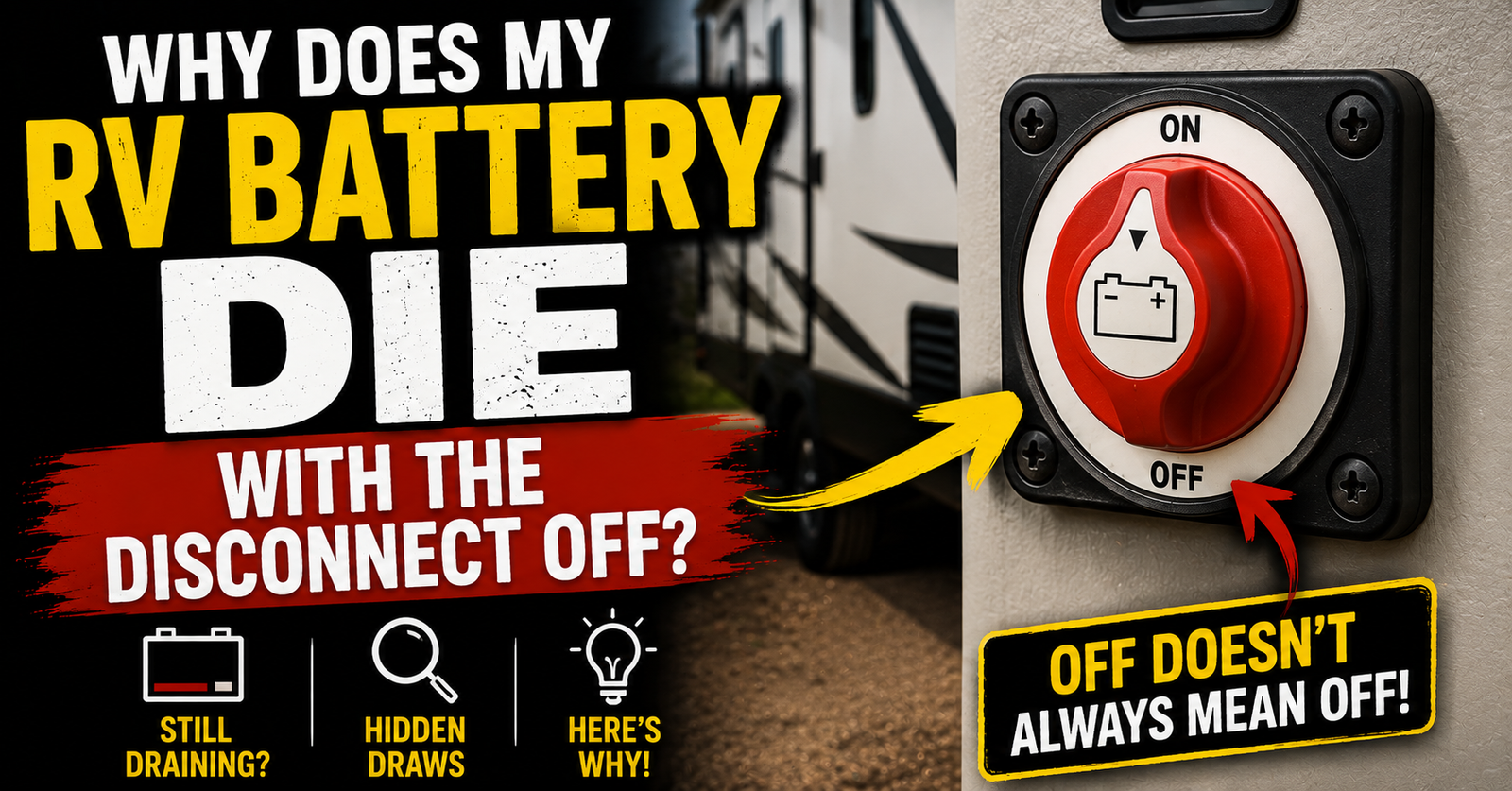
Some equipment may be wired in a way that leaves it connected even when the primary battery disconnect is in its storage or off position. That wiring possibility is explained in more detail in this guide to why an RV battery dies with the disconnect off.
There may also be separate disconnect arrangements for equipment such as an inverter.
That’s why I don’t use the position of the switch as proof.
I want to know whether current is actually leaving the battery.
If your battery remains connected to loads with the disconnect supposedly off, figuring out which equipment bypasses that disconnect becomes very important.
Don’t Assume the Disconnect Switch Is Bad
There’s another possibility.
The switch may be working perfectly.
It simply may not have been designed to isolate every single load.
Those are two completely different problems.
Before replacing the disconnect, find the wiring information for your camper and determine what the switch is actually supposed to control.
RV electrical systems make a lot more sense once you stop assuming every manufacturer’s wiring layout is identical.
The LP and Carbon Monoxide Detector Gets Blamed a Lot
Detectors are one of the first things RV owners hear about when they start researching battery drain.
And yes, hardwired safety detectors can be part of the continuous 12-volt load in an RV.
But I wouldn’t immediately disconnect a safety device and declare the problem solved.
First, safety equipment shouldn’t be defeated while the RV is occupied or being used in conditions where that protection is required.
Second, a normal detector load may be only one piece of the total consumption.
If your healthy battery is dying unbelievably fast, I want actual measurements before deciding one detector explains everything.
The Stereo May Not Be Completely Off
RV stereos and entertainment systems can have standby or memory circuits.
You press the power button and the screen goes dark, but that doesn’t necessarily mean the unit has been physically disconnected from 12-volt power.
Again, the amount matters.
A tiny memory load may be perfectly normal.
An entertainment system or amplifier that isn’t shutting down properly is a different story.
If removing power from the entertainment circuit causes a large change in measured battery draw, now you’ve found something worth investigating.

USB Outlets Can Still Be Connected
Modern campers are loaded with USB charging ports.
Some are combined with lights.
Some have illuminated indicators.
Some are part of larger outlet assemblies.
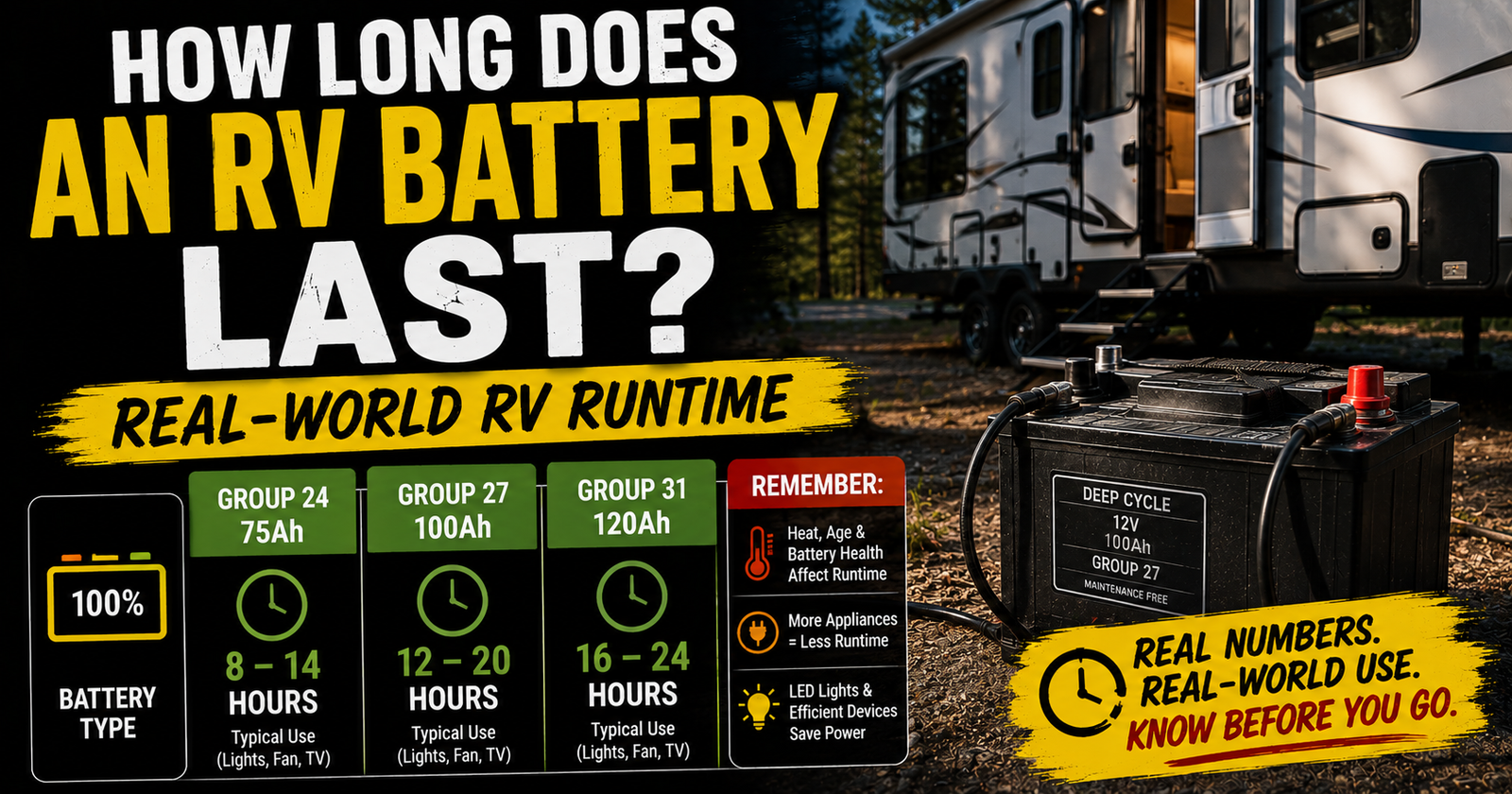
A single tiny electronic load may not be exciting, but campers can accumulate a surprising number of little devices connected to the battery system. To see how those small loads add up over a camping day, use how small loads affect RV runtime as a planning reference.
That’s why I don’t guess based on what looks important.
I measure the total draw first.
Then I isolate circuits.
The Inverter Is High on My List
If the camper has an inverter, I want to know whether it’s truly off.
An inverter takes battery power and creates AC electricity.
Depending on the inverter, it may consume power simply by remaining on even when the equipment connected to it isn’t doing much.
Then we have the devices on the AC side.
Televisions.
Chargers.
Residential refrigerators.
Entertainment equipment.
Anything else plugged into an inverter-powered circuit.
An owner can look around and see nothing obviously running while the inverter system is quietly consuming energy.
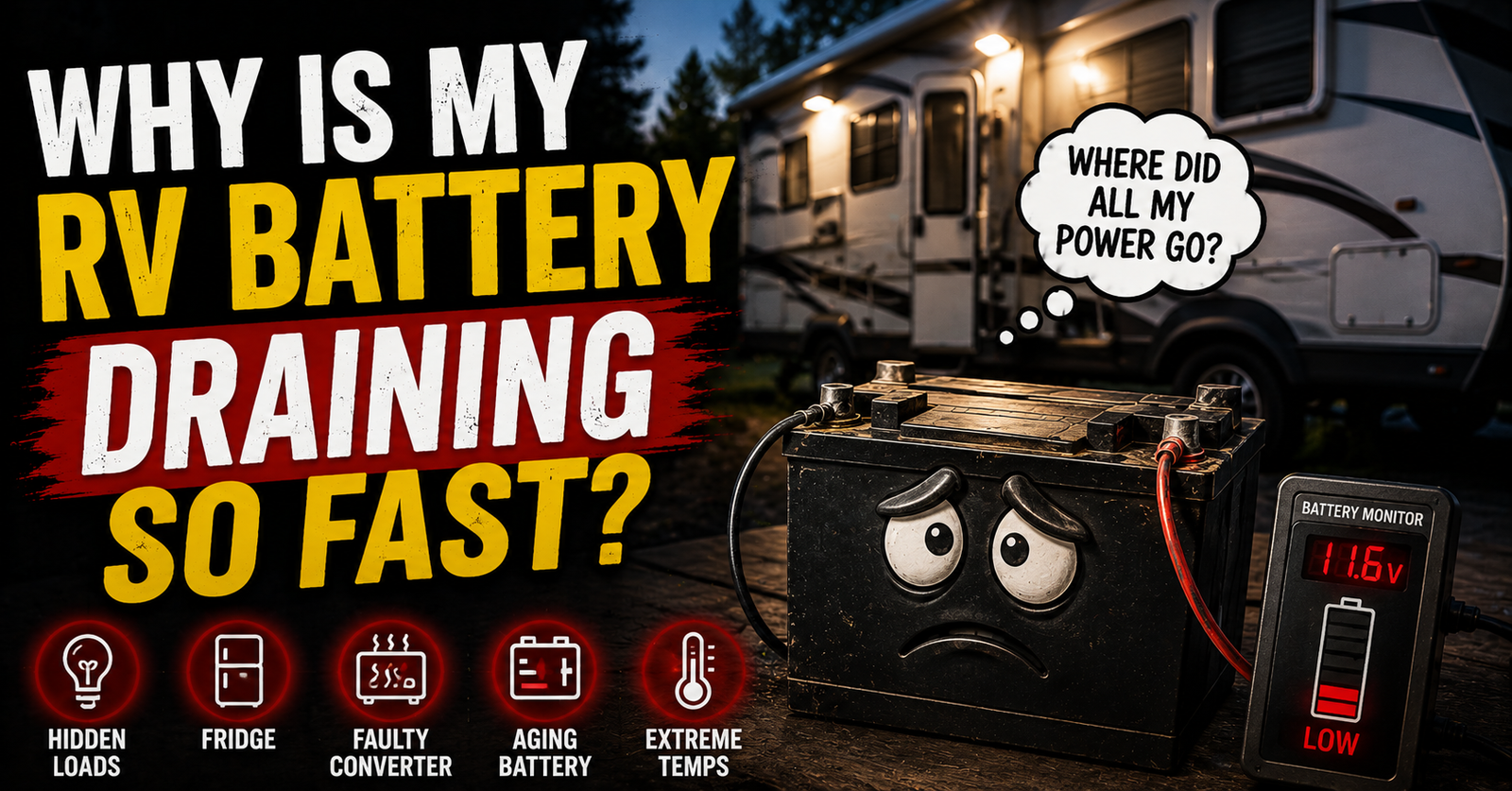
If your RV battery seems to drain much faster than it should, inverter use is one of the first larger loads I’d rule out before chasing tiny standby circuits.
Check for a Separate Inverter Disconnect
Some installations have a separate disconnect or shutdown procedure for the inverter.
That’s worth knowing before storage.
Turning the RV’s main battery disconnect doesn’t necessarily tell you what the inverter is doing.
Use the instructions for the equipment actually installed in your camper.
I’ve learned that assuming a switch controls something is never as good as knowing what it controls.
Don’t Forget Aftermarket Accessories
This is one of my favorite clues because the timeline can practically hand you the answer.
Think back.
Did the battery drain begin after installing something?
Maybe you added a backup camera.
Battery monitor.
Cellular booster.
Wi-Fi equipment.
Stereo.
Solar controller.
Security system.
Inverter.
USB outlet.
Exterior lighting.
Electric tongue jack wiring.
Some other 12-volt accessory.
If the camper sat for years without killing batteries and suddenly developed a drain right after electrical work, I don’t start by accusing equipment on the other side of the RV.
I start with what changed.
An Accessory Can Be Wired Correctly and Still Consume Power
This is important too.
Finding an aftermarket accessory drawing current doesn’t automatically mean whoever installed it made a mistake.
Maybe that accessory is designed to remain in standby.
The real question becomes whether you want it connected continuously during storage and whether its installation includes an appropriate way to shut it down.
That’s different from a wiring fault.
Knowing the difference helps you choose the right fix.
Relays and Control Modules Can Be Easy to Miss
Campers use electrical controls for all kinds of equipment.
Slides.
Leveling systems.
Appliances.
Battery systems.
Heating and cooling equipment.
Other automated features.
Depending on the RV, some modules can remain connected while the camper is parked.
This is another reason circuit-by-circuit testing works so much better than trying to remember every electronic device hidden inside the coach.
You don’t necessarily need to know what’s behind every wall before you begin.
You need to know which circuit changes the draw.
A Light Can Be On Somewhere You Can’t See
Sometimes the “mystery” isn’t very mysterious at all.
Storage compartments can have lights.
Pass-through compartments can have lights.
Exterior compartments can have lights.
Some RVs have lights in places you don’t regularly check.
A switch can get bumped.
A compartment can close while the light remains on.
Before breaking out meters and wiring diagrams, I physically walk around the camper.
Open compartments.
Look inside cabinets.
Check storage areas.
Look for anything glowing, humming, warm or otherwise obviously powered.
I’ll take a two-minute easy fix over a two-hour electrical diagnosis any day.
A Refrigerator Can Still Need 12-Volt Power on Propane
Switching an absorption refrigerator to propane doesn’t necessarily eliminate its electrical needs.
The controls can still rely on 12-volt power.
The same general principle applies to other propane appliances.
That doesn’t automatically make the refrigerator an abnormal parasitic load.

It’s an example of why understanding how RV electrical, propane and appliance systems depend on each other is so useful.
Something can be “running on propane” and still be connected to your battery.
The Furnace Has Electrical Controls Too
A furnace is another mixed-system appliance.
Propane produces the heat.
The battery supplies electricity for the controls and blower.
If the thermostat is completely off and the furnace isn’t running, its consumption should be evaluated according to the actual furnace and RV design.
But if you’re diagnosing what you think is a parasitic drain during camping and the furnace keeps cycling, that’s not really hidden consumption.
That’s a major legitimate load doing its job.
Don’t confuse high normal use with a wiring problem.
Tank Heaters Can Destroy Your Theory Pretty Quickly
If you’re trying to find a mysterious battery drain and discover the tank heaters are on, you’ve probably found something more interesting than the clock memory in the stereo.
Heating equipment can represent a meaningful electrical load.
Cold-weather switches are easy to forget after the weather changes.
That’s why my first pass through a camper is always about finding the big obvious stuff before measuring tiny standby current.
Your Battery Could Be Fooling You
Here’s something I always keep in the back of my mind.
What looks like parasitic drain may actually be poor battery capacity.
Imagine a worn battery that has only a fraction of the useful energy it had when new.
A perfectly normal standby load will discharge that battery much sooner.
You measure some current leaving the battery and think, “There it is!”
Maybe.
But that draw might have existed for years.
The battery is what changed.
That’s why a good diagnosis considers both sides of the equation.
How much energy is leaving, and how much usable energy can the battery actually store?
Make Sure the Battery Starts Fully Charged
This sounds painfully obvious until you realize how many battery-drain problems are actually charging problems.
If your battery starts every storage period partially discharged, it’s naturally going to reach dead sooner.
Don’t assume plugging the RV in means the battery became fully charged.
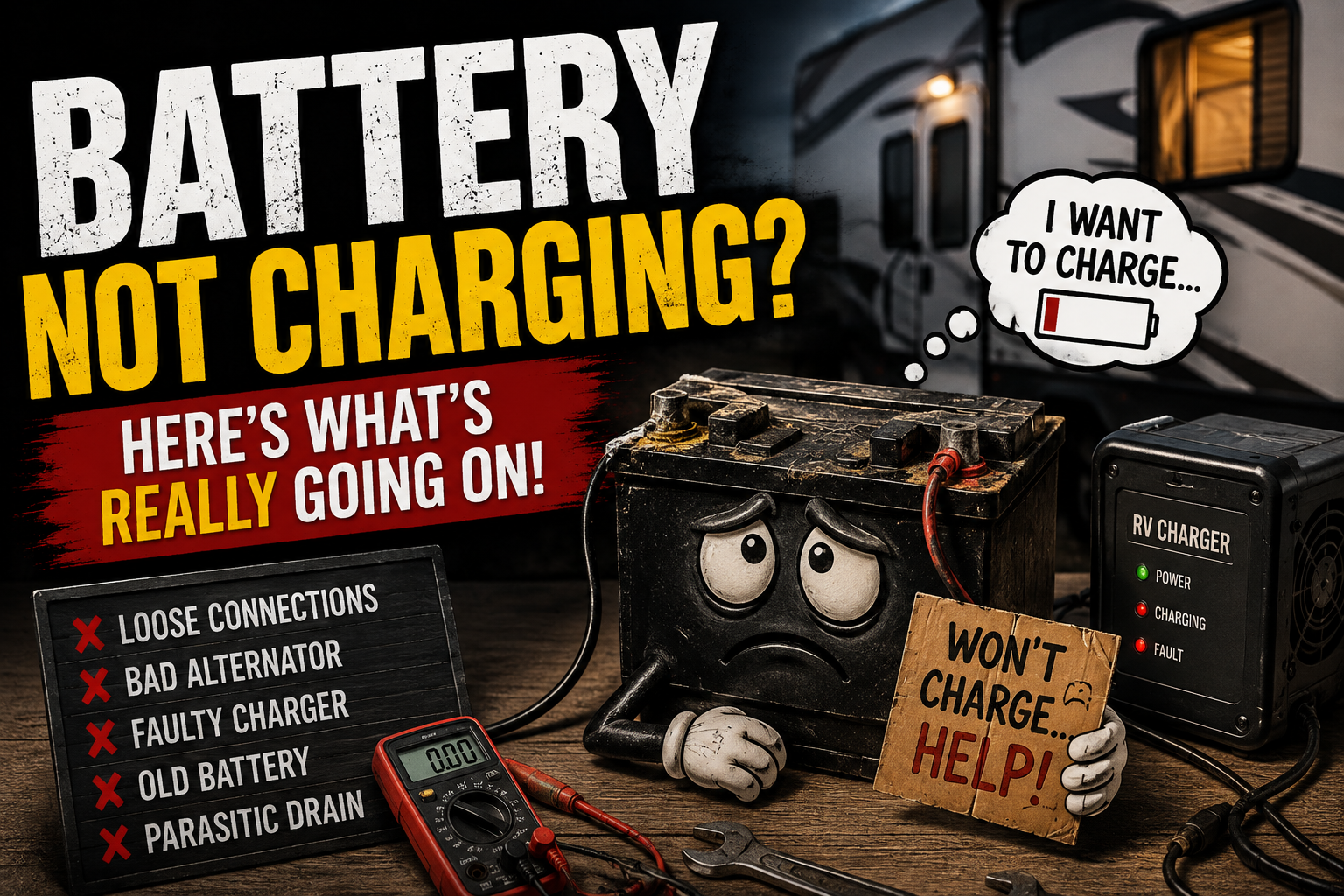
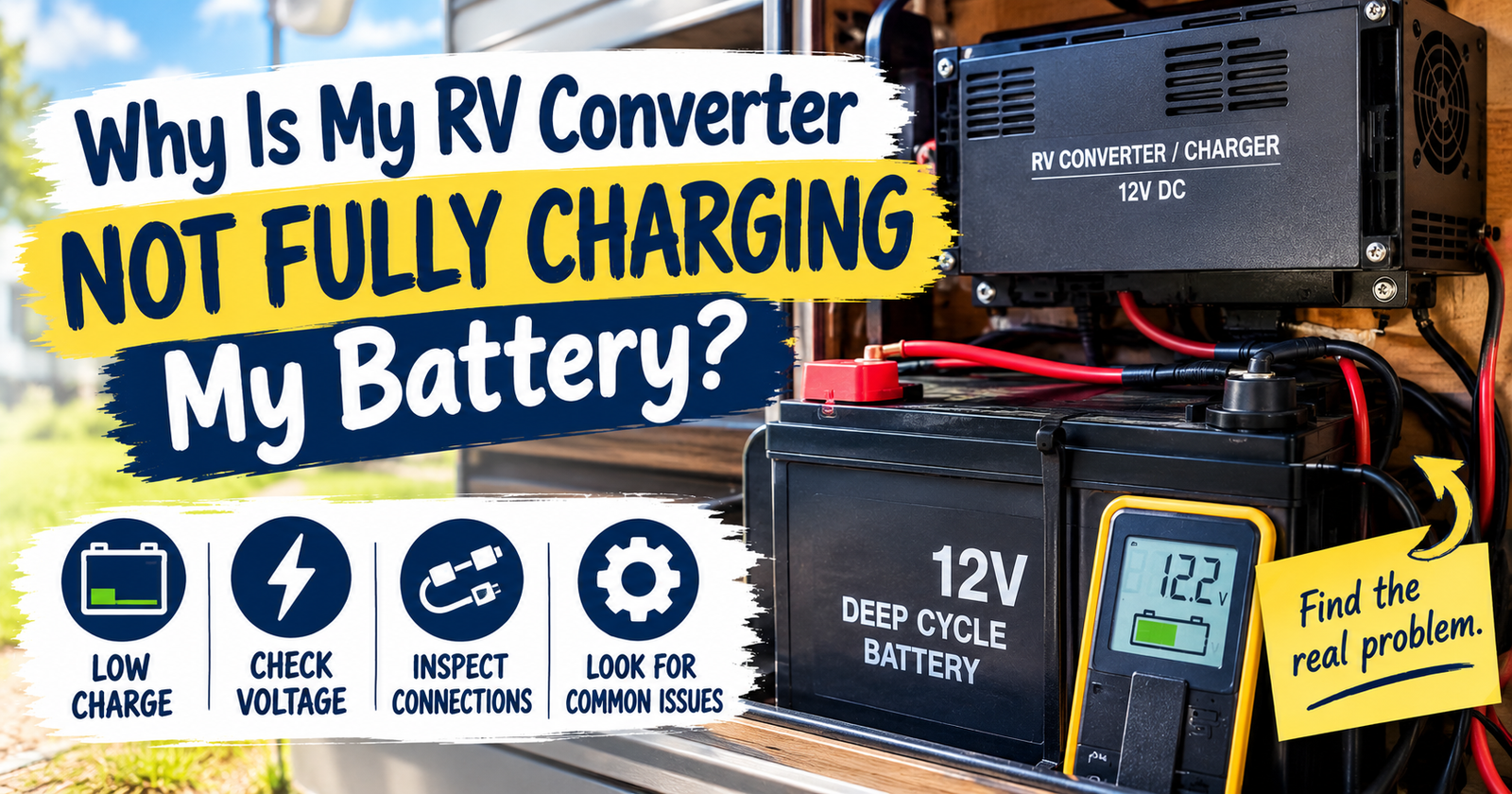
We’ve already covered why an RV battery may refuse to charge properly, including converter problems, protection devices, disconnects and bad connections.
Before measuring how long a battery takes to discharge, make sure you know where it started.
Shore Power Can Hide a Parasitic Draw
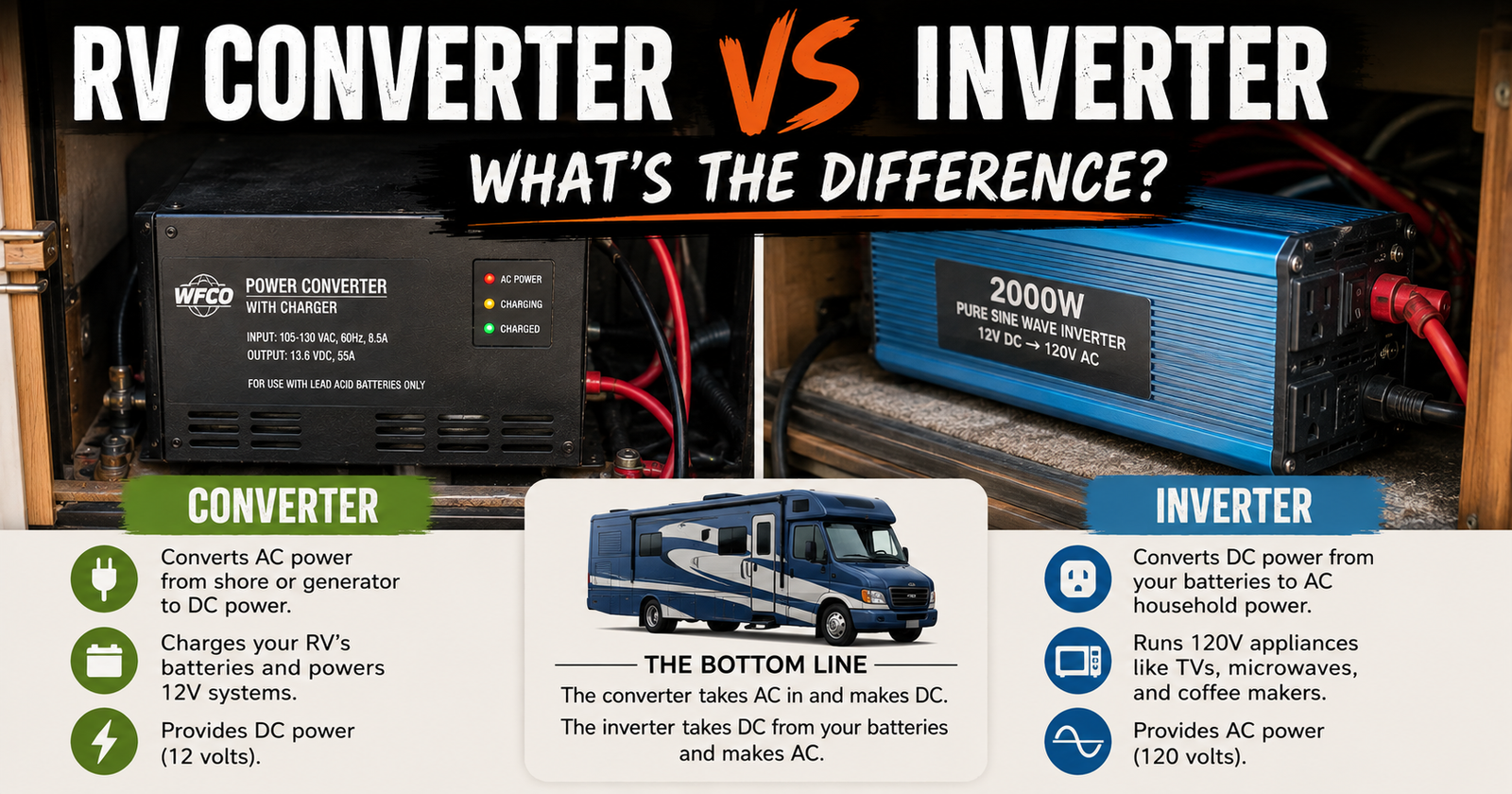
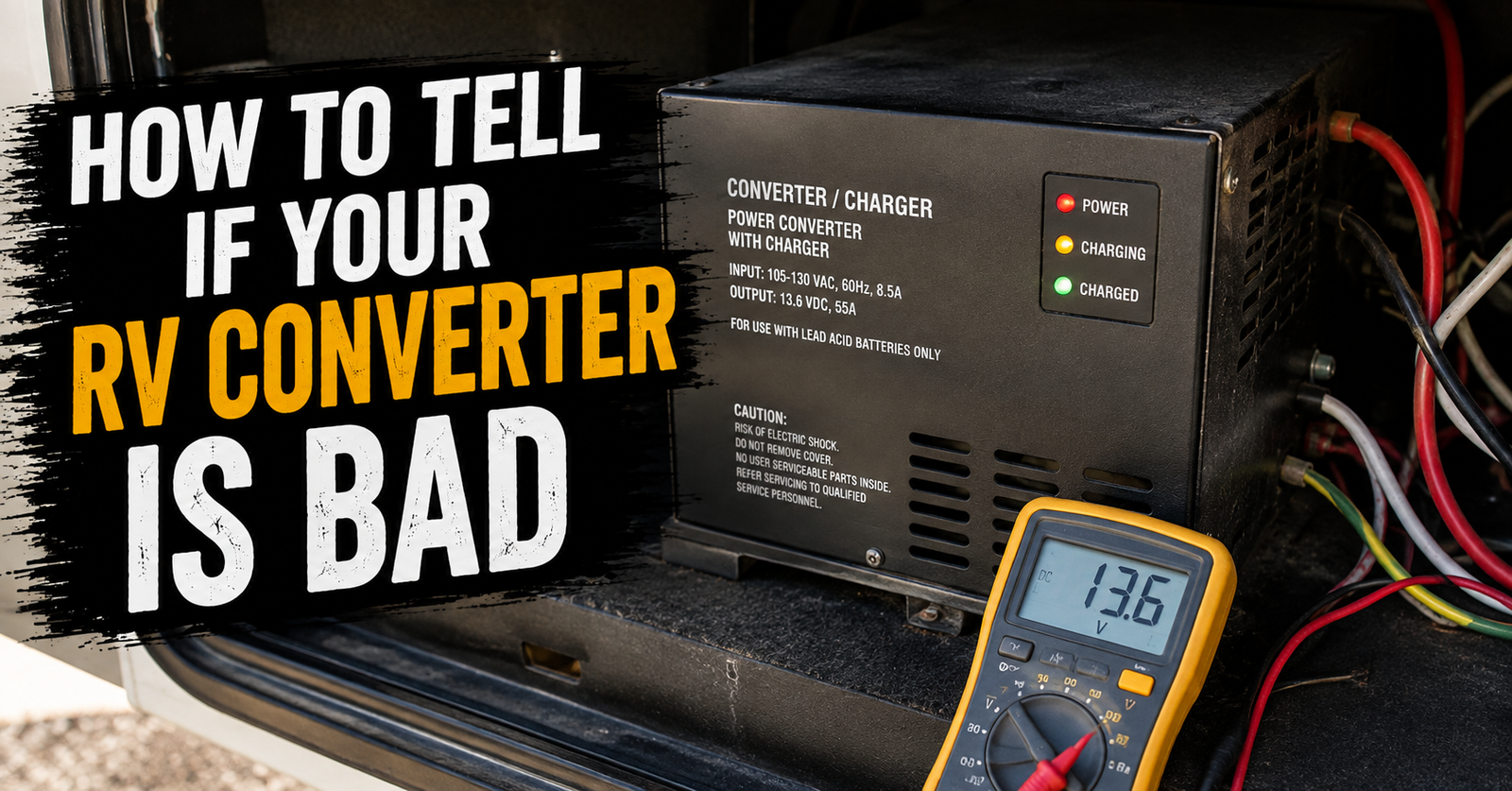
When you’re plugged in, the converter or inverter/charger may continuously replace the energy being consumed by small loads. The difference between converter and inverter/charger functions matters when deciding whether shore power should be replenishing the battery.
You never notice them.
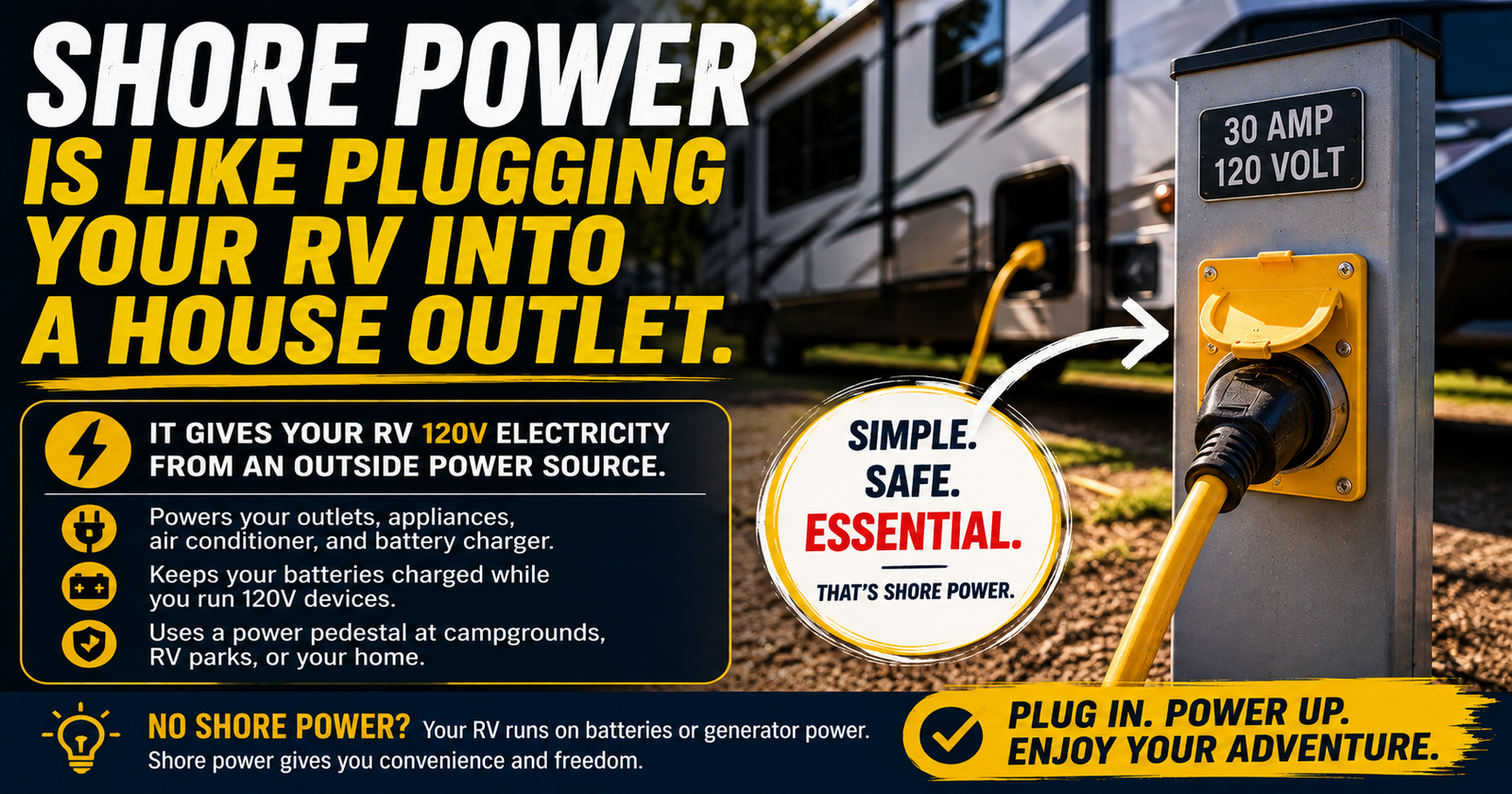
Unplug the camper and suddenly those same loads begin taking energy directly from the battery without anything putting it back. The explanation of how shore power supports an RV shows what changes electrically when that outside supply is removed.
That’s why an RV can behave perfectly at a campground and then mysteriously kill its battery in the driveway.
The loads didn’t necessarily appear when you unplugged.
The charging stopped hiding them.
A Charging Problem Can Look Exactly Like Excessive Drain
Let’s say your camper normally consumes a modest amount of 12-volt power.
Everything is fine as long as the converter replenishes it.
Then the charging circuit develops a problem.
The loads stay exactly the same.
But now every amp-hour comes out of the battery and none goes back in.
From your perspective, the battery suddenly “started draining.”
The real problem is charging.
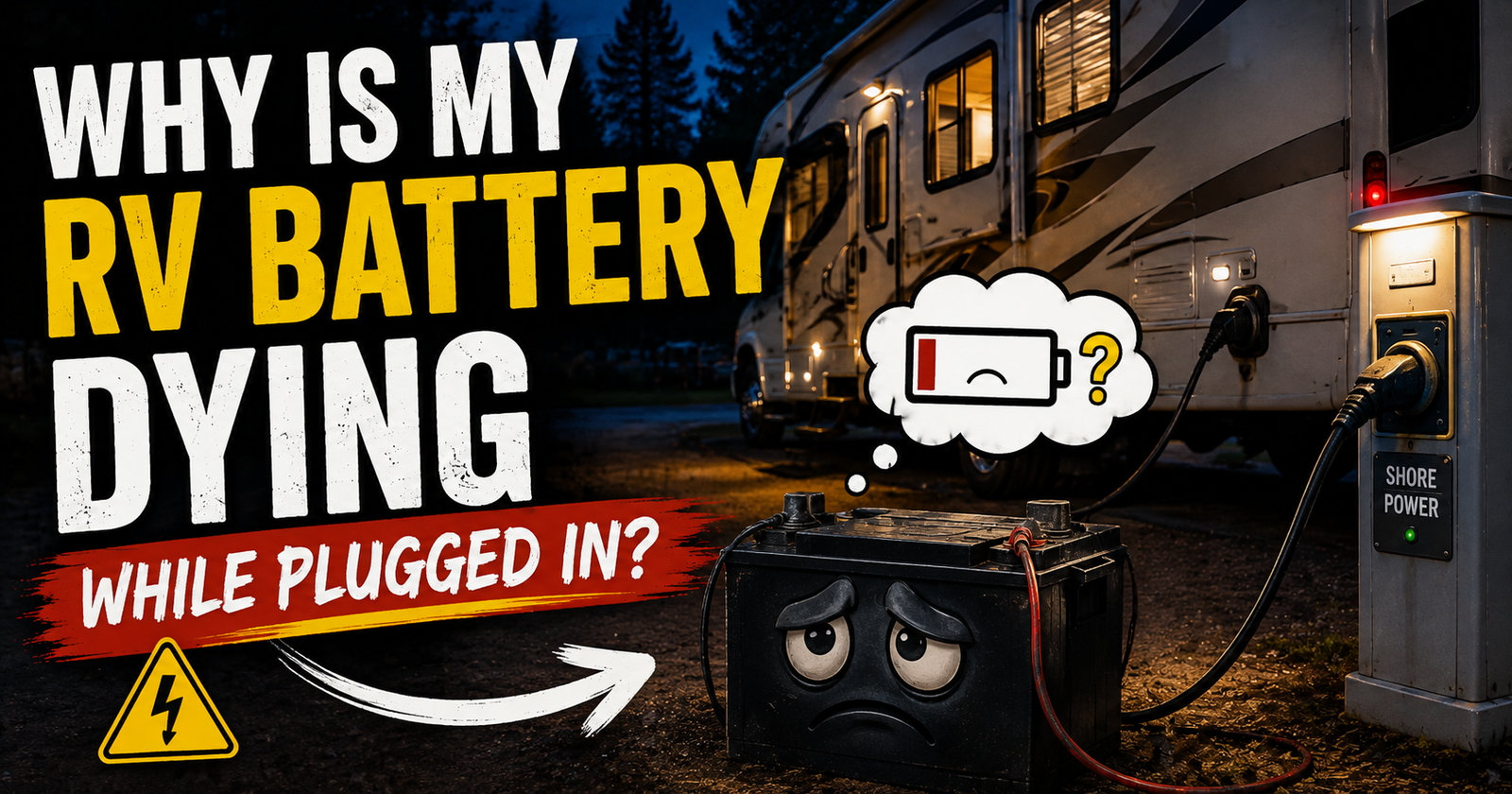
If the battery is actually losing power while the RV is still plugged into shore power, I’d investigate the charging side much sooner.
That’s a different clue than a battery slowly discharging in storage with no charger connected.
How I Start Testing for an RV Parasitic Draw
I don’t begin by randomly removing fuses.
First I establish the battery’s condition.
I want it properly charged and I want reasonable confidence that the battery itself is usable.
Then I turn off everything I intentionally can.
Lights.
Fans.
Water pump.
Furnace.
Tank heaters.
Entertainment equipment.
Inverter.
Anything else that isn’t supposed to be operating.
Then I determine whether current is still leaving the battery.
This gives me a baseline.
Only after that does circuit isolation become really useful.
A Shunt-Based Battery Monitor Makes This Job Much Easier
If your RV already has a properly installed shunt-based battery monitor, you’ve got a great troubleshooting tool sitting there.
A shunt measures current moving into and out of the battery.
That means you can watch what happens when equipment turns on and off.
Switch off the inverter.
Did the current change?
Remove power from an accessory.
Did it change?
Turn off a circuit.
Anything happen?
This is so much better than guessing.
You start seeing the RV as a collection of measurable loads instead of one giant electrical mystery.
Measuring Current With a Multimeter Requires More Care
This is where I want people to slow down.
Measuring current isn’t the same as measuring voltage.
When you’re checking voltage, the meter is typically placed across two points.
Current measurement can require placing the meter into the circuit, depending on the test being performed.
Set the meter up incorrectly and you can blow its internal fuse or create a short circuit.
RV batteries can deliver tremendous current even though we’re talking about a nominal 12-volt system.
If you’re not completely comfortable with current measurement, use a properly installed battery monitor or let an RV technician perform the test.
There’s no reason to turn a battery-drain problem into a melted meter-lead problem.
Once You Know There’s a Draw, Start Isolating Circuits
This is where the fuse panel becomes useful.
The basic idea is simple.
You have measurable current leaving the battery.
You isolate one circuit.
Watch the current.
Restore that circuit as appropriate.
Move to another.
Eventually, you may find a circuit that causes the current draw to drop substantially when it’s removed from the equation.
Now we’ve made real progress.
We don’t have “an RV electrical problem” anymore.
We have a problem associated with a particular circuit.
That’s a much smaller haystack.
Don’t Just Leave a Fuse Out and Call It Fixed
Suppose you identify the circuit.
Great.
Now find out what’s on it.
Maybe several devices share that fuse.
Maybe one is operating normally.
Maybe another is malfunctioning.
Maybe the circuit contains safety equipment that should not simply be abandoned.
Pulling a fuse is a diagnostic step.
The actual repair depends on why that circuit is consuming more electricity than expected.
Label Everything Before You Forget
If the fuse panel labeling is poor, take pictures before you start.
Write things down.
Record the current before and after each change.
Don’t rely on remembering that “the fourth blue fuse did something.”
Good troubleshooting is repeatable.
You want to be able to return the camper to its original configuration and know exactly what you tested.
This also makes life much easier if you eventually hand the problem to a technician.
What If Pulling Every Normal DC Fuse Doesn’t Stop the Draw?
Now things get interesting.
Some equipment can be connected outside the main branch fuse panel.
That can include equipment wired directly to the battery or through separate protection devices.
Inverters are an obvious example in some installations.
Solar equipment may have its own connections.
Electric jacks, breakaway systems, leveling equipment or aftermarket accessories may use separate wiring arrangements depending on the RV.
If the normal fuse panel doesn’t eliminate the measured draw, don’t assume the measurement must be wrong.
Start looking for battery-connected equipment that doesn’t pass through those branch fuses.
Trailer Breakaway Systems Deserve Respect
Towable RVs use a breakaway system designed to apply the trailer brakes if the trailer separates from the tow vehicle.
That’s safety equipment, not something I’d casually disconnect while experimenting.
If you’re tracing battery wiring on a trailer, know what you’re looking at before removing connections.
This is another good example of why “just disconnect everything until the drain stops” isn’t a great troubleshooting strategy.
Some of those wires have important jobs.
Solar Complicates Parasitic-Draw Testing
If solar is actively charging while you’re trying to measure battery drain, your numbers can become harder to interpret.
The battery may have current flowing in from the solar controller at the same time loads are pulling current out.
A monitor may show only the net result depending on how the system is installed.
That can make a real load look smaller than it is.
When performing a controlled test, you need to understand every charging source connected to the battery and follow the equipment manufacturer’s safe shutdown procedures.
Don’t start unplugging live solar connectors simply because you’re trying to get the display to zero.
Vehicle Charging Can Complicate It Too
The same goes for a tow vehicle or motorhome charging source.
If the engine is running or the trailer is connected to a vehicle that supplies charging current, you’re no longer looking only at battery discharge.
For a clean storage-drain diagnosis, I want to understand what’s coming into the battery as well as what’s going out.
Otherwise, the numbers can tell a misleading story.
How Much Parasitic Draw Is Too Much?
I don’t like giving one universal number here.
Different RVs contain different equipment.
A basic older travel trailer and a modern luxury fifth wheel with multiple control systems aren’t going to have identical standby electrical consumption.
Battery capacity also matters.
Instead, I look at the actual draw and calculate what that means over time.
A seemingly small continuous load becomes much easier to understand when you multiply it across 24 hours and then across several days.
Now you can compare expected consumption with the battery’s usable capacity.
That’s far more useful than someone online telling every RV owner that one specific current reading is “normal.”
Do the Math Over 24 Hours
Here’s the part that makes parasitic loads click for most people.
Current multiplied by time gives you an idea of the amp-hours being consumed.
A continuous 0.5-amp load, for example, represents about 12 amp-hours over 24 hours.
Leave it for five days and you’re around 60 amp-hours, assuming the draw stays constant.
That’s no longer tiny.
And that’s before considering other loads, battery condition or self-discharge.
This is why measuring matters.
“Half an amp doesn’t sound like much” means something very different when it never stops.
Battery Capacity Determines How Long the Draw Can Hide
A larger battery bank can mask the same parasitic load longer.
That’s important when comparing your camper with someone else’s.
Maybe their RV can sit for three weeks while yours struggles after one.
That doesn’t automatically mean your RV has three times the parasitic draw.
They may simply have far more usable battery capacity.
Always compare consumption with the battery bank that’s supplying it.
Lithium Can Make the Symptoms Look Different
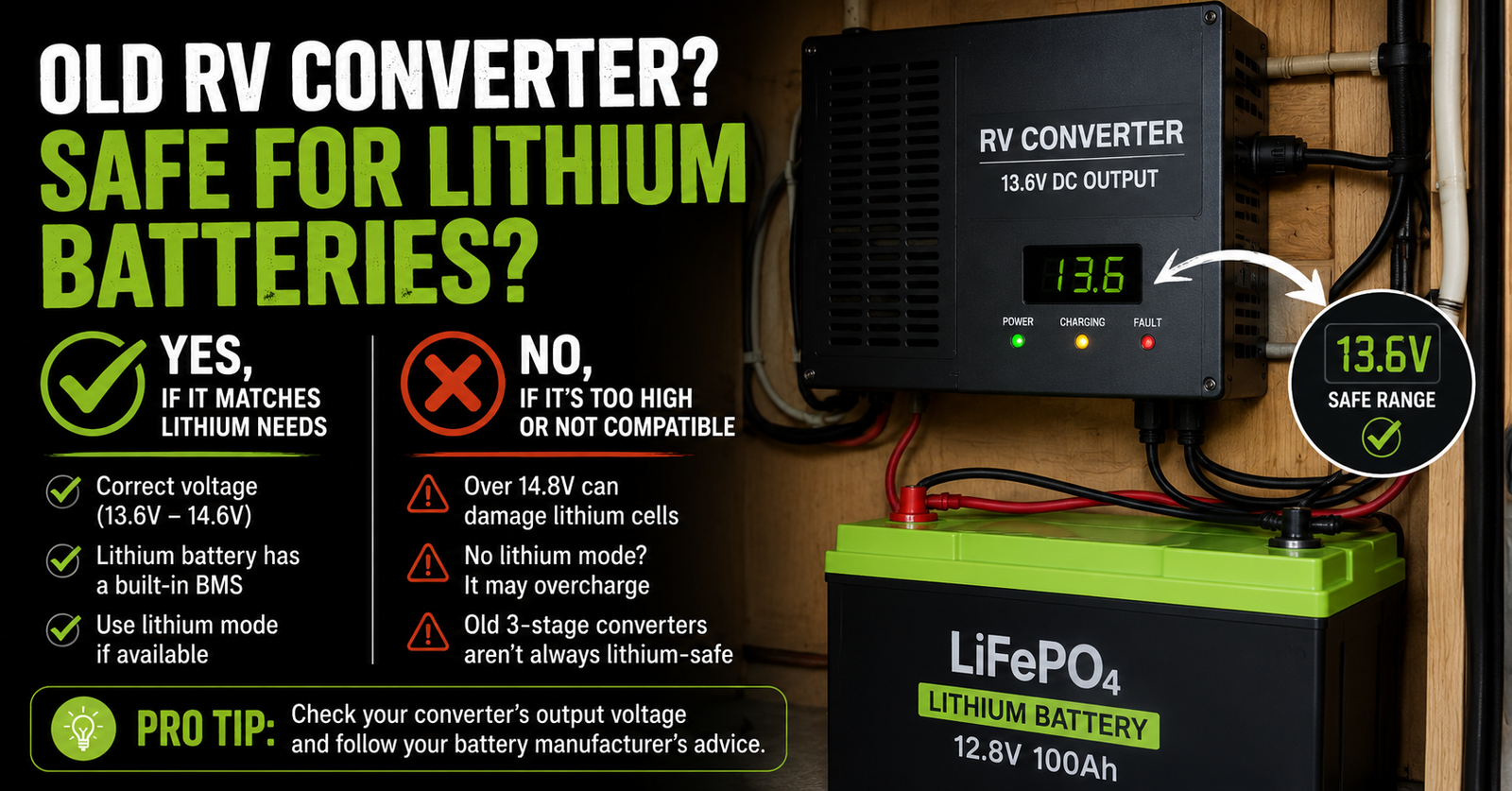
Lithium batteries often provide a different voltage profile than lead-acid batteries and commonly include a battery management system. That difference makes lithium battery charging compatibility important when diagnosing charging behavior.
Depending on the battery, the BMS may disconnect the battery when certain limits are reached.
That can make the final failure seem sudden.
Everything works.
Everything works.
Everything works.
Then the battery protection system shuts down.
Don’t interpret lithium behavior using assumptions developed around flooded lead-acid batteries.
Use the battery manufacturer’s information and a proper state-of-charge monitoring method.
Don’t Forget Battery Self-Discharge
A battery can lose some charge even when completely isolated from the RV.
The rate depends on battery chemistry, temperature, condition and other factors.
That’s why isolating the battery can be such a useful comparison.
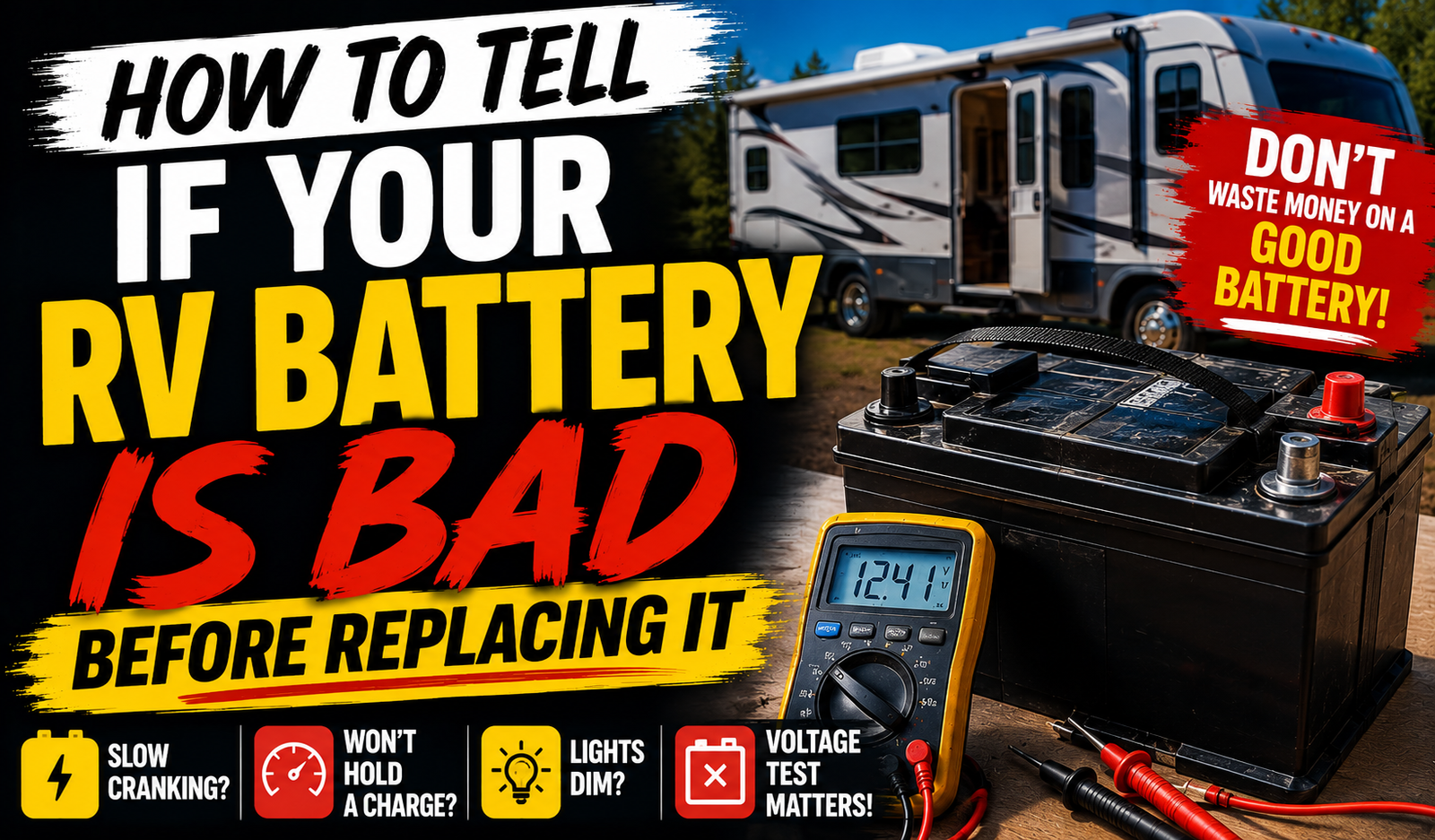
If a properly charged battery loses substantial usable energy while genuinely disconnected from every RV load, the camper may not be your main problem. At that point, you can check the battery's actual condition before replacing it.
Now battery condition and self-discharge behavior deserve much more attention.
The Best Test Is Often Connected Versus Truly Disconnected
When it’s safe and appropriate for the particular RV and battery setup, comparing storage performance while connected with performance while genuinely isolated can tell you a lot.
Battery repeatedly dies while connected.
Battery holds charge much better while isolated.
That’s meaningful.
Now you have evidence that something associated with the RV is contributing to the discharge.
If it dies either way, I’d stop obsessing over the fuse panel and investigate the battery itself.
What If You Find Several Small Draws Instead of One Big One?
That’s completely possible.
Everyone wants the satisfying moment where one fuse gets pulled and the current drops to zero.
Real RVs don’t always cooperate.
You might find a detector drawing a little.
Entertainment equipment drawing a little.
A control module drawing a little.
An aftermarket accessory drawing a little.
Individually, none looks dramatic.
Together, they may explain why the battery can’t survive long-term storage.
That’s still a successful diagnosis.
There doesn’t have to be one villain.
Decide What Needs to Stay Powered
Once you understand the loads, you can make smarter decisions about storage.
Some equipment may need to remain powered for safety or system operation under certain conditions.
Other equipment may be unnecessary during storage.
Your RV and equipment manufacturers should determine what can safely be shut down.
The answer isn’t to blindly disconnect everything.
The answer is to understand what each load does and configure the camper appropriately for how you’re storing it.
Fix the Charging Side Too
Even after finding standby loads, make sure the battery is being properly maintained.
A battery repeatedly left deeply discharged can deteriorate, particularly with lead-acid chemistries.
That creates a nasty cycle.
Small draw discharges battery.
Battery sits discharged.
Battery loses capacity.
Now the same draw kills it faster.
Eventually you solve the parasitic load and still have terrible battery life because the battery has already been damaged.
Both sides matter.
What I’d Do Before Paying an RV Shop
I’d write down the symptoms.
How long does the battery take to die?
Does it happen only in storage?
Does the battery hold charge when isolated?
What is the measured current draw with intentional loads off?
Which circuits change that draw?
What aftermarket equipment has been installed?
Does the inverter have a separate connection?
Is solar connected?
How old is the battery?
Does the battery fully charge?
Walking into a shop with those answers can save a tremendous amount of diagnostic wandering.
You’re giving the technician a trail to follow.
When I’d Stop DIY Troubleshooting
I stop when the testing requires working around energized equipment I’m not comfortable with, when the wiring doesn’t match the documentation, when a fuse repeatedly blows, when wiring or terminals show signs of overheating, or when the current draw remains unexplained after the accessible circuits have been isolated.
A 12-volt battery is capable of delivering enough current during a short circuit to create serious heat and sparks.
The RV also contains 120-volt AC circuits that can be dangerous.
Knowing when not to poke around is part of knowing campers.
Don’t Replace the Battery Until You Know Where the Power Went
A parasitic drain doesn’t automatically mean the battery is bad.
And a bad battery doesn’t automatically mean you have a parasitic drain.
That’s why I always come back to the same simple approach.
Charge the battery properly.
Confirm its condition.
Measure the draw.
Isolate circuits.
Identify what remains powered.
Then decide whether what you found is normal, unnecessary or actually faulty.
Once you know how much electricity is leaving and where it’s going, that mysterious RV battery that keeps dying in the driveway isn’t much of a mystery anymore.
Written by Evan Mercer
Evan Mercer writes about RV systems, camper troubleshooting, maintenance and everyday ownership questions for CamperAnswers.com. His work focuses on turning technical information and manufacturer guidance into practical answers ordinary RV owners can actually use.