
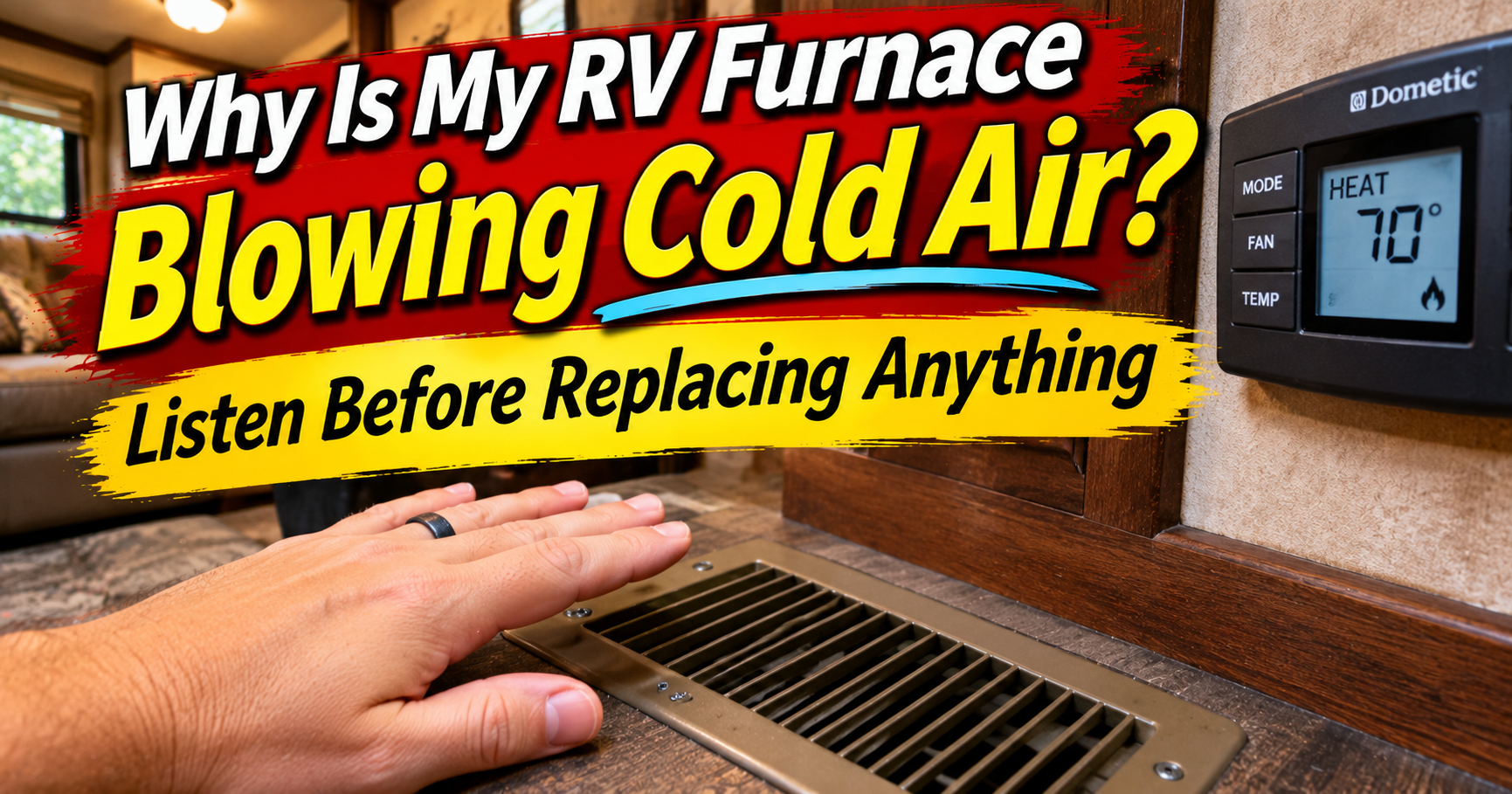
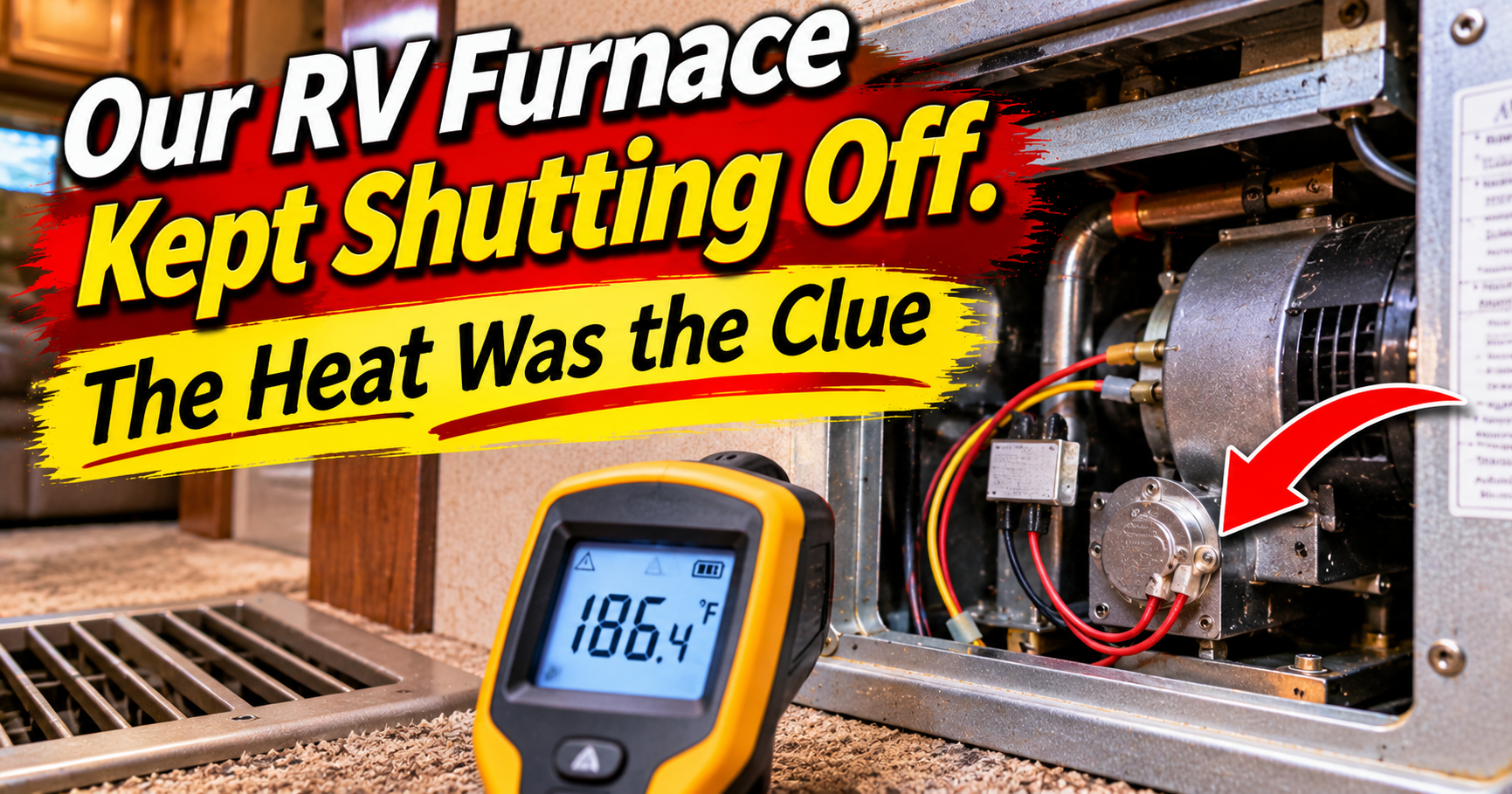
There aren’t many camper problems that get your attention faster than turning the furnace on when it’s cold outside and getting nothing but cold air from the vents.
The blower starts.
You wait for the heat.
Still cold.
At first, I wouldn’t panic. An RV furnace normally moves some unheated air before the burner fires and the ductwork warms up.
But if it keeps blowing cold air, that’s different. The broader RV heating and airflow problems category can help compare this symptom with related thermostat, duct, and furnace issues.
The first thing I’d pay attention to isn’t a replacement part. I’d listen to what happens after the blower starts. Do you hear the furnace trying to ignite? Does it click several times and then shut down? Does the blower run without any ignition attempt at all? Those symptoms can point you in very different directions.
The Blower Starting Is Actually a Useful Clue
If the furnace blower comes on, we’ve already learned something.
The furnace isn’t completely dead.
It has enough 12-volt power to start the blower, the thermostat is calling for heat, and at least part of the startup sequence is happening.
Now I listen.
On many propane RV furnaces, the basic sequence goes something like this:
The thermostat calls for heat.
The blower starts.
Airflow proves that it’s safe to continue.
The furnace opens the propane valve and attempts ignition.
The burner lights.
Then warm air starts coming through the vents.
If the sequence stops somewhere in the middle, where it stops matters.
Do You Hear Clicking After the Blower Starts?
This is one of the easiest observations you can make without taking anything apart.
Turn the furnace on.
Listen.
Does the blower run for a short time and then you hear:
click-click-click
or repeated ignition attempts?
If so, the furnace is at least getting far enough into its startup sequence to attempt ignition.
That makes me think differently than a furnace where the blower runs but the ignition sequence never seems to begin.
RV owners describe this exact symptom frequently: blower starts, igniter clicks, but the burner never establishes flame.
At that point, propane supply and the burner/ignition side become much more interesting.
Check the Stupidly Simple Propane Stuff First
Before deciding the furnace needs parts, I’d check the propane. For related fuel-supply questions, the RV propane troubleshooting section provides another place to check before replacing furnace components.
Is the tank actually open?
Is there propane in it?
If you have two bottles, is the regulator selecting the bottle you think it is?
Does another propane appliance work?
The stove is useful here because you can actually see the flame.
One real-world furnace problem I found involved an owner whose furnace stopped heating after one propane bottle emptied. Once the full bottle was selected and the system was reset, the furnace returned to operation.
That’s exactly why I don’t start with:
Bad circuit board.
I start with:
Do we actually have propane reaching the system?
This Can Happen Right After Running Out of Propane
That’s another pattern worth remembering.
The furnace worked.
Propane ran out.
Bottle was refilled or switched.
Now the stove works, but the furnace doesn’t want to light.
That doesn’t automatically mean the furnace coincidentally failed the same day.
Air can enter the propane line, and restoring propane service may require the system to purge that air before the furnace successfully lights.
If another propane appliance is operating normally but the furnace still refuses to ignite after reasonable attempts, then I’d keep troubleshooting.
But the timing matters.
What If I Don’t Hear Any Ignition Clicking?
That’s a different clue.
If the blower starts but the furnace never seems to attempt ignition, I become more interested in the safety sequence that has to occur before propane ignition is allowed.
One important part is the sail switch.
The blower has to move enough air for the furnace to confirm that airflow is present.
If it can’t prove adequate airflow, the furnace may prevent the ignition sequence from continuing.
That’s a safety feature, not the furnace being difficult.
A Weak Battery Can Matter Even Though the Furnace Burns Propane
This one catches people because the furnace is called a propane furnace.
Propane makes the heat.
But electricity runs the blower and controls.
If battery voltage is too low, the blower may not move enough air for the furnace to complete its normal startup sequence.
That’s especially relevant when camping without hookups.
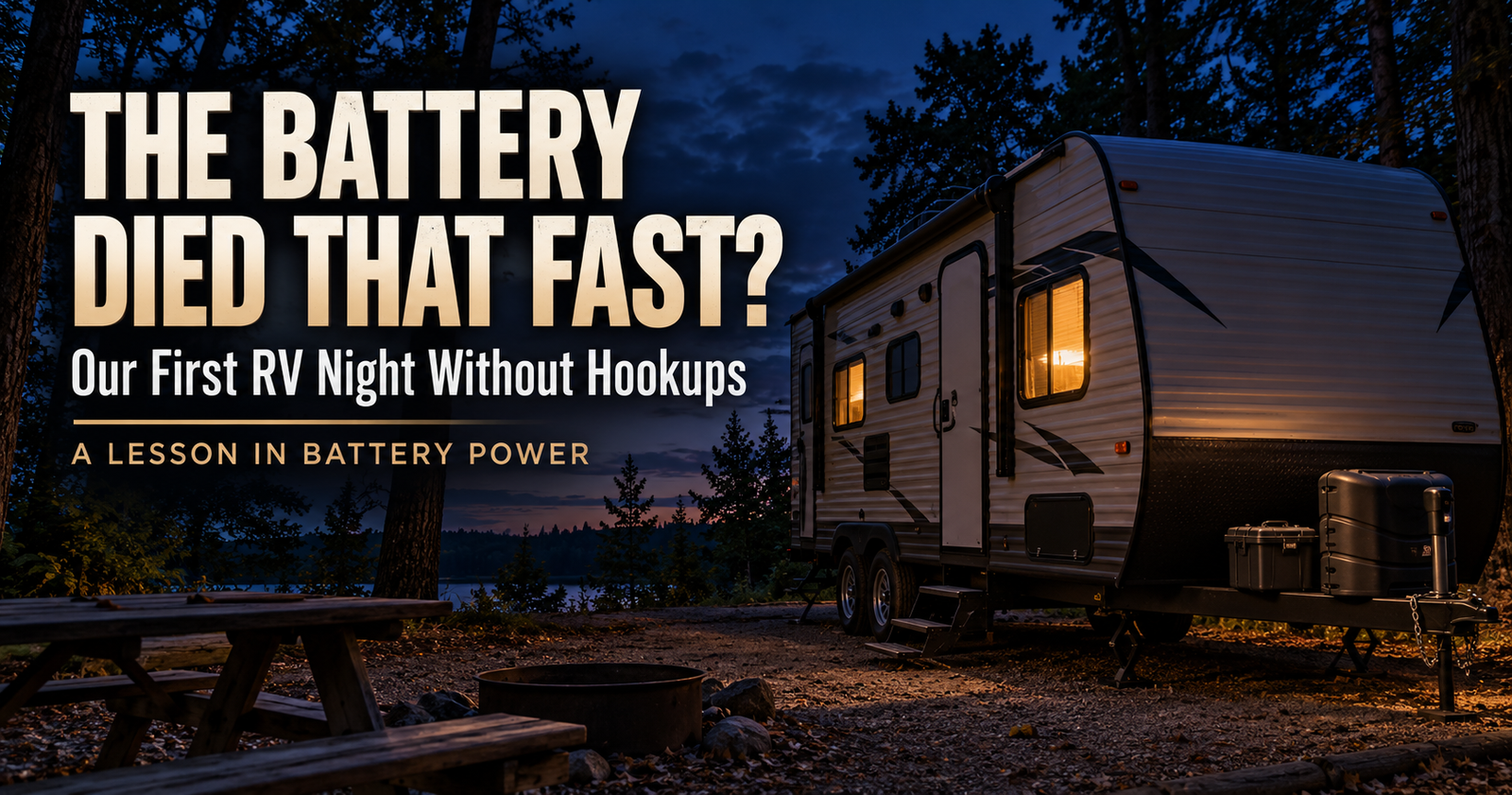
We learned how quickly 12-volt loads can add up during our first night camping without hookups.
So if the furnace works normally on a fully charged battery but starts acting strange late in the night as the battery gets low, I’d absolutely pay attention to voltage.
Check the Outside Furnace Vent
This is another easy inspection before taking the furnace apart.
With the furnace off and safe to inspect, look at the exterior intake and exhaust area.
You’re looking for obvious obstruction.
Insects love finding places they shouldn’t be.
Mud daubers, spider webs, debris, and other obstructions are repeatedly reported around RV furnace burner and exhaust areas.
Don’t stick random objects deep into the furnace.
Just recognize that airflow and a clean burner/exhaust area matter.
If It Lights and Then Goes Cold Again, That’s Another Problem
Suppose you actually get warm air.
Then the flame goes out.
Blower continues.
Maybe it relights.
Maybe it doesn’t.
That’s different from a furnace that never ignites in the first place.
A furnace that lights but won’t stay lit deserves its own troubleshooting path because flame sensing, propane supply, overheating, airflow, and other issues can come into play.
That’s why I don’t want this article turning into a 5,000-word list of every furnace failure ever invented.
We’re solving one problem:
The blower runs, but we’re not getting heat.
Don’t Start Replacing the Sail Switch Just Because Somebody Said “Sail Switch”
This is something I noticed repeatedly while researching real RV furnace problems.
The sail switch gets blamed for nearly everything.
Sometimes it’s absolutely the problem.
Sometimes it isn’t.
If the furnace is already reaching the point where you can clearly hear repeated ignition attempts, that tells you the startup sequence has progressed farther than a simple no-airflow condition would suggest on many furnace designs.
That’s why the exact sequence of sounds matters more to me than guessing a part from the symptom “cold air.”
What I’d Check Before Calling Someone
I’d keep this pretty short.
First, verify propane.
Then see whether another propane appliance works.
Listen for the ignition attempt after the blower starts.
Check battery voltage if you’re relying on the house battery.
Look for obvious obstruction around the exterior furnace vent.
Check the furnace fuse and thermostat settings if the behavior doesn’t make sense.
Then I’d get the furnace model number before going any deeper.
Different furnaces have different diagnostic procedures and fault codes.
When I’d Stop Messing With It
Propane changes where I’m willing to experiment.
Checking the tank?
Fine.
Checking whether the stove lights?
Fine.
Looking at the battery voltage?
Fine.
Inspecting an exterior vent?
Fine.
But if troubleshooting starts involving opening propane fittings, bypassing safety switches, defeating the sail switch, or experimenting around a burner that isn’t lighting correctly, that’s where I’d rather use the service manual or someone qualified to work on the furnace.
One RV owner I found considered bypassing a failed sail switch just to get through a cold night. The responses correctly pointed out that the switch exists as a safety device.
I wouldn’t bypass it.
The Sound Tells Me Where I’d Start
That’s the biggest takeaway.
Blower doesn’t start at all: I’m thinking power, thermostat, fuse, blower circuit, or another no-start problem.
Blower runs but I never hear an ignition attempt: I’m thinking about why the furnace isn’t progressing through the startup safety sequence.
Blower runs and I hear repeated clicking but no flame: I’m looking much harder at propane delivery, ignition, burner/orifice condition, and related components.
It actually lights but won’t stay lit: different problem again.
That’s much more useful than saying:
RV furnace blowing cold air has 17 possible causes.
Listen to what the furnace is doing.
It may already be telling you which half of the system deserves your attention.
Written by Caleb Warren
Caleb Warren writes about RV heating, campground systems, batteries, water, and practical camper troubleshooting for CamperAnswers.com. His articles focus on the actual symptom RV owners notice first, then narrow down what that symptom can tell you before expensive parts start getting replaced.