
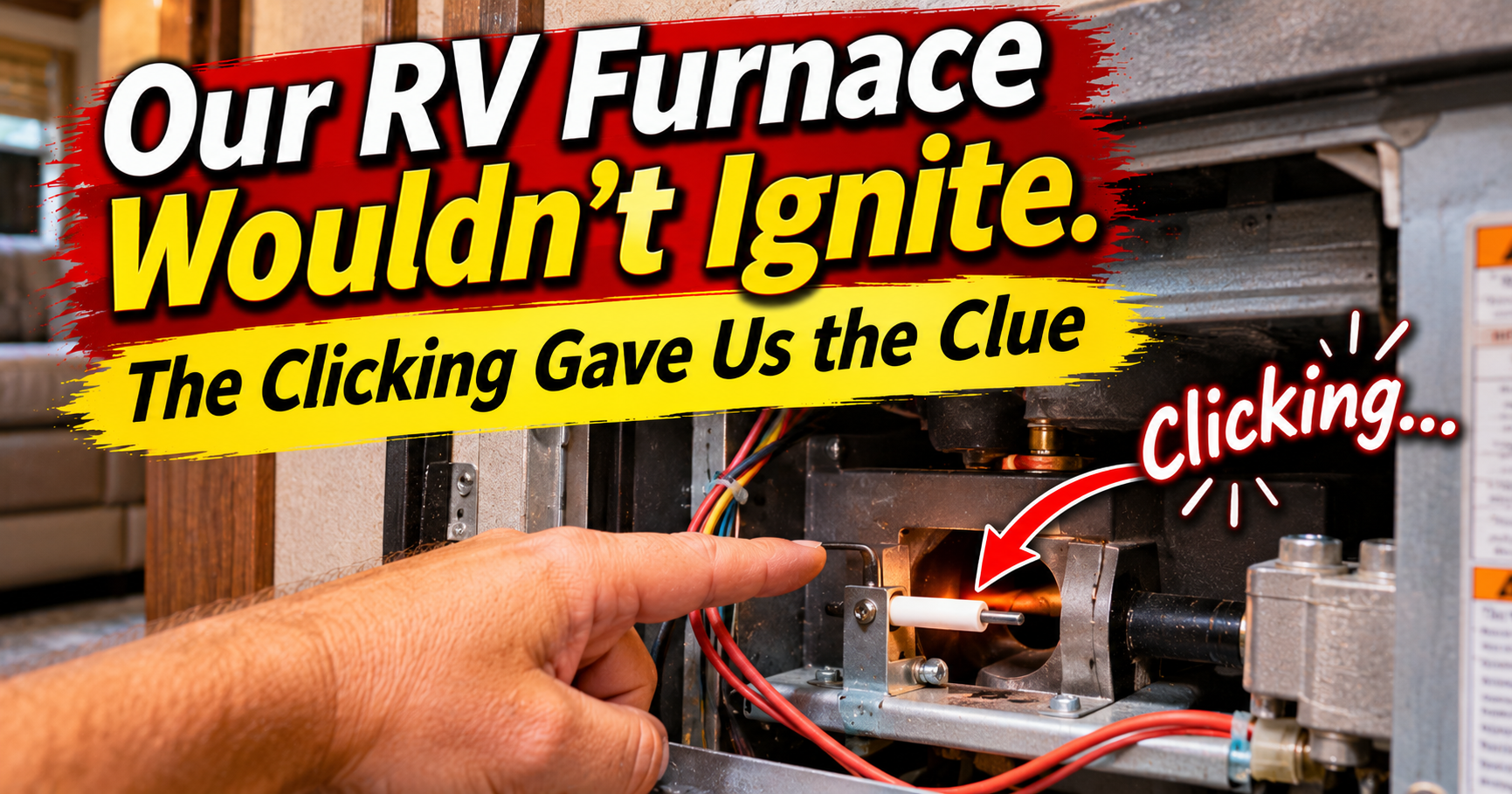
Cold air from the RV furnace is annoying.
Hearing the furnace actively trying to light over and over while you’re sitting there getting colder is somehow worse.
The blower would come on like normal.
Then after a little while:
Click. Click. Click.
Nothing.
No warm air.
Then it would try again.
That’s when I stopped thinking we had a completely dead furnace. Something was obviously happening in there. The blower worked and we could hear the ignition attempt.
The furnace just wasn’t successfully lighting.
That clicking turned out to be one of the best clues we had. If an RV furnace blower runs and you hear the igniter clicking but never get flame, I’d check whether propane is actually reaching the furnace before assuming the igniter, sail switch, or control board needs replacing.
We Started With the Propane Because It Was Easy
Before touching the furnace, I wanted to know whether we actually had propane.
Tank valve open?
Yep.
Propane in the tank?
Should’ve been.
But “should’ve been” isn’t much of a test.
So the easiest thing was the stove.
Turn a burner on and see what happens.
If the stove produces a healthy propane flame, at least I know propane is making it through part of the RV’s LP system.
If the stove doesn’t light either, suddenly I’m much less interested in tearing apart the furnace.
Now I have a propane supply problem affecting more than one appliance.
That’s an important distinction.
Running Out of Propane Can Create This Exact Situation
This is especially worth remembering if the furnace problem starts immediately after a propane bottle runs empty.
You switch bottles or refill one.
Now the stove eventually works, but the furnace still keeps trying and failing to ignite.
Air can be sitting in the propane line.
Furrion’s current furnace troubleshooting guidance specifically recommends verifying the LP valves are open and tanks aren’t empty, and notes that air in the LP line can prevent ignition after the gas supply has been interrupted.
So if this happened right after running out of propane, I wouldn’t assume the furnace conveniently broke at the exact same moment.
I’d let another propane appliance establish normal gas flow first and then retry the furnace according to its normal reset procedure.
The Clicking Means Something Important
This is what I didn’t understand at first.
An RV furnace doesn’t simply:
Thermostat calls for heat → FIRE.
It runs through a safety sequence.
The thermostat asks for heat.
The blower starts.
The furnace needs adequate airflow.
The sail switch proves that airflow.
Then the ignition sequence can proceed.
Propane is supplied and the igniter attempts to light the burner.
The furnace then has to confirm that flame actually exists.
That’s why the sounds matter.
If I can clearly hear the igniter clicking, the furnace has already progressed farther through that sequence than one where absolutely nothing happens.
Manufacturer troubleshooting information likewise uses whether the blower runs and whether the gas valve and igniter are audible as important diagnostic clues.
No Clicking Would Send Me Down a Different Path
Imagine the blower starts.
It runs.
But there’s never any clicking.
Never any obvious attempt to ignite.
That’s different.
Now I’d be thinking more about why the furnace isn’t progressing far enough through its safety sequence to attempt ignition.
Battery voltage matters.
Airflow matters.
The sail switch matters.
The furnace’s controls matter.
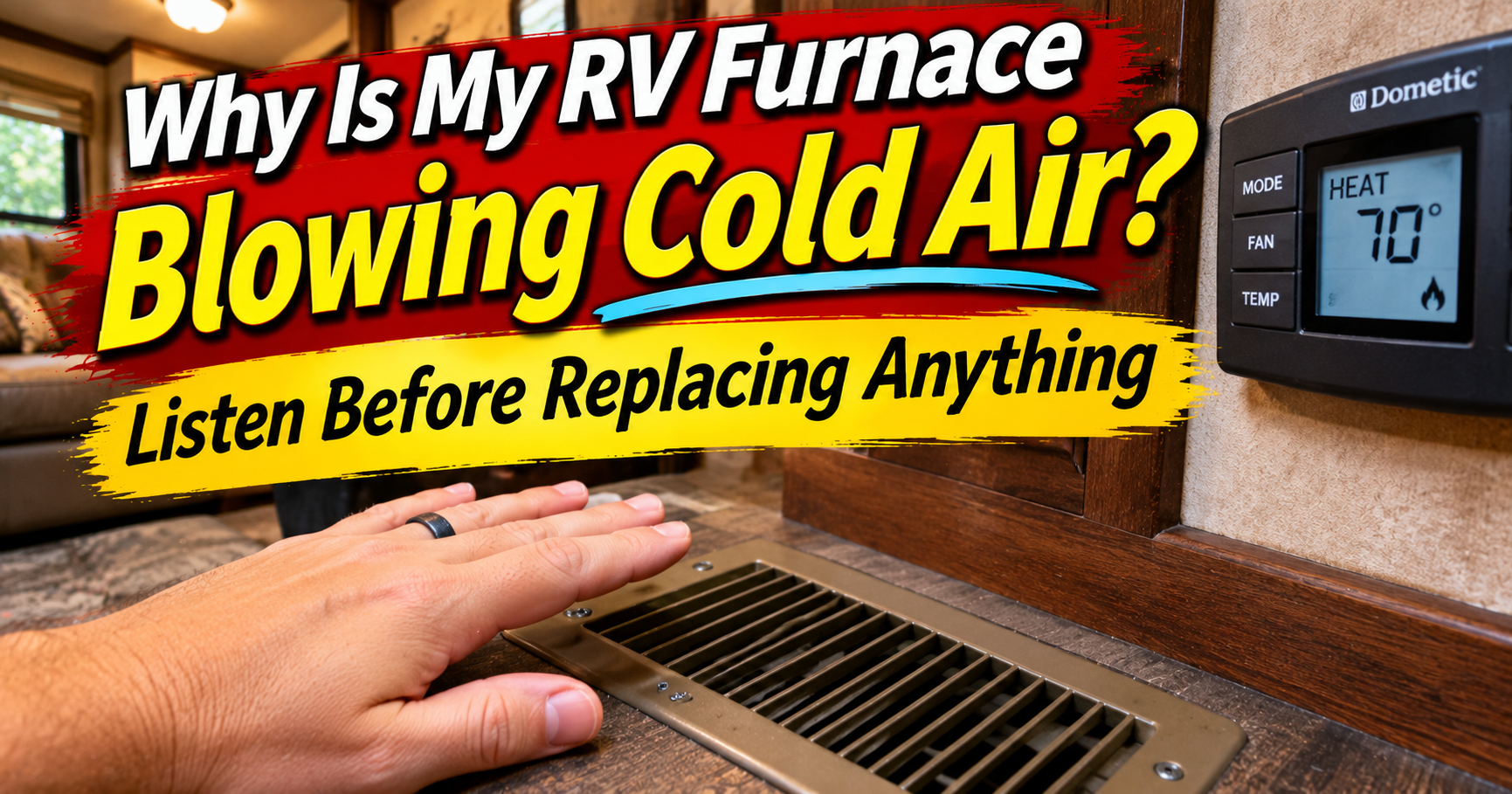
That’s why our article about an RV furnace blowing cold air approaches the problem from the sequence of events rather than immediately blaming one component.
But when I can hear repeated ignition attempts, I’m not starting by ordering a sail switch.
I Would Still Check the Battery
This seemed strange to me at first because it’s a propane furnace.
Why should the battery matter?
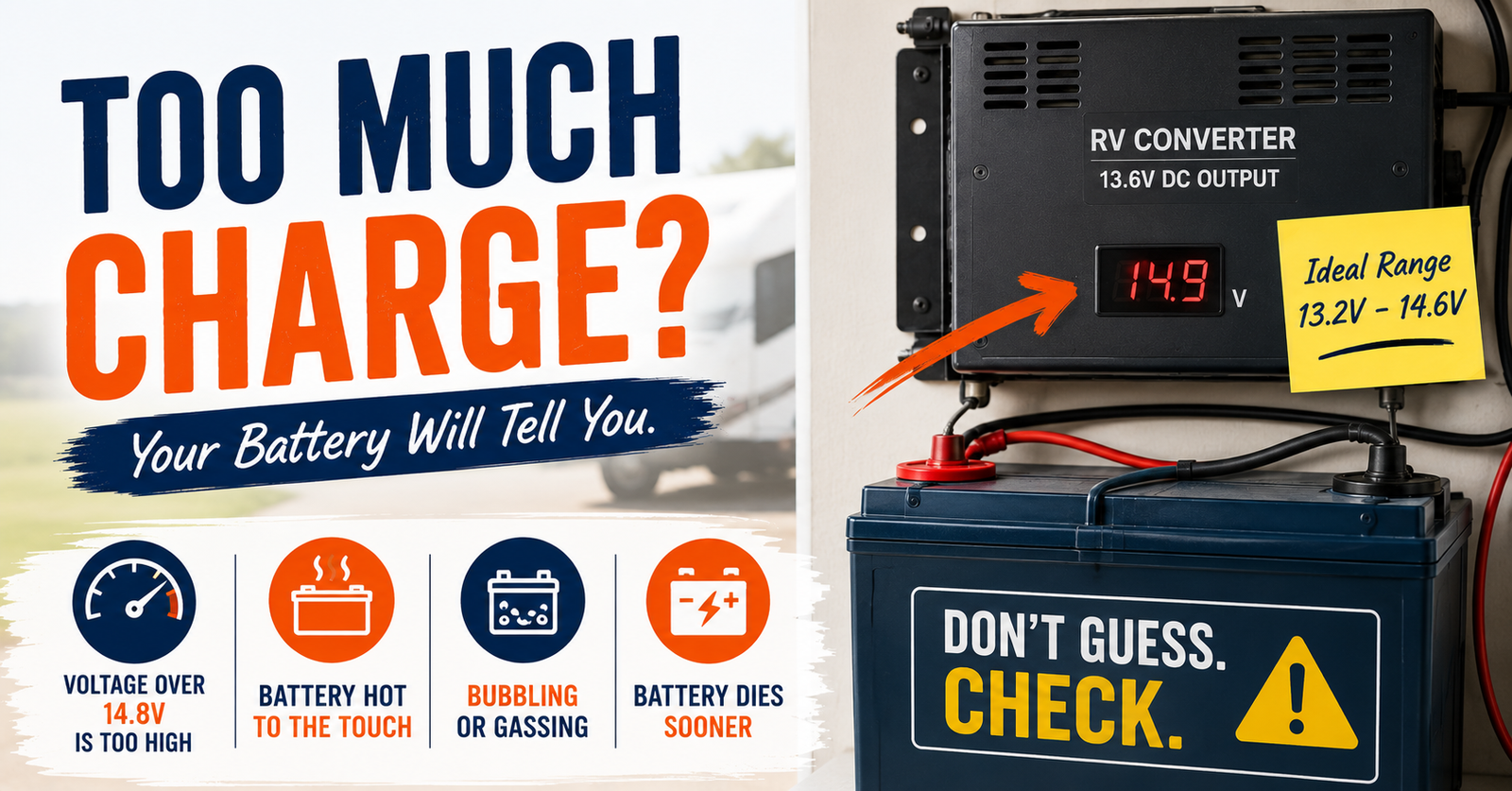
Because propane creates the heat, but 12-volt electricity runs the blower and controls.
The blower has to move enough air for the furnace’s safety system to allow ignition.
Low battery voltage can prevent the blower from reaching adequate speed, which can stop the sequence before ignition. Furnace manuals and RV troubleshooting guidance specifically identify low 12-volt power as a reason the furnace may fail to proceed normally.
This becomes especially relevant when camping without shore power.
If the furnace worked perfectly at bedtime but starts behaving strangely at 4 AM after running from the battery all night, I’d check battery voltage before buying furnace parts.
The Outside Furnace Vent Is Another Easy Check
Before taking anything apart, I’d look outside.
The furnace needs intake and exhaust airflow.
Campers sit.
Bugs move in.
Mud daubers apparently see RV appliance vents and think:
Fantastic real estate.
Leaves, dirt, nests, webs, and other debris can create problems around furnace intake, exhaust, and burner areas.
Current furnace troubleshooting guidance specifically recommends checking exterior intake and vent openings for obstruction when ignition fails.
I’m not sticking random objects deep inside the furnace.
I’m just checking the obvious before assuming an expensive component failed.
What If It Actually Lights for a Few Seconds?
Now we’ve got a different symptom.
Suppose you hear the ignition.
The burner catches.
You finally get heat.
Then a few seconds later the flame shuts down.
That tells me something completely different from a furnace that never establishes flame.
The propane and ignition systems got far enough to create a flame.
Now I’d be thinking more about whether the furnace is confirming that flame exists.
A dirty or poorly positioned flame-sensing electrode, grounding problem, or related ignition-control issue can cause a furnace to light and then shut the gas valve because the control board doesn’t confirm flame.
That’s why I don’t want to lump:
won’t ignite
and
won’t stay lit
into one giant article.
They sound similar.
The clues aren’t.
I Wouldn’t Keep Letting It Try Forever
If the furnace repeatedly attempts ignition and fails, eventually the control system can enter lockout.
That’s intentional.
It isn’t supposed to sit there endlessly releasing propane and sparking.
Different furnace models handle retries and lockout differently, so once we’ve confirmed the simple stuff, I’d find the exact furnace model and its manual rather than guessing.
The model number matters more than somebody online saying:
“Mine did that and it was definitely the board.”
Maybe theirs was.
Ours might not be.


The Stove Test Is Still One of My Favorites
Not because it completely diagnoses the furnace.
It doesn’t.
But it divides the problem quickly.
Stove doesn’t work either
Now I’m thinking propane supply, tank, regulator, valve position, or another problem affecting the LP system.
Stove works normally
Now I know propane is at least reaching another appliance.
That doesn’t prove correct gas pressure at the furnace, but it moves me farther toward the furnace itself.
That’s useful information from a test that takes about 30 seconds.
I Wouldn’t Start Replacing Parts From a Guess
This is where RV repairs can get expensive.
Someone says:
Sail switch.
Order one.
Didn’t fix it.
Someone else says:
Control board.
Order one.
Still doesn’t work.
Then:
Igniter.
Another part.
By the time the furnace finally works, you’ve replaced three perfectly good things.
I’d rather use the sequence.
What works?
What happens next?
Where does it stop?
That’s exactly how current furnace diagnostic guidance recommends approaching these systems because each successful stage rules out some earlier failures.
When I’d Stop and Call Someone
I’m comfortable checking the basic stuff.
Thermostat.
12-volt power.
Fuse.
Propane tank.
Whether the stove works.
Exterior vent obstruction.
Listening to the startup sequence.
But once I’m getting into propane valves, gas-pressure testing, burner adjustments, or bypassing furnace safety devices, I’m done experimenting.
Especially if I smell propane.
That’s not the time to keep clicking the thermostat hoping the furnace eventually changes its mind.
Shut the system down and get the gas side properly diagnosed.
That Clicking Isn’t Just an Annoying Sound
That’s probably the biggest thing I took away from the problem.
At first it sounds like:
The furnace is broken and making noises.
Once you understand the startup sequence, it becomes:
The furnace got this far and then failed.
That’s much more useful.
Blower doesn’t start?
One direction.
Blower runs but there’s no ignition attempt?
Another direction.
Igniter clicks but no flame?
Now propane delivery and ignition become much more interesting.
Flame starts and immediately dies?
Different direction again.
You don’t have to understand every component inside the furnace to use those clues.
Sometimes the camper is already telling you where to start.
You just have to listen before ordering parts.
Written by Caleb Warren
Caleb Warren writes about RV heating, campground systems, batteries, water, and the strange problems that usually announce themselves with a sound before you know what they mean for CamperAnswers.com. His articles focus on using the symptom you can actually see or hear to narrow down what deserves checking next.