
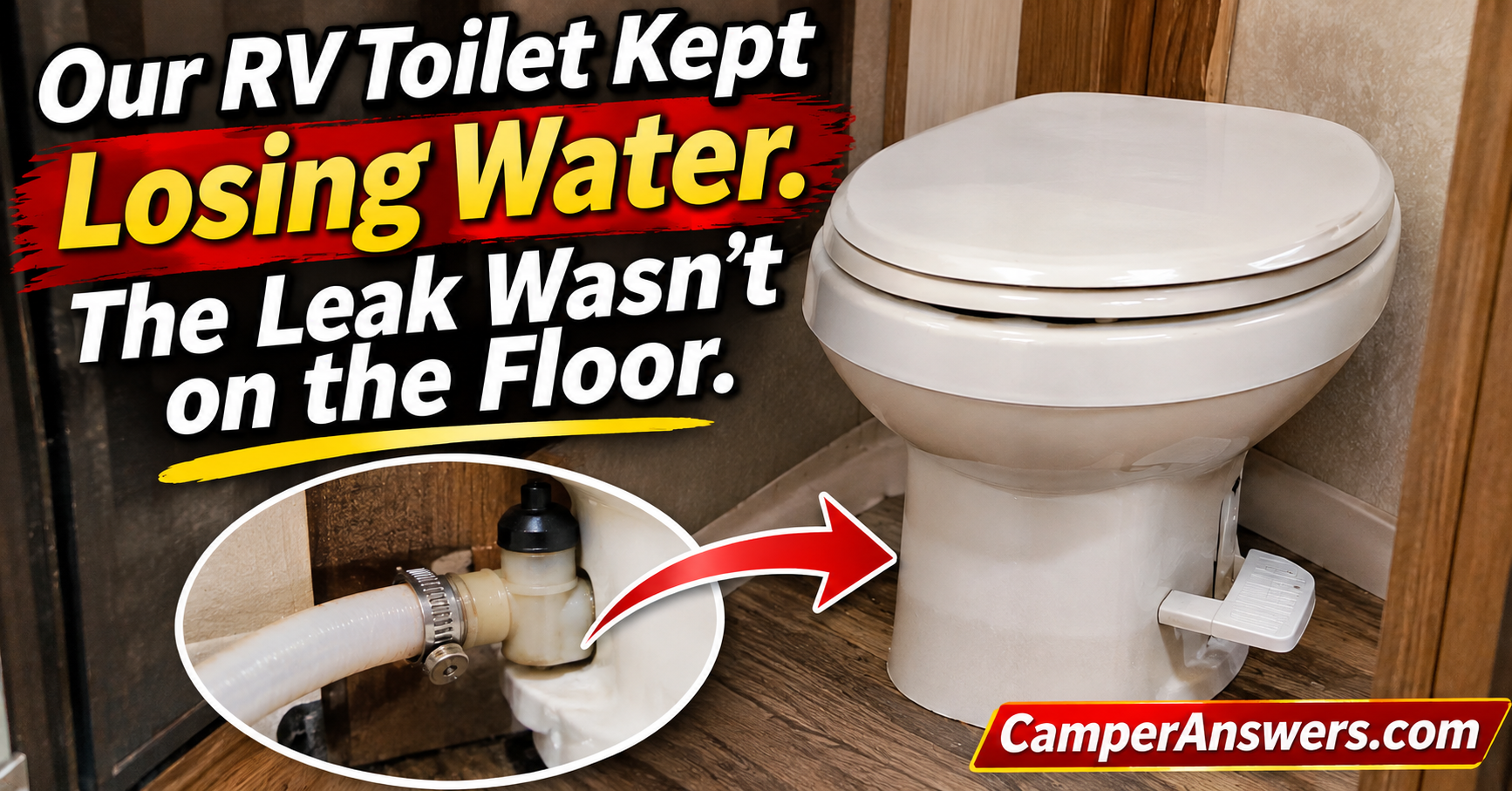
I first noticed it because the toilet bowl looked completely dry.
I added a little water with the foot pedal.
Everything looked normal.
Came back later.
Empty again.
That’s when I started looking around the base of the toilet because naturally I assumed we had a leak.
Floor was dry.
Nothing wet behind the toilet.
No water running underneath anything.
So where the heck was the water going?
The answer was actually underneath the water the entire time.
If an RV toilet won’t hold water in the bowl but the floor around it stays completely dry, the water is usually leaking past the blade or ball seal at the bottom of the bowl and slowly draining into the black tank. Before replacing the toilet, I’d clean that seal and its track thoroughly. Debris, mineral buildup, toilet paper, or a dried seal can prevent it from closing completely.
Thetford’s own troubleshooting guidance starts in basically the same place: check the blade/ball seal track for debris, check whether the seal is compressing correctly, and replace the seal if it’s worn.
Once I Realized the Floor Was Dry, the Problem Made More Sense
That was the clue.
If the water supply line behind the toilet were leaking, I’d expect water somewhere outside the bowl.
If the connection at the floor were leaking, again, I’d be looking for water where water shouldn’t be.
But everything outside the toilet was dry.
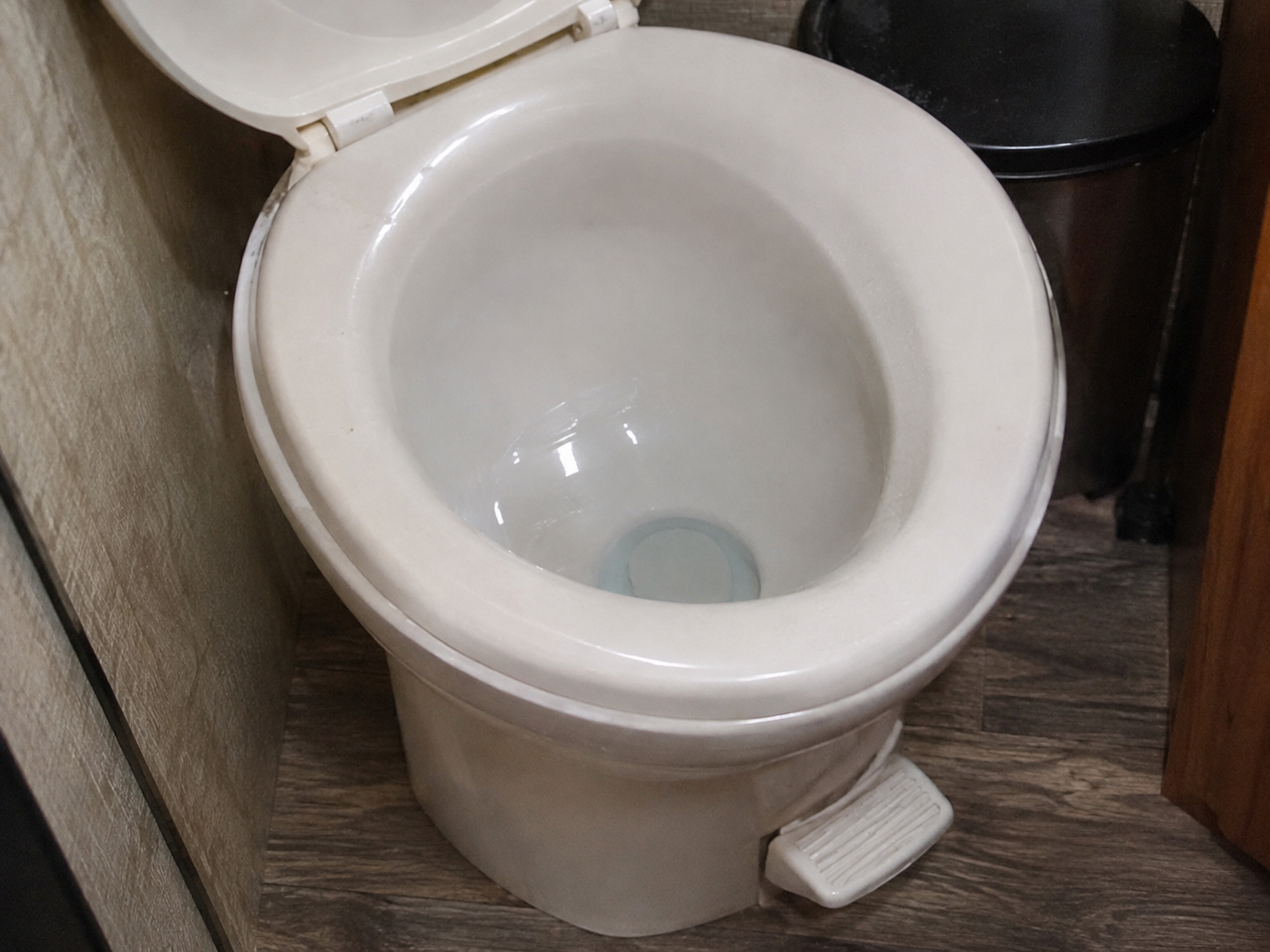
The water was simply disappearing downward.
One RV owner described essentially the same symptom: the bowl wouldn’t hold water, cleaning the seal temporarily helped, and they could actually hear the water slowly entering the black tank.
That’s a completely different problem from a toilet leaking onto the camper floor.
And thankfully, it’s usually a much nicer problem to discover.
I Would Look at the Blade Seal Before Buying Anything
Push the flush pedal and look down into the bowl.
Most RV toilets don’t work like the toilet at home.
There’s no big tank behind the bowl.
At the bottom is a valve that opens so waste drops into the black tank.
Depending on the toilet, that may be a sliding blade or rotating ball-style mechanism.
When it closes, a rubber seal around that opening needs to seal tightly enough to keep a small amount of water in the bowl.
If something prevents that seal from closing completely, you’ve basically created a tiny drain.
The water slowly disappears.
Sometimes It’s Just Something Stuck in the Seal
This is why I wouldn’t immediately order a replacement seal.
Toilet paper fibers can get where they shouldn’t.
Hard-water minerals can build up.
Sand or other debris can make its way into the water system.
The seal itself can get dirty.
Thetford specifically recommends checking for debris in the seal track before replacing the seal.
And RV repair guidance points out that calcium, lime, sand, or other material can prevent the valve from making a complete seal.
So cleaning is my first move.
I Don’t Use Something Sharp to Dig Around the Seal
It’s rubber.
I don’t want to fix a dirty seal by damaging it.
I’d follow the toilet manufacturer’s cleaning instructions and use something that isn’t going to cut or gouge the seal.
The goal is simply to get whatever is preventing the valve from closing completely out of there.
I’d also clean around the mating surface of the blade or ball itself.
A seal can be perfectly good and still leak if something is sitting between the two surfaces.
Then I’d Put Some Water in the Bowl and Wait
This is the easiest test.
Close the valve.
Add enough water that the level is obvious.
Take a picture with your phone if you want an easy reference.
Come back later.
Did the water level stay basically where you left it?
Great.
Did it slowly disappear again?
Then cleaning alone didn’t solve it.
Now I’m more interested in the condition of the seal itself.
Rubber Seals Don’t Last Forever
An RV toilet seal lives a pretty rough life.
It gets wet.
Then the camper may sit unused.
It can dry out.
It gets exposed to cleaners.
Hard water.
Temperature changes.
Repeated opening and closing.
Eventually the rubber can become stiff, cracked, distorted, or simply stop sealing as well as it used to.
Thetford says that if the blade/ball seal is worn and no longer sealing correctly, replacement is the next step.
That’s still a very different repair from replacing the entire toilet.
The Bowl Is Actually Supposed to Hold Some Water
This was another thing I didn’t really think about until ours wouldn’t.
A little water sitting in an RV toilet bowl isn’t just there because that’s what toilets look like.
That water helps create a barrier between the inside of the camper and the black tank below.
If the bowl stays bone dry because the seal leaks, black-tank odors have an easier path upward.
Current RV toilet guidance specifically recommends maintaining some water in the bowl after flushing to help seal against odors.
So if your bathroom suddenly starts smelling like the black tank and the toilet bowl keeps going dry, those two symptoms may be related.
This Is Different From the Toilet Continuously Running Water
Here’s another distinction I want to keep clear.
Our problem is:
I put water in the bowl and it slowly disappears.
Another RV owner may have the opposite problem:
Water keeps entering the bowl and won’t stop.
That’s a different issue involving the water valve, foot pedal mechanism, or something preventing the valve from shutting correctly.
We’re going to keep that as its own article because Ubersuggest shows “RV toilet keeps running” at SD 15.
I don’t want this page turning into another giant article that tries to solve every possible RV toilet problem.

Don’t Forget What Is Directly Under the Toilet
The black tank.
If the bowl water leaks past the seal, it hasn’t vanished.
It has simply joined everything else down there.
That usually isn’t a big deal by itself.
But it explains why you can have a completely dry camper floor while the toilet bowl mysteriously empties over and over.
Once I understood that, the problem stopped feeling like some hidden plumbing leak inside the camper.
The toilet was leaking internally.
I’d Be Careful With Household Cleaners Too
RV toilet seals aren’t something I’d attack with whatever aggressive cleaner happens to be under the kitchen sink.
Manufacturer guidance warns against certain harsh or highly concentrated cleaners because they can damage toilet components and rubber seals. Thetford also recommends compatible seal lubricant or silicone products for the blade/ball mechanism rather than petroleum-based sprays.
If I’m trying to save an existing rubber seal, damaging it with the wrong chemical seems pretty counterproductive.
What If Cleaning Fixes It for a While and Then It Starts Again?
That would make me look more closely at the seal condition and the water we’re putting through the camper.
Maybe debris keeps getting into the seal.
Maybe hard-water deposits are building up.
Maybe the seal is simply worn enough that cleaning temporarily helps but can’t restore it permanently.
That’s exactly the pattern one RV owner reported: cleaning initially restored the seal, but the toilet later stopped holding water again.
At that point, replacing the seal starts making much more sense.
I Would Get the Toilet Model Before Ordering a Seal
This is another lesson I’ve learned from working on just about anything.
Don’t order:
RV toilet seal
and hope for the best.
Find the manufacturer.
Find the toilet model.
Then get the correct replacement seal or seal kit for that model.
Thetford alone has multiple permanent RV toilet models, and other campers may use Dometic or another manufacturer.
A five-minute model-number check can save you from having the toilet apart while discovering the new seal doesn’t fit.
This Problem Is Gross, but It’s Actually Pretty Simple
That’s probably what surprised me most.
An RV toilet that won’t hold water sounds like:
Great. Something is wrong with the plumbing.
But if the floor is dry and the water simply disappears from the bowl, the troubleshooting path gets much smaller.
Look at the seal.
Clean the seal and track.
Test it again.
If it still leaks, inspect the seal condition.
Replace the correct seal if it’s worn.
That’s essentially the same troubleshooting order the manufacturer recommends.
No reason to start pulling plumbing apart behind the camper.
And I’d Rather Fix This Before the Bathroom Starts Smelling
A bowl that won’t hold water can be easy to ignore.
You flush.
Everything goes down.
Technically the toilet still “works.”
But that little bit of standing water is useful.
Once the bowl started staying dry, I’d fix the seal rather than making it part of the camper’s personality.
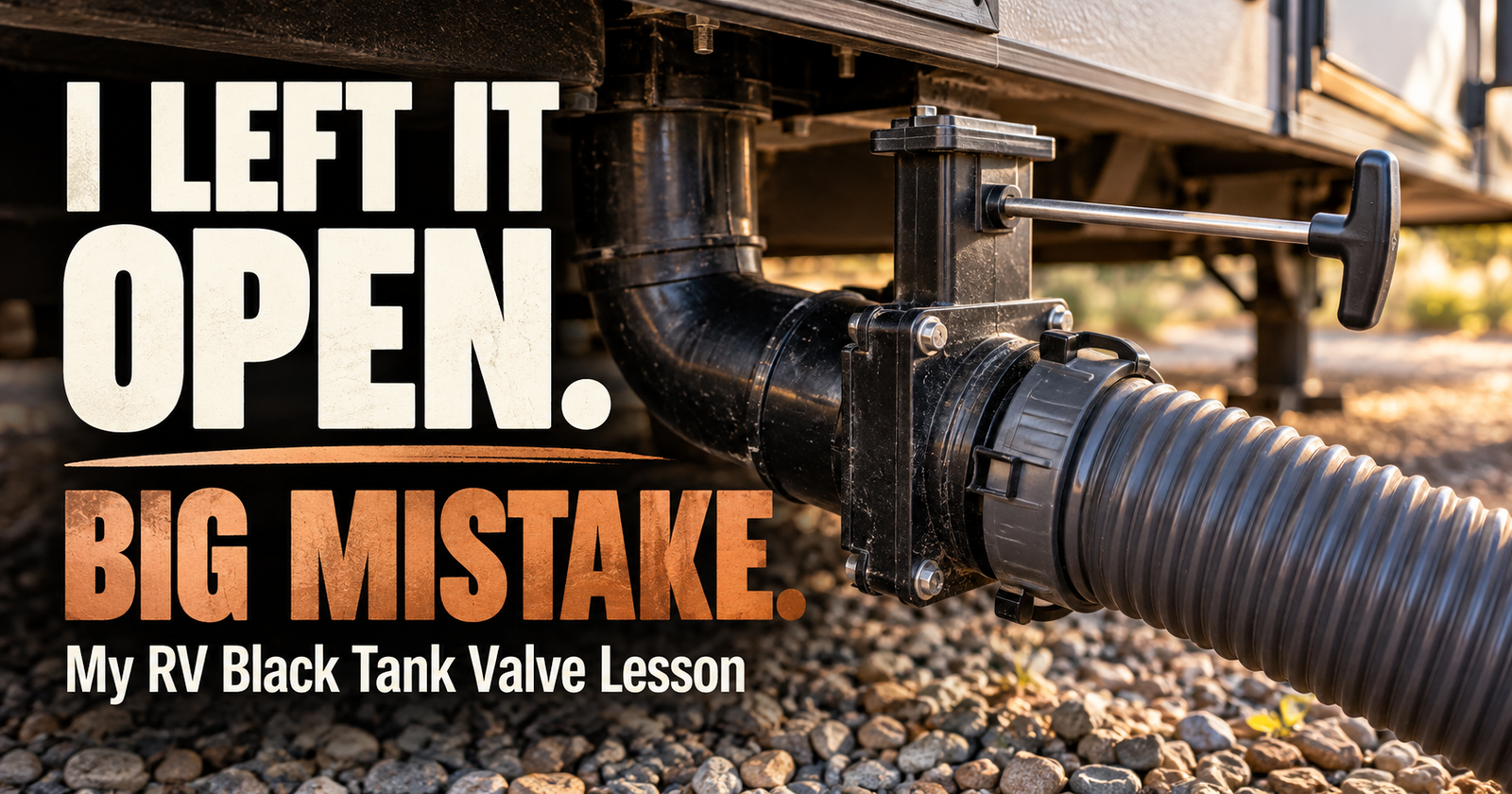
We’ve already learned with the black tank valve mistake that RV waste systems work much better when you let them operate the way they were designed instead of getting used to weird behavior.
A toilet bowl that won’t hold water is another one of those little warnings.
The Dry Floor Was the Best Clue
That’s what I’d remember if this happened again.
Water in bowl.
Come back.
Water gone.
Floor dry.
Instead of hunting around the camper for some invisible water leak, I’m looking straight at the blade or ball seal at the bottom of the bowl.
Sometimes the easiest RV problems to solve are the ones where you stop asking:
“Where did the water go?”
and start asking:
“What’s directly underneath it?”
In this case, that’s the black tank.
And there’s one little rubber seal standing between the two.
Written by Caleb Warren
Caleb Warren writes about RV toilets, holding tanks, water systems, campground problems, and the little camper issues that are usually much easier to fix once you figure out where the symptom is actually coming from for CamperAnswers.com. His articles focus on practical troubleshooting before expensive parts get blamed.