
It was one of those hot camping days where the air conditioner wasn’t optional.
The RV AC had been running and everything seemed fine.
Then somebody mentioned that it was getting warmer inside.
I remember thinking that couldn’t be right because I could still hear the air conditioner running.
So I put my hand under one of the vents.
Barely anything.
The AC sounded like it was doing its job, but hardly any air was coming out.
That’s when you start wondering whether the fan is dying, the air conditioner is going bad, or the poor thing simply can’t keep up with the heat.
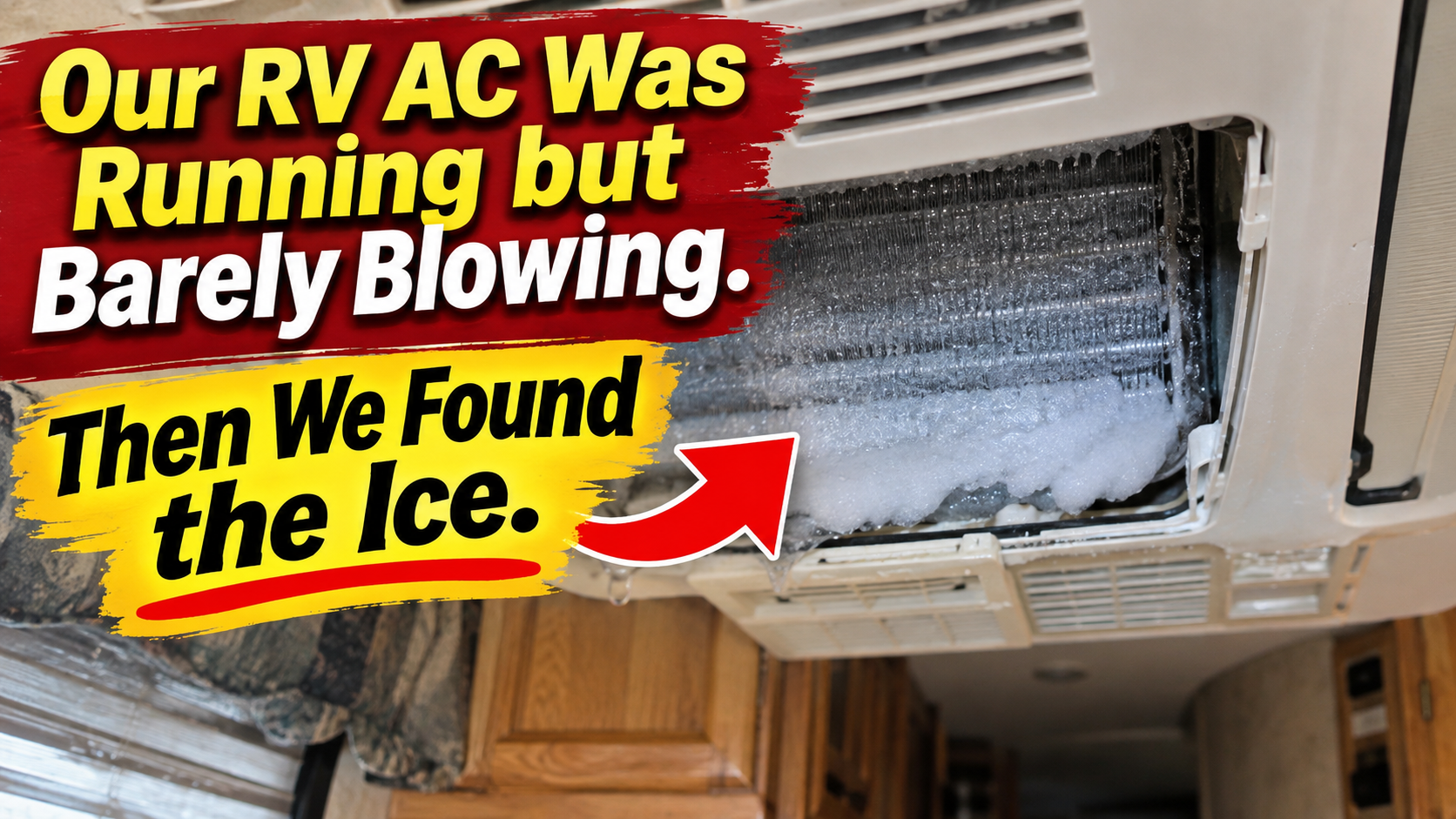
Then we found the ice.
If your RV AC starts out cooling normally but the airflow gradually gets weaker until almost nothing comes from the vents, the evaporator coil may be freezing over. Before assuming the whole AC is bad, I’d let it thaw and check the simple airflow problems first, especially the return-air filter, open vents, dirty evaporator coil, and fan operation.
Ice can actually explain why an air conditioner that’s clearly running suddenly stops cooling the camper.
What Threw Me Off Was Hearing the AC Still Running
That’s what made the problem confusing.
If the AC had completely shut off, I would’ve known immediately that something wasn’t right.
Instead, we could hear it.
The camper just kept getting warmer.
And when I checked the vents, the airflow wasn’t anything like it had been earlier.
Other RV owners describe almost exactly the same thing. The AC works normally, then airflow gradually disappears. Shut it down long enough for the ice to melt and suddenly it works again.
That pattern is a huge clue.
Ice Can Actually Block the Airflow
This was the part that finally made the symptom make sense to me.
The evaporator coil inside the AC gets cold during normal operation.
Warm camper air is supposed to keep moving across it.
Moisture condenses on that cold coil and normally drains away.
But if the coil gets cold enough, that moisture can freeze.
Then a little frost becomes more frost.
More frost restricts airflow.
Less warm air crosses the coil.
The coil gets even colder.
More ice forms.
Eventually you’ve basically created an ice-covered wall where air is supposed to move.
That’s why an RV AC can still sound like it’s running while barely blowing anything through the vents.

I Wouldn’t Keep Running It Hoping the Ice Goes Away
That was my first instinct.
It’s hot.
The AC isn’t keeping up.
Obviously the answer is:
MORE AC.
Not when it’s frozen.
Continuing to run the cooling cycle isn’t going to magically melt an evaporator that’s icing over.
I’d turn cooling off and let the ice thaw.
Depending on the particular unit and manufacturer instructions, fan-only operation may help move warmer air across the coil while it thaws. Etrailer likewise recommends thawing the evaporator and checking the airflow side before assuming the refrigerant system has failed.
And I definitely wouldn’t start stabbing at the ice with a screwdriver or anything else that could damage those thin coil fins.
The Filter Is the First Thing I’d Look At
This is the wonderfully boring possible fix.
Pull the return-air filter.
Is it covered in dust?
Pet hair?
Lint?
Whatever else has been floating around inside the camper?
That filter is sitting directly in the air path the AC needs.
Restrict that airflow enough and the evaporator doesn’t get the warm air it needs moving across it.
Several real-world freeze-up reports point right back toward airflow, filters, and dirty coils as the first things worth checking.
So before I start worrying about refrigerant or replacing an RV rooftop AC, I’m checking the cheap piece of foam I can reach from inside.


Then I Make Sure the Vents Are Actually Open
This is another easy one.
Sometimes we’re our own problem.
One part of the camper gets too cold, so somebody closes a vent.
Then another.
Maybe something gets placed over a return opening.
Now we’ve changed the airflow through the system.
If the AC is freezing, I’d open the supply vents and make sure nothing is blocking the return-air path.
I want the unit moving as much air as it’s supposed to before I blame the refrigeration system.
Low Fan Speed Can Be Part of the Pattern
This one showed up repeatedly when I looked at what actual RV owners experienced.
Some owners reported their AC freezing on LOW or AUTO, but behaving normally when the fan ran on high.
That doesn’t mean everyone should blindly leave every RV AC on high forever.
But if mine repeatedly freezes while airflow is low and stops freezing when airflow improves, that’s a useful clue.
I’d want to know whether the blower is actually operating correctly at every commanded speed.
One owner discovered the compressor was running while the fan wasn’t operating on certain settings because a fan-speed wire had been damaged. The result was exactly what you’d expect: the coil iced over.
That’s much more useful than simply saying:
AC freezes because it’s hot outside.
A Dirty Evaporator Coil Can Hide Behind a Clean Filter
This is where I’d go next if the filter looks fine.
The coil itself can collect dirt.
Once those thin fins get coated, airflow across the evaporator drops.
And we’re right back to the same basic problem.
Not enough warm air crossing a very cold coil.
So if the AC repeatedly freezes after thawing and the filter isn’t the issue, I’d want the evaporator inspected and cleaned correctly.
I’d follow the AC manufacturer’s cleaning instructions rather than spraying whatever chemical happens to be sitting in the garage onto the rooftop unit.
Humidity Makes the Ice Problem Easier to Notice
Think about what happens on a humid day.
There’s a lot of moisture in the air.
That moisture is being pulled across a cold evaporator.
Normally it condenses as water.
But if the coil falls below freezing, you’ve now got plenty of moisture available to become ice.
That’s why a marginal airflow problem may suddenly become obvious during hot, humid camping weather.
The humidity isn’t necessarily the only thing wrong.
It can expose a problem that wasn’t as noticeable under easier conditions.
If It Thaws and Freezes Again an Hour Later, We Haven’t Fixed It
This is probably the most important part.
Turn the AC off.
Wait.
Ice melts.
Turn it back on.
Cold air!
Problem solved?
Not necessarily.
One RV owner described exactly that pattern: shutting the AC down for about an hour restored airflow, only for the unit to freeze again roughly an hour later.
Thawing fixed the ice.
It didn’t fix whatever caused the ice.
If it keeps coming back, I keep troubleshooting.
The Freeze Sensor Is Another Possibility
Some RV air conditioners use a freeze sensor positioned at the evaporator coil.
Its job is pretty much what the name suggests.
It helps prevent the evaporator from becoming a block of ice.
If that sensor comes loose, is positioned incorrectly, or fails, the AC may not respond correctly as the coil approaches freezing.
Owners have reported freeze sensors coming out of position and repeated icing until the sensor issue was corrected.
That’s farther down my list than a dirty filter or blocked airflow, but it’s absolutely something I’d investigate if the easy checks don’t solve it.
And Yes, Refrigerant Problems Can Cause Freezing Too
This is where I’d stop pretending every frozen RV AC is a five-minute DIY fix.
Restricted airflow is common.
But low refrigerant can also contribute to evaporator icing. RV AC troubleshooting resources specifically identify restricted airflow and low refrigerant as possible freeze-up causes.
If I’ve got:
Clean filter.
Clean coil.
Good airflow.
Fan operating properly.
Vents open.
Freeze sensor where it belongs.
And the evaporator still repeatedly freezes…
I’m ready for someone qualified to diagnose the refrigeration side.
Many rooftop RV air conditioners are sealed systems, so this can become a repair-versus-replacement question rather than something I want to experiment with at the campsite.
The Weak Airflow Was the Clue I Wish I’d Recognized Earlier
That’s what I’d pay attention to next time.
Not just:
Is the air cold?
But:
Is the amount of air changing?
If an RV AC starts the afternoon blowing hard and cold, then a couple hours later I can barely feel air from the same vents even though the unit is still running, I’m thinking about ice.
I’d shut the cooling cycle down before letting the problem get worse.
Then:
Check the filter.
Open the vents.
Check the return.
Let the evaporator thaw.
See whether the blower works correctly.
Inspect the coil.
And watch what happens after restarting.
That’s a much better plan than sitting in a camper that’s getting hotter while repeatedly lowering the thermostat from 72 to 68 to 65 like the AC just needs more encouragement.
Because once that evaporator becomes a block of ice, setting the thermostat colder isn’t going to win the argument.
The AC is already plenty cold.
That’s the problem.
Written by Caleb Warren
Caleb Warren writes about RV air conditioners, furnaces, campground systems, water, electrical problems, and the strange camper symptoms that make a lot more sense once you figure out what changed first for CamperAnswers.com. His articles focus on the clues RV owners actually notice at the campsite and the simple checks worth making before an expensive part gets blamed.