
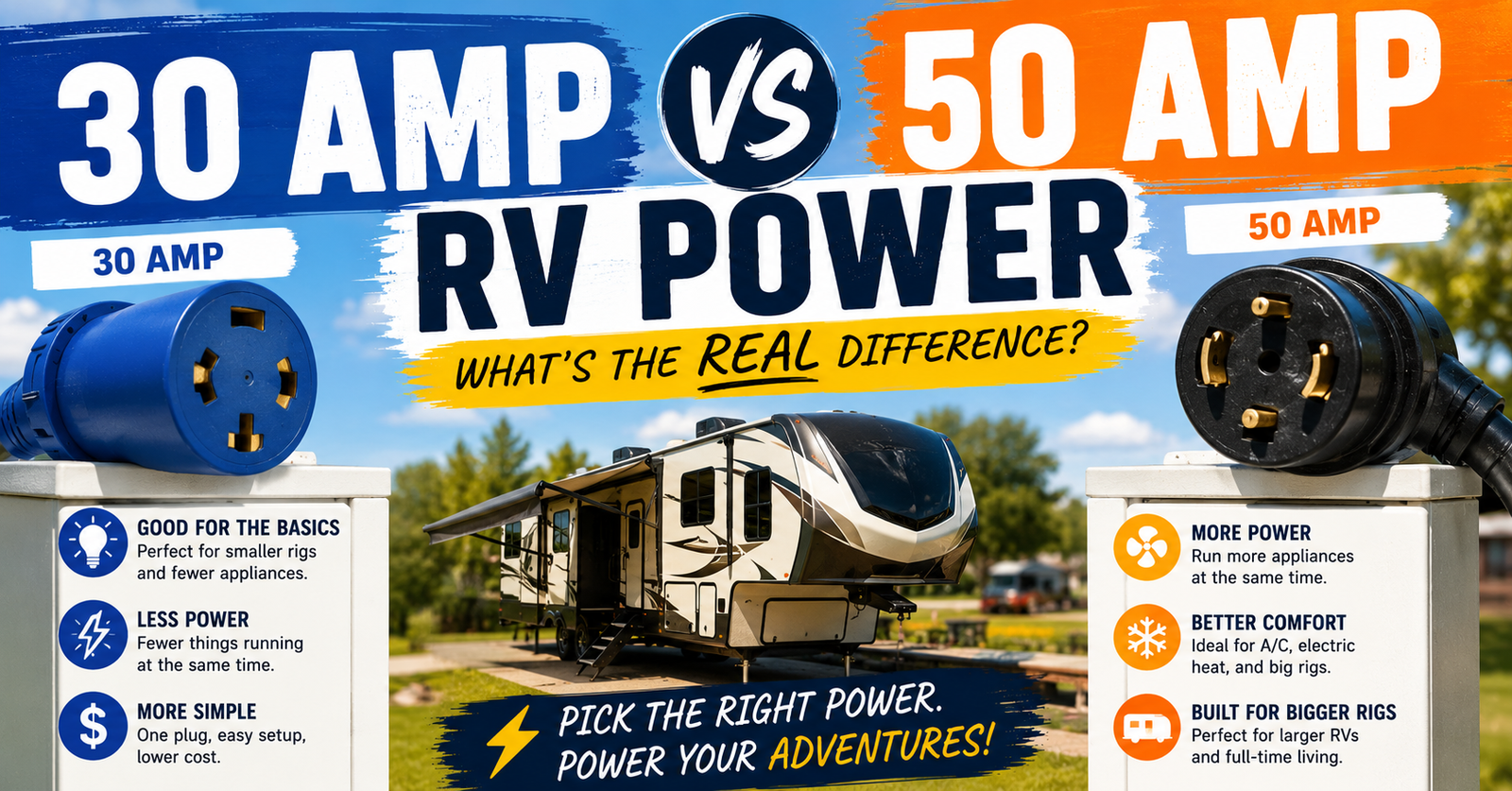
The first time somebody told me a 50 amp RV actually has more than three times the available power of a 30 amp RV, I thought that sounded wrong. Fifty isn’t even twice thirty, so how in the world could the difference be that big?
But that’s exactly what makes 30 amp vs 50 amp RV service so confusing.
A 30 amp RV has one 120-volt hot leg and can use up to about 3,600 watts. A 50 amp RV has two 120-volt hot legs, each capable of supplying 50 amps, giving the RV up to about 12,000 watts of total available power.
That’s a massive difference, and you can actually feel it when you’re camping.
In a 30 amp camper, you may find yourself thinking about whether the air conditioner, microwave, water heater, and coffee maker should all be running together. If you want to avoid adding the coffee maker to that load, fire-free camping coffee methods covers ways to make camping coffee without a fire.
With 50 amp service, there’s considerably more breathing room.
Once you understand why, those strange-looking campground plugs and all the talk about adapters start making a lot more sense.
30 Amp vs 50 Amp RV Power at a Glance
Here’s the easiest way I know to understand the difference.
30 amp RV service:
120 volts × 30 amps = 3,600 watts
50 amp RV service:
120 volts × 50 amps × 2 hot legs = 12,000 watts
That’s why simply comparing “30” to “50” is misleading.
You’re not comparing 30 amps with only 50 amps of total RV capacity.
A 50 amp RV connection provides two separate 120-volt, 50-amp legs.
That gives you more than three times as much total available wattage.
Why Do RVs Have 30 Amp and 50 Amp Service?
It mostly comes down to how much electricity the RV is expected to need.
A smaller travel trailer with one air conditioner, a microwave, a refrigerator, and relatively modest electrical equipment may get along perfectly well with 30 amp service.
Move into a large fifth wheel or Class A motorhome with two or three air conditioners, residential-style appliances, electric fireplace, washer and dryer, and other electrical equipment, and 3,600 watts starts looking pretty small.
That’s where 50 amp service makes sense.
It’s not necessarily that one type is “better.”
It’s about having enough electrical capacity for the camper.
How Do I Know If My RV Is 30 Amp or 50 Amp?
Look at the shore power plug.
A typical 30 amp RV plug has three prongs.
A typical 50 amp RV plug has four prongs.
That’s usually the quickest giveaway.
The 30 amp RV connection has:
One hot
One neutral
One ground
The 50 amp connection has:
Two hots
One neutral
One ground
That extra hot conductor is the secret behind the huge difference in available power.
A 30 Amp RV Has 3,600 Watts Available
The math is simple.
Watts = volts × amps.
So:
120 volts × 30 amps = 3,600 watts.
That means your entire RV is sharing roughly 3,600 watts of available shore power.
And 3,600 watts sounds like plenty until you start adding up appliances.
Imagine the air conditioner is running.
Then somebody turns on the microwave.
The electric water heater is already heating.
Someone plugs in a hair dryer.
Now we’re asking quite a bit from that 30 amp connection.
That’s when you can find yourself walking outside to reset a breaker.

A 50 Amp RV Has Up to 12,000 Watts Available
Here’s where things get interesting.
People sometimes calculate:
120 volts × 50 amps = 6,000 watts.
And then assume that’s the answer.
It isn’t.
A standard 50 amp RV service has two 120-volt hot legs, each capable of supplying 50 amps.
So you effectively have:
120 × 50 = 6,000 watts on one leg
and
120 × 50 = 6,000 watts on the other leg.
Together:
12,000 watts of potential power.
That’s also why you’ll sometimes see 50 amp RV service described in terms of 120/240 volts. The two hot legs are opposite each other electrically, so there is 240 volts measured hot-to-hot, while typical RV branch circuits use 120 volts from either hot leg to neutral.
Does That Mean My 50 Amp RV Uses 240-Volt Appliances?
Not necessarily, and this is where I’d be careful with the terminology.
The pedestal connection provides the two legs that make 240 volts available when measured between them.
But the typical RV distributes those legs to 120-volt circuits.
So your microwave doesn’t suddenly receive 240 volts.
Your outlets aren’t suddenly 240 volts.
One group of circuits can be supplied by one 120-volt leg while another group is supplied by the other.
That allows the RV to spread a large electrical load across both sides.
Why Does a 50 Amp RV Need So Much More Power?
Usually because there’s simply more stuff inside.
Think about a large fifth wheel.
It might have two air conditioners.
Maybe three.
An electric fireplace.
A large microwave.
Electric water heating.
Residential refrigerator.
Washer.
Dryer.
Coffee maker.
Televisions.
Kitchen appliances.
Battery charging equipment.
And all the normal electrical odds and ends people bring camping.
You won’t necessarily run everything simultaneously, but having 12,000 watts available gives you considerably more freedom.
Is 30 Amp Enough for an RV?
Absolutely.
Thousands upon thousands of campers operate perfectly well on 30 amp service.
You just have to understand its limits.
The biggest issue isn’t usually running one major appliance.
It’s running several major electrical loads at the same time.
That’s why people with 30 amp campers quickly develop little habits.
Maybe you turn the electric water heater off before running the microwave.
Maybe you don’t use the hair dryer while the microwave and air conditioner are both running.
You learn which combinations your camper tolerates.
It becomes second nature.
What Uses the Most Electricity in an RV?
Heating and cooling equipment tends to be where the big loads live.
Air conditioners can draw substantial power.
So can electric water heating, microwaves, electric space heaters, hair dryers, coffee makers, electric fireplaces, and similar high-wattage equipment.
The exact draw depends on the appliance, so I’d look at its label rather than relying on one generic number.
Here’s the important lesson:
Small loads add up, but large heating and cooling loads add up really fast.
That’s why a 30 amp RV owner can run into the electrical ceiling much sooner than expected.
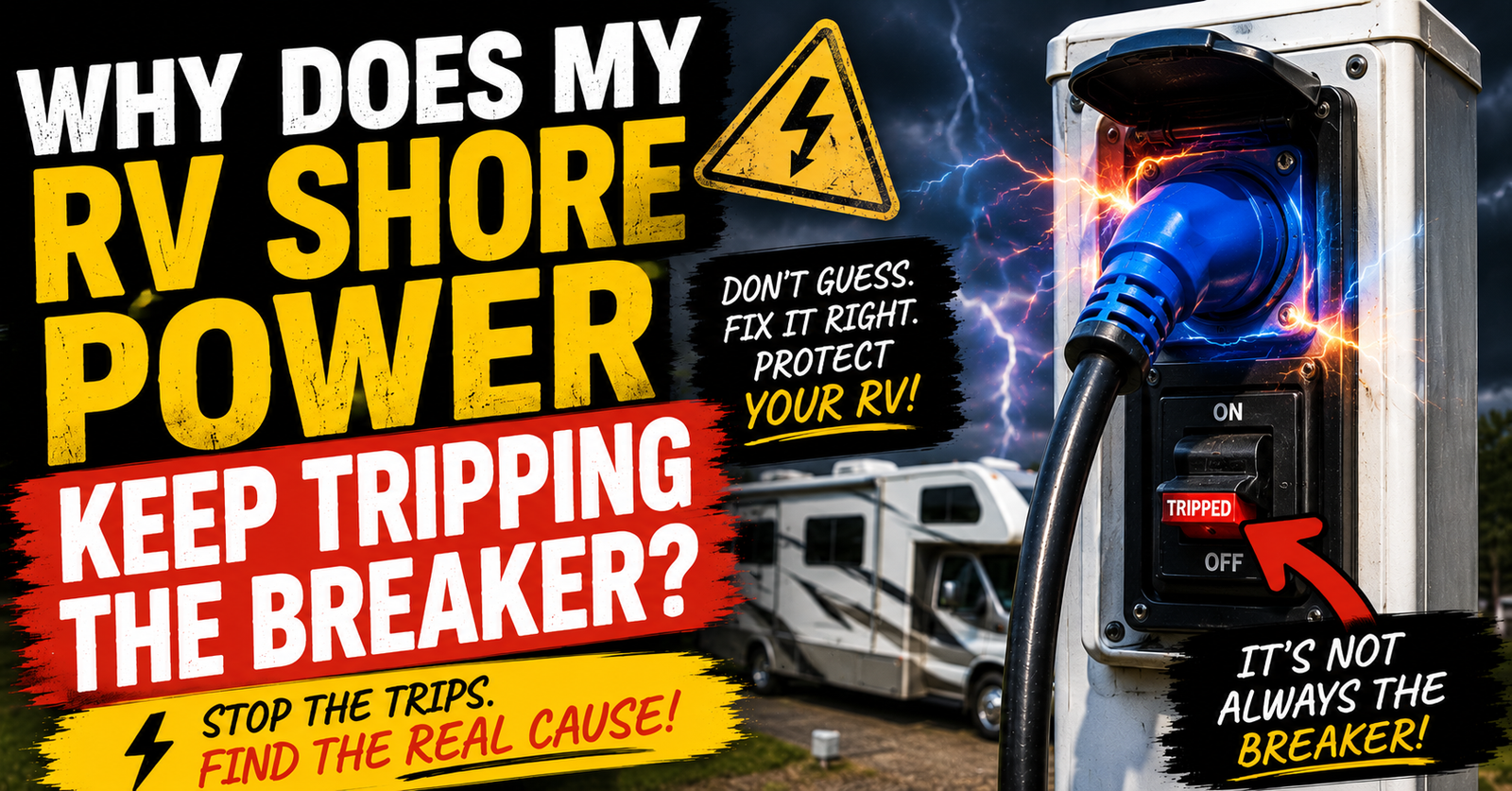
Why Does My 30 Amp Breaker Trip When Everything Seems Normal?
Start adding the loads.
Maybe the air conditioner is already running.
The converter is charging a depleted battery.
The refrigerator is operating on electric.
The water heater is on electric.
Then somebody starts the microwave.
The breaker doesn’t care that each appliance is operating normally.
It cares about the combined electrical load.
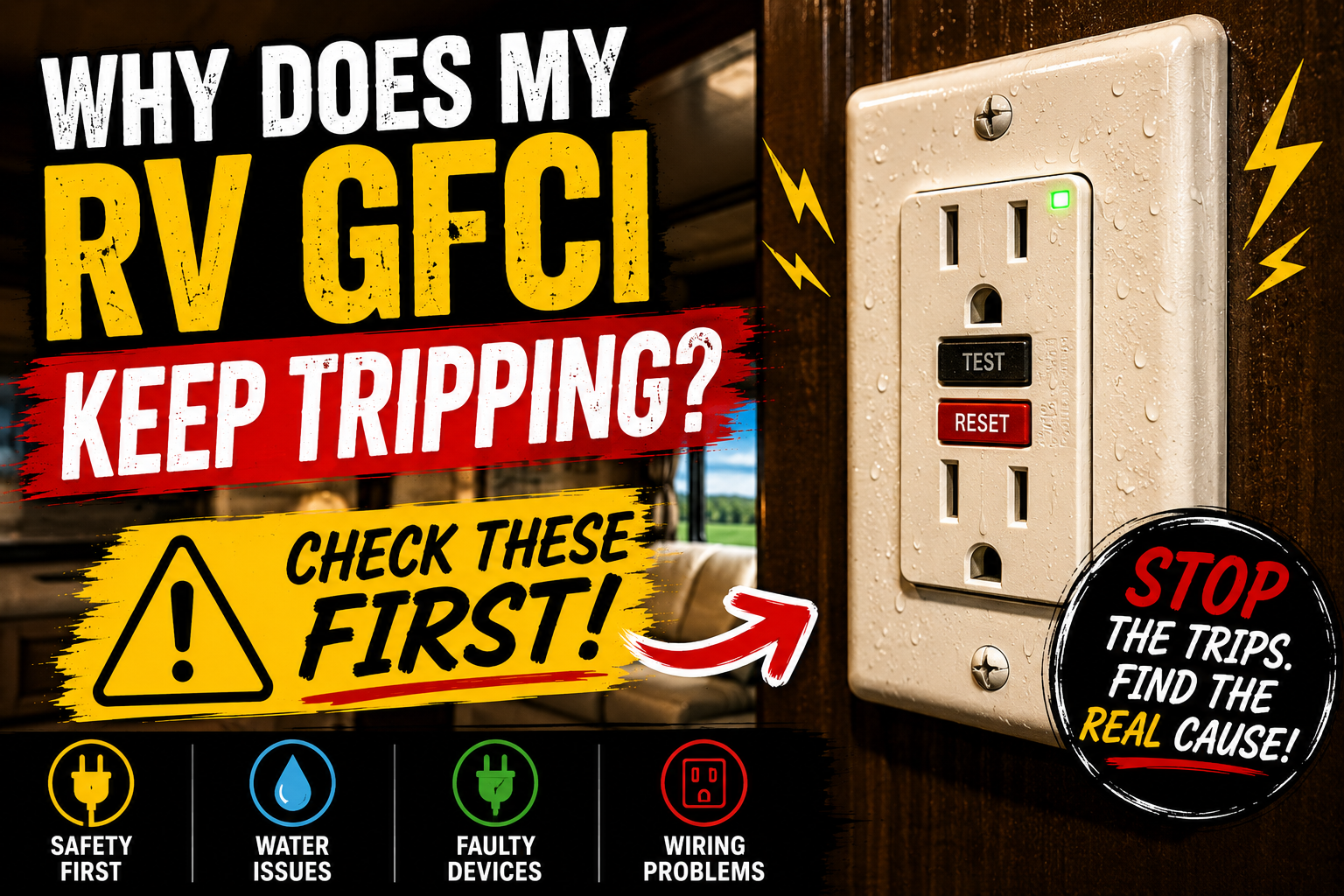
Your RV can have absolutely nothing wrong with it and still trip the breaker because you’re simply asking for more power than the circuit is designed to provide. That kind of overload is different from the fault pattern discussed in GFCI trips versus breaker overload.
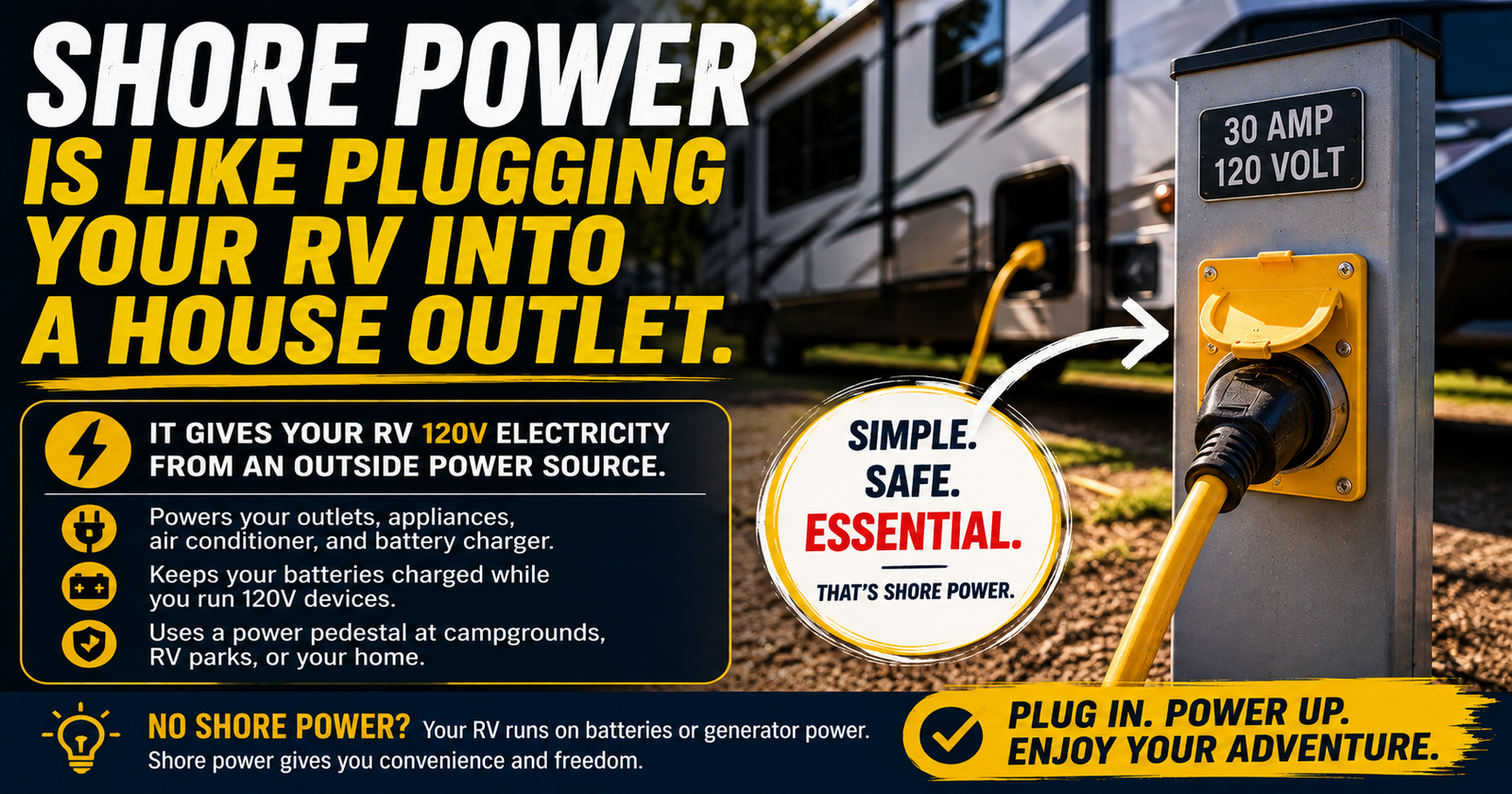
If you’re brand new to campground electricity, our simple explanation of RV shore power explains where this incoming electricity goes once you plug the camper in.
Does a 50 Amp RV Mean Every Appliance Gets More Power?
No.
That’s another important distinction.
Your 120-volt microwave doesn’t become some supercharged microwave because the RV has 50 amp service.
The difference is total available capacity.
Think of it less like increasing the pressure going into every appliance and more like making the electrical highway much wider.
You can have more things using electricity without everything trying to squeeze through one 30 amp supply.
Can I Run Two Air Conditioners on 30 Amp?
This is where I’d say maybe, but don’t assume you can.
It depends on the air conditioners, their actual running and startup requirements, what other electrical loads are operating, and whether the RV has equipment designed to manage those loads.
Two air conditioners can consume a substantial portion of a 30 amp RV’s 3,600-watt capacity.
Add a microwave or another large load and you may quickly exceed what the connection can provide.
This is one reason larger RVs with multiple air conditioners commonly use 50 amp service.
Why Can a 50 Amp RV Run More Air Conditioners?
Because it has vastly more available electrical capacity.
Remember:
30 amp = about 3,600 watts
50 amp = about 12,000 watts
That additional capacity makes it much easier to operate multiple large loads.
It’s one of those differences that doesn’t sound dramatic when somebody says “30 versus 50.”
It sounds enormous when somebody says:
3,600 watts versus 12,000 watts.
Because it is.
Can I Plug a 30 Amp RV Into a 50 Amp Campsite?
Yes, with the proper RV adapter.

A 30 amp RV can be connected to a 50 amp campground receptacle using the correct 50-to-30 adapter. The RV is still limited by its own 30 amp electrical system. Connecting it to a 50 amp pedestal doesn’t magically turn the camper into a 50 amp RV. The practical details of connecting a 30 amp RV to 50 amp service, including the adapter direction and why the RV remains limited to 30 amps, are covered separately.
That’s an important distinction.
You’re adapting the connection.
You’re not upgrading the RV.
We’ll cover this exact situation in its own article because there’s enough confusion around adapters, protection, and what actually happens electrically that it deserves a focused answer.
Can I Plug a 50 Amp RV Into a 30 Amp Campsite?
Yes, again with the correct RV adapter.
But this direction has a much more noticeable limitation.
Your RV may normally have up to 12,000 watts available on proper 50 amp service.
Now you’ve connected it to a supply with only about 3,600 watts available.
The camper can still operate, but you can’t expect to use everything the way you would on a 50 amp hookup.
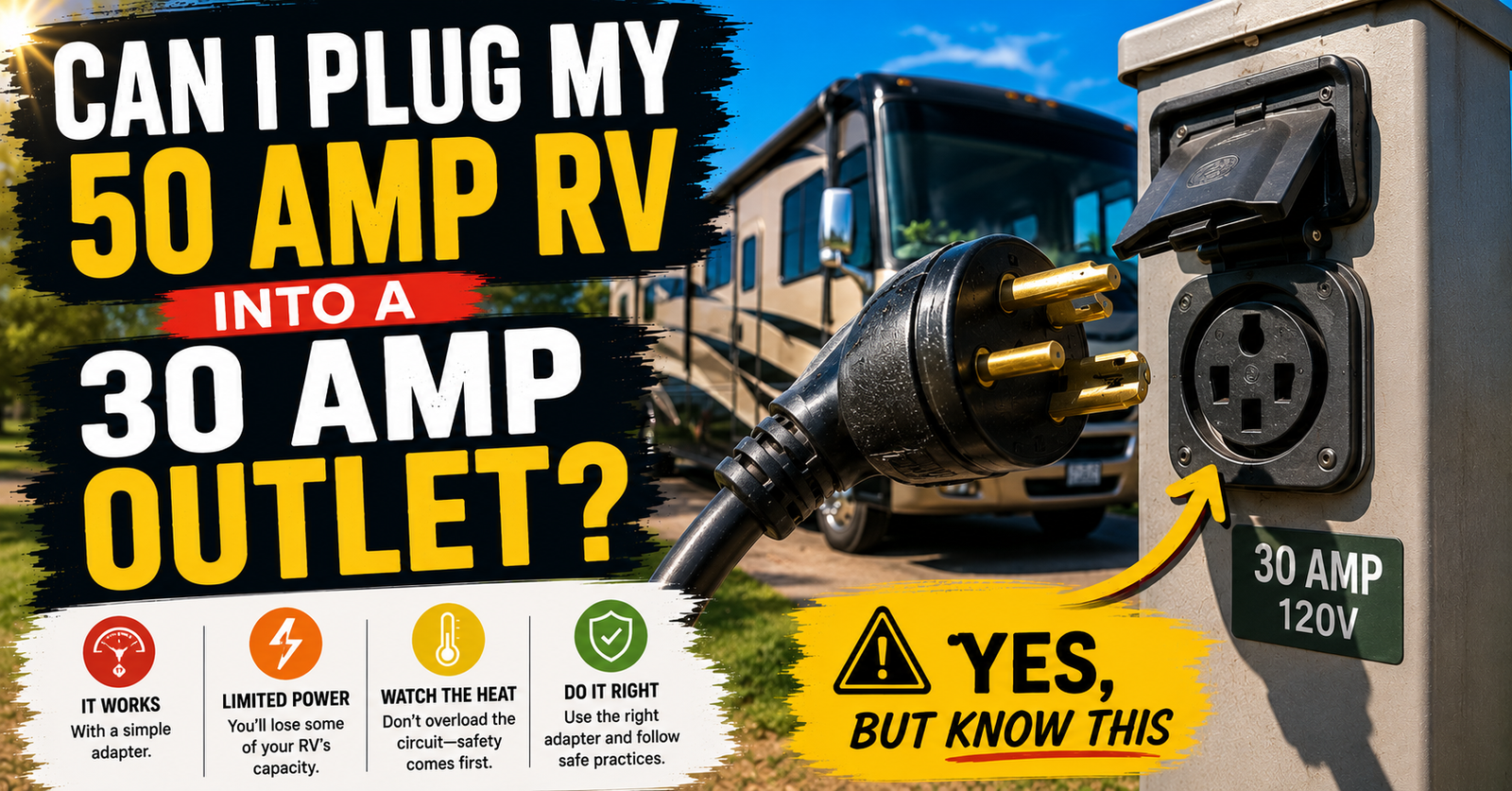
Etrailer specifically notes that a 50 amp RV connected to 30 amp service will have restrictions on how many high-demand appliances can operate simultaneously.
That’s when power management becomes important.
An Adapter Does Not Create Electricity
This is worth remembering.
A dogbone adapter changes how compatible connections connect.
It doesn’t manufacture another 8,400 watts.
If the pedestal is providing 30 amp service, you have 30 amp service available regardless of the fact that your camper normally accepts 50.
That’s why I wouldn’t look at an adapter as a power upgrade.
It’s a way to use a different available connection within its limitations.
What Is a Dogbone Adapter?
You’ll hear RV owners talk about “dogbones” all the time.
They’re simply short RV electrical adapters with a plug on one end, a receptacle on the other, and a short section of heavy cable between them.
For example, you can have an adapter that allows a 30 amp RV cord to connect to a 50 amp pedestal.
Or the opposite for a 50 amp RV connecting to 30 amp service.
I generally like the basic concept because the cable provides some flexibility instead of hanging a bulky solid adapter directly from the pedestal receptacle.
The important part is using an adapter specifically intended for the connection you’re making.
Can I Plug My 30 Amp RV Into a Dryer Outlet?
Do not assume a 30 amp household outlet is an RV outlet.
This is a potentially expensive mistake.
A standard 30 amp RV plug is the NEMA TT-30 configuration and is designed for 120-volt RV service. A 30 amp dryer receptacle can be a completely different electrical configuration.
The plugs may look vaguely similar to somebody who doesn’t work with them every day.
That doesn’t make them interchangeable.
If you want a proper 30 amp RV receptacle installed at home, have it wired specifically as an RV TT-30 connection by someone who understands exactly what it is.
Putting the wrong voltage into your RV can damage electrical equipment.
This Is One Place I’d Be Very Clear With an Electrician
If you’re having a 30 amp RV outlet installed at home, don’t simply tell somebody:
“I need a 30 amp outlet.”
Tell them it’s a 120-volt NEMA TT-30 RV receptacle.
That’s much more specific.
I’ve heard enough stories about RV owners ending up with incorrectly wired hookups that I wouldn’t leave this to assumptions.
A proper RV hookup is cheap compared with replacing appliances and electrical equipment after somebody feeds the camper the wrong voltage.
Can I Plug an RV Into a Regular Household Outlet?
That’s a separate situation from 30 or 50 amp campground service.
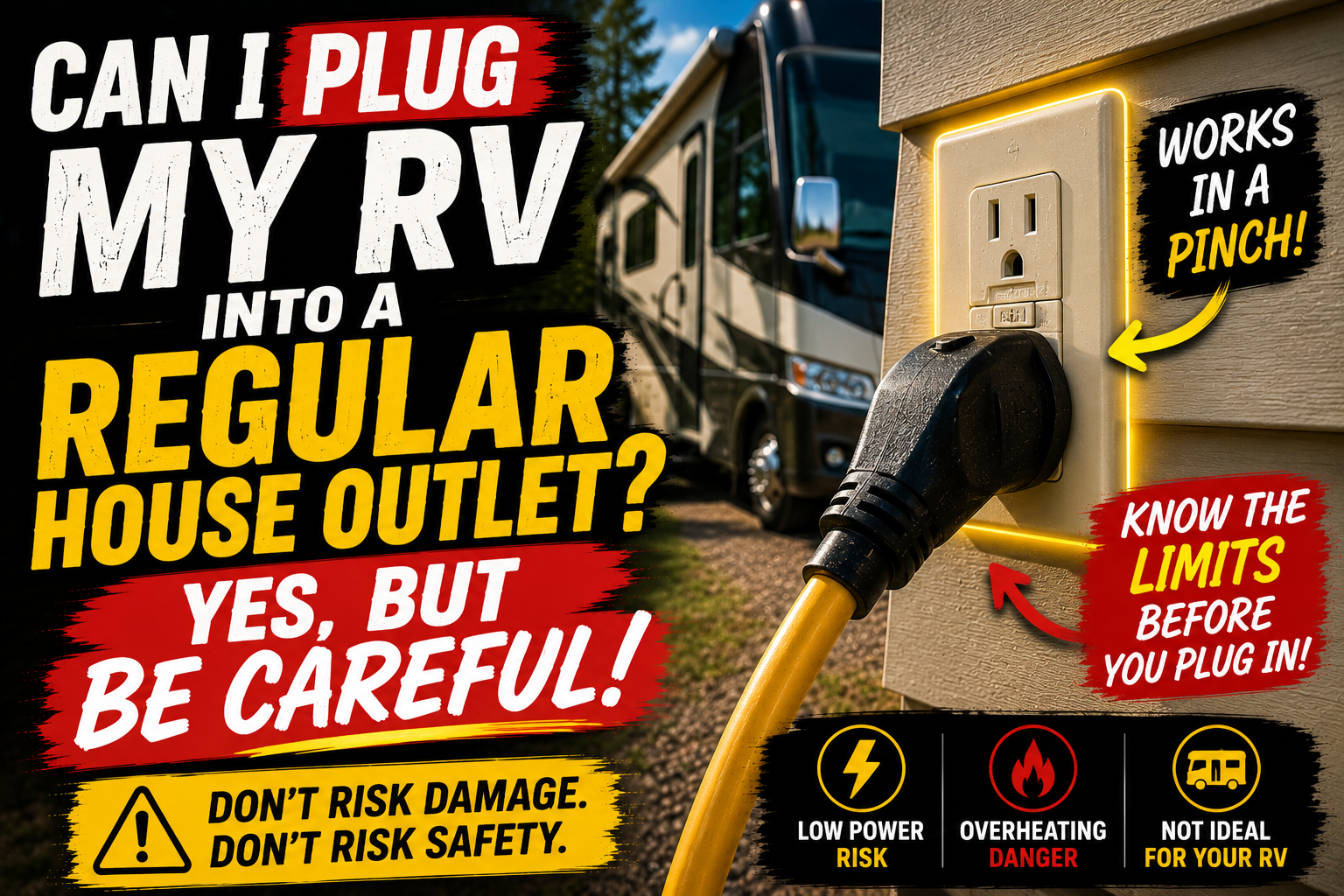
With the proper connection, an RV can often be connected to an ordinary household circuit for limited use, but you don’t suddenly have full campground electrical capacity. The practical details of using an ordinary household circuit cover the adapter and power limits involved.
A 15 or 20 amp household circuit has far less available power than your normal RV hookup.
That may be perfectly adequate for battery charging and light electrical use.
It may not be adequate for running the camper exactly as you do at a full-hookup campsite.
That’s another topic we’ll cover separately rather than stuffing every shore-power question into this one article.
Why Does My 50 Amp Plug Have Four Prongs?
Because it needs connections for:
Hot leg 1
Hot leg 2
Neutral
Ground
A 30 amp RV plug only needs:
Hot
Neutral
Ground
That physical difference is an easy way to identify what kind of service your camper uses.
Three prongs usually points you toward 30 amp RV service.
Four points you toward 50 amp.
Why Does My RV Still Have 12-Volt Lights on 30 or 50 Amp Shore Power?
Because 30 amp and 50 amp describe the AC shore-power service entering the RV.
Your camper still has a 12-volt DC electrical system.
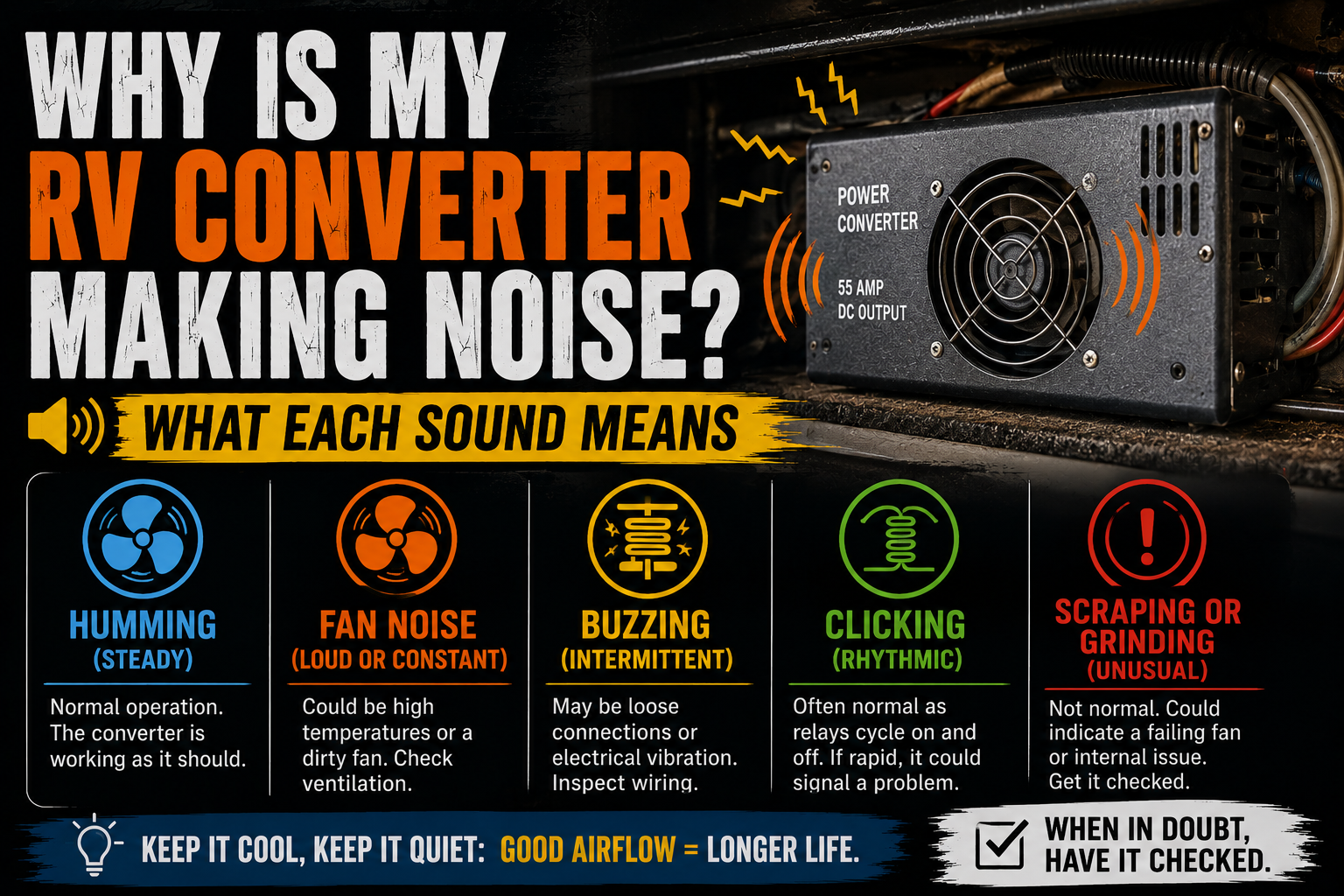
That’s where the converter enters the picture.
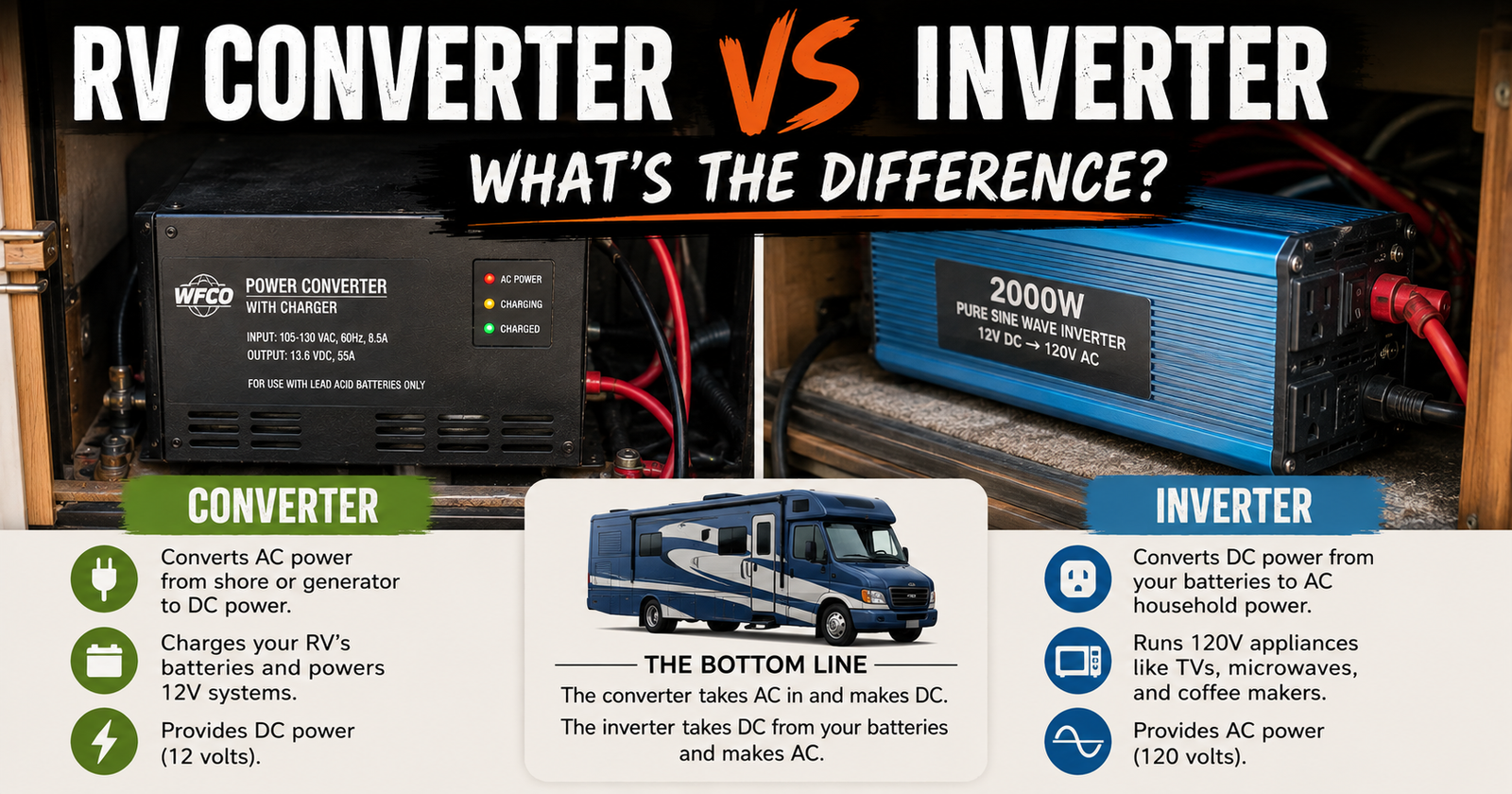
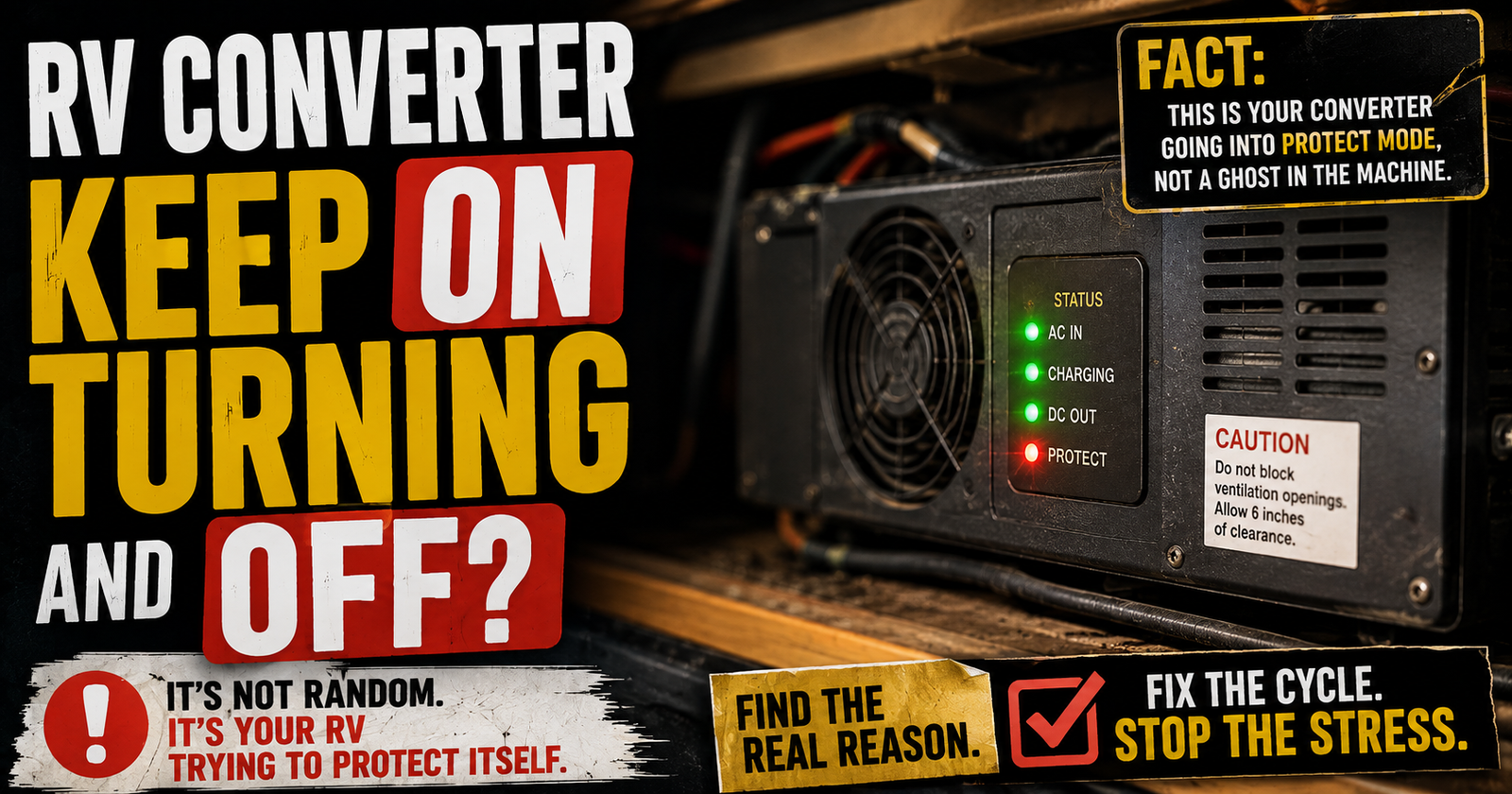
The converter takes some of that incoming AC electricity and converts it into DC electricity that can supply the RV’s 12-volt equipment and charge the house battery. The broader explanation of how the converter works alongside an inverter appears in 12-volt system.
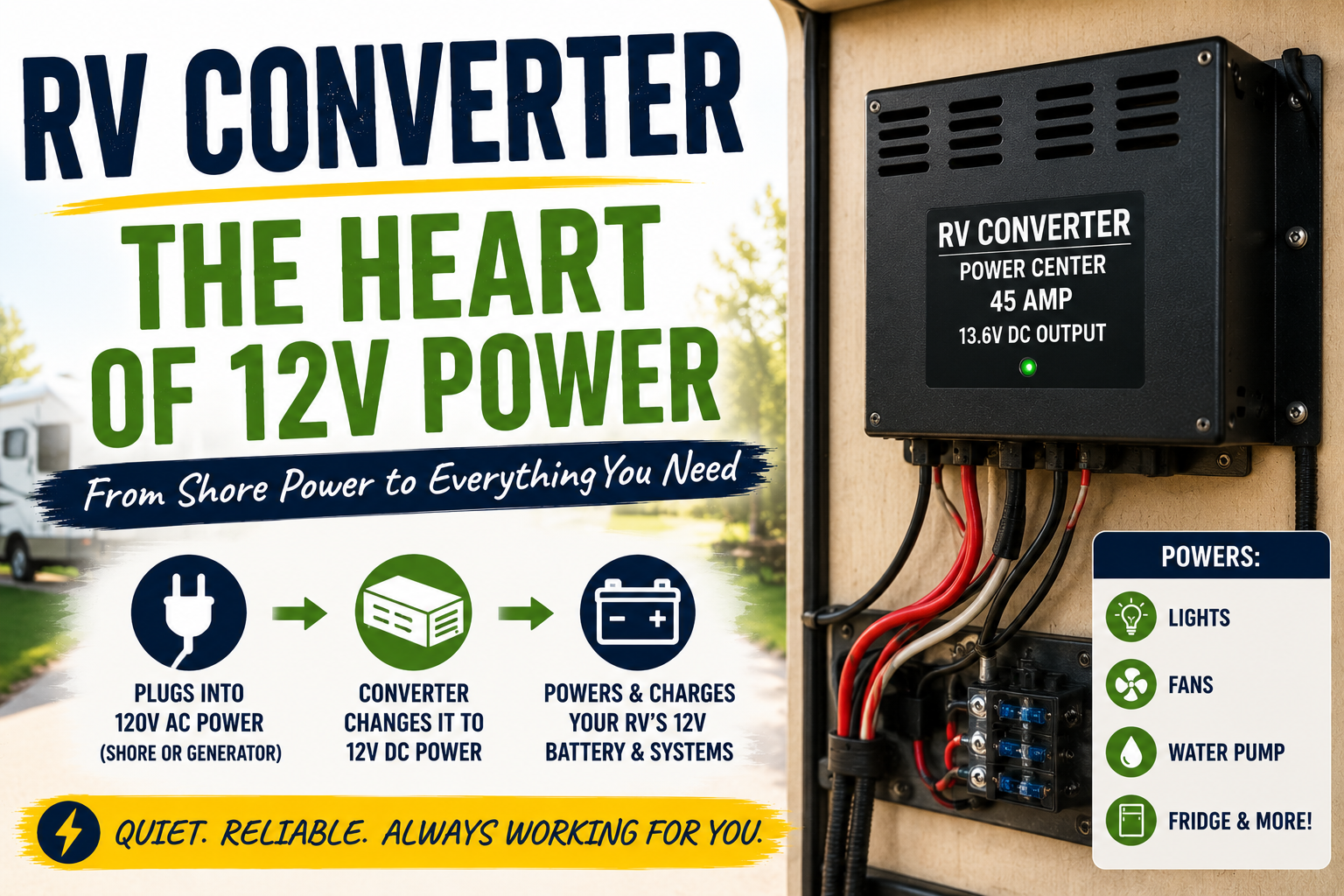
If that whole relationship sounds confusing, our guide explaining exactly what an RV converter does makes the AC-to-DC side much easier to understand.
The converter doesn’t turn your 30 amp camper into a 12-volt camper.
Your RV simply has both AC and DC electrical systems working together.
Does the Converter Use Some of My Available Shore Power?
Yes.
The converter isn’t creating electricity from nothing.
When it’s operating from shore power, it’s an electrical load on the AC system.
If your battery is significantly discharged and the converter is working hard to recharge it, the converter can draw more AC power than it does while simply maintaining a charged battery and handling light DC loads.
That’s another reason a 30 amp RV can sometimes seem more electrically limited immediately after plugging in with a low house battery.
There may be more going on in the background than you realize.
What Happens If I Use More Than 30 Amps?
Ideally, the appropriate circuit breaker opens.
That’s exactly what circuit protection is there to do.
But I wouldn’t make a habit of repeatedly loading a connection right to the edge and waiting for the breaker to decide when you’ve gone too far.
If you’re constantly tripping the campground breaker, start looking at what you’re running simultaneously.
Sometimes the solution isn’t an electrical repair.
It’s turning off one high-draw appliance before starting another.
Does a 50 Amp RV Have Two 50 Amp Breakers?
At the RV’s main distribution equipment, 50 amp service is handled differently from the single-pole 30 amp service because there are two incoming hot legs.
That’s why understanding the two-leg design matters.
Each leg can supply up to 50 amps at 120 volts.
Together, they provide the large total capacity we’ve been talking about.
This is also why 50 amp RV electrical systems shouldn’t simply be thought of as a slightly larger version of 30 amp.
The supply architecture is different.
What Happens If One Leg of 50 Amp Service Has a Problem?
This is where 50 amp systems can produce an interesting symptom.

Because different RV circuits can be distributed across the two incoming legs, a problem affecting one side can potentially leave you with some things working while others don’t. That partial-power pattern is examined in more detail in some RV circuits losing power.
That can be confusing.
You plug in and think:
“The RV has power.”
Technically, some of it might.
But that doesn’t mean both incoming legs and every circuit are healthy.
That’s one reason a future article in this cluster will specifically cover an RV that has power to some things but not others.
It’s a different troubleshooting intent from simply having no shore power at all.
Should I Use a Surge Protector With 30 Amp or 50 Amp Service?
Electrical protection is something I strongly like around campground power.
And whatever protection equipment you choose needs to make sense for your RV’s electrical service and the way you’re connecting it.
Campground pedestal problems aren’t limited to dramatic lightning strikes.
Voltage conditions and wiring faults matter too.

Some RV electrical protection devices go beyond basic surge suppression and monitor conditions such as high or low voltage and pedestal wiring faults. That broader approach is explained in this guide to broader RV electrical protection.
We’re going to give RV surge protection its own article because “Do I really need an RV surge protector?” deserves a better answer than one paragraph buried inside a 30-vs-50-amp guide.
Does 50 Amp Service Mean I’m Safer From Low Voltage?
No.
Having greater electrical capacity doesn’t guarantee that the campground is supplying healthy voltage.
Voltage problems can occur on either service.
Campground demand, wiring conditions, poor connections, and other electrical issues can affect what reaches your RV.
That’s why amperage and voltage shouldn’t be treated as the same thing.
Your RV might be connected to a 50 amp receptacle and still have an electrical supply problem.
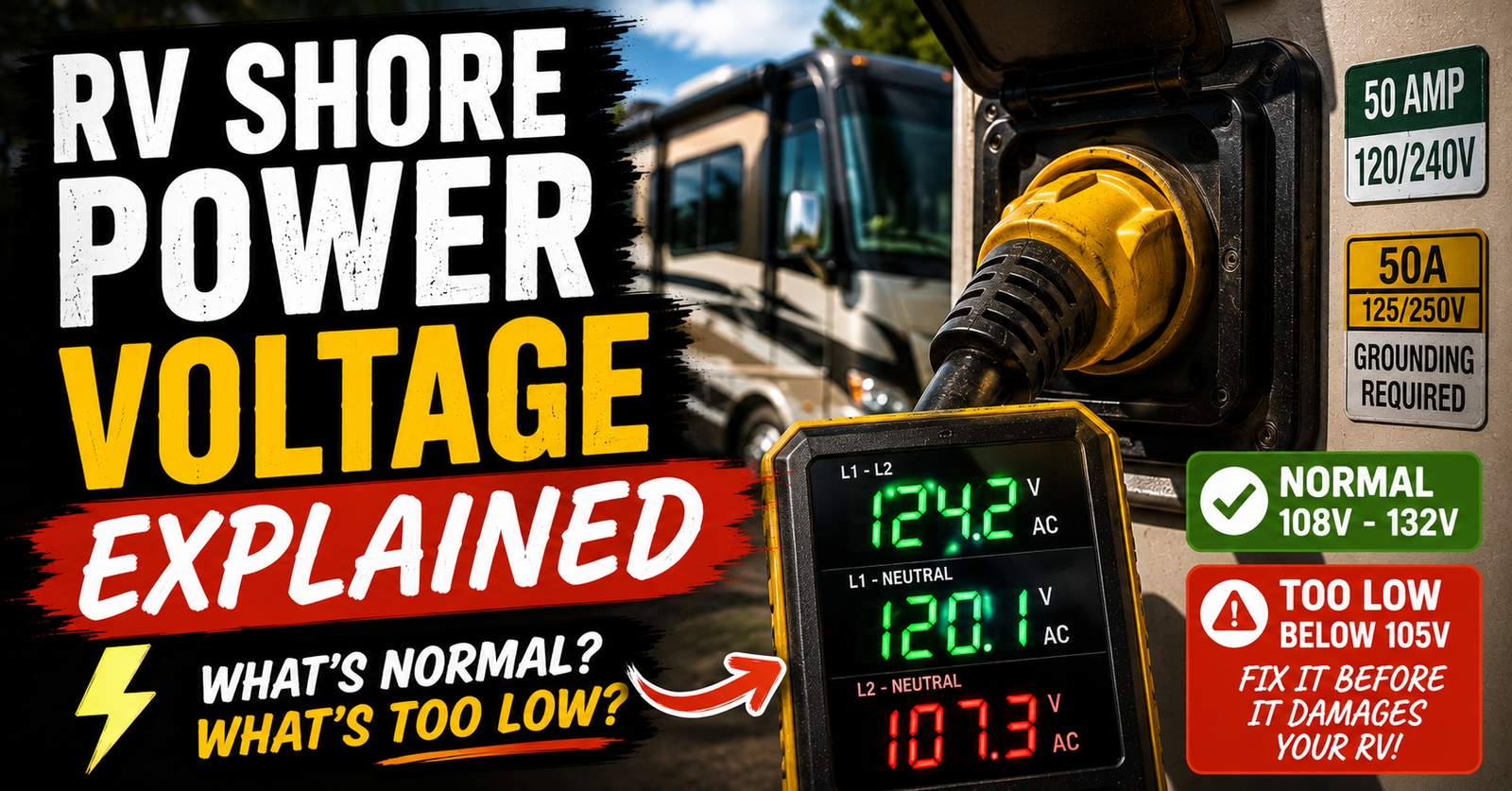
We’ll get into low shore-power voltage separately because running certain equipment on inadequate voltage can be a much bigger issue than simply not having enough amperage.
Is 50 Amp Better Than 30 Amp?
If we’re talking strictly about available electrical power, absolutely.
12,000 watts gives you far more flexibility than 3,600 watts.
But that doesn’t mean I’d choose an RV solely because it has 50 amp service.
If a smaller camper only needs 30 amps, there’s nothing wrong with that.
Thirty amp cords are generally lighter and easier to handle.
The camper’s electrical system is simpler.
And if you aren’t running multiple large appliances simultaneously, you may rarely care about the difference.
Fifty amp service becomes especially valuable as the RV gets larger and the electrical demands increase.
Can I Upgrade a 30 Amp RV to 50 Amp?
Technically, major electrical systems can be modified.
Practically, this isn’t anything like swapping the plug on the end of the cord.
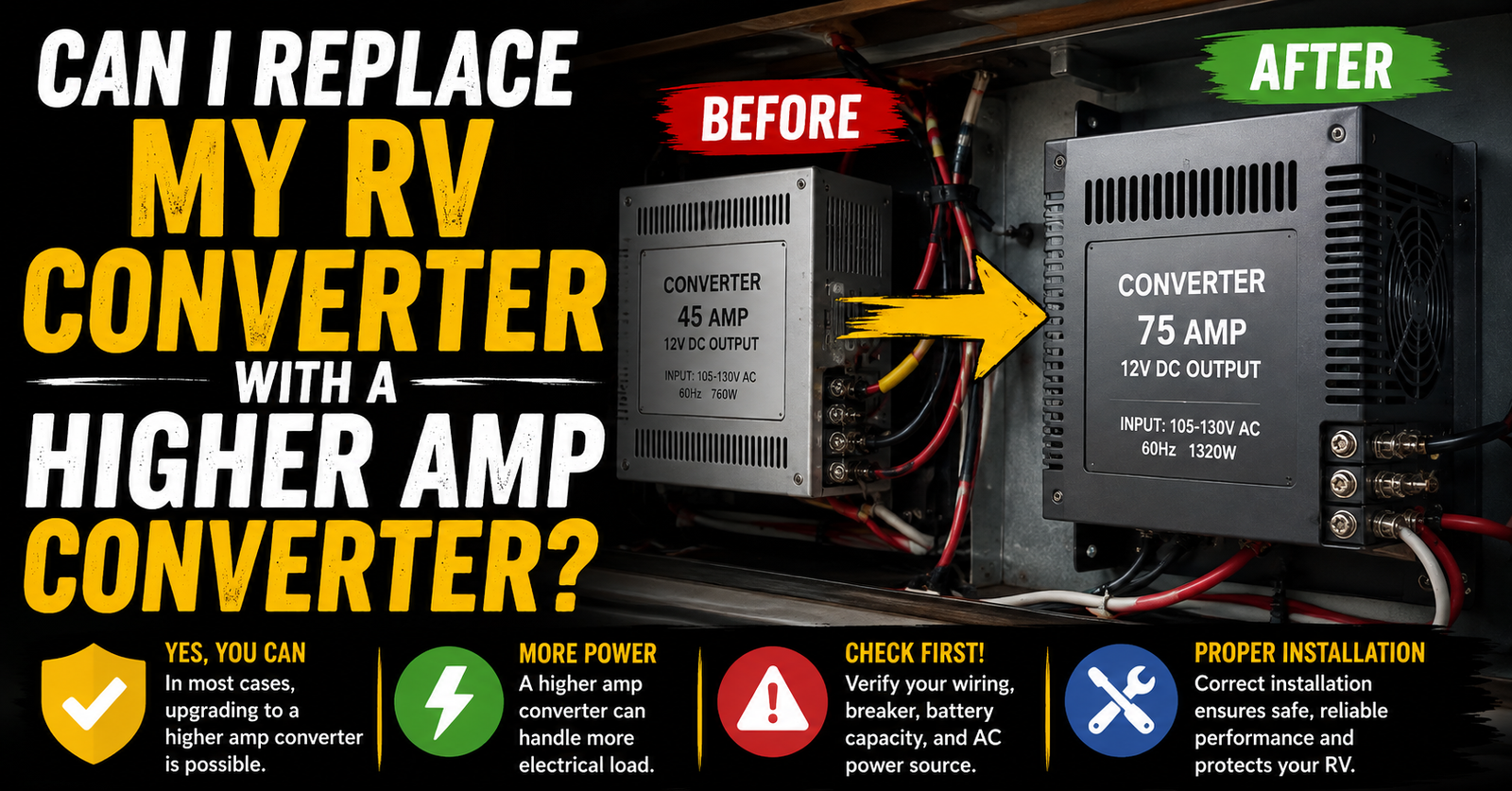
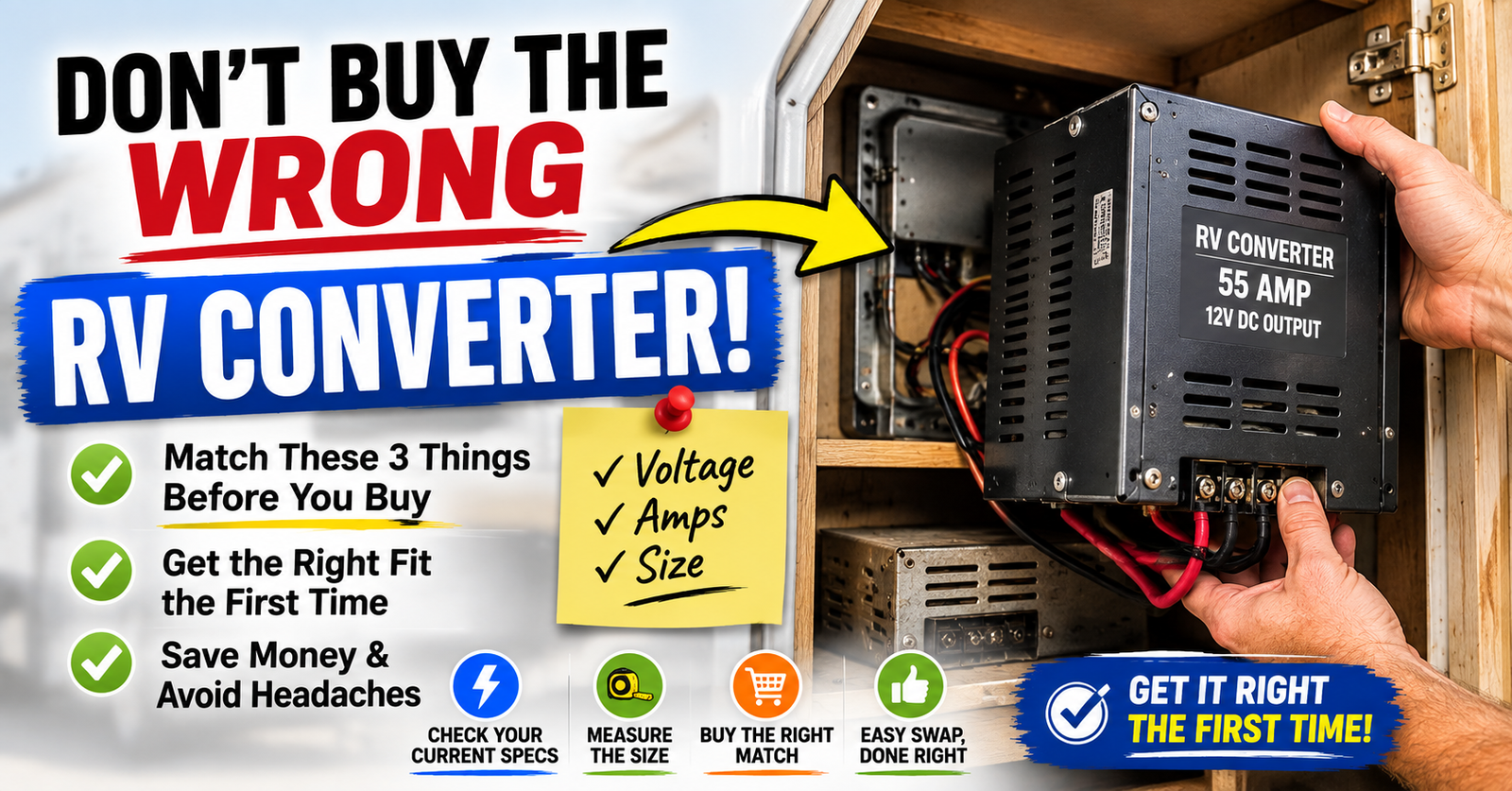
A true conversion can involve the shore-power inlet, cord, transfer equipment where applicable, main distribution panel, breakers, wiring, load distribution, and other parts of the electrical system. That broader system-level approach is also important when considering a higher-amp RV converter, since the converter cannot be evaluated separately from the wiring and protection around it.
You’re changing the electrical architecture of the RV.
That’s not something I’d recommend doing simply because you occasionally trip a 30 amp breaker.
First ask whether you actually need more service or simply need to manage high-draw appliances better.
Does a 30 Amp RV Charge the Battery Slower Than a 50 Amp RV?
Not automatically.
This is a great example of why shore-power capacity and battery charging shouldn’t be confused.
Your battery charging rate depends heavily on the converter/charger, battery, wiring, charging profile, battery state of charge, and other factors.
A 50 amp shore-power connection doesn’t automatically mean the RV has a faster battery charger.
Likewise, a 30 amp RV can have a perfectly capable converter.
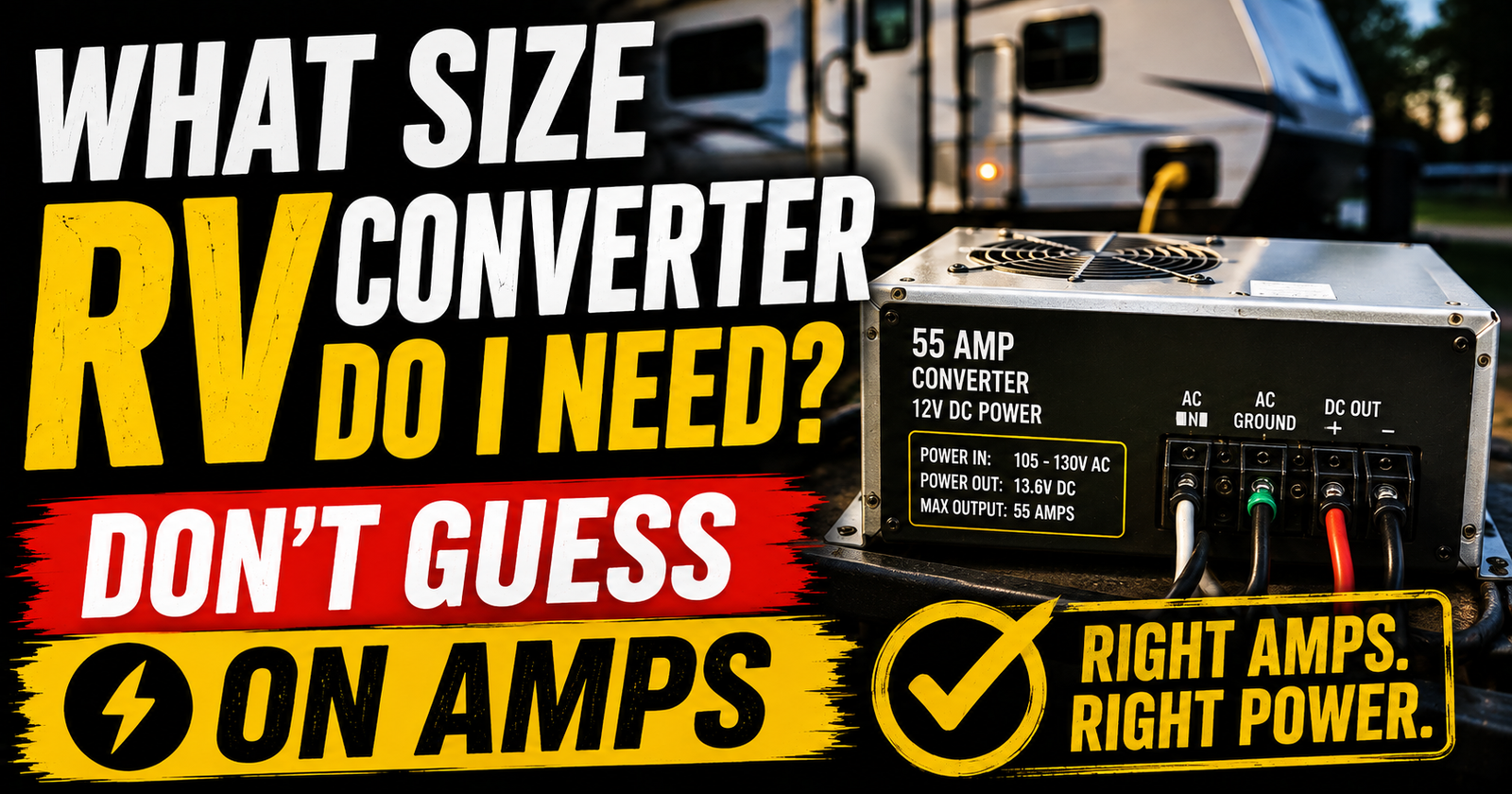
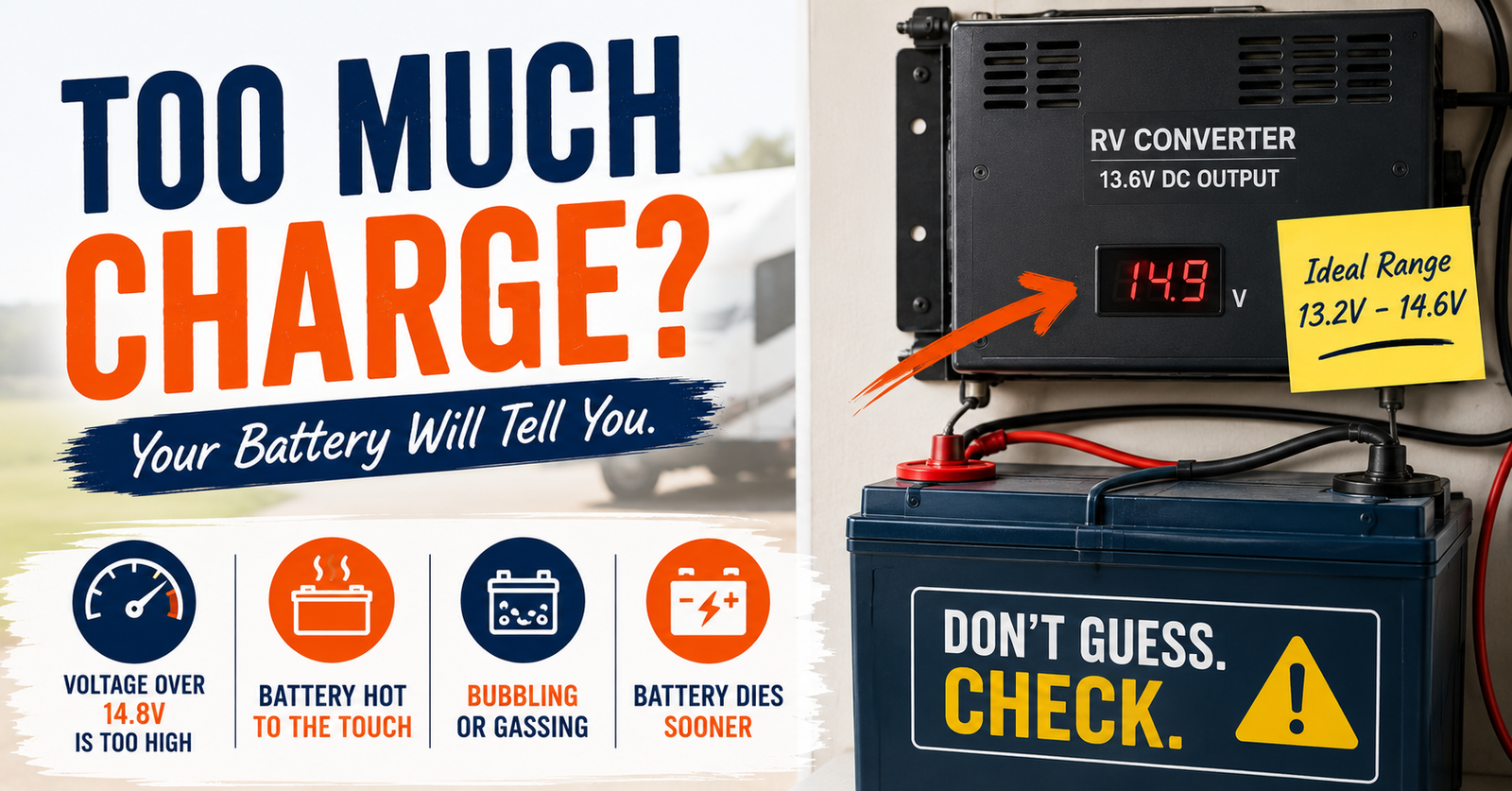
The shore-power rating tells you how much AC electrical capacity is available to the whole RV, not how many charging amps automatically go into the battery. To separate those ratings from the converter's DC output, see the difference between AC service and converter amps: the difference between AC service and converter amps.
Which One Do I Have to Select When Booking a Campsite?
Match the campsite to your RV whenever possible.
If your RV has 30 amp service, a campsite with 30 amp RV service is perfectly appropriate.
If your RV has 50 amp service and you want full use of its electrical capacity, choose a campsite with 50 amp service.
Adapters give you flexibility when the exact service isn’t available.
But remember what we discussed earlier.
A 50 amp RV connected to 30 amp service is still limited by the 30 amp supply.
You’re camping with 3,600 watts available instead of the roughly 12,000 watts the RV can use on full 50 amp service.
You’ll probably notice that difference if you have a large RV with several high-demand appliances.
The Number on the Plug Doesn’t Tell the Whole Story
This is what I wish somebody would explain to every new RV owner.
Thirty versus fifty sounds like a small jump.
It isn’t.
A 30 amp RV has one 120-volt hot leg and approximately 3,600 watts of available shore power.
A 50 amp RV has two 120-volt, 50 amp hot legs and approximately 12,000 watts of total available shore power.
That’s why a 30 amp camper owner learns to pay attention before running the air conditioner, microwave, electric water heater, and hair dryer together.
And it’s why a big 50 amp fifth wheel can operate several substantial electrical loads without immediately sending somebody outside to reset the pedestal breaker.
Neither system is inherently wrong for an RV.
They’re simply designed around very different amounts of available power.
Once you remember 3,600 watts versus 12,000 watts, the real difference between 30 amp and 50 amp RV power becomes a whole lot easier to understand.
Written by Evan Mercer
Evan Mercer writes about RV electrical systems, shore power, batteries, converters, and everyday camper troubleshooting for CamperAnswers.com. He focuses on explaining RV systems in plain English so camper owners understand what they’re plugging into and what their electrical system can actually handle.