
I learned one of my biggest RV lessons years before I was old enough to own a camper myself.
I was a teenager camping with my grandma and my sister. We had finished the trip, packed everything up, and as far as we knew, the camper was ready for the road.
The awning was put away.
Or at least we thought it was.
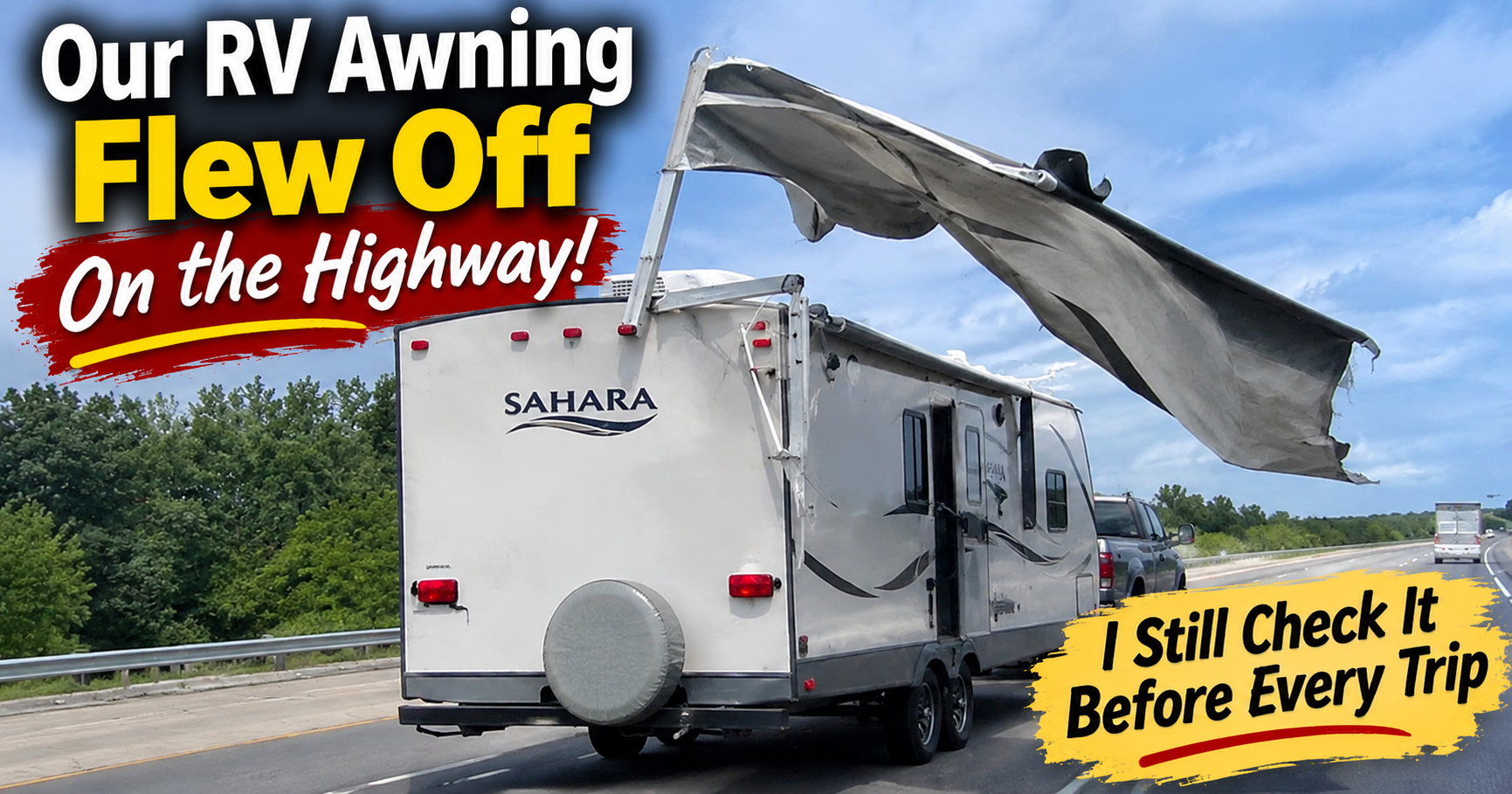
We got out on the highway and somehow that camper awning started unraveling while we were driving.
Then the dang thing flew off.
Gone.
I don’t remember exactly what mechanical part failed or wasn’t secured correctly. I was a teenage boy watching our camper awning disappear while going down the highway. Diagnosing the roller mechanism wasn’t exactly what was going through my head.
But I’ve remembered the lesson ever since:
Never assume an RV awning is secure just because it looks rolled up. Before leaving a campground, I want it completely retracted and I physically check the locks, latches, arms, or other travel-security features used on that particular awning.
What happened to us isn’t as unusual as I once thought.
RV owners have reported awnings unfurling on the highway even while the support arms remained against the RV, and failed roller-locking mechanisms have been identified as a cause. There have even been safety recalls involving awnings that could unexpectedly unfurl during travel.
We Really Thought Everything Was Put Away
That’s what stuck with me.
This wasn’t a situation where we knowingly left camp with a giant awning stretched out beside the camper.
We thought we were done.
Campsite packed.
Camper ready.
Time to go.
That’s exactly why I don’t like relying on:
“I’m pretty sure we put that away.”
An awning can look rolled up from a quick glance and still deserve a closer check before highway speeds get involved.
I Check More Than Whether the Fabric Is Rolled Up
This is something I understand much better now.
Depending on the awning, there can be more involved than simply rolling the fabric against the camper.
Manual awnings may have travel locks, safety latches, locking knobs, a cam or roller lock, and support arms that need to be secured correctly.
Lippert’s current instructions for its manual awnings specifically say that once the awning is rolled up against the RV, that alone doesn’t mean it’s ready for travel. The locking lever, safety latches, and other applicable hardware still need to be secured.
That sentence would’ve meant a lot more to teenage me after watching ours fly away.
The Roller Is Something I Pay Attention to Now
Here’s something else I learned while looking deeper into what can actually cause this.
The arms being secured doesn’t necessarily guarantee that the fabric can’t unfurl.
The roller tube itself has to be prevented from rotating when the awning design requires it.
There are documented cases where RV owners had the awning arms secured but a failed roller locking mechanism still allowed the awning to unroll while traveling.
That’s why I don’t want to give somebody a universal checklist that says:
Check these exact three latches and you’re good.
Awnings differ.
I want to know how our particular awning is supposed to be secured for travel and check those components.
Your Awning May Not Lock the Same Way Ours Did
This is important because RV awnings have changed a lot over the years.
The camper I was riding in as a teenager isn’t necessarily anything like the power awning on a newer travel trailer.
Some manual awnings use obvious travel locks.
Some power awnings use different locking or drive mechanisms.
Some have additional travel latches.
Lippert specifically notes that travel locks vary among manufacturers, and owners should identify the travel-lock system on their particular awning.
So I wouldn’t copy what the camper next door does.
I’d learn mine.
Now the Awning Is Part of My Final Walk-Around
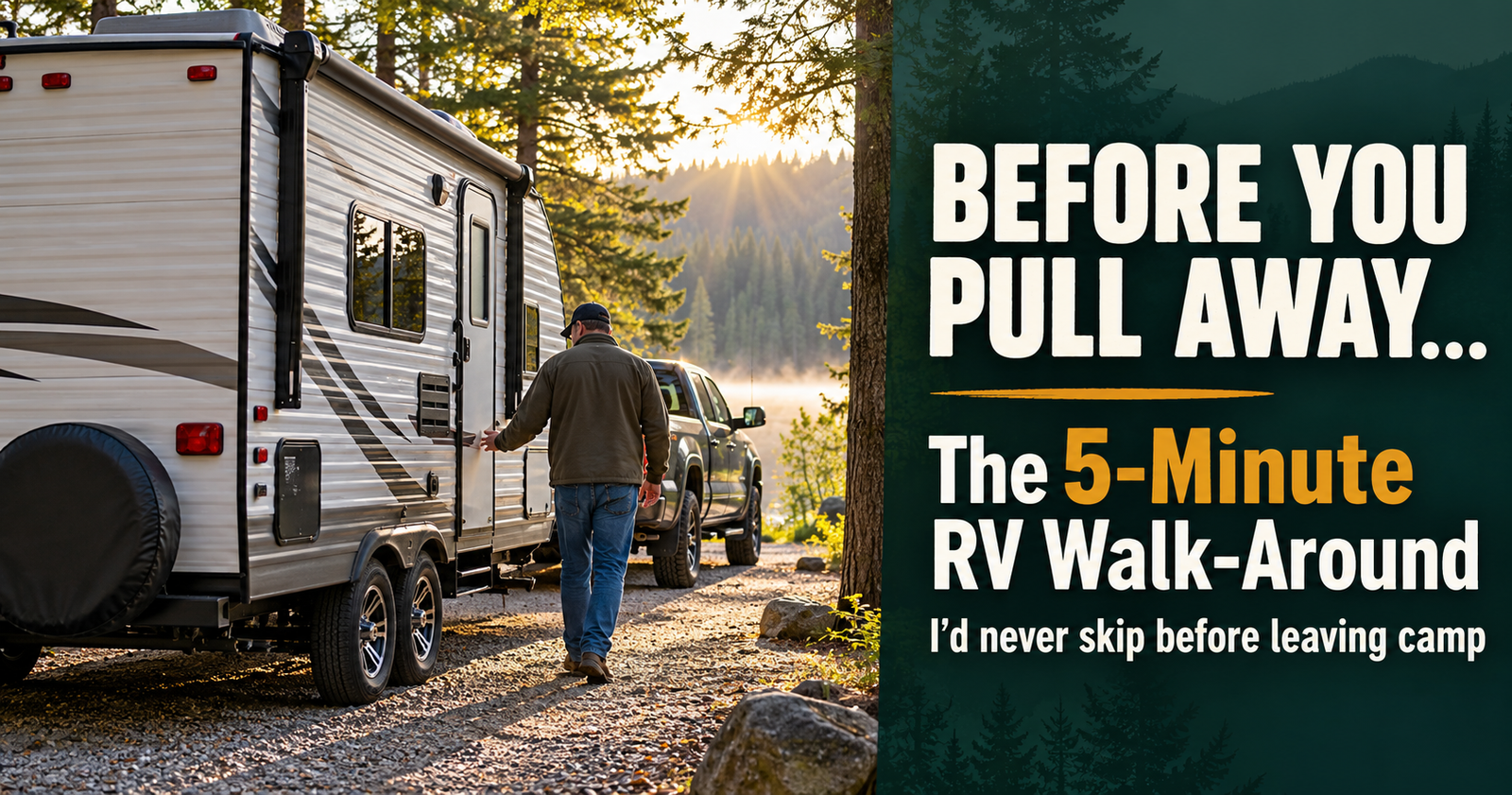
We’ve already talked about the five-minute RV walk-around I wouldn’t skip before leaving camp.
This old experience is one of the reasons that habit makes so much sense to me.
Before the camper moves, I look up at the awning.
Completely retracted?
Both ends look right?
Arms seated correctly?
Travel locks or latches secured if equipped?
Nothing loose?
Nothing sticking out?
If something doesn’t look exactly like it normally does in travel position, I’m checking it before we leave.
I Wouldn’t Just Press Retract and Walk Away
Power awnings make this especially tempting.
Hold the button.
Awning comes in.
Done.
Except I still want to look outside.
Manufacturer instructions for power awnings call for making sure the awning is completely retracted before travel, and some models have an additional locking latch that must be secured if equipped.
That takes maybe 20 seconds to verify.
After what happened to us, that’s 20 seconds I’m willing to spend.
If the Awning Doesn’t Look Secure, I’m Not Driving
This is where I wouldn’t compromise.
If an awning doesn’t fully retract, an arm isn’t seated correctly, a latch won’t hold, or something seems loose, I don’t want highway wind to be the final test.
Get it properly secured first.
If the normal mechanism has failed, use the manufacturer’s emergency or manual procedure for that specific awning or get help securing it.
Different power awning manufacturers use different manual-retraction procedures, which is another reason I wouldn’t start forcing the mechanism based on instructions for somebody else’s awning.
Highway Wind Is a Whole Different Animal
At the campsite, an awning that’s slightly loose may not look dramatic.
Then you start traveling 60 or 70 mph.
Now air is moving around that camper with a tremendous amount of force.
Once fabric catches that air and begins unfurling, you’ve got a completely different situation.
And it’s no longer only about damaging your camper.
An awning or awning hardware coming loose at highway speed can become a hazard to everybody behind you.
That’s why unexpected awning deployment has been treated as a road-safety issue in actual vehicle recalls.

What I’d Do If I Saw the Awning Coming Open While Driving
I wouldn’t try to keep going until the next convenient stop.
I’d slow down carefully and get off the roadway somewhere safe as soon as possible.
Then I’d figure out how badly the awning had come loose and whether it could be properly secured.
I definitely wouldn’t have somebody hanging out a window trying to hold anything while we’re moving.
And I wouldn’t continue highway travel with loose awning fabric flapping around hoping it stays attached.
I already know how that story can end.
Ours Didn’t Stay Attached
That’s the image I still remember.
Somehow that awning unraveled and eventually flew off into nowhere while we were going down the highway.
At the time it was one of those:
Oh my gosh. Did that seriously just happen?
moments.
Years later, I look at it differently.
We were fortunate it didn’t turn into something worse.
An awning can be replaced.
Someone getting hurt because RV hardware comes flying off at highway speed is a completely different story.
This Is Why My Departure Check Isn’t Just About Forgetting Stuff
It’s easy to think of a pre-trip walk-around as:
Did we forget the chairs?
Did we disconnect the water?
Are the steps up?
Did somebody leave something on the picnic table?
Those things matter.
But I’m also checking whether the camper itself is actually ready to travel.
Awning.
Slides.
Storage doors.
Hitch.
Tires.
Shore cord.
Anything that can open, extend, drag, or come loose.
Our awning experience is probably the best example I have of why “we already put everything away” isn’t quite good enough.
I Can’t Tell You Exactly What Failed That Day
And I’m not going to pretend I can.
It happened years ago when I was a teenager.
Maybe something wasn’t locked properly.
Maybe a locking mechanism failed.
Maybe there was another mechanical problem with the awning.
I genuinely don’t know.
What I do know is that we believed the awning was put away when we left.
Then we watched it unravel on the highway.
And other RV owners have reported remarkably similar failures, including awnings unfurling while the arms themselves remained secured.
That’s enough for me to take the travel check seriously.
One Extra Check Would Have Been Cheap
That’s probably why this memory has stuck with me for so many years.
The prevention side is so simple.
Walk over.
Look up.
Physically verify the awning is completely retracted.
Check whatever travel locks, latches, knobs, or locking mechanisms your particular awning requires.
Give the arms a look.
If something doesn’t seem right, don’t leave until you understand why.
It takes almost no time.
An awning flying off a camper at highway speed takes considerably longer to deal with.
I Still Think About That Trip When I See an Awning
There are camping memories you keep because they were beautiful.
Great campsite.
Good food.
Sitting around the fire.
Then there are the memories you keep because something went completely sideways.
Camping with my grandma and sister and watching our camper awning fly off while we were traveling definitely falls into the second category.
But I’m glad I remember it.
Because every time I’m getting ready to leave a campsite, it reminds me not to trust:
“I think we got everything.”
I want to know.
And when I reach the awning during that final walk-around, I don’t just check whether it’s rolled up.
I check whether it’s actually ready for the highway.
Written by Caleb Warren
Caleb Warren writes about real RV experiences, campsite mistakes, awnings, camper systems, and the lessons that tend to stick with you long after the trip ends for CamperAnswers.com. His articles combine real camping experiences with practical research so other RV owners can avoid learning every lesson the expensive way.