
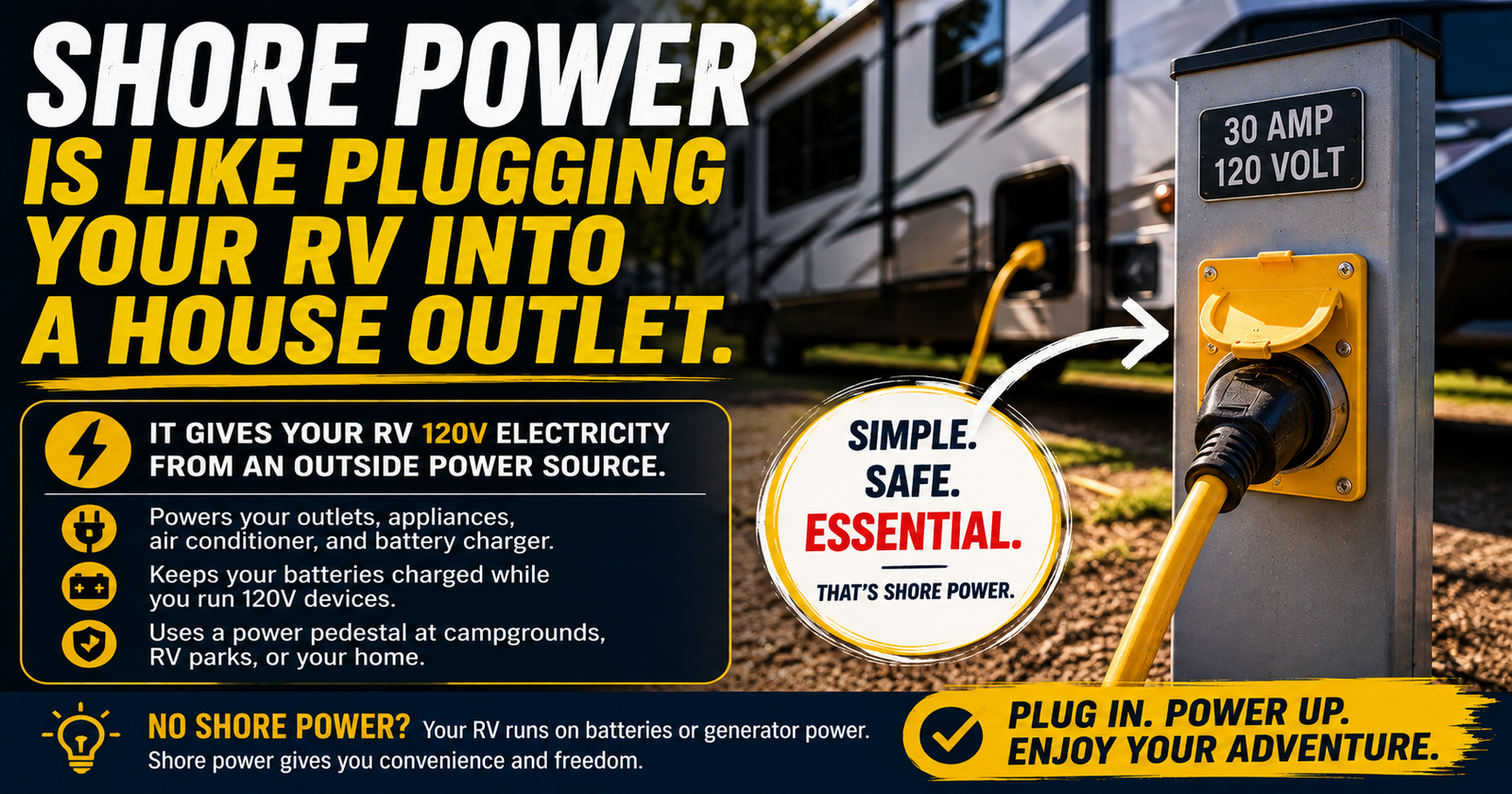
If you’ve ever pulled into a campground, grabbed that big electrical cord from your camper, and plugged it into the pedestal beside your site, you’ve used shore power. I used to think the term sounded way more complicated than what it actually means.
Shore power is simply outside AC electricity supplied to your RV through its power cord.
At a campground, that electricity usually comes from the pedestal at your campsite. At home, it might come from a properly sized household circuit or RV receptacle. Either way, instead of relying only on your batteries, solar, or a generator, you’re bringing outside electrical power into the camper. If home power is your planned connection, a properly sized household circuit explains what that setup can and cannot support.
But here’s where people understandably get confused.
Plugging your RV into shore power doesn’t suddenly make everything in the camper run directly on the electricity coming through that cord. RVs commonly have both a 120-volt AC electrical system and a 12-volt DC electrical system, and shore power interacts with both of them. The explanation of how the RV converter bridges AC and DC makes that relationship easier to follow.
Once you understand that one idea, converters, batteries, outlets, generators, 30-amp service, 50-amp service, and a bunch of those mysterious switches inside a camper start making a whole lot more sense.
Where Did the Name “Shore Power” Come From?
The term wasn’t invented specifically for RVs.
It’s commonly associated with boats and ships connecting to electricity while they’re at shore instead of producing all of their power onboard.

The name carried over nicely to RVs.
You’re essentially parking your camper and connecting it to an outside electrical supply.
There’s no shoreline required.
So if someone at a campground says:
“Are you on shore power?”
They’re basically asking:
“Is your RV plugged into outside AC electricity?”
That’s it.
What Happens When You Plug an RV Into Shore Power?
This is where I think it’s easiest to picture the electricity as taking different paths through the camper.
Your shore-power cord brings AC electricity into the RV.
From there, part of that electrical system supplies your RV’s 120-volt AC circuits.
Another part can feed the converter/charger, which changes AC electricity into DC electricity for the RV’s 12-volt system and battery charging.
In simple terms, think of it like this:
Campground pedestal → shore-power cord → RV electrical panel → 120V AC circuits
And another path looks roughly like:
Shore power → converter/charger → 12V DC system + battery charging
The exact electrical layout varies between campers, especially when you start adding inverter/chargers, solar equipment, transfer switches, and other components. But that’s a really good basic picture to keep in your head.
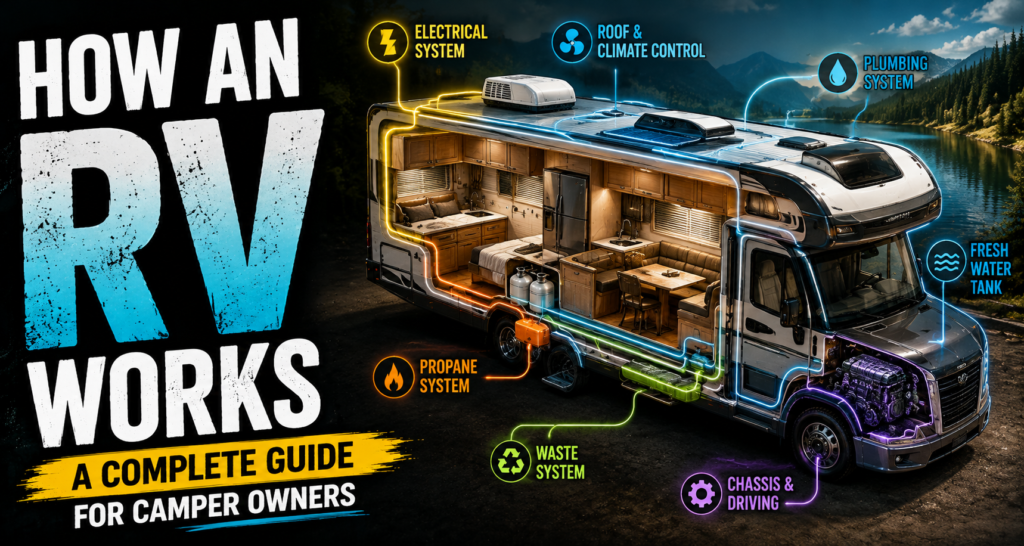
It’s also why understanding shore power makes our broader guide to how an RV works much easier to follow.
What Does Shore Power Actually Run in an RV?
This depends on the camper.
Your 120-volt AC system may power things such as:
Air conditioner.
Standard wall receptacles.
Microwave.
Certain televisions and entertainment equipment.
Electric water-heater element, if equipped.
Electric refrigerator operation on some RV refrigerators.
Residential-style refrigerators in some campers.
Other 120-volt appliances.
But here’s the part that surprises a lot of new RV owners:
Your 12-volt system doesn’t disappear when you plug in.
Many important things inside an RV still operate from DC power.
Interior lights.
Water pump.
Furnace controls and blower.
Vent fans.
Propane appliance controls.
Slide-out systems on many RVs.
Awning motors on many RVs.
Various control boards.
Other 12-volt accessories.
That brings us to one of the most important components in this entire discussion.
The Converter Is What Connects Shore Power to Your 12-Volt World
This is why we’ve spent so much time building out our converter information.
A converter/charger takes incoming AC electricity and produces DC electricity.
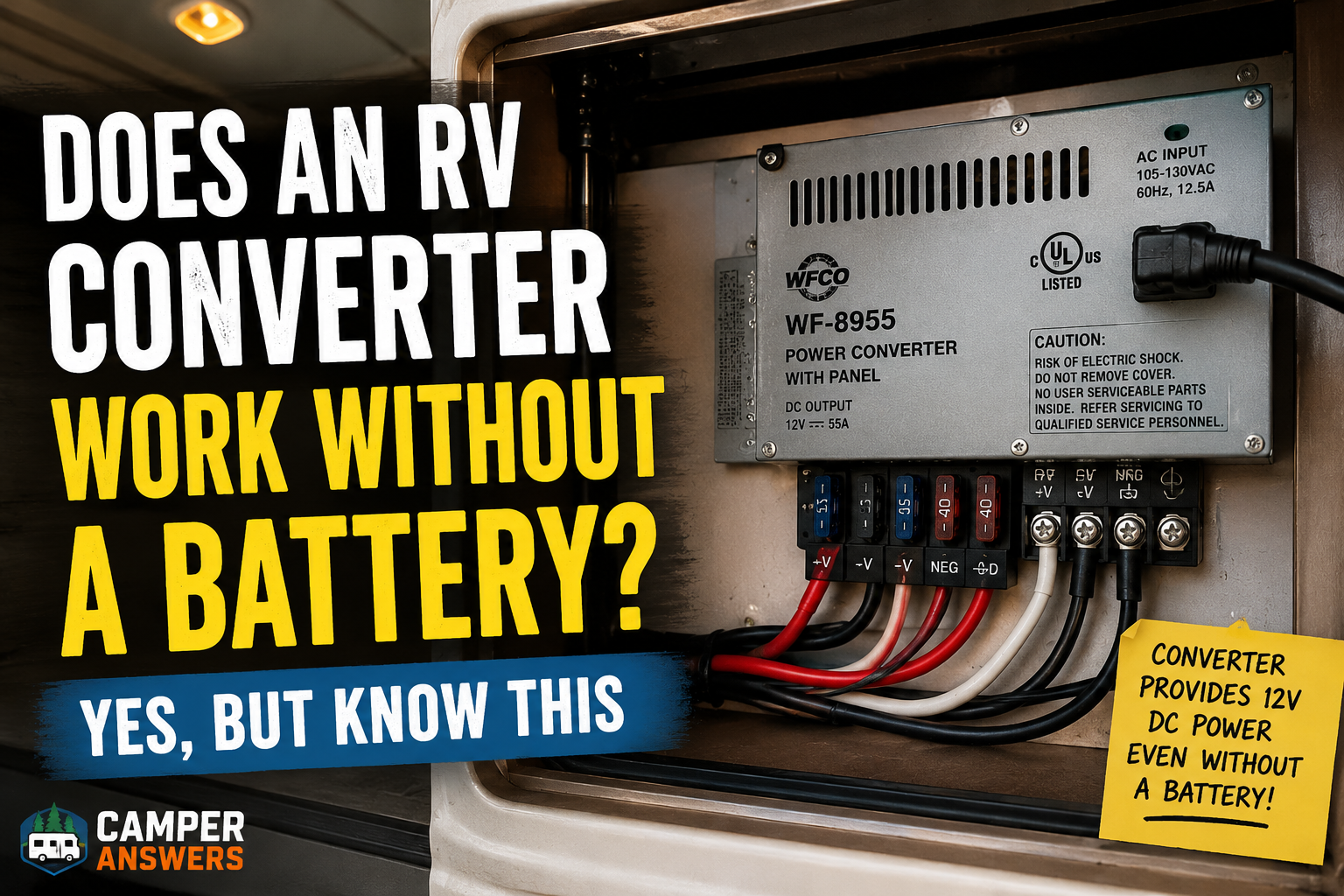
Modern converter/chargers commonly provide DC power for the camper’s 12-volt electrical needs while also charging the house battery.
Progressive Dynamics describes the basic relationship in its converter documentation. When AC power is available, the converter supplies DC power to the RV’s 12-volt circuits and provides charging power to the battery.
So when you plug into shore power, the converter is a major reason your 12-volt equipment can continue operating without simply draining the battery until it’s dead.
Does Shore Power Charge the RV Battery?
Usually, yes, if the RV has a functioning converter/charger and the charging path to the battery is intact.
That’s an important qualification.
People often assume:
“I’m plugged in, so my battery has to be charging.”
Not necessarily.
Shore power provides the AC electricity that allows the converter/charger to operate. The converter/charger then handles the DC charging side.
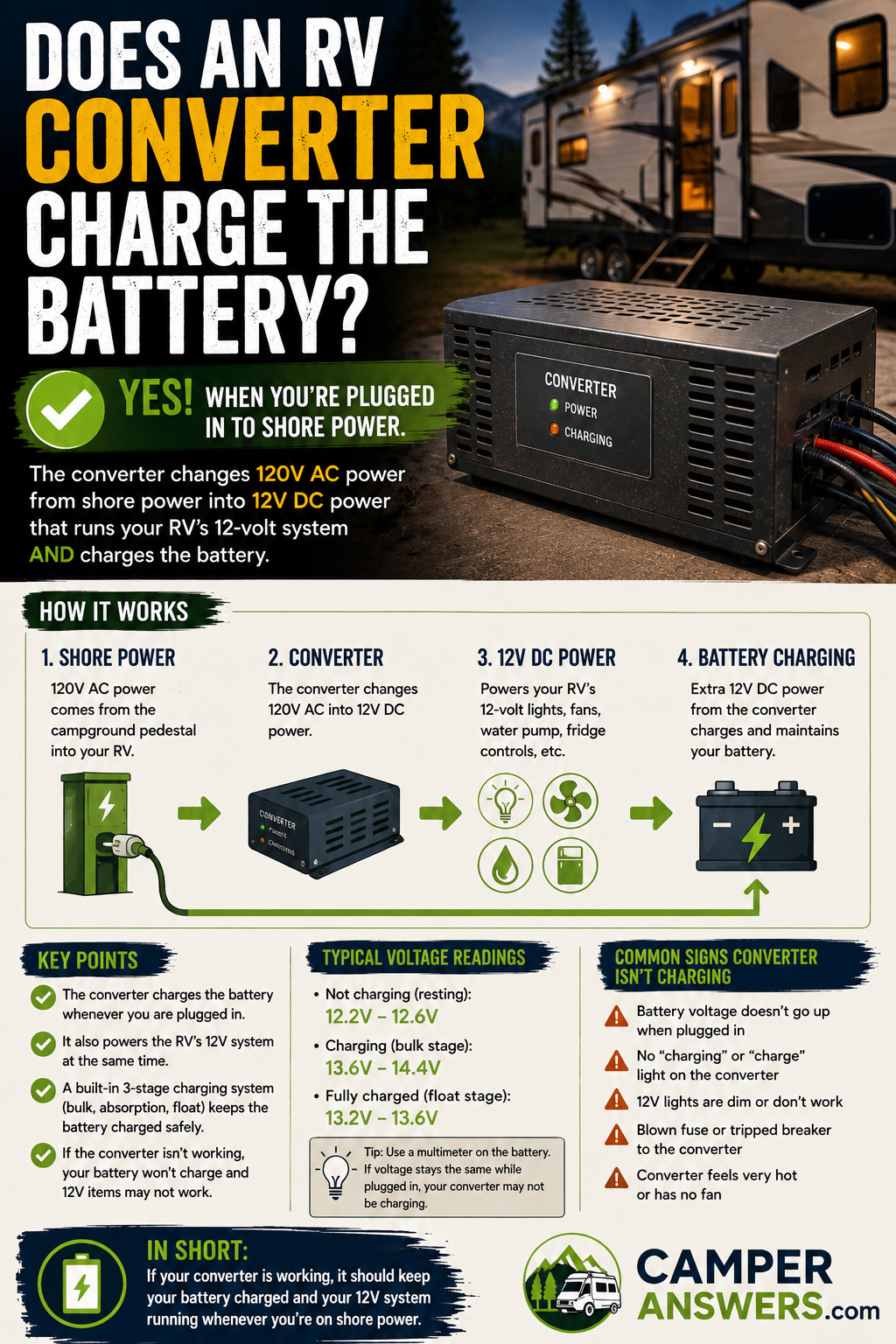
We’ve explained that entire relationship in our guide to how an RV converter charges the battery.
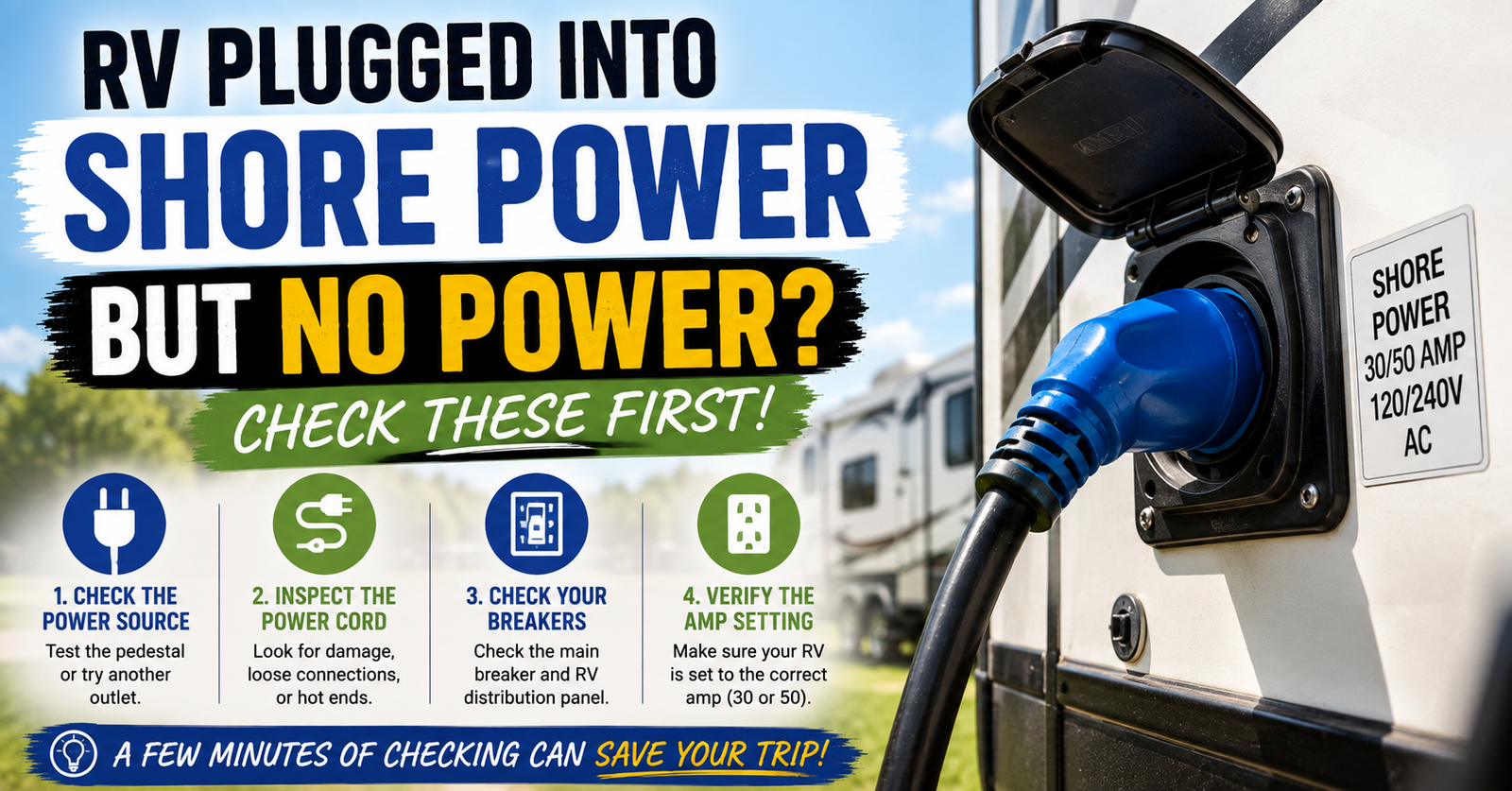
A problem anywhere along that path can leave you plugged into shore power with a battery that still isn’t receiving a proper charge. For a practical way to trace that problem from the pedestal toward the camper, use troubleshooting RV power loss.
Can My RV Battery Still Die While I’m Plugged Into Shore Power?
Absolutely.
And now that you understand shore power, this problem makes a lot more sense.
Imagine shore power is entering the camper normally.
Your AC outlets work.
The microwave works.
The air conditioner works.
But the converter isn’t producing DC output.

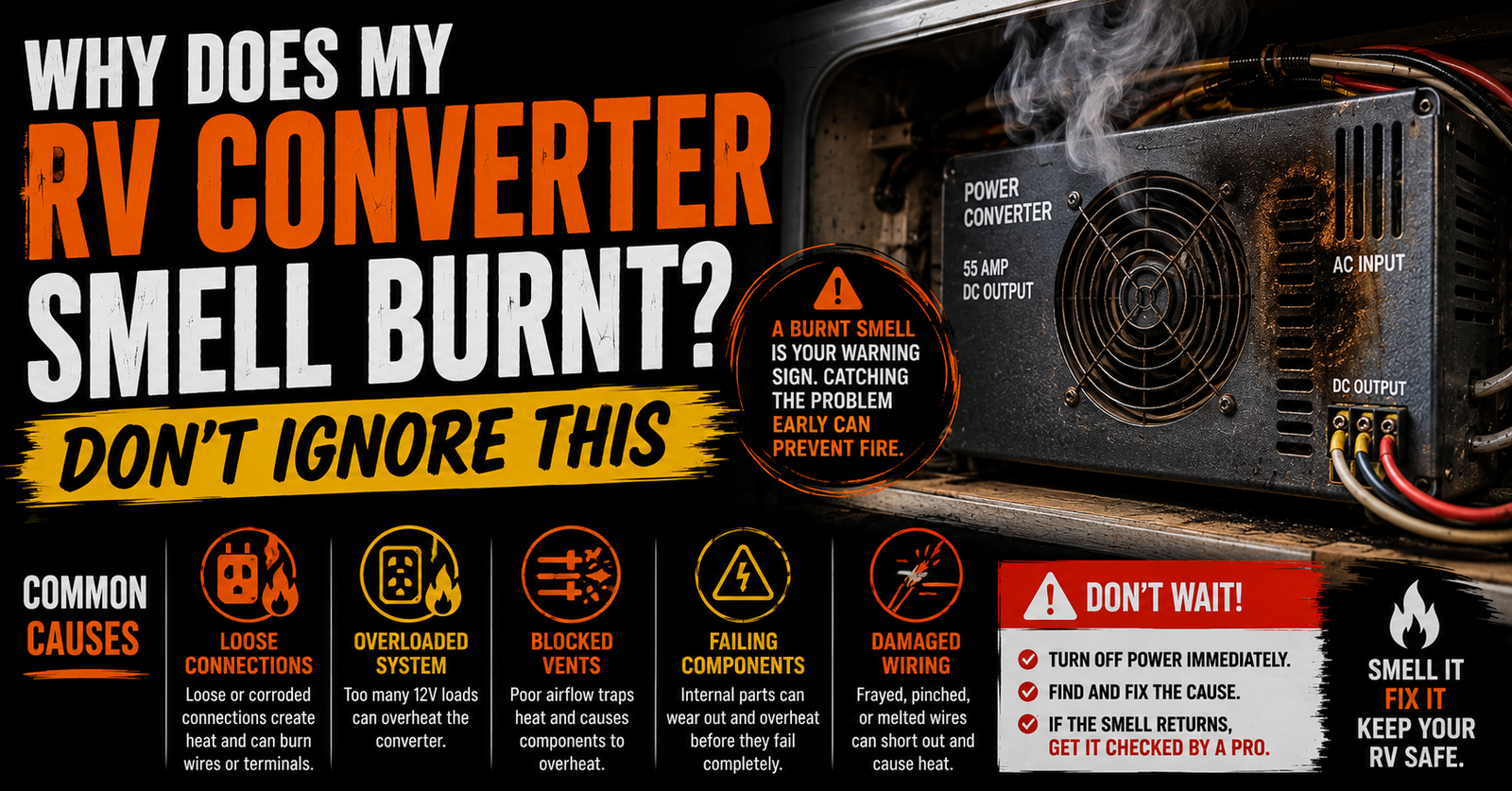
Or perhaps the converter works, but a fuse, breaker, disconnect, wiring problem, or bad connection prevents charging power from reaching the battery. When a fuse is the suspected interruption, RV converter fuse problems can help narrow down whether the fault is in the converter circuit or elsewhere.
The camper can appear to have electricity while the battery continues discharging.
That’s why we’ve got an entire troubleshooting guide for an RV battery that keeps dying while plugged in.
“Plugged in” and “battery charging” aren’t exactly the same thing.
Why Does My RV Still Need a Battery When I Have Shore Power?
This is another great beginner question.
If the campground is providing electricity, why haul a battery around at all?
Because shore power isn’t always available, and the battery is an important part of the RV’s 12-volt electrical system.
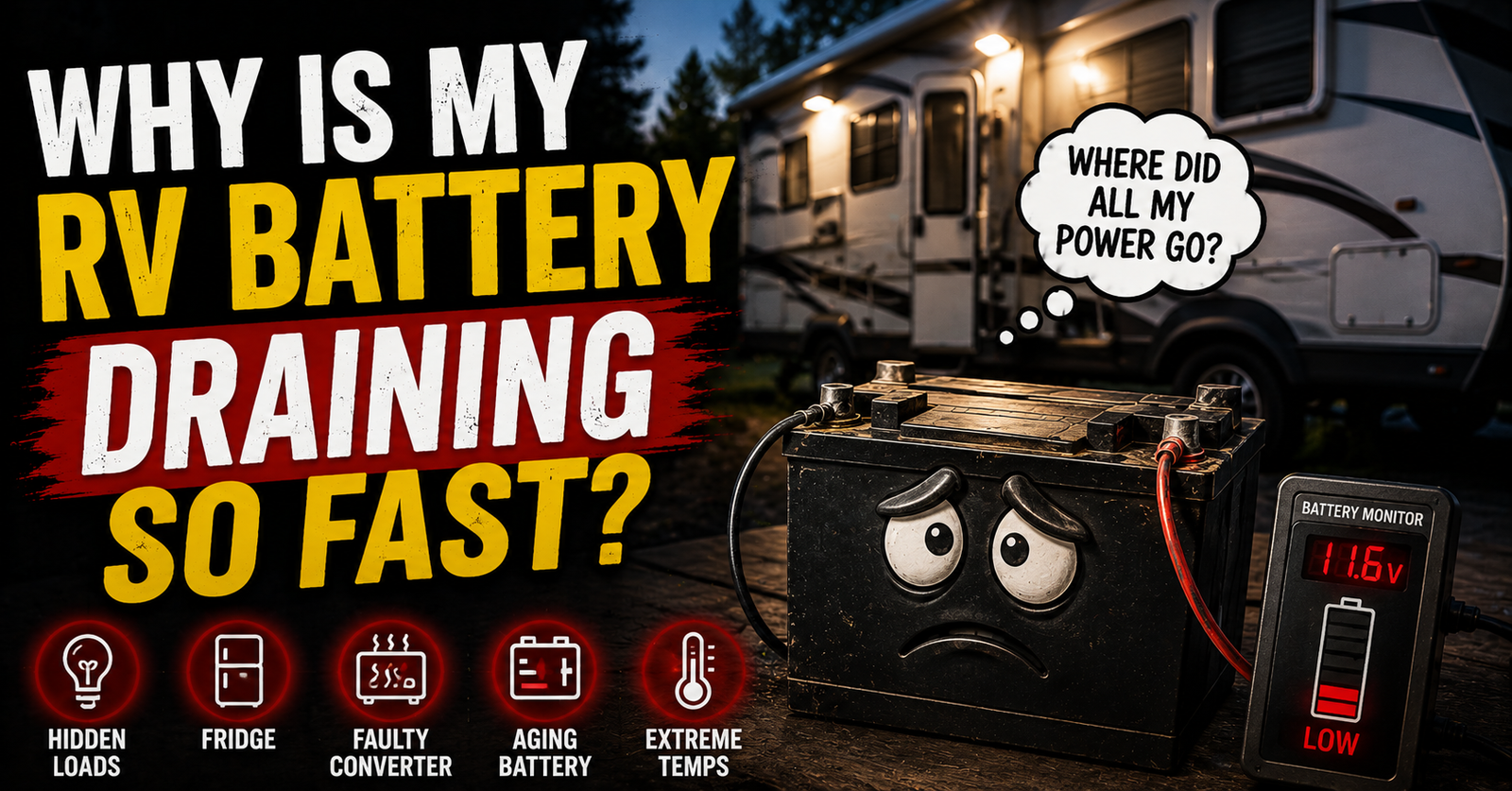
Unplug from the pedestal and your battery can supply DC power to things such as lights, water pumps, control boards, furnace equipment, and other 12-volt loads, depending on the camper. If those 12-volt demands are exhausting the battery sooner than expected, RV battery losing power quickly explains how to narrow down the cause.
There are also RV systems where the battery plays important roles even when other power sources are available.
And once you leave a full-hookup campsite, that stored energy becomes extremely important.
What Happens When I Unplug From Shore Power?
Your 120-volt AC equipment normally loses its outside AC supply.
Your standard outlets may stop working.
The microwave won’t have its normal AC source.
The air conditioner won’t continue running from an ordinary 12-volt house battery system.
But your 12-volt equipment can continue operating from the battery.
That’s one of the neat things about an RV.
Unplugging doesn’t necessarily plunge the entire camper into darkness.
Your electrical system simply changes where it’s getting energy.
Can My RV Outlets Work Without Shore Power?
Not normally from the battery alone unless the RV has an inverter or another AC source.
This is where converters and inverters get mixed up constantly.
A converter generally takes:
AC → DC
An inverter generally takes:
DC → AC
So the converter helps turn shore power into the type of electricity your 12-volt system and battery need.
An inverter can take battery power and create AC electricity that can operate certain AC loads, depending on how the system is designed.
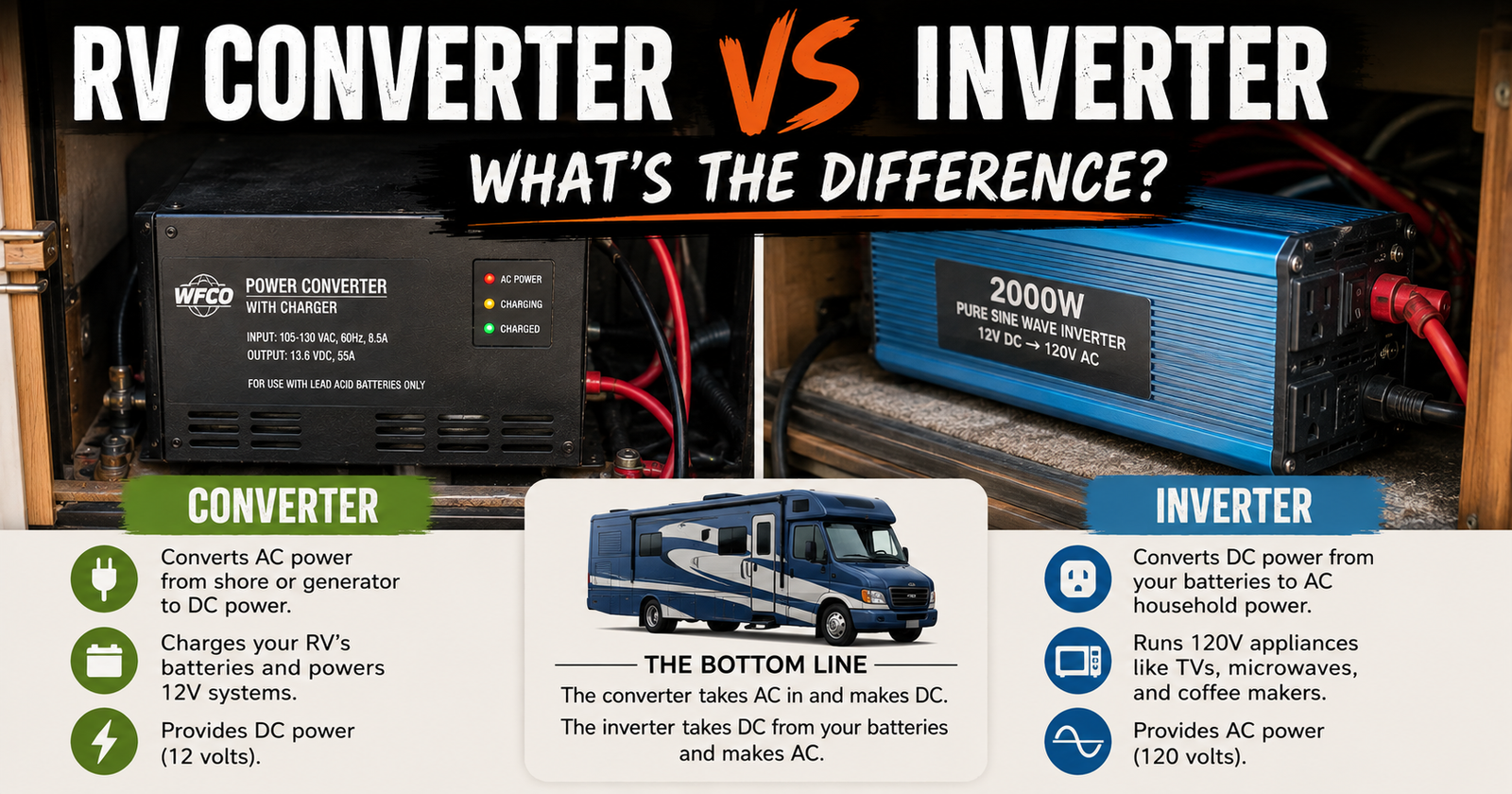
If those two boxes still sound like the same thing, our guide to RV converters vs. inverters makes the distinction much easier.
What Is a Campground Power Pedestal?
That little electrical box beside many campsites is the campground power pedestal.
It’s essentially your RV’s connection point to the campground’s electrical system.
Depending on the campground and campsite, you may find connections for:
30-amp RV service.
50-amp RV service.
A standard household-style receptacle.
Sometimes several of them on the same pedestal.
You’ll typically also see circuit breakers associated with those receptacles.
The pedestal isn’t just a fancy extension cord holder. It’s supplying substantial electrical power to the RV, so its condition and wiring matter.
What Is 30-Amp RV Shore Power?
A 30-amp RV connection is common on many travel trailers, smaller motorhomes, and other campers.
A typical 30-amp RV service in the United States supplies 120 volts and has three connections:
Hot.
Neutral.
Ground.
At a nominal 120 volts and 30 amps, that’s up to about 3,600 watts of available power.
That doesn’t mean you should think of every electrical load as something you can pile on indefinitely. Circuit breakers and electrical-system design still determine what can operate safely.
But the 3,600-watt figure gives you a good idea of the amount of power available.
What Is 50-Amp RV Shore Power?
This one fools people because it sounds like it’s only a little bigger than 30 amps.
It isn’t.
A typical 50-amp RV connection in the United States uses four conductors:
Hot leg 1.
Hot leg 2.
Neutral.
Ground.
Each hot leg is 120 volts to neutral and can supply up to 50 amps.
That gives the RV up to about 12,000 watts of total available 120-volt power across the two legs.
So a 50-amp RV can potentially have more than three times the usable power available from a 30-amp RV connection.
That’s a huge difference.
The RV Industry Association’s current electrical information recognizes both 30-amp and 50-amp electrical servicesused by RVs.
30-Amp vs. 50-Amp Is Worth Understanding
Here’s the simple comparison:
| RV Service | Basic Configuration | Approx. Maximum Power |
|---|---|---|
| 30 Amp | 120V, one hot leg | 3,600 watts |
| 50 Amp | Two 120V hot legs | 12,000 watts |
That’s why a big fifth wheel with multiple air conditioners, a residential refrigerator, fireplace, microwave, electric water heating, and a bunch of other equipment is much more likely to have 50-amp service.
There’s simply much more electrical capacity available.
And this topic deserves its own future article, because adapters, plug shapes, breakers, wattage, and the electrical differences between 30 and 50 amps can confuse the heck out of new RV owners.
How Do I Know If My RV Is 30 Amp or 50 Amp?
Look at the shore-power plug and the RV’s electrical information.
A 30-amp RV plug and 50-amp RV plug are physically different.
You can also check:
The RV data and electrical labels.
Owner’s manual.
Main breaker rating.
Shore-power connection.
Don’t determine it by camper size alone.
A particular size or style of camper doesn’t guarantee one service type.
Can I Plug a 30-Amp RV Into 50-Amp Shore Power?
With the correct RV adapter, this is commonly done.
The adapter allows the RV’s 30-amp shore cord to connect to a 50-amp pedestal receptacle.
But the adapter doesn’t magically turn your RV into a 50-amp camper.
Your RV’s own 30-amp main breaker and electrical system still determine what the RV can use.
This is another place where using proper RV electrical equipment matters.
Don’t improvise adapters or modify plugs because something “looks close enough.”
Can I Plug a 50-Amp RV Into a 30-Amp Pedestal?
Again, the proper RV adapter can allow the connection.
But now you’re moving in the opposite direction.
Your 50-amp RV does not have its normal full electrical capacity available.
That means you have to be much more conscious of what you’re running.
Two air conditioners, the microwave, electric water heater, space heater, hair dryer, and other heavy loads aren’t going to magically fit through a 30-amp supply just because the camper normally has 50-amp service.
This is where load management becomes important.
Can I Plug My RV Into a Regular House Outlet?
This is possible in some situations with the correct setup, but it needs more explanation than simply saying yes.
A normal household receptacle typically provides much less available current than a dedicated 30-amp or 50-amp RV connection.
That can still be useful.
Maybe you’re keeping the battery charged.
Running lights.
Operating the refrigerator appropriately.
Doing maintenance.
Getting the camper ready for a trip.
But heavy electrical loads can exceed what that household circuit can provide.
An air conditioner is where people often get themselves into trouble.
Don’t Assume an Extension Cord Is Good Enough
A long, undersized extension cord can create voltage drop and heat.
That’s not something I want feeding a large RV load.
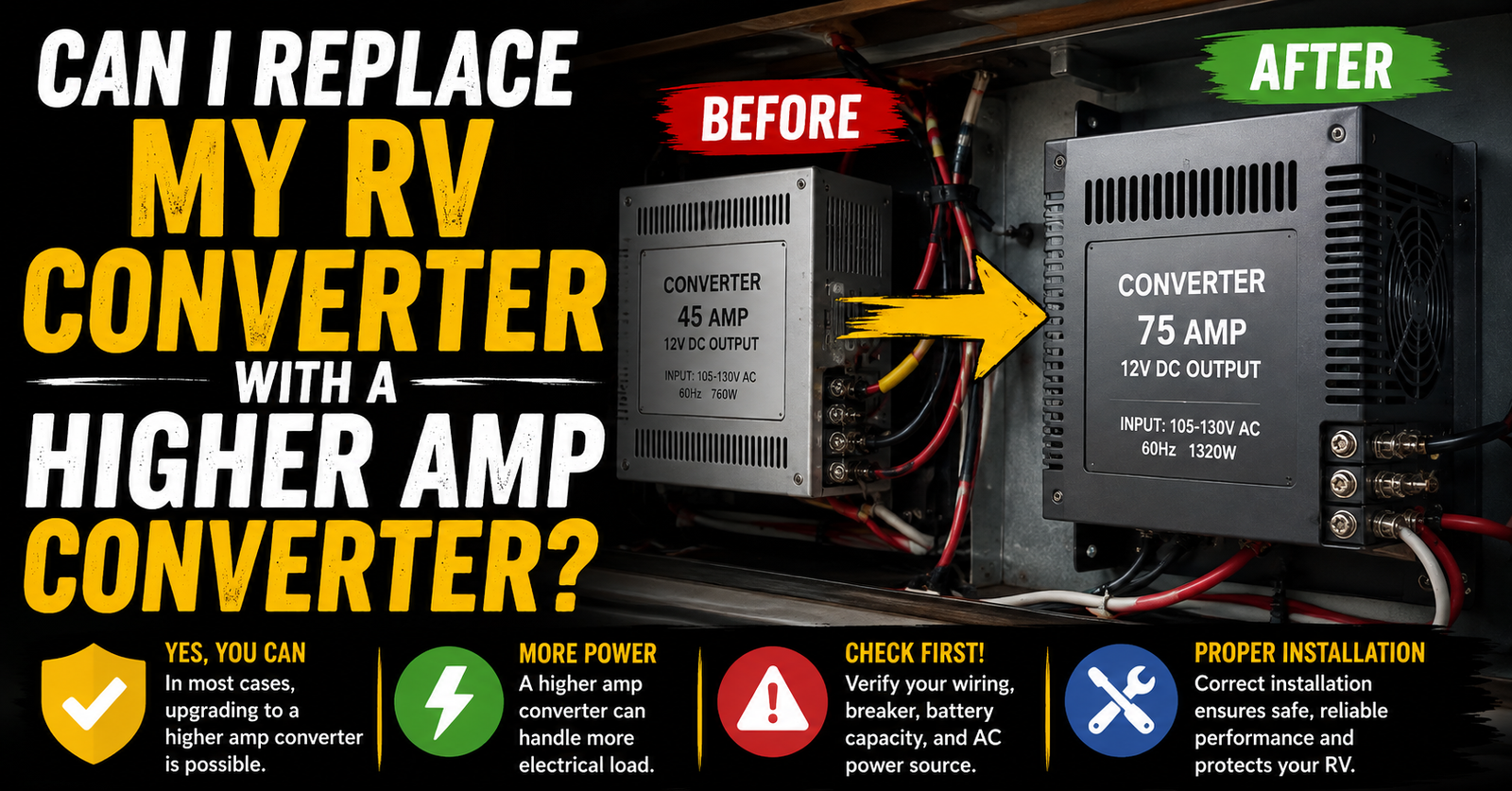
The wire size, cord length, connectors, circuit rating, equipment load, and condition of the connections all matter. Those same considerations become especially important when checking RV wiring before a converter upgrade.
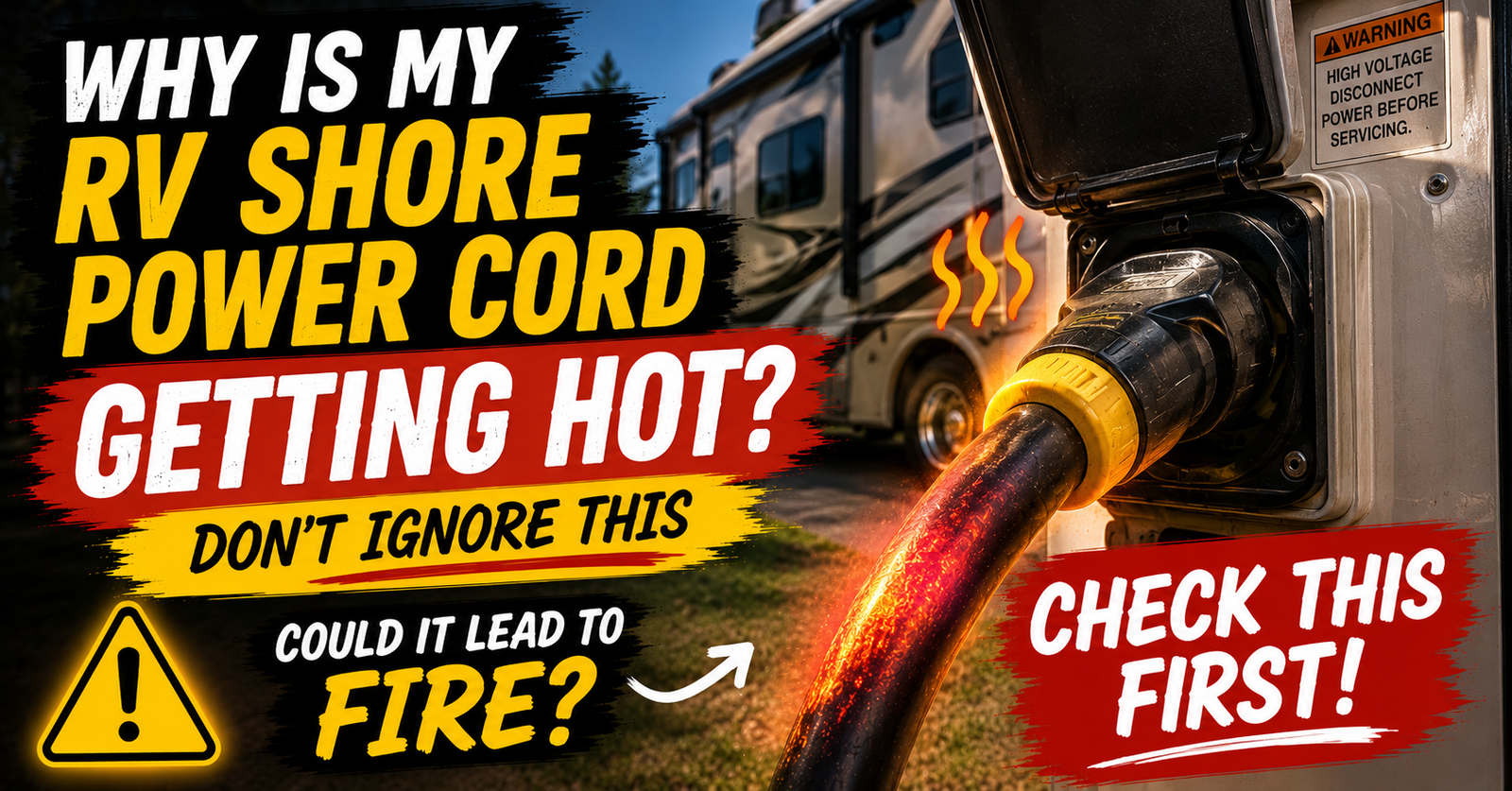
If a plug or receptacle becomes unusually hot, stop and figure out why.
Electrical connections shouldn’t be melting themselves while you camp.
Never Plug a 30-Amp RV Into a Dryer Outlet Just Because It Looks Similar
This mistake can get expensive fast.
A 30-amp RV receptacle is normally 120 volts.
Some household 30-amp receptacles used for appliances may be wired differently and may supply 240 volts.
A plug or receptacle looking vaguely similar doesn’t make the electrical service compatible.
Never guess.
If you’re having an RV receptacle installed at home, tell the electrician specifically that it is for an RV and verify the proper receptacle, voltage, wiring, grounding, and circuit protection.
This is not a place for “I think this is right.”
Is 50-Amp RV Service 240 Volts?
This question needs a careful answer.
A typical 50-amp RV service has two 120-volt hot legs that are 240 volts apart from each other.
However, most RV loads are connected from one hot leg to neutral and operate at 120 volts.
So you’ll commonly hear people say a 50-amp RV has “two legs of 120 volts.”
That’s a useful way for an RV owner to think about it.
The important thing is not to confuse a 30-amp 120-volt RV service with other 30-amp electrical circuits that may be 240 volts.
What Is a Shore-Power Cord?
It’s the heavy electrical cord that connects your camper to the outside AC supply.
Some RVs have a permanently attached cord that stores inside a compartment.
Others use a detachable cord that plugs into an inlet on the side of the RV.
These cords are substantially heavier than the little extension cord you’d use for a lamp.
They’re designed around the electrical service the RV requires.
Treat them like important electrical equipment, because they are.
Inspect Your Shore-Power Plug
Every once in a while, actually look at it.
I’m looking for:
Burned areas.
Discoloration.
Melted plastic.
Loose blades.
Corrosion.
Cracks.
Damaged insulation.
Signs that a connection has been running hot.
Don’t keep plugging in a damaged shore cord because it technically still works.
Heat damage is telling you something.
Should I Turn the Pedestal Breaker Off Before Plugging In?
I prefer connecting and disconnecting an RV shore-power cord with the pedestal breaker turned off when the pedestal allows it.
That means you’re not plugging the connector together while it’s already carrying the RV’s electrical load.
Once the connection is secure, the breaker can be turned on.
When leaving, reverse the process.
Turn the pedestal breaker off before disconnecting.
It’s a simple habit.
Is Campground Shore Power Always Safe?
I wouldn’t blindly assume every pedestal at every campground is perfect.
Electrical equipment lives outside.
It gets used constantly.
Plugs wear.
Connections loosen.
Weather happens.
Pedestals age.
Campgrounds can have wiring problems.
The RV Industry Association specifically discusses checking campground receptacles for physical damage, overheating, corrosion, proper grounding, and polarity. It also warns that an improper or lost ground can create a dangerous condition where metal portions of an RV become energized.
That’s a pretty good reason to take the pedestal seriously.
What Is an RV Surge Protector?
This term gets used pretty loosely.
Basic RV surge protectors can help protect against voltage spikes.
More advanced electrical-management systems can monitor additional power conditions, depending on the product, such as:
High voltage.
Low voltage.
Open ground.
Reverse polarity.
Other wiring faults.
Some systems disconnect the RV when incoming electricity falls outside acceptable conditions.
That can be valuable because not every campground electrical problem announces itself with sparks and smoke.
Why Low Shore-Power Voltage Matters
Electrical equipment is designed to operate within certain voltage ranges.
Low voltage can cause trouble for equipment, particularly motors and compressors.
That’s one reason I care about incoming campground voltage when an air conditioner or converter suddenly starts behaving differently at a particular campsite.
If everything worked perfectly yesterday, you changed campgrounds, and now the electrical system acts strange, don’t immediately assume three RV components simultaneously failed.
Look at what changed.
The incoming power source is one of those things.
What Does an Open Ground Mean?
The ground is an important safety path.
An open or missing ground can create a serious electrical hazard.
The RV Industry Association specifically warns about what’s commonly called a hot-skin condition, where the RV’s metal exterior, frame, or other metal parts become energized because of an electrical fault and improper grounding.
That’s not something to troubleshoot by touching the camper and deciding whether the tingle feels bad enough.
If you suspect the exterior of an RV is electrically energized, disconnect from the source if that can be done safely and have the electrical problem properly diagnosed.
What Is Reverse Polarity?
In simple terms, reverse polarity means the expected hot and neutral connections have been reversed.
That’s another campground-pedestal condition worth detecting rather than ignoring.
RVIA includes polarity testing among the electrical checks that can reveal improper pedestal wiring and potentially serious hazards.

This is why an electrical protection device or properly used circuit analyzer can be worthwhile when you’re constantly connecting your RV to electrical systems you don’t own. The main types of protection are compared in this guide to RV electrical protection devices.
Is Shore Power the Same as Generator Power?
No, although both can provide AC electricity to the RV.
With shore power, the AC electricity comes from an outside electrical system through the shore cord.
With generator power, you’re producing electricity locally with the generator.
Once that AC power is properly supplied to the RV, many downstream systems may operate similarly.
The converter can receive AC power.
AC appliances can operate.
The battery can be charged through the converter/charger.
But the original source of the AC electricity is different.
How Does an RV Know Whether to Use Shore Power or the Generator?
That depends on the RV.
Some setups require manual connections.
Others use an automatic transfer switch.
An automatic transfer switch handles which AC source feeds the RV when multiple possible AC sources exist.
This is another great future article because transfer switches are one of those RV components many owners don’t even realize they have until something quits working.
Progressive Dynamics, for example, produces both 30-amp and 50-amp automatic transfer equipment alongside RV power centers and converters.
Is Shore Power the Same as Solar Power?
No.
Solar panels produce DC electricity.
That electricity normally goes through a solar charge controller and is used to charge the battery bank or support the DC system, depending on how the system is designed.
Shore power is AC electricity coming into the camper from an external electrical supply.
They can both ultimately help keep your batteries charged, but they get there in completely different ways.
Can Solar Work While I’m Connected to Shore Power?
Many properly designed RV systems can have solar charging available while the camper is also connected to shore power.
The solar charge controller and converter/charger can each respond to battery voltage and their own charging logic.
Exactly how the system behaves depends on the equipment installed and how it’s configured.
That’s why battery chemistry and compatible charging equipment matter, particularly once lithium batteries enter the picture.
Shore Power vs. Battery Power
Here’s the simplest distinction I can make.
Shore power is incoming outside AC electricity.
Battery power is stored DC electricity already onboard the RV.
When shore power disappears, your battery doesn’t suddenly become a miniature campground pedestal.
The battery continues providing DC power.
If you want battery energy converted into household-style AC electricity, you generally need an inverter.
That’s the missing piece that confuses a lot of first-time camper owners.
Why Doesn’t My Air Conditioner Run From the RV Battery?
Technically, sophisticated battery and inverter systems can run RV air conditioners.
But we’re talking about a completely different level of electrical demand compared with running LED lights.
A typical basic camper battery system isn’t designed to directly operate a conventional 120-volt air conditioner.
That’s why shore power or generator power has traditionally been so important for RV air conditioning.
Large lithium battery banks and powerful inverters are changing what’s possible, but the energy requirement hasn’t magically disappeared.
Why Do My Lights Work When I’m Not Plugged In?
Because those lights are probably 12-volt DC lights.
The house battery can power them.
This is one of the easiest demonstrations of the RV’s two electrical systems.
Unplug shore power.
The microwave dies.
The normal wall outlets stop supplying AC power, assuming no inverter is powering them.
But the ceiling lights still work.
That’s your 12-volt system doing its job.
Why Are My RV Lights Dim Even Though I’m Plugged In?
Now we’ve come full circle to the problem that made us realize we needed this article in the first place.
If your lights are 12-volt DC lights, simply connecting shore power doesn’t guarantee they’re receiving proper DC voltage.
The converter has to be operating correctly.
The DC distribution system has to be intact.
The battery and connections can matter.
The electrical load can matter.
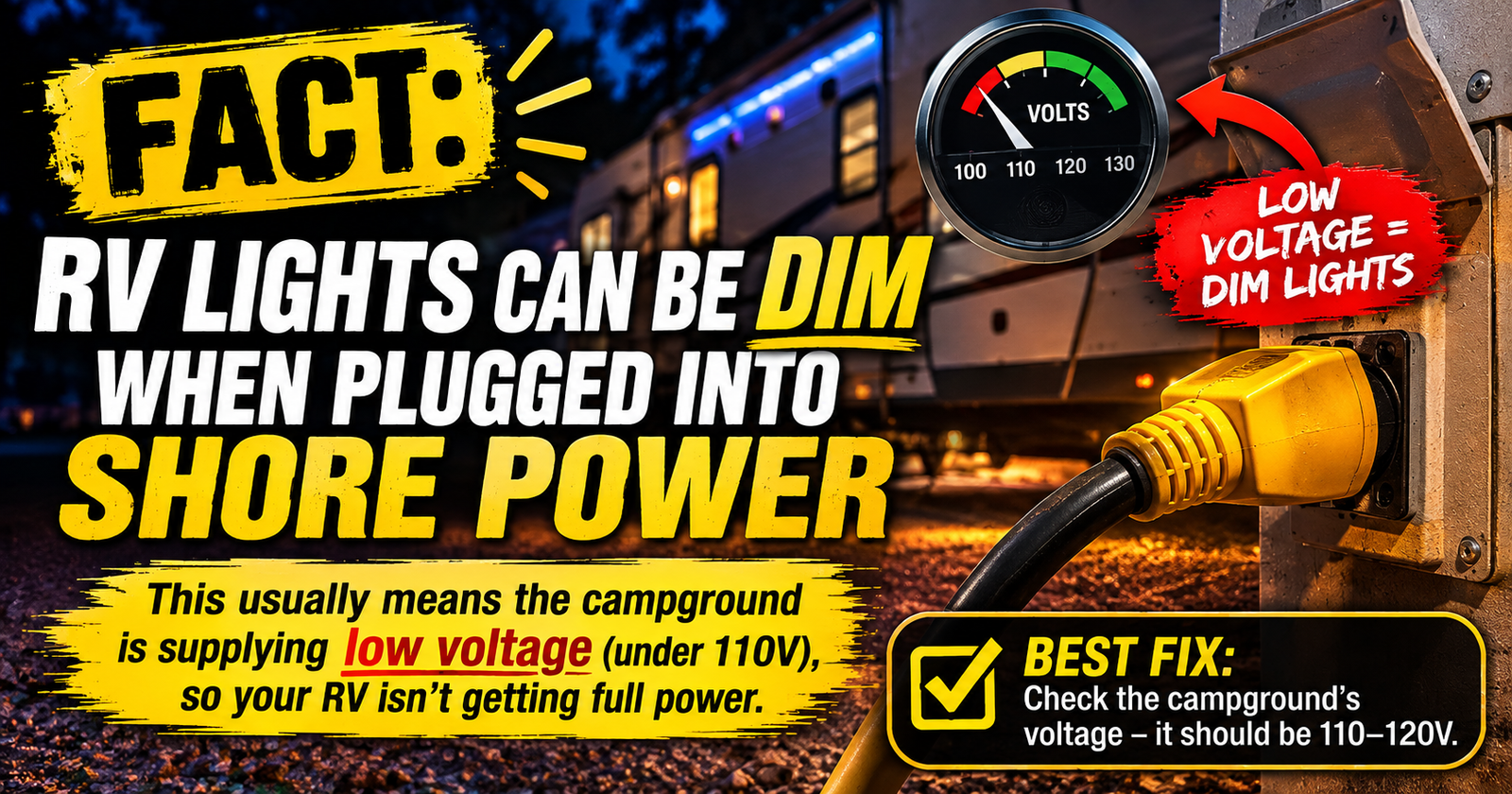
That’s why our guide to dim RV lights while connected to shore power starts looking at the converter, battery, wiring, and actual DC voltage rather than telling you to replace every light bulb.
Now the reason for that troubleshooting process should make a lot more sense.
What If My Outlets Work but the Battery Isn’t Charging?
This is another symptom that makes perfect sense once you separate AC from DC.
Your AC system can be receiving shore power normally.
So the outlets work.
Meanwhile, the converter/charger or the charging path between it and the battery has a problem.
So the battery doesn’t charge.
One half of the electrical system can work while the other has a problem.
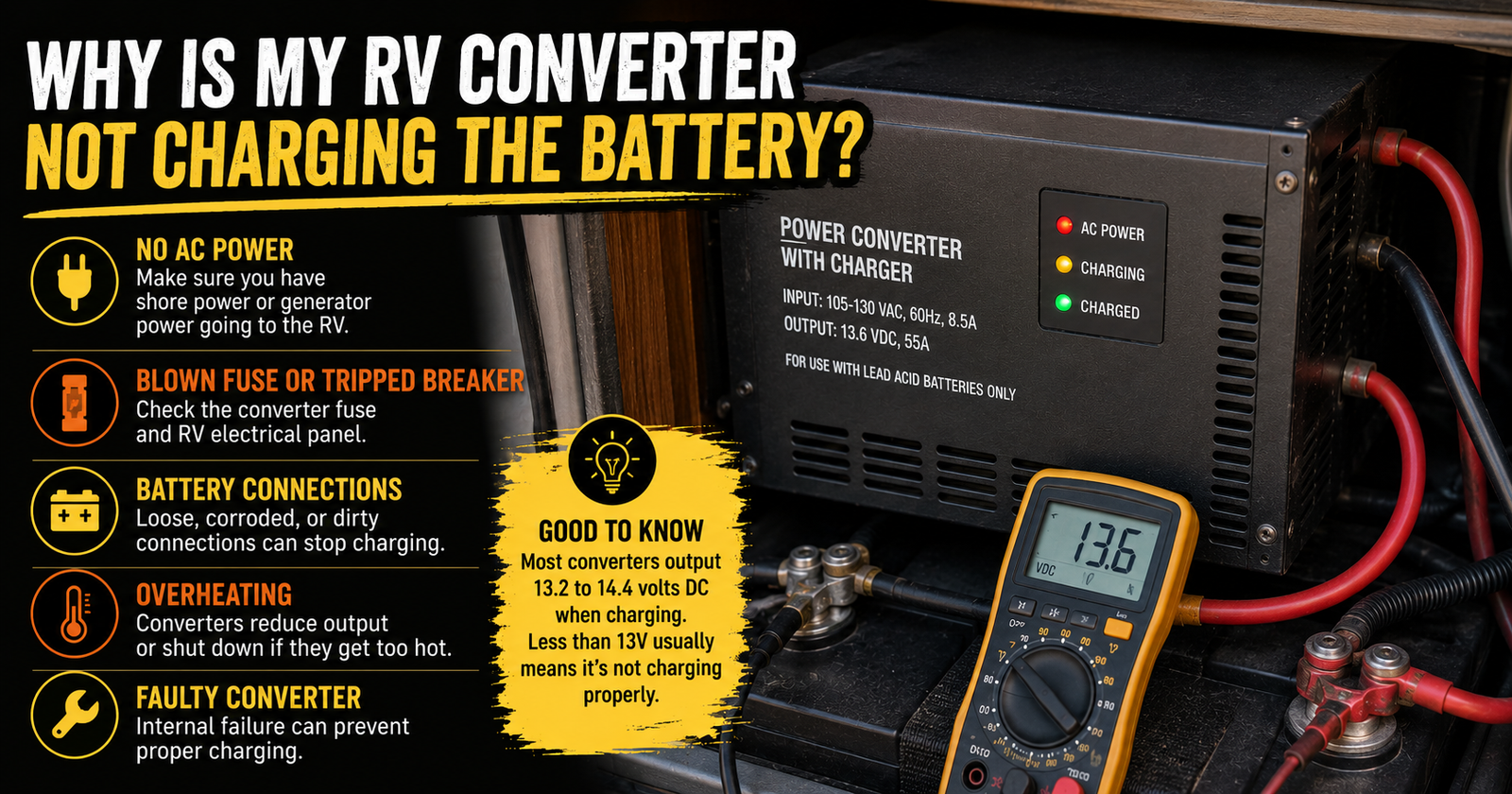
Our guide to an RV converter that isn’t charging the battery walks through that exact situation.
What If the Battery Charges but My Outlets Don’t Work?
Now I’d start looking at the AC side rather than immediately blaming the converter.
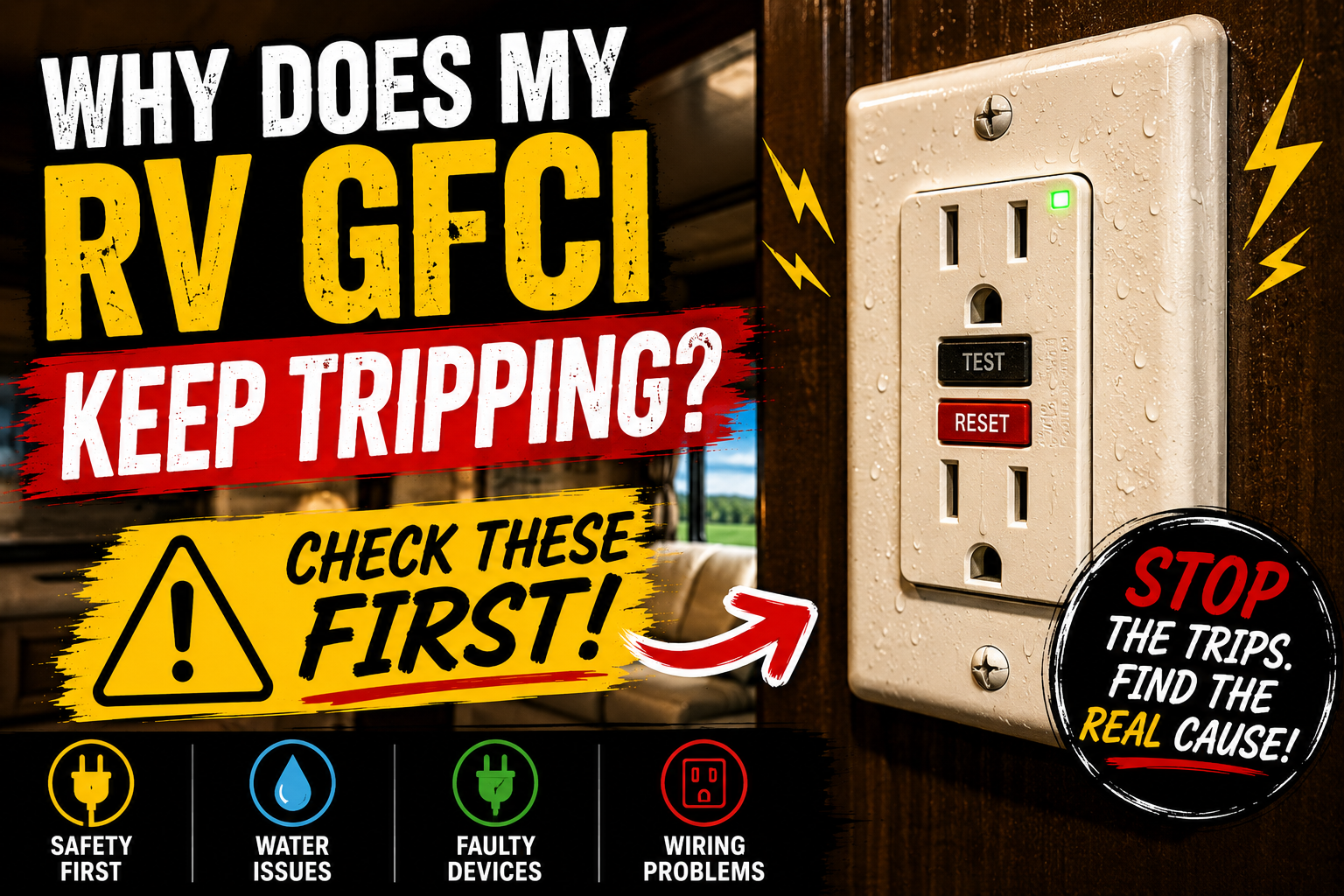
Check things such as the appropriate breakers and GFCI protection according to your RV’s electrical design.
A converter can potentially receive AC power while another AC branch circuit has a problem.
Again, don’t treat the entire RV electrical system as one giant circuit.
There are multiple branches and protective devices.
Does the Converter Run the Whole RV?
No.
This is a misconception worth clearing up.
The converter isn’t taking all incoming shore power and somehow redistributing every watt in the camper.
Your AC loads are supplied through the RV’s AC electrical distribution system.
The converter is one of those AC loads.
Its special job is producing DC electricity for the 12-volt side and charging system.
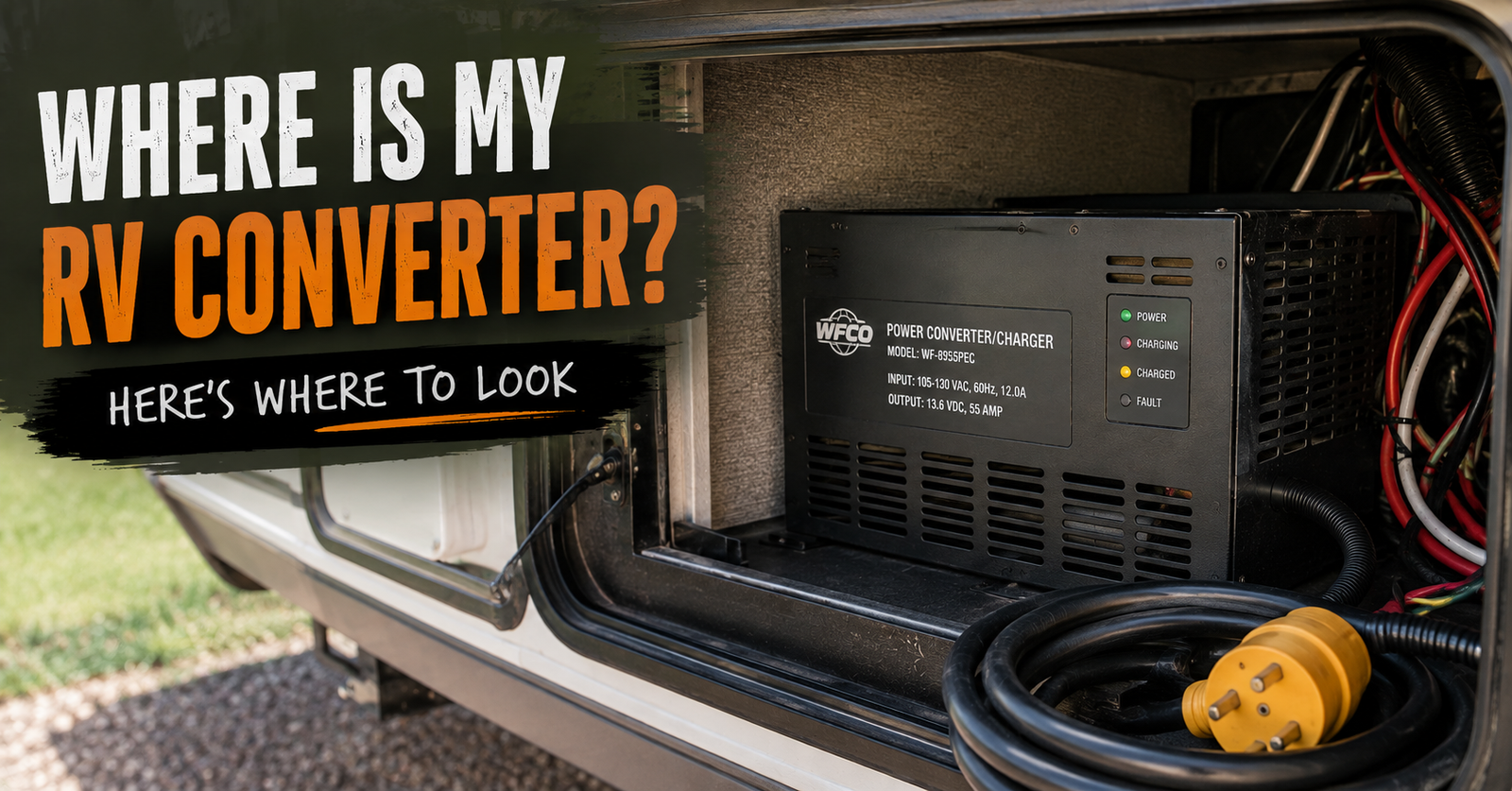
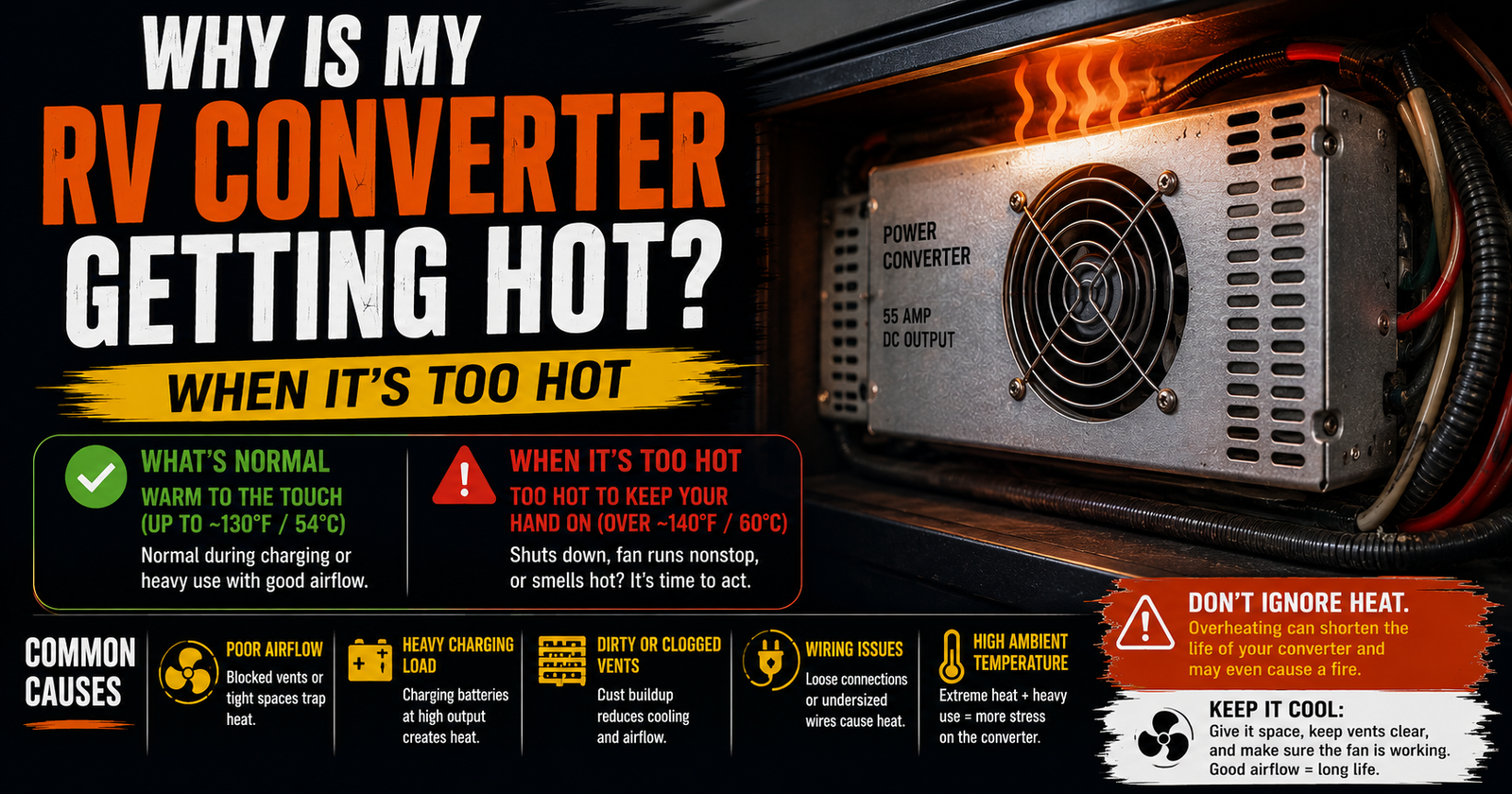
Many modern RV power centers combine the AC breaker panel, DC fuse panel, and converter section into one physical assembly, which can make everything look like one device. Progressive Dynamics, for example, describes its power centers as all-in-one units containing the converter, DC fuse panel, and AC breaker space. That integrated design is why knowing where RV converters are commonly located can save you from searching for a separate metal box.
Electrically, though, understanding the separate AC and DC functions is extremely helpful.
Do I Need to Turn My Converter On When I Plug Into Shore Power?
On many modern RVs, normal converter operation is automatic.
You plug into shore power, the converter receives its AC supply, and it does its job without you manually flipping a “converter on” switch every time you arrive at a campsite.
Older RV electrical systems can be different, and modified campers can be very different.
So if you’re dealing with an older camper, don’t assume its converter operates exactly like a brand-new one.
Identify the equipment.
Can I Leave My RV Plugged Into Shore Power All the Time?
This depends heavily on the charging equipment, battery type, battery condition, and how the RV is being stored.
Modern multi-stage converter/chargers are designed to manage battery charging much more intelligently than old fixed-voltage charging systems.
But that doesn’t mean I’d plug an RV in for six months and never look at anything.
For flooded lead-acid batteries, maintenance and electrolyte levels matter.
Battery compatibility matters.
Converter settings matter.
Lithium batteries have their own charging and temperature considerations.
This is another topic that deserves its own dedicated article rather than a one-paragraph answer buried here.
Does Shore Power Charge a Lithium RV Battery?
It can, provided the converter/charger and charging setup are appropriate for the battery.
Modern converters may support selectable charging profiles for different battery chemistries. For example, Progressive Dynamics currently sells converter/chargers with selectable profiles for flooded lead-acid, AGM, and LiFePO4 batteries. Battery chemistry is only one part of choosing an RV converter for your battery system; the converter’s amp rating and the RV’s wiring matter too.
Don’t assume an old converter is automatically ideal for a new lithium battery just because voltage comes out of it.
Check compatibility.
Why Does My RV Have Both Breakers and Fuses?
Because you’re dealing with both AC and DC electrical distribution.
In a typical setup, circuit breakers protect AC circuits.
Fuses commonly protect DC circuits.
That’s why opening an RV power center can reveal a row of household-looking breakers on one side and automotive-style blade fuses on another.
Once you understand shore power and the converter, that arrangement stops looking so strange.
What Does “Full Hookups” Mean?
Shore power is only one possible campground hookup.
A campsite advertised as having full hookups generally means you have hookups for:
Electricity.
Fresh water.
Sewer.
The electrical hookup is your shore-power connection.
A site can also have electric-only or electric-and-water service without sewer.
So “shore power” doesn’t mean you’re automatically on a full-hookup campsite.
It only describes the electrical side.
Can I Camp Without Shore Power?
Of course.
That’s a huge part of RVing.
Without shore power, you may rely on some combination of:
House batteries.
Solar.
Generator power.
Propane for compatible appliances.
An inverter for selected AC loads.
How long you can camp that way depends heavily on battery capacity, energy consumption, charging ability, weather, and the equipment you’re trying to run.
That’s where RV electrical systems get really interesting.
Shore Power Is Basically Your RV’s Electrical Lifeline at a Campsite
The phrase sounds technical, but the idea really isn’t.
Shore power means your RV is connected to an outside source of AC electricity.
At most campgrounds, that means plugging your RV’s shore cord into the electrical pedestal beside your campsite.
That incoming electricity can directly supply your RV’s AC system and provide power to the converter/charger. The converter then supports the 12-volt DC system and normally charges the house battery.
A 30-amp RV usually has up to about 3,600 watts available.
A 50-amp RV can have up to about 12,000 watts available across its two 120-volt legs.
Your battery is still important.
Your converter is still important.
Your 12-volt system is still operating.
And being connected to shore power doesn’t guarantee that every electrical component in the camper is working correctly.
Once you understand those few pieces, a huge portion of RV electrical troubleshooting starts falling into place.
The next time somebody at a campground asks whether you’re running on battery, generator, or shore power, you won’t have to wonder what they’re talking about.
If that big cord is plugged into the campground pedestal and the RV is receiving AC electricity from it, you’re on shore power.
Written by Evan Mercer
Evan Mercer writes about RV electrical systems, batteries, converters, shore power, and practical camper ownership for CamperAnswers.com. His goal is to take the electrical terms RV owners hear constantly and explain what they actually mean without making a camper feel like an electrical-engineering project.