
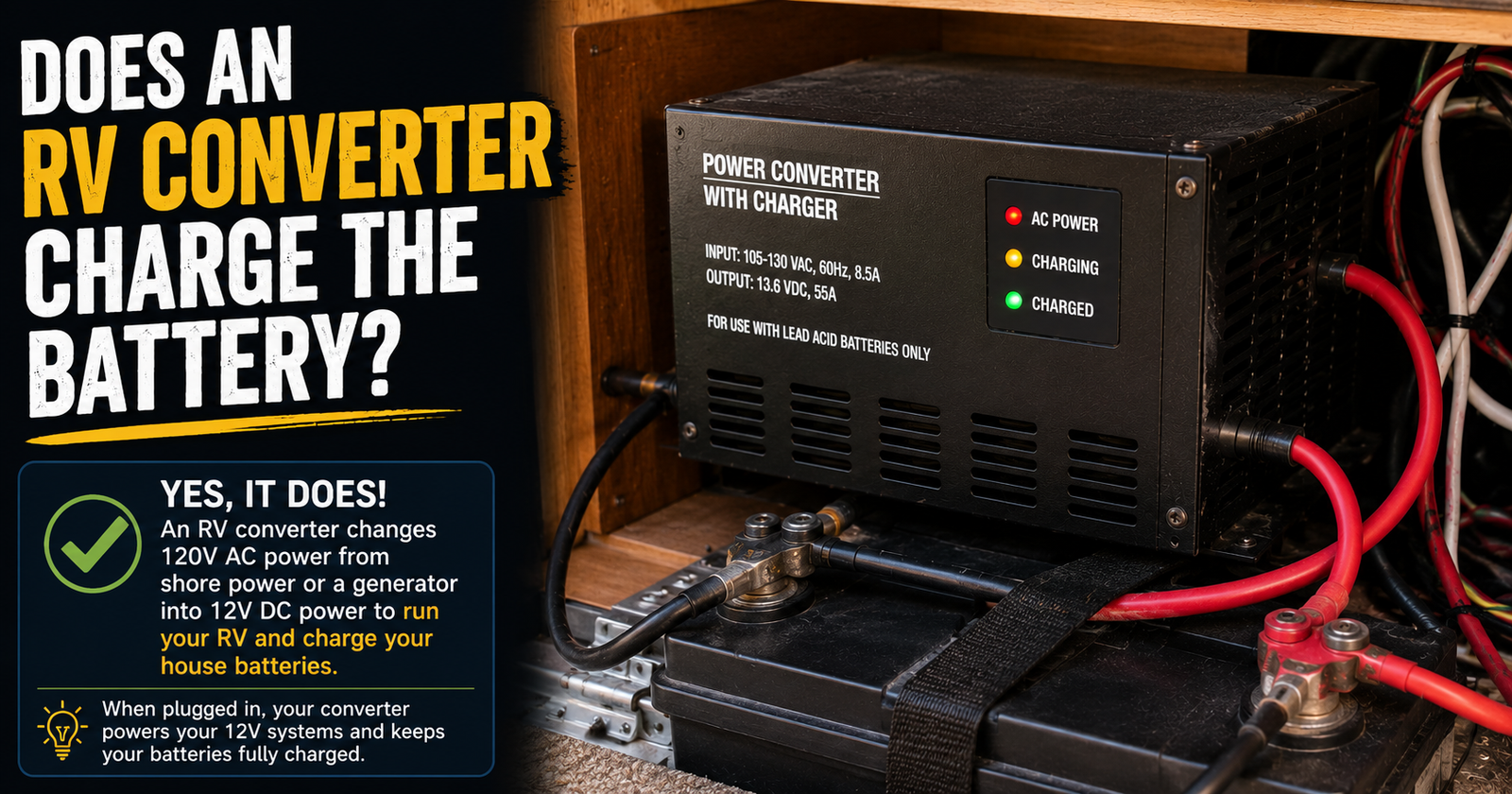
Yes, your RV converter normally charges the house battery when the camper is connected to shore power.
That’s the short answer.
But there’s an important catch: just because your RV is plugged in doesn’t guarantee the battery is actually receiving a charge.
I’ve seen this cause a lot of confusion because everything inside the camper appears normal. The air conditioner runs. The microwave works. The outlets have power. Maybe the lights even look perfectly fine.
Then you unplug the camper and discover the house battery is nearly dead.
So yes, the converter is supposed to charge the battery. Understanding how it does that makes it much easier to figure out what’s wrong when it doesn’t.
How Does an RV Converter Charge the Battery?
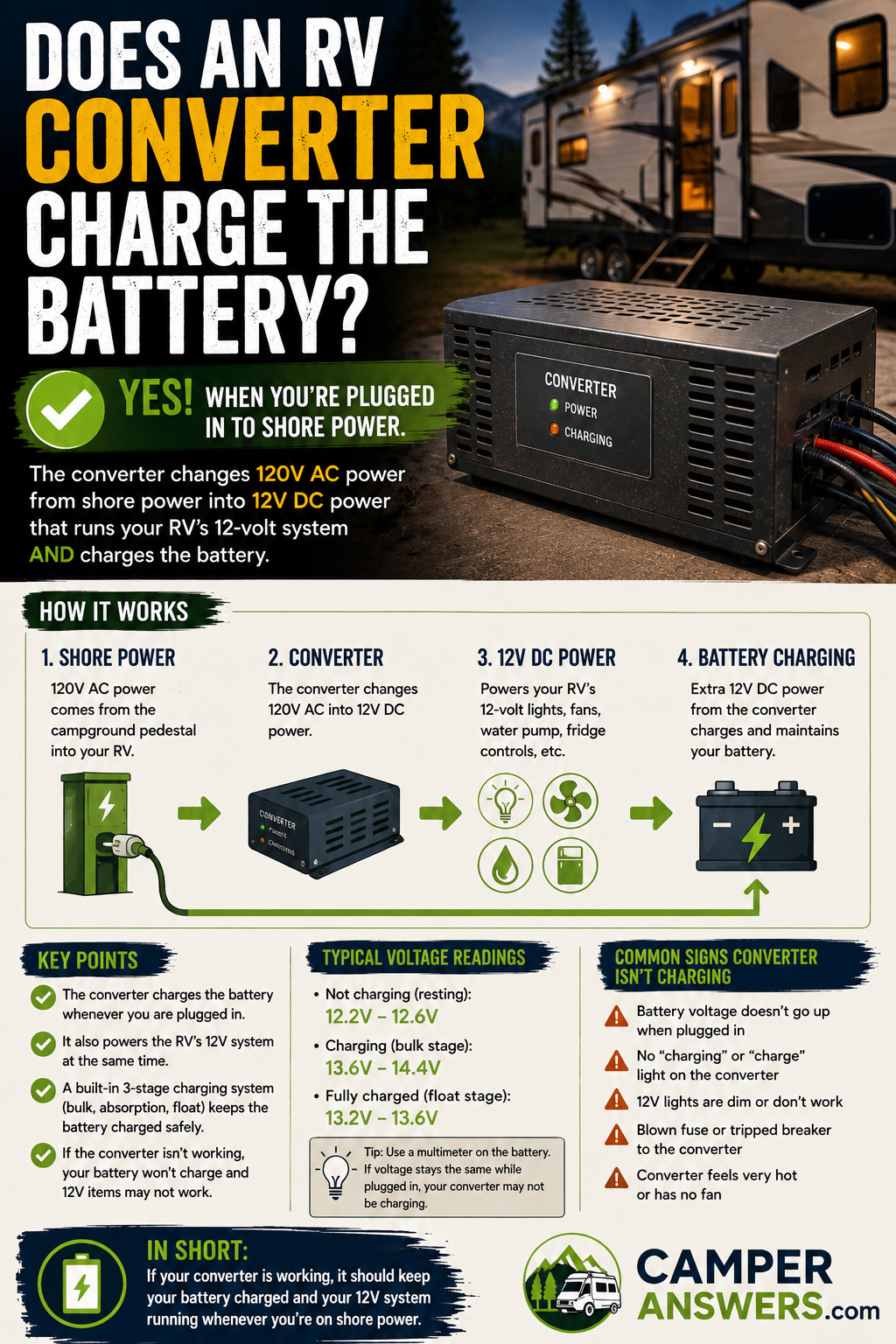
Your campground electrical hookup supplies AC electricity to the RV.
Your house battery stores DC electricity.
Those aren’t the same thing.
The converter/charger bridges that gap by taking incoming AC power and providing DC power for the camper’s 12-volt electrical system while also charging the battery.
That’s why it’s called a converter.
It’s converting AC electricity into DC electricity.
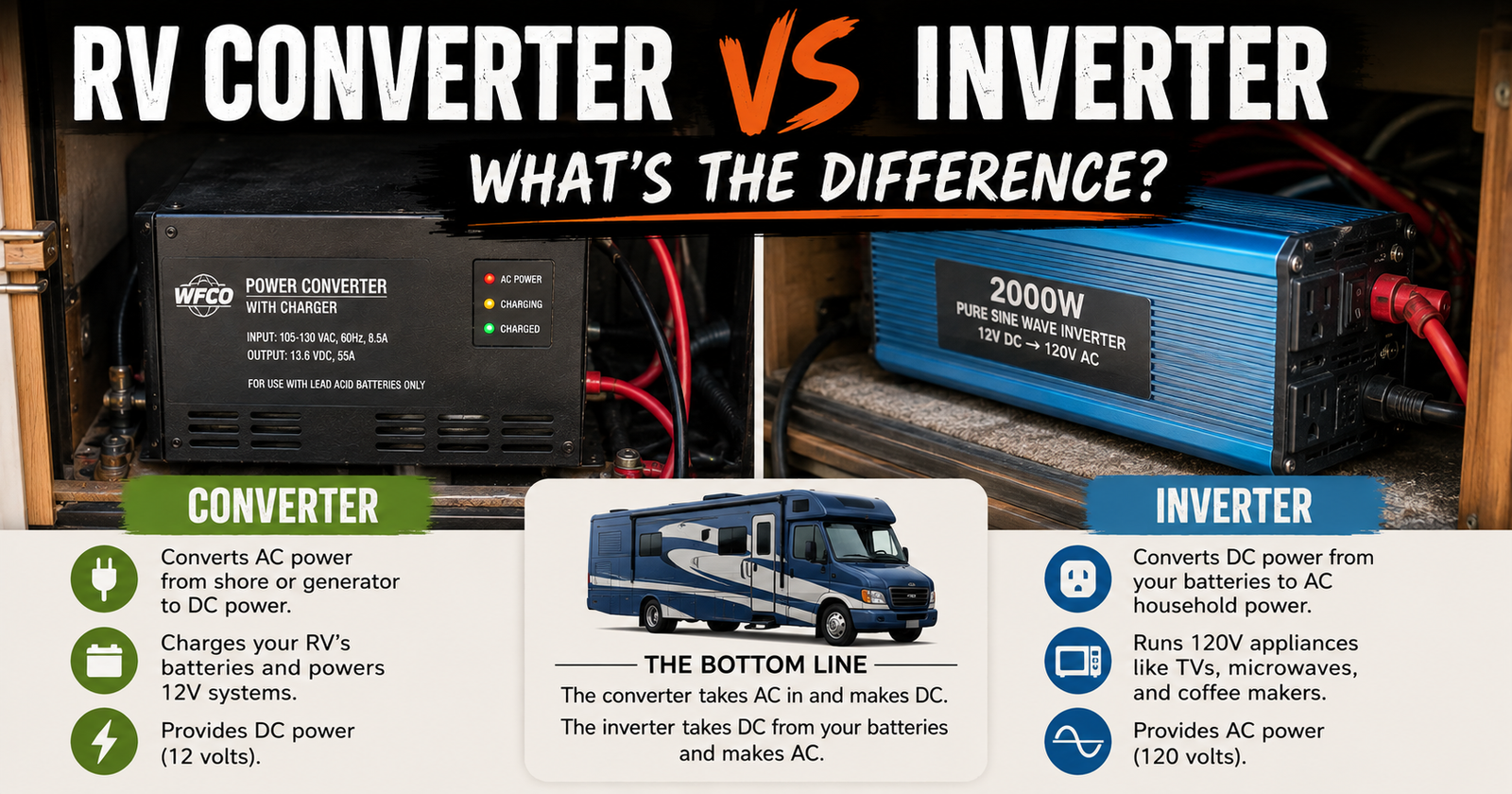
If you’ve been following our electrical guides, this is also the big difference between an RV converter and an inverter.
They work in opposite directions.
Does My RV Battery Charge Whenever I’m Plugged Into Shore Power?
Normally, yes, assuming the charging system is operating correctly and your particular RV is configured to charge the house battery from shore power.
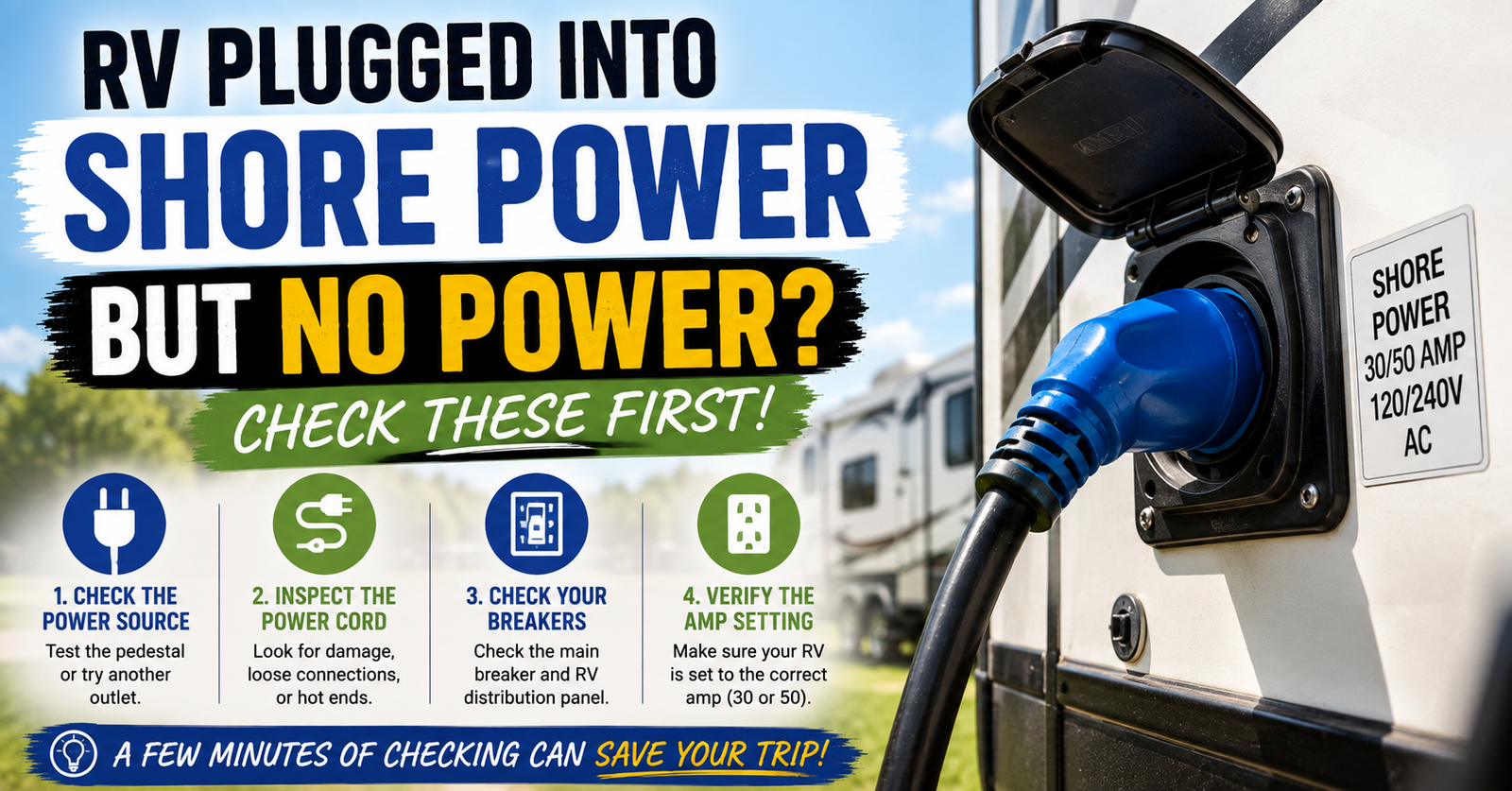
Plug the camper into a proper shore-power source and the converter/charger should have AC power available.
The converter then supplies DC power and charges the house battery according to its design and charging profile.
Progressive Dynamics describes its converter/chargers as supplying 12-volt power to RV equipment while recharging the battery when 120-volt AC power is available.
That’s the normal arrangement in a lot of campers.
But there are plenty of reasons the charging process can be interrupted.
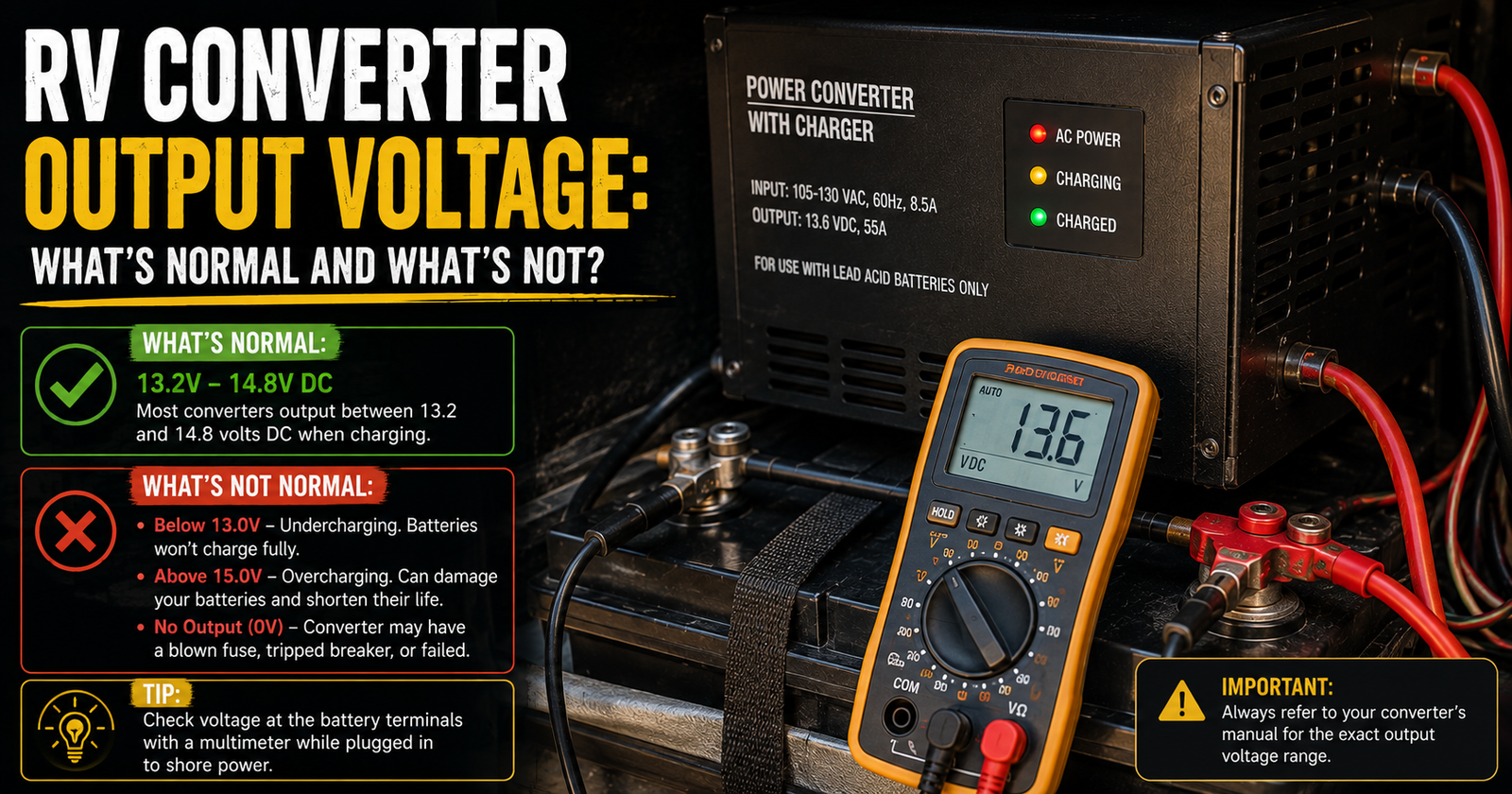
What Actually Happens After I Plug In?
Think of it as a path.
Shore power enters the RV.
The AC electrical system distributes that power.
The converter receives AC power.
The converter produces DC output.
That DC electricity supplies the 12-volt system and provides charging current to the battery.
The battery stores that energy so you can use it later when shore power isn’t available.
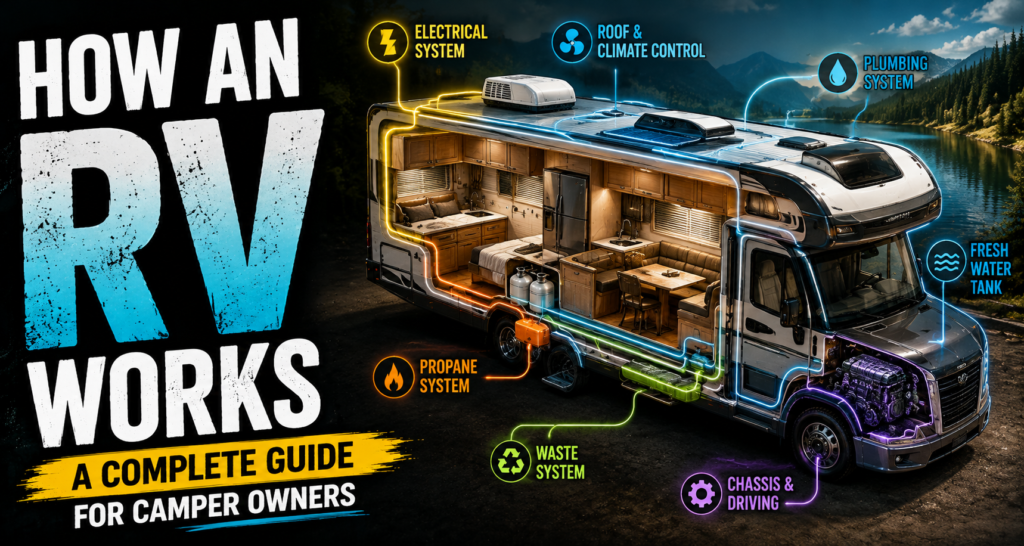
If you want a bigger-picture explanation of how all of this connects to the rest of the camper, our complete guide to how an RV works breaks the major systems down in plain English.
Does the Converter Power the 12-Volt System Too?
Yes, that’s another major part of its job.
Your RV has plenty of equipment that operates on the 12-volt DC side.
Depending on the camper, that can include interior lighting, the water pump, furnace controls and blower, vent fans, appliance controls, and other equipment.
When you’re plugged into shore power, the converter can supply DC power to those loads while also charging the battery.
This is one reason the camper can appear to be working normally even when there’s a battery problem.


Can My 12-Volt Lights Work With a Dead Battery?
Depending on the RV’s design and the nature of the battery problem, the converter may be able to supply the 12-volt system while shore power is connected.
That can create a confusing situation.
Lights work while plugged in.
Water pump works.
Everything seems fine.
Then you disconnect shore power and suddenly the 12-volt system becomes weak or stops working.
That’s a major clue.
The converter may have been carrying the 12-volt loads while the battery itself wasn’t providing useful stored energy.
Does the Converter Charge the Battery With the RV Battery Disconnect Off?
This is where I stop giving universal yes-or-no answers.
Battery-disconnect wiring varies between RVs.
Depending on how the manufacturer wired the charging circuit, the disconnect position can affect whether the converter charges the battery.
Aftermarket modifications can complicate it even further.
Someone may have added solar, an inverter, a second disconnect, a lithium battery bank, or direct battery connections.
So don’t assume every RV behaves exactly like the camper parked next to you.
How Can I Tell If the Converter Is Charging My Battery?
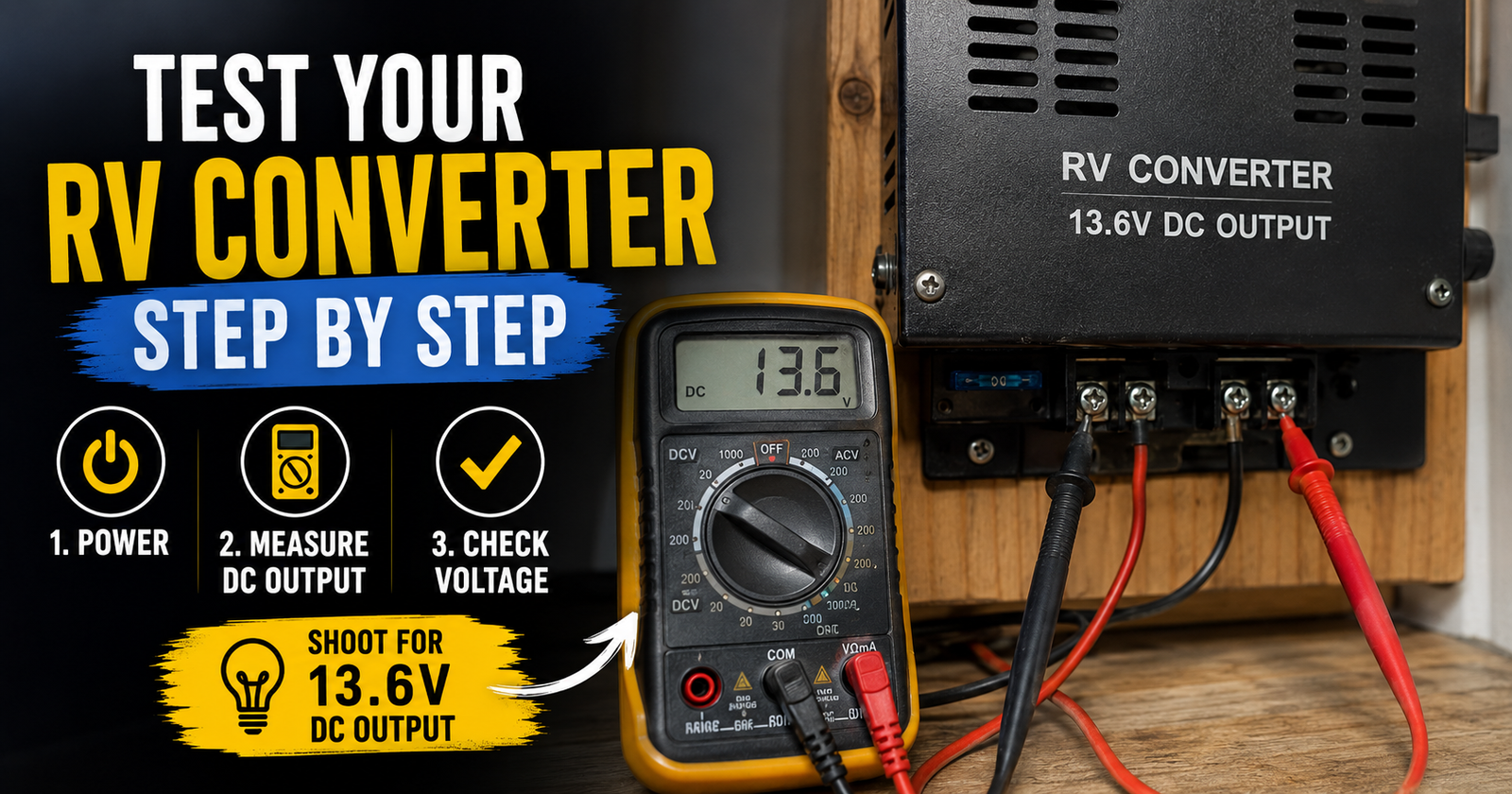
A multimeter makes this much easier.
Measure battery voltage directly at the battery under appropriate conditions before connecting shore power.
Then connect the RV to shore power and measure again.
If the converter is charging, you should normally see the battery-side voltage reflect charging activity.
The exact number depends on battery chemistry, converter model, charging stage, temperature compensation where applicable, and other factors.
That’s why I don’t use one magic voltage number for every RV.
What Voltage Should I See While the Converter Is Charging?
This depends on your equipment.
A modern multi-stage converter may intentionally change its charging voltage as the battery moves through different charging stages.
Battery chemistry matters too.
Lead-acid and lithium systems aren’t necessarily going to use identical charging profiles.
So instead of asking:
“Is 13.6 volts always correct?”
I prefer:
“What does the manufacturer of this converter and battery say I should see under these conditions?”
That’s much more useful.
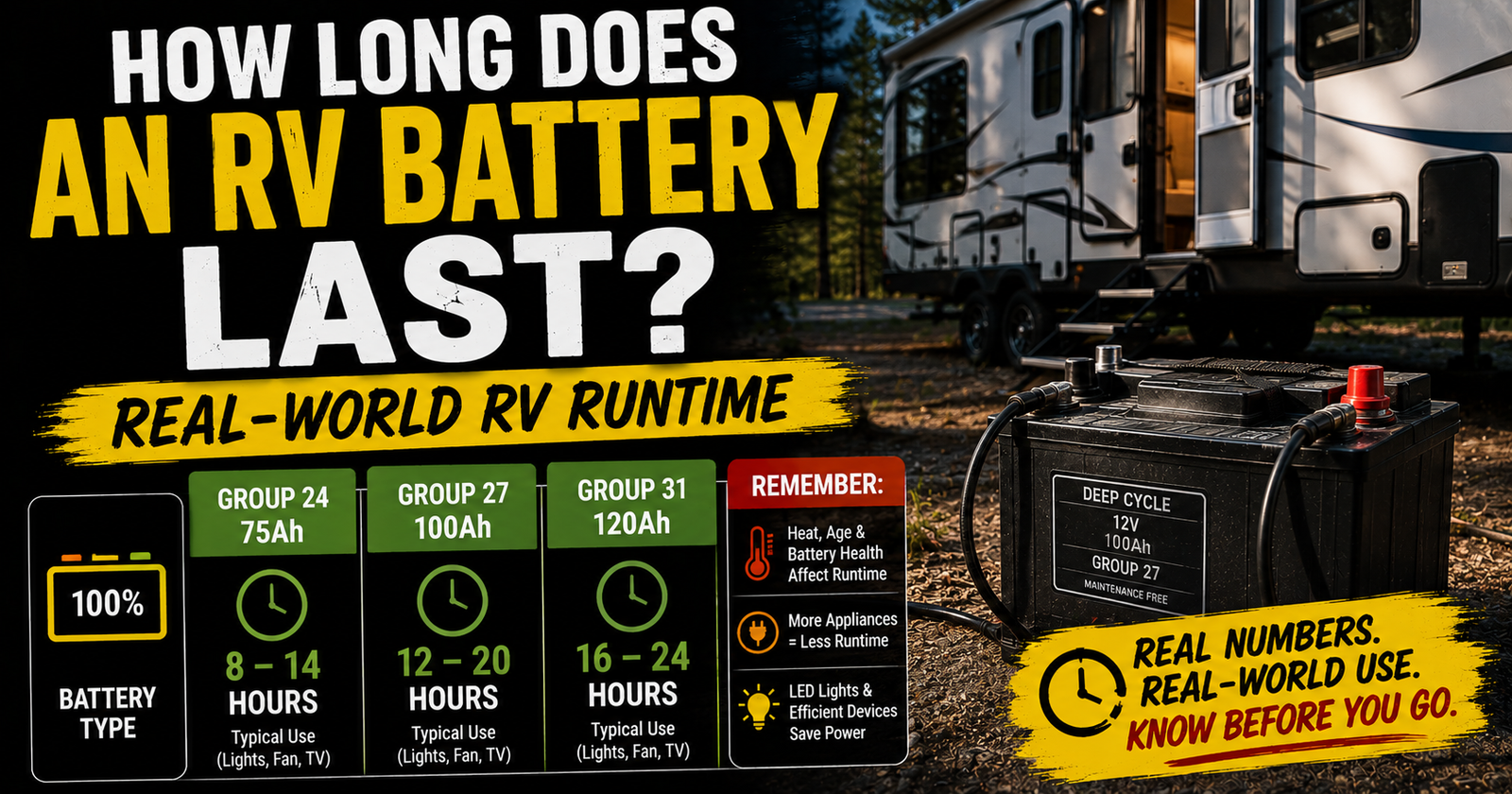
Charging Voltage Is Different From Resting Battery Voltage
This trips people up constantly.
You read online that a fully charged 12-volt lead-acid battery should have a resting voltage somewhere in a certain range.
Then you plug the camper in and see a considerably higher number.
You think something is wrong.
Not necessarily.
You’re no longer measuring a battery simply sitting at rest.
You’re measuring a battery connected to an active charging source.
Those are different conditions.

Our RV battery voltage guide goes much deeper into interpreting those numbers correctly.
Does the RV Converter Charge the Battery From a Generator?
Usually the generator supplies AC electricity to the RV, and the converter/charger then uses that AC electricity to charge the house battery.
So in many conventional RV electrical systems, the generator isn’t directly acting as the battery charger.
It’s providing an AC source that allows the charging equipment to do its job.
That’s an important distinction.
If your converter isn’t charging properly, running the generator for another three hours may accomplish very little for the battery.
Does the Converter Charge the Battery While Driving?
Not by itself in the usual sense.
While driving, battery charging may come from the vehicle’s alternator through the RV’s charging arrangement.
Modern systems may use a DC-to-DC charger to manage that process, particularly with upgraded battery systems.
Victron describes DC-to-DC chargers as equipment used in dual-battery systems to provide controlled charging from the alternator/start-battery side to the service battery.
That’s a different charging path from your AC converter.
Does Solar Use the RV Converter?
No, not in the normal solar-charging path.
Solar panels produce DC electricity.
That power generally goes through a solar charge controller before reaching the battery.
So now your camper can potentially have several different ways to charge the same battery bank.
Shore power can charge through the converter or inverter/charger.
A generator can provide AC power to that charging equipment.
Solar can charge through its solar controller.
The vehicle alternator may charge through its own charging path.
This is why RV electrical systems become much easier to troubleshoot once you think in terms of charging sources and paths.
Can Solar and the Converter Charge at the Same Time?
Depending on the equipment and system design, multiple charging sources can be present simultaneously.
That’s something I keep in mind when troubleshooting.
Suppose you’re plugged into shore power on a beautiful sunny afternoon.
You measure charging voltage at the battery.
Can you immediately declare the converter healthy?
Not necessarily.
Solar may also be contributing.
When I’m trying to test one charging source, I want to understand what the other sources are doing too.
What If I Have an Inverter/Charger Instead?
Then the terminology changes a little, but the battery still needs a charging device.
An inverter/charger combines multiple functions in one unit.
Victron describes an inverter/charger as combining an inverter, battery charger, and automatic transfer function. When an external AC source is available, it can supply AC loads while charging the batteries. When that external source disappears, it can switch to inverter operation and supply AC power from the batteries.
So you may not have a traditional standalone converter at all.
Your inverter/charger may be handling the shore-power battery charging.
How Do I Know Which System My RV Has?
Find the equipment.
Look at the model numbers.
Read the manufacturer’s documentation.
Don’t assume every camper has the same setup.
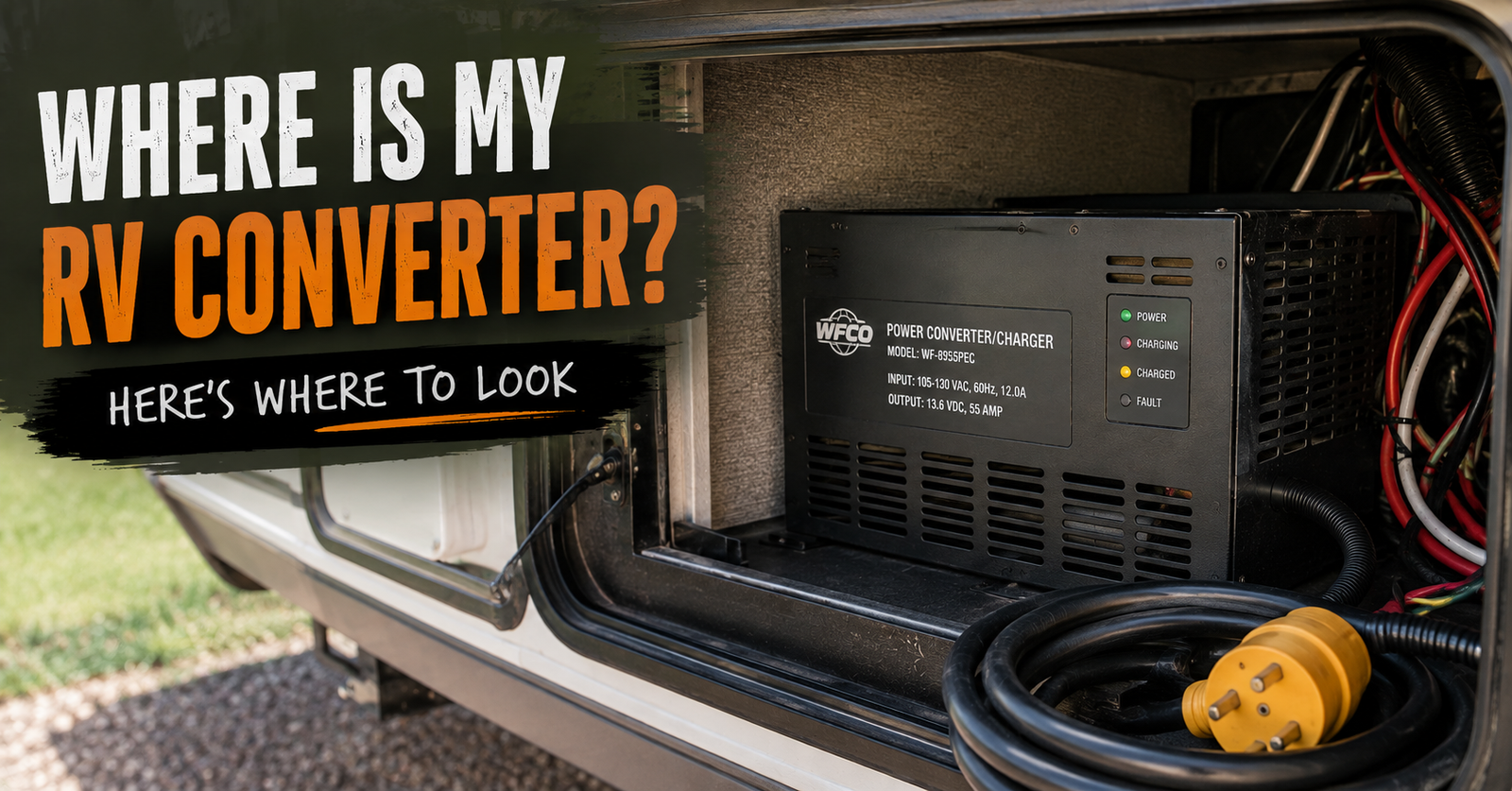
We’ve already covered where to look for your RV converter because sometimes identifying what you’ve actually got is half the battle.
Once you know the manufacturer and model, troubleshooting becomes much easier.
Why Isn’t My Converter Charging the Battery?
Now we get into the problems.
If the converter is supposed to charge the battery but isn’t, I start checking the charging path.
Does the converter have AC input?
Is its breaker on?
Are the applicable fuses good?
Is the converter producing DC output?
Is there a blown fuse or open breaker between the converter and battery?
Is the battery disconnect involved?
Are the battery cables connected properly?
Is there corrosion?
Is the battery itself capable of accepting the charge?
You don’t need to guess because each part can be checked.
The Converter Can Be Good and the Battery Still Won’t Charge
This is one of the most important things to understand.
The converter can produce perfectly good output while the battery receives nothing.
There may be an interruption somewhere between them.
A fuse.
Circuit breaker.
Loose connection.
Damaged cable.
Disconnect.
Corrosion.
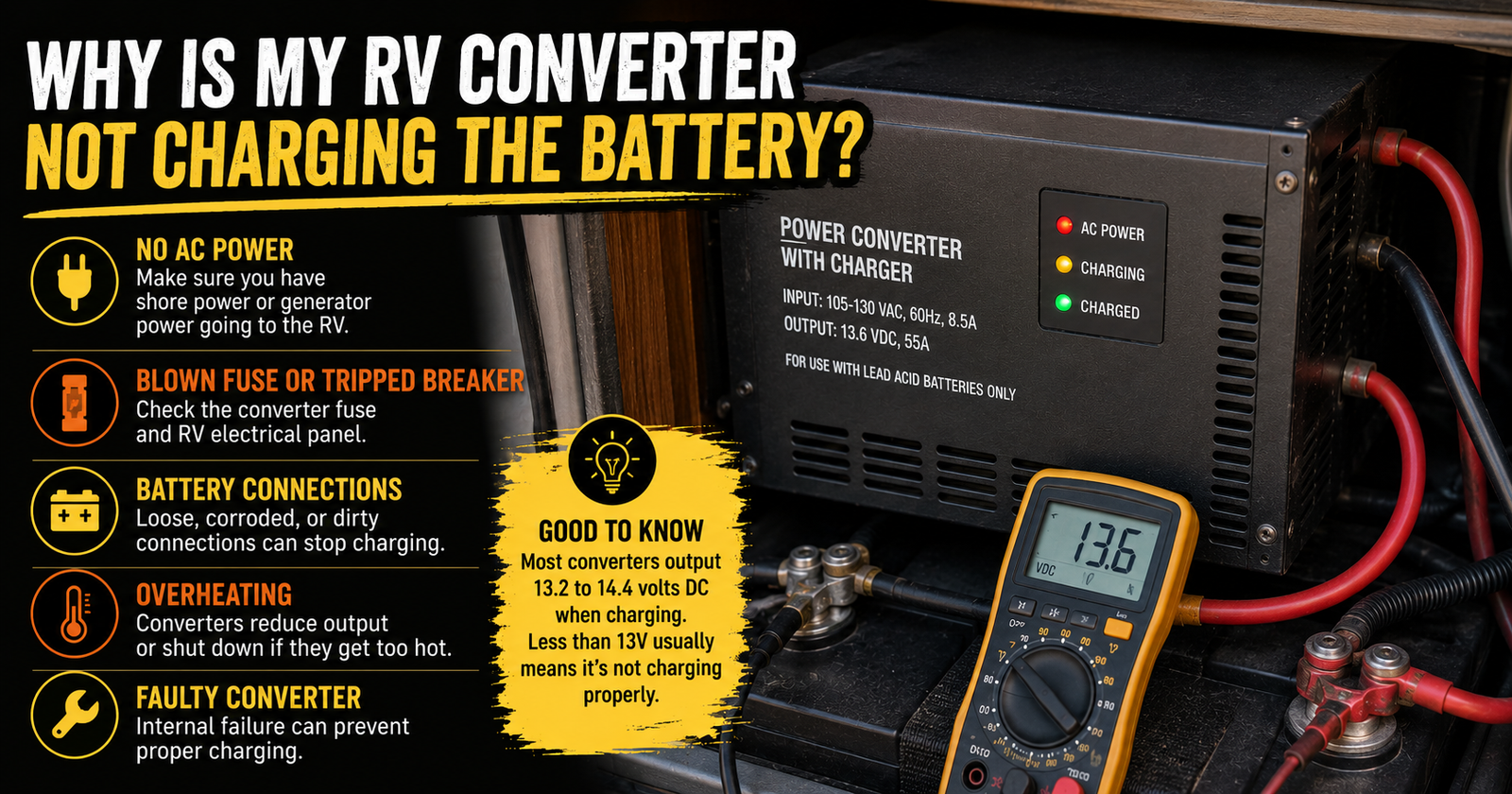
That’s why our guide to an RV converter that isn’t charging the battery traces the entire charging path instead of automatically replacing the converter.
The Battery Can Be the Problem Too
Let’s say charging voltage reaches the battery.
Everything looks correct on the converter side.
But the battery still performs terribly.
Now I start questioning the battery itself.
A worn battery may accept charging voltage and still have very little usable capacity left.
That’s how you get a battery that seems to charge quickly but also dies ridiculously fast.
The converter can’t restore capacity that’s no longer there.
Don’t Replace the Converter Just Because the Battery Is Dead
A dead battery tells you the battery is discharged.
It doesn’t automatically tell you why.
Maybe the converter failed.
Maybe the battery is worn out.
Maybe something drained it.
Maybe it wasn’t plugged in long enough.
Maybe the charging circuit has an open fuse.
Maybe the disconnect prevented charging.
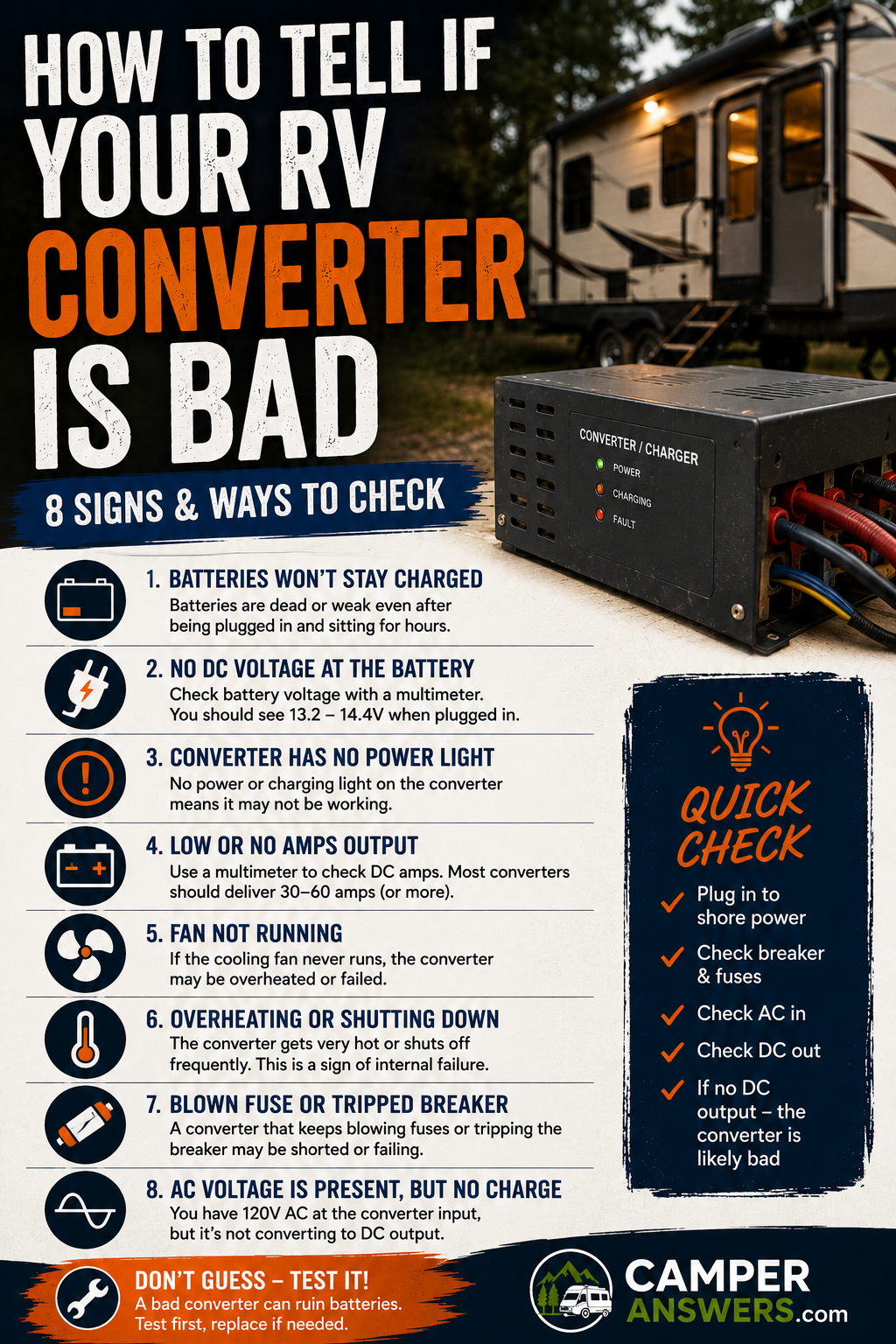
That’s why we built a separate process for determining whether the RV converter is actually bad.
I’d rather spend ten minutes testing than spend hundreds of dollars guessing.
Can a Converter Overcharge an RV Battery?
Charging problems aren’t limited to too little charge.
Improper charging can also damage batteries.
Modern multi-stage charging equipment is designed to manage battery charging more intelligently than simply applying one charging condition forever.
The charging equipment also needs to be appropriate for the battery chemistry you’re using.
That’s especially important as more RV owners switch from traditional lead-acid batteries to lithium iron phosphate batteries.
Will My Old RV Converter Charge a Lithium Battery?
This needs a more careful answer than simply yes or no.
You need to compare the converter’s charging capabilities with the lithium battery manufacturer’s requirements.
Progressive Dynamics specifically offers lithium-compatible converter replacements and warns owners not to install a replacement with a higher DC output rating than the existing system if the RV wiring isn’t designed for that additional current.
And when converting an RV from lead-acid to lithium, the shore-power charging system is only one part of the picture. Alternator and solar charging may need to be evaluated too.
We’re going to give lithium converter compatibility its own article because it deserves one.
How Long Does the Converter Take to Charge an RV Battery?
There isn’t one useful answer for every camper.
Charging time depends on things such as battery capacity, state of charge, battery chemistry, converter output, charging profile, wiring, temperature, and how much 12-volt power the RV is consuming at the same time.
A 100Ah battery that’s only somewhat discharged is a completely different charging job from a huge battery bank that’s nearly empty.
So don’t assume that plugging in for an hour means the battery must be full.
Your RV Can Use Power While the Converter Is Charging
This matters.
The converter isn’t necessarily sending every bit of its available DC output into the battery.
Your RV may also be using 12-volt power.
Turn on lights.
Run the water pump.
Cycle the furnace.
Operate vent fans.
All of those loads can consume some of the available DC power.
So battery charging occurs alongside whatever else the 12-volt system is doing.
Why Does My Battery Still Die After Being Plugged In All Weekend?
This is when I start testing.
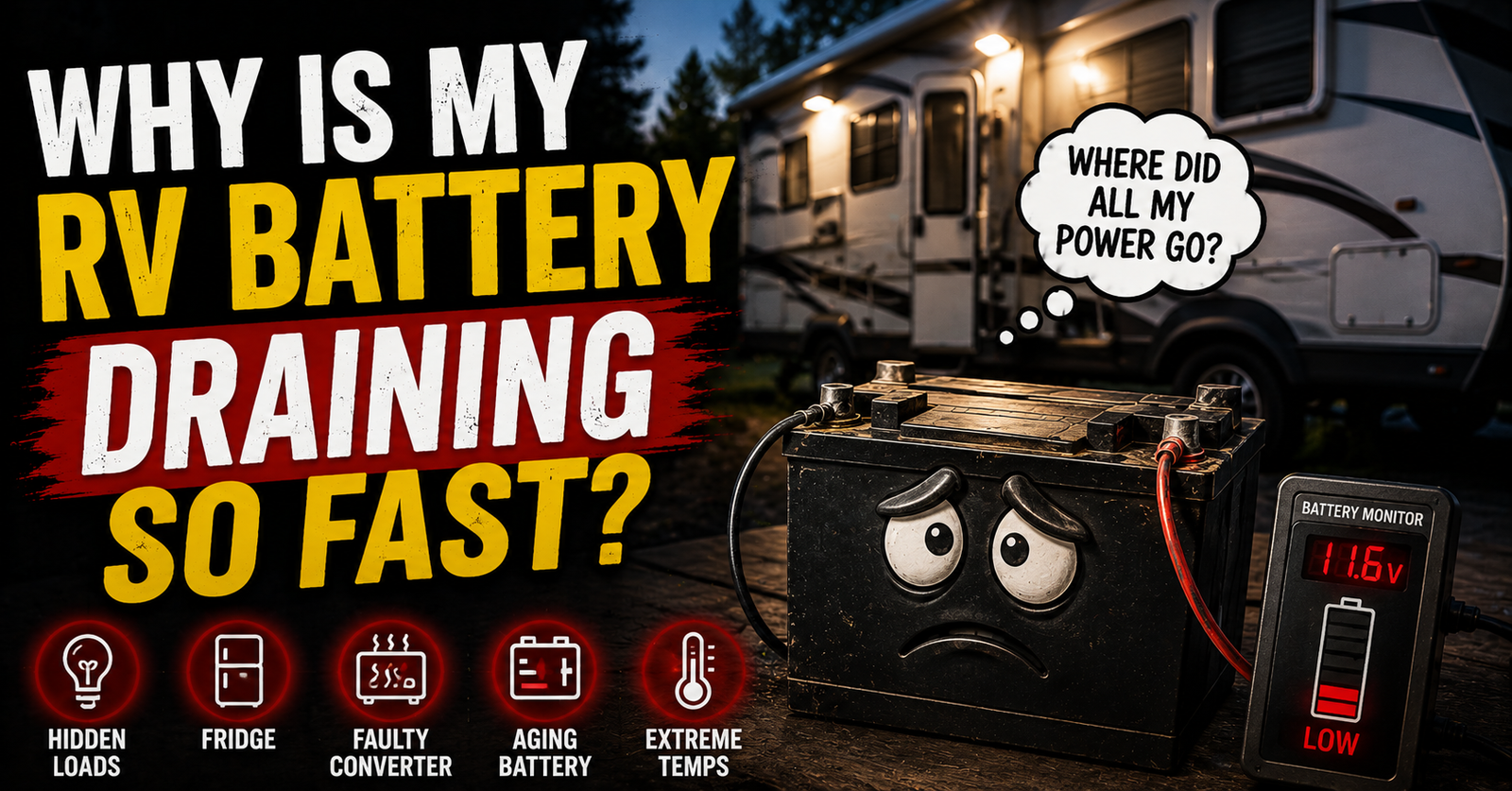
If the camper has been plugged in for plenty of time but the battery has little useful energy after you disconnect shore power, something isn’t right. The next step is to compare the timing and conditions described in why an RV battery drains so fast.
First verify charging voltage is actually reaching the battery.
If it isn’t, trace the converter and charging circuit.
If charging voltage does reach the battery, evaluate battery condition and usable capacity.
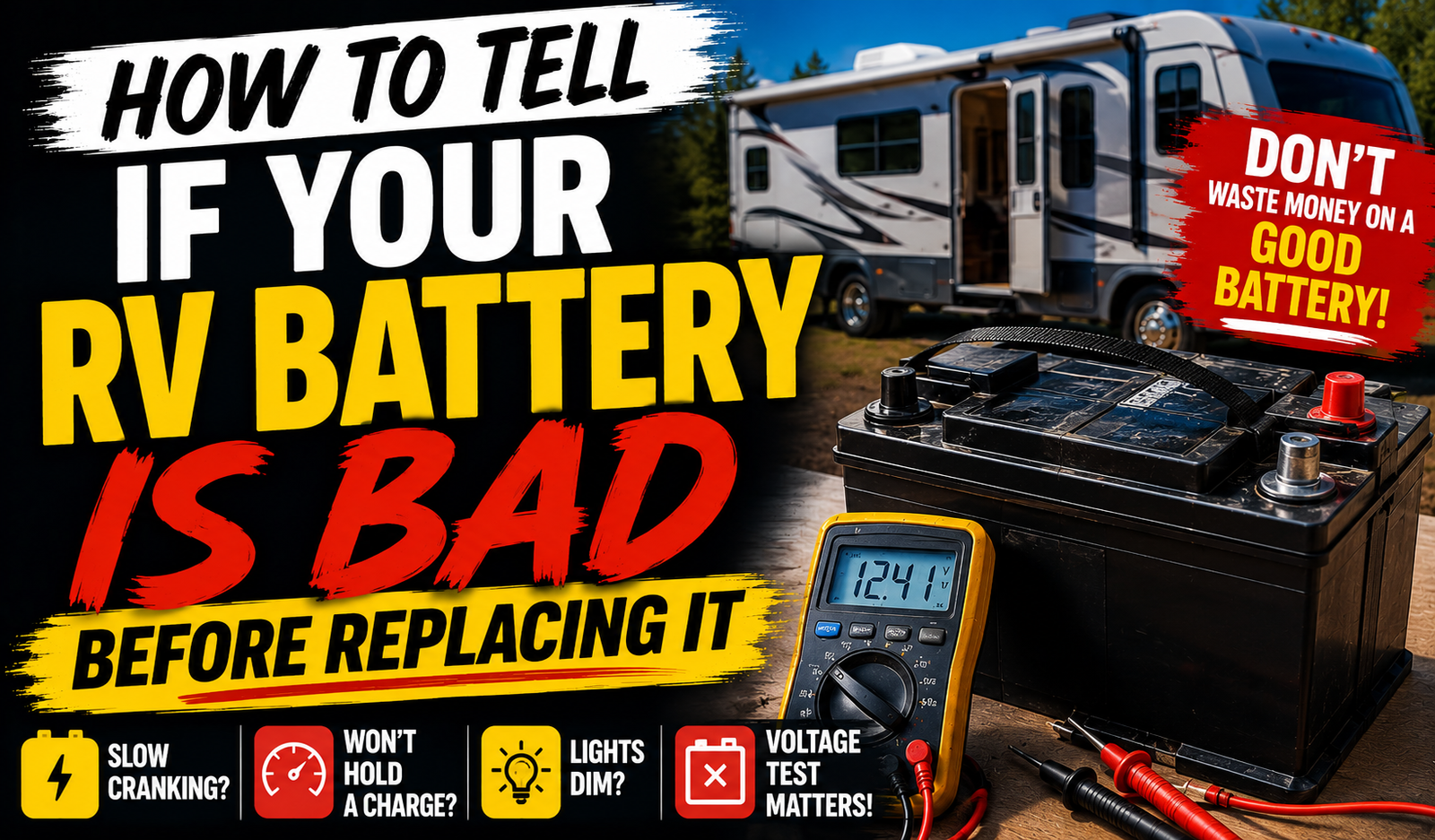
Our guide to telling whether an RV battery is bad is the path I’d take next.
A Battery Can Charge and Still Die Fast
This distinction is huge.
“Won’t charge” and “won’t hold a useful charge” aren’t the same problem.
A worn battery can reach an encouraging voltage and still have badly reduced capacity.
So if you’ve proven the converter is charging but the battery dies shortly after unplugging, stop chasing the converter.
Follow the stored energy.
The Simple Way I Think About It
When you’re plugged into shore power, the converter/charger should help supply the RV’s DC system and charge the house battery.
When you’re unplugged, the battery becomes your stored DC energy source.
If you have an inverter, some of that stored DC energy can then be converted back into AC electricity for compatible AC loads.
That’s the basic cycle.
Shore power comes in.
Converter provides DC power and charges the battery.
Battery stores energy.
You unplug.
Battery supplies DC power.
Inverter can turn some of that battery power into AC when needed.
Once that clicks, a lot of RV electrical problems stop feeling random.
So yes, your RV converter is supposed to charge the house battery.
If it doesn’t, don’t immediately replace the converter and don’t immediately replace the battery.
Find out whether the converter has power, whether it’s producing the correct output, whether that output reaches the battery, and whether the battery can actually accept and store it.
That’s how you turn “my battery isn’t charging” into a problem you can actually track down.
Written by Evan Mercer
Evan Mercer writes about RV electrical systems, converters, battery charging and practical camper troubleshooting for CamperAnswers.com. His work focuses on making RV systems understandable so owners can figure out what their campers are doing before they start replacing parts.