
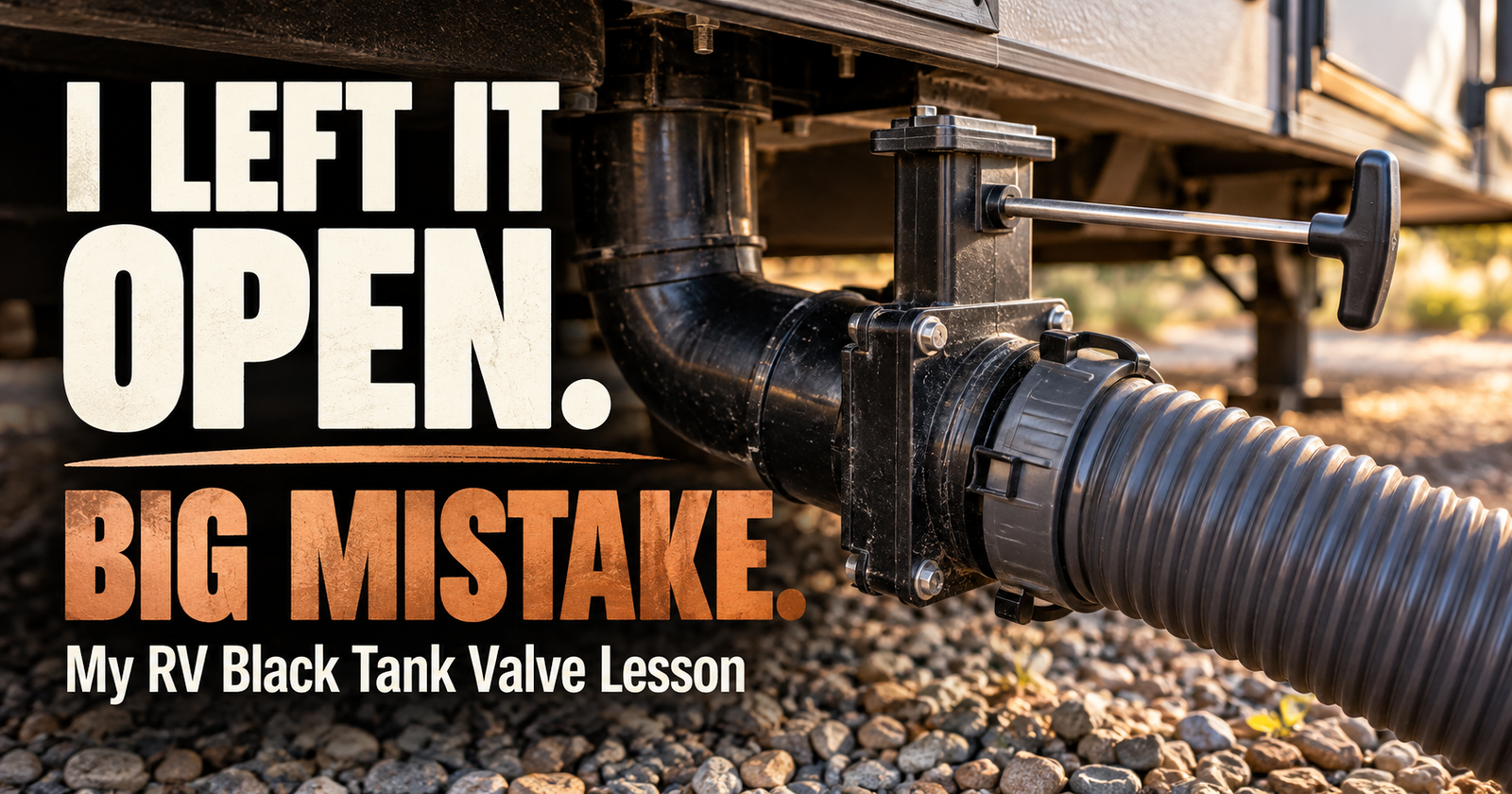
Having a full-hookup campsite feels like you’ve finally won at camping.
Electricity right beside you.
Water that doesn’t run out.
And a sewer connection sitting right there.
So the first time I thought about that sewer hookup, leaving the black tank valve open seemed completely logical.
Why let the tank fill up if everything can just drain straight into the sewer?
Open valve.
Use toilet.
Waste goes away.
No tank to dump later.
Perfect.
Except that’s not really what happens inside the black tank, and it’s one camping shortcut I wouldn’t use again.
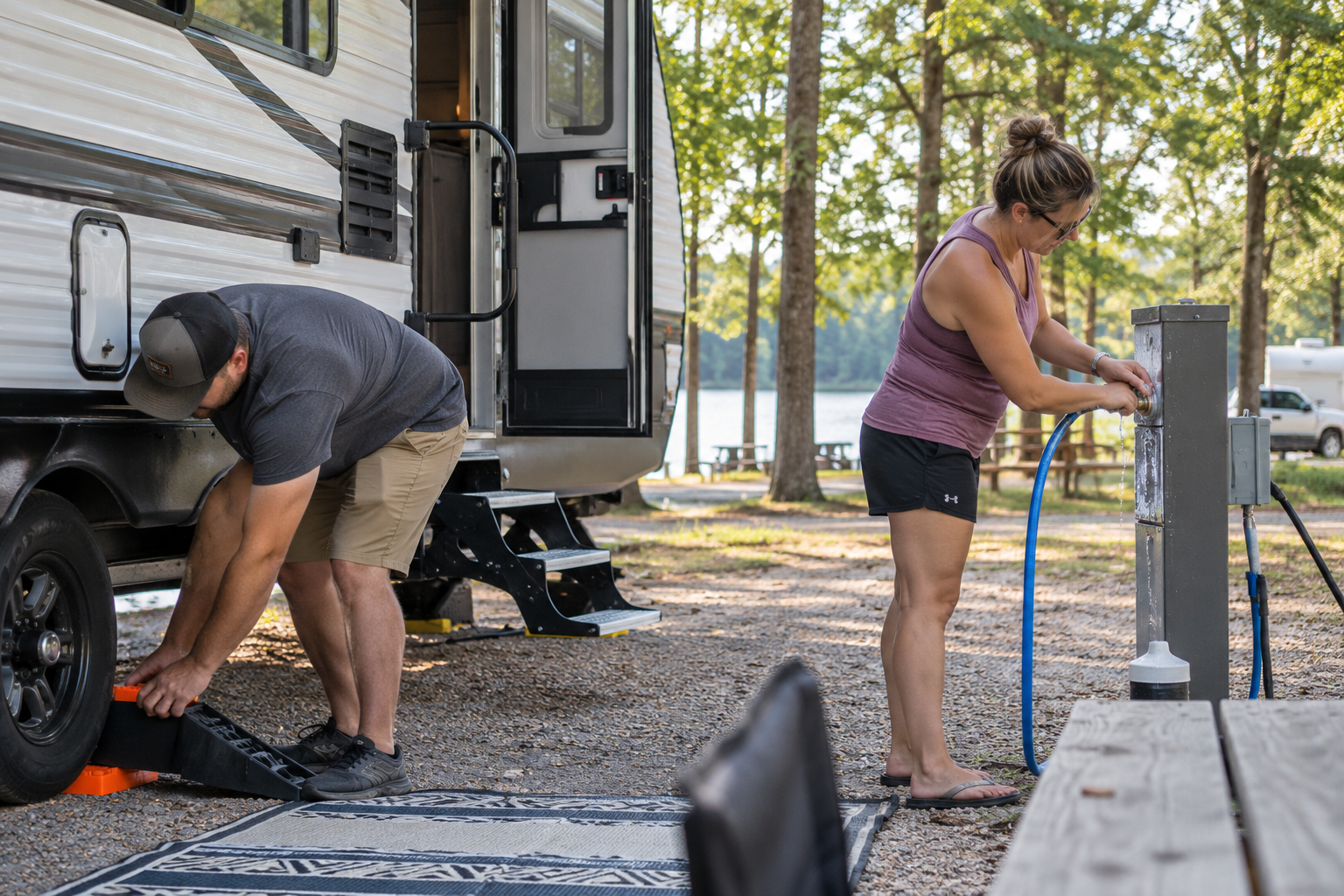
The Liquid Leaves Better Than the Solids
That’s the problem.
When the black valve stays open, liquid can continually drain away.
But the solids and toilet paper don’t necessarily make the same graceful journey.
They can remain behind in the tank.
Now you’ve removed the liquid that would’ve helped keep everything wet and move it out during a proper dump.
Keep doing that long enough and you can end up with dried waste accumulating in the bottom of the tank.
Camping World specifically warns that leaving the black valve open can allow liquids to drain while solids remain behind and dry out.
RV owners have a wonderfully descriptive name for what can eventually develop:
The poop pyramid.
Once you’ve heard that term, you probably don’t need a diagram.
I Had the Whole Thing Backwards
I thought keeping the tank empty was protecting it.
What I actually want during normal use is enough liquid in the tank to help everything leave when I dump it.
Water is my friend here.
When the valve stays closed, waste and liquid collect together.
Then, when the tank is reasonably full and I open the valve, I’ve got a large amount of liquid moving at once.
That gives the tank a much better flush than allowing tiny amounts of liquid to constantly trickle away.
So now my basic rule is simple:
Black tank valve stays closed until I’m ready to dump.
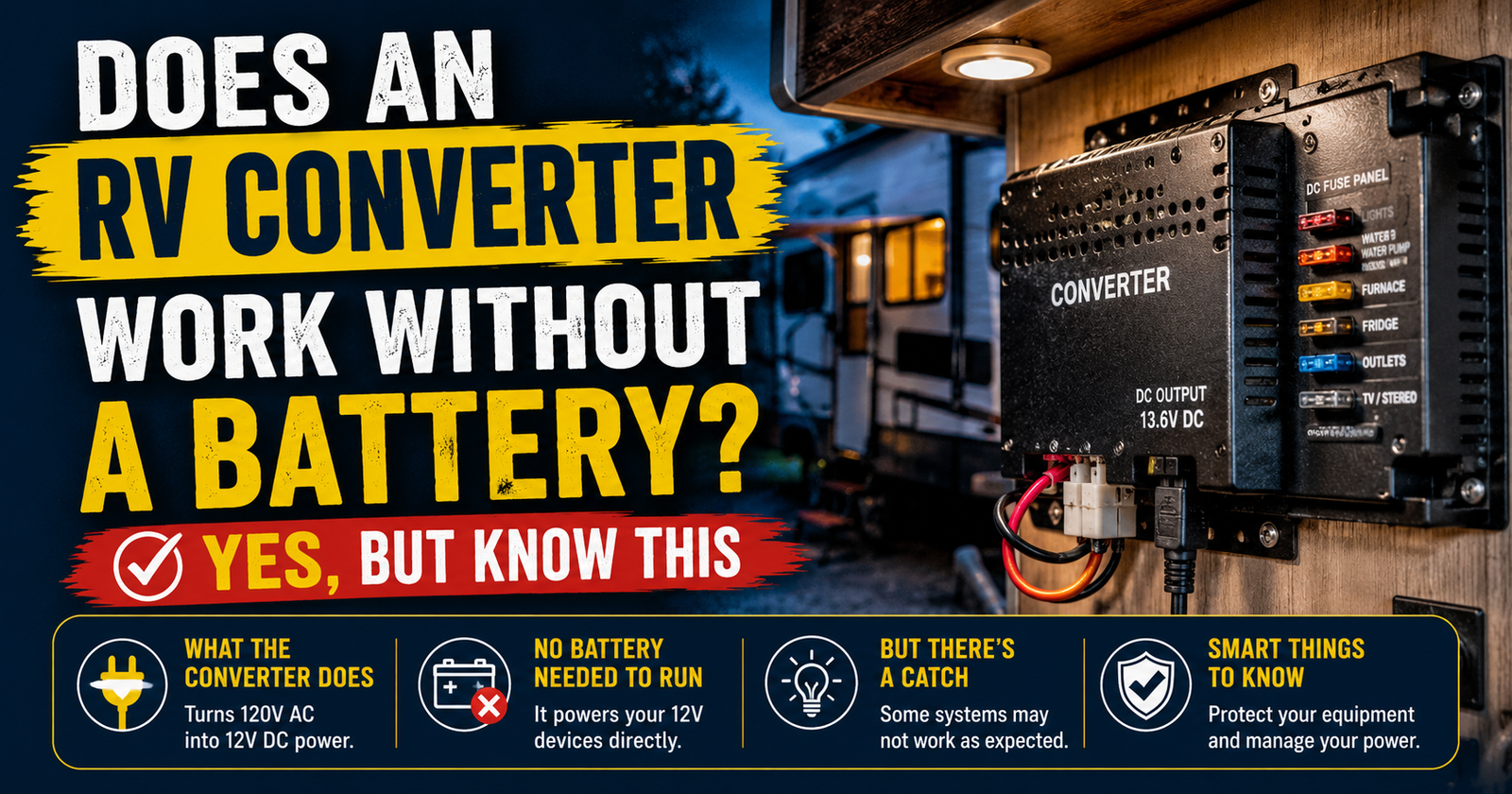
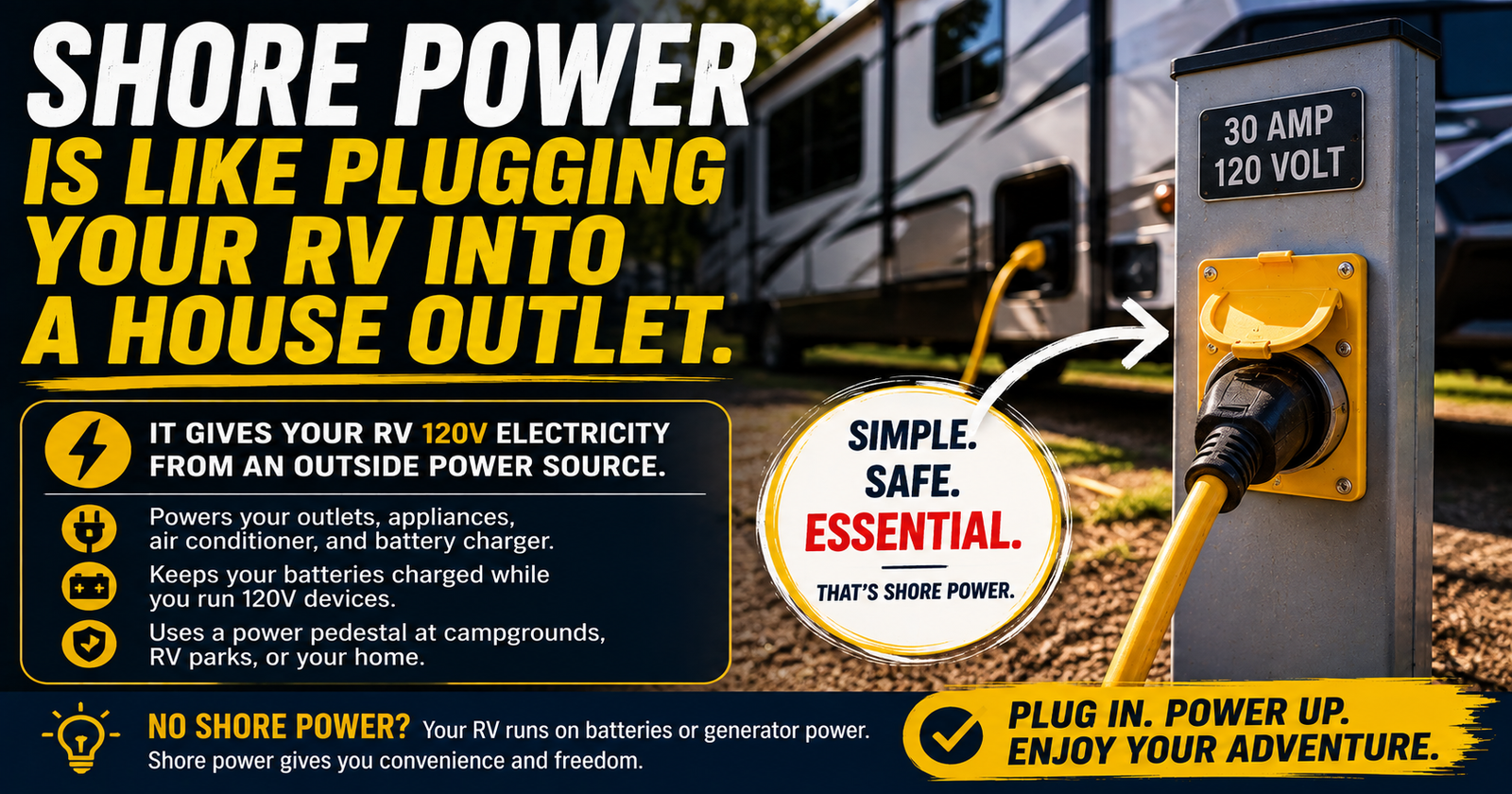
Full Hookups Don’t Change That for Me
This was the part I initially misunderstood.
If I’m at a campsite without sewer, obviously the valve stays closed.
Otherwise I’d have a much bigger problem.
But having a sewer connection directly beside the camper doesn’t mean the black valve needs to stay open.
The hookup simply means I can conveniently dump the tank when I need to.
That’s a very different thing.
I can leave the sewer hose connected if the campground allows it and everything is properly set up.
The valve itself stays closed until dump time.
I Want Some Water in the Black Tank
After dumping, I don’t want the inside of that tank sitting bone dry either.
Water helps keep remaining waste from drying into the tank.
And every toilet flush should use enough water to actually move waste where it needs to go.
Trying to save every ounce of water in a black tank is one of those ideas that sounds efficient until you’re trying to clear dried waste later.
Water is part of how the system works.

This Is One Place Where Being Stingy With Water Can Backfire
When you’re camping without hookups and carefully watching fresh water, it’s natural to start conserving everywhere.
But the black tank still needs enough water to function properly.
I don’t mean wasting gallons every time somebody uses the toilet.
I mean actually flushing with enough water to move the waste and keep the tank contents from becoming increasingly dry.
Camping World’s current black-tank maintenance guidance similarly recommends proper toilet use, enough water, appropriate toilet paper, and regular tank flushing to avoid clogs and buildup.
I Don’t Wait Until the Tank Is Packed Solid Either
Keeping the valve closed doesn’t mean I try to squeeze three more weeks out of the tank.
I want enough contents in there to create a good dump, but I’m still paying attention to tank capacity.
Camping World recommends waiting until the black tank is roughly two-thirds full before dumping rather than leaving the valve continuously open.
That’s a much better system in my mind.
Let the tank do what it was designed to do.
Then empty it properly.
And I Don’t Completely Trust the Tank Gauge
If you’ve owned a camper for long, you probably already know where this is going.
Holding-tank sensors can be…optimistic.
Or pessimistic.
Or apparently just making numbers up.
Waste or toilet paper can interfere with sensors and make the monitor panel show a level that doesn’t match reality.
So I pay attention to the gauge, but I also learn how quickly our family normally fills the tank.
If something suddenly looks strange, I don’t assume the little light on the panel has revealed absolute truth.
Dumping Order Matters Too
Once I’m actually ready to dump, I want to do it in a sensible order.
Black tank first.
Then gray.
The reason is beautifully practical.
The gray tank contains the relatively dirty water from sinks and showers rather than toilet waste.
Dumping gray water afterward helps rinse some of the nastier stuff from the sewer hose.
It’s one of those RV routines that makes perfect sense once somebody explains it.
I Treat the Sewer Hose Like Sewer Equipment
This sounds obvious, but campsite routines get sloppy surprisingly fast.
I don’t want the drinking-water hose and sewer equipment becoming interchangeable pieces of camping gear.
Separate storage.
Separate handling.
Wash hands afterward.
If I’m using a black-tank flush connection, I don’t use my drinking-water hose for that job.
KOA likewise recommends keeping potable-water and wastewater hoses clearly separate so they aren’t confused.
That’s one camping mix-up I’d really prefer not to experience firsthand.
The Black Tank Flush Isn’t a Magic Fix Either
If the RV has a built-in tank flush, I like using it according to the manufacturer’s directions.
It can help rinse material from the tank.
But I’d rather prevent dried buildup than depend on the flush system to rescue me after weeks of leaving the valve open.
Maintenance is usually easier than recovery.
That’s becoming a theme with campers.
If the Tank Stops Draining, I Don’t Keep Pretending Everything Is Fine
Open the black valve and almost nothing comes out?
That’s a clue.
Toilet isn’t draining properly?
Another clue.
At that point I’d start thinking about a clog or buildup rather than repeatedly opening and closing the valve hoping the problem fixes itself.
A clogged black tank can become a considerably uglier project than simply using the system correctly from the beginning.
And yes, we’ll eventually build a proper black-tank troubleshooting section on CamperAnswers rather than trying to cram every holding-tank problem into this story.
This Is Exactly the Kind of Mistake Nobody Explains Before Your First Trip
That’s what I find funny about RV ownership.
Everybody tells you the obvious stuff.
Don’t forget to hitch the trailer.
Don’t drive away with the awning out.
Don’t forget the wheel chocks.
But there are dozens of little system-specific things you don’t know until somebody tells you.
The black tank valve is one of them.
Leaving it open at a full-hookup campsite seems completely reasonable if nobody has explained what’s happening inside the tank.
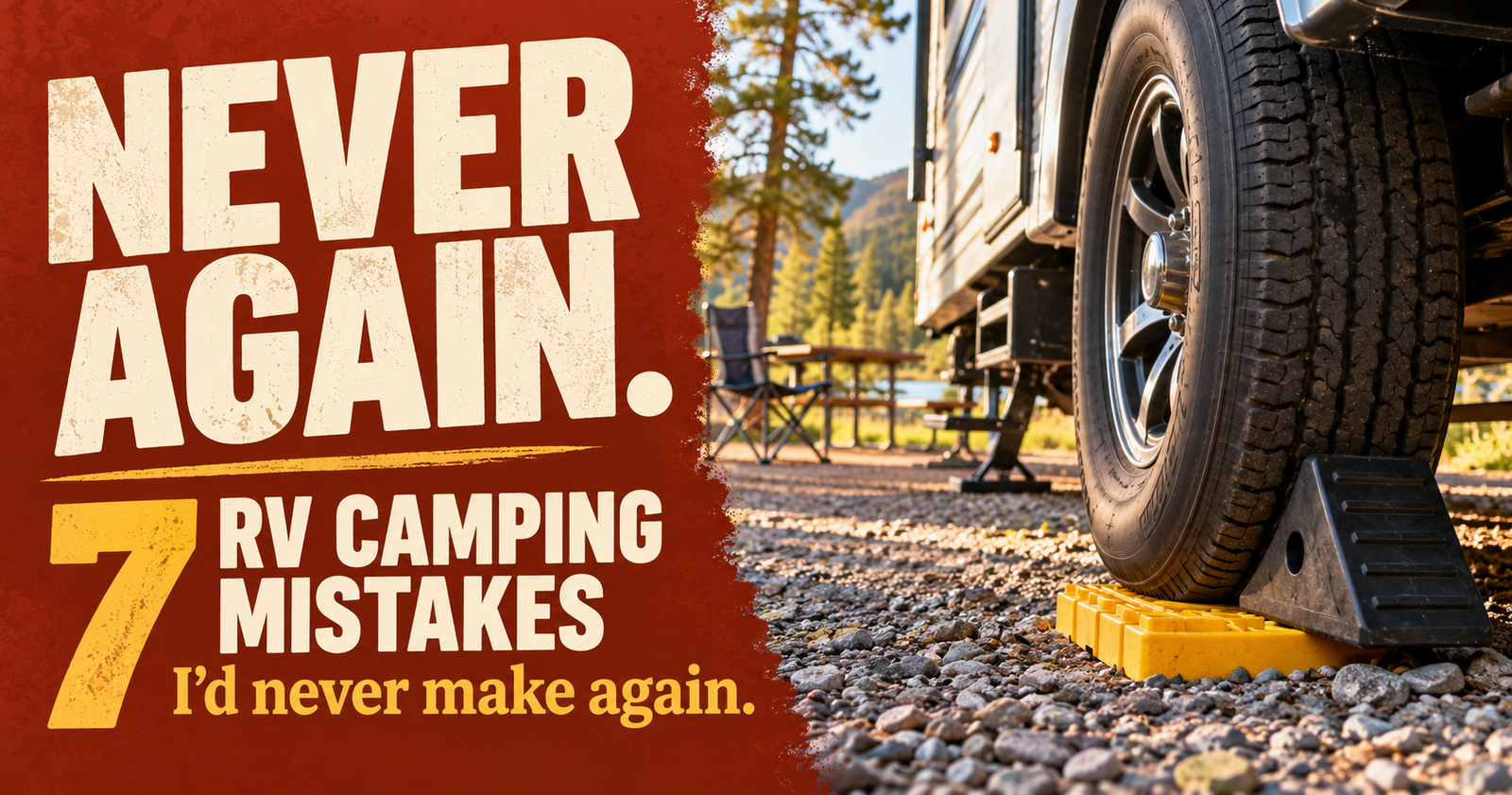
That’s why it belongs right beside the other RV camping mistakes I’d never want to make twice.
It’s not stupidity.
It’s just learning how the camper actually works.
Now My Full-Hookup Routine Is Pretty Simple
Sewer hose gets connected and secured properly.
Black valve stays closed.
Gray valve handling depends on how we’re camping and when I want gray water available for flushing the hose, but I always want some gray water available when it’s time to clean things up.
We use plenty of water with the toilet.
When the black tank reaches an appropriate level, I dump it.
Black first.
Gray afterward.
Then everything gets put away properly before we leave.
That routine isn’t nearly as exciting as dealing with a clogged black tank.
That’s exactly why I like it.
Sometimes the Best Camping Lesson Is Learning What Not to Leave Open
I’ve learned this with electrical connections.
Water.
Slides.
Awnings.
And now holding tanks.
RV systems tend to work pretty well when you understand what each part is actually supposed to do.
The black tank isn’t meant to act like a household sewer pipe with waste constantly flowing through it.
It’s a holding tank.
Let it hold.
Give it enough liquid.
Then dump it properly.
Because if the choice is between closing one valve at the campsite and someday learning how to remove a poop pyramid from an RV tank, I know which camping experience I’m choosing.
Written by Caleb Warren
Caleb Warren writes about real-world RV ownership, campground hookups, holding tanks, camper systems, and the little mistakes that tend to become unforgettable lessons for CamperAnswers.com. He focuses on practical camping habits that help RV owners avoid learning every lesson the messy way.